Kusu Island and the Ninth-Month Pilgrimage
On Sunday the 17th of October 1948, a record 5,000 Chinese men, women and children crossed from Singapore to Kusu Island by motor sampan. It was the birthday of the deity Tua Pek Kong, on the 15th day of the ninth lunar month, and the high point of a pilgrimage that lasts the whole month. Most of them then climbed a small hill at the other end of the island to pray at the shrine of a Muslim holy man. The pilgrimage is still made every year, and this year’s season runs from the 10th of October to the 8th of November.

Kusu Island from the air in 2016. (Bob Tan, CC BY-SA 4.0, via Wikimedia Commons)
The record crossing of 1948
 The Straits Times of 18 October 1948, page 1, with "5,000 Sail To Worship Tua Peh Kong" in the centre. (Singapore Press Holdings, via NewspaperSG, National Library Board Singapore, public domain)
The Straits Times put the crossing on its front page the next morning. Singapore’s Chinese boatmen had run 60 flag-decked motor tongkangs and sampans on a non-stop schedule from 6 a.m. until late in the evening. Most of the visitors were women, who brought joss sticks, paper, flowers, cakes and sweets as offerings, and took home mementoes they believed would bring them luck for the rest of the year: “blessed water”, seaweed and half-burned candles.
After praying at Tua Pek Kong’s temple at one end of the island, most of the pilgrims also visited the shrine of a Malay holy man, Dato Syed Abdul Rahman, on top of a hillock at the other end. In 1948 it was reached by 122 steps. Hawkers had set up stalls all over the island.
A turtle in the sea
Kusu lies about 5.6 kilometres south of the main island of Singapore. Its name is Hokkien for tortoise or turtle, and in 1948 it was still two small mounds of earth joined by a narrow neck of sand. The Chinese said that the smaller mound was the turtle’s head and the bigger one its body. The island’s Malay name is Pulau Tembakul, after the mudskipper. Early British maps marked it Signal Island, after a signal post put up around 1822, and a brick obelisk built on its south shore around 1877 as a marker for shipping gave it another name, Peak Island.
The best-known story of how the island began is that a giant turtle turned itself into land to save two shipwrecked fishermen, one Malay and one Chinese, who built shrines there in thanks. A researcher, William Gibson, traced the story’s other versions through the newspapers for the National Library’s magazine BiblioAsia. In 1932 it was a Chinese fisherman and a Malay fisherman who died on the island and were buried there. In 1940 the shrine was said to stand over the graves of two Malay girls and their father. A 1973 magazine version had two holy men, an Arab called Syed Rahman and a Chinese called Yam, meditating on the island until they died. The shrine’s caretakers keep no written records, and its history has been passed down by word of mouth.
The earliest records
The pilgrimage is older than any of these stories in print. In a letter of the 9th of March 1875, the Hokkien merchant Cheang Hong Lim described Chinese and Malay visitors making offerings on Kusu around 1845, to “Twa Pek Kong Koosoo” and to the “Datok Kramat”. On the 16th of October 1894 the Baba Malay newspaper Bintang Timor reported that many Peranakan women and men, Malays and people of all races went to Kusu to fulfil vows. Two plaques at the keramat, dated 1917 and 1921, record work done on the shrine.

The Tua Pek Kong temple on Kusu Island in 2023, its centenary year. (Psyduckk, CC0, via Wikimedia Commons)
The Tua Pek Kong temple on the turtle’s head is usually dated to 1923, and it marked its 100th anniversary in 2023. The sources differ on how it began: a 1948 feature said it had been built 30 or 40 years earlier by nine Chinese philanthropists, on the site of the hut of a fisherman who lived and died on the island. Tua Pek Kong, whose name means “Grand Uncle”, is a deity found only among the Chinese of Southeast Asia, worshipped as a god of prosperity and a protector of seafarers. The temple also houses Guan Yin, the Goddess of Mercy, who is prayed to by couples hoping for children.
Two faiths on one island
 The Sunday Times of 24 October 1948, page 4: "Two Faiths Share Holy Island", by Sit Yin Fong. (Singapore Press Holdings, via NewspaperSG, National Library Board Singapore, public domain)
A week after the record crossing, the Sunday Times ran a long feature on the island under the headline “Two Faiths Share Holy Island”. It described Chinese pilgrims praying at the temple, then giving up pork and other “impurities” before crossing the neck of sand to the Muslim shrine on the hill. They brought boiled pork and fowl for Tua Pek Kong, and yellow rice and flowers for the Dato. The keramat’s caretaker that year, Chik bin Embee, a retired police peon, said he was a descendant of the Dato.
The newspapers recorded how the pilgrims’ vows were made and kept. In 1932, devotees hung strings of stones on a tree at the keramat when they made a wish, and took them down once it had come true. In 1940, women were given small scraps of yellow cotton and flower petals wrapped in newspaper for luck, and in 1952 Chinese visitors were reported to give up pork for the whole of the ninth month. The Straits Times Annual noted in 1952 that the keramat’s fame depended almost entirely on the reverence of non-Muslim Chinese.

The steps and painted rocks below the keramat on the hilltop, in 2020. (Kbseah, CC BY-SA 4.0, via Wikimedia Commons)
Today the keramat is said to honour three people: Syed Abdul Rahman, his mother Nenek Ghalib, and Sharifah Fatimah, described in some accounts as his sister and in others as his daughter. Pilgrims climb 152 steps to reach it, tie yellow ribbons to the trees around it, and many still come to pray for children.
From bumboats to ferries
For most of the 20th century, the crossing was made in hired boats. A Singapore Standard headline of 1951 put it as “Pilgrims Pray, Boatmen Prey”. In October 1972, the Marine Police stepped up their patrols to check on overcrowded bumboats carrying devotees from Clifford Pier to Kusu.
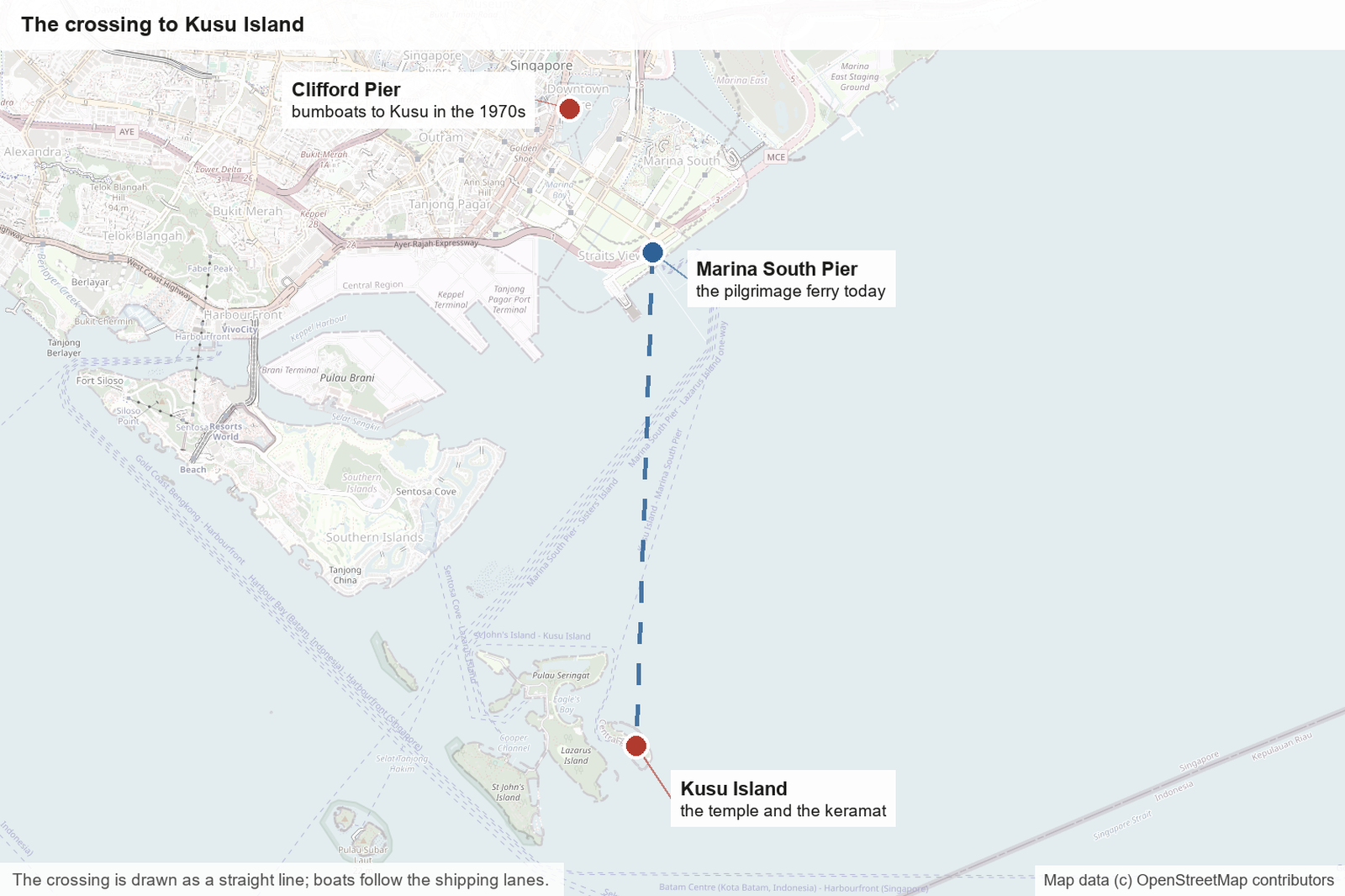
The crossing to Kusu from Marina South Pier today, and Clifford Pier, where the bumboats loaded in the 1970s. (Map data © OpenStreetMap contributors)
In the 1970s the island was handed to the Sentosa Development Corporation and transformed. In April 1975 the first phase of the work, a rock bund to enlarge the island seven times, was nearing completion. Reclamation took Kusu from 1.2 hectares to 8.5 hectares, at a cost of about $3.9 million, and joined the temple’s mound and the keramat’s hill into one island. It gained a new jetty, a water supply, toilets, footpaths and beaches, and in 1976 the steps to the keramat were concreted and given guardrails. In 1983 a $1 levy was added to the Kusu boat trip, and on some days pilgrims had to buy ferry tickets in advance. Crowds were large: 60,000 people crossed in the first 12 days of the 1984 season, and in 1996 the corporation expected about 200,000 devotees.
Kusu today
Kusu Island, 1822 to today
- c. 1822 A British signal post gives the island the name Signal Island.
- c. 1845 Chinese and Malay visitors make offerings at the temple and the keramat, by a later account.
- 16 Oct 1894 Bintang Timor reports pilgrims of all races going to Kusu to fulfil vows.
- 1917, 1921 Plaques record work on the keramat.
- 1923 The usual date given for the Tua Pek Kong temple.
- 17 Oct 1948 A record 5,000 pilgrims cross on Tua Pek Kong's birthday.
- Oct 1972 Marine Police check overcrowded bumboats from Clifford Pier.
- 1975 Reclamation begins, taking the island from 1.2 to 8.5 hectares.
- Apr 2018 The pilgrimage is listed in Singapore's inventory of intangible cultural heritage.
- 2021 COVID-19 limits cap visitors at 500 a day.
- 17 Apr 2022 A fire almost destroys the keramat; it is rebuilt for that year's season.
- 2023 The temple marks its centenary.
- 2025 About 15,500 visitors in the season, half the 2019 figure.
The island is now managed by the Singapore Land Authority, which licenses a single ferry operator to carry pilgrims from Marina South Pier during the season. In 2021, COVID-19 rules limited visitors to 500 a day. On the evening of the 17th of April 2022 a fire almost completely destroyed the keramat. Its caretaker, Ishak Samsudin, the third generation of his family to look after the shrine, raised money from friends and companies to rebuild it in time for that year’s pilgrimage. The temple’s caretaker, Seet Seng Huat, took over from his parents in 1986.

A ferry on the Marina South Pier to St John’s Island and Kusu Island service in May 2024. (LN9267, CC BY-SA 4.0, via Wikimedia Commons)
The crowds have thinned. According to Singapore Land Authority figures reported by CNA this year, about 30,000 people visited Kusu during the 2019 season. Numbers fell during the COVID-19 limits, recovered to about 22,500 in the temple’s centenary year, and dropped to about 15,500 in 2025. The festival once had about 20 food stalls and a dozen souvenir shops; this year it has three food stalls and one souvenir stall. Those involved point to an ageing body of pilgrims and little awareness of the island among younger Singaporeans. Hoo Tiang Lai, who has run stalls at the pilgrimage for more than 40 years, told CNA that younger people “think it’s just a picnic spot”.
Visitors to Kusu Island in the pilgrimage season, 2019–2025
About half as many in 2025 as in 2019
Source: Singapore Land Authority figures, reported by CNA, 2026.
View as table
| Season | Visitors | Note |
|---|---|---|
| 2019 | about 30,000 | |
| 2020 | about 11,200 | COVID-19 restrictions |
| 2021 | about 9,400 | COVID-19 restrictions, 500 a day |
| 2022 | about 20,000 | After the keramat fire |
| 2023 | about 22,500 | Temple centenary |
| 2024 | about 18,500 | |
| 2025 | about 15,500 |
The pilgrimage has been listed since 2018 in the National Heritage Board’s inventory of Singapore’s intangible cultural heritage. This year’s season also includes a performance of Nanyin, the Southern Chinese music, by the Siong Leng Musical Association at the temple on the 7th of November.
See more photos of Kusu Island, its temple and its keramat →
Where it fits in the bigger story: Kusu has never had permanent residents, and almost everything known about its shrines comes from the people who crossed to them: a merchant’s letter, a Malay newspaper’s report, journalists on the busiest day of the year, and caretakers who passed the stories down. For more than 150 years, Chinese and Malay worshippers have shared one small island and its two shrines. The pilgrimage still runs every ninth month, but it now depends on a smaller and older group of devotees, and on whether younger Singaporeans come to see the island as more than a place for a picnic.
Sources:
- “5,000 Sail To Worship Tua Peh Kong”, The Straits Times, 18 October 1948, page 1, NewspaperSG
- Sit Yin Fong, “Two Faiths Share Holy Island”, The Sunday Times, 24 October 1948, page 4, NewspaperSG
- William L. Gibson, “The Origin Stories of Keramat Kusu”, BiblioAsia, January–March 2023, National Library Board
- Pilgrimage to Kusu Island, Roots.gov.sg (National Heritage Board), Intangible Cultural Heritage inventory
- The Tua Pek Kong Temple at Kusu Island, Roots.gov.sg (National Heritage Board)
- Kusu Island, Wikipedia
- “Pilgrims Pray, Boatmen Prey”, Singapore Standard, 16 October 1951; “Check on Kusu bumboats”, New Nation, 18 October 1972; “Kusu rock bund takes shape”, The Straits Times, 28 April 1975; “$1 levy for Kusu boat trip”, The Straits Times, 23 September 1983; “60,000 pilgrims visit Kusu in just 12 days”, Singapore Monitor, 8 October 1984; “Annual Kusu pilgrimage”, 28 October 1996 (NewspaperSG search results)
- Kusu Pilgrimage Season 2026, Singapore Land Authority, 25 September 2026
- Kusu Pilgrimage Season 2025, Singapore Land Authority
- ‘They think it’s just a picnic spot’: Kusu Island regulars lament its declining appeal among youth, CNA, republished by Red Hot Singapore, 2026
- Map data © OpenStreetMap contributors
- File:Aerial perspective of Kusu Island, Singapore. Shot in 2016.jpg, Wikimedia Commons
- File:Kusu Island Tua Pek Kong Temple Photo.jpg, Wikimedia Commons
- File:Keramat Kusu, Kusu Island (70917).jpg, Wikimedia Commons
- File:SP1471A Singapore Island Cruise Marina South Pier to Saint John’s Island and Kusu Island 17-05-2024(7).jpg, Wikimedia Commons
- File:KUSU island from the sky - panoramio.jpg, Wikimedia Commons (gallery)
- File:KusuIsland01.JPG, Wikimedia Commons (gallery)
- File:Kusu Island, Singapore - 20110227-01.jpg, Wikimedia Commons (gallery)
- File:Kusu Island, Singapore - 20110227-03.jpg, Wikimedia Commons (gallery)
- File:Kusu Island Chinese Temple, Singapore - 20110227.jpg, Wikimedia Commons (gallery)
- File:Da Bogong Temple Kusu Island.JPG, Wikimedia Commons (gallery)
- File:Marble Tortoise Kusu Island.JPG, Wikimedia Commons (gallery)
- File:Tortoise shelter on Kusu island,Singapore SF0001.jpg, Wikimedia Commons (gallery)
- File:Wishing Well Kusu Island.JPG, Wikimedia Commons (gallery)
- File:Welcome to Kusu Island - The Pier (4815257760).jpg, Wikimedia Commons (gallery)
- File:Fertility Tree.jpg, Wikimedia Commons (gallery)
- File:Keramat Kusu, Kusu Island (24732).jpg, Wikimedia Commons (gallery)


