From Graves to Gardens: How Singapore Makes Room for Its Dead
By 1985, Singapore had cleared 21 cemeteries and exhumed about 120,000 graves to make room for flats, roads and the MRT. The clearing went on after that: Bidadari, once the island’s largest cemetery, was emptied in the early 2000s, and today even a new grave is leased for only 15 years. Over the same decades, Singaporeans changed how they lay their dead to rest, from burial to cremation, from cemeteries to columbaria, and now to gardens where the ashes go back into the soil.

Tombs at Bukit Brown Cemetery in 2011. (Jacklee, CC BY-SA 3.0, via Wikimedia Commons)
The old burial grounds
The first European cemetery in British Singapore was on the slope of Fort Canning, used from 1823 until it filled up in 1865. Its replacement was a Christian cemetery on Bukit Timah Road, which took its first burial in April 1865 and its last in 1907. When that ground was finally cleared around 1971, a dozen of its gravestones were moved to Fort Canning Green, where they still stand.

Gravestones from the Bukit Timah Road cemetery, moved to Fort Canning Green. (Smuconlaw, CC BY-SA 3.0, via Wikimedia Commons)
The town’s municipal cemeteries came next. Bidadari, off Upper Serangoon Road, opened on the 1st of January 1908 with Christian sections, and later Muslim, Hindu and Sinhalese ones. Bukit Brown, off Lornie Road, opened on the 1st of January 1922 as the municipal cemetery for the Chinese, and grew to about 100,000 graves. Alongside them were dozens of private cemeteries run by Chinese clan and dialect associations, the largest of them Peck San Theng, the Cantonese and Hakka burial ground founded in 1870 on the land that is now Bishan. Singapore’s Jews buried their dead first off Orchard Road and, from 1904, in a cemetery on Thomson Road, where Sir Manasseh Meyer, whom I wrote about in an earlier post, was buried in 1930.
 The gates of Bidadari Cemetery in the 1930s, on a postcard. (The Continental Stamp Company, public domain, via Wikimedia Commons)
Funerals at these cemeteries could be large public events. In January 1953, a newspaper photographer recorded the burial of Ng Thian Eng at Bukit Brown, with mourners gathered round the open grave as the coffin was lowered.

The funeral of Ng Thian Eng at Bukit Brown in January 1953. (Singapore Press Holdings, public domain, via Wikimedia Commons)
The land runs out
As early as 1950, the colonial government set up a committee, headed by the Commissioner of Lands, to look into the problem of burial grounds. Its report, tabled in the Legislative Council in May 1952, found 182 licensed or private burial grounds in Singapore, including seven run by the City Council, and 26 more so small they could no longer be located. Graves took up nearly 1,730 acres of land, and the Tiong Bahru flats, the Maxwell Road market and parts of the Kallang airport had all been built on old graveyards. With the population growing by 30,000 a year, the committee recommended that a public crematorium be built as soon as possible and that space be saved in the existing cemeteries.
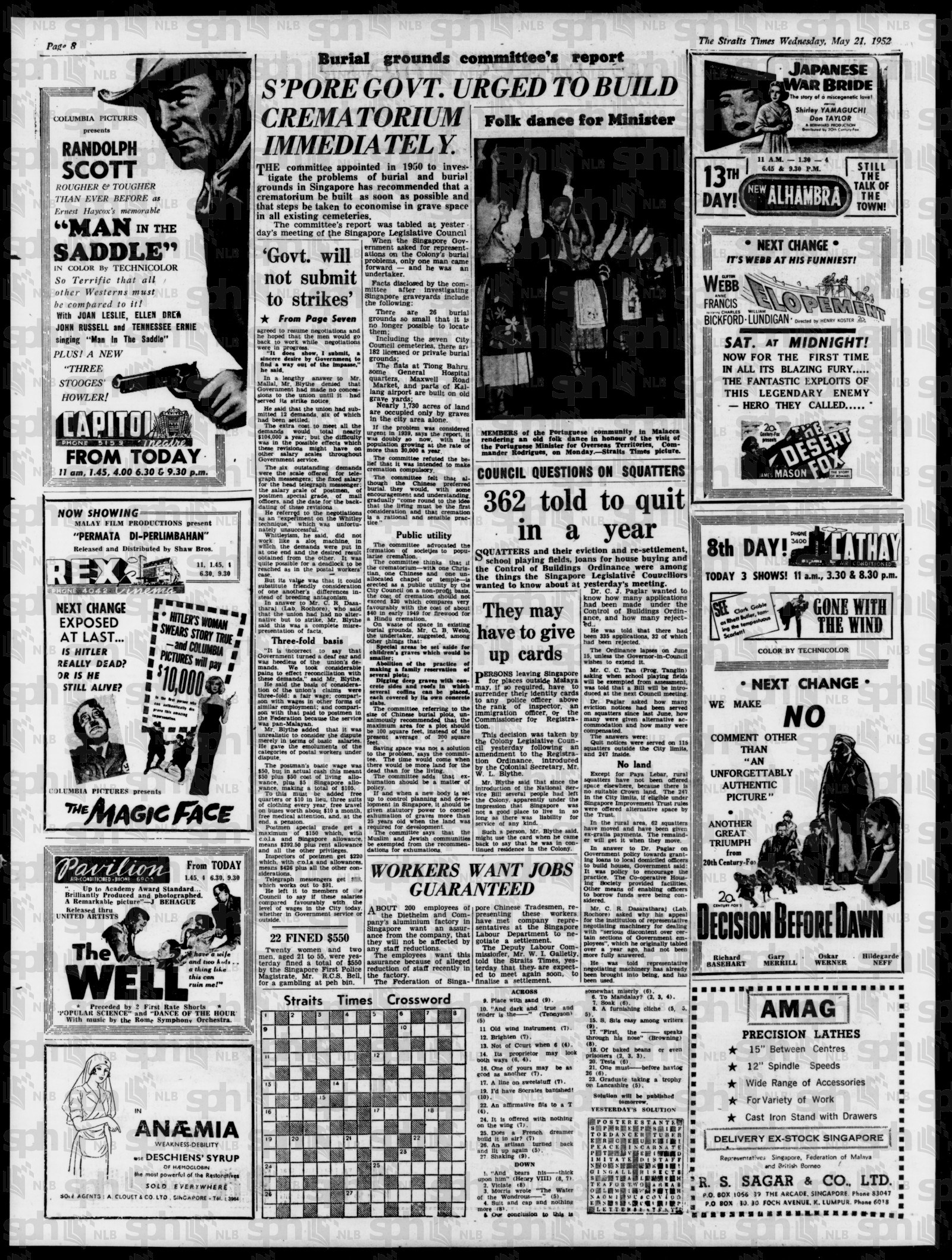 The Straits Times of 21 May 1952, page 8, reporting the burial grounds committee's call for a crematorium. (Singapore Press Holdings, via NewspaperSG, National Library Board Singapore, public domain)
The committee was careful to say that it did not want cremation made compulsory. It noted that the Chinese preferred burial, but believed they would come round to cremation with encouragement, on the principle that the living must come first. Two days later, the Straits Times reported that most sections of the Chinese community supported a public crematorium.
The government crematorium at Mount Vernon was built in 1962, and a columbarium beside it opened in 1976. Meanwhile a new municipal cemetery had opened at Choa Chu Kang in 1947, far from the town. In the early 1970s the city cemeteries took their last burials: Bidadari in October 1972, and Bukit Brown and Peck San Theng in 1973. Choa Chu Kang is now the only cemetery in Singapore still open for burials.
The great exhumations
Once a cemetery was closed, its land could be taken for development. Peck San Theng was acquired by the government in 1979, and in stages between 1982 and 1984 an estimated 100,000 graves were exhumed to make way for Bishan New Town. The clan association kept a small part of the site, where it built a temple and a columbarium for the remains.

Kwong Wai Siew Peck San Theng in Bishan, on the part of the old cemetery the association kept. (Jnzl’s Photos, CC BY 2.0, via Wikimedia Commons)
The Jewish cemetery on Thomson Road was cleared in 1985 for Novena MRT station. The remains were moved to a Jewish section at Choa Chu Kang, though some families had their relatives reburied in Israel instead. Between 2001 and 2006, about 58,000 Christian and 68,000 Muslim graves were exhumed at Bidadari, where a new housing estate now stands. The Muslim remains were reburied at Choa Chu Kang, and the unclaimed Christian remains were cremated and their ashes scattered at sea in March 2008. Even Bukit Brown, which still stands, lost 3,746 graves to a new road through the cemetery in the 2010s.

The site of Bidadari Cemetery in December 2013, after the exhumations and before the flats were built. (Mokkie, CC BY-SA 3.0, via Wikimedia Commons)
Cremation and columbaria
As the cemeteries closed, cremation became the norm. The government’s crematorium at Mandai opened in 1982, and when the old Mount Vernon crematorium closed on the 30th of June 2004, a new crematorium at Mandai took over the next day. According to the National Environment Agency, cremations rose from 66 per cent of deaths in 1992 to 80 per cent in 2011. The ashes of most Singaporeans now go to a niche in a columbarium, run by the government, a temple, a church or a private company.

The Mandai Crematorium and Columbarium Complex in 2015. (Jnzl, CC BY 2.0, via Wikimedia Commons)
A niche is not always forever either. The Mount Vernon columbarium closed in September 2018 to make way for the Bidadari estate, and its niches were moved to Mandai and Choa Chu Kang. Many religious columbaria lease their niches for a fixed term. The Franciscan columbarium, for example, keeps urns for 30 years, which families can then extend 10 years at a time for a fee, and the Methodist Garden of Remembrance leases its niches up to 2059.
When my grandfather died, and after him my grandmother, and later two of her sons, my family’s first thought each time was to place their ashes in the columbarium at St Theresa’s Church.
Fifteen years in the ground
Burial is still possible at Choa Chu Kang, but not for good. Since the 1st of November 1998, every grave there has been limited to 15 years, after which the remains are exhumed. The National Environment Agency began exhuming the oldest blocks in December 2004. When the expansion of Tengah Air Base was announced in 2017, about 45,500 Chinese graves and 35,000 Muslim graves at Choa Chu Kang were to be exhumed in stages.

Graves at Choa Chu Kang Chinese Cemetery in 2007. (William Cho, CC BY-SA 2.0, via Wikimedia Commons)
In these exhumation programmes, the agency exhumes each grave and cremates the remains the same day, and it pays for a standard niche and urn. Families can also choose to scatter the ashes. For faiths that require burial, such as Islam and Judaism, the remains are reburied in a much smaller plot, about an eighth the size of a full grave.
Ashes to the sea and to gardens
Ashes can also be scattered at sea, and the National Environment Agency plans a weekly ferry service, as a two-year pilot from the second half of 2027, to take families out to do it.
My father’s ashes were scattered into the sea off Punggol End.
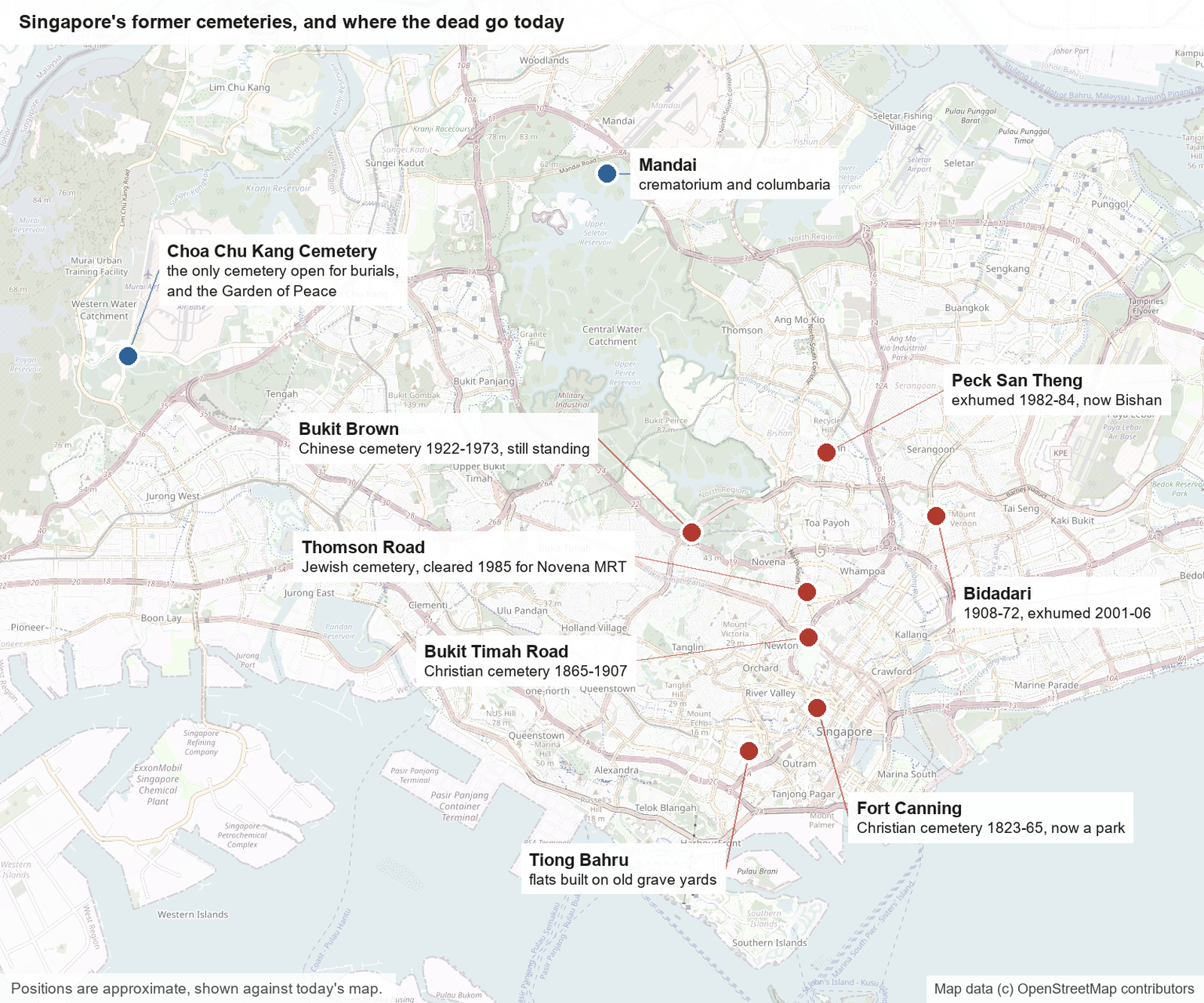
Singapore’s former cemeteries, and where the dead go today, plotted on today’s map. (Map data © OpenStreetMap contributors)
In May 2021 the agency opened the Garden of Peace at Choa Chu Kang Cemetery, Singapore’s first inland ash-scattering garden. It is a secular garden, open to all faiths. Families scatter the finely ground ashes along separate lanes, then water them so that they sink into the soil beneath. Demand grew quickly, from about 900 applications in 2021 to about 2,000 in 2023, and when the lanes fill up, the soil is moved to a designated spot within the garden. A second garden, the Garden of Serenity, opened at the new Mandai crematorium in August 2025.
My mother’s and my brother’s ashes were scattered at the Garden of Peace, and I have been back there many times. It is out of the way if you do not drive, but it is manageable. I like that the ashes are washed into the gardens around the lanes, which feels better to me than the uncertainty of a loved one being somewhere in the sea.
For Catholic families the choice is not simple. The Church has allowed cremation since 1963, but in 2016 the Vatican’s instruction on burial and cremation asked that ashes be kept in a sacred place, such as a cemetery or a church columbarium, rather than scattered, kept at home or divided. In 2023 it allowed a small part of the ashes to be kept in a place of significance, with the bishop’s permission. In practice, many families weigh this against cost, space and their own wishes.
Among the Catholics I know, burial versus cremation is still debated, but the characteristic Singaporean pragmatism usually comes through, and more and more people are choosing to scatter.
Making room for the dead, 1823 to today
- 1823 The first Christian cemetery opens on Fort Canning.
- 1865 The Bukit Timah Road cemetery takes its first burial.
- 1908 Bidadari Cemetery opens.
- 1922 Bukit Brown opens as the municipal Chinese cemetery.
- 1947 Choa Chu Kang Cemetery opens.
- May 1952 A committee urges a public crematorium.
- 1962 The Mount Vernon crematorium is built.
- 1972-1973 Bidadari, Bukit Brown and Peck San Theng take their last burials.
- 1982-1984 About 100,000 graves at Peck San Theng are exhumed for Bishan.
- 1985 The Thomson Road Jewish cemetery is cleared for Novena MRT.
- Nov 1998 Graves at Choa Chu Kang are limited to 15 years.
- 2001-2006 About 126,000 graves at Bidadari are exhumed.
- May 2021 The Garden of Peace opens at Choa Chu Kang.
- Aug 2025 The Garden of Serenity opens at Mandai.
- 2027 A pilot ferry service for scattering ashes at sea is due to start.
See more photos of Singapore’s cemeteries, old and new →
Where it fits in the bigger story: Singapore’s cemeteries show, more plainly than almost anything else, what a small island gives up to keep growing. In about a century the country went from sprawling clan burial grounds to leased graves, numbered niches and gardens where the ashes go back into the soil, each step pushed by the shortage of land and made easier by families who chose to adapt. Some of the old grounds survive in fragments, at Bukit Brown, Fort Canning Green and the Peck San Theng columbarium, but most of the dead of old Singapore now lie, in one form or another, under the city that grew over them.
Sources:
- Former cemeteries in Singapore, Wikipedia
- Bidadari Cemetery, Wikipedia
- Choa Chu Kang Cemetery, Wikipedia
- Mount Vernon Columbarium, Wikipedia
- Mandai Crematorium and Columbarium, Wikipedia
- Kwong Wai Siew Peck San Theng, Wikipedia
- Past and present cemeteries of Singapore (part 1), Remember Singapore
- Jewish Cemetery, Thomson Road, National Archives of Singapore (record)
- Singapore Jewish cemetery, JewishGen cemetery directory
- Burial, cremation and ash storage, National Environment Agency
- Ash scattering facilities, National Environment Agency
- NEA’s new Garden of Peace @ CCK (17 May 2021), National Environment Agency
- Singapore’s first inland ash scattering garden, SG101
- Ash soil transfer works at NEA’s inland ash scattering facility, National Environment Agency
- Upcoming exhumation for Choa Chu Kang Cemetery Chinese graves (Tengah Airbase), Singapore Land Authority (2017)
- Choa Chu Kang Cemetery exhumation programme, National Environment Agency
- Why Singapore is digging up cemeteries, Atlas Obscura
- Columbarium agreement summary, Franciscan Friars, Singapore
- The Garden of Remembrance, Methodist Church in Singapore
- Instruction Ad resurgendum cum Christo (2016), Holy See Press Office
- Vatican offers further guidance on handling cremains (2023), USCCB
- The Straits Times, 10 December 1950, “Burial grounds committee”, NewspaperSG
- The Straits Times, 21 May 1952, “S’pore Govt. urged to build crematorium immediately”, page 8, NewspaperSG
- The Straits Times, 23 May 1952, “Chinese hail crematorium plan for S’tore”, page 10, NewspaperSG
- Map data © OpenStreetMap contributors
- File:Bukit Brown Cemetery, Singapore - 20110326-01.jpg
- File:Gravestones in Fort Canning Green, Singapore, relocated from Bukit Timah Cemetery - 20130401-01.jpg
- File:Gates of Bidadari Cemetery.jpg
- File:Funeral of Ng Thian Eng at Bukit Brown.jpg
- File:Kwong Wai Siew Peck San Theng.jpg
- File:Bidadari cemetery.jpg
- File:Mandai Crematorium and Columbarium Complex Overview, 2015.jpg
- File:Choa Chu Kang Chinese Cemetery, Singapore - 20070615.jpg
- File:Aerial photography of Bukit Brown Cemetery.png
- File:Bukit Brown Cemetery, Singapore - 20110326-03.jpg
- File:Gravestone in Bukit Brown Cemetery, Singapore - 20130728.JPG
- File:Gravestone of William Cuppage, Fort Canning Green, Singapore - 20130401-01.jpg
- File:Gate of the former Bidadari Cemetery, Bidadari Garden, Singapore - 20121008-02.jpg
- File:Bidadari cemetery 5.jpg
- File:Niches, Mount Vernon columbarium complex.jpg
- File:Mandai Crematorium and Columbarium Complex Overview 3, 2015.jpg
- File:Choa Chu Kang Chinese Cemetery, Singapore - 20090913.jpg
- File:Muslim Cemetery, Choa Chu Kang 01.jpg


