Robinsons and the 1972 Fire: 162 Years of Singapore's Oldest Department Store
Just before ten o’clock on the morning of the 21st of November 1972, an overloaded electrical circuit caught fire inside Robinsons, the department store on Raffles Place. Within minutes the four-storey building was alight, and nine people died, eight of them trapped in the store’s lifts when the power failed. Robinsons was 114 years old that morning. It reopened on Orchard Road twenty days later, and it went on trading for almost half a century more, until its last Singapore store closed in January 2021.

Raffles Place in 1971, the year before the fire. Robinsons is the building on the right, with its name in Chinese in red on the black facade; the domed building is the Chartered Bank. (Wilford Peloquin, CC BY 2.0, via Wikimedia Commons)
Commercial Square, 1858 to 1941
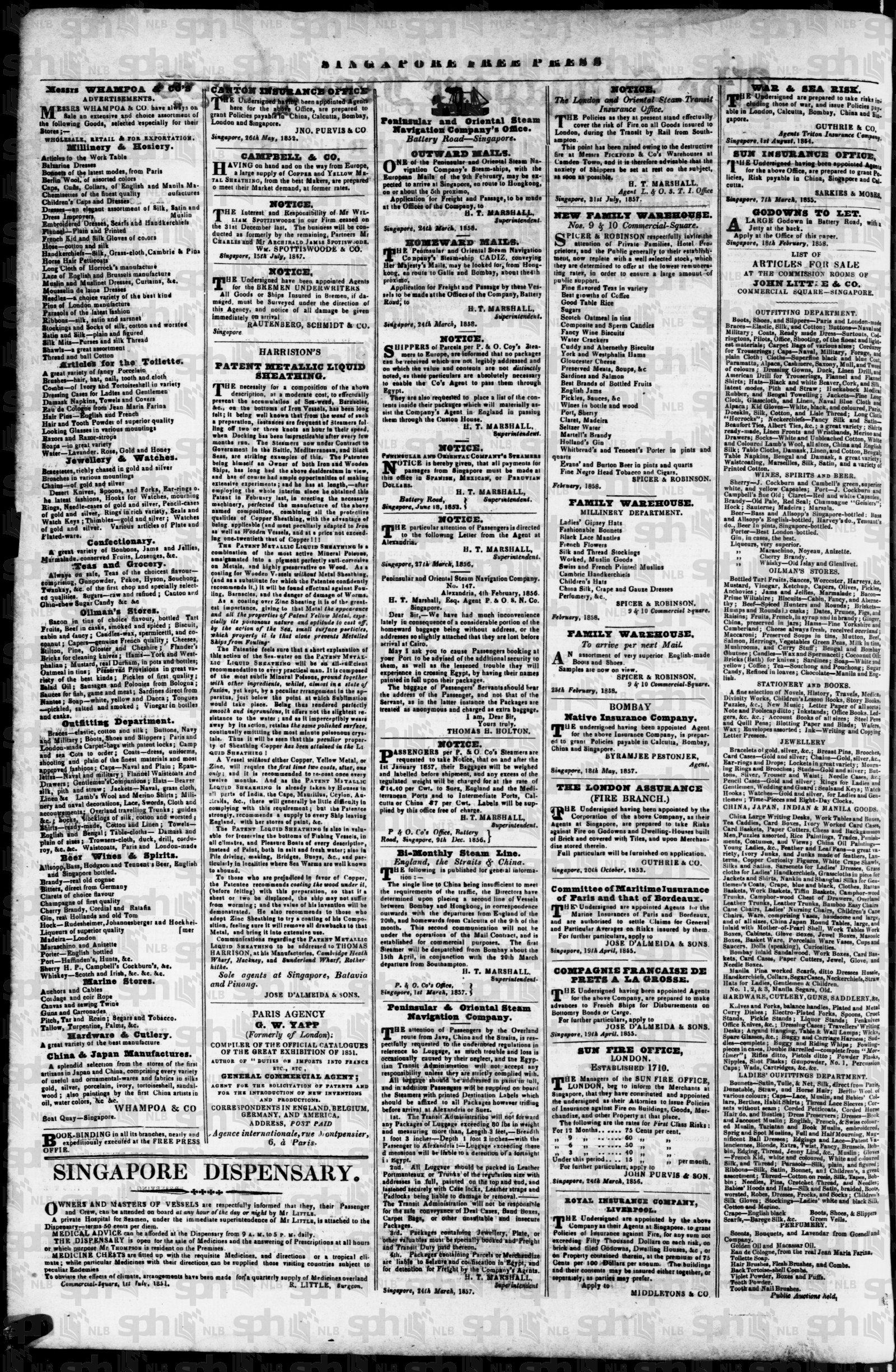 The Singapore Free Press of 25 March 1858, page 2. Spicer & Robinson's advertisement from "Nos. 9 & 10 Commercial Square" is in the fourth column, weeks after the shop opened. (Singapore Free Press, via NewspaperSG, National Library Board Singapore, public domain)
The store began on the 1st of February 1858 as Spicer & Robinson, a shop at 9 and 10 Commercial Square opened by Philip Robinson, who had come to Singapore from Australia, and James Gaborian Spicer. Its first advertisement appeared in The Singapore Free Press on the 25th of February. The partnership with Spicer was dissolved the next year, George Rappa Junior joined, and the business became Robinson & Company.
The shop moved several times in its first decades: to the corner of Coleman Street and North Bridge Road in 1859, and to new premises on Battery Road in 1881, with a tailoring department. Philip Robinson died in 1886 and his son, Stamford Raffles Robinson, took over. In about 1891 the store went back to Commercial Square, by then renamed Raffles Place, in much larger premises, and it stayed on the square for the next 81 years.

Raffles Place around 1910, when it was the town’s shopping square. The store at left is John Little, Robinsons’ long-time neighbour and rival. (C. J. Kleingrothe, KITLV collection, public domain, via Wikimedia Commons)
From 1907 the store was also among the first agents in the world for Raleigh bicycles. In 1920 the firm became a limited company, with the businessman Eu Tong Sen on its board, and in 1928 it opened its first branch outside Singapore, in Kuala Lumpur.
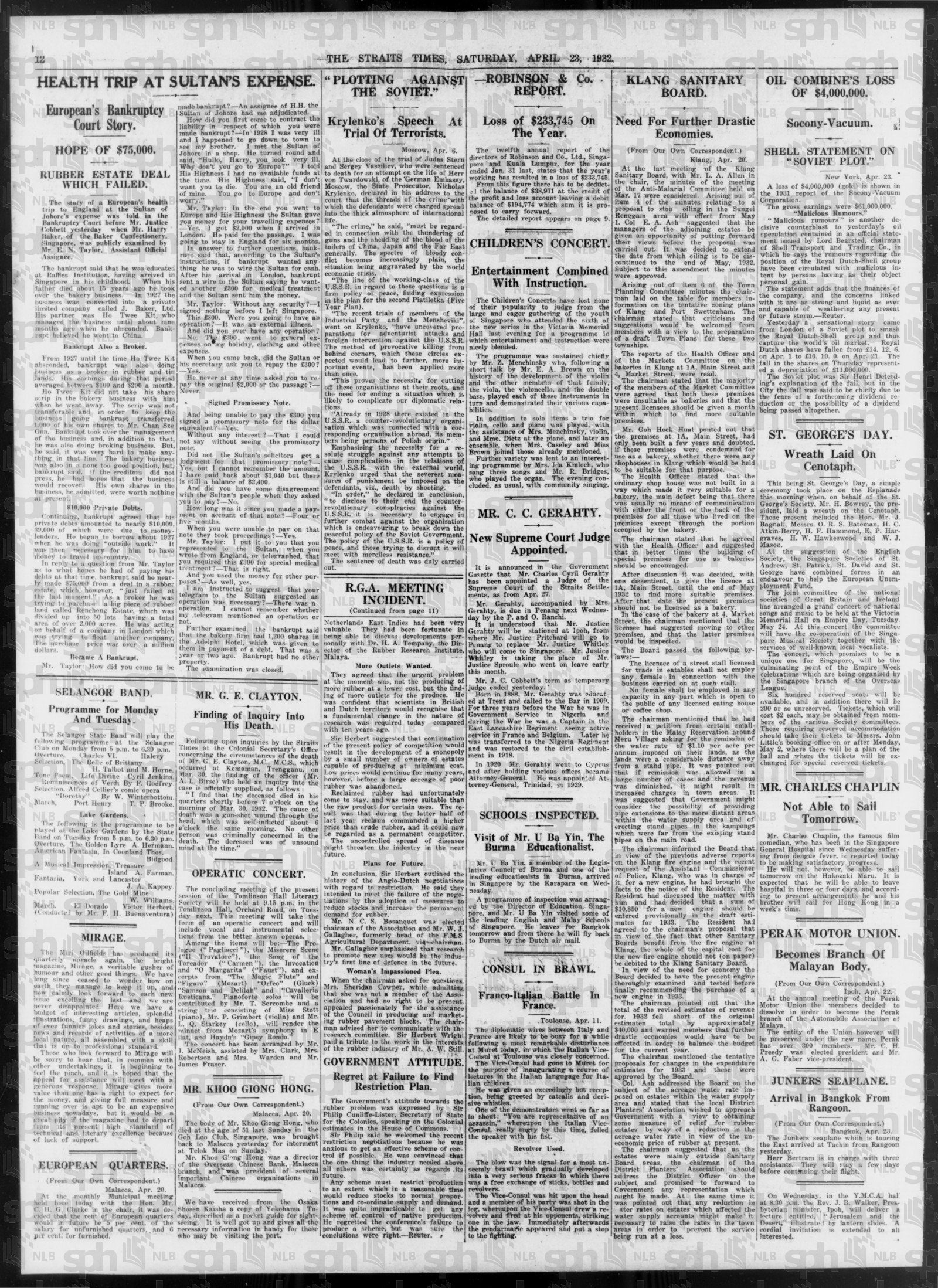 The Straits Times of 23 April 1932, page 12. The report "Robinson & Co. Report: Loss of $233,745 On The Year" is in the fourth column. (Singapore Press Holdings, via NewspaperSG, National Library Board Singapore, public domain)
The Great Depression hit the store hard. In April 1932 the directors reported a loss of $233,745 for the year to January, and the losses continued for six years in a row. Robinsons showed a profit again only in 1936, a modest $25,355, and by the year to February 1941 its net profit had grown to $270,910. (The Depression’s wider effect on Singapore is the subject of an earlier post.)
War and the post-war years, 1941 to 1972
In November 1941 the store moved across the square into Raffles Chambers. A few weeks later, on the 8th of December, Japanese bombs damaged its frontage in the first air raid on Singapore, and the next day the store put up a notice that it was “Open as usual”. It was bombed again on the 13th of February 1942, two days before the surrender, and later looted. Its chairman, W. H. MacGregor, died in internment in March 1942, and the store stayed shut through the Japanese Occupation.
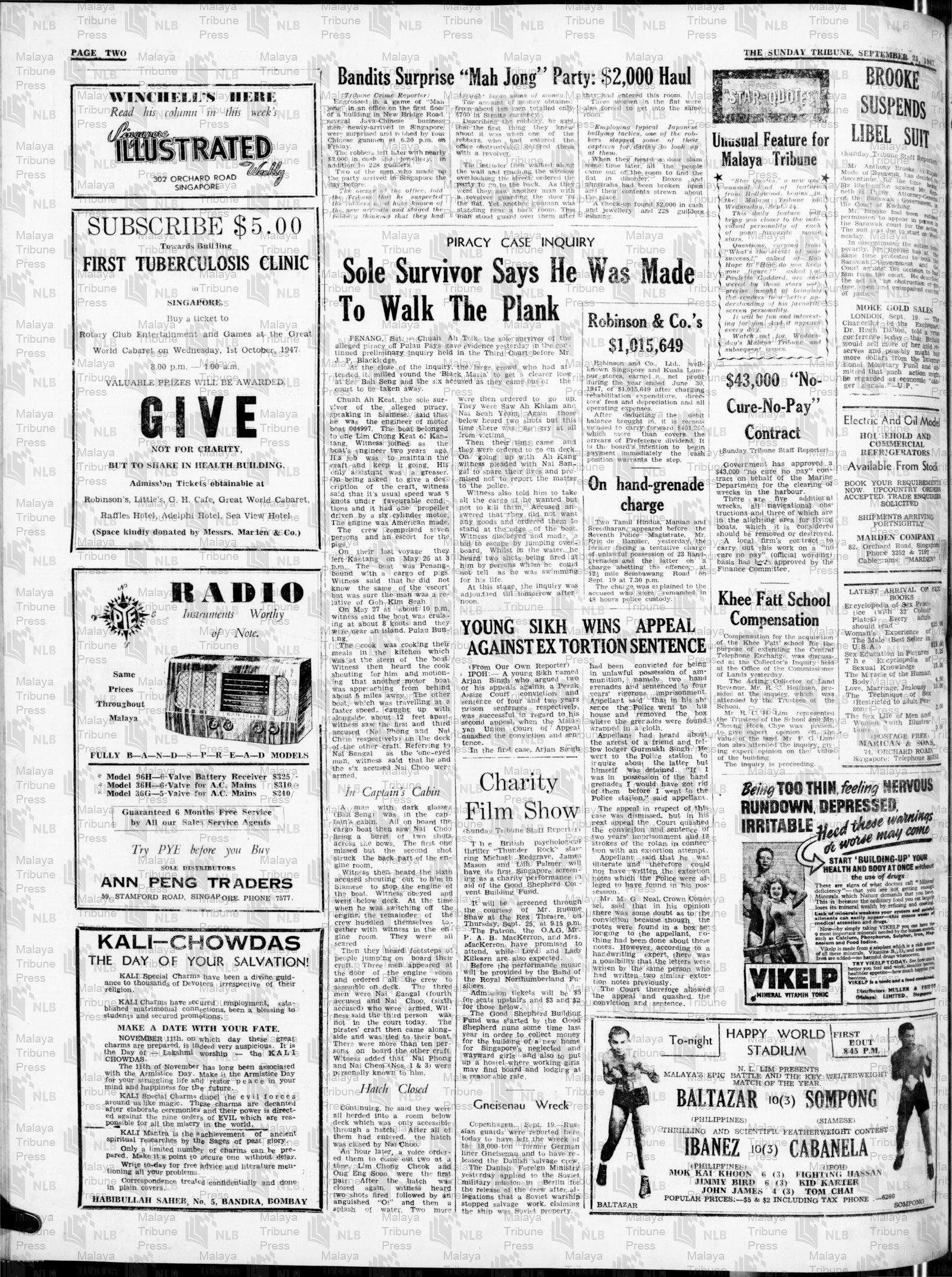 The Sunday Tribune of 21 September 1947, page 2. The report headed "Robinson & Co.'s $1,015,649" is on the right of the page. (Singapore Press Holdings, via NewspaperSG, National Library Board Singapore, public domain)
Robinsons reopened in April 1946. In its first full year, to the 30th of June 1947, the company made a net profit of $1,015,649, nearly four times its last pre-war figure. In 1955 the Raffles Place store became the first department store in Southeast Asia to be fully air-conditioned, and a facelift in 1957 added the store’s name in Malay and Chinese to its front, as in the 1971 photograph above. In 1965 an underground car park opened beneath Raffles Place, giving shoppers direct access to the store’s supermarket.

Raffles Place in about 1963, still the city’s main shopping square. (David Pirmann, CC BY 2.0, via Wikimedia Commons)
The fire, 21 November 1972
The fire started on the morning of Tuesday the 21st of November 1972, with the store full of Christmas stock and about 350 staff and 200 shoppers and visitors inside. An overloaded electrical branch short-circuited, drapes and displays caught fire, and the flames spread through the building within minutes. They reportedly rose 200 feet into the air and could be seen from Toa Payoh and Jurong.
The power failed, and eight people were trapped in the lifts. Six people were rescued from one lift, but the heat kept firefighters from reaching the other two. Nine people died: eight store employees, one of them a pregnant woman, and one shopper, who was found in a second-floor washroom.
The Fire Brigade arrived at 13 minutes past ten. Some of the nearby hydrants had too little pressure, so the firemen pumped water from the Singapore River. Eighteen fire engines were at the scene by the afternoon, and the fire was brought under control at about twenty past twelve, although the firemen were still damping it down that night. The rooftop statue of Mercury melted, and the roof of the Overseas Union Bank next door was damaged. The Stock Exchange’s trading room closed after 85 minutes that morning, and Robinson shares fell by as much as $1.20, to $3.90, on the news. About 30 cars in the basement car park came through undamaged, protected by its thick walls.
Estimates of the loss, covering the building, the stock and lost trade, ranged from about $14 million to $21 million. The Straits Times noted the next day that the store had stayed open through two wartime bombings, only to be destroyed by fire.
On the 21st of December 1972 President Benjamin Sheares appointed a Commission of Inquiry, chaired by Justice F. A. Chua. Its report, released on the 1st of December 1973, found that ageing wiring had been overloaded with festive lighting, warnings from electricians had not been acted on, fire precautions were inadequate, and large amounts of flammable goods had been stored in loft areas that had not been approved. It did not blame the Fire Brigade, but found that the building could not have been saved by the time the firemen arrived. Many of its recommendations were written into the Building Control Act of 1974.
Orchard Road, 1972 to 2021

The Specialists’ Shopping Centre on Orchard Road in 2005, where Robinsons reopened twenty days after the fire. The building has since been demolished. (mailer_diablo, CC BY-SA 3.0, via Wikimedia Commons)
Robinsons reopened on the 11th of December 1972 in the Specialists’ Shopping Centre on Orchard Road, with new stock flown in for the Christmas season. The company planned to rebuild on Raffles Place, but on the 17th of January 1973 the government announced that it had acquired the 24,123-square-foot site.
My own memory of Robinsons is of this store. When I was a boy, my parents took us to the Specialists’ Shopping Centre to buy things, I think about once a year. I also remember hearing about a big fire, which must have been the Raffles Place fire of 1972, the year I turned 12.
Orchard Road was by then becoming Singapore’s main shopping street, and in 1983 Robinsons moved across the road into The Centrepoint, which became its flagship for the next 30 years. For a few of those years it also had a second store back in the old business district: a branch in Clifford Centre, near Raffles Place, from 1977 to 1983. A branch opened in Raffles City in 2001, and in 2008 the Dubai-based Al-Futtaim Group bought the company, paying $7.20 a share for 88 per cent of it.

The Centrepoint on Orchard Road in February 2006, Robinsons’ flagship from 1983 to 2013. (Terence Ong, CC BY 2.5, via Wikimedia Commons)
When the Centrepoint lease ended in 2013, the flagship moved to The Heeren, also on Orchard Road, and a suburban store opened at Jem in Jurong East. In 2020, the year of the COVID-19 pandemic, Robinsons closed its Jem store in August and The Heeren in December, and the Singapore company went into a creditors’ voluntary winding-up. The Raffles City store sold off its remaining stock and closed in January 2021, ending 162 years of Robinsons stores in Singapore.
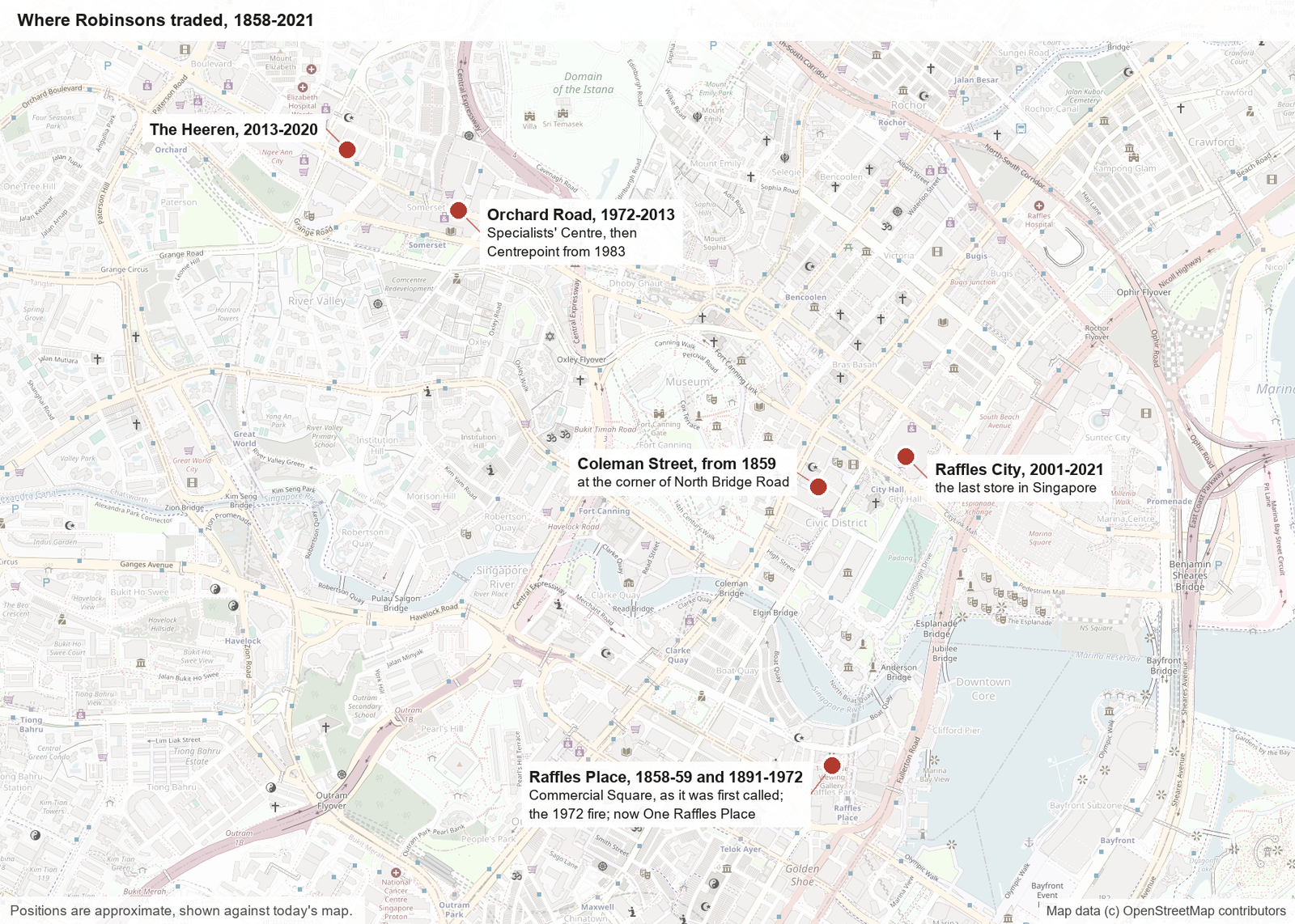
Where Robinsons traded, from Commercial Square in 1858 to Raffles City in 2021. The Jem store in Jurong East is off the map to the west. Positions are approximate. (Map data © OpenStreetMap contributors)
Raffles Place today
 One Raffles Place, the former OUB Centre, in September 2025. It stands on the site of the store that burned in 1972. (DvTor8303, CC0, via Wikimedia Commons)
In 1980 the Overseas Union Bank bought the fire site from the Urban Redevelopment Authority, and on it the bank built the OUB Centre, a 280-metre tower designed by Kenzo Tange that was completed in 1986. It was renamed One Raffles Place in 2008. Raffles Place itself is now the heart of the financial district rather than a shopping square. John Little, Robinsons’ old neighbour and rival on the square, later came under the same ownership, and its last Singapore store closed in 2016.
The Robinsons name was bought by an Australian company, Canningvale, and relaunched in June 2021 as an online store. The fire’s most lasting legacy is in the building rules, since the inquiry’s recommendations on wiring, storage and fire safety went into the Building Control Act.
Robinsons, 1858 to today
- Feb 1858 Spicer & Robinson opens on Commercial Square.
- 1859 The firm becomes Robinson & Company and moves to Coleman Street.
- c. 1891 The store returns to Raffles Place, as the square is now called.
- 1920 Robinsons becomes a limited company.
- 1931–36 Six years of losses in the Depression.
- Dec 1941 Japanese bombs damage the store; it opens as usual the next day.
- Apr 1946 The store reopens after the Occupation.
- 1955 The first fully air-conditioned department store in Southeast Asia.
- Nov 1972 The fire destroys the Raffles Place store and kills nine people.
- Dec 1972 Robinsons reopens at the Specialists' Shopping Centre.
- 1974 The Building Control Act takes up the inquiry's recommendations.
- 1983 The flagship moves to The Centrepoint.
- 1986 The OUB Centre is completed on the fire site.
- 2008 The Al-Futtaim Group buys Robinsons.
- 2013 The flagship moves to The Heeren.
- Jan 2021 The last Singapore store, at Raffles City, closes.
- Jun 2021 The name returns as an online store.
See more historical photos related to this post →
Where it fits in the bigger story: Robinsons was founded when Singapore was not yet 40 years old, and for most of its 162 years its story followed the city’s shopping. It traded on Raffles Place while the square was the town’s commercial centre, and it moved to Orchard Road just as the shoppers did. The fire that ended its time on the square is remembered less as the end of a building than as the beginning of stricter fire rules, while the department store itself gave way to the malls, chains and online shops that replaced it, as so many of the world’s old department stores have done.
Sources:
- Kevin Khoo, “Remembering Robinsons”, BiblioAsia, January–March 2021
- Robinsons & Co., Wikipedia
- 1972 Robinsons department store fire, Wikipedia
- One Raffles Place, Wikipedia
- The Singapore Free Press, 25 March 1858, Spicer & Robinson advertisement, page 2, NewspaperSG
- The Straits Times, 23 April 1932, “Robinson & Co. Report: Loss of $233,745 On The Year”, page 12, NewspaperSG
- The Straits Times, 23 April 1937, “Robinson’s Profit Last Year”, page 12, NewspaperSG
- Pinang Gazette, 24 July 1941, “Robinson & Co., Limited: Net Profit For Year $270,910”, NewspaperSG
- The Sunday Tribune, 21 September 1947, “Robinson & Co.’s $1,015,649”, page 2, NewspaperSG
- The Straits Times, 22 November 1972, “Nine feared dead”, page 1, NewspaperSG
- The Straits Times, 22 November 1972, “Third time unlucky”, page 14, NewspaperSG
- The Straits Times, 22 November 1972, “Thick basement walls save cars from blaze”, page 9, NewspaperSG
- The Straits Times, 22 November 1972, “All is not lost at Robinson”, page 15, NewspaperSG
- The Straits Times, 22 November 1972, “Fire disrupts share trading”, page 17, NewspaperSG
- The Straits Times, 11 December 1972, Robinson’s reopening advertisement, page 36, NewspaperSG
- The Straits Times, 12 December 1972, “Robinson’s plans to rebuild at fire site”, page 15, NewspaperSG
- The Straits Times, 18 January 1973, “Govt takes over Robinson fire site”, page 1, NewspaperSG
- Map data © OpenStreetMap contributors
- 522a Singapore 1971 (51316419105).jpg, Wikimedia Commons
- KITLV - 79891 - Kleingrothe, C.J. - Medan - Raffles Place, Singapore - circa 1910.tif, Wikimedia Commons
- SG Singapore Raffles Square - 1963 (W63-K27-15).jpg, Wikimedia Commons
- SpecialistsShoppingCentre.JPG, Wikimedia Commons
- Centrepoint Shopping Centre, Singapore - 20060212.jpg, Wikimedia Commons
- One Raffles Place 20250903 (1).jpg, Wikimedia Commons
- KITLV - 155824 - Shop John Little & Co., Singapore - circa 1870.tif, Wikimedia Commons
- KITLV - 79888 - Kleingrothe, C.J. - Medan - Square at Singapore - circa 1910.tif, Wikimedia Commons
- KITLV A723 - Raffles Place te Singapore, KITLV 87929.tiff, Wikimedia Commons
- Raffles Place Singapore, KITLV 1404977.tiff, Wikimedia Commons
- 71-610a Raffles Place Singapore 1971 (51251176861).jpg, Wikimedia Commons
- Raffles Place in front of OUB Centre, Singapore - 20020829.jpg, Wikimedia Commons
- Centrepoint, Singapore, decorated for Christmas - 20041231.jpg, Wikimedia Commons
- Robinsons and Marks & Spencer, Raffles City Shopping Centre, Singapore - 20051211.jpg, Wikimedia Commons
- The Heeren, Dec 05.JPG, Wikimedia Commons


