The Marquis and the Museum: Tokugawa Yoshichika in Syonan, 1942–44
On 5 September 1942 the Syonan Times reported that Marquis Yoshichika Tokugawa, adviser to the Japanese military administration in Malaya, had been made director of the Syonan Museum, Botanical Gardens and Library. These were the old Raffles Museum and the Botanic Gardens under new names. The paper added that “no damage was caused” to them in the fighting for Singapore. For the next two years a Japanese nobleman who had once come to Malaya to hunt tigers presided over the island’s two great scientific collections. Working under him, and outside the internment camps, were two British botanists, Eric Holttum and John Corner. Both collections came through the war largely intact, and their descendants are still in Singapore today.

The Raffles Museum on Stamford Road around 1900. (Unknown author, KITLV collection, public domain, via Wikimedia Commons)
The professor with the notices
Singapore surrendered on 15 February 1942. Within days a Japanese volcanologist, Professor Hidezō Tanakadate of Tohoku Imperial University, was going round the city’s scientific buildings. He had come down from Saigon behind the army, and according to later accounts he used the rank of a junior officer to post handwritten notices on the doors of the Raffles Museum and other buildings, telling soldiers to keep out.
The Botanic Gardens’ own report on the war years, published in 1947, says that “three days after the Japanese occupation” Tanakadate “assumed control of the Gardens”. He asked Eric Holttum, the Gardens’ director since 1925, to stay in executive charge and to carry on the normal work. He then joined the Gardens and the Raffles Museum into a single department under the municipality, with its head office at the museum. By June 1942 the Syonan Times was describing his work there: the museum and the gardens had been open to the public since 29 April, the Emperor’s birthday, and thousands of rare exhibits had escaped “the wave of looting” after the fall of Singapore thanks to his quick action. Rain coming through the damaged roof, the paper noted, had given the museum’s elephant “a jolly good bath”.
A marquis in 1942
 Marquis Tokugawa Yoshichika in April 1929, with a tiger-skin rug at his feet. (Unknown author, published in the magazine Rekishi Shashin, April 1929, public domain, via Wikimedia Commons)
The man who took over from him in September was a marquis, and in 1942 that was a real rank. In 1884 Meiji Japan created a new peerage, the kazoku, with five ranks: kōshaku (prince or duke), kōshaku again, written with a different character (marquis), hakushaku (count), shishaku (viscount) and danshaku (baron). The names came from the ranks of ancient Chinese nobility, and their official English versions were the European titles they were meant to match. The peerage lasted until 1947, when Japan’s new constitution abolished it.
Yoshichika was born in Tokyo in 1886, the youngest son of Matsudaira Shungaku, a former feudal lord. In 1908 he was adopted into the Owari branch of the Tokugawa family, one of the three senior branches of the clan that had ruled Japan until 1868, and became its 19th head. He studied history at Tokyo Imperial University and then turned to biology, and in 1918 he founded his own research institute in Tokyo.
He also knew Malaya. In 1921 he sailed to the Malay Peninsula and Java, arriving in Singapore on 21 May, and in early June he went tiger hunting near Muar with Sultan Ibrahim of Johor. The trip earned him the nickname toragari no tonosama, “the tiger-hunting lord”, and the friendship with the Sultan lasted for the rest of their lives. After a later visit he began to learn Malay. At home he gave much of his family’s art collection to a foundation, which opened the Tokugawa Art Museum in Nagoya in 1935. His politics were less settled: in 1931 he gave money to army officers plotting a coup, the March Incident, and then helped persuade them to call it off.
He left Japan on 11 February 1942, four days before the surrender, and reached Syonan on 5 March as an adviser to the military administration.
Director of the museum and the gardens
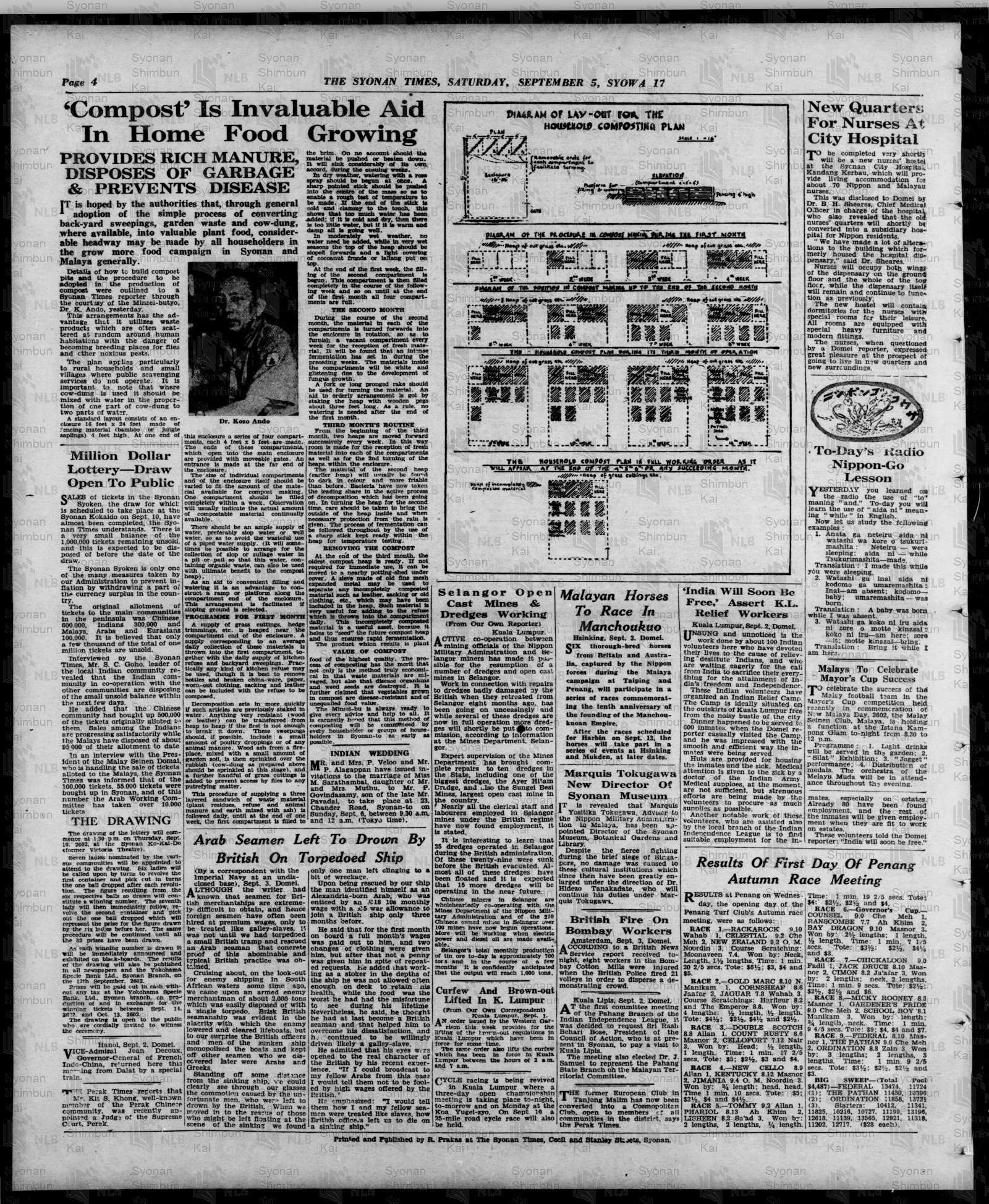 The Syonan Times of 5 September 1942, page 4. The short report "Marquis Tokugawa New Director Of Syonan Museum" is in the lower middle of the page. (The Syonan Times, via NewspaperSG, National Library Board Singapore, public domain)
The Syonan Times report of 5 September 1942 said that the institutions had been “greatly enlarged under the direction of Dr. Hideso Tanakadate, who will continue his duties under Marquis Tokugawa”. The Gardens’ 1947 report describes the Marquis’s position as Honorary President of the Museum and Gardens, which he held until he went back to Japan in the middle of 1944. In December 1942 Professor Kwan Koriba, a botanist from Kyoto Imperial University, arrived to run the Gardens as director.
Holttum and Corner were among the very few British civilians in Singapore who were not interned. Corner, the Gardens’ assistant director, had a right arm weakened by a monkey bite and had not joined the volunteer forces. The 1947 report says that Koriba “obtained permission” for both men to stay in the Gardens and continue their botanical work. Corner studied the larger fungi and the development of flowers and fruits in tropical trees. Holttum wrote new descriptions of the peninsula’s ferns, orchids, gingers and grasses. Corner and Tanakadate, meanwhile, drew up lists of abandoned libraries in government offices and private homes, and their books were gathered into the museum, and Raffles’s statue was taken down from Empress Place in September 1942 and moved into the museum. Domei said it would be kept there “as a mark of respect”.
The Marquis also spent his own money. In December 1942 the Syonan Sinbun reported that he would pay for five young people from Johor, three young men and two young women, to study in Tokyo for three years. In Tokyo they lived at his mansion, and one of them was Ungku Aziz, later a well-known Malaysian economist.
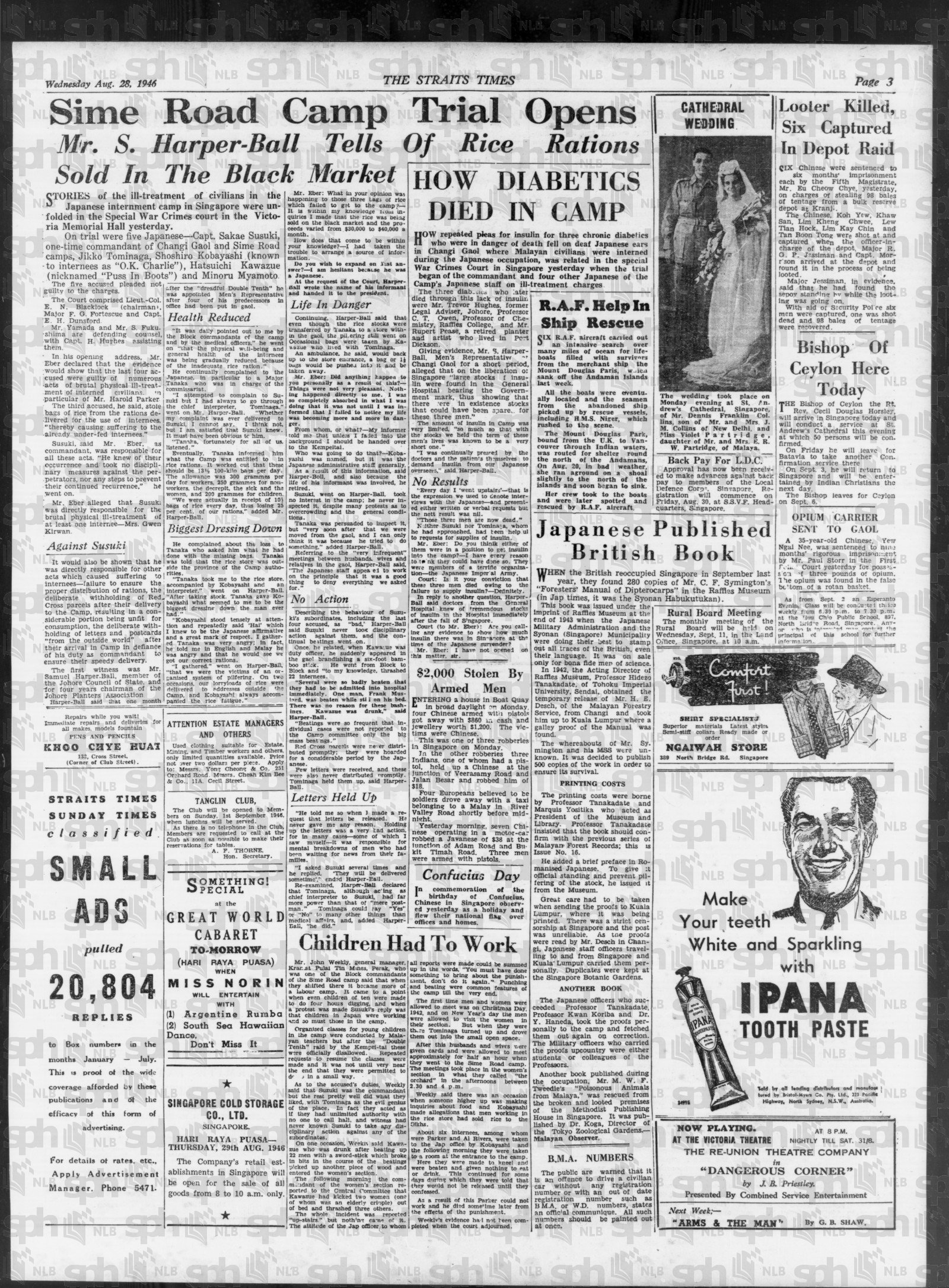 The Straits Times of 28 August 1946, page 3. The report "Japanese Published British Book", in the middle right, tells how a British forestry manual was printed in Syonan. (Singapore Press Holdings, via NewspaperSG, National Library Board Singapore, public domain)
One of the stranger results came to light in 1946. When the British returned they found 280 copies of a new book at the Raffles Museum: C. F. Symington’s Foresters’ Manual of Dipterocarps, a guide to Malaya’s most important timber trees, written by a British forest officer before the war. Symington’s whereabouts were unknown, but in 1942 Tanakadate had a British forest officer, H. E. Desch, released from Changi for a time and taken to Kuala Lumpur, where a galley proof of the manual was found. The printing costs, the Straits Times reported, were borne by Tanakadate and Marquis Tokugawa, “who acted as President of the Museum and Library”. Koriba and a Japanese biologist, Yata Haneda, took the proofs into the internment camp themselves so that Desch could correct them. The book came out at the end of 1943 under the museum’s own imprint, in the middle of the occupation.
The other side of the arrangement
The museum under its new masters had its own purpose. In January 1943 the Syonan Sinbun reported that about 600 people a day were visiting it, most of them Japanese soldiers, and that its staff were translating every label from English into Japanese. “We want to do away with English as much as possible,” the curator, Mr Nakata, told the paper. Corner’s own report on the museum staff, written at the end of the war, praises one staff member, Mrs E. Reyes, who kept trying to stop others from stealing books from the library and selling them in Bras Basah Road.
The Gardens also paid a price that the scientists could not prevent. According to the 1947 report, more than half of the outdoor staff, 49 men, were sent by the Japanese military to work on the Siam–Burma railway, and 22 of them died there, both Indians and Malays. Others were set to growing medicinal, fibre and dye plants on the neighbouring Tyersall estate, and later to growing food. By the end of the occupation prices had risen to about 500 times their 1941 level, while wages had not even doubled.
For Holttum and Corner the arrangement had a cost of a different kind. Corner signed an undertaking to the Japanese authorities, and some of his fellow Britons regarded him as a collaborator. The two men’s own account, in the 1947 report, sets out the basis on which they worked: “All the Japanese scientific officers concerned were insistent that the Herbarium and library (as also the collections at the Raffles Museum) should be preserved as part of the cultural heritage of Malaya, and on this basis the British staff cooperated with them.”
After 1945
 A bronze statue of Tokugawa Yoshichika on Komakiyama in Komaki, Aichi, a hill he gave to the nation in 1927, photographed in 2009. (KKPCW, CC BY 3.0, via Wikimedia Commons)
The Marquis left Syonan in August 1944, under orders to return to Japan. His diary from that month has a short line: Marē ga suki na no de aru, “I love Malaya.” Tanakadate had already been recalled, in 1943, and his own books and research notes in Tokyo were destroyed in an air raid in 1945. Koriba stayed in Singapore to the end. When the war was over, Holttum and Corner were given permission to have him released from the camp for Japanese prisoners, but he declined and stayed with his countrymen, a choice Holttum later praised.
The 1947 report found that the herbarium had survived intact, apart from some specimens that had been on loan in Germany, and that so had the library. Under the British Military Administration the Gardens were looked after until March 1946 by Gilbert Archey of the Auckland Museum, and Holttum returned as director in May 1946.
In Japan the Marquis lost most of his fortune and, in 1947, his title. He became an adviser to the new Japan Socialist Party in 1945, was purged from public office in 1946, and spent his last years in charitable work. He died in Tokyo in 1976. Five years later Corner published The Marquis: A Tale of Syonan-to, a memoir of the occupation years and of his friendship with Tokugawa. The Straits Times reviewed it in February 1982 under the headline “A wartime controversy”.
Today
The Marquis and the collections, 1884 to today
- 1884 Japan creates the kazoku peerage, with five ranks including marquis.
- 1921 Tokugawa hunts tigers in Johor with Sultan Ibrahim.
- Feb 1942 Tanakadate takes control of the Botanic Gardens and the Raffles Museum.
- Sep 1942 Tokugawa becomes head of the Syonan Museum, Botanical Gardens and Library.
- Aug 1944 Tokugawa leaves Syonan for Japan.
- Sep 1945 The British return; the herbarium and library are found intact.
- 1947 Japan's new constitution abolishes the peerage.
- 1972 The museum's natural history collections go to the University of Singapore.
- 1981 Corner publishes The Marquis: A Tale of Syonan-to.
- 2015 The Lee Kong Chian Natural History Museum opens; the Botanic Gardens become a UNESCO World Heritage Site.

The Lee Kong Chian Natural History Museum at the National University of Singapore, July 2026. (RFNirmala, CC BY 4.0, via Wikimedia Commons)
The old Raffles Museum building on Stamford Road is now the National Museum of Singapore. Its natural history collections, the specimens Tanakadate’s notices protected in 1942, were moved to the University of Singapore’s zoology department in 1972. They spent years in temporary homes, including seven years at Nanyang Technological University, and in 2015 they moved into the new Lee Kong Chian Natural History Museum at the National University of Singapore, which now holds more than 560,000 catalogued lots.
The Botanic Gardens became Singapore’s first UNESCO World Heritage Site in July 2015. The building that held Holttum’s office and laboratory as director is now Holttum Hall, home of the Gardens’ heritage museum, and Corner’s old house in the Gardens is a restaurant called Corner House. In Nagoya the Tokugawa Art Museum, which the Marquis founded, still shows the family’s treasures.
See more historical photos related to this post →
Where it fits in the bigger story: the occupation took a heavy toll on Singapore’s people, including the Gardens’ own workers on the Siam–Burma railway, and the museum was put to work for Japan’s cultural aims. Yet the island’s oldest scientific collections came through it largely intact, because a Japanese volcanologist, a Japanese marquis and two British botanists agreed that they belonged to Malaya’s heritage. Most visitors to the Botanic Gardens and the natural history museum today know little of that wartime arrangement, which is still debated.
Sources:
- The Syonan Times, 27 June 1942, “Syonan To Be Centre Of Scientific Research In Malayan Archipelago”, page 4, NewspaperSG
- The Syonan Times, 5 September 1942, “Marquis Tokugawa New Director Of Syonan Museum”, page 4, NewspaperSG
- The Syonan Times, 13 September 1942, “Statue Of Founder Removed To Museum”, page 4, NewspaperSG
- The Syonan Sinbun, 16 December 1942, “Marquis Tokugawa Grants Five Scholarships To Malaians”, page 1, NewspaperSG
- The Syonan Sinbun, 18 December 1942, “Johore Residents Get Scholarships”, NewspaperSG
- The Syonan Sinbun, 25 January 1943, “Syonan Museum, Library Popular With Scientists”, page 2, NewspaperSG
- The Syonan Sinbun, 26 January 1943, “Malai And Sumatra Plants To Be Used For Research”, page 1, NewspaperSG
- The Syonan Shimbun, 26 August 1944, “7,000 Varieties Of Vegetation In Nampo”, page 2, NewspaperSG
- The Straits Times, 28 August 1946, “Japanese Published British Book”, page 3, NewspaperSG
- Singapore Free Press, 2 June 1921, “To Hunt Tigers”, NewspaperSG
- The Straits Times, 20 February 1982, “A wartime controversy”, NewspaperSG
- R. E. Holttum and others, “The Singapore Botanic Gardens during 1941–46”, The Gardens’ Bulletin, Singapore, vol. XI, part 4, 30 September 1947
- Raffles Museum WW2 staff reports, Roots.gov.sg, National Heritage Board
- “How war enemies collaborated to save Singapore’s treasures during WW2”, The Kopi, 30 January 2021
- Tokugawa Yoshichika, Wikipedia
- 徳川義親, Japanese Wikipedia
- 小牧山, Japanese Wikipedia
- E. J. H. Corner, Wikipedia
- Richard Eric Holttum, Wikipedia
- Holttum Hall, Wikipedia
- Lee Kong Chian Natural History Museum, Wikipedia
- Singapore Botanic Gardens, Wikipedia
- Raffles Museum in Singapore, circa 1900, Wikimedia Commons
- Tokugawa Yoshichika, April 1929, Wikimedia Commons
- Bronze statue of Tokugawa Yoshichika, Komakiyama, Wikimedia Commons
- Lee Kong Chian Natural History Museum, July 2026, Wikimedia Commons
- Tokugawa Yoshichika, October 1913, Wikimedia Commons
- Raffles Museum in Singapore, circa 1910, Wikimedia Commons
- Guide to the zoological collections of the Raffles Museum, plate II, Wikimedia Commons
- Entrance to the Botanical Gardens, Singapore, Wikimedia Commons
- Doctors in front of the Victoria Memorial Hall with the statue of Raffles, Wikimedia Commons
- Singapore Botanic Gardens Heritage Museum, Wikimedia Commons
- Tokugawa Art Museum Original Hall, Nagoya, 2023, Wikimedia Commons


