Horsburgh Lighthouse: Building the Light on Pedra Branca
On 24 May 1850, Queen Victoria’s birthday, a steam frigate towed two ships out to a bare granite rock 37 miles east of Singapore. On board were the Governor of the Straits Settlements, an admiral, the foreign consuls and the Freemasons of Lodge Zetland in the East, who had come to lay a foundation stone with Masonic honours. The rock was Pedra Branca, and the stone was the first of a lighthouse that would carry the name of the hydrographer James Horsburgh. Its architect, the government surveyor John Turnbull Thomson, wrote a long account of how it was built, and more than 150 years later the building and running of that lighthouse were part of the evidence when the International Court of Justice decided who owns the rock.

Horsburgh Lighthouse in October 1851, the month it was first lit, in a lithograph from a drawing by its architect. (John Turnbull Thomson, public domain, via Wikimedia Commons)
Why a light was needed
 Pedra Branca before the lighthouse, white with the droppings of sea birds, in an aquatint of about 1820. (Thomas and William Daniell, public domain, via Wikimedia Commons)
Pedra Branca means “white rock” in Portuguese, and the Malays called it Batu Putih, which means the same. Thomson wrote that before the work began the rock looked perfectly white, because it was covered in the droppings of the sea birds that rested there. It sits at the eastern entrance to the Singapore Strait, nine miles from the nearest point of the Johor coast, and for centuries it was the mark that ships steered for when they came in from the South China Sea. Portuguese sailing directions from the 1500s already named it as the mark for the channel.
It was also a dangerous place. Thomson went through every Singapore newspaper published since 1824 and listed the ships lost or damaged near the rock. Between 1824 and 1839 there were five total wrecks, and between 1841 and 1851 there were eleven, about one a year, as trade through Singapore grew. One of them, the Dourado, went down with 500,000 Spanish dollars on board.
James Horsburgh had spent his career making these waters safer. He was a Scottish hydrographer to the East India Company, and his charts and sailing directions were the ones that ships’ captains carried in the Eastern seas. After he died in 1836, money was raised by subscription for a memorial to him, and the memorial became a lighthouse, the “Horsburgh Testimonial”. Of the final cost, $9,884 came from private subscriptions, much of it gathered through the trading firm Jardine, Matheson and Company of Canton, and the East India Company’s government paid the rest.

Where Pedra Branca lies, with Middle Rocks and South Ledge nearby, at the eastern entrance to the Singapore Strait. (Jappalang, public domain, via Wikimedia Commons)
Building it
Thomson had first drawn plans in 1844 for a lighthouse on Peak Rock, one of the Romania islands close to the Johor shore. In June 1847 the government told him it had chosen Pedra Branca instead, on the advice of the Admiralty, because it stood further out and ships could steer straight for it. To find out how hard the sea hit the rock, he had brick pillars built on it in November 1847. When he went back in March 1848, the ones on the north side, some of them 13 feet above the sea, had been swept away, so he designed a tower built of granite from its foundation to the top, not just at its base. The East India Company’s directors approved his plans in December 1849.
 "Chinese Stone Cutters in Pulau Ubin", Hakka masons of the kind who cut the lighthouse's granite, sketched by Thomson. (John Turnbull Thomson, public domain, via Wikimedia Commons)
The granite was not cut on the rock but at quarries on Pulau Ubin, by Chinese stonecutters who dressed each block, laid out every course of the tower in the quarry to check the fit, and then shipped the courses out. A good stonecutter, Thomson noted, earned nine Spanish dollars a month. The first party went out at the end of March 1850: eleven Indian convicts to work as quarrymen and three Chinese blacksmiths. The day after they landed, the north-east wind rose so quickly that the gunboat had to run for shelter, and the men were left on the rock with two days’ water, waving handkerchiefs on sticks when the ship came back. In the end they were hauled off through the surf on a line and a buoy.
When the work began in earnest in April 1850, Thomson listed everyone on the rock: Chinese stonecutters, carpenters, blacksmiths, coolies and a cook, Indian convict quarrymen, Malay sailors from the gunboat, a Hindu cook and a Muslim table servant, 46 people in all, living in huts of plank and attap on a rock about 450 feet long at low water. In June the contractor, Choah Ah Lam, disappeared. Thomson found that he had boarded an American ship bound for China, and from then on he paid the workmen daily wages himself. The number of men at the Pulau Ubin quarries rose from about 20 to between 80 and 100.
The waters around the rock had a reputation for piracy, and Thomson designed the tower itself as a strongpoint, with thick doors and room inside for six months of stores, water and provisions. Two armed gunboats served the works, and no pirate came near the rock while the men were there. Boats belonging to the stonecutters were less lucky: three of the Pulau Ubin men were killed in attacks, and Thomson heard of eight more killed on the 15 miles between Singapore town and Pulau Ubin.
By the time the north-east monsoon closed the first season in October 1850, the shaft of the tower stood 59 feet above its foundation. Work resumed in April 1851. The lantern and the lighting apparatus, designed in Scotland by Alan Stevenson, engineer to the Northern Lighthouse Board, were landed on 27 August, and on 27 September the Governor came out to inspect the finished tower. That evening the light was lit for the first time, for a few hours, and Thomson watched it from the departing steamer until it sank below the horizon about 15 nautical miles away. The whole work had cost 23,665 Spanish dollars and 87 cents, not counting the gunboats and the steamer.
The light
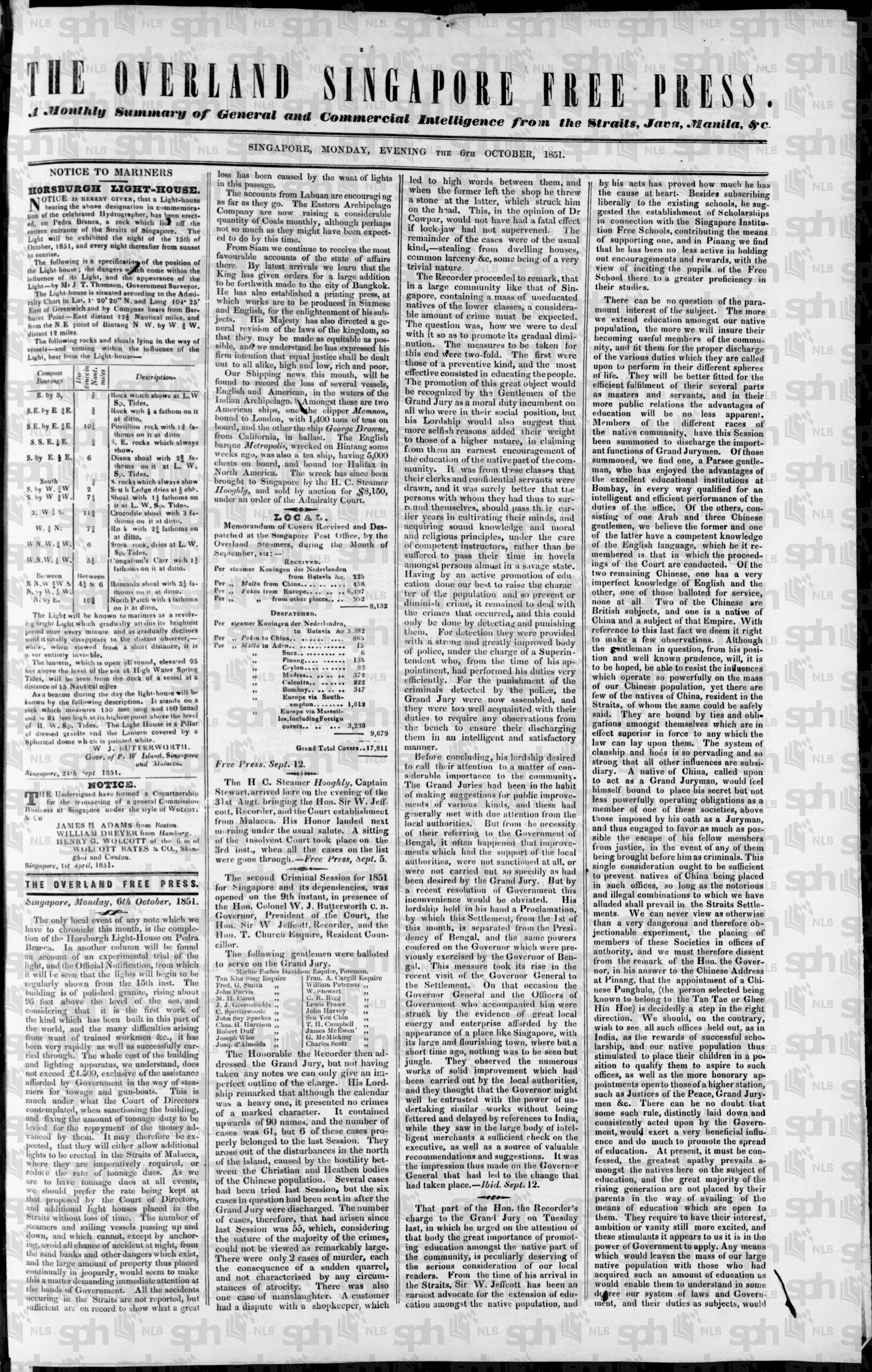 The front page of the Overland Singapore Free Press, 6 October 1851. The "Notice to Mariners" at top left announces the Horsburgh light from 15 October. (The Singapore Free Press, via NewspaperSG, National Library Board Singapore, public domain)
On 6 October 1851 the Singapore Free Press printed a Notice to Mariners. It said the light would first be shown on the night of 15 October 1851, “and every night thereafter from sunset to sunrise”. It would be a revolving light that grew to its brightest once a minute and then faded, set 95 feet above high water and visible from the deck of a ship 15 nautical miles away. The notice listed every rock and shoal within reach of the light, with its compass bearing. The same page reported that the English barque Metropolis, a tea ship, had been wrecked on nearby Bintan some weeks before. The last of the workmen left the rock on 22 October 1851.
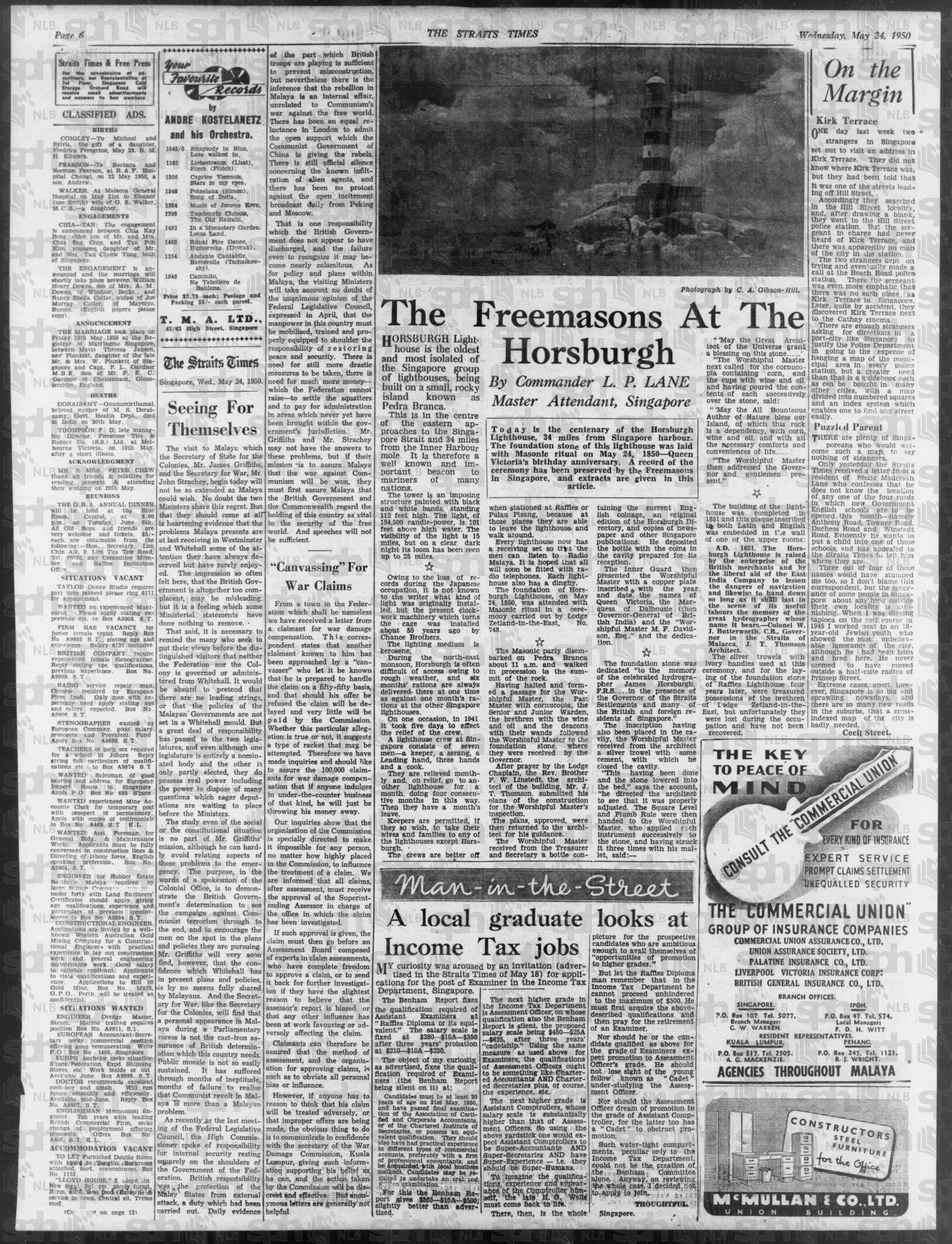 Page 6 of the Straits Times, 24 May 1950, the lighthouse's centenary, with "The Freemasons At The Horsburgh" by the Master Attendant, Commander L. P. Lane. (Singapore Press Holdings, via NewspaperSG, National Library Board Singapore, public domain)
Life on the rock stayed hard. In 1950, when the lighthouse turned 100, Singapore’s Master Attendant, Commander L. P. Lane, described it in the Straits Times as the oldest and most isolated of the colony’s lighthouses. Its crew of seven, a keeper, a serang (boatswain), a leading hand, three hands and a cook, were relieved once a month. During the north-east monsoon, six months of rations were landed at once, and in 1941 it had taken five days to get a relief party onto the rock. Keepers at the other lights could bring their families, but not at Horsburgh.
By then the light burned kerosene and turned on clockwork machinery that Chance Brothers had installed about 50 years earlier. Lane gave it a strength of 154,500 candle-power, still visible at 15 miles and, on a clear night, glowing over the horizon at 25. Many of the station’s older records, he noted, had been lost during the Japanese Occupation.
Who owns the rock
For more than a century after 1851 the British ran the lighthouse from Singapore, and Singapore kept running it after independence. The question of who owns the rock became a public dispute on 21 December 1979, when Malaysia published a map that showed Pedra Branca, which Malaysia calls Pulau Batu Puteh, inside its territorial waters. Singapore protested by diplomatic note on 14 February 1980. Talks in 1993 and 1994 did not settle the matter, and on 6 February 2003 the two countries signed a Special Agreement to ask the International Court of Justice in The Hague to decide it, together with two smaller features nearby, Middle Rocks and South Ledge.
The two sides read the history of the lighthouse differently. Malaysia argued that the island had always been part of Johor and that Britain had built and kept the lighthouse there with the permission of the territorial sovereign, which did not make it British. Singapore argued that the building of the lighthouse between 1847 and 1851 had been a lawful taking of possession by the British Crown, and that Britain and then Singapore had acted as sovereign over the island ever since.
The Court gave its judgment on 23 May 2008. It found that the Sultanate of Johor had held original title to Pedra Branca. It then looked at what both sides had done over the following century and a half. In 1953 Singapore’s Colonial Secretary had written to the British Adviser to the Sultan of Johor asking about the island’s status, and the Acting State Secretary of Johor replied that “the Johore Government does not claim ownership” of it. The Court described that reply as clear in its meaning. It also pointed to acts by Britain and Singapore that went beyond running a lighthouse, such as investigating shipping accidents, controlling who could visit, and installing naval communication equipment, and noted that Malaysia and its predecessors had not responded to them. It concluded that by 1980 sovereignty over Pedra Branca had passed to Singapore. The vote was 12 to 4. By 15 votes to 1, it awarded Middle Rocks to Malaysia, and it ruled that South Ledge, which is above water only at low tide, belongs to whichever state owns the waters around it.

Horsburgh Lighthouse on Pedra Branca, seen from the sea in 2017. (Martian-2008, CC BY-SA 4.0, via Wikimedia Commons)
Since 2008
The case came back into the news in 2017. In February that year Malaysia asked the Court to revise the 2008 judgment, saying it had found new documents in the British National Archives, and in June it filed a separate request for the Court to interpret the judgment. On 28 May 2018 Malaysia told the Court it would discontinue both cases, Singapore agreed the next day, and the Court closed the proceedings. In July 2021 Singapore’s Ministry of National Development announced development works at Pedra Branca, including land reclamation within half a nautical mile of the island, to improve maritime safety and search and rescue. In Malaysia, a royal commission of inquiry set up in 2024 examined how the government had handled the cases, and its report was made public in December that year.
Horsburgh Lighthouse: the light and the rock
Building the light, 1836-1851, and the question of who owns Pedra Branca, 1953-2018
Sources: J. T. Thomson (1852); Singapore Free Press, 6 Oct 1851; ICJ judgment, 23 May 2008; ICJ order, 29 May 2018.
View as table
| Date | Event |
|---|---|
| May 1836 | The East India Company's hydrographer, author of the standard sailing directory for these seas, dies on 14 May 1836. Merchants later raise a fund for a lighthouse in his memory. |
| Jun 1847 | On 21 June 1847 the government tells Thomson the light will go on Pedra Branca rather than Peak Rock, on the Admiralty's advice. |
| May 1850 | On 24 May 1850, Queen Victoria's birthday, Freemasons of Lodge Zetland in the East lay the stone with Masonic honours, watched by Governor Butterworth. |
| Oct 1851 | The Notice to Mariners says the light will be exhibited from the night of 15 October 1851, and every night thereafter from sunset to sunrise. |
| Sep 1953 | On 21 September 1953 the Acting State Secretary of Johor replies to Singapore that the Johore Government does not claim ownership of Pedra Branca. |
| Dec 1979 | Malaysia publishes a map placing Pedra Branca in its territorial waters. Singapore protests by diplomatic note on 14 February 1980. |
| Feb 2003 | Malaysia and Singapore sign a Special Agreement at Putrajaya on 6 February 2003 to put the question to the International Court of Justice. |
| May 2008 | On 23 May 2008 the Court awards Pedra Branca to Singapore by 12 votes to 4, Middle Rocks to Malaysia by 15 to 1, and South Ledge to the state in whose waters it lies. |
| 2017-18 | Malaysia files for revision in February 2017 and for interpretation in June 2017, and discontinues both in May 2018; the Court removes the case from its list on 29 May 2018. |
The lighthouse that Thomson built still stands on the rock and still flashes every night. See 12 more historical pictures related to this post →
Why it matters today: A lighthouse built in 1851 to stop ships running aground on a white rock ended up as part of the story of a border. The construction records Thomson kept, the 1953 letter and a century of routine acts such as inspecting the light and investigating wrecks were all weighed by a court in The Hague, and the two neighbours chose to put the question to a court rather than leave it unsettled. The light also still does the job it was built for, at one of the busiest shipping entrances in the world.
Sources
- The Singapore Free Press, 6 October 1851, “Notice to Mariners: Horsburgh Light-House”, page 1
- The Sunday Times, 6 March 1932, “Sentinel Which Points Way To China Sea”, page 10
- The Straits Times, 24 May 1950, “The Freemasons At The Horsburgh”, page 6
- The Straits Times, 31 December 1955, “Violent seas marooned men who built Horsburgh Light”, page 9
- J. T. Thomson, “Account of the Horsburgh Light-house”, Journal of the Indian Archipelago and Eastern Asia, vol. 6 (1852), pp. 376–498, via Internet Archive
- International Court of Justice: Sovereignty over Pedra Branca/Pulau Batu Puteh, Middle Rocks and South Ledge (Malaysia/Singapore), Judgment of 23 May 2008
- International Court of Justice: Application for Revision of the Judgment of 23 May 2008 (Malaysia v. Singapore), Order of 29 May 2018
- Ministry of Foreign Affairs, Singapore: Pedra Branca
- Ministry of National Development: Development Works at Pedra Branca to Enhance Maritime Safety and Security (July 2021)
- Free Malaysia Today: Malaysia withdraws challenge on Pedra Branca ruling (30 May 2018)
- New Straits Times: Chronology of the Pulau Batu Puteh case (December 2024)
- Wikipedia: Horsburgh Lighthouse
- Wikimedia Commons: Horsburgh Lighthouse by John T Thomson 2.jpg
- Wikimedia Commons: PedraBranca-Daniell-c1820.jpg
- Wikimedia Commons: Pedra Branca Map.svg
- Wikimedia Commons: ChineseKayTribeStonecutters-Singapore.jpg
- Wikimedia Commons: LightHouse.jpg
- Wikimedia Commons: HorsburghLighthouse-JTThomson-1851-02.jpg
- Wikimedia Commons: PedraBranca-TRobertson-1882.jpg
- Wikimedia Commons: Hessel Gerritsz, Map of Sumatra showing Pedra Branca (1620).jpg
- Wikimedia Commons: Thomson’s topographic map of Pedra Branca.png
- Wikimedia Commons: JohnTurnbullThomson.jpg
- Wikimedia Commons: John Turnbull Thomson - Singapore Town from Pearl’s Hill Looking East.jpg
- Wikimedia Commons: Strait of Malacca Horsburgh 1806 nla.obj-373089850.jpg
- Wikimedia Commons: Admiralty Chart No 2404 STRAIT OF SINGAPORE Sheet 3 Surveyed by JT Thomson Esq Governor Survr 1846-54 RMG F1203, Published 1855.tiff
- Wikimedia Commons: Convicts stone-quarrying at Pulau Ubin, Singapore (McNair 1899, Plate XX).jpg
- Wikimedia Commons: International Court of Justice HQ 2006.jpg


