Learning Nippon-go: The Occupation's Japanese-Language Drive, 1942–45
On 21 February 1942, six days after the British surrender, page 4 of the Syonan Times carried a small box headed “Nippon Lesson”. It listed eight everyday phrases and how to count from one to twenty-one: “Good morning: Ohayo gozaimasu”, “Thank you: Arigato”, “How are you? Ikaga desu?”. The paper had been the Straits Times until a week earlier, and its printer and publisher was now the Japanese novelist Ibuse Masuji. It was the first of hundreds of lessons. For the next three and a half years the military administration tried to make Japanese the common language of Singapore and Malaya, through schools, newspapers, radio, campaigns and pay, and the newspapers of the time show both how hard it pushed and how far it got.
 A wartime poster urging Malayans to learn Japanese. The Malay reads "Belajarlah! Pakailah! Bahasa Nippon!" (Learn it! Use it! The Nippon language!), with the same call in Hindustani and Chinese, and the book is titled "Nippongo, Volume 1". (Government of Japan, public domain, via Wikimedia Commons)
A lesson a day
The lessons appeared almost every day and were numbered as they went. Lesson 10 ran on 4 March, and by 20 March the paper had reached Lesson 24, a list of words that ran from “Christmas: kurisumasu” and “sore throat: nodo kataru” to “ticket: kippu”, each with its pronunciation spelled out for English readers (“koo-ree-soo-mah-soo”). On 26 February a Syonan Times reporter wrote that the lessons were “proving to be a regular feature in many Syonan homes”, and that households where only English and Malay had been spoken were picking up phrases such as “Ohayo gozaimasu” and “Sayonara”. The children of one family had run up to him calling “Ikaga desu ka?”, and he had not known how to answer. Their father told him, “I think it is very useful for my children to learn a bit of Nipponese. It might assist them in later life to obtain good jobs.”
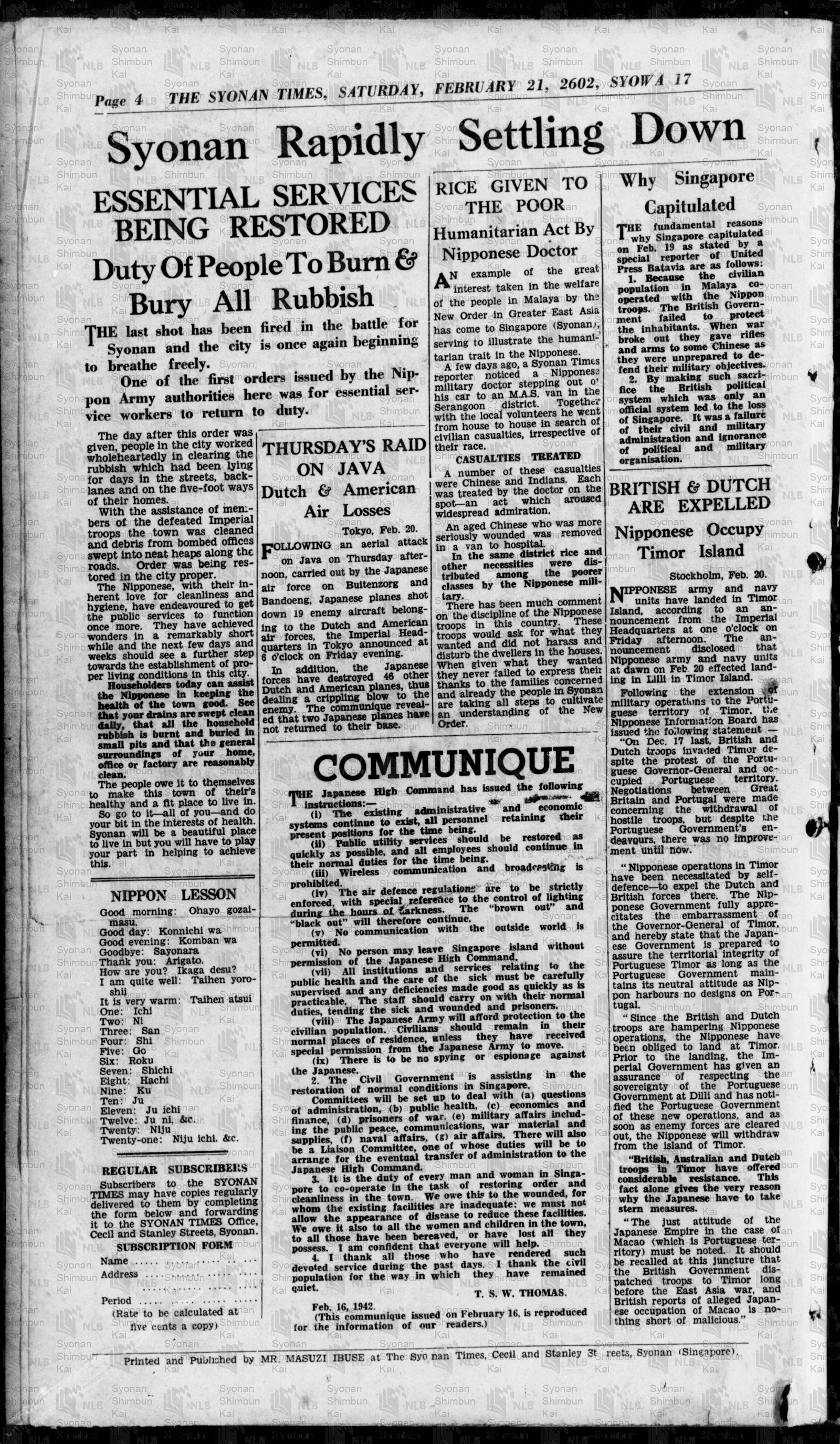 Page 4 of the Syonan Times, 21 February 1942. The first "Nippon Lesson" is the small box in the bottom left column, and the line at the foot of the page names Masuzi Ibuse as printer and publisher. (Singapore Press Holdings, via NewspaperSG, National Library Board Singapore, public domain)
Ibuse had been conscripted into the Japanese army’s propaganda unit in November 1941 and arrived in Singapore with it, and he was in charge of the English paper for about two months. He later became one of Japan’s best known writers, the author of Black Rain (1965), a novel about the bombing of Hiroshima.
Why Japanese
The policy behind the lessons was set out in Tokyo. In March 1942 the Japanese government laid down that education in the occupied south should spread Japanese as the lingua franca of the Greater East Asia Co-Prosperity Sphere, the bloc of territories Japan meant to lead. English was the language of the old colonial government, and the new rulers wanted it replaced. On 4 June 1942 the front page of the Syonan Times carried a banner across its full width, “Manabe Tukae Nippon-go”, Learn and Use Nippon-go. A poster of the period carried the same message in Malay, Hindustani and Chinese, showing a boy in a songkok reading from a book titled “Nippongo, Volume 1”.
In the schools
On 1 July 1942 the Syonan Times reported on the city’s schools under the Education Department of the Syonan Tokubetu-si, the municipality. There were 51 Futu Ka Gakko (common public schools), with 29 more to be added. The existing schools included 22 Malay schools with more than 4,000 pupils and 23 former English schools with 3,840, and the additions included 16 Chinese schools and eight Indian schools. Nippon-go was a compulsory subject, and “English has been discarded as a subject from all Syonan schools”, though it was still used to teach “only when Malay or Chinese fail to meet requirements”. The paper also noted that some parents were still keeping their children at home.
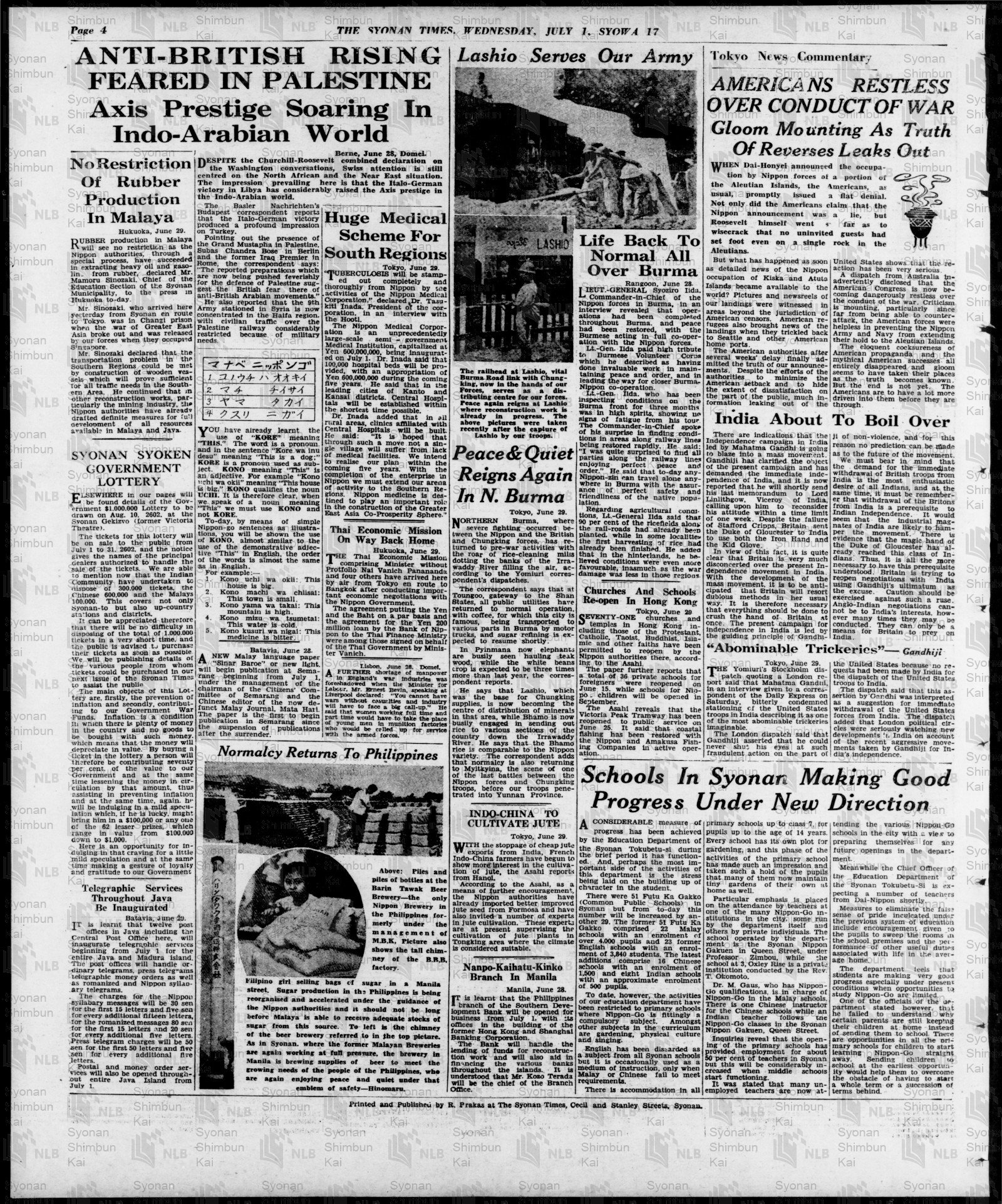 Page 4 of the Syonan Times, 1 July 1942. The report on the city's schools runs across the bottom right, and a short katakana lesson sits in the second column. (Singapore Press Holdings, via NewspaperSG, National Library Board Singapore, public domain)
Teachers had to learn the language too, and those who struggled with it or would not learn it were dismissed. In June 1942 the Syonan Broadcasting Station started daily Nippon-go courses for the schools, and the newspaper printed each day’s radio lesson so that listeners could follow it. The administration also required people to bow towards the Imperial Palace in Tokyo, sing the Japanese national anthem and observe Japan’s national holidays.
The school on Queen Street
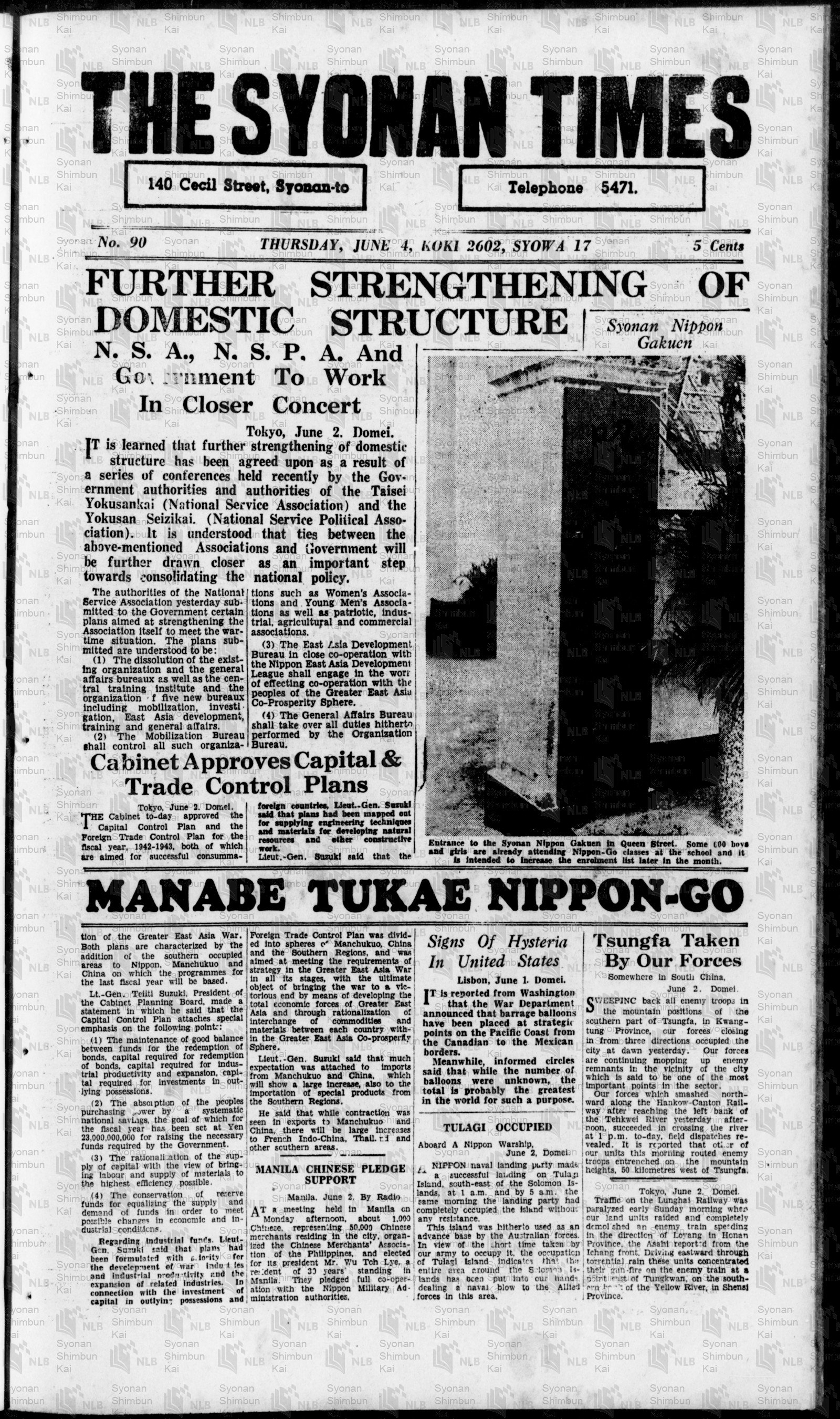 The front page of the Syonan Times, 4 June 1942, with the banner "Manabe Tukae Nippon-go" (Learn and Use Nippon-go) and a photograph of the entrance to the Syonan Nippon Gakuen in Queen Street. (Singapore Press Holdings, via NewspaperSG, National Library Board Singapore, public domain)
The main language school was the Syonan Nippon Gakuen, which took students of all ages and occupations. It opened on 1 May 1942 in Queen Street under the poet Jinbo Kotaro, another member of the army’s propaganda unit. By early June about 100 boys and girls were attending its classes. Its first graduation ceremony was held on 2 August 1942 at the Dai Toa Gekizyo, the former Cathay Theatre, and the paper reported that 135 students had scored more than 85 marks in the final examination. The courses were short and popular. When the school tested applicants for its one-month third term in October 1942, 234 were selected out of 734, and it opened a special class for older unemployed students. At the end of October the school was taken over by the military administration and renamed the Gunseikanbu Kokugo Gakko, and in 1944 the Nippon-go School in Queen Street was still taking in 300 students at a time for three-month courses.
Paid to speak it
The administration also paid people to learn. In September 1942 the municipality announced a bonus scheme for employees who studied Japanese, and in November 1943 the Syonan Sinbun reported a revised scheme of monthly Nippon-go allowances for local staff of the military administration and the provincial governments who had served for more than six months. The allowance was up to $50 a month for those whose Japanese was judged better than a higher-school graduate’s, up to $30 for those above a primary-school level, up to $10 for those who had passed the higher standard in the Nippon-go examination and up to $5 for those who had passed the intermediate one. The examinations themselves were graded. In February 1945 tests at primary, middle and higher level (Syokyu, Chukyu and Jyokyu) were held throughout Malaya under new rules, and a special grade, Tokkyu, was announced.
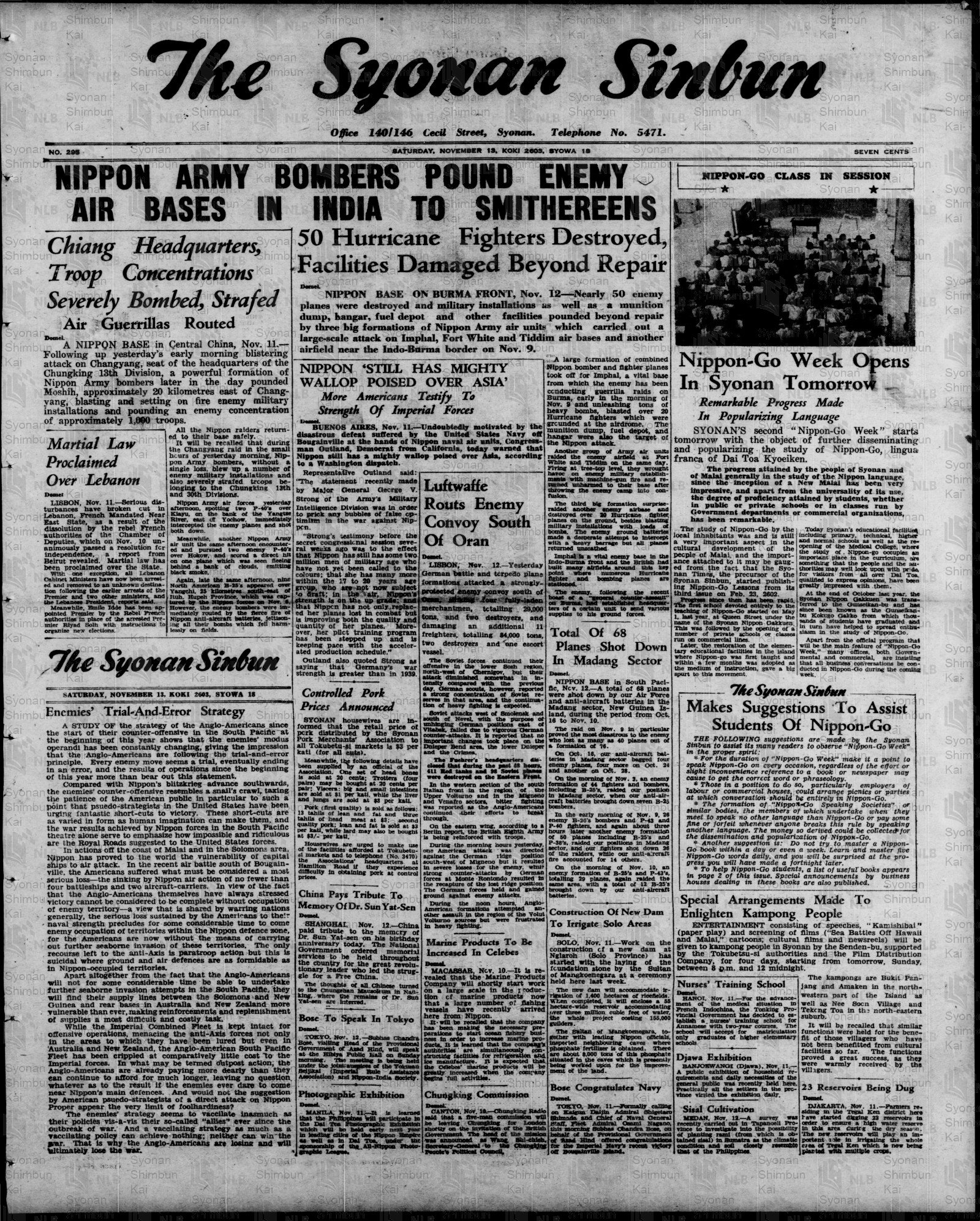 The front page of the Syonan Sinbun, 13 November 1943, with a photograph of a Nippon-go class and the paper's suggestions for Nippon-go Week in the right-hand column. (Singapore Press Holdings, via NewspaperSG, National Library Board Singapore, public domain)
There were campaigns as well. The first Nippon-go Popularizing Week ran for the first seven days of June 1942, and the second opened on 14 November 1943. For that week the paper asked its readers to “speak Nippon-Go on every occasion”, suggested that employers arrange picnics or parties “at which conversation should be entirely in Nippon-Go”, and proposed Nippon-go speaking societies whose members would pay a fine whenever they spoke another language. It also gave some practical advice: “Do not try to master a Nippon-Go book within a day or even a week. Learn and master five Nippon-Go words daily.” Small notices in the paper that month read “Make It A Rule To Speak Nippon-Go An Hour Every Day”.
How far it got
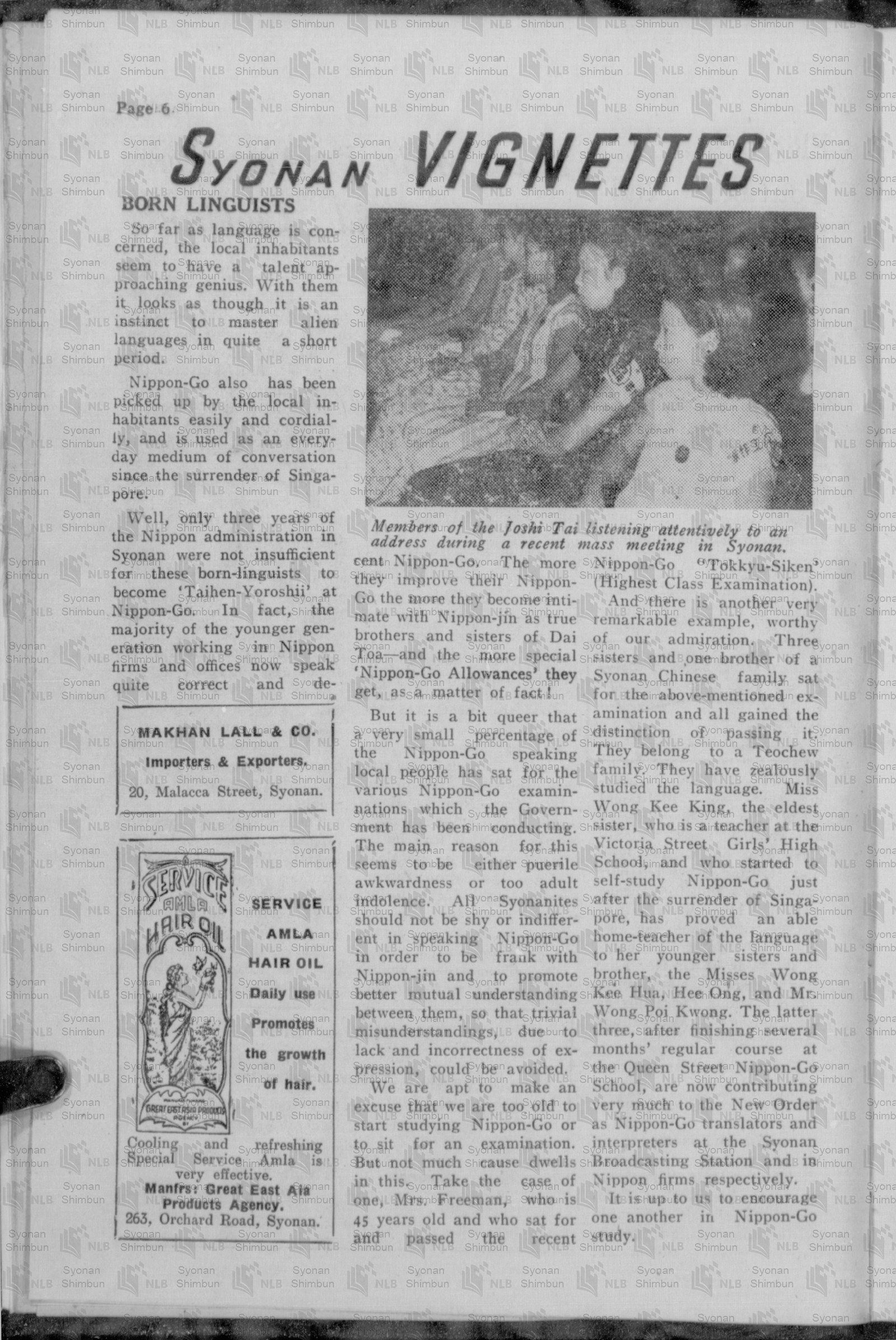 Page 6 of the Syonan Shimbun, 20 June 1945. The "Born Linguists" column runs down the left and continues in the centre and right columns. (Singapore Press Holdings, via NewspaperSG, National Library Board Singapore, public domain)
By the end, the Syonan Shimbun was claiming success. A column in June 1945 called the local people “born linguists” and said that most of the younger people working in Japanese firms and offices now spoke “quite correct and decent Nippon-Go”. The same column admitted that “a very small percentage of the Nippon-Go speaking local people has sat for the various Nippon-Go examinations”, and blamed “either puerile awkwardness or too adult indolence”. Three and a half years was a short time to change the language of a city, there were never enough teachers or textbooks, and most people went on using their own languages at home and in the market. The Syonan Shimbun printed its last issue on 4 September 1945, as British forces arrived, and the lessons stopped with it.
The grammar the lessons explained
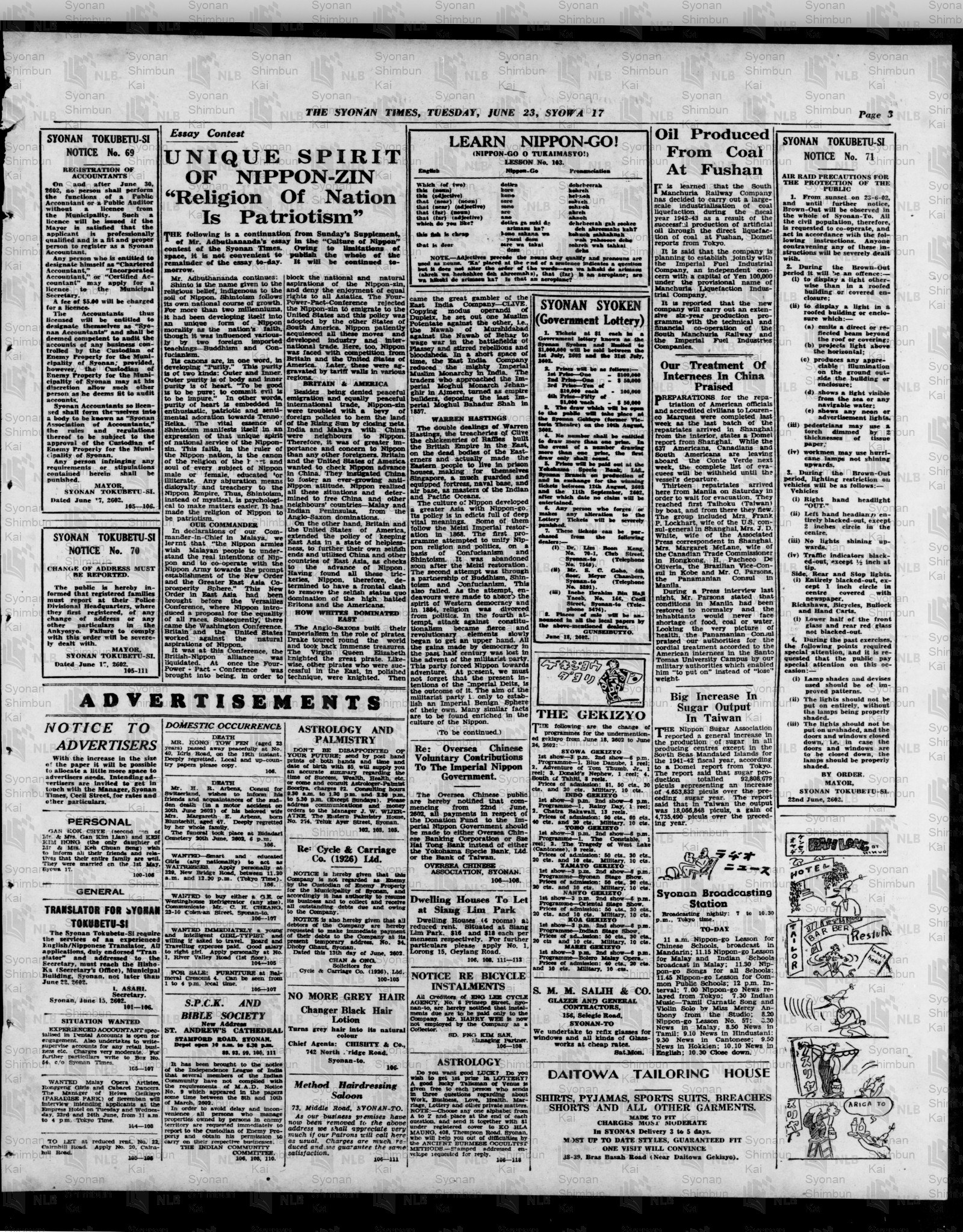 Page 3 of the Syonan Times, 23 June 1942. Lesson No. 103, at the top of the centre columns, ends with a note on word order and the question marker "ka". (Singapore Press Holdings, via NewspaperSG, National Library Board Singapore, public domain)
The newspaper lessons did more than list words. By Lesson 103, printed on 23 June 1942, they had reached grammar, with a note that adjectives come before the nouns they describe and that “ka” placed at the end of a sentence turns it into a question.
At the start of 1986, straight after graduating from NUS, I went to Japan for 18 months on a scholarship from AOTS, a Japanese organisation that trains engineers and managers from abroad, and we started with Nihongo lessons at the Yokohama Kenshu Center. I was not a good student, and it was years before I understood why. The teaching was intensive, but no one explained how differently the language is built. Japanese puts the verb at the end of a sentence (subject, object, verb), while English puts it in the middle (subject, verb, object), and I wasn’t sharp enough to work out that basic but critical difference for myself. I still picked up a smattering of spoken Japanese from daily life, but I count it as a wasted opportunity.
Learning Nippon-go in Syonan, 1942-45
How the Japanese-language drive unfolded, from the first lesson to the last newspaper
Sources: Syonan Times / Syonan Shimbun, 1942-45 (NewspaperSG); BiblioAsia (last issue, 4 Sep 1945).
View as table
| Date | Event |
|---|---|
| Feb 1942 | On 21 February 1942, six days after the surrender, the Syonan Times prints its first Nippon Lesson: greetings and the numbers one to twenty-one. |
| May 1942 | The Syonan Nippon Gakuen, a Japanese-language school under the poet Jinbo Kotaro, opens on 1 May 1942. |
| Jun 1942 | The first Nippon-go Popularizing Week runs from 1 to 7 June 1942, with help from the radio station and the Gakuen. |
| Jul 1942 | On 1 July 1942 the Syonan Times reports that Nippon-go is compulsory in the city's schools and English has been dropped as a subject. |
| Nov 1943 | On 11 November 1943 the paper reports higher monthly Nippon-go allowances for government staff, from $5 to $50 by grade; Syonan's second Nippon-go Week opens on 14 November. |
| Feb 1945 | Nippon-go examinations at primary, middle and higher grades are held throughout Malai in February 1945 under new rules. |
| Sep 1945 | The Syonan Shimbun prints its last issue on 4 September 1945, as British forces return. |
See 12 more photographs and newspaper pages related to this post →
Why it matters today: The Occupation tried to make Singapore speak Japanese by order, through compulsory lessons, examinations, allowances and slogans, and its own newspaper conceded at the end that only a small share of speakers had sat its tests. Japanese is still taught in Singapore today, but by choice: since 1978 the Ministry of Education Language Centre has offered it as a third language to secondary school students, and many people learn it for work, study or travel. The two show the difference between a language that people are made to learn and one they choose to learn for their own reasons.
Sources
- The Syonan Times, 21 February 1942, “Nippon Lesson”, page 4
- The Syonan Times, 26 February 1942, “Nippon Lessons Appreciated”, page 4
- The Syonan Times, 4 March 1942, “Nippon Lesson (No. 10)”, page 2
- The Syonan Times, 20 March 1942, “Nippon Lesson No. 24 (Nippon-Go)”, page 2
- The Syonan Times, 4 June 1942, “Syonan Nippon Gakuen”, page 1
- The Syonan Times, 8 June 1942, “Nippon-Go Radio Courses For Syonan Schools”, page 4
- The Syonan Times, 9 June 1942, “Nippon-Go Week A Great Success”, page 5
- The Syonan Times, 23 June 1942, “Learn Nippon-Go! Lesson No. 103”, page 3
- The Syonan Times, 1 July 1942, “Schools In Syonan Making Good Progress Under New Direction”, page 4
- The Syonan Times, 1 August 1942, “Nippon Gakuen Graduation Ceremony To-morrow”, page 4
- The Syonan Times, 24 September 1942, “Nippon-Go Bonus Scheme For Employees Of Tokubetu-si”, page 4
- The Syonan Times, 8 October 1942, “Popularity Of Syonan Nippon Gakuen Course Amply Demonstrated”, page 4
- The Syonan Sinbun, 11 November 1943, “Nippon-Go Allowances Increased”, page 1
- The Syonan Sinbun, 13 November 1943, “Nippon-Go Week Opens In Syonan Tomorrow”, page 1
- The Syonan Sinbun, 13 November 1943, “Makes Suggestions To Assist Students Of Nippon-Go”, page 1
- The Syonan Sinbun, 18 November 1943, “Make It A Rule To Speak Nippon-Go An Hour Every Day”, page 2
- The Syonan Shimbun, 2 February 1944, “Syonan Shimbun Nippon-Go Lessons: How To Write Katakana”, page 2
- The Syonan Shimbun, 28 February 1944, “300 Students To Be Admitted To New Nippon-Go Courses”, page 2
- The Syonan Shimbun, 12 May 1945, “Nippon-Go Examinations”, page 2
- Syonan Shimbun Fortnightly, 20 June 1945, “Syonan Vignettes”, page 6
- Lee Meiyu, “Propaganda Paper: The Syonan Shimbun”, BiblioAsia, vol. 11, issue 4 (2016)
- Takiguchi Akihiro, on Ibuse Masuji and the Syonan Times, Kokubungaku Kenkyu 164 (Waseda University, in Japanese)
- Jinbo Kotaro’s Nanpo Shishu and the Propaganda Division in Syonan, Gwagyeong Ilboneo Munhak Yeongu (2018)
- MOE Heritage Centre: The Japanese Occupation
- Pacific Atrocities Education: Education in Singapore During the Japanese Occupation
- Roots.sg (National Heritage Board): Certificate in Japanese language proficiency issued by Syonan-to’s Education Department
- Ministry of Education Language Centre: About MOELC
- AOTS: History
- Wikipedia: Masuji Ibuse
- Wikimedia Commons: Belajarlah Pakailah Bahasa Nippon.jpg
- Wikimedia Commons: Street in Shonan.JPG
- Wikimedia Commons: ‘Queen Street. Singapore., KITLV 1404750.tiff
- Wikimedia Commons: The Cathay Building in Singapore 1945.jpg
- Wikimedia Commons: Masuji Ibuse 01.jpg
- Wikimedia Commons: Jimbo Kotaro.jpg
- Wikimedia Commons: Downtown Singapore (Syonan), Djawa Baroe, Vol. 1, Iss. 4 (1943-02-15), p18.jpg


