P. Govindasamy Pillai: From Shop Boy to Serangoon Road Retail Pioneer
In 1905 a teenage runaway from a village in South India stepped ashore at Tanjong Pagar with 13 rupees and the clothes he was wearing. He found work in a provision shop on Serangoon Road, where he was paid in meals and a place to sleep rather than wages, and twenty-four years later he bought the shop. P. Govindasamy Pillai, popularly known as PGP, went on to build a chain of stores that reached Malacca and Johor, and he gave much of what he earned to temples, missions and hospitals. The stores that carried his initials closed in 1998, and his name is less familiar today than those of the Chinese business families of his generation.

The gopuram, or entrance tower, of the Sri Srinivasa Perumal Temple on Serangoon Road, built with $300,000 from P. Govindasamy Pillai and completed in 1979. (Diego Delso, CC BY-SA 4.0, via Wikimedia Commons)
The runaway
 An Indian man photographed in a Singapore studio around 1890, some fifteen years before Pillai arrived. (Unknown photographer, KITLV, Leiden University Libraries, public domain, via Wikimedia Commons)
Pillai was born in 1887 and grew up in Koorainadu, a village near the town of Mayavaram, now called Mayiladuthurai, in what was then the Tanjore district of the Madras Presidency. In his teens he ran away from home and boarded a ship for Singapore, landing at Tanjong Pagar in 1905. After many failed attempts to find a job, he was taken on at a provision store at 50 Serangoon Road. The work started before dawn and ended after midnight, and he was paid no wages, only his food and lodging. It was in this shop, according to the National Library’s account of his life, that he learned how to run a business.
He stayed for more than twenty years. In 1929 he went back to India and returned to Singapore with his wife, Pakiriammal, who was then 15. He came back to find himself without a job, because the owner of the provision store had died and the shop had been put up for sale.
Buying the shop
 A Chettiar moneylender in the Straits Settlements, photographed by G. R. Lambert & Co. around 1890. (Lambert & Co., G.R., KITLV, Leiden University Libraries, public domain, via Wikimedia Commons)
Pillai decided to buy it. He borrowed $2,000 from the Chettiars, the South Indian moneylenders who lent to traders across the Straits Settlements, and took over the shop he had worked in since his arrival. He started by selling spices, oils and grains, then widened the range to everything from canned goods to shoes, and opened more shops in the area. Customers came to know the business by his name.
Pillai was known for his frugality, and he put his savings back into the business. He opened textile shops and flour and spice mills, and his saree shops became the best known part of the trade. His staff worked from 7 a.m. to about 9 p.m., with a two-hour break at lunch, and he gave them lodging in his own home.
By the late 1930s he was one of the leading figures in Singapore’s South Indian community. He had helped found the Ramakrishna Mission in Singapore in 1928, and he was a founder-member of the Indian Chamber of Commerce, set up in 1937. In 1939 he was appointed a Justice of the Peace. According to the Singapore Memory Project, the appointment recognised his work in rallying the South Indian community behind the war effort after war broke out in Europe.
Losing everything, and starting again
When Japan invaded Malaya in December 1941, Pillai and his family were in India, and they spent the rest of the war there. They were spared the Japanese Occupation of Singapore, but he lost his property and goods. He returned in 1945 and started the business again from the beginning.
This time it grew larger than before. He expanded across the Causeway, opening stores in Malacca and Johor. The Malacca shops were at first called Dhanalakshmi Stores, after his eldest daughter, and later renamed P. Govindasamy Pillai Stores, or PGP Stores. He also invested in property on Serangoon Road, Race Course Road and Buffalo Road, and built houses in Campbell Lane and later in Race Course Road.
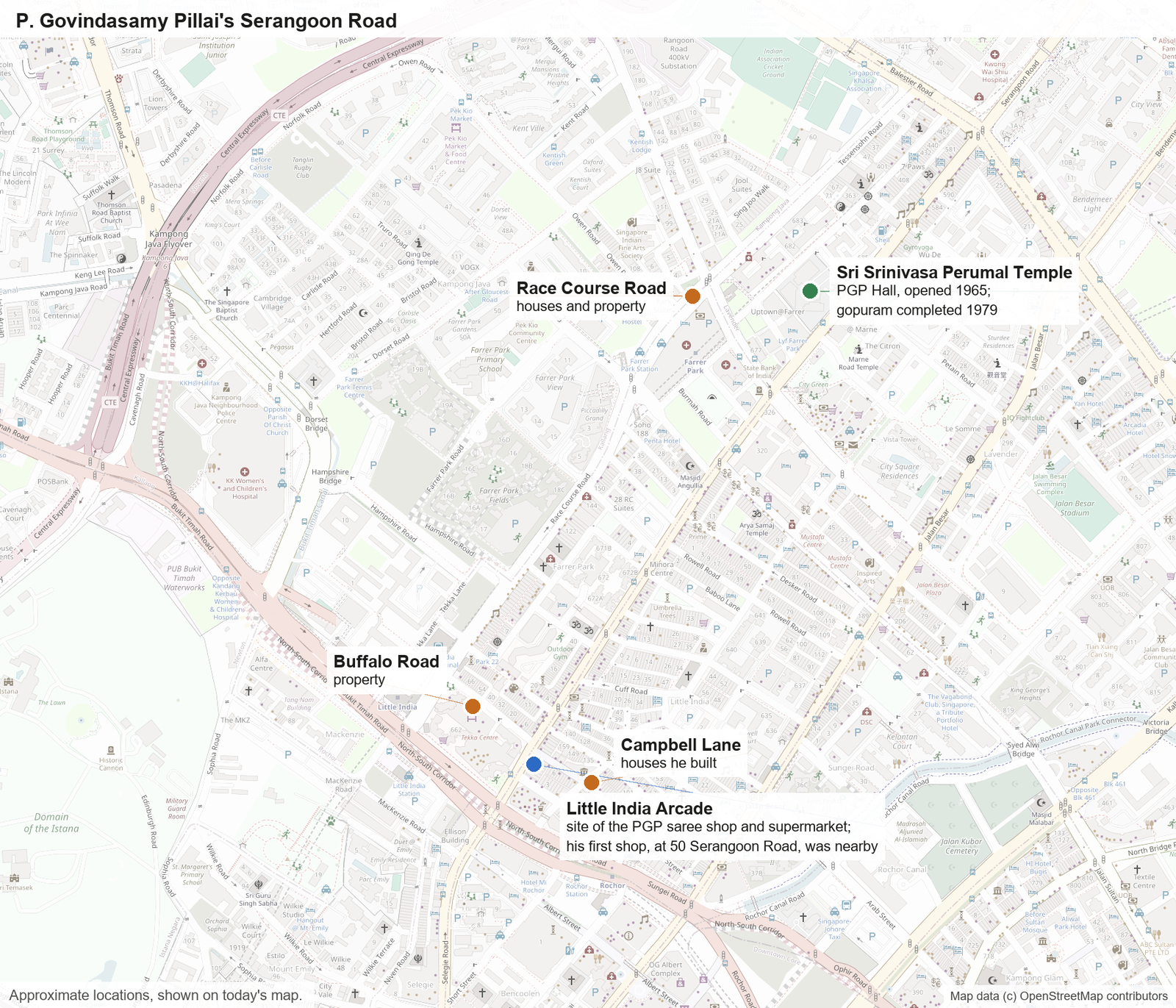
The places in Pillai’s story, at approximate locations on today’s map. (Map data © OpenStreetMap contributors)
The money he gave away
Pillai was a devout Hindu, and he gave away a great deal of what he made. In 1952 the Ramakrishna Mission moved into a new home at Bartley Road, built with his donation. He went to the opening of its new temple himself, and handed out drinks, cakes and sweets to the children there. He also gave to the University of Malaya and to Mount Alvernia Hospital, and he sat on a Singapore Indian Association committee raising funds for a home for people who could no longer work because of sickness or old age.

The prayer hall of the Ramakrishna Mission at Bartley Road, photographed in 2003. The mission’s home there was built with Pillai’s donation in 1952. (Ishouldbeworking, CC BY-SA 4.0, via Wikimedia Commons)
His largest gifts went to the Sri Srinivasa Perumal Temple on Serangoon Road. In the early 1960s he paid for much of its redevelopment, including a wedding hall, one of the first Indian wedding halls in Singapore. Named PGP Hall, it was opened on 19 June 1965 by Yusof bin Ishak, then the Yang di-Pertuan Negara, and the first wedding held there was that of his son Ramakrishnan. The temple’s present five-tier gopuram, completed in 1979, was built with $300,000 from Pillai, according to the National Heritage Board. The temple was gazetted as a national monument in 1978.
The stores after him
Pillai retired in 1963 and handed the family business, then valued at S$3 million, to his children, and his sons expanded the saree trade. He died of a heart attack on 21 July 1980, at the age of 93.
After the death of his youngest son, Pillai’s daughter-in-law managed the PGP stores, including the saree shop and supermarket that stood on the site now occupied by Little India Arcade. The stores ran into heavy debts and closed in 1998.
From shop boy to retail pioneer
P. Govindasamy Pillai's life, his business, and the stores that carried his name
Sources: NLB Infopedia; Roots.gov.sg (National Heritage Board); Singapore Memory Project.
View as table
| Year | Event |
|---|---|
| 1905 | Arrives as a teenage runaway and finds work for food and board at a provision store at 50 Serangoon Road. |
| 1929 | The owner dies and the shop is put up for sale; he buys it with $2,000 borrowed from Chettiar moneylenders. |
| 1937 | A founder-member of the Indian Chamber of Commerce, set up this year. |
| 1939 | Appointed a Justice of the Peace. |
| 1945 | Back from India after the Japanese Occupation, in which he lost his property and goods, he rebuilds the business. |
| 1952 | A new home for the Ramakrishna Mission is built at Bartley Road with his donation. |
| 1963 | He retires and hands the family business, valued at S$3 million, to his children. |
| 1965 | The wedding hall he funded at the Sri Srinivasa Perumal Temple is opened on 19 June 1965. |
| 1979 | The temple's five-tier gopuram, which he funded at a cost of $300,000, is completed. |
| 1980 | He dies of a heart attack on 21 July 1980. |
| 1998 | Run by his daughter-in-law after his youngest son's death, the stores run into heavy debts and close. |
| 2001 | Singapore Post issues stamps featuring him on 28 February 2001. |
| 2019 | He is one of the eight pioneers on the back of the Bicentennial commemorative $20 note. |

Little India Arcade on Serangoon Road in 2023. The PGP saree shop and supermarket stood on this site. (Bahnfrend, CC BY-SA 4.0, via Wikimedia Commons)
His name has lasted longer than his stores. PGP Hall still stands in the grounds of the Perumal temple. Singapore Post issued stamps featuring him on 28 February 2001, and in 2019 he was one of the eight pioneers pictured on the back of the $20 note issued to mark Singapore’s bicentennial, alongside Tan Kah Kee and Munshi Abdullah.
See 15 more historical photos related to this post →
Why it matters today: Singapore’s best-remembered business pioneers are mostly Chinese towkays, but Serangoon Road had its own. A shop hand who worked for his meals built one of the best-known Indian businesses of his time, and the mission home, wedding hall and temple tower he paid for still stand on the streets where he worked.
Sources
- Sitragandi Arunasalam, “P. Govindasamy Pillai”, Singapore Infopedia, National Library Board
- Ng Jian Cheng, “From runaway to philanthropist, P. Govindasamy Pillai (born 1887 - died 1980)”, Singapore Memory Project, National Library Board
- “Govindasamy Pillai”, Roots.gov.sg, National Heritage Board
- “Sri Srinivasa Perumal Temple”, Roots.gov.sg, National Heritage Board
- “Sri Srinivasa Perumal temple” (gopuram, 1977 to 1979), Roots.gov.sg collection, National Heritage Board
- “Little India Arcade”, Roots.gov.sg, National Heritage Board
- “2019 20SGD Bicentennial Commemorative Notes Featuring P Govindasamy Pillai”, Roots.gov.sg collection, National Heritage Board
- “Singapore Bicentennial 2019 – A Note to Remember”, Remember Singapore
- “P. Govindasamy Pillai”, Wikipedia
- “Sri Srinivasa Perumal Temple”, Wikipedia
- Map data © OpenStreetMap contributors
- File:Templo Sri Srinivasa Perumal, Singapur, 2023-08-17, DD 04.jpg, Wikimedia Commons
- File:KITLV - 103785 - Indian man, Singapore - circa 1890.tif, Wikimedia Commons
- File:KITLV - 6539 - Lambert & Co., G.R. - Singapore - Chetti or Coromandel lender in the Straits Settlements - circa 1890.tif, Wikimedia Commons
- File:RamakrishnaSg.jpg, Wikimedia Commons
- File:Little India Arcade, 2023 (01).jpg, Wikimedia Commons
- File:Tanjong Pagar in Singapore gezien vanuit het westen Panoramic view of Tanjong Pagar from the west (titel op object), RP-F-F01140-AE.jpg, Wikimedia Commons (gallery)
- File:Drie schepen van de Glen Line aan de kade van de Tanjong Pagar Dock Co. Ltd. in Singapore Three glen steamers alongside the wharf (titel op object), RP-F-F01140-O.jpg, Wikimedia Commons (gallery)
- File:KITLV - 1404957 - Greetings from Singapore - 1895-1908.tif, Wikimedia Commons (gallery)
- File:KITLV - 50187 - Lambert & Co., G.R. - Singapore - Klingalese family at Singapore - circa 1900.tif, Wikimedia Commons (gallery)
- File:KITLV - 103787 - Two Indian men at Singapore - circa 1890.tif, Wikimedia Commons (gallery)
- File:Electric Tram Singapore about 1910.png, Wikimedia Commons (gallery)
- File:Indiase tempel te Singapore, KITLV 25595.tiff, Wikimedia Commons (gallery)
- File:KITLV - 79921 - Kleingrothe, C.J. - Medan - Klingalese temple in Singapore - circa 1910.tif, Wikimedia Commons (gallery)
- File:Negapatnam van Choromandel.jpg, Wikimedia Commons (gallery)
- File:Mayuranathar8.jpg, Wikimedia Commons (gallery)
- File:Silk saree on the making at Kanchipuram (7642281054).jpg, Wikimedia Commons (gallery)
- File:Street in Shonan.JPG, Wikimedia Commons (gallery)
- File:KITLV A1363 - Weg van Djohor Bahru naar Singapore, KITLV 78456.tiff, Wikimedia Commons (gallery)
- File:KITLV - 79915 - Kleingrothe, C.J. - Medan - Mosque at Johor - circa 1910.tif, Wikimedia Commons (gallery)
- File:KITLV - 101100 - Kleingrothe, C.J. - Medan - Dutch Reformed Church (left) and the Stadt Huys (center behind the tree) at Malacca (Melaka) in Malaysia - circa 1905.tif, Wikimedia Commons (gallery)


