Munshi Abdullah: The Malay Scribe Who Watched Singapore Begin
One evening in March 1823, a young Malay teacher on his way to give a language lesson met William Farquhar, the British Resident of Singapore, coming the other way with his son, his son-in-law and four armed sepoys. When Farquhar heard where he was going, he told him to turn back and come along, because a man had run amok near a merchant’s house. Within the hour the teacher was holding Farquhar up as he collapsed, his coat soaked in blood. The teacher was Abdullah bin Abdul Kadir, known as Munshi Abdullah, and twenty years later he wrote the whole night down in the Hikayat Abdullah, one of the few first-hand accounts of Singapore’s founding years written in Malay.

Singapore from the sea, sketched by Lieutenant Philip Jackson on 5 June 1823, a few months after the attack on Farquhar. It is the earliest known drawing of the settlement. (Philip Jackson, public domain, via Wikimedia Commons)
The night Farquhar was stabbed
 William Farquhar, Singapore's first Resident, in a portrait from around 1830. (Unknown artist, public domain, via Wikimedia Commons)
The trouble began with a debt. Abdullah tells it this way. A trader from Pahang named Syed Yassin owed about 1,400 dollars, most of it to Pangeran Sharif Omar, a merchant from Palembang. Farquhar heard the case, and when Syed Yassin said he could not pay until the next year and could find no one to guarantee the debt, he was sent to jail. Nobody searched him, and he had a kris hidden under his coat.
That evening he asked to be allowed to see the Pangeran, to plead for more time, and he was let out with an Indian peon, a police constable, as his escort. When the Pangeran saw him coming, he ran out of the back of his house and went to Farquhar for help. Syed Yassin stabbed the peon dead at the gate and hid in the dark garden, under a raised summer-house.
Farquhar searched the grounds three times and found no one. As the party walked back across the lawn, he pushed his walking stick under the summer-house. Syed Yassin lunged out and stabbed him in the chest, just above the nipple. Farquhar cried out, and Abdullah caught him as he fell. Farquhar’s son Andrew slashed the attacker across the face with his sword, and the sepoys killed him with their bayonets.
The wound turned out to be shallow. The doctor probed it with a silver needle and told Farquhar’s weeping daughters that he would soon be well. Outside, though, the settlement was in uproar. Hundreds of sepoys, some only half dressed, dragged up twelve cannon and aimed them at the compound of the Temenggong, the Malay chief, because at first the British suspected his followers.
Stamford Raffles, who was then in Singapore, arrived in his carriage and asked who the dead man was. Nobody could tell, because the body had been hacked beyond recognition. When it came out that the officer who had taken Syed Yassin to jail had let him out under escort, Raffles shook his fist in the man’s face, knocking off his hat. In the 1874 English translation of the Hikayat, Raffles tells him, “if Farquhar dies, I shall hang you in Singapore.”
The next morning, Raffles asked Sultan Hussein and the Temenggong what Malay custom laid down for a man who drew the blood of his ruler. They told him that the man, his wives and his children would all be put to death and his house torn down and thrown into the sea. Raffles refused to punish the family, who had done nothing. Instead, the body was drawn around the town in a buffalo cart to the beat of a gong, and then hung in an iron cage on a mast at Tanjong Malang, near Telok Ayer, for ten or fifteen days, until only the bones were left. Only then was it handed to the Sultan to be buried.
Who he was
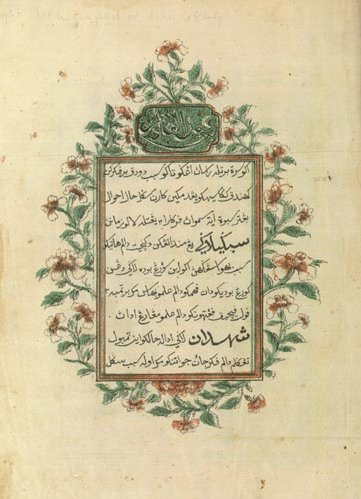 A page from a first edition of the Hikayat Abdullah, printed in Singapore in 1849, now in the National Library of Singapore. (Abdullah bin Abdul Kadir, public domain, via Wikimedia Commons)
Abdullah was born in 1797 in Kampong Pali, Malacca, the only one of five sons to survive infancy. His father, Sheikh Abdul Kadir, was a devout Muslim of Arab and Indian descent who ran a petition-writing business, and he drilled his son hard: the boy copied the whole Koran in Arabic and translated it into Malay. While still a boy, Abdullah taught religion to Muslim soldiers of the Indian garrison at Malacca, and they gave him the name that stuck for the rest of his life. “Munshi” means teacher.
In December 1810, Raffles arrived in Malacca to prepare the British invasion of Java and hired Abdullah, then about 13, as the youngest of his copyists of Malay manuscripts. When Raffles left for Java the next year, he wanted to take Abdullah with him, but Abdullah’s mother would not let her only child go. From 1815 he taught Malay to Protestant missionaries in Malacca, and some time after June 1819 he left for the new settlement at Singapore with one of them, the German missionary Claudius Thomsen. There he taught Malay and worked for a time as Raffles’s secretary and interpreter.
Rats as big as cats

The Plan of the Town of Singapore drawn up under Lieutenant Philip Jackson in 1822, laying out the streets of the town Abdullah lived in. (Unknown author, public domain, via Wikimedia Commons)
Abdullah’s Singapore was a small town cut out of forest, and some of his liveliest pages are about the animals. Rats were everywhere, some almost the size of cats. One night he woke to his cat screaming and lit a torch to find six or seven rats holding it down by the ears, the legs and the jaw. It took neighbours with sticks to beat them off.
Farquhar’s answer, as Abdullah tells it, was a bounty. He paid a small sum for every dead rat brought to his house, and at first people came with almost a thousand a morning, some carrying fifty or sixty each. When the rats kept coming, he cut the reward to five duit, a small copper coin, had a deep trench dug to bury the bodies, and in time only ten or twenty a day were being handed in, until the infestation was over. He did the same for the centipedes that were biting people in their houses, and Abdullah says it worked just as well. On another occasion, a crocodile in the Rochor River took Farquhar’s dog, and when the animal was cornered and speared, its body was hung from a tree beside the Bras Basah river for everyone to see.
Raffles as he saw him
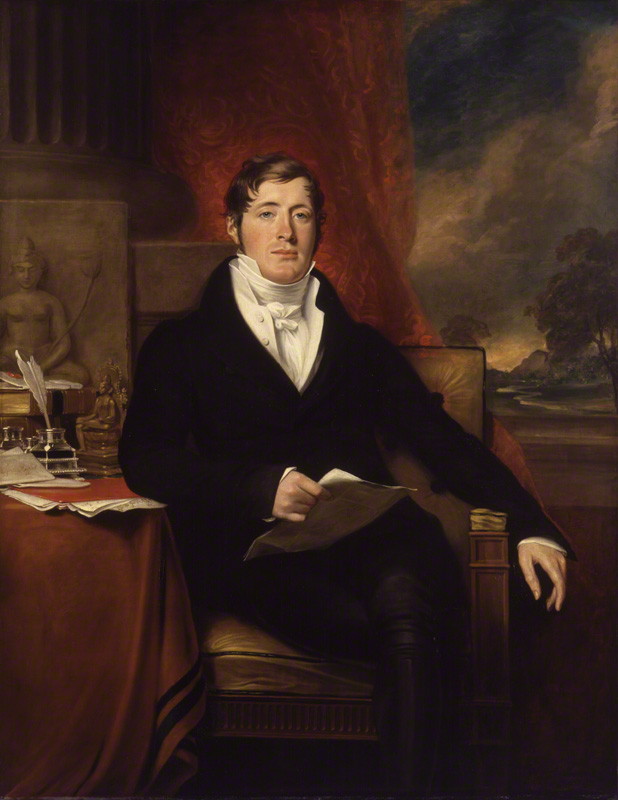 Stamford Raffles, painted by George Francis Joseph in 1817, between his years in Java and the founding of Singapore. (George Francis Joseph, public domain, via Wikimedia Commons)
Abdullah knew Raffles well, and his description of him is more personal than most official portraits. He saw a man of middle height with a broad forehead, fair hair, thick eyebrows and a slight squint in his left eye, who walked with a stoop. Raffles was courteous to everyone, he wrote, and “spoke in smiles”, but he kept to a strict timetable and would see no one until he had finished whatever he was reading or writing.
In the evenings Raffles would lie back with his eyes closed, so still that Abdullah often thought he was asleep, then spring up, write for a while and lie down again, until midnight or one in the morning. The next day he would read over what he had written, pacing up and down, and keep perhaps three or four sheets out of ten. He paid four men to collect plants, insects, shells and animals, kept a barrel of arrack to preserve snakes and scorpions, and bought Malay books by the hundred. Abdullah noted that so many manuscripts were sold to him that Malacca’s store of old histories was nearly used up.
The stone at the river mouth

The Singapore Stone at the National Museum of Singapore, the largest surviving fragment of the inscribed slab that Abdullah saw at the river mouth. (Jon Callas from San Jose, California, USA, CC BY 2.0, via Wikimedia Commons)
When the British cleared the point at the mouth of the Singapore River, workers came across a large slab of sandstone covered in carved letters worn down by centuries of tides. Abdullah describes crowds of every community coming to look at it. The Hindus said the writing was Hindu and the Chinese said it was Chinese, but no one could read it. When Raffles took Abdullah and Thomsen to see it, Abdullah thought the letters looked Arabic. People pressed paste into the grooves to take moulds and smeared the stone with ink to make the letters stand out, and in the end Raffles concluded that the script was Hindu in origin.
The stone stayed where it was for more than twenty years. Around January 1843, it was blown up on the orders of the acting settlement engineer, to widen the river mouth and make room for Fort Fullerton. A few fragments were rescued and sent to Calcutta, one of them was returned to Singapore in 1919, and that piece is now in the National Museum of Singapore. Its script, possibly Old Javanese, has still not been fully deciphered.
The slave boats
 A Bugis trading prau, drawn by William Westall in 1803. Abdullah saw slaves brought to Singapore on boats like this in the Bugis trading season. (William Westall, public domain, via Wikimedia Commons)
Abdullah’s book also records something the settlement’s official records said little about. During one Bugis trading season he saw fifty or sixty slaves, men, women and children, driven through the town “like sheep”, and was told that a boat that had arrived the night before carried two or three hundred more. Out of curiosity he asked the price and was quoted thirty or forty dollars a person.
The next day he rowed out to the boat. He found it packed with people, among them pregnant women and young girls, and men tied by the waist to the side of the boat. He watched children cry as their mothers were sold to different buyers, and he wrote that he was ashamed to describe some of what he saw. When he told Raffles, Raffles said that the trade would not last much longer, because Britain was turning against it, and added, “If I live, I hope to see every slave a free man.” The regulations Raffles drew up for Singapore before he left in 1823 banned slavery in the settlement.
Saying goodbye
Raffles left Singapore in June 1823, after falling out with Farquhar, whom he had dismissed as Resident that May. Abdullah wrote that when he heard Raffles was going, he felt as if he had lost his father and mother. Raffles wiped his own eyes, told him he hoped to come back, and gave him a written testimonial so that other Europeans would trust him. On board the ship, Lady Raffles gave him twenty-five dollars for his children in Malacca. As his small boat pulled away, Abdullah turned and saw Raffles at the cabin window, and Raffles raised his hand to him as the sails went up. Raffles never returned, and he died in England three years later.
Farquhar followed at the end of the year. Years later, Abdullah lost the testimonial in a great fire near his house in the merchants’ quarter, which broke out while he lay ill with fever, along with his books, his letters and 150 dollars in cash.
The scribe who watched Singapore begin
Munshi Abdullah's life, from Malacca to the Hikayat Abdullah
Sources: NLB Infopedia; Hikayat Abdullah (1849), J. T. Thomson's translation (1874).
View as table
| Year | Event |
|---|---|
| 1797 | Born in Kampong Pali, Malacca, the only surviving child of Sheikh Abdul Kadir. |
| 1810 | Raffles arrives in Malacca in December and hires him as a copyist of Malay manuscripts. |
| 1815 | The missionary William Milne makes him his Malay teacher; other missionaries follow. |
| 1819 | Some time after June he leaves Malacca for the new settlement, where Raffles later makes him his secretary and interpreter. |
| 1822 | Back in Singapore, Raffles takes him to see the inscribed stone found at the river mouth. |
| 1823 | He is beside Farquhar when Syed Yassin stabs him in March; in June he says goodbye to Raffles on his ship. |
| 1840 | Encouraged by the American missionary Alfred North, he begins writing his life story. |
| 1843 | The Singapore Stone is blasted to clear the river mouth; only fragments survive. |
| 1843 | He completes the first draft of the Hikayat Abdullah in May. |
| 1849 | The Hikayat Abdullah is printed in Singapore, in Jawi script. |
| 1854 | He dies in October, on his way to Mecca on the pilgrimage. |
How far to trust him
Abdullah is a valuable witness, but he was writing between 1840 and 1843, twenty years after most of these events, and he was not present for all of them. His account of the first British landing in 1819 was put together from what others told him, and NLB’s Infopedia notes that it fails to mention that Raffles was there at all. He also blamed the destruction of the Singapore Stone on George Coleman, the government architect, although Coleman was on leave when it was blown up.
He was openly fond of Raffles, and he was sharply critical of the Malay rulers of his day. Later readers have weighed both against his closeness to the British, who employed him for most of his life. The English version matters too. The quotations here come from the 1874 translation by J. T. Thomson, the surveyor who had been Abdullah’s pupil, which Infopedia describes as containing notable inaccuracies. The details here have been checked against NLB’s summaries of the later translation by A. H. Hill. Where his account can be checked against other sources, as with the attack on Farquhar, the main facts agree.
After the founding years
Once Raffles and Farquhar had gone, Abdullah earned his living as a petition-writer, interpreter and teacher. He taught Malay to merchants such as Edward Boustead and, in the late 1830s, taught at the Singapore Institution’s free school. There he met the American missionary Alfred North, who encouraged him to write his life story, and Benjamin Keasberry, with whom he printed a large number of books. He began the Hikayat Abdullah in 1840, finished the first draft in May 1843, and saw it printed in Jawi script in 1849. He also wrote an account of a voyage to Kelantan and other northern Malay states in 1837 or 1838.
In 1854 he set out on the pilgrimage to Mecca, keeping a diary as he went. He died in October that year in Jeddah, according to Infopedia, though some accounts say Mecca. The diary was published after his death.

Statues put up beside the Raffles statue at the Raffles’ Landing Site for the 2019 bicentennial, photographed in January 2019. Munshi Abdullah is second from the left, next to Sang Nila Utama. (Altopian1, CC BY-SA 4.0, via Wikimedia Commons)
He is often called the father of modern Malay literature, because he broke with the old court style of legends and kings and wrote in plain, everyday Malay about things he had seen for himself. Until the 1970s the Hikayat was a textbook in Malay schools in Singapore. Munshi Abdullah Avenue in Singapore is named after him, and in 2019 he was one of the pioneers whose statues stood beside Raffles’s at the river for the bicentennial, and one of the eight figures on the back of the commemorative $20 note.
See 12 more historical photos related to this post →
Why it matters today: Most of what is known about Singapore’s first years comes from the letters and reports of British officials. Abdullah’s book is a rare view of the same events from a local resident, who knew the officials but saw the town from the street. It is not a neutral record, and it should be read with the same care as Raffles’s own letters. But without it, much of everyday life in early Singapore, from the rat bounty to the slave boats, would be far less well known.
Sources
- Vernon Cornelius-Takahama, “Munshi Abdullah”, Singapore Infopedia, National Library Board
- Abdullah bin Abdul Kadir, Translations from the Hakayit Abdulla (bin Abdulkadar), Munshi, translated by J. T. Thomson (London: Henry S. King, 1874), via the Internet Archive
- Mazelan Anuar, “Excerpts from Hikayat Abdullah”, BiblioAsia, National Library Board
- Mazelan Anuar, “Excerpts from Hikayat Abdullah” (part 2), BiblioAsia, National Library Board
- “Stories of Abdullah”, BiblioAsia, National Library Board
- “Singapore Stone”, Wikipedia
- “William Farquhar”, Wikipedia
- “What Killed Sir Stamford Raffles?”, Singapore Medical Association News, August 2019
- “Singapore Bicentennial 2019 – A Note to Remember”, Remember Singapore
- File:Singapore from the Sea June 1823 - Lt. Phillip Jackson.jpg, Wikimedia Commons
- File:Portrait of William Farquhar (c. 1830).jpg, Wikimedia Commons
- File:AbdullahbinAbdulKadir-HikayatAbdullah-1849.jpg, Wikimedia Commons
- File:Plan of the Town of Singapore (1822) by Lieutenant Philip Jackson.jpg, Wikimedia Commons
- File:George Francis Joseph - Sir Thomas Stamford Bingley Raffles.jpg, Wikimedia Commons
- File:SingaporeStone-NationalMuseumofSingapore-20090712.jpg, Wikimedia Commons
- File:Bugis-Makassan prauw William Westall 1803.jpg, Wikimedia Commons
- File:Statues of Singaporean Pioneers at the Raffles’ Landing Site - three-quarter front view.jpg, Wikimedia Commons
- File:SingaporeStone-drawings.jpg, Wikimedia Commons
- File:1837-SingaporeStone-WBlanddrawing.jpg, Wikimedia Commons
- File:Singapore Stone - 20121019.jpg, Wikimedia Commons
- File:Part of Singapore Island (British Library India Office Records, 1825, detail).jpg, Wikimedia Commons
- File:View of Singapore 1830 Sophia Raffles’ memoir of Stamford Raffles.jpg, Wikimedia Commons
- File:AbdullahbinAbdulKadir-HikayatAbdullah-1843.jpg, Wikimedia Commons
- File:Signature of Munshi Abdullah.jpg, Wikimedia Commons
- File:James Lonsdale (1777-1839) - Sir Thomas Stamford Raffles (1781–1826) - ART10000042 - Zoological Society of London.jpg, Wikimedia Commons
- File:Schilderij van kolonel William Farquhar, de eerste Britse resident van Singapore tussen 1819 en 1823, KITLV 16311.tiff, Wikimedia Commons
- File:The Seal of the Sultan Hussein Shah of Johor and Singapore.jpg, Wikimedia Commons
- File:Initial pages of the Taj al-Salatin, ‘The Crown of Kings’, a Malay ‘mirror for princes’.jpg, Wikimedia Commons
- File:Malakka Stadhuis.jpg, Wikimedia Commons


