Change Alley: Singapore's Lane of Money-Changers and Bargains
For about a century, the quickest way from the sea to the heart of Singapore’s business district was a narrow lane about a hundred metres long. Change Alley ran from Collyer Quay, where sailors and passengers came ashore at Clifford Pier, to Raffles Place, the square of banks and trading houses. It was named, by most accounts, for the money-changers who did business along it, and over the years it also became one of the busiest bazaars in the city, where tourists, sailors and the clerks and office workers from the surrounding buildings haggled over watches, pens, shirts and cloth. The open-air alley closed on 30 April 1989, and an air-conditioned arcade now stands on the site.

The entrance to Change Alley in January 1965, with its street sign, the City Book Store and the awnings of the stalls. (Don Christie, CC BY-SA 4.0, via Wikimedia Commons)
A lane between the square and the sea
The lane got its official name on 11 November 1890, when Singapore’s municipal commissioners chose “Change Alley” over “Change Lane”. There are two explanations for the name. One links it to Exchange Alley in London, also known as Change Alley, a historic centre of trading in the City. The other, and the one most often repeated in Singapore, links it to the money-changers who worked there.
Whatever its origin, the alley was a short cut. At the Collyer Quay end stood Winchester House, a four-storey building dating from 1905, and the lane ran from there between the commercial buildings to Raffles Place. For anyone landing at the waterfront, it was the most direct way into the business district.
The money-changers
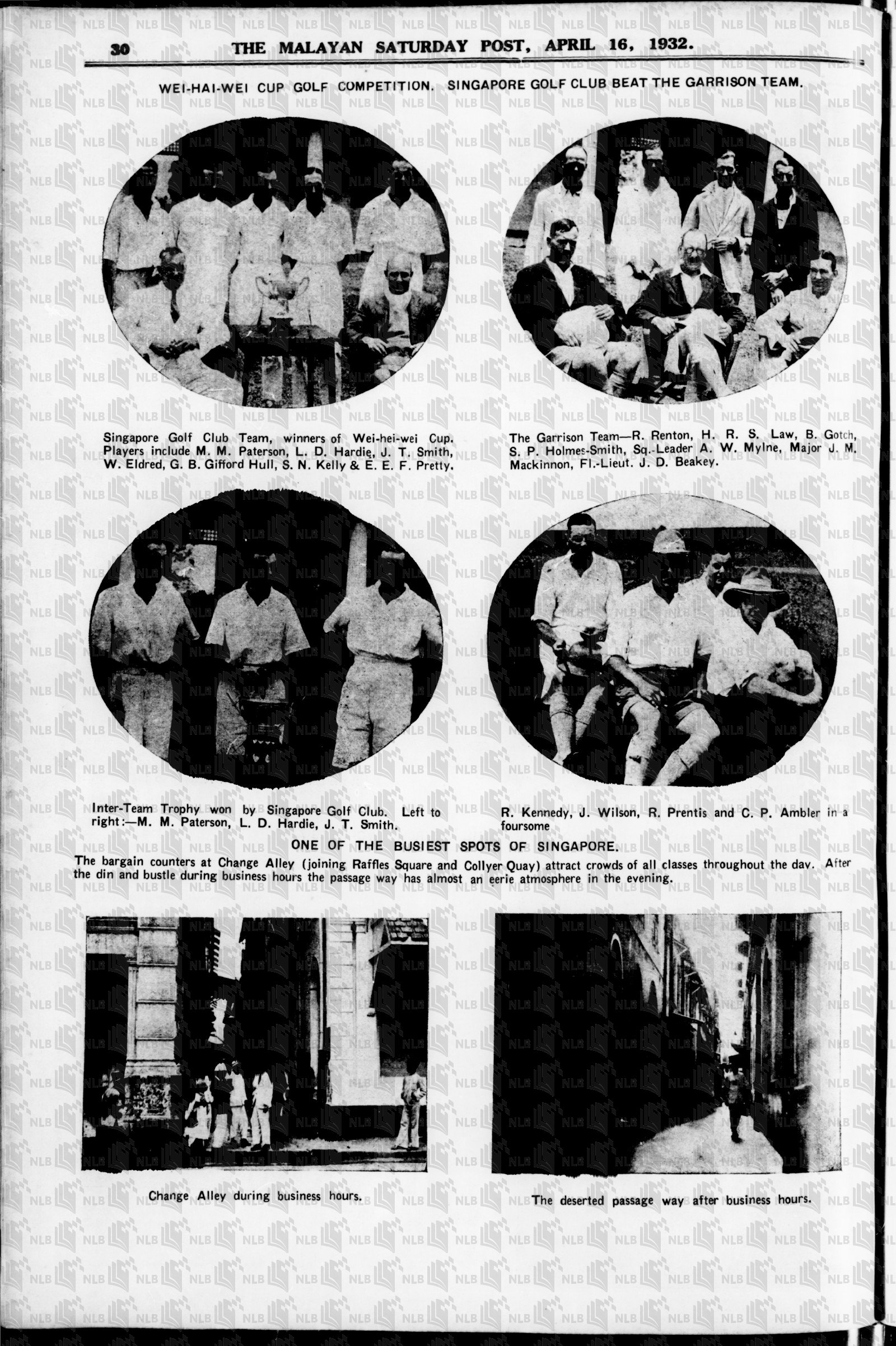 Page 30 of The Malayan Saturday Post, 16 April 1932. The two photographs at the bottom show Change Alley "during business hours" and "after business hours". (The Malayan Saturday Post, via NewspaperSG, National Library Board Singapore, public domain)
The money-changers of Change Alley were mostly Indian, and they ran their businesses from small shops of their own along the lane. They appear in the newspapers from at least the 1920s. In October 1929, the Singapore Free Press reported that burglars had broken into “two Indian money changers’ shops in Change Alley” in a single night. For a port city full of ships’ crews and passengers carrying the money of a dozen countries, a row of changers a few steps from the landing pier was a convenience.
Not every changer worked from a shop. In later years, unlicensed money-changers stood at both entrances to the alley, offering foreign currency at rates that could be negotiated, and one visitor remembered them flashing foreign banknotes to attract customers. In 1932 The Malayan Saturday Post called the alley “one of the busiest spots of Singapore”, with bargain counters that drew “crowds of all classes throughout the day”, and noted how quiet and almost eerie the same passage became once business hours were over.
From Mincing Lane to Petticoat Lane
In February 1931 a writer for the Singapore Free Press walked into the alley at about noon and described what he found. He compared it with two London streets. In earlier years it had been Singapore’s Mincing Lane, the street of London’s commodity brokers, and now it was its Petticoat Lane, London’s best-known street market. At the back of the alley was an exchange room where Chinese produce dealers sat at a long table reading Chinese newspapers, trading gambier, pepper, copra, tin, tapioca and sago, and slipping into back rooms to sign contracts. Compradors for the European firms and commission agents worked there too.
According to the writer, that side of the alley was fading. Ten years earlier, Change Alley had been a name known in business circles in London and New York, through the commission agents who bought and sold raw rubber there. By 1931 most of that business was done by telephone in offices, and the alley’s importance in business life had become, in his words, only “second rate”. In its place had come the bazaar. Hawkers called out their prices in Malay, ten cents, twenty cents, five cents, and sold fountain pens from Germany, silks from Japan, iced water, toffee, fruit, shirts, scissors, pencils and curios. Retailers had set up shops by the dozen, alongside barbers, eating places and stairways leading up to lawyers’ offices. The writer thought there could be no more business per square foot anywhere else in Singapore. He also noted, with some amusement, the municipal notice at the Raffles Place entrance announcing that no hawkers were allowed to ply in the street.

Clifford Pier in 1971, with Shell House behind it. Change Alley ran inland from the waterfront here, past the foot of Shell House, to Raffles Place. (Wilford Peloquin, CC BY 2.0, via Wikimedia Commons)
A bazaar for sailors, tourists and office workers
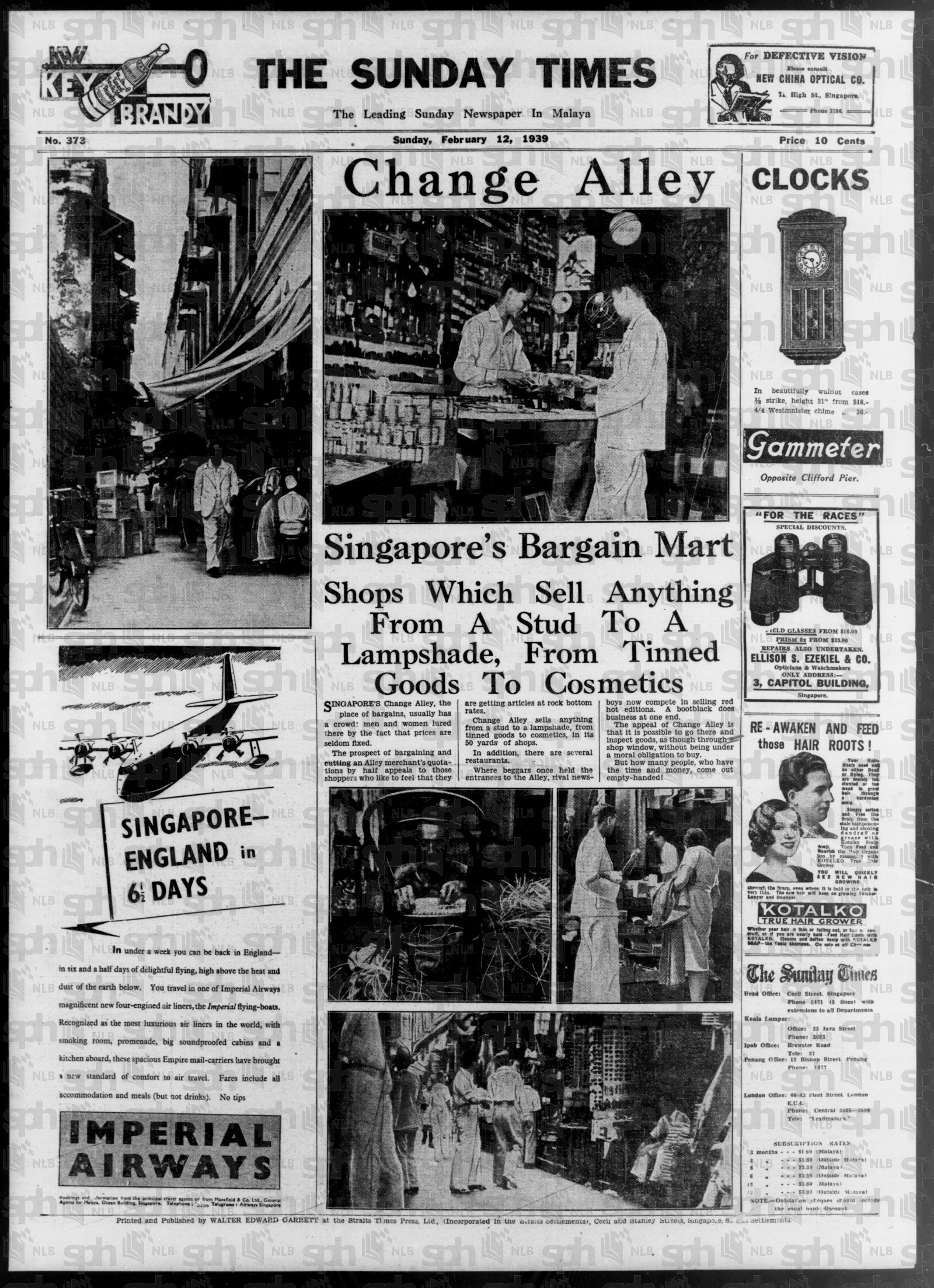 The back page of The Sunday Times, 12 February 1939, given over to Change Alley as "Singapore's Bargain Mart". (Singapore Press Holdings, via NewspaperSG, National Library Board Singapore, public domain)
By the end of the 1930s the bazaar was the main attraction. In February 1939 The Sunday Times gave its back page to photographs of the alley, describing it as a place that sold “anything from a stud to a lampshade, from tinned goods to cosmetics” in its 50 yards of shops. Prices were seldom fixed, and shoppers enjoyed cutting a merchant’s first price by half. Where beggars had once sat at the entrances, newspaper boys now competed to sell the latest editions, and a bootblack worked at one end. The paper suggested that the alley’s appeal was that shoppers could inspect the goods closely without feeling obliged to buy.
After the Second World War, the goods became even more varied. There were clothes, briefcases, watches, toys, fishing tackle, handicrafts and souvenirs, as well as tailors, shoe-shiners and cobblers. Small shops shared the lane with makeshift tables, and roving salesmen carried wooden boxes of pens and watches. A covering of zinc, plastic and canvas sheets kept off most of the rain, though not all of it.
Two groups of customers kept the bazaar going. The first came from the sea. Tourists from passenger ships, sailors on shore leave and servicemen landed at Clifford Pier, across the road from the alley’s seaward entrance, and walked through it into town. To serve them, some shopkeepers picked up phrases in French, German, Italian and Russian. The second group worked a few minutes’ walk away. As more Asian clerks and staff joined the offices around Raffles Place and Collyer Quay after the war, office workers came to the alley for watches, fountain pens, handbags and cheap textiles that could be made into office wear. In a crowded, narrow lane with no fixed prices, bargaining was expected. One shopper, recalling it decades later, put it simply: “In Change Alley, if you don’t bargain you’re a fool.”
Decline and closure
In 1973, after a revamp of Clifford Pier, an air-conditioned shopping arcade called the Change Alley Aerial Plaza opened on the bridge linking the pier to the alley. The old lane itself, however, was losing its customers. Through the 1980s, fewer visitors arrived by sea, the foreign forces had withdrawn from Singapore, and shoppers had moved to the new air-conditioned shopping centres. The alley also sat on some of the most valuable land in the city.
In February 1989 The Straits Times reported that the alley’s last 55 stallholders would have to leave, to make way for new development. After weeks of clearance sales, the shops opened for the last time on 30 April 1989. The stallholders were offered the chance to rent sundry and cooked-food stalls at markets and food centres. Winchester House at the Collyer Quay end and Singapore Rubber House, as Shell House had been renamed in 1976, at the Raffles Place end were then demolished.
I worked at Security Pacific National Bank in Singapore from 1987, and I walked through Change Alley many times. I don’t recall anything memorable about it. It was where we went to buy snacks from a Delifrance, and I used the money-changer there too, which was convenient but not exceptional.
Change Alley, 1890 to today
From a named lane to a bargain bazaar, and then an air-conditioned arcade
Sources: Daily Advertiser, 12 Nov 1890; Singapore Free Press, 25 Feb 1931; Sunday Times, 12 Feb 1939; NLB Infopedia, Change Alley.
View as table
| Year | Event |
|---|---|
| 1890 | On 11 November 1890 the municipal commissioners choose the name Change Alley over Change Lane. |
| 1905 | Winchester House, at the Collyer Quay entrance, dates from 1905. |
| 1931 | The Singapore Free Press finds a produce exchange at the back and a crowded bazaar of hawkers in front. |
| 1939 | The Sunday Times devotes its back page to the alley's 50 yards of shops. |
| 1960 | The 14-storey Shell House, later Singapore Rubber House, is completed at the Raffles Place entrance. |
| 1973 | An air-conditioned shopping arcade opens on the bridge from Clifford Pier to the alley. |
| 1989 | After weeks of clearance sales, the shops open for the last time on 30 April 1989. |
| 1993 | An air-conditioned arcade opens between the new Caltex House and Hitachi Tower. |
The alley today
Change Alley came back in 1993, when Caltex House (now Chevron House) and Hitachi Tower (now 16 Collyer Quay) were completed on the sites of the two old buildings. This time it was an air-conditioned shopping arcade between the two towers, joined to the overhead bridge across Collyer Quay that is now called OUE Link. Its customers are once again mostly office workers from the business district, but the open-air stalls, the touts and the haggling are gone. Money-changing itself is now a licensed business in Singapore, regulated by the Monetary Authority of Singapore under the Payment Services Act.

The Change Alley overhead bridge across Collyer Quay in December 2005, lined with small shops. (Mailer diablo, copyrighted free use, via Wikimedia Commons)
See 16 more historical photos related to this post →
Why it matters today: Change Alley was never grand, but for a century it was where Singapore’s small change met its big money, a hundred metres of money-changers, hawkers and haggling squeezed between the waterfront and the banks, and its name still marks the spot.
Sources
- “Change Alley”, Singapore Infopedia, National Library Board
- “Going Shopping in the 60s”, BiblioAsia, National Library Board, July-September 2018
- “Change Alley, Singapore”, Wikipedia
- “The Municipal Commission”, Daily Advertiser, 12 November 1890, page 3, NewspaperSG
- “Change Alley Burglaries”, Singapore Free Press (weekly edition), 16 October 1929, NewspaperSG
- “The Heart of the Lion City: Change Alley”, Singapore Free Press, 25 February 1931, page 10, NewspaperSG (also in the gallery)
- “One of the Busiest Spots of Singapore”, The Malayan Saturday Post, 16 April 1932, page 30, NewspaperSG
- “Change Alley: Singapore’s Bargain Mart”, The Sunday Times, 12 February 1939, page 32, NewspaperSG
- “Change Alley to pass into history on March 31”, The Straits Times, 23 February 1989, NewspaperSG
- Payment Services Act, Monetary Authority of Singapore
- File:Change_Alley_Singapore_street_sign_January_1965.jpg, Wikimedia Commons
- File:545a_Singapore_1971_(51316139004).jpg, Wikimedia Commons
- File:Change_Alley_Overhead_Bridge,_Dec_05.JPG, Wikimedia Commons
- File:SG_Singapore_Raffles_Square_-1963(W63-K27-15).jpg, Wikimedia Commons (gallery)
- File:71-610a_Raffles_Place_Singapore_1971_(51251176861).jpg, Wikimedia Commons (gallery)
- File:71-610Raffles_Place_Singapore_1971(51252222815).jpg, Wikimedia Commons (gallery)
- File:522a_Singapore_1971_(51316419105).jpg, Wikimedia Commons (gallery)
- File:KITLV_-79891-Kleingrothe,_C.J.-Medan-Raffles_Place,_Singapore-_circa_1910.tif, Wikimedia Commons (gallery)
- File:KITLV_-79893-Kleingrothe,_C.J.-Medan-Raffles_Place_and_King_Street_in_Singapore-_circa_1910.tif, Wikimedia Commons (gallery)
- File:Raffles_Place_c._1920.jpg, Wikimedia Commons (gallery)
- File:KITLV_A723_-_Raffles_Place_te_Singapore,_KITLV_87929.tiff, Wikimedia Commons (gallery)
- File:Collyer_Quay,_Singapore_postcard.jpg, Wikimedia Commons (gallery)
- File:Kade_te_Singapore,_KITLV_104787.tiff, Wikimedia Commons (gallery)
- File:KITLV_A1112_-_Haven_van_Singapore,_KITLV_142600.tiff, Wikimedia Commons (gallery)
- File:KITLV_-6539-Lambert%26Co.,_G.R.-Singapore-Chetti_or_Coromandel_lender_in_the_Straits_Settlements-_circa_1890.tif, Wikimedia Commons (gallery)
- File:Change_Alley_Aerial_Plaza,_Dec_05.JPG, Wikimedia Commons (gallery)
- File:Change_Alley,_Dec_05.JPG, Wikimedia Commons (gallery)
- File:OUE_Link_Entrance.jpg, Wikimedia Commons (gallery)


