Fort Palmer, Fort Canning and the Forts That Guarded a Free Port
On the afternoon of 13 October 1891, a party of ladies and gentlemen climbed Mount Wallich, above the docks at Tanjong Pagar, to watch the Governor press a button. An electric wire ran from the hilltop to two new 10-inch breech-loading guns in the fort on neighbouring Mount Palmer, the heaviest guns in any fortification in the Straits Settlements, and when he pressed it they fired at a target boat three and a half miles out to sea. Seven months earlier, at what the Straits Times called the largest gathering ever held in Singapore, the town’s merchants had protested against the sum London wanted the colony to pay each year for the soldiers who manned such guns. A port that charged no duties on its trade still needed forts, and for most of the nineteenth century the question of who should pay for them was argued over as hard as where to put them.

The foot of Mount Palmer, also called Mount Parsee or Parsee Hill, between about 1870 and 1910. Fort Palmer stood on the hill above. (Rijksmuseum, CC0, via Wikimedia Commons)
The day the big guns fired
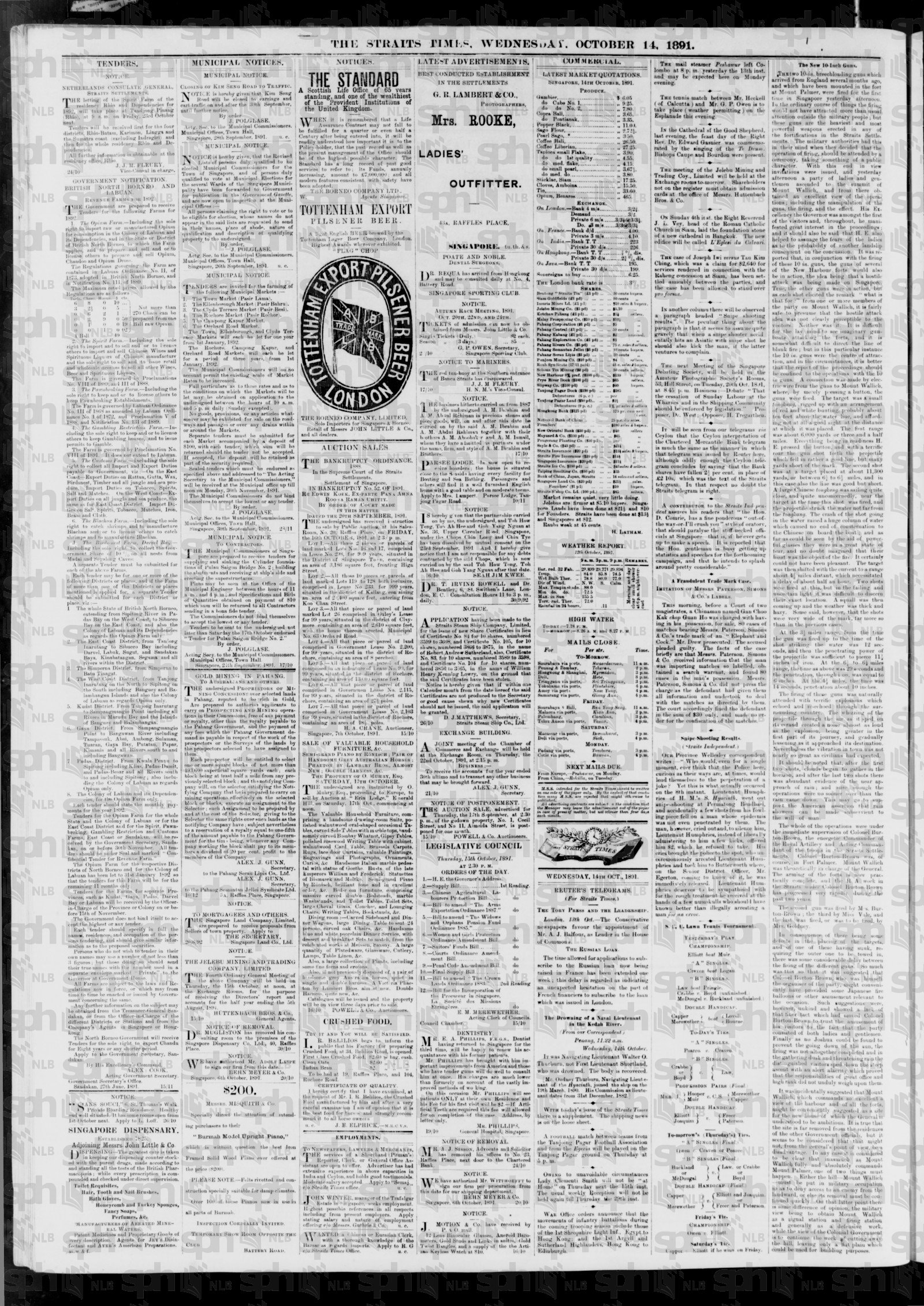 Page 2 of The Straits Times, 14 October 1891. The report "The New 10-Inch Guns" is at the top of the right-hand column. (Singapore Press Holdings, via NewspaperSG, National Library Board Singapore, public domain)
The Straits Times described the firing the next morning. The two guns had arrived from England several months before and had been mounted in the fort at Mount Palmer, overlooking the eastern entrance to the harbour. The military authorities treated their first firing as a public occasion and sent out invitations. According to the paper, the Governor also took the trouble to reassure the ladies in the party that the concussion was unlikely to set off another landslip.
The target was a small tongkang, a local cargo boat, rigged with red and white bunting and anchored about 6,000 yards out. The Governor pressed the button and the first shot fell in a good line but short. The target for the second shot was about 11,300 yards away, between six and six and a half miles, and a large Chinese tongkang was sailing “quite unconcernedly” near it at the time. The shell struck the water not far from the boat, and the paper reported that it caused “no end of consternation” to the crew. At the shorter range, the paper said, a shell took 12 seconds to reach the water and could pierce eleven and a half inches of iron.
The new guns had a cost the visitors could not see from the hilltop. Later that month the Straits Times reported that the concussion from the gun practice had made the Parsee Lodge, an old building on the western side of Mount Palmer, uninhabitable.
A free port with few defences
Singapore’s defences began modestly. Soon after the treaty of February 1819, Stamford Raffles told the Resident, William Farquhar, to put up “one or two strong batteries” along the coast. For years that was close to all there was. Singapore was a free port that charged no duties on the goods passing through it, so its government had no customs revenue to spend on forts. The money came instead from revenue farms, licences to sell opium, spirits and other goods, and at its peak in the nineteenth century, according to the National Library Board, opium accounted for over half the revenue of the Straits Settlements.
The first full survey of the defences was made in 1827 by Captain Edward Lake of the Bengal Engineers, who found them scanty and recommended a chain of batteries along the coast and a citadel. He picked out two hills, Mount Palmer near Tanjong Pagar and Pearl’s Hill, as sites for guns. The only fort that came out of his report was Fort Fullerton, at the mouth of the Singapore River, probably begun under Governor Robert Fullerton between 1826 and 1830 and named after him. Between 1854 and 1859 it was enlarged to three times its size, and by 1858 it mounted seven 68-pounders with a range of about three miles, along with smaller guns and mortars.
The merchants did not much like it. The fort sat on what they saw as the best site in town, its artillery practice was a nuisance, and their godowns along the river and at Commercial Square, now Raffles Place, stood directly in its line of fire. In the 1850s a visiting naval captain said his ship’s guns could “smash the fort in a minute and a half”. By 1864 a second battery, Fort Palmer, stood on part of Mount Palmer, with five 56-pounder guns.
Government Hill becomes Fort Canning
In 1859 the colonial government pulled down Government House, the governor’s residence on the hill above the town that had begun as Raffles’s bungalow, and began building an artillery fort in its place. Some people objected at the time that the hill was too far from the shore. About 400 Chinese labourers cut a plateau into the hilltop, and the fort was finished in 1861. It was named Fort Canning, after Viscount Canning, the Governor-General of India.
Seven 68-pounders were in place facing the sea by May 1859, and eight 8-inch shell guns and two 13-inch mortars were added in 1867. The fort was also meant as a place of refuge in case of trouble in the town, but it had no water supply, which made it useless for that, and ships could come close enough to bombard the town while staying out of range of its guns. Its most regular duty turned out to be telling the time. A 68-pounder was fired at five o’clock every morning to start the day, and until 1896 the guns were also fired to signal the outbreak of a fire. When the fort was finished, the engineers found that the battery on Pearl’s Hill stood higher than Fort Canning, so the top of Pearl’s Hill was cut down.

Singapore town and harbour around 1860. The archive’s caption identifies the building on the right as the battery that fired the morning and evening guns. (Unknown photographer, KITLV 29173, public domain, via Wikimedia Commons)
A coaling station needs guns
Until 1867 the Straits Settlements were governed from British India, and in Singapore the old defences came to be seen as a relic of that era. Fort Fullerton was dismantled between the 1860s and 1873. An 1872 editorial in the Straits Times Overland Journal said the fort seemed “expressly designed for the destruction of the Collyer Quay godowns and the whole [Commercial] Square”, and suggested that the site would suit the Post Office better. The Post Office moved there in August 1874.
What brought new forts was the harbour. After the Suez Canal opened in 1869, more and more steamships called at Singapore, and the docks and coal stores of the Tanjong Pagar Dock Company at New Harbour, later renamed Keppel Harbour, became worth defending. From 1878, when Britain feared a war with Russia, forts were built on both sides of the western entrance to the harbour: Fort Pasir Panjang on the mainland, now part of Labrador Park, and Fort Siloso on Pulau Blakang Mati, now Sentosa, with Fort Serapong and Fort Connaught elsewhere on the island. The batteries on Mount Palmer were rebuilt at the same time. The Dock Company owned the hill, and under a deal with Governor William Robinson it let the government put a battery on the top in return for the government paying for the roads to the docks. The hilltop was handed over in 1879.
Who pays: the military contribution
The forts were manned by the garrison, British regular troops such as the Royal Artillery, and the Straits Settlements paid London a yearly military contribution towards the garrison’s cost. In 1890 the Colonial Office asked the colony for £60,000 to build new barracks and other works, and proposed to double the annual contribution to £100,000.
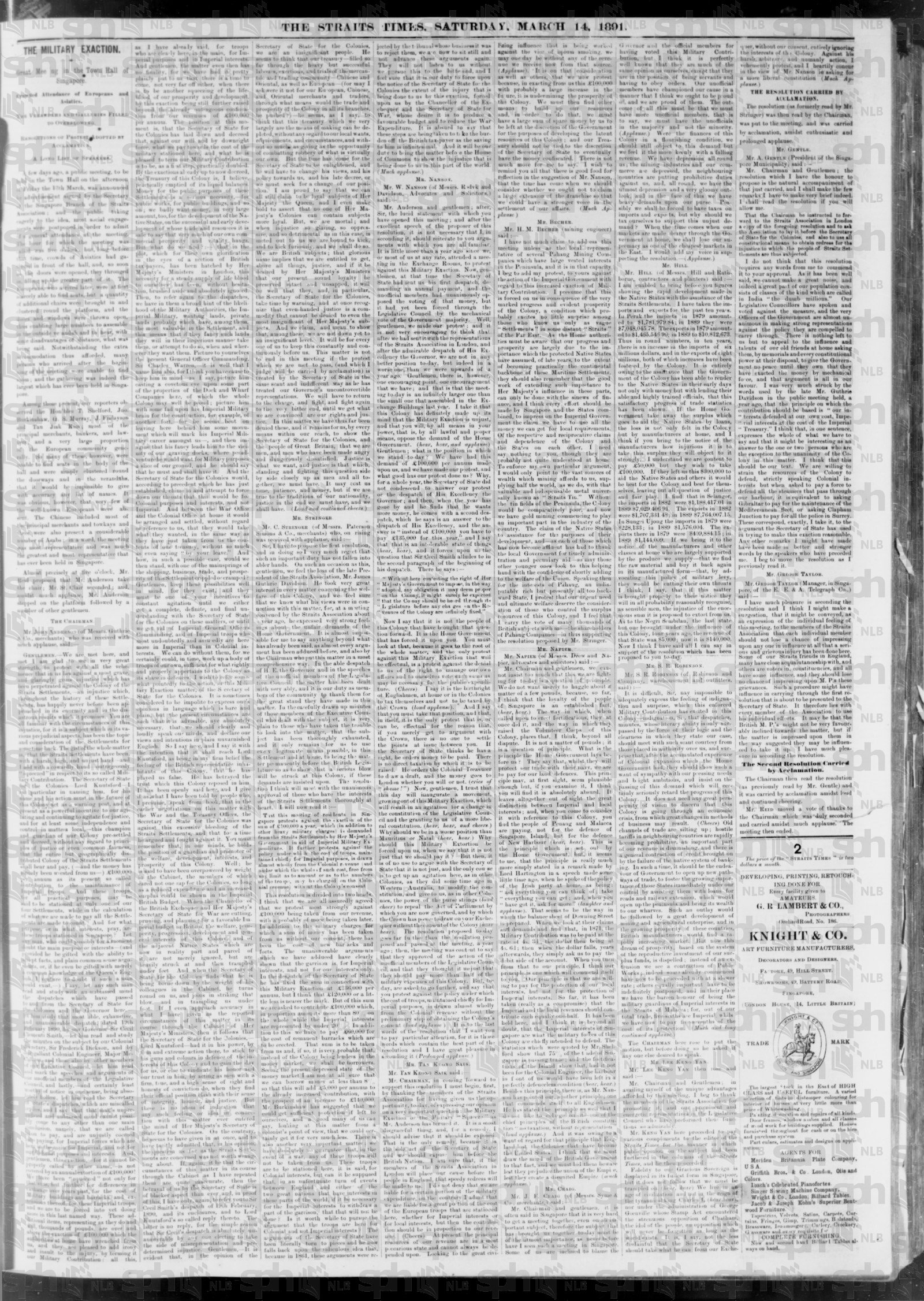 Page 3 of The Straits Times, 14 March 1891: "The Military Exaction. Great Meeting in the Town Hall of Singapore." (Singapore Press Holdings, via NewspaperSG, National Library Board Singapore, public domain)
The Singapore branch of the Straits Settlements Association, the merchants’ lobby, called a public meeting at the Town Hall for Friday 13 March 1891. The Straits Times gave a whole page to it the next day. According to the paper, social engagements were put off so that people could attend, crowds gathered outside the hall well before the five o’clock start, and the verandahs and galleries were “filled to overflowing”. Most of the principal Chinese merchants and towkays were there, along with a considerable number of Arab residents, and the paper called it “the largest which has ever been held in Singapore”.
The meeting, chaired by the merchant John Anderson, passed its resolutions of protest by acclamation. Among the speakers were Tan Keong Saik and Lee Keng Yan. Looking back in 1895, the Straits Times summed up the resolutions as a protest against the “squeezing of the life-blood of our prosperity and development” and against “the barren honour of being the military guardians of Imperial interests in the Straits of Malacca.”
The protests did not stop the demand, and the fall in the value of silver made it heavier. The contribution was set in pounds sterling, but the colony’s revenue was collected in silver dollars. In 1891 a dollar was worth three shillings and threepence, and by January 1895 it was worth less than two shillings, so the same sum in pounds cost far more dollars. By then London had settled on £110,000 for 1897 and £120,000 for 1898, with a rise of £10,000 a year after that until the contribution covered the full cost of the garrison, £136,000. In protest, most of the unofficial members of the Legislative Council resigned, and the Singapore justices of the peace and the members of the Chinese Advisory Board followed. The dispute was settled in 1896, when the contribution was fixed at 20 per cent of the colony’s revenue.
The contribution did not get smaller. In 1914, according to the National Library Board, the Straits Settlements paid the largest share of military funds to the Imperial Exchequer of any Crown colony, and more than half of it came from opium revenue.
The forts on today’s map
The map shows where each fort stood. Use the buttons to step through the stages, from the two early batteries in town to the forts guarding New Harbour, and then to what is left.
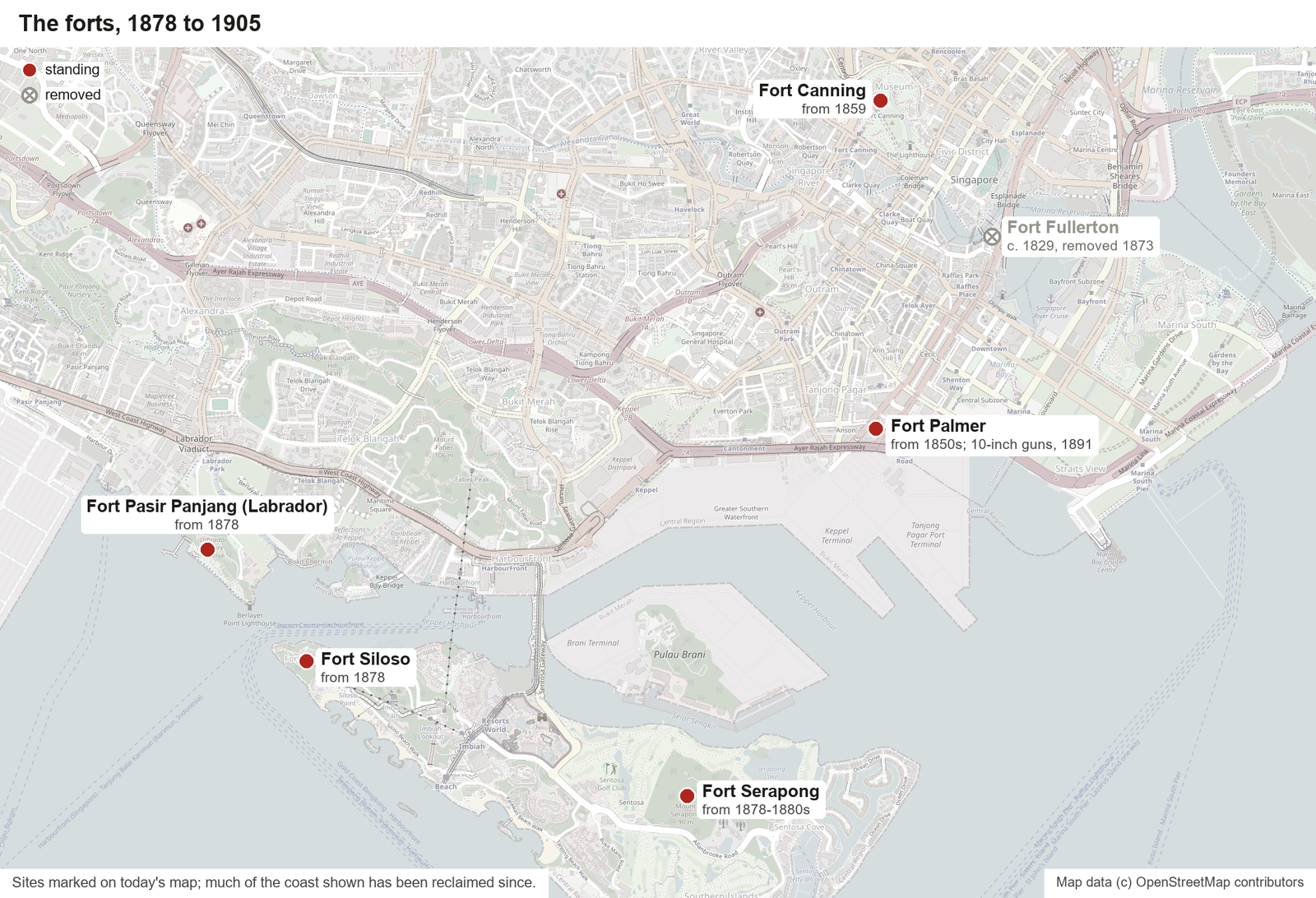
The forts by period, marked on today’s map at the sites they occupied. Use the buttons to step through each stage. Much of the coastline shown, including the land around Tanjong Pagar and the Marina, has been reclaimed since the forts were built. (Map data © OpenStreetMap contributors)
Quietly removed
The gun emplacements left at the old Fort Fullerton site were destroyed in 1889, the Post Office there was replaced by a larger building in the 1920s, and that building, the Fullerton Building, opened in 1928. It is now the Fullerton Hotel.
Mount Palmer went next, and the hill went with it. The fort was demolished in 1905 to make way for the second Telok Ayer reclamation and the Telok Ayer Basin, and by the time that work was finished in 1932 most of the hill had been dug away and used as landfill. A small knoll with the shrine of Habib Noh, a nineteenth-century Muslim saint, is all that remains of it, beside a road still called Palmer Road, after the old Palmer Battery Road.
Fort Canning was demolished in 1907, never having been used in the defence of the colony. In the 1920s a large covered reservoir for the city was built on the hilltop, and the British Army later built an underground command centre, the Battlebox, into the hill, which is the subject of an earlier post. The fort’s 1859 gateway and some of its walls still stand, along with two nine-pound cannons.

The gateway of Fort Canning, built in 1859 and one of the few parts of the fort still standing, in 2009. (Jonathan Protzenko, CC BY-SA 2.0, via Wikimedia Commons)
What is left
The forts guarding New Harbour lasted longest. Fort Pasir Panjang was enlarged in 1892 into a six-gun battery with underground magazines and tunnels, and in 1938 it was given two 6-inch guns. In February 1942, according to the National Library Board, its guns were turned almost 180 degrees and used by the Malay Regiment in its 48-hour fight against the Japanese 18th Division at Pasir Panjang. The guns at Fort Siloso were also turned inland and fired at Japanese troops advancing from the west. After the war the tunnels at Labrador were forgotten until park officials came across them in 2001, and they were opened to the public in 2005. Fort Siloso, on Sentosa, is today a military museum and the only complete fort left in Singapore.
What changed
The question that filled the Town Hall in 1891 was who should pay to defend a trading port, and how much. Today Singapore pays for its own defence from its national budget. The Ministry of Defence describes a policy of steady spending, projected to grow by about 3 to 4 per cent a year, which it says avoids “the disruptive changes arising from fluctuations in the expenditure from year to year”. That is a different arrangement from the sudden demands from London that the merchants of the 1890s protested.
See more historical photos related to this post →
Where it fits in the bigger story: Fort Fullerton, Fort Palmer and the fort on Fort Canning Hill gave their names to places most Singaporeans pass every day, from the Fullerton Hotel to Palmer Road, but the forts themselves were removed more than a century ago and rarely fired a shot except in practice. The harder fight was over the bill. A free port that taxed none of its trade paid for its garrison in large part out of opium revenue, and its merchants packed the Town Hall to argue that the bill was too high.
Sources
- “Fort Fullerton,” Singapore Infopedia, National Library Board Singapore
- “Mount Palmer,” Singapore Infopedia, National Library Board Singapore
- “Fort Canning Park,” Singapore Infopedia, National Library Board Singapore
- “Labrador Park/Fort Pasir Panjang,” Singapore Infopedia, National Library Board Singapore
- “Fort Siloso,” Singapore Infopedia, National Library Board Singapore
- “Straits Settlements Association,” Singapore Infopedia, National Library Board Singapore
- “The Sticky Problem of Opium Revenue,” BiblioAsia, National Library Board Singapore
- Fort Canning Park, Wikipedia
- Coastal fortifications of Singapore, Wikipedia
- “The New 10-Inch Guns,” The Straits Times, 14 October 1891, page 2, NewspaperSG
- “Singapore News” (on the Parsee Lodge), Pinang Gazette and Straits Chronicle, 29 October 1891, NewspaperSG
- “The Military Exaction,” The Straits Times, 14 March 1891, page 3, NewspaperSG
- “The Military Contribution: Former Public Protests,” The Straits Times, 10 January 1895, page 3, NewspaperSG
- Defence Spending, Ministry of Defence Singapore
- OpenStreetMap contributors
- File:Strand en badgasten aan de voet van Mount Palmer (Mount Parsee, Parsee Hill) bij Singapore Foot of Mount Palmer. S.pore (titel op object), RP-F-F01104-Z.jpg, Wikimedia Commons
- File:KITLV - 29173 - Singapore city and harbor, at the right the battery for the day and evening shot - circa 1860.tif, Wikimedia Commons
- File:Fort Gate, Fort Canning, Singapore - 20090103.jpg, Wikimedia Commons
- File:Gezicht op Fort Canning met de Singapore River, RP-F-F01025-BS.jpg, Wikimedia Commons (gallery)
- File:KITLV - 29175 - View of the harbor of Singapore - 1860.tif, Wikimedia Commons (gallery)
- File:KITLV - 106516 - Singapore - circa 1870.tif, Wikimedia Commons (gallery)
- File:KITLV - 1404879 - Ludwig, Deutsche Buchhandlung Max - Singapore - View from Fort Canning, Singapore - 1895-1903.tif, Wikimedia Commons (gallery)
- File:KITLV - 150812 - Lambert & Co., G.R. - Singapore - Johnston’s pier in the harbor at Singapore - circa 1890.tif, Wikimedia Commons (gallery)
- File:KITLV A740 - Stadhuis te Singapore, KITLV 90268.tiff, Wikimedia Commons (gallery)
- File:Gezicht op de ingang van de nieuwe haven te Singapore Entrance to New-harbour. S.pore (titel op object), RP-F-F01104-X.jpg, Wikimedia Commons (gallery)
- File:KITLV - 1404881 - Singapore. Entrance at New harbor. - 1895-1908.tif, Wikimedia Commons (gallery)
- File:Gezicht op de gebouwen en dokken van de Tanjong Pagar Dock Co. Ltd. in Singapore Panorama of six sheets taken from clock tower (titel op object), RP-F-F01140-S.jpg, Wikimedia Commons (gallery)
- File:Admiralty Chart No 2023 Keppel Harbor, Singapore, Published 1893.jpg, Wikimedia Commons (gallery)
- File:Labrador tunnel 1 entrance 20060419.jpg, Wikimedia Commons (gallery)
- File:Casemates, Fort Siloso Square (171549).jpg, Wikimedia Commons (gallery)
- File:9-pound cannon at Fort Canning, Singapore.jpg, Wikimedia Commons (gallery)
- File:Keramat Habib Noh and remains of former Mount Palmer.jpg, Wikimedia Commons (gallery)


