The Gurkha Contingent: Singapore's Neutral Force, 1949–1965
In February 1949 an officer of the Singapore police flew to New Delhi to bring back 148 Gurkhas recruited in the hills of Nepal. They were to form a new riot squad, replacing the Sikh contingent that had kept order in Singapore since 1881, and they were valued for one quality above all: they belonged to none of the communities they might be called on to police. Within two years that quality was tested in the worst communal riots Singapore had seen, and the Gurkha Contingent has been part of the Singapore police ever since.

Men of the 2/9th Gurkha Rifles training in the Malayan jungle in October 1941. Gurkha soldiers of the British Army fought in the defence of Malaya before the Gurkha Contingent was formed in Singapore. (Photo: Lt Palmer, War Office official photographer, public domain, via Wikimedia Commons)
A gap in the force
The Sikh Police Contingent was disbanded after the Japanese occupation, and the independence of India in 1947 changed where the colony could recruit. The Britain–India–Nepal agreement of 1947 divided the Gurkha regiments of the old Indian Army between the Indian Army and the British Army, and the British looked to Gurkhas to fill the place the Sikhs had left. The National Library Board’s account notes that Gurkhas had already proved themselves in the defence of Malaya during the war, and describes them as impartial but loyal.
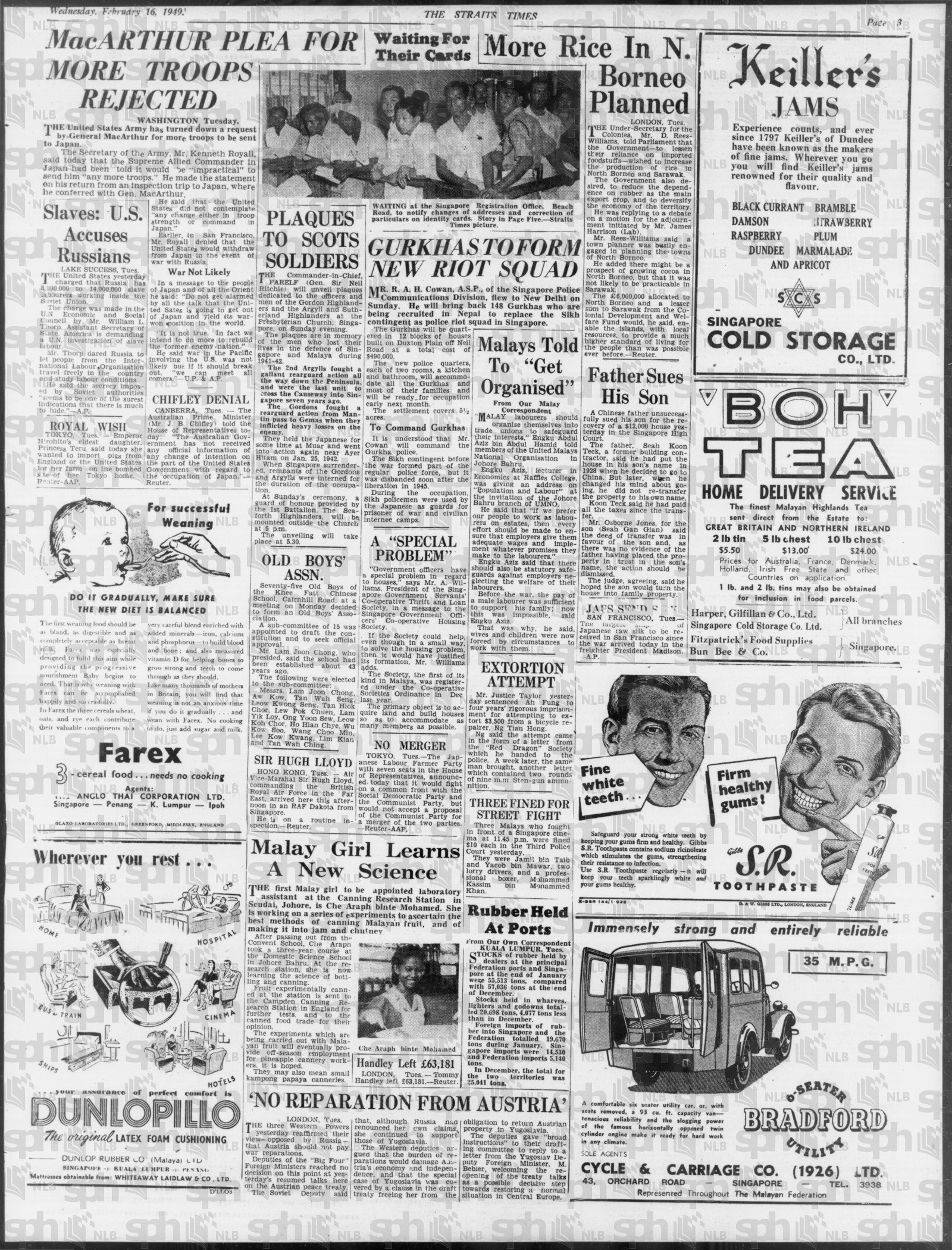 Page 3 of The Straits Times, 16 February 1949. The centre column reports the recruitment of 148 Gurkhas to replace the Sikh contingent. (Singapore Press Holdings, via NewspaperSG, National Library Board Singapore, public domain)
The Straits Times of 16 February 1949 carried the news under the headline “Gurkhas to form new riot squad.” It reported that R. A. H. Cowan, an assistant superintendent in the police communications division, had flown to New Delhi and would bring back 148 Gurkhas recruited in Nepal to replace the Sikh contingent as the police riot squad in Singapore. The men and most of their families were to be housed in 12 blocks of new quarters on Duxton Plain, off Neil Road, built at a cost of $490,000 on a site of five and a half acres. The paper also recalled that during the occupation the Japanese had used Sikh policemen as guards for prisoner-of-war and civilian internment camps, and that the Sikh contingent had been disbanded soon after liberation in 1945.
The Gurkha Contingent was formed as part of the Singapore police on 9 April 1949, with 142 men who had served as Gurkhas in the British Army. Its first commanding officer, according to the National Library Board, was Major Scott Leathart.
December 1950
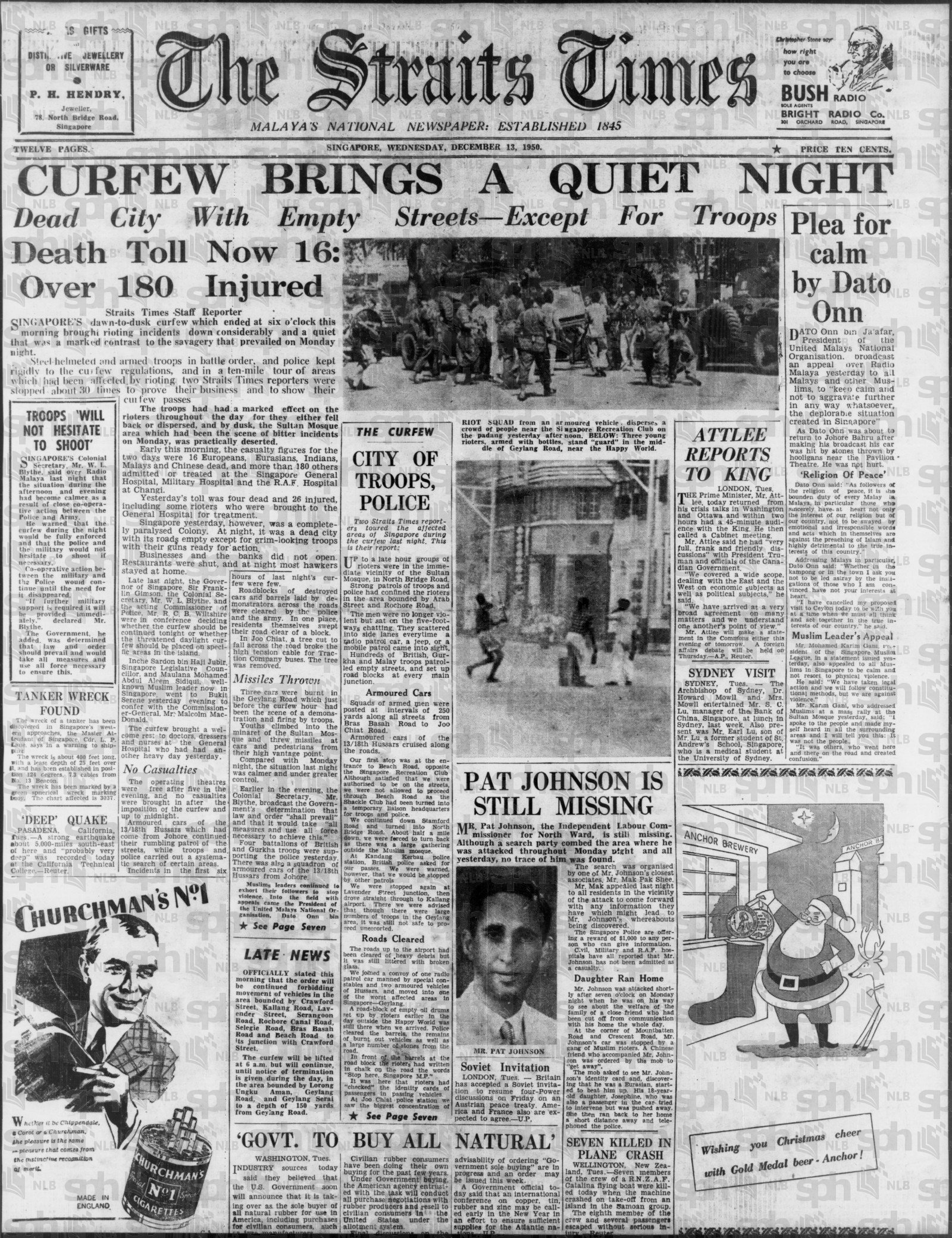 Front page of The Straits Times, 13 December 1950, the day after the worst of the Maria Hertogh riots. (Singapore Press Holdings, via NewspaperSG, National Library Board Singapore, public domain)
Its first real test came within two years. On 2 December 1950 the High Court ruled on the disputed custody of Maria Hertogh, a Dutch girl who had been raised by a Malay Muslim family, and on 11 December riots broke out across the city. The Straits Times of 13 December reported that the death toll had reached 16, with more than 180 people treated in hospital, and described a dawn-to-dusk curfew enforced by troops and police. Its reporters wrote that “hundreds of British, Gurkha and Malay troops patrolled empty streets.” The paper did not separate the police contingent from the army’s Gurkha units, but the National Library Board’s account names the Maria Hertogh riots as one of the occasions on which the Gurkha Contingent’s impartiality was shown.
A neutral force
The same reasoning applied through the 1950s. The contingent was used again during the Hock Lee bus strike and riots of 1955 and during the Chinese middle-school unrest of the same decade, and it is also recorded as having been deployed in the communal riots of July 1964. Lee Kuan Yew later explained the value of that neutrality in his memoirs. Using Chinese policemen against Malays, or Malay policemen against Chinese, he wrote, would have had widespread repercussions, whereas “the Gurkhas, on the other hand, were neutral.”
When Singapore became independent in 1965, it kept the contingent as part of its police force.

Gurkha Contingent officers on guard at Raffles City during the 117th IOC Session in 2005. (Photo: Huaiwei, CC BY-SA 2.5, via Wikimedia Commons)
The contingent today
The contingent remains a unit of the Singapore Police Force. According to the National Library Board and the government’s SG101 resource, its members come to Singapore at around 18 and return to Nepal after 15 to 20 years of service, living in the meantime in a self-contained cantonment at Mount Vernon with its own temple and schools. It guards selected installations, augments the police at major security events, and serves as a counter-terrorism force.
The Gurkha Contingent, 1945–1965
From the end of the Sikh contingent to independence (linear scale)
Dates from the sources cited below the post.
View as table
| Date | Event |
|---|---|
| 1945 | The Sikh Police Contingent was disbanded after the Japanese occupation. |
| 1947 | The Britain–India–Nepal agreement of 1947 divided the Gurkha regiments between the British and Indian armies. |
| Feb 1949 | An officer of the Singapore police flew to New Delhi to bring back 148 Gurkhas recruited in Nepal, as reported in the Straits Times of 16 February 1949. |
| 9 Apr 1949 | The Gurkha Contingent was formed as part of the Singapore police on 9 April 1949. |
| Dec 1950 | Riots followed a court ruling on the custody of Maria Hertogh; the Gurkha Contingent was among the forces deployed. |
| May 1955 | The contingent was again used as a neutral force during the Hock Lee bus riots. |
| Jul 1964 | Communal riots broke out on 21 July 1964 and recurred into September; the contingent was deployed again. |
| Aug 1965 | Singapore became independent on 9 August 1965 and kept the Gurkha Contingent as part of its police force. |
See more photos related to this post →
Where it fits in the bigger story: The Gurkha Contingent was created to solve a specific problem that the end of the Sikh contingent had left behind: how to keep order in a city of several communities without the police being seen to take one community’s side. Its value was tested in 1950, within two years of its formation, and the decisions made then about who should police a divided city are part of the reason a small force recruited from the hills of Nepal is still part of Singapore’s police more than seventy years later.
Sources
- Gurkhas, Infopedia, National Library Board
- The Gurkha Contingent in Singapore, SG101
- Gurkha Contingent, Wikipedia
- Men in Blue: A History of the Singapore Police Force, BiblioAsia (National Library Board)
- “Gurkhas to form new riot squad,” The Straits Times, 16 February 1949, page 3, NewspaperSG
- “Curfew brings a quiet night” and “City of troops, police,” The Straits Times, 13 December 1950, page 1, NewspaperSG
- “Five dead, 100 hurt in riots,” The Straits Times, 12 December 1950, page 1, NewspaperSG (gallery)
- File:The British Army in Malaya 1941 FE237.jpg, Wikimedia Commons
- File:Gurkha IOC 1.jpg, Wikimedia Commons
- File:The British Army in Malaya 1941 FE239.jpg, Wikimedia Commons (gallery)
- File:The British Army in Malaya 1941 FE248.jpg, Wikimedia Commons (gallery)
- File:A Gurkha soldier’s tombstone at Kranji War Cemetery, Singapore.jpg, Wikimedia Commons (gallery)
- File:Singapore Gurkha 01.jpg, Wikimedia Commons (gallery)
- File:Gurkha IOC 2.jpg, Wikimedia Commons (gallery)
- File:Gurkha Band.jpg, Wikimedia Commons (gallery)


