The Private Company That Ran Singapore's Harbour, 1864–1905
In 1905 the government of the Straits Settlements took over the Tanjong Pagar Dock Company and paid its shareholders about $755 for every $100 share, a price that was still being questioned in the British House of Commons more than a year later. The company had begun in 1864 as the first local joint-stock company to offer shares to the public in Singapore, and by the time it was bought out it controlled nearly all of the docks and wharves at the deep-water harbour that had made Singapore a coaling stop for steamships.

Workers leaving one of the company’s docks at the meal hour, from an album of photographs of the Tanjong Pagar Dock Company made between about 1890 and 1905. (Photo: Rijksmuseum, CC0, via Wikimedia Commons)
Coal first, docks second
Steamships had to be fed. When the Peninsular and Oriental Steam Navigation Company (P&O) began monthly sailings to the Far East in 1845, with a stop at Singapore, the coal for its ships was carried out from ships anchored at the mouth of the Singapore River on small lighters, stored in godowns along the river bank, and then lightered out again to each arriving steamer. It was slow work, worse in choppy weather when a lighter could capsize, and damp stored coal caught fire easily.
In 1852 P&O became the first shipping company to move its coaling station from the river to New Harbour, where it built its own wharf. The anchorage was sheltered, the water was deep, and there was room for coal stores and warehouses, so other firms followed. New Harbour was renamed Keppel Harbour in 1900, after Admiral Henry Keppel, who had found deep water so close to the shore in 1848 when he sailed HMS Meander in for repairs. Ship repair was the next need. In 1859 a British mariner, Captain William Cloughton, built Singapore’s first dry dock at New Harbour, and the Patent Slip and Dock Company was formed in 1861 to take it over.

A panoramic view of Tanjong Pagar from the west, as titled in the company’s album. (Photo: Rijksmuseum, CC0, via Wikimedia Commons)
A company anyone could buy into
 Tan Kim Ching, from Song Ong Siang's 1923 history of the Chinese in Singapore. (Photo: Song Ong Siang, CC BY-SA 4.0, via Wikimedia Commons)
In 1864 a group of investors decided to build another dry dock at New Harbour. To raise the money they set up a joint-stock limited liability company, the Tanjong Pagar Dock Company, which was registered on 29 September 1864 and was the first local company of that kind to offer shares to the public in Singapore. The agency house Guthrie & Co. and the Chinese merchant Tan Kim Ching were among its founders. The company hoped to raise $200,000 in Singapore, in 2,000 shares of $100 each, but not all of the shares were taken up locally and the balance was sold to investors in London. Its articles of association gave a London Consulting Committee a veto over spending above $20,000, an arrangement that would matter forty years later.
Tan Kim Ching was the eldest of the three sons of Tan Tock Seng, and after his father’s death he ran the family firm, which became Kim Ching & Co. and owned rice mills at Saigon and in Siam. He was Consul-General for Siam in the Straits Settlements. Song Ong Siang’s 1923 history records that his name was on the committee of promoters when the dock company was started in 1863, that he was made a Justice of the Peace in 1865, and that when he died in February 1892 he owned the steamers Siam and Singapore. The same book notes that Ong Kew Ho, a Malacca-born merchant, was one of the few Chinese merchants who believed in the future of the enterprise and attended its annual general meeting in 1871.
A price war, the Suez Canal and a monopoly
The company’s first dock, Victoria Dock, was opened by Governor Harry St George Ord on 17 October 1868. It began badly. The Patent Slip and Dock Company, which now faced a competitor, started a price war, and the Tanjong Pagar company had to cut its own prices and made losses. Then the Suez Canal opened in 1869, more steamships called at Singapore, and by the following year the docks were profitable. The Patent company built a second dock in 1870 and became the New Harbour Dock Company in 1875, and in 1879 the Tanjong Pagar company opened Albert Dock, east of Victoria Dock, to meet the growing demand.
In 1871 a meeting was held at the office of Boustead & Co. to form a company to build a railway from the town to the company’s wharves. The Hon. H. A. K. Whampoa was elected one of its provisional directors and was also a director of the dock company, which was then one of only two limited-liability companies in existence besides the proposed railway company, the other being the gas company. Meanwhile, the company bought up smaller rivals. In 1899 it merged with the New Harbour Dock Company, and with that purchase it controlled the whole of the shipping, dockyard and wharf business at New Harbour except the P&O wharf.
The people who worked the wharves
Behind the docks was a large workforce. Song Ong Siang’s history describes Chinese coolies carrying baskets of coal at the coal wharves, and the company’s own album has a photograph titled “Coal coolies quarters.” Much of the labour was arranged through contractors. Gan Eng Seng, who died in 1899, was labour contractor to the company and made a considerable part of his fortune from it, and from December 1901 Tan Kheam Hock held the same role, with a permanent labour force numbering some thousands. The company also kept its own police force and fire brigade.

The coal coolies’ quarters at Tanjong Pagar, as titled in the company’s album. (Photo: Rijksmuseum, CC0, via Wikimedia Commons)
1904–05: a modernisation plan and a takeover
By 1904 Singapore was the seventh-largest port in the world, but it faced strong competition from Hong Kong, and the company’s wharf system was under strain because no major improvements had been carried out since 1885. The Singapore board and the London Consulting Committee disagreed about capital spending. In March 1904 the company submitted a $12-million plan to upgrade and expand its facilities, and it was rejected by its Europe-based shareholders, who feared the cost would “endanger a dividend of 12 per cent.” The company then asked the Straits Settlements government for financial support. The government decided instead to take over the company. The London committee, for its part, had said it would not agree to cede control unless the dividend was assured at the existing rate.
The Tanjong Pagar Dock Bill was introduced in the Legislative Council on 20 January 1905, and its second reading was on 3 March. The Governor’s stated ground, as recorded by Song Ong Siang, was that the company had obtained a practical monopoly of the port’s shipping facilities, and that it was undesirable for commerce that they should all be under one company’s control. The Hon. Mr Napier, supporting the bill, said that public opinion outside those interested in the company was practically unanimous in favour. He recalled that the first chairman, Thomas Scott, had said the company’s motto should be “Live and let live,” and argued that the company had since taken over the Slipway, the Borneo Wharf, Jardine’s Wharf and finally the New Harbour Dock. The Hon. Tan Jiak Kim added that the company was not popular with the Chinese, and that for some years Chinese shipping firms had been trying to avoid sending their steamers and cargoes to Tanjong Pagar because of its “enormous charges.” The bill passed on 13 April 1905, and on 1 July the government took over the management as the Tanjong Pagar Dock Board.
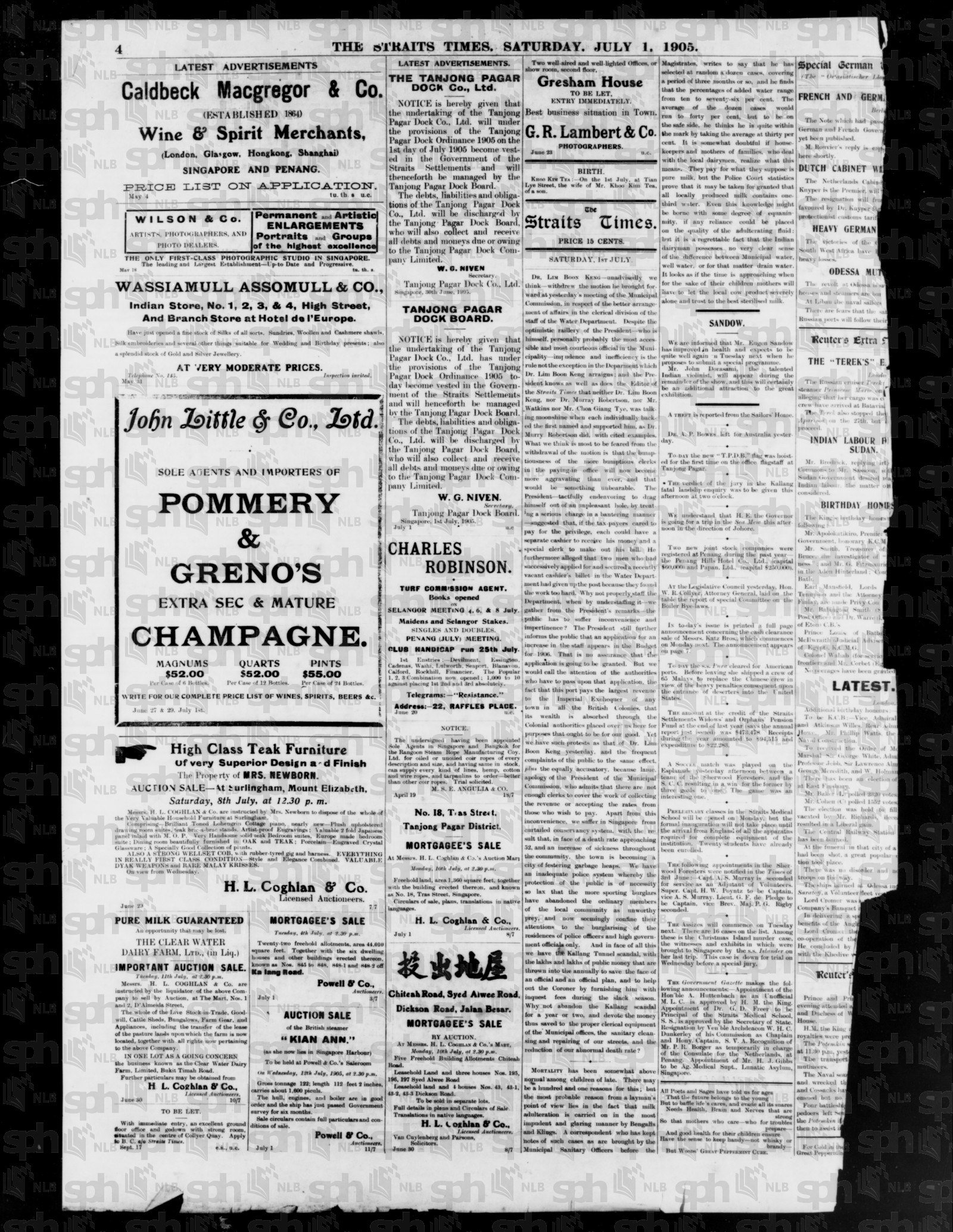 Page 4 of The Straits Times, 1 July 1905. The second column carries the company's notice and the Tanjong Pagar Dock Board's notice that the undertaking had passed to the government. (Singapore Press Holdings, via NewspaperSG, National Library Board Singapore, public domain)
The Straits Times of Saturday 1 July 1905 printed two notices signed by the company’s secretary, W. G. Niven. They said that the company’s undertaking had, under the Tanjong Pagar Dock Ordinance 1905, become vested in the Government of the Straits Settlements on that day, that it would be managed by the Tanjong Pagar Dock Board, and that the Board would discharge the company’s debts and liabilities. A short item on the same page recorded that the new “T.P.D.B.” flag had been hoisted for the first time on the office flagstaff at Tanjong Pagar.
The Governor had told the Legislative Council the day before that the Board would hold its first meeting on 1 July, and that a large number of its members already had very long experience of working the undertaking. The Board had nine appointed members and two official members. One of the appointed members was J. Rumney Nicholson, who had come to Singapore in 1902 as the company’s general manager and later became chairman of the Singapore Harbour Board.
What a share was worth
Compensation was settled by arbitration, with Lord St Aldwyn as umpire, and the award was declared on 14 July 1906. When the Under-Secretary of State for the Colonies, Winston Churchill, answered questions about it in the House of Commons on 28 November 1906, he said it worked out at about $755 per share. The National Library Board’s account gives $761, against the $600 that is recorded as the highest price the share reached on the market.
The questioner, Josiah Wedgwood, put the other side of the case to the House: that the shares had been quoted at about $240 when expropriation was decided on, that the directors had mentioned $700 to the Governor, and that with a total capital of $3.7 million on which 12 per cent was paid, the award came to about $28.5 million, or sixty-five years’ purchase of the annual dividend, against the fourteen years’ purchase the Governor had said was usual. Churchill accepted that the figures were correct except in two respects. Twelve per cent, he said, was the smallest dividend paid in recent years and dividends did not accurately measure the value of the property, and the government had taken over a considerable amount of land not needed for the company’s business. The Governor, he added, had told the directors that 7 per cent was the ordinary rate of interest in Singapore, which on that basis meant fourteen years’ purchase of the ordinary dividend. He also confirmed that the arbitration would cost well over £40,000, of which Lord St Aldwyn received £5,750.
What a $100 share was worth in 1905–06
Five figures from the takeover, ordered by amount (not a timeline)
Sources: House of Commons Hansard, 28 November 1906; BiblioAsia (National Library Board), July–September 2019.
View as table
| Figure | Per $100 share | Note |
|---|---|---|
| Par value of a share | $100 | The face value of one share in the Tanjong Pagar Dock Company. |
| Quoted price when expropriation was decided | about $240 | The Under-Secretary of State for the Colonies, Winston Churchill, told the House of Commons on 28 November 1906 that a quotation of about $240 when expropriation was first decided on was approximately correct. |
| Highest market price reached by the share | $600 | BiblioAsia (National Library Board) gives $600 as the peak the share reached in the stock market. |
| Figure the directors mentioned to the Governor | $700 | Churchill told the Commons that no formal offer was made, but the directors mentioned $700 in conversation with the Governor. |
| Arbitration award (declared 14 July 1906) | about $755 | Churchill told the Commons that the award of Lord St Aldwyn as umpire worked out at about $755 per share. BiblioAsia gives $761. |
What came after
The Tanjong Pagar Dock Board was reconstituted in 1913 as a statutory body, the Singapore Harbour Board, which that year opened King’s Dock, the largest dock east of Suez, and completed Empire Dock in 1917. The Board kept the company’s ship-repair business and controlled the whole chain of repair work at Keppel Harbour for the next five decades. Through later changes of name it became the Port of Singapore Authority in 1964, and eventually the Maritime and Port Authority of Singapore.
See more historical photos related to this post →
Where it fits in the bigger story: Singapore’s deep-water harbour is often told as a story about governors and navies. This part of it began with an agency house, a Chinese rice merchant and shareholders in Singapore and London who wanted a dry dock, and it ended with the government paying more than seven times face value to own what they had built, at a price still being argued over in London a year later. The docks, the coaling wharves and the people who worked them stayed in place. What changed in 1905 was who owned the port.
Sources
- The Story of Two Shipyards: Keppel and Sembawang, BiblioAsia (National Library Board)
- Tanjong Pagar Dock Company Limited is established, Singapore History (National Library Board)
- British government gains control of Tanjong Pagar Dock Co., Singapore History (National Library Board)
- Tanjong Pagar Dock Award, House of Commons, 28 November 1906, Hansard
- “Tanjong Pagar Dock Co., Ltd.” and “Tanjong Pagar Dock Board” notices (page 4) and “T.P.D. New Board and Old Employees” in the Legislative Council report (page 5), The Straits Times, 1 July 1905, NewspaperSG issue index
- Song Ong Siang, One Hundred Years’ History of the Chinese in Singapore (1923; annotated edition, National Library Board and World Scientific, 2020), on Tan Kim Ching (pp. 134–136), the 1871 railway meeting and Ong Kew Ho (p. 223), labour contractors, and the 1905 expropriation debate (p. 539)
- Tanjong Pagar Dock Company, Wikipedia
- Tan Kim Ching, Wikipedia
- File:Schepen in een dok van de Tanjong Pagar Dock Co. (RP-F-F01140-A, meal hour), Wikimedia Commons
- File:Tan Kim Ching.jpg, Wikimedia Commons
- File:RP-F-F01140-N, Albert Dock entrance, Wikimedia Commons (gallery)
- File:RP-F-F01140-E, Chinese cruisers in dock, Wikimedia Commons (gallery)
- File:RP-F-F01140-O, Glen Line steamers, Wikimedia Commons (gallery)
- File:RP-F-F01140-P, section of wharf, Wikimedia Commons (gallery)
- File:RP-F-F01140-I, machine shop, Wikimedia Commons (gallery)
- File:RP-F-F01140-Q, wharf godown, Wikimedia Commons (gallery)
- File:RP-F-F01140-B, H.M.S. Orion, Wikimedia Commons (gallery)
- File:RP-F-F01140-G, H.N.M.S. De Ruyter, Wikimedia Commons (gallery)
- File:RP-F-F01140-C, King of the Netherlands, Wikimedia Commons (gallery)
- File:RP-F-F01140-AS, Maria Rickmers, Wikimedia Commons (gallery)
- File:RP-F-F01140-AT, tug Bangkok, Wikimedia Commons (gallery)
- File:RP-F-F01140-AQ, police station, Wikimedia Commons (gallery)
- File:RP-F-F01140-AY, Slipway company, Wikimedia Commons (gallery)
- File:RP-F-F01104-X, entrance to New Harbour, Wikimedia Commons (gallery)
- File:KITLV 79927, New Harbour c. 1910, Wikimedia Commons (gallery)
- File:Admiralty Chart 2023, Keppel Harbour 1893, Wikimedia Commons (gallery)


