The Fullerton Building: The Post Office With a Lighthouse on the Roof
For about twenty years, a revolving beacon of 540,000 candelas swept the harbour from the roof of Singapore’s General Post Office, visible from ships some 29 kilometres away. Many people who walk past the building today, now a luxury hotel, have never heard that it ever guided anyone anywhere.

The Fullerton Building across the harbour, on a postcard published between 1920 and 1940. (Photo: anonymous, KITLV, Leiden University Library, CC BY 4.0, via Wikimedia Commons)
The square before the building
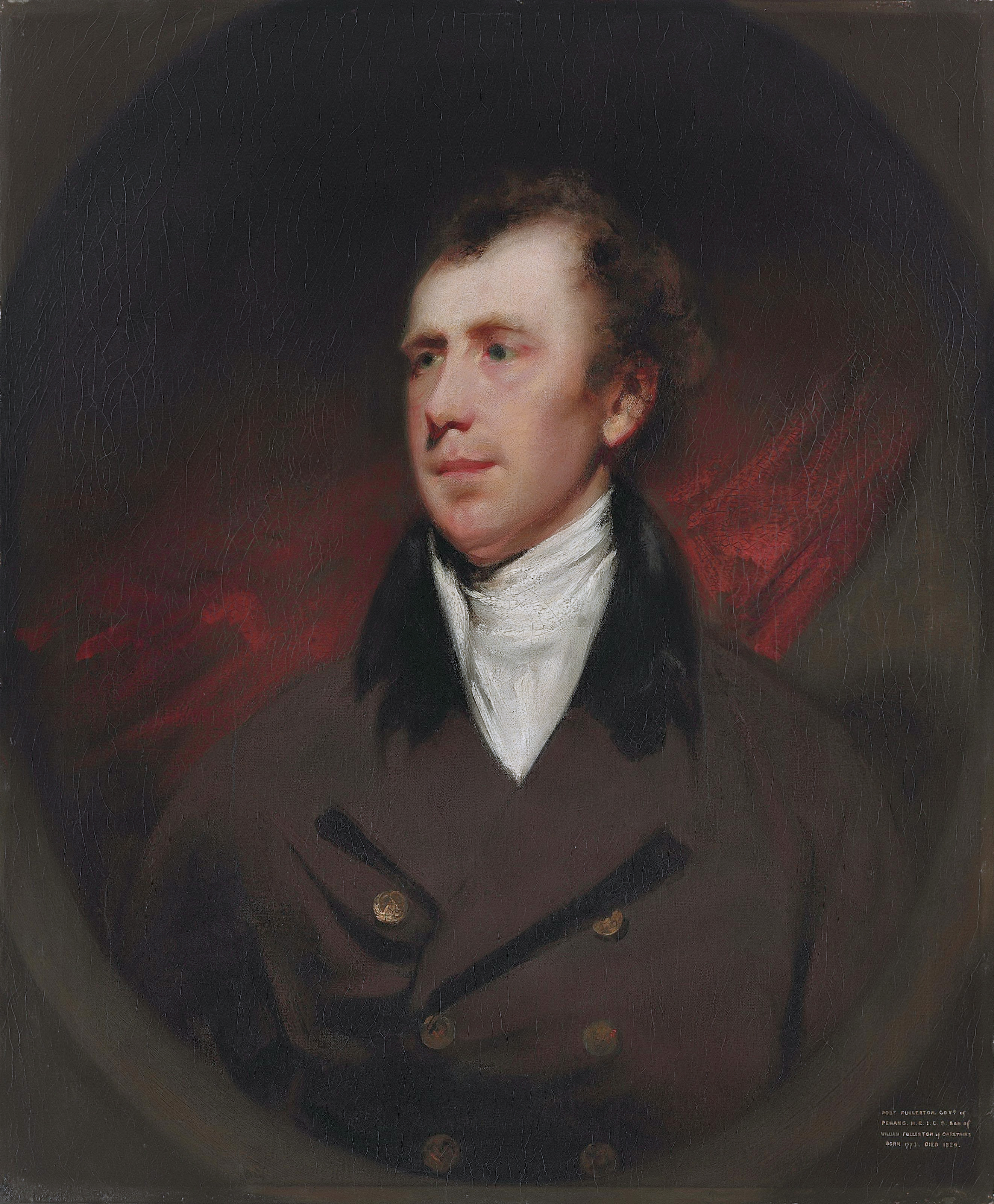 Robert Fullerton, first Governor of the Straits Settlements, in a portrait by George Chinnery painted between 1802 and 1807. (George Chinnery, public domain, via Wikimedia Commons)
The site was named for Robert Fullerton, the first Governor of the Straits Settlements, and began as Fort Fullerton, built around 1829 to guard the mouth of the Singapore River. By the 1880s the ground in front of it had become Fullerton Square, dominated by the Post Office and Exchange Building. In the middle of the square stood the Tan Kim Seng fountain, whose strange afterlife is its own story.

The Post Office and Exchange Building on Fullerton Square around 1890, with the Tan Kim Seng fountain at left. (Photo: unknown, KITLV, Leiden University Library, public domain, via Wikimedia Commons)
By the 1920s the General Post Office was still working from older premises on Collyer Quay, and the government had bigger plans for the waterfront site. The buildings then on it, among them the old Singapore Club and government offices, were cleared to make way for something on a different scale.
The largest building in the Straits
The idea dated from before the First World War, but active work only began in 1920, when Major Percy Keys, of the Shanghai firm Keys & Dowdeswell, was appointed architect. Postwar financial stringency stalled the project for years. Tenders were not called until November 1923, and the contract went to Perry & Co. (Overseas) Limited in February 1924, on a four-year schedule that the builders very nearly met. According to NLB’s BiblioAsia, the site sat below tide level, so the foundations were poured as a floating concrete raft with pumps running continuously.
Sir Hugh Clifford, the Governor, opened it at ten o’clock on the morning of 27 June 1928, beneath the main portico, and used the occasion to give it its name. The original tender had come in just under $4.1 million, and the total vote, including fittings, was $4.75 million, which he expected would not be exceeded. Clifford called it the most imposing building in the Straits Settlements. It stood 120 feet tall behind a colossal Doric colonnade, and it had been designed to house far more than letters: the Post Office, ten other government departments, the Singapore Club and the Chamber of Commerce.
A post office with a subway
The Straits Times described the interior the same day. The public counter was 300 feet long, “probably the longest in the world,” and a letter dropped in the postbox fell to the sub-ground floor, rode a 200-foot conveyor along the basement and was shot onto a sorting table upstairs. Small windowed galleries ran along the sorting-room ceiling so that supervisors could watch the staff unseen, a design copied from the big post offices in Britain.
The most unusual feature was a subway beneath Fullerton Road that led to a Post Office pier. Launches serving the ships in the harbour loaded and unloaded mail there, and the mail travelled up and down by lift or spiral chute. The paper noted that residents who remembered messengers carrying baskets of mail across Fullerton Road in the old days would be grateful for it.
There was also a quirk in the arrangements that the Governor mentioned himself. Singapore had been given the grandest post office in Malaya, yet the head office of the Postal Department itself would stay in Kuala Lumpur, because the telegraph and telephone networks it also ran were administered from there.
Under one roof
 Sir Shenton Thomas, Governor of the Straits Settlements from 1934 to 1942. (Unknown author, public domain, via Wikimedia Commons)
Having so many tenants under one roof made the building a small town on the waterfront. In February 1942, in the final days of the Battle of Singapore, it served as a makeshift hospital, and Governor Sir Shenton Thomas sheltered in the Singapore Club on its upper floors. After the surrender it became a base for the Japanese military administration.

Smoke from the burning Singapore Naval Base oil tanks, seen across Empress Place in early 1942, with the Fullerton Building’s colonnade at right. (Photo: Clifford Bottomley, public domain, via Wikimedia Commons)
In peacetime, the building went on doing what it was designed for. The Post Office, the Marine Department and other government offices worked side by side for decades, and the Inland Revenue Department was among the later tenants.
The light on the roof
On 14 December 1958, a beacon was lit on the roof. It was built by the British firm Stone-Chance, stood about 48 metres above the sea, and replaced the light at Fort Canning, whose 1903 tower had been steadily blocked by new high-rises and was switched off the same month. The sources I found don’t record why a navigation light went on top of a post office, but the building was already home to the Marine Department.

The Fullerton Building in 1973 or 1974, with the Merlion at its original riverside site and new towers rising behind it. (Photo: Rainer Halama, CC BY-SA 4.0, via Wikimedia Commons)
The light did not last as long as the building. Fort Canning’s had been overtaken by the growth of the city, and the Fullerton Light met the same fate as towers went up and reclaimed land spread around the old waterfront. Bedok Lighthouse, Singapore’s first unmanned lighthouse, began operating in August 1978, and the Fullerton Light was decommissioned in the late 1970s. Sources differ on whether that was in 1978 or 1979.
The lantern itself survived. It was moved to the Maritime Museum in 1985, and later to HarbourFront and then to the entrance of Mapletree Business City, where it has since been refitted with LED lamps.

The lantern of the former Fullerton Lighthouse, photographed at HarbourFront Tower One in 2011. (Photo: Thaejas, CC BY-SA 3.0, via Wikimedia Commons)
Emptied, then reborn
The General Post Office moved out in March 1996, and the building was conserved the following year. Sino Land and Far East Organization converted it into The Fullerton Hotel, which opened on 1 January 2001 with about 400 rooms. In December 2015 the building was gazetted a national monument, the 71st in Singapore. The Post Office counter, the mail subway and the rooftop beacon are all gone, but the colonnade remains.
See more historical photos related to this post →
Why it matters today: Almost everyone who sees the Fullerton knows it as a hotel, and some know it as the old GPO. Far fewer know that it was built as the whole waterfront’s working headquarters, with a 300-foot counter, a mail subway, ships’ launches at its door and, for twenty years, a lighthouse on top. It is a reminder that a building’s best-known use is often only one of several lives it has lived.
Sources:
- “THE NEW POST OFFICE.” The Straits Times, 27 June 1928, page 11, NewspaperSG
- “HIS EXCELLENCY’S SPEECH.” The Straits Times, 27 June 1928, page 9, NewspaperSG
- “THE FULLERTON BUILDING.” and “100 YEARS OF LOCAL HISTORY: Fort Fullerton and Later Buildings,” The Straits Times, 27 June 1928, pages 9 and 11, NewspaperSG issue index
- The Fullerton Hotel Singapore, Wikipedia
- Former Fullerton Building, Roots.gov.sg, National Heritage Board
- Former Fullerton Lighthouse Lantern at Mapletree Business City, Roots.gov.sg, National Heritage Board
- The Tale of Three Lighthouses, Roots.gov.sg
- Singapore’s Waterfront Skyline, BiblioAsia, National Library Board
- Bedok Lighthouse, Wikipedia
- File:Robert Fullerton, by George Chinnery.jpg, Wikimedia Commons
- File:Singapore, KITLV 1404891.tiff, Wikimedia Commons
- File:KITLV - 103747 - Post and exchange office in Singapore - circa 1890.tif, Wikimedia Commons
- File:Shenton Thomas.jpg, Wikimedia Commons
- File:Burning oil fields.jpg, Wikimedia Commons
- File:Singapore-Merlion-1973-74-WUS08176.jpg, Wikimedia Commons
- File:Fullerton Lighthouse, Singapore - 20110904.jpg, Wikimedia Commons
- File:Singapore - The Fullerton Hotel IMG 9254.jpg, Wikimedia Commons
- File:Fullerton Hotel - panoramio (1).jpg, Wikimedia Commons
- File:Former Fullerton Lighthouse Lantern at Mapletree Business City, Singapore 2021.jpg, Wikimedia Commons


