The 1915 Singapore Mutiny: The Week a Regiment Rose on Chinese New Year
On the afternoon of 15 February 1915, which was Chinese New Year, about 800 Indian soldiers of the 5th Light Infantry were stationed at Alexandra Barracks, some of them guarding German prisoners of war in the middle of a world war. By evening, some of them had turned their rifles on their own officers and on civilians. It took the better part of a week, and warships from Japan, France and Russia, to put it down.

“Review of Japanese sailors after the mutiny at Singapore,” from H. W. Wilson’s “The Great War,” 1916. (H. W. Wilson, public domain, via Wikimedia Commons)
A regiment with a grievance
 A Musalman Rajput havildar (sergeant) of the 5th Light Infantry, left, beside a Jat havildar of a different regiment, in a watercolour of about 1908. (A. C. Lovett, National Army Museum, public domain, via Wikimedia Commons)
The 5th Light Infantry was a Muslim regiment of the Indian Army, made up largely of Rajput and Pathan sepoys. It reached Singapore in October 1914 and settled into Alexandra Barracks under Lieutenant-Colonel E. V. Martin, whom several accounts describe as a weak commander. In January 1915 the men were told they would be sent to Hong Kong. Rumours spread that this was a cover story and that they were really bound for the front against the Ottoman Empire, whose sultan had called on Muslims to fight Britain and its allies.
A court of inquiry later blamed a mix of causes: the Ottoman call, seditious propaganda circulated by the Ghadar movement, discord within the regiment itself, and the fact that the sepoys had been guarding a camp of German prisoners at Tanglin. Historians still argue about how much weight each deserves, and about whether it was a religious revolt, a nationalist one or an argument among soldiers over their own treatment.
The afternoon of 15 February
At about 3.30 pm, four companies of the regiment rose. Two British officers, Captain Boyce and Lieutenant Elliott, were among the first killed. Around a hundred mutineers went on to the Tanglin camp, where 309 German internees were held, and about ten guards died in the attack. Some 35 Germans escaped, though most did not join the mutineers.
Civilians were among the dead. Through the night, the mutineers besieged the bungalow of the commanding officer. Martial law was declared the next day.
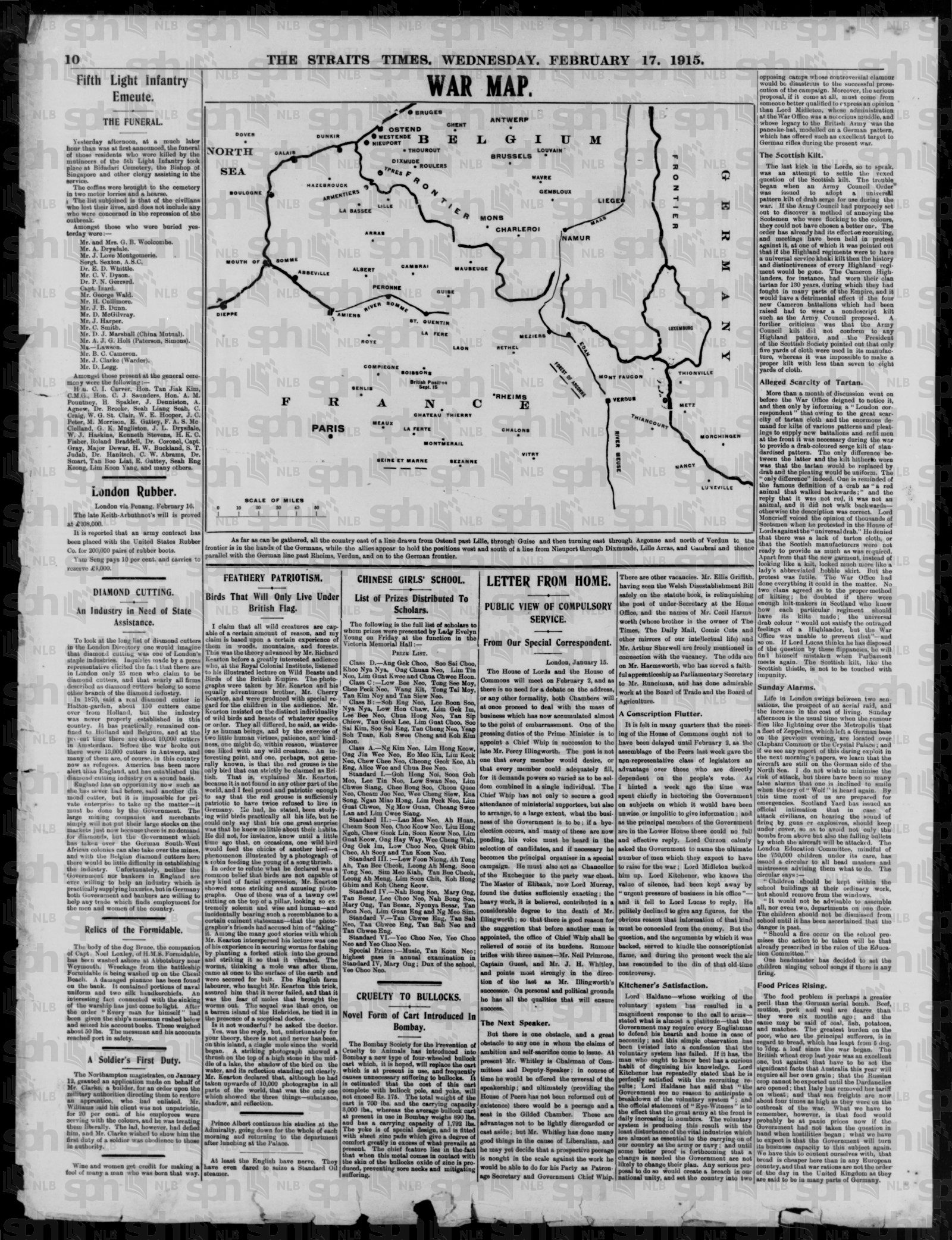 Page 10 of The Straits Times, 17 February 1915. The left-hand column, "Fifth Light Infantry Emeute," reports the funeral of the civilians killed; the rest of the page is a war map. (Singapore Press Holdings, via NewspaperSG, National Library Board Singapore, public domain)
The Straits Times reported that the civilians killed by the mutineers were buried at Bidadari Cemetery the next afternoon, with the Bishop of Singapore assisting. The coffins were brought in two motor lorries and a hearse. The paper’s list covered civilians only, not those killed helping to put down the outbreak. Sources today put the number of soldiers and civilians killed at somewhere between about 36 and 44.
The ships and the sweep
Help came from outside the island. On 17 February, ships arrived: the French cruiser Montcalm, the Russian cruiser Orel, and the Japanese cruisers Otowa and Tsushima. Landing parties from the ships went ashore, roughly 75 Japanese, 22 Russians and 190 French marines, joining the Singapore Volunteer Corps, the Malay States Volunteer Rifles, police, and troops sent by the Sultan of Johor.

The Japanese cruiser Otowa, one of the two Japanese warships sent to Singapore, in a pre-war photograph. (Unknown photographer, public domain, via Wikimedia Commons)
By the evening of 17 February, 432 mutineers had been captured. The Shropshire Light Infantry arrived from Rangoon on 20 February. Some of the mutineers had fled into Johor, where a group was picked up the same day. The fighting was largely over within a week, though a last skirmish was reported on 25 February.
Trials and public executions
More than 200 men were court-martialled. Forty-seven were executed, about 64 were transported for life, and roughly 73 were imprisoned for between seven and twenty years. The executions took place outside Outram Road Prison, in public, although public executions had ended in the 1890s.

Outram Prison, then called Pearl’s Hill Prison, in the 1850s. Its walls were the setting for the 1915 executions. (Unknown photographer, public domain, via Wikimedia Commons)
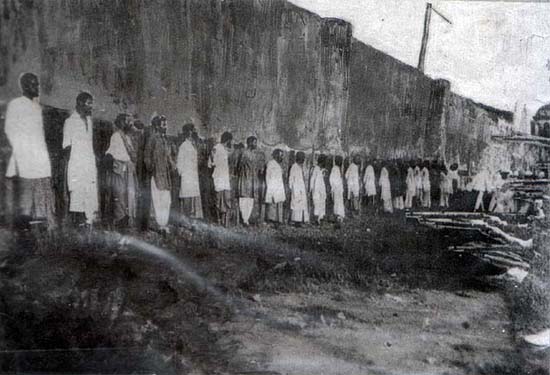 A line of men against the prison wall at Outram Road, captioned in a 1995 collection of documents as the convicted mutineers before their execution. The print is grainy and its exact date is not established. (Tilak Raj Sareen, Secret Documents on Singapore Mutiny 1915, public domain, via Wikimedia Commons)
The Straits Times described the largest batch. On 25 March, the sentences of 45 mutineers were read out in public outside the prison walls, and the 22 who had been condemned to death were executed on the spot. The paper estimated a crowd of 15,000 watching from the slopes of Sepoy Lines. The firing party was 110 men of the Singapore Volunteer Corps, and the sentences were translated into Malay, Chinese and Hindustani for the audience. Other accounts name a different firing party, and which men fired on which day is still disputed.
The full trial records were sealed for about fifty years.
What changed, and what is remembered
The 5th Light Infantry left Singapore in July 1915 and was disbanded in 1922. Three years after the mutiny, the colonial government created a Criminal Intelligence Department, which became the Special Branch and, later, the Internal Security Department.
The mutiny left few marks on the city. There are memorial tablets to the dead at the Victoria Memorial Hall and plaques at St Andrew’s Cathedral, and a few roads, such as Walton, Harper and Holt Roads, are named for the people killed. I could find no memorial in Singapore to the men who were executed. Historians still frame the event differently, some as a colonial security failure, others as part of a wider global war in which Indian soldiers had their own reasons to act.

The memorial tablet to those killed in the February 1915 mutiny, at what is now the Victoria Concert Hall. (Photo: Smuconlaw, CC BY-SA 3.0, via Wikimedia Commons)
A firm approach to unrest
Singapore treats racial and religious tension as a matter for law as well as persuasion. Parliament repealed the Sedition Act in 2021, but the Maintenance of Religious Harmony Act of 1990 lets the Minister issue restraining orders against religious leaders, and a new Maintenance of Racial Harmony Act came into force on 15 September 2026, replacing the race-related offences in the Penal Code. Housing and electoral rules are also designed to mix communities. The state usually explains this approach by pointing to the racial riots of 1964 and 1969, and supporters see it as a safeguard against a danger that has already been shown to be real.
Critics, including scholars and United Nations experts, have questioned what such laws mean for freedom of expression. I found no official speech that cites 1915 in this debate. It is an earlier episode, though, in which questions of religion, community and loyalty collided with colonial authority.
See more historical photos related to this post →
Why it matters today: The mutiny is one of the few times the island’s colonial order was seriously shaken from inside, yet it is far less remembered than the wars that followed. Its lessons are still argued over, from how a government treats the soldiers it relies on to how it balances order against free expression.
Sources:
- “Fifth Light Infantry Emeute.” The Straits Times, 17 February 1915, page 10, NewspaperSG
- “The Mutiny: Execution of Twenty-Two Renegades,” The Straits Times, 26 March 1915, page 7, NewspaperSG issue index
- 1915 Singapore Mutiny, Wikipedia
- Trial by Firing Squad, BiblioAsia, National Library Board
- The Sepoy Mutiny of 1915, Internal Security Department
- How a handful of Indian soldiers rose against the British in Singapore during WWI, Scroll.in
- The real story behind photo of soldiers being executed in Singapore in 1915, Heritage Times
- Singapore Mutiny of 1915: global origins in a global war, Heather Streets-Salter, Cambridge University Press
- Commencement of the Maintenance of Racial Harmony Act 2025, Ministry of Home Affairs
- Maintaining Racial and Religious Harmony, Ministry of Home Affairs
- Sedition Act (Singapore), Wikipedia
- Maintenance of Religious Harmony Act, Wikipedia
- File:REVIEW OF JAPANESE SAILORS ALTER THE MUTINY AT SINGAPORE, 1915.png, Wikimedia Commons
- File:A Musalman Rajput Havildar of the 5th light infantry and a Jat Havildar of the 6th Jat light infantry.jpg, Wikimedia Commons
- File:Japanese cruiser Otowa.jpg, Wikimedia Commons
- File:Photograph of Outram Prison (Pearl’s Hill Prison) in the 1850’s.jpg, Wikimedia Commons
- File:1915 Singapore Mutiny memorial tablet, Victoria Concert Hall, Singapore - 20140926.jpg, Wikimedia Commons
- File:Cruiser Montcalm - Page’s Magazine 1902.png, Wikimedia Commons
- File:1915 Singapore Mutiny.jpg, Wikimedia Commons


