When Singapore Had Wild Tigers
By the middle of the 19th century, tigers in Singapore were rumoured to kill a person every day. Pressed on the subject in the House of Commons, the Governor of the Straits Settlements put the real figure at a still-alarming two hundred deaths a year, in a population of only fifty thousand. The last of those tigers was shot in 1930, at the edge of what is now Choa Chu Kang New Town. Wild animals never really left Singapore after that — they just got smaller, and mostly harmless. An otter family crossing the road in the middle of the financial district now gets a road sign of its own.

A “watch out for otters crossing” sign on Robertson Quay, a few minutes’ walk from Raffles Place. (Photo: Philip Mallis / Flickr / Wikimedia Commons, CC BY-SA 4.0)
A menace worth a bounty
Singapore’s tigers were never native in the sense of having nowhere else to go. They swam across the Strait of Johor from Malaya — strong enough swimmers that some were caught in the fishing stakes set along the shore — and found a virgin jungle full of pigs and deer to hunt. The earliest newspaper report of an attack, in the Singapore Chronicle on 8 September 1831, described a Chinese man killed, with the same tiger probably responsible for a second death shortly after. In May 1839 two labourers were carried off near what is today Serangoon Road, then known as Rangong Road.
The real danger began with gambier and pepper. When cultivation of the two crops took off from the 1840s, plantations pushed out of the town and into the jungle tigers hunted in; by the late 1840s there were some six hundred of them. Chinese plantation coolies made easy, isolated targets, and reports of encounters rose through the 1830s and 1840s. By the middle of the century tigers were rumoured to kill someone every day. William Butterworth, the Governor of the Straits Settlements, questioned on the subject in the House of Commons, gave a still-alarming estimate of two hundred deaths a year. A village near Bukit Timah was abandoned altogether in 1859 after repeated attacks. Officially, only seven deaths were reported to the police in 1857, against a believed toll of three hundred; plantation owners often kept quiet about the deaths, unwilling to scare off the next batch of workers.

The landing point of a gambier and pepper plantation in Singapore, around 1900 — a man carries in a bundle of gambier leaves. Isolated plantation labourers were the tigers’ most frequent victims. (National Archives of Singapore, via Wikimedia Commons, public domain)
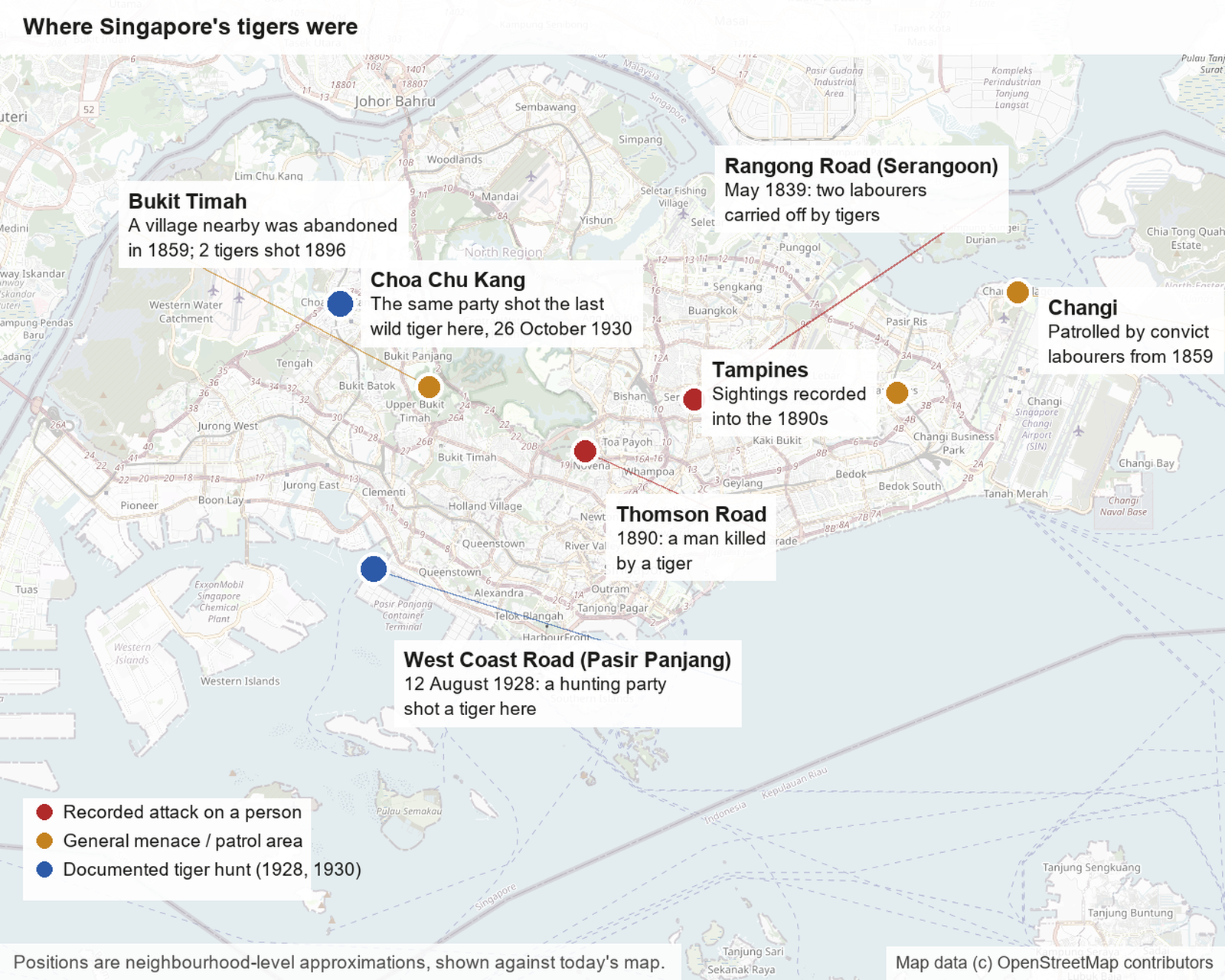
Where the tigers were: two recorded attacks on people, the general menace and patrol areas, and the two documented hunts — Pasir Panjang in 1928 and Choa Chu Kang in 1930. (Map data © OpenStreetMap contributors)
The government’s answer was money. A reward of twenty dollars a tiger climbed to fifty, then a hundred, then a hundred and fifty as the toll grew, and hunters could earn more again selling the skin and other parts. Pits four to four and a half metres deep were dug and camouflaged; a tiger caught alive went into a rattan basket too strong to bite through, and one caught in a pit was often simply shot where it lay. Hunting tigers became something between a public service and a sport, lucrative enough that at least two Europeans made a living at it. In 1859 the Superintendent of Convicts, J. F. A. McNair, put convict labourers on regular patrol through Bukit Timah, Serangoon, Changi and Choa Chu Kang; within a year the patrols had killed half a dozen tigers.
The last tiger
The bounty and the shrinking jungle did their work. A man was killed by a tiger on Thomson Road in 1890, and two more tigers were shot at Bukit Timah in 1896, but sightings after that grew rare. In 1902 a tiger did turn up in the middle of town, hiding under the elevated Bar & Billiard Room of the Raffles Hotel — but it was not one of the wild survivors. It had escaped from a travelling circus on Beach Road and was shot by Charles McGowan Phillips, the principal of nearby Raffles Institution. It’s the story most people know; the wild tiger it’s usually mistaken for had, by then, almost nowhere left to hide.
By the 1920s a wild tiger in Singapore was rare enough to be an event. My wife’s family has a thread in this story of its own. One of her maternal relatives, by family account, was part of the hunting party on 12 August 1928 that tracked down a Malayan tiger off West Coast in the Pasir Panjang district — though he never claimed to have fired the shot himself, only to have been there.
That hunt is on the record. A group photograph held by the National Archives names sixteen of the party — Tan Tian Quee as leader, Tan Ah Mui credited with the shot, a tracker recorded only as Mahally — with a row of beaters left unnamed. The tiger was killed in the jungle at the tenth milestone of West Coast Road, and measured eight feet three inches from nose to tail.
The same party finished the job two years later. On 26 October 1930, at eleven in the morning, on the fringe of Choa Chu Kang village, Ong Kim Hong — one of the 1928 group — shot a tiger of eight feet six inches. It was the last wild tiger anyone recorded in Singapore. A photograph of the party under the village’s roadside sign, several dozen men and their dogs, survives in the National Library’s collection.
Timeline as a table
| Year | Event |
|---|---|
| 1831 | First newspaper report of a tiger attack (Singapore Chronicle, 8 September) |
| 1839 | Two labourers carried off near Rangong Road (today's Serangoon Road) |
| 1857 | A believed 300 deaths from tiger attacks; only seven reported to the police |
| 1859 | A village near Bukit Timah abandoned after repeated attacks; convict patrols begin |
| 1890 | A man killed by a tiger on Thomson Road |
| 1902 | An escaped circus tiger shot under the Raffles Hotel (not a wild tiger) |
| 1928 | A Straits Chinese hunting party shoots a tiger off West Coast Road, Pasir Panjang (12 August) |
| 1930 | The same party shoots the last wild tiger, at Choa Chu Kang (26 October) |
From tiger to otter
A century later, Singapore has wild animals again, just not the kind that used to kill a person a day. Smooth-coated otters, extinct here for decades, began turning up in the 1990s and have since colonised the island’s waterways so thoroughly that a family swimming past Robertson Quay or Sungei Serangoon is now closer to routine than remarkable — routine enough that the road sign pictured above shares a signpost with an ordinary traffic-slowing notice, not a special warning of its own.

A family of smooth-coated otters in Sungei Serangoon (Serangoon Reservoir). (Photo: Kokhuitan / Wikimedia Commons, CC BY-SA 4.0)
The Oriental Pied Hornbill tells a similar story: locally extinct for decades, it recolonised Singapore from the 1990s onward and is now seen in parks and reserves across the island, from Sungei Buloh to the Botanic Gardens.

An Oriental Pied Hornbill at Sungei Buloh Wetland Reserve. (Photo: Tan Pek Nan / Wikimedia Commons, CC BY 4.0)
Not every comeback is welcome. Wild boars from the forests of Pulau Ubin and the Central Catchment area have pushed into nearby housing estates often enough that, in a 2020 survey, nearly 40 per cent of Pasir Ris residents said they would rather the animals — along with the neighbourhood’s stray dogs — were removed or relocated altogether. The National Parks Board’s usual first move is to relocate an animal; it culls only when an animal is judged a genuine danger, as with a boar that attacked a woman and bit an officer in Punggol in February 2021, after residents had been feeding it.

Wild boars on a forest path at Pulau Ubin. (Photo: Zairon / Wikimedia Commons, CC BY-SA 4.0)
Saltwater crocodiles get the same case-by-case treatment. When a nearly three-metre crocodile turned up near Marina East Drive in October 2023, NParks first looked at relocating it to Sungei Buloh Wetland Reserve — already home to twenty crocodiles and with no room for another — and only put it down once that option was closed off. A smaller crocodile spotted off Sentosa Cove in January 2026 was simply kept under watch for a week, with beaches reopened once it moved on; another spotted off the same stretch that May was caught and euthanised in turn.

Eco-Link@BKE, opened 2012, the first bridge of its kind in the Asia-Pacific. (Photo: Jnzl’s Photos / Flickr / Wikimedia Commons, CC BY 2.0)
The clearest sign of how far the management philosophy has shifted sits over the Bukit Timah Expressway, on almost the same ridge that killed two tigers in 1896. The Eco-Link@BKE, a 75-metre vegetated bridge, was built for no other reason than to let animals move between the Bukit Timah and Central Catchment nature reserves without having to cross the highway at all.
Where it fits in the bigger story: Singapore spent a century clearing the jungle that made tigers a genuine daily danger, and now spends real effort managing what has grown back in its place — a boar, a crocodile, a hornbill, a family of otters. The forest patches that are left, Bukit Timah and the Central Catchment chief among them, have become some of the few places on the island where the built-up city recedes, which may be exactly why they draw a following among Singapore’s own seniors, many of whom now treat a hike through them as a regular part of retirement — a quiet, present-day echo of an island that was once almost entirely theirs.
Sources:
- Tigers in Singapore — Singapore Infopedia, National Library Board
- “This tiger was shot by Tan Ah Mui (Chan Ah Mui)…” (12 August 1928, off West Coast Road, Pasir Panjang) — Tan Tuan Khoon Collection, National Archives of Singapore
- When Tigers Used to Roam — BiblioAsia, National Library Board
- File:ChineseGambierSingapore.jpg — Wikimedia Commons
- Nearly 40% of Pasir Ris residents would prefer to remove or relocate wild boars & stray dogs from estate — Mothership.SG
- Singapore wild boar caught, euthanized after dramatic chase — Inquirer.net
- NParks to put down 3m-long crocodile found at East Coast Park for ‘public safety’ — Mothership.SG
- NParks considered relocating crocodile basking at East Coast but Sungei Buloh already full — Mothership.SG
- It’s been a while, crocodile: Singapore reopens Sentosa beaches after scaly guest moves on — Malay Mail
- Crocodile seen in waters off Sentosa Cove caught & euthanised — Mothership.SG
- Eco-Link@BKE — Wikipedia
- File:’Watch out for otters crossing’ sign on Robertson Quay near Kim Seng Park, Singapore.jpg — Wikimedia Commons
- File:Smooth-coated otters (Lutrogale perspicillata), Sungei Serangoon, Singapore - 20130518.jpg — Wikimedia Commons
- File:Anthracoceros albirostris (Oriential Pied Hornbill).jpg — Wikimedia Commons
- File:Singapore Wildschweine auf Pulau Ubin 1.jpg — Wikimedia Commons
- File:Eco-link @ BKE (23337731653).jpg — Wikimedia Commons
- Map data © OpenStreetMap contributors


