The Botanic Gardens and the Rubber That Remade Malaya
Joggers, wedding photographers and picnicking families fill the Singapore Botanic Gardens most weekends, and few of them know they’re walking through the origin point of one of the twentieth century’s biggest economic transformations. A UNESCO World Heritage Site since 2015 — the only tropical botanic garden on the list — it looks like exactly what it is: a beautifully kept research garden. It doesn’t look like the place that decided, more or less single-handedly, that Malaya would become the world’s rubber supplier.

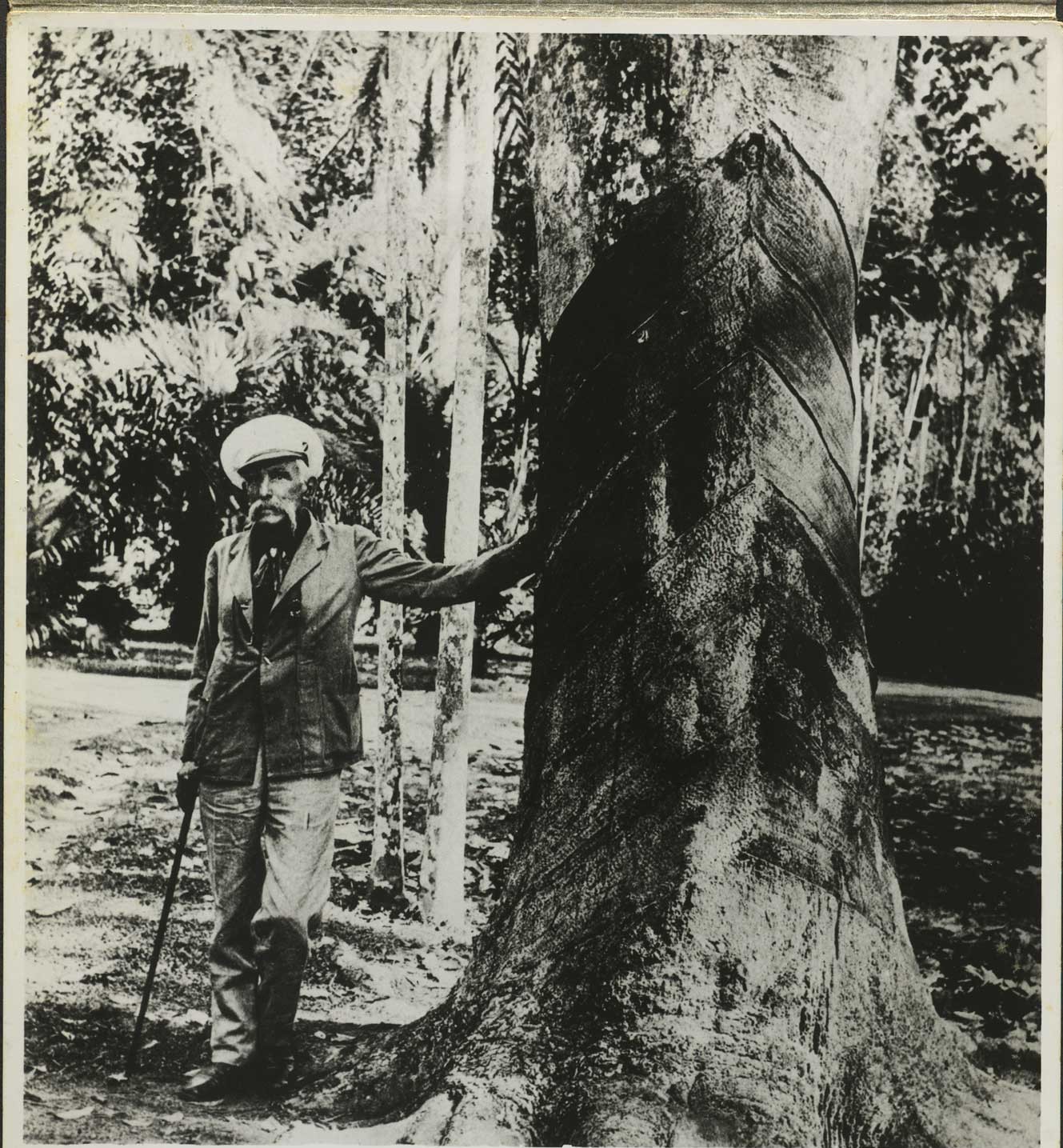
Henry Nicholas Ridley beside a Para rubber tree, its bark cut in his herringbone tapping pattern, around 1900. (Photo: Singapore Ministry of National Development, public domain, via Wikimedia Commons)
 Seeds of Hevea brasiliensis, the Para rubber tree — the same kind Wickham smuggled out of Brazil in 1876. (Photo: Luis Fernández García, CC BY-SA 2.5, via Wikimedia Commons)
The rubber itself came from a theft. In 1876, an Englishman named Henry Wickham smuggled around 70,000 Para rubber (Hevea brasiliensis) seeds out of Brazil, breaking the country’s wild monopoly on the world’s only reliable source of natural rubber. Most of the roughly 2,700 seeds that germinated at Kew Gardens in London went to Ceylon. A smaller batch — 22 seedlings, sent from Kew on 11 June 1877 — went to Singapore, and eleven of them were planted at the Botanic Gardens itself.
For over a decade, that was the end of the story. Nobody wanted to grow rubber. Malaya’s planters were making their money from coffee and gambier, and a slow-growing tree with no proven market held no appeal. When Henry Nicholas Ridley arrived in 1888 as the Gardens’ new director, he inherited a stand of mature, healthy, entirely uneconomic trees — and became obsessed with them anyway.
 Henry Wickham, whose 1876 seed-smuggling operation out of Brazil started the whole story. (Photo: Biblioteca Nacional Digital Brasil, CC BY-SA 4.0, via Wikimedia Commons; cropped)
 A 1961 Federation of Malaya postage stamp, "Tapping Rubber" — by then a mature national industry built on estates like Tan Chay Yan's. (Photo: Government of Malaya, public domain, via Wikimedia Commons)
Ridley spent the next several years pestering anyone who would listen, and plenty who wouldn’t — he carried rubber seeds in his own pockets and pressed them on visiting planters uninvited, earning himself the nickname “Mad Ridley.” His actual scientific contribution was solving the one real problem holding rubber back: the wild-rubber tapping method used in Brazil hacked deep into the bark and killed the tree within a few seasons. Around 1895, Ridley worked out a shallow, diagonal herringbone cut that let a tree be tapped for latex again and again without dying. It’s essentially the same method used on rubber trees today.
The planters only started listening once they had no choice. A coffee-leaf disease tore through Malaya’s coffee estates in the 1890s, wiping out the crop those planters had been counting on. In 1896, a Malacca-born Straits Chinese planter named Tan Chay Yan — grandson of the philanthropist Tan Tock Seng — used Gardens seedlings to plant a 22-acre rubber estate at Bukit Lintang. It worked. By 1898 he’d expanded into a 3,000-acre estate at Bukit Asahan; by 1906 that single plantation was the largest stand of Hevea rubber anywhere in the world, and other planters were finally following his lead.
Then the automobile arrived. Demand for tyres sent rubber prices climbing through the 1900s into the speculative “rubber boom” of 1910, and Malaya’s planters had exactly what the market wanted. Within twenty years of Tan Chay Yan’s first planting, Malaya’s rubber acreage went from around 345 acres to more than 2.3 million. By the 1920s, the country alone supplied roughly half the world’s natural rubber.
Ridley himself never made a cent from any of it. He left Malaya in 1911, spent the rest of his long life publishing plant taxonomy back in England, and died in 1956 at nearly 101 — outliving almost everyone who’d once called him mad. Singapore’s press at the time put it plainly: he’d made millions for Malaya and never made a penny in the boom.
 The Botanic Gardens today, inscribed a UNESCO World Heritage Site in 2015 partly for the pivotal role its rubber research played in the region's history. (Photo: PinciiKee, CC BY-SA 4.0, via Wikimedia Commons)
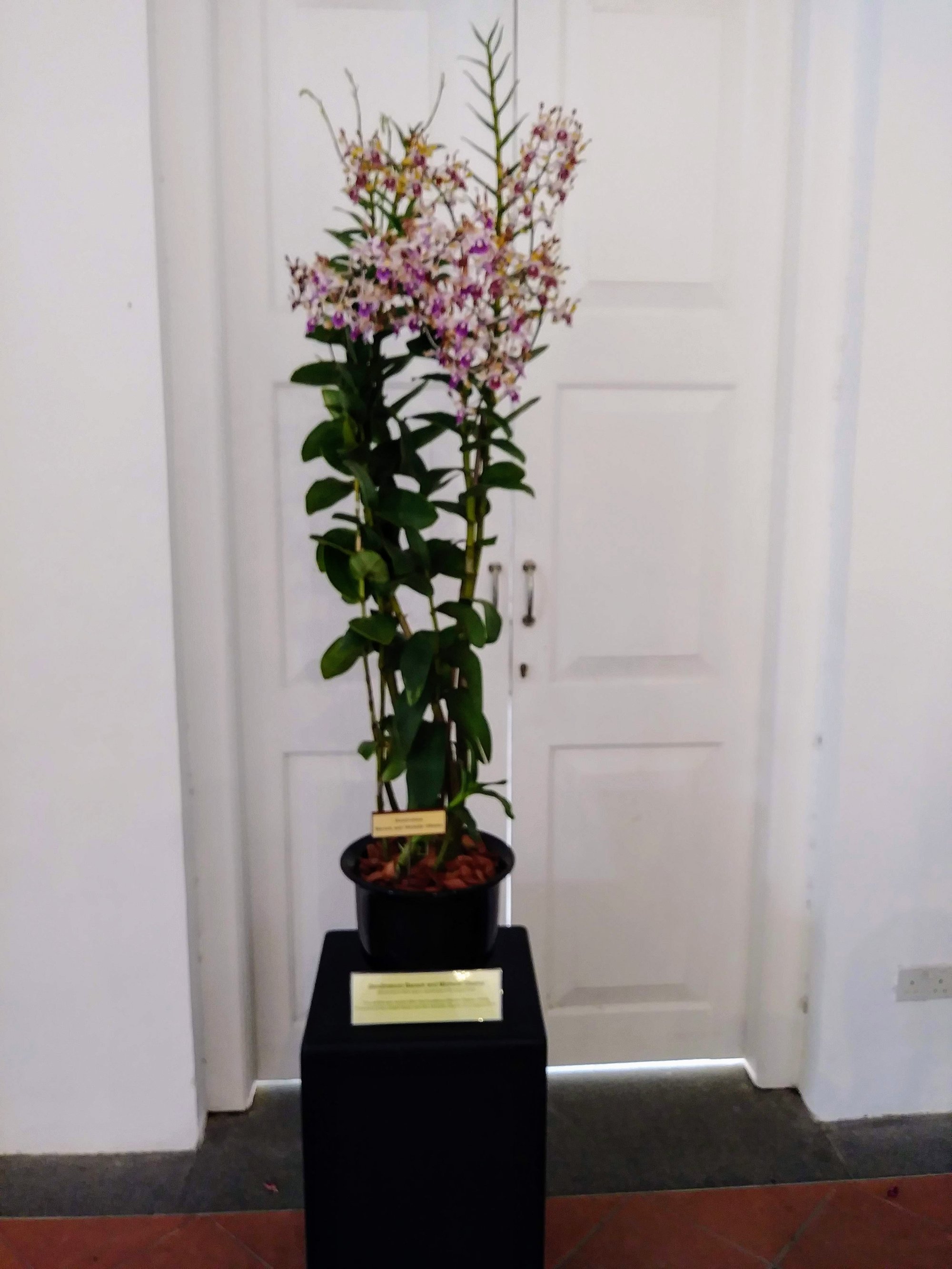 Dendrobium Barack and Michelle Obama, photographed on a visit of my own in 2018. (Photo: Chris Lee)
I’ve visited the Gardens myself, most memorably to see this orchid — Dendrobium Barack and Michelle Obama, a hybrid named for the then-US president and First Lady in August 2016 to mark fifty years of US-Singapore diplomatic ties. It’s one of dozens of orchids in the National Orchid Garden named after visiting heads of state over the decades, a much gentler kind of horticultural diplomacy than the one this post is actually about.
See more historical photos related to this post →
Why it matters today: a botanic garden most people treat as a place for a quiet walk or a wedding photo is where a persistent, unpaid civil servant turned a handful of stolen Brazilian seeds into the industry that built modern Malaysia and Singapore’s early economy. The trees themselves are largely gone now, but the tapping method cut into their bark over a century ago is still how the world’s rubber gets harvested.
Sources:
- Henry Nicholas Ridley — Wikipedia
- Singapore Botanic Gardens — Wikipedia
- Tan Chay Yan — Wikipedia
- Henry Wickham (explorer) — Wikipedia
- “Ridley — he made millions for Malaya — is dead” — The Straits Times, 26 October 1956, NewspaperSG
- “He founded the rubber trade” — The Straits Times, 31 December 1949, NewspaperSG
- “Our debt to Dr. Ridley — man who ended hatchet tapping” — The Straits Times, 28 June 1955, NewspaperSG
- “Gardens’ rubber research a key factor for accolade” — The Straits Times, 6 July 2015, NewspaperSG
- File:Henry Nicholas Ridley, Botanist (1855-1956).jpg — Wikimedia Commons
- File:”Henry Wickham, who in 1876 directed an operation smuggling 70,000 rubber tree seeds”.jpg — Wikimedia Commons
- File:UNESCO HERITAGE AT BOTANIC GARDEN 1859.jpg — Wikimedia Commons
- File:Tan Chay Yan.png — Wikimedia Commons
- File:Statue of Sir Henry Nicholas Ridley (DSCF0927).jpg — Wikimedia Commons
- File:6. Tanglin Gate.jpg — Wikimedia Commons
- File:Singapore Botanic Gardens, Cluny Park Gate, Sep 06.JPG — Wikimedia Commons
- File:Singapore Botanic Gardens 6, Jul 06.JPG — Wikimedia Commons
- File:Singapore Botanic Gardens Palm Valley.jpg — Wikimedia Commons
- File:Singapore coconut.jpg — Wikimedia Commons
- File:Singapore Botanic Gardens, Bamboos 3, Sep 06.JPG — Wikimedia Commons
- File:Singapore Botanic Gardens Cactus Garden 1.jpg — Wikimedia Commons
- File:Singapore Botanic Gardens waterfall.jpg — Wikimedia Commons
- File:Singapore Botanic Gardens 4, Jul 06.JPG — Wikimedia Commons
- File:Singapore Botanic Gardens, Eco-lake, panorama, Sep 06.jpg — Wikimedia Commons
- File:Bandstand, Singapore Botanic Gardens - 20060805.jpg — Wikimedia Commons
- File:Chopin at Singapore Botanical Gardens.jpg — Wikimedia Commons
- File:Singapore Botanic Gardens, Jul 06.JPG — Wikimedia Commons
- File:Singapore Botanic Gardens, Evolution Garden 25, Sep 06.JPG — Wikimedia Commons
- File:1961tappingrubber.png — Wikimedia Commons
- File:Hevea semillas2.jpg — Wikimedia Commons
- File:KITLV - 79909 - Kleingrothe, C.J. - Medan - Botanical Gardens, Singapore - circa 1910.tif — Wikimedia Commons


