Whampoa: The Merchant Who Brought Singapore Its First Ice
Most Singaporeans know Whampoa as a place — a housing estate near Novena and Balestier, a hawker centre whose sign spells the name out in giant letters — not a person. Almost nobody connects it to Hoo Ah Kay, the 19th-century merchant behind it, who at various points supplied the Royal Navy, imported Singapore’s first ice, sat on the colonial Legislative Council, and served as honorary consul for three different empires at once.
I never lived in Whampoa myself, but I’ve known the name my whole life — it’s right next to Hougang, where I grew up. I never once wondered who it actually belonged to, until I went looking.

Hoo Ah Kay — “Whampoa” — wearing the CMG and a second honour, in a studio portrait from later in his life. (Wellcome Collection, CC BY 4.0, via Wikimedia Commons.)
Who he was
Hoo Ah Kay was born in 1816 in Whampoa, a district of Canton — today’s Huangpu, in Guangzhou — which gave him the name Singapore would remember him by. He arrived in Singapore in 1830, still a boy, to work alongside his father at the family’s provisioning firm, Whampoa & Co. He inherited the business on his father’s death and, by 1840, had built it into a shipchandler to the British Royal Navy, supplying the frigates that called at the harbour.
 Admiral of the Fleet Sir Henry Keppel, late in his long career. (Public domain, via Wikimedia Commons.)
That role grew into a genuine friendship with one particular officer. Henry Keppel, the aristocratic son of the 4th Earl of Albemarle, first sailed into Singapore as a young officer in 1832 and kept coming back for the next seven decades, eventually helping suppress piracy across the Malay Archipelago in the 1840s and surveying the deep-water anchorage then known as New Harbour. He revisited Singapore once more in 1900, at the age of 92; the colonial government renamed the harbour Keppel Harbour on the spot, in his honour, four years before his death at 95. Whampoa was his regular provisioner across that entire span — a business relationship that outlasted most friendships.
Singapore’s first ice
In 1854 Whampoa partnered with a fellow merchant, Gilbert Angus, on something genuinely new to the tropics: ice. Blocks were cut from frozen lakes in the United States, packed in thick sawdust using a technique the American ice merchant Frederick Tudor had pioneered to slow the melt, and shipped across a months-long ocean voyage to an ice house Whampoa built at Boat Quay — on land the colonial government gave him in exchange for his own 60-acre nutmeg plantation at Tanglin, a stretch of ground that would later become the founding site of the Singapore Botanic Gardens.
It was a bet on demand that didn’t exist yet. The partners projected sales of 1,000 pounds of ice a day and got 400 to 500. Within three years, on 30 November 1857, Whampoa withdrew from the partnership, forced out by heavy financial losses. Singapore’s first taste of ice was, commercially, a flop.

Boat Quay around 1900 — the riverside district where Whampoa’s ice house once stood. (Public domain, via Wikimedia Commons.)
The site outlived his failure. An American firm, Tudor Ice, took over in 1861 and did no better, but by 1865 a locally-run competitor, Singapore Ice Works, had taken the building — making ice instead of importing it, at a third less cost — and turned it into the colony’s dominant ice factory through the 1880s. The Victorian ice house stood at Boat Quay for well over a century before it was finally torn down in 1981 to widen River Valley Road; a replica now occupies roughly the same stretch of riverbank. Whampoa & Co. itself didn’t last much beyond his own sons — but the ice trade he started at that one spot on the river did, for decades, just not under his name.
Beyond ice
Whampoa’s public career outgrew his balance sheet. In 1869 he became the first Asian nominated to the Straits Settlements Legislative Council; the following year, on 23 May 1870, he took the rarer position of extraordinary member of the Executive Council — the only Chinese man ever to hold it. Over the 1870s he served as honorary consul for China, Japan and Russia, an unusual concentration of diplomatic trust for a merchant of any background in colonial Singapore, and on 10 May 1876 became the first Chinese recipient of the Order of St Michael and St George, appointed a Companion (CMG). None of it came from a title track or a birthright — it came from four decades of being useful to everyone who mattered, from a British admiral to three separate empires.
The garden
Whampoa’s other legacy was more private: a sprawling garden estate on Serangoon Road, decades in the making, with an orange plantation, rockeries, artificial ponds, a small menagerie and an aviary. It became a genuine gathering place for Singapore’s Chinese community and drew a stream of distinguished visitors over the years, including Admiral Keppel himself. After Whampoa’s death in 1880 the estate passed to the merchant Seah Liang Seah, who renamed it Bendemeer House at the governor’s suggestion and kept the tradition of lavish entertaining going into the early 1900s. By the 1950s the mansion had fallen into disrepair; the government acquired the site in 1964 and demolished it for redevelopment. Nothing of the garden survives today — only the road names, Bendemeer and Whampoa, sitting a short walk apart.

“Avenue to Whampoa’s Gardens” — an American visitor’s own illustration of the estate, published a few years after Whampoa’s death. (Public domain, via Wikimedia Commons.)
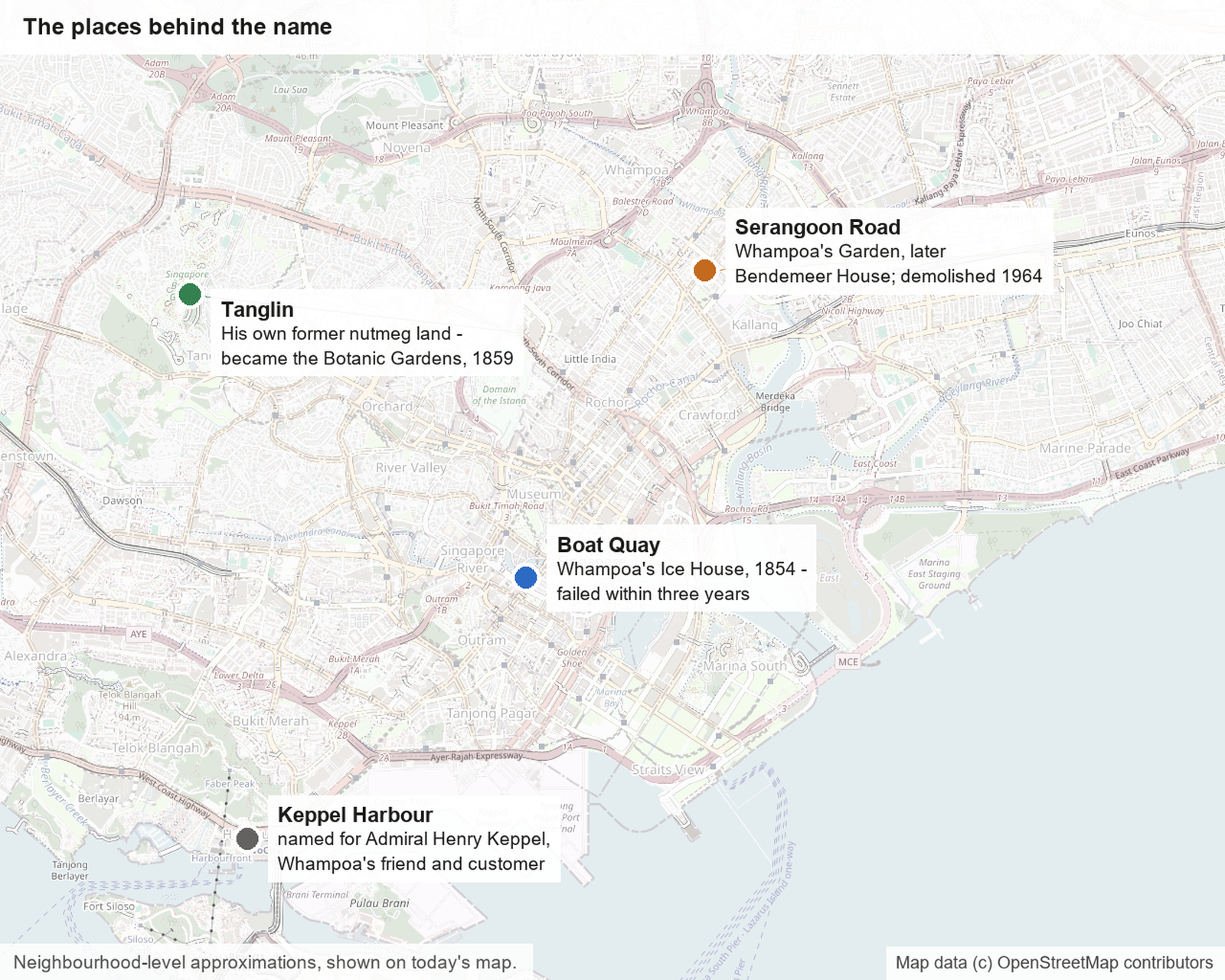
The places behind the name — none of them still connected to Whampoa in most people’s minds. (Map data © OpenStreetMap contributors.)
What’s left today

Bendemeer Road, with a “Whampoa South” sign just visible on the right — the two names from Whampoa’s story, standing a street apart, unconnected in most passers-by’s minds. (Photo: Kimchi.sg, CC BY-SA 3.0, via Wikimedia Commons.)
See more historical photos related to this post →
Why it matters today: Hoo Ah Kay never got a founder’s statue or a national holiday — just a housing estate, a hawker centre and a stretch of road that all carry a name most people walk past without a second thought. His actual businesses mostly didn’t survive him; his name did, detached from everything he actually did. It’s a smaller, quieter version of the same pattern this blog keeps finding in Singapore’s street map: the name outlives the man, and finding him again takes actually going looking.
Sources:
- Hoo Ah Kay, Wikipedia
- Whampoa’s Ice House, Wikipedia
- Bendemeer House, Wikipedia
- Henry Keppel, Wikipedia
- A Mansion in Serangoon: Whampoa House-Bendemeer, BiblioAsia, National Library Board
- A Cool Business: The History of Ice-Making in Singapore, BiblioAsia, National Library Board
- Landmarks of Yesteryears – Whampoa Ice House, Remember Singapore
- 1859: Establishment of the Gardens at Tanglin, National Parks Board
- On the Whampoa neighbourhood name and Hoo Ah Kay’s Legislative/Executive Council roles: Whampoa, SG101
- On the garden itself, as an eyewitness visitor described it a few years after Whampoa’s death: A Tour Around the World in 1884, or Sketches of Travel in the Eastern and Western Hemispheres, John B. Gorman (1886), Internet Archive
- Hero portrait: The Hon. Hoh-Ah-Kay Whampoa, C.M.G., M.L.C., and Consul, Wellcome Collection, CC BY 4.0, via Wikimedia Commons
- Admiral of the Fleet Sir Henry Keppel, public domain, via Wikimedia Commons
- Singapore, Boat Quay, ca. 1900, public domain, via Wikimedia Commons
- Bendemeer Rd bef Whampoa South, 2006, CC BY-SA 3.0, via Wikimedia Commons
- Avenue to Whampoa’s Gardens (1886), public domain, via Wikimedia Commons
- Map data © OpenStreetMap contributors


Gallery images:
- Hoo Ah Kay, via Wikimedia Commons
- Henry Keppel, by James Tissot, Vanity Fair, via Wikimedia Commons
- Whampoa Makan Place, exterior, via Wikimedia Commons
- Whampoa Park, via Wikimedia Commons


