Peter Sinclair Hunter: The Health Officer Whose One Report Built Tiong Bahru
Tiong Bahru’s Art Deco corner shophouses and curved balconies are one of the most photographed pockets of old Singapore, and almost nobody who photographs them could name the man whose single 1925 recommendation set the whole estate in motion. His name barely survives even in the record: for decades, the only trace most researchers could find was “Dr. P. S. Hunter, Municipal Health Officer.” His actual name was Dr. Peter Sinclair Hunter, and the newspapers that quoted him constantly throughout his career turn out to hold a genuinely full life story.

A Singapore Improvement Trust corner block on Tiong Poh Road, Tiong Bahru — the estate that grew out of Hunter’s 1925 recommendation. (Sengkang, copyrighted free use, via Wikimedia Commons)
Arrival
Hunter joined Singapore’s colonial health service in May 1913, a young doctor with an M.B., Ch.B. and a Diploma in Public Health behind his name. His earliest work in the colony was hands-on rather than administrative: in those early days he served as a bacteriologist, called in to Middleton Hospital to attend post-mortem examinations. He didn’t stay purely a civilian doctor for long, either: in May 1914 the Governor commissioned him Surgeon-Lieutenant in the Medical Company of the Singapore Volunteer Corps, the colony’s part-time defence force. The following year, on 7 June 1915, a son was born to Dr. and Mrs. Hunter at their home on Leonie Hill Road — a son who, decades later, would make his own small appearance in the Singapore papers.
The report
By the mid-1920s Hunter held the post of Municipal Health Officer, responsible for the sanitary condition of the town under the Singapore Municipal Commission. What he found in Chinatown troubled him enough to act on: severe overcrowding, with all the disease risk that came with it. In 1925 he recommended to the colonial government that a well-planned suburb be laid out near Chinatown specifically to relieve the pressure — new housing people could actually move into, not just tighter regulation of the housing they already had.
The recommendation had real consequences. The Singapore Improvement Trust was established in 1927 to carry out large-scale planning and slum clearance, and the land at Tiong Bahru — recommended by Hunter — was purchased in 1926 and laid out under the Trust soon after. On 1 December 1936, the first block of Trust flats on Tiong Bahru Road was occupied: eleven families moving into homes that hadn’t existed when Hunter first raised the alarm about Chinatown. It became the template Singapore’s public housing system, HDB included, would build on for the rest of the century.
The malaria years
Housing wasn’t Hunter’s only fight. Singapore’s anti-malaria campaign dated to 1911, when the colonial government brought in Dr. Malcolm Watson (later Sir Malcolm Watson) to apply the subsoil drainage methods he’d used to make the malarial towns of Klang and Port Swettenham liveable. By the 1930s, running and defending that campaign had become part of Hunter’s own job as Municipal Health Officer.
It got genuinely serious in December 1935, when a mosquito known locally as the “ludlowi” was found breeding in large numbers around the Kallang Basin, and malaria cases climbed with it. Hunter spent that month in the papers constantly: reassuring readers that the outbreak, while real, “does not represent a grave state of affairs;” warning, days later, that swift action was still needed to check it. By the time he left for leave in England in May 1936, the Straits Times noted he’d “had a busy time last year in supervising the campaign against malaria.” His own annual report that July, candid about not agreeing with everything the press had written about the epidemic, still thanked the Singapore newspapers for pushing the issue into public view and forcing action. Malaya, as he put it himself that October, had been free of any fixed pattern of recurrence since 1911 — the campaign worked, but it never stopped needing defending.
Recognition and retirement
Hunter was named in the 1937 Coronation Honours list, alongside Municipal Commission president William Bartley, who received the C.M.G. that same list. By 1948, when Hunter resurfaces in the papers as acting chairman of the Singapore Turf Club, he’s already styled C.B.E.
He retired on Friday, 10 March 1939, twenty-six years after he’d arrived. The send-off was substantial. Days before, he visited the Middleton Hospital — the same hospital he’d once attended as a young bacteriologist — where, the Straits Times reported, he’d known every member of staff since the date of their employment, except the steward, who’d joined before Hunter himself arrived in the colony. A group photograph was taken to mark it.
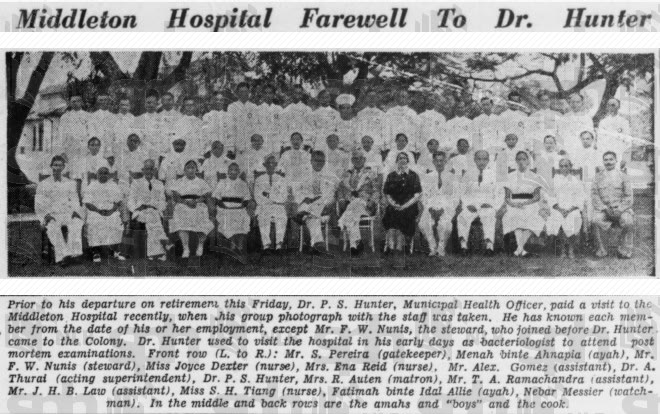
“Middleton Hospital Farewell To Dr. Hunter” — The Straits Times, 8 March 1939. Front row includes gatekeeper S. Pereira, steward F. W. Nunis, nurses Joyce Dexter and Ena Reid, acting superintendent Dr. A. Thurai, Hunter himself, matron R. Auten, and watchman Nebar Messier; the middle and back rows are the hospital’s amahs, “boys” and cook. (The Straits Times, public domain by age)
Colleagues also gave him a farewell dinner at the home of a Mr. N. A. Sen. In his own farewell interview with the Straits Times, Hunter chose to talk about the problems still ahead rather than look back at what he’d already done — enough to prompt the paper’s own editorial page to gently push back and remind readers what Singapore’s health record had actually looked like before men like him got to work on it.
The long coda
Retirement didn’t mean leaving. Hunter stayed on in Singapore, and by 1948 was active enough in civic life to chair the Singapore Turf Club, telling its annual general meeting that the club’s finances didn’t currently stretch to charitable donations, whatever the regret. He was still there in March 1952, thirteen years after his retirement, when his son — by then a solicitor in Surrey, and confusingly also styled “Mr. P. S. Hunter” — flew out from London on a Qantas-BOAC flight to spend three weeks visiting his parents, his wife alongside him. Three separate Singapore papers ran the reunion with a photograph — the clearest surviving likeness of Hunter himself found for this post.
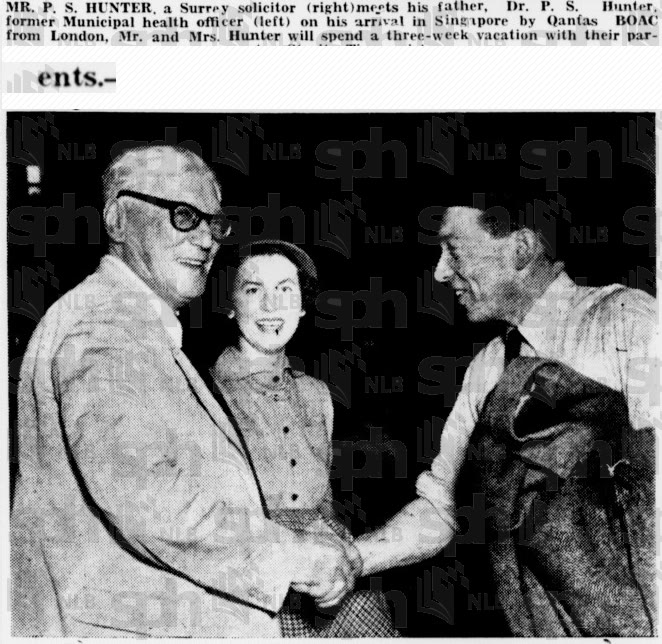
Dr. Peter Sinclair Hunter (left) greets his son, also styled Mr. P. S. Hunter, on the younger Hunter’s arrival from London with his wife, March 1952. (The Straits Budget, 13 March 1952, photo credited to The Straits Times; public domain by age)

Singapore General Hospital, photographed around 1900 — well before Hunter’s own era, but the same institution where he died in 1954. (G. R. Lambert & Co., public domain, via Wikimedia Commons)
Dr. Peter Sinclair Hunter died in Singapore General Hospital on 28 March 1954, aged 70. His obituary in the Straits Budget was headlined “Death of Colony Housing Pioneer,” and it credited him with exactly the two things that had defined his career: he had “played a major role in overcoming malaria in Singapore,” and he “was a champion of better housing.”
Why it matters today: it would be a stretch to draw a straight line from one Municipal Health Officer’s 1925 memo to the hawker centre grading cards or the mosquito-control patrols Singapore runs today — too many agencies, reorganisations and decades sit in between. But the direction was set here. Hunter’s own office — the municipal health inspectorate responsible in one breath for housing, sanitation and vector control — is the direct institutional ancestor of the public-health apparatus modern Singapore takes for granted. The mosquito fight itself never actually stopped, either, even after its original target was beaten: Singapore was declared free of indigenous malaria in 1982, but the same vigilance simply turned to dengue, still fought with annual public clean-up campaigns and, since 2016, a tool Hunter couldn’t have imagined — the National Environment Agency’s Project Wolbachia, which releases male mosquitoes carrying a bacterium that makes their offspring non-viable, suppressing the population by sterilising it rather than draining the swamp it breeds in. Tiong Bahru still stands as the one piece of Hunter’s own legacy anyone can point to; the rest of it is harder to see, which is exactly why it’s easy to forget there was ever a person behind it at all.
Sources:
- Tiong Bahru: Exploring Singapore’s First Public Housing Estate, BiblioAsia, National Library Board
- “S.V.C. Orders in Brief,” Malaya Tribune, 13 May 1914
- “Hunter” (birth notice), Pinang Gazette and Straits Chronicle, 10 June 1915
- “TIONG BAHRU HOUSING PLAN,” The Straits Times, 20 April 1935
- “IMPROVEMENT TRUST FLATS OCCUPIED,” The Straits Budget, 10 December 1936
- “MALARIA OUTBREAK NOT DANGEROUS — DR. HUNTER GIVES REASSURANCE,” Malaya Tribune, 13 December 1935
- “SWIFT ACTION NEEDED TO CHECK MALARIA,” The Straits Budget, 19 December 1935
- “OUTBREAK OF MALARIA,” The Straits Times, 5 October 1935
- “DR. HUNTER’S LEAVE,” The Straits Times, 8 May 1936
- “GOOD NAME OF SINGAPORE. Dr. Hunter’s Report On Malaria,” The Straits Times, 3 July 1936
- “Magical Drains,” The Straits Budget, 16 March 1939
- “MALAYANS IN CORONATION HONOURS LIST,” Singapore Free Press and Mercantile Advertiser, 11 May 1937
- “Dr. P. S. Hunter To Retire Next Friday,” The Sunday Tribune, 5 March 1939
- “Farewell Dinner To Dr. P. S. Hunter,” Malaya Tribune, 8 March 1939
- “Middleton Hospital Farewell To Dr. Hunter,” The Straits Times, 8 March 1939
- “Singapore Fever,” The Straits Budget, 16 March 1939
- “S’pore Turf Club To Resume Donations,” The Straits Budget, 5 February 1948
- “Dr. Hunter’s son here,” The Straits Times, 9 March 1952
- “MR. P. S. HUNTER, a Surrey solicitor…,” The Straits Budget, 13 March 1952 (photo credited to The Straits Times)
- “FATHER AND SON MEET,” The Singapore Free Press, 10 March 1952
- “DEATH OF COLONY HOUSING PIONEER,” The Straits Budget, 1 April 1954
- Wolbachia-Aedes Mosquito Suppression Strategy, National Environment Agency
- All newspaper articles accessed via NewspaperSG, National Library Board