The Three Days Singapore's Stock Market Closed
On Monday, the 2nd of December 1985, the Stock Exchange of Singapore did not open for trading. Neither did the Kuala Lumpur Stock Exchange. Both stayed shut for three days — the only time Singapore’s market has ever closed completely. What forced it was a single company, Pan-Electric Industries, a refrigerator maker that had grown into a sprawling conglomerate, and a web of undisclosed contracts that had been propping up its share price. At the centre of it was Tan Koon Swan, a businessman who three weeks earlier had been elected leader of Malaysia’s main Chinese political party.

Raffles Place, the centre of Singapore’s financial district. In 1985 the Stock Exchange of Singapore ran its trading floor here, at Clifford Centre. Photo by Calvin Teo, 2006. CC BY-SA 3.0.
From refrigerators to a conglomerate
Pan-Electric began in 1956 as Climate Engineering, importing French Frimatic refrigerators into Singapore. Its founder, Ernest Kahlenberg, moved into local assembly under the government’s pioneer-industry scheme, renamed the company Pan-Electric Industries in 1961, and opened a factory at Kampong Arang Road in 1965. By 1967 it was billed as the largest refrigerator plant in Southeast Asia, and in August 1968 it listed on the stock exchange.
From the mid-1970s the company diversified quickly and widely: marine salvage through a firm called Selco, property development through Vanguard Realty, a 1981 merger with the electrical-goods maker Acma, stakes in hotels. By 1985 Pan-Electric sat at the head of around sixty subsidiaries. Peter Tham joined the board in 1982; Kahlenberg had left by 1983.
The man at the centre
Tan Koon Swan was a Malaysian who had made his fortune in Singapore’s stock market in the 1970s, with a reputation for a golden touch. He held his interest in Pan-Electric through two companies he controlled, Sigma International and Grand United Holdings. In November 1985 he was elected president of the Malaysian Chinese Association, a senior partner in Malaysia’s ruling coalition — a man with money in Singapore’s markets and a hand now in Malaysian government.
The contracts holding it up
The way Pan-Electric’s share price was supported was through forward contracts. A shareholder sells a block of shares to a broking firm now, with an agreement to buy them back at a fixed price several months later — in effect a bet that the price will have risen in the meantime. On its own this was an accepted piece of market practice. What made Pan-Electric’s version dangerous was that the contracts were large and, for the most part, undisclosed, and that when the market softened through 1985 and the shares fell rather than rose, the parties committed to buying them back were facing heavy losses.
How a forward contract held the share price up
…and the shareholder agrees to buy the shares back in a few months, at a price fixed today.
If the price rises — the bet works
Buy the shares back below the fixed price, and pocket the difference. The downside looked small.
If the price falls — 1985
Buy back above the market price. The loss lands on whoever is left holding the shares.
Pan-Electric's forward contracts were unusually large and mostly undisclosed, so the scale of the losses stayed hidden until the company failed. Sources: MAS Staff Paper No. 32 (2004); Singapore Academy of Law (2022).
Tan Koon Swan’s own forward commitments came to about S$140 million. Across the whole market, brokers’ forward exposure to Pan-Electric and related stocks was estimated at close to S$600 million. As the shares kept sliding, Tan and Tham worked to hold the price up, and Tan moved roughly S$29 million out of company accounts to keep the arrangement going.
The 1985 crisis, by the scale of the money (S$ million)
Broker exposure to Pan-Electric stock, the company's bank debt, the rescue line, and Tan Koon Swan's own position.
View data as a table
| 1985 Pan-Electric crisis | S$ million |
|---|---|
| Brokers' forward exposure to Pan-Electric and related stocks | ~600 |
| Pan-Electric's disclosed borrowings from 35 banks | 453 |
| The four banks' rescue credit line (first announced as S$150m) | 180 |
| Tan Koon Swan's own forward commitments | ~140 |
| Sum Tan moved out of company accounts to hold the price up | ~29 |
Figures approximate, drawn from contemporary reports and the two published reviews of the crisis: MAS Staff Paper No. 32 (2004) and the Singapore Academy of Law retrospective (2022).
The unravelling
 Clifford Centre, Raffles Place, where the Stock Exchange of Singapore ran its trading floor in the 1980s. Photo: Terence Ong, 2006. CC BY-SA 3.0.
On 27 September 1985 the company announced a S$64 million rights issue meant to steady its finances. On 18 November it missed a payment on a bank loan. On 21 November it disclosed borrowings of S$453 million from thirty-five banks, most of it unsecured. The banks stopped lending — not only to Pan-Electric but to the broking firms tied to it. On 30 November the company was placed in receivership.
Three days shut
With Pan-Electric in receivership and its forward contracts about to come due, the danger was a chain reaction. Around half a dozen broking firms were heavily exposed, and because Singapore’s and Malaysia’s brokers traded with one another, one failure could pull others down with it. On Monday, 2 December, the two exchanges suspended all trading. They stayed closed through Wednesday.
From the shutdown to the CLOB freeze
View as a table
| Date | Event |
|---|---|
| Dec 1985 | The Stock Exchange of Singapore and the Kuala Lumpur Stock Exchange suspend all trading for three days (2–4 December); a S$180 million bank credit line keeps the exposed brokers afloat. |
| 1986 | Tan Koon Swan is jailed for two years; Pan-Electric is wound up; the Securities Industry Act tightens the rules on forward contracts, broker capital and disclosure. |
| Jan 1990 | After the two exchanges delist each other's companies, Singapore opens CLOB International, an over-the-counter market for Malaysian shares. |
| Sep 1998 | Malaysia imposes capital controls and freezes CLOB — about S$4 billion of shares held by roughly 172,000 investors, nearly all Singaporean. |
| Feb 2000 | A deal backed by both exchanges begins releasing the frozen CLOB shares in stages. |
Sources as for the article, including the two published reviews of the crisis: MAS Staff Paper No. 32 (2004) and the Singapore Academy of Law retrospective (2022).
Behind the closed doors, a rescue was put together. On 3 December the Stock Exchange of Singapore asked the four big local banks — DBS, OCBC, OUB and UOB — for a credit line, first reported at S$150 million and settled at S$180 million, to keep the exposed brokers afloat while the forward contracts were unwound in an orderly way rather than through a fire sale. A lawyer named Chan Sek Keong, later Singapore’s Chief Justice, helped the Monetary Authority draft the agreement. The Finance Minister, Richard Hu, was clear that the fund was not there to save brokers who had been reckless, only to see that the exchange’s own obligations were met, and that anything drawn would be repaid with interest. Even so, about six broking firms did not survive. The market reopened on Friday, 5 December.
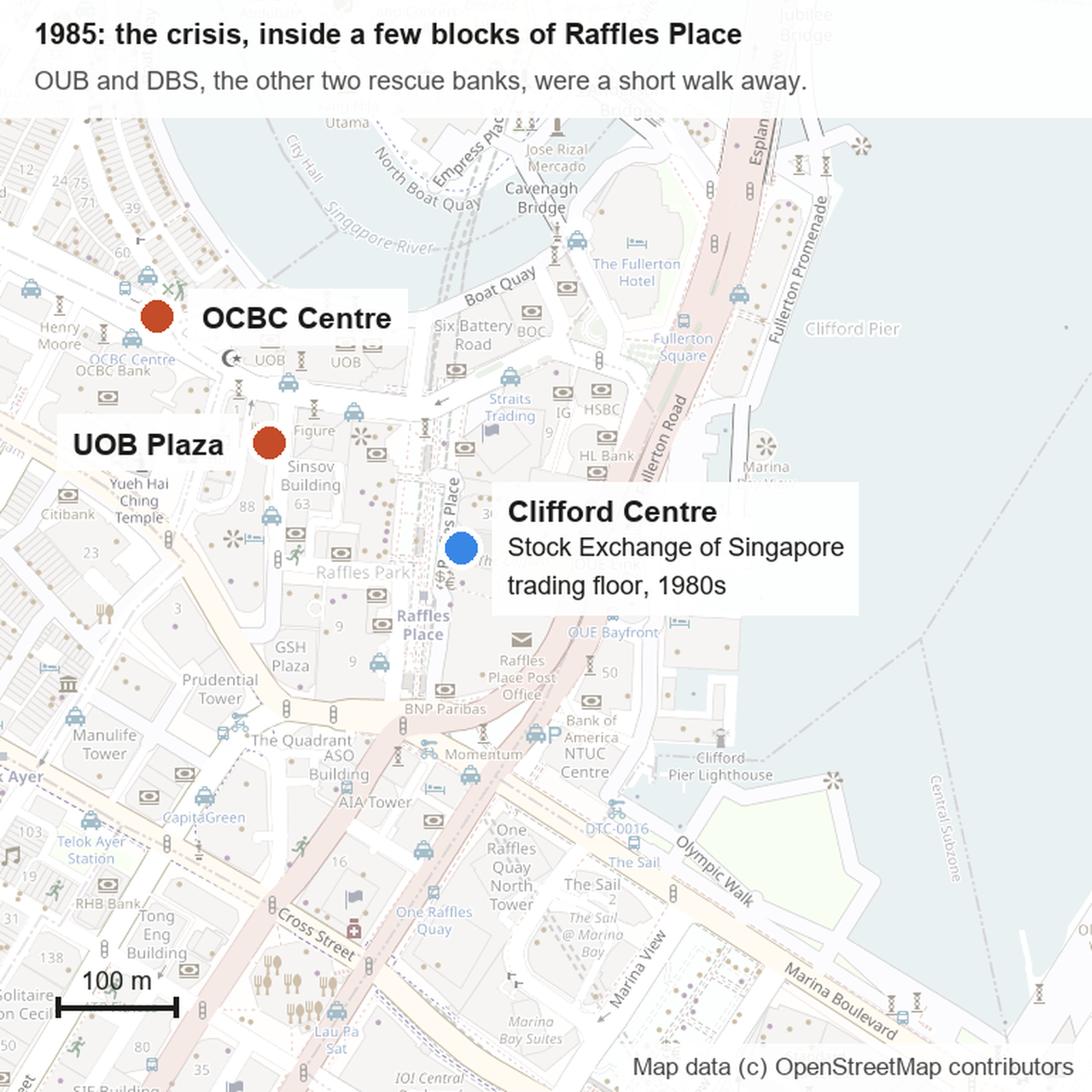
The whole episode played out inside a few blocks. The Stock Exchange of Singapore’s trading floor was at Clifford Centre; three of the four rescue banks — OCBC, UOB and OUB — had their head-office towers within a few minutes’ walk, and DBS was a short way south on Shenton Way. Building names and positions are shown as they stand today. Base map data © OpenStreetMap contributors.
The reckoning
Pan-Electric was wound up in October 1986. Its shares were worthless; thousands of shareholders and a long list of creditors carried the loss.
Tan Koon Swan was arrested in January 1986. He pleaded guilty, under a bargain that cut fifteen charges down to one, to abetting criminal breach of trust, and was sentenced to two years in jail and a fine. He resigned the MCA presidency, and the conviction ended a political career only weeks into its peak. Peter Tham was sentenced to eight years on dozens of forgery charges; Pan-Electric’s finance director received a shorter term. Decades later, some in Malaysia — and the case’s own lead prosecutor — would argue that Tan had been wrongly convicted, a view that remains contested.
The lasting change was to the rules. The Securities Industry Act of 1986 gave the Monetary Authority far greater control over the securities business and tightened the requirements on forward contracts, on how much capital a broker had to hold, and on what had to be disclosed.
The long tail
The crisis also exposed how entangled the Singapore and Kuala Lumpur exchanges had become. At the end of 1989 the two of them removed each other’s companies from their boards. So that Singaporeans could still trade Malaysian shares, Singapore opened an over-the-counter market called CLOB International in January 1990.
CLOB ran quietly for eight years. Then, in September 1998, in the depths of the Asian financial crisis, Malaysia imposed capital controls and froze it — around S$4 billion of shares belonging to about 172,000 investors, almost all of them Singaporean, locked in place. The freeze lasted more than a year; the shares were released in stages under a deal reached in early 2000. The untangling of the two markets that began with Pan-Electric took fifteen years and a second crisis to finish.
See more historical photographs related to this post →
Where it fits in the bigger story: the shape of it is familiar to anyone who has watched a financial crisis since. It begins with a scheme that bends convention without breaking the law — here, forward contracts run at a size and secrecy the rules had not anticipated. It runs longer than it should because the person at the centre is trusted, and large positions held in a respected name draw fewer questions than they would from a stranger. Then something unforeseen — a soft market, this time — turns the bet the wrong way, and what was one company’s problem becomes everyone’s, carried outward along the web of people who had lent it money or stood on the other side of its trades. Pan-Electric was the first time that pattern closed a Singapore exchange. It was not the last time the pattern would run.
Sources:
- “Fridge Maker Freezes Stock Market” — BiblioAsia, National Library Board
- “The Pan-Electric crisis hits the stock market” — Singapore Infopedia / NLB
- Pan-Electric Industries — Wikipedia
- Tan Koon Swan — Wikipedia
- “Remembering the Pan-Electric Crisis, Nearly 40 Years On” (11 October 2022) — Singapore Academy of Law
- “Case Study on Pan-Electric Crisis” — MAS Staff Paper No. 32, June 2004 (PDF), Monetary Authority of Singapore
- “Rise and fall of Tan Koon Swan” — The Edge Malaysia
- “DPM Lee’s Reply to Parliamentary Question on CLOB” (12 Oct 1998) — Monetary Authority of Singapore
- “The impacts of mass delisting: Evidence from Singapore and Malaysia” — Pacific-Basin Finance Journal
- “Rescue plan for stockbroking firms” — The Straits Times, 3 December 1985, page 1 (NewspaperSG; cited, not reproduced — a 1985 edition is still under copyright)
- OpenStreetMap — Raffles Place (base map tiles for the Raffles Place map; map data © OpenStreetMap contributors)
- Raffles Place skyline at night — Calvin Teo, Wikimedia Commons (CC BY-SA 3.0)
- Clifford Centre — Terence Ong, Wikimedia Commons (CC BY-SA 3.0)
- Raffles Place, 1971 — Wilford Peloquin, Wikimedia Commons (CC BY 2.0)
- Singapore River skyline from Parliament House — Terence Ong, Wikimedia Commons (CC BY-SA 3.0)
- Evening view of UOB Plaza, OUB Centre and OCBC Centre — Steven Byles, Wikimedia Commons (CC BY-SA 2.0)
- Clifford Centre and Ocean Towers — Terence Ong, Wikimedia Commons (CC BY-SA 3.0) (gallery)
- OCBC Centre tower — Sengkang, Wikimedia Commons (copyrighted free use) (gallery)


