The Strip of Malaysia That Ran Through Singapore Until 2011
Until the middle of 2011, catching the train to Kuala Lumpur from the centre of Singapore involved something strange: you walked into Tanjong Pagar Railway Station, a few minutes from the banks of Shenton Way, and cleared Malaysian immigration. The station, its platforms and a ribbon of land running most of the length of the island were owned and run by Malaysia’s railway. For forty-six years after Singapore left the Federation, a strip of foreign-administered ground cut straight through the country.

The former Tanjong Pagar Railway Station, photographed in 2011, its final year of service. (Photo: EquatorialSky2, retouched by MagentaGreen / Wikimedia Commons, CC BY-SA 3.0)
The lease that outlived the Federation
The railway reached Singapore in 1903, running down from the Johor Strait to a terminus at Tank Road. In 1918 the colonial government transferred the railway and about 217 hectares of land along it to the Federated Malay States Railways on a lease of 999 years, to be used only for running trains. In 1932 the line into town was rerouted, and a new terminus opened at Tanjong Pagar, on reclaimed land facing the docks.
 One of the Doulton ceramic panels in the main hall, showing scenes of Malayan industry. (Photo: Marijn de Vries Hoogerwerff / Wikimedia Commons, CC BY-SA 2.0)
The new station was an Art Deco building by the firm Swan and Maclaren. Four marble figures over the entrance stood for Agriculture, Commerce, Industry and Transport, the initials “F M S R” were set across the front, and inside the barrel-vaulted main hall a set of Doulton ceramic panels showed the industries of Malaya: rubber tapping, tin mining, rice planting, shipping. Governor Sir Cecil Clementi opened it on 2 May 1932, telling the crowd he had “not the slightest doubt that, for centuries, this Singapore terminal station” would serve the region.
When Singapore separated from Malaysia in 1965, the Separation Agreement said nothing about the railway. The successor to the FMSR, Malaysia’s Keretapi Tanah Melayu, simply kept what the 1918 lease gave it: the track, the land beside it, and the stations. Tanjong Pagar, by then inside the central business district, stayed a Malaysian-run terminus, flying the Malaysian flag, staffed by Malaysian railway workers, with Malaysian customs and immigration counters.
Living with the anomaly
Most of the time this was just a curiosity. The sharpest illustration of it came from immigration. Under an agreement reached in the early 1990s, the two countries were to place both their checkpoints together at a new Woodlands Train Checkpoint by August 1998. Singapore moved its checks to Woodlands on schedule. Malaysia did not: it wanted its counters inside the Woodlands building rather than on the open platform, treated the question as bound up with the wider unresolved dispute over the land, and kept its checkpoint at Tanjong Pagar.
For the next thirteen years the effect was this. A passenger leaving Singapore by train was stamped out of Singapore at Woodlands, then rode more than twenty kilometres south to Tanjong Pagar and back north again before the train actually crossed the Causeway. Someone arriving from Malaysia was admitted to Singapore at Woodlands but got off in the middle of the city, on ground the Singapore government did not administer. Singapore called Malaysia’s arrangement a breach of the agreement; Malaysia called Singapore’s move a unilateral one.
The 1990 deal that did not take
On 27 November 1990 the two governments signed a document called the Points of Agreement, initialled by Singapore’s prime minister Lee Kuan Yew and Malaysia’s finance minister Daim Zainuddin on behalf of Prime Minister Mahathir Mohamad. KTM would give up Tanjong Pagar and move its Singapore operations north. The railway land between Bukit Timah and Tanjong Pagar would return to Singapore. Three parcels, at Tanjong Pagar, Kranji and Woodlands, would be handed to a joint company and developed, sixty per cent owned by Malaysia and forty by Singapore.
The agreement then sat frozen for twenty years. The two sides could not agree on whether it took effect the day it was signed, as Singapore held, or only once KTM had physically moved out, as Malaysia held. They argued over how the parcels should be valued, over development charges, over a Malaysian request for additional land at Bukit Timah, and over the checkpoint. Negotiating rounds through the 1990s produced nothing. A broader attempt in 2001 to settle several disputes together — the railway, the price Singapore paid for water, the use of Malaysian airspace, a proposed bridge to replace the Causeway — collapsed the year after. Mahathir stepped down in 2003, and relations stayed cool for years afterward.
The swap that did
On 24 May 2010, Prime Ministers Lee Hsien Loong and Najib Razak announced they had broken the deadlock. KTM would move its terminus to Woodlands by 1 July 2011. The former railway land would be developed by a joint company, M+S Pte Ltd, sixty per cent held by Malaysia’s Khazanah Nasional and forty by Singapore’s Temasek Holdings — the same split written into the 1990 document.
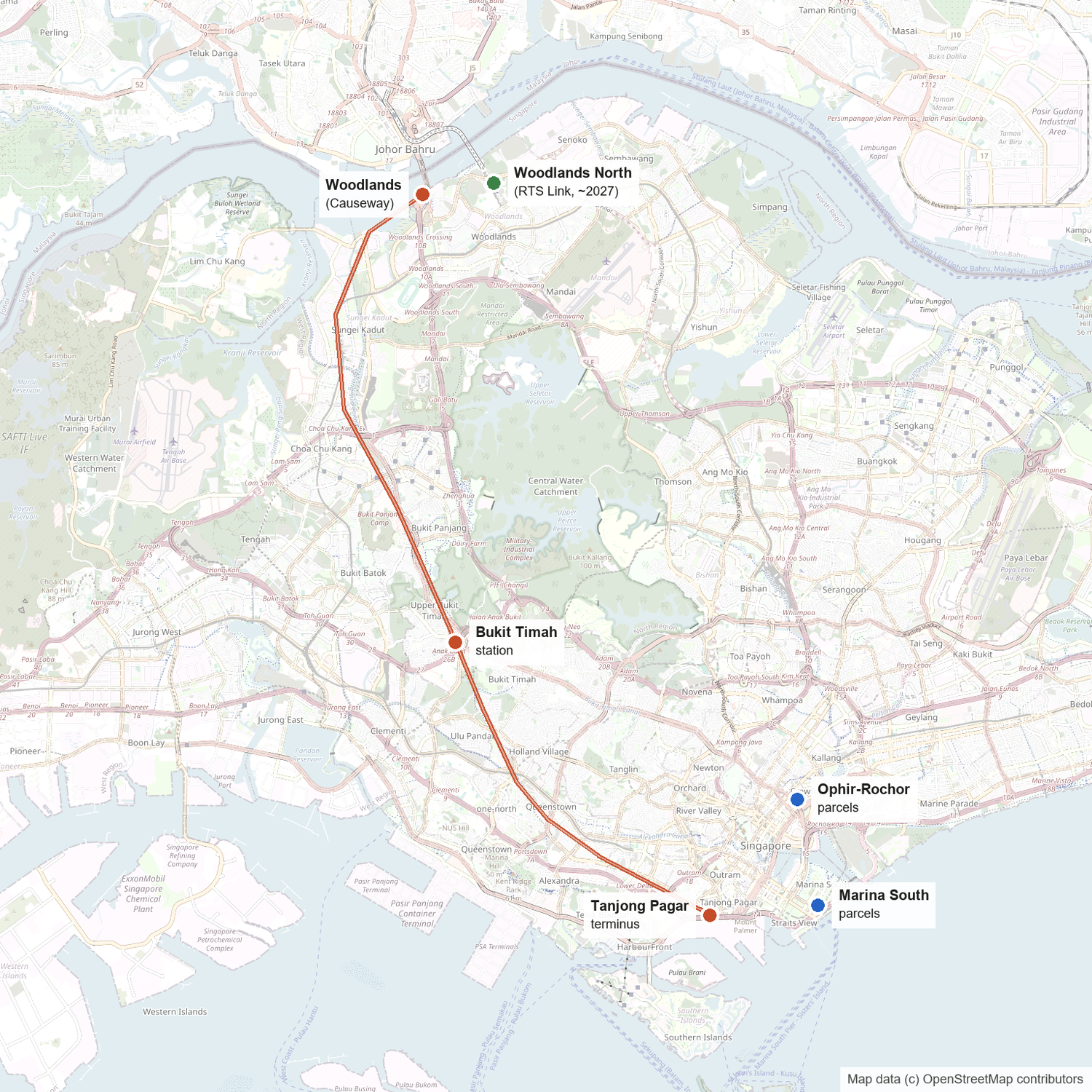
The former KTM line ran the length of the island, from the Causeway at Woodlands to the terminus at Tanjong Pagar; the land beside it was Malaysian-administered. Blue marks the parcels Malaysia received in the 2010 swap; green marks Woodlands North, the Singapore end of the coming RTS Link. The route is an approximate trace. (Map data © OpenStreetMap contributors)
What had changed was the other side of the trade. Instead of the three original parcels, Malaysia would receive six: four at Marina South, on the reclaimed downtown waterfront, and two at Ophir–Rochor near Kampong Glam. The joint company went on to build the Marina One and DUO developments on them. It was a trade of land for land, valued to match, rather than a legal ruling — although a ruling did follow. In 2014 an arbitration tribunal in The Hague settled a leftover question about development charges on the original parcels, in Malaysia’s favour.
The last train
Thousands of people came to Tanjong Pagar on 30 June 2011 for the final day of service. They bought platform tickets to keep, photographed the split-flap departure board, and prised souvenir spikes out of the track. The last train pulled out shortly before ten that night, driven by the Sultan of Johor, Ibrahim Iskandar, whose grandfather had opened the Causeway in 1923.
 The platforms at Tanjong Pagar in 2010, a year before the last train. (Photo: alicereneztay / Wikimedia Commons, CC BY 2.0)
The next morning the line south of Woodlands closed. Over the following year the rails were lifted. Tanjong Pagar station, gazetted a national monument that April, was left standing, as were the steel truss bridges near Bukit Timah. The twenty-four-kilometre strip the trains had run on became the Rail Corridor, a continuous green route from Kranji down to Tanjong Pagar that has been reopening in sections since 2021. The terminus building is used for exhibitions and events, and is being worked into the future Cantonment MRT station on the Circle Line.
The link that replaced it
The 2010 settlement also cleared the way for new cross-border rail plans that had been entangled with the dispute.
The larger one did not survive. A high-speed line from Kuala Lumpur to a terminus at Jurong East, which would have cut the journey to around ninety minutes, was agreed in 2016, suspended in 2018 by a new Malaysian government, and formally terminated at the start of 2021. Malaysia paid Singapore about 103 million dollars for costs already run up.
A line of ground through Singapore: 1903 to the present
View as a table
| Year | Event |
|---|---|
| 1903 | The railway reaches Singapore, ending at Tank Road. |
| 1918 | The colonial government leases the railway and ~217 ha of land along it to the Federated Malay States Railways for 999 years, for railway use only. |
| 1932 | The line is rerouted and the Tanjong Pagar terminus opens. |
| 1965 | Singapore separates from Malaysia; the Separation Agreement does not mention the railway, so the Malayan Railway (KTM) keeps the land and stations. |
| 1990 | The Points of Agreement is signed — KTM to leave Tanjong Pagar, the land to be jointly developed — then sits unimplemented. |
| 1998 | Singapore moves its rail checkpoint to Woodlands; Malaysia refuses and keeps its checkpoint at Tanjong Pagar for another 13 years. |
| 2010–11 | A land swap is agreed (24 May 2010); KTM's terminus moves to Woodlands and the last train leaves Tanjong Pagar on 30 June 2011. |
| 2021–27 | The KL–Singapore High Speed Rail is terminated (2021); the Johor Bahru–Woodlands RTS Link is due to open around 2027. |
Sources as for the article. The axis is linear in years; "2010–11" and "2021–27" each cover a pair of closely spaced events.
The smaller one is nearly here. The Johor Bahru–Singapore Rapid Transit System Link, a four-kilometre shuttle between Bukit Chagar in Johor Bahru and a new station at Woodlands North, was itself suspended in 2019 and revived in 2020 on changed terms. It is due to carry passengers by the end of 2026 or early 2027. Its main feature is that a traveller clears both countries’ immigration once, at the station being left from, before boarding — the reverse of the arrangement that made Tanjong Pagar such an oddity for so long.
See more historical photographs related to this post →
Where it fits in the bigger story: for forty-six years a foreign country administered a line of ground through the middle of Singapore, because the agreement that split the two countries in 1965 never dealt with the railway. It was resolved in the end not by a court but by a trade of land — and the cross-border train it took out of downtown is now being rebuilt, shorter and faster, at the edge of the island.
Sources:
- Malaysia–Singapore Points of Agreement of 1990 — Wikipedia
- Tanjong Pagar railway station — Wikipedia
- Former Tanjong Pagar Railway Station — Roots, National Heritage Board
- “Land Swap Deal: New Era for Singapore-Malaysia Relations” — RSIS Commentary
- “Malaysia railway land in Singapore: Unravelling the dispute” — The Malaysian Reserve
- “Joint Statement on the Settlement of Compensation … for the Kuala Lumpur – Singapore High Speed Rail (HSR) Project” — Ministry of Transport, Singapore
- RTS Link — MRT Corp
- “On this day in 1932, Tanjong Pagar Railway Station opened at Keppel Road” — AsiaOne
- “Governor Opens New Station” and “A Fine Engineering Achievement” — The Straits Times, 3 May 1932, page 11 (NewspaperSG; the issue and its ceremony photograph are public domain but not yet on Wikimedia Commons)
- Rail Corridor (Singapore) — Wikipedia
- OpenStreetMap — Singapore (base map tiles for the rail-line map; map data © OpenStreetMap contributors)
- File:Tanjong Pagar Railway Station exterior view(1 retouched).jpg — Wikimedia Commons
- File:TanjongPagarRailwayStation-mural-Singapore-20080223.jpg — Wikimedia Commons
- File:Platforms and tracks, Tanjong Pagar Railway Station, Singapore - 20100619-01.jpg — Wikimedia Commons
- File:Tanjong Pagar Railway Station interior - public hall (1).jpg — Wikimedia Commons (gallery)
- File:Disused train, Tanjong Pagar Railway Station, Singapore - 20090822.jpg — Wikimedia Commons (gallery)
- File:Rail Corridor running on a former railway bridge over Hindhede Drive.jpg — Wikimedia Commons (gallery)
- File:Rail Corridor, Singapore in 2024-09-27 3.jpg — Wikimedia Commons (gallery)
- File:KITLV - 79913 - Kleingrothe, C.J. - Medan - Woodlands Station in Singapore - circa 1910.tif — Wikimedia Commons (gallery)


