The Ointment Outlasted the Empire It Paid For
There is a fair chance that somewhere in your home, or on a shelf at the pharmacy nearest you, there is a small six-sided glass jar with a leaping tiger on the lid. Tiger Balm is sold in more than a hundred countries and turns up at a suburban American drugstore as readily as at a Singapore provision shop. Almost nobody who buys it knows that the jar is the last everyday trace of a fortune that once also ran a stable of newspapers and a bank, and paid for the hillside of painted concrete demons that Singaporeans know as Haw Par Villa.

The entrance to the Ten Courts of Hell at Haw Par Villa. (Photo: Jnzl’s Photos / Flickr / Wikimedia Commons, CC BY 2.0)
A herbalist’s sons and a jar of balm
 Aw Boon Haw, from a 1941 Japanese biographical volume. (Public domain, via Wikimedia Commons)
The story begins not in Singapore but in Rangoon, where a Hakka herbalist named Aw Chu Kin had emigrated from Fujian and, around 1870, opened an apothecary shop called Eng Aun Tong, the Hall of Everlasting Peace. He had two sons who would matter: Aw Boon Haw, born in 1882, whose given name means “gentle tiger”, and Aw Boon Par, born in 1888, “gentle leopard”. When their father died in 1908 the brothers inherited the shop and the family’s recipes, among them a warming ointment of camphor, menthol, cajuput and clove oil in a petroleum-jelly base.
They refined that ointment, packed it in the little hexagonal jars that are still used today, and named it Tiger Balm after the elder brother. The division of labour between them held for the rest of their lives. Boon Par was the quiet one who ran the factory and kept the books. Boon Haw was the salesman, and he had an instinct for publicity that was decades ahead of the market he was selling to. By about 1920 he was reckoned to be among the richest Chinese in Rangoon.
Moving the base to Singapore
In 1926, with an eye on the much larger market in China, the brothers moved their headquarters and their main factory to Singapore. The new plant on Neil Road, in Chinatown, could turn out roughly ten times what the Rangoon works had managed. The building still stands: a conserved corner block with a hexagonal pavilion on the roof said to echo the shape of the balm jar, and once a model tiger over the entrance.
 A replica, displayed at Haw Par Villa, of one of Aw Boon Haw's "tiger cars". The originals toured the region in the 1930s as moving advertisements. (Photo: Dionisius Purba / Flickr / Wikimedia Commons, CC BY 2.0)
What set the business apart was the advertising. Boon Haw bought space relentlessly in the Chinese and English press, wrote copy that told little stories, and gave away free samples by the crate. He commissioned “tiger cars”, motor cars and delivery vans painted in stripes with a snarling tiger’s head mounted over the radiator, red bulbs for eyes and a horn modified to sound like a roar, and sent them touring from town to town as rolling billboards. The leaping-tiger trademark went onto every jar, every wall he could rent and, in time, the mastheads of newspapers he owned outright.
What the balm money bought
The ointment threw off enough cash to build a conglomerate. In 1929 Boon Haw founded the Chinese-language daily Sin Chew Jit Poh in Singapore, the first of some seventeen newspapers he would start across South-East Asia and China between then and 1951, including the Sing Tao papers in Hong Kong and, later, the English-language Tiger Standard. In 1950 he opened Chung Khiaw Bank on Robinson Road and served as its first chairman. There were also rubber holdings, property, and for a time the island now called Coney Island.
Alongside the empire-building was serious philanthropy. Boon Haw gave away more than a million dollars in his lifetime to schools and hospitals across the region, and donated heavily to China’s war relief funds after Japan’s invasion in 1937. His record during the Japanese Occupation that followed is more contested. He spent the war in Hong Kong, met Japanese officials, and afterwards faced accusations of collaboration and opportunism; defenders argued he was a marked man as a wealthy overseas Chinese who had bankrolled China’s resistance, and did what was needed to protect his people and his assets. Both readings have been argued ever since.
The hillside on the far side of the island
In 1935 the brothers bought a seafront hill on Pasir Panjang Road, on the rural south-western coast well away from the Chinatown factory. There the architect Ho Kwong Yew built an Art Deco villa, finished in 1937, which Boon Haw gave to his homesick brother. Around it he laid out a garden, open to the public without charge, filled with painted statues and tableaux illustrating Chinese folklore and Confucian, Buddhist and Taoist morality. The set piece was, and remains, the Ten Courts of Hell, a walk-through of the punishments said to await the wicked. Similar gardens went up in Hong Kong and in the family’s ancestral county in Fujian.
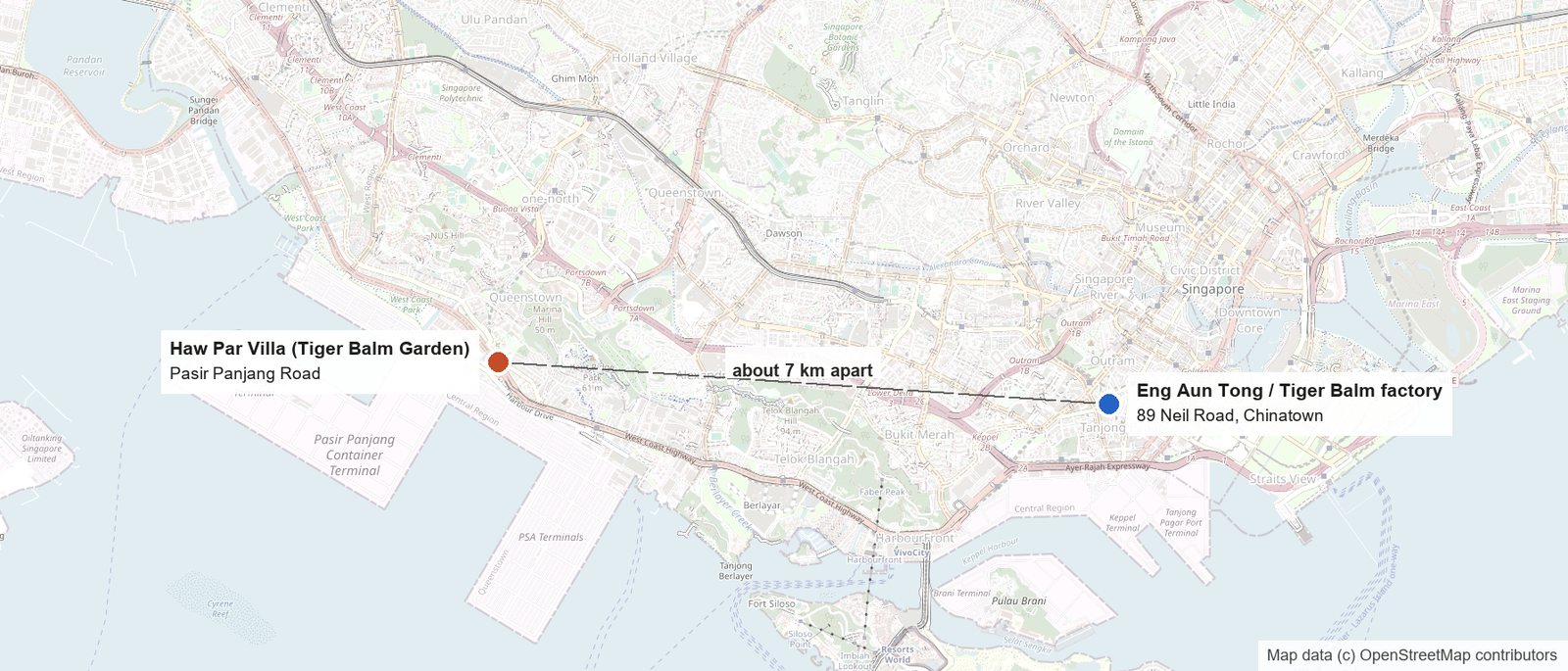
The working end of the business and the pleasure garden sat at opposite ends of the southern coast: the Eng Aun Tong factory in Chinatown, Haw Par Villa about seven kilometres west at Pasir Panjang. (Map data © OpenStreetMap contributors)
The war reached the hill too. Japanese forces used the high ground as a lookout, the villa was bombed, and after 1945 the ruined mansion was pulled down, though the statues survived. Boon Par had already gone back to Rangoon, where he died in 1944. Boon Haw kept adding to the garden until his own death, of heart failure, in Honolulu on 4 September 1954, on his way back from the United States. He was 72.
The fortune after the founders
What happened next is a study in how a family fortune comes apart.
The Aw fortune's main parts, and what became of each
Blue: run by the Aw family, or still trading under its own name. Grey: after it passed to others.
View as a table
| Part of the empire | Ran / built | What became of it |
|---|---|---|
| Tiger Balm (Eng Aun Tong) | 1908 – today | The only part that survived intact. Control passed to Slater Walker in 1971 and to the Wee family from 1978, but the balm still sells in more than 100 countries under Haw Par Corporation. |
| Sin Chew Jit Poh (Singapore) | 1929 – 1983 | Last issue 15 March 1983; merged with Nanyang Siang Pau into Lianhe Zaobao, whose masthead still carries the words "Sin Chew". |
| Haw Par Villa (Tiger Balm Garden) | 1937 – today | Run by the family as a free garden for decades; site taken over by the state around 1985. Still open, now a heritage park. |
| Chung Khiaw Bank | 1950 – 1999 | Control sold to United Overseas Bank in 1971–72; ran as a UOB subsidiary under its own name until fully merged into UOB in 1999. |
| The listed holding company | 1969 – today | Formed as Haw Par Brothers International; sold to Slater Walker in 1971; after a 1970s asset-stripping scandal, chaired by UOB's Wee Cho Yaw from 1978. Now Haw Par Corporation. |
Sources: Wikipedia entries for Aw Boon Haw, Haw Par Corporation, Chung Khiaw Bank and Haw Par Villa; the Singapore Chinese Cultural Centre on the 1983 newspaper merger; contemporary reporting on the Slater Walker affair. Dates for gradual changes (the UOB takeover, the state's involvement in Haw Par Villa) are approximate.
In 1969 the family bundled the businesses into a listed company, Haw Par Brothers International. Within two years they had sold control to Slater Walker, the British investment group run by Jim Slater, and Boon Par’s son Aw Cheng Chye, who had been chairman, died suddenly on a trip to South America. Slater Walker broke the conglomerate up: the Chung Khiaw Bank stake went to United Overseas Bank in 1972, the newspapers were sold off, and Tiger Balm production moved out of the Neil Road building in 1971 to a contractor’s factory in Jurong. In 1975 Singapore authorities alleged that Slater Walker executives had rigged Haw Par’s shares and stripped its assets; Singapore sought Jim Slater’s extradition from Britain and was refused, and he resigned soon after. From 1978 the banker Wee Cho Yaw of UOB became chairman, and his family has been the controlling shareholder since. The company is now called Haw Par Corporation.
The other pieces went their own ways. Sin Chew Jit Poh in Singapore printed its last issue on 15 March 1983 and merged with a rival into Lianhe Zaobao, whose masthead still carries the words “Sin Chew” to mark the descent. The Neil Road factory building was given conservation status in 1992. Haw Par Villa, which the family had run as a free attraction for decades, was taken over by the state in the 1980s; from around 1990 it was relaunched as a ticketed theme park, “Dragon World”, with animatronics and an “oriental Disneyland” pitch that reportedly lost about S$31 million over a decade before admission was made free again in 1998.
What the fortune became
Haw Par Corporation's two income streams, FY2025 (S$ million)
The entire worldwide balm business next to the dividends from a bank shareholding the company has held for decades.
View data as a table
| Haw Par Corporation, FY2025 | S$ million |
|---|---|
| Tiger Balm & medicated-oil sales (healthcare segment revenue) | 240.5 |
| of which: ASEAN | 80.5 |
| of which: rest of Asia | 62.5 |
| of which: Americas, Europe & Middle East | 67.4 |
| Dividends received from its UOB shareholding | 169.9 |
| Group net profit for the year | 265.5 |
| Group revenue for the year | 230.0 |
The group's UOB and UOL shareholdings are together worth roughly S$3 billion; the dividends they pay, plus the balm margin, are why net profit (S$265m) came in above group revenue (S$230m) for the year. Figures: Haw Par Corporation FY2025 results, as summarised by Growbeansprout.
Haw Par Corporation today is a quiet company listed in Singapore. Tiger Balm and its sister medicated oils are almost the whole of its revenue, and the balm sells in more than a hundred countries, made in Singapore, Malaysia and China, with roughly a third of sales now outside Asia. But most of the company’s profit does not come from balm at all. Decades ago the group acquired large blocks of shares in UOB and the property developer UOL, and never sold them; those holdings are worth several billion dollars and the dividends alone now exceed what Tiger Balm brings in. The Tiger Balm company, in effect, is a well-run ointment brand wrapped around an old bank shareholding.
See more historical photographs related to this post →
Where it fits in the bigger story: one of the largest overseas-Chinese fortunes of the twentieth century was built and run from Singapore, then scattered, and the family name has largely faded from local memory. Three fragments of it are still in plain sight: a jar in the bathroom cabinet, the words on a newspaper’s masthead, and a hillside of concrete demons at Pasir Panjang that the government now keeps as a heritage park.
Sources:
- Aw Boon Haw — Wikipedia
- Aw Boon Par — Wikipedia
- Haw Par Villa — Wikipedia
- Haw Par Corporation — Wikipedia
- Chung Khiaw Bank — Wikipedia
- Eng Aun Tong Building — Wikipedia
- “Aw Boon Haw and His Tiger Balm Newspaper Advertisements 1916–1954” — BiblioAsia, National Library Board
- “Aw Boon Haw 胡文虎 and Aw Boon Par 胡文豹, the brothers behind Tiger Balm’s huge Asian success” — The Industrial History of Hong Kong Group
- “Tiger Balm Kings built a business empire on Chinese ointment and drove in ‘Catmobiles’” — Mothership
- “Eng Aun Tong Building” — SG101
- “Nanyang Siang Pau and Sin Chew Jit Poh: The history of Chinese newspapers in Singapore” — Culturepaedia, Singapore Chinese Cultural Centre
- “Lianhe Zaobao” — Wikipedia
- “A ‘group washing machine’ and ‘tangled skein’: the failure of Slater Walker” — Bank Underground, Bank of England
- Haw Par Corporation Limited Annual Report 2024 — investor.hawpar.com
- “Haw Par Corporation: More than just Tiger Balm” — Growbeansprout
- OpenStreetMap — southern Singapore (base map tiles for the headquarters-and-park map; map data © OpenStreetMap contributors)
- File:Entrance to the Ten Courts of Hell (十殿阎罗), Haw Par Villa (14791602374).jpg — Wikimedia Commons
- File:Hu Wenhu.jpg — Wikimedia Commons
- File:TigerCar-HawParVilla-Singapore-20081115.jpg — Wikimedia Commons
- File:161a Tiger Balm Garden Singapore 1971 (51253058784).jpg — Wikimedia Commons (gallery)
- File:71-528a Tiger Balm, Singapore 1971 (51251929204).jpg — Wikimedia Commons (gallery)
- File:89 Neil Road, Singapore (2025) - img 04.jpg — Wikimedia Commons (gallery)
- File:Hu Wenhu2.jpg — Wikimedia Commons (gallery)
- File:Sin Chew Jit Poh 1.JPG — Wikimedia Commons (gallery)
- File:Eighth Court of Hell – Yama King Dushi, Haw Par Villa (14793981305).jpg — Wikimedia Commons (gallery)
- File:Haw Par Villa, Singapore (3327855083).jpg — Wikimedia Commons (gallery)
- File:D 100 View of Haw Par Villa. S ‘pore., KITLV 1404806.tiff — Wikimedia Commons (gallery)
- File:Armed monkeys, Haw Par Villa (Tiger Balm Theme Park), Singapore (41102156).jpg — Wikimedia Commons (gallery)
- File:Acrobatics and chained monkey (Virtues and Vices display) Haw Par Villa (14813757583).jpg — Wikimedia Commons (gallery)
- “Page 11 Advertisements Column 1” — Bintang Pranakan, 22 November 1930, NewspaperSG, National Library Board (gallery)


