How a Japanese Greengrocer Changed the Way Singapore Shops
When Yaohan opened at Plaza Singapura on 1 November 1974, it put a supermarket, a department store and a hall of ready-to-eat food under one roof, with fixed price tags on everything and staff who greeted shoppers at the door. Nothing in Singapore had worked quite like it. About a million people came through in the first week, in a country of 2.2 million. Half a century on, the stores that followed Yaohan in have mostly closed, and Yaohan itself no longer exists anywhere near Singapore — but the idea it arrived with, good food sold cheaply in the basement, has outlasted all of them.

Plaza Singapura, at the Dhoby Ghaut end of Orchard Road, photographed in 2005. Yaohan was its anchor tenant from the mall’s opening in 1974 until 1997. (Photo: Sengkang / Wikimedia Commons, copyrighted free use)
A greengrocer that went global
Yaohan began in 1930 as a single fruit-and-vegetable shop in Atami, a hot-spring town south-west of Tokyo, run by Ryohei and Katsu Wada. Their son Kazuo Wada built it into a supermarket chain in Shizuoka prefecture and then, from the early 1970s, took it abroad — first to Brazil in 1971, then Singapore in 1974, and later Hong Kong, Malaysia, Brunei, Thailand, Indonesia and the United States. At its height the group ran around 450 stores in 16 countries. Wada was a member of Seicho-no-Ie, a Japanese spiritual movement, and new Yaohan recruits in Japan were expected to join it and attend its seminars; the requirement was applied more loosely overseas.
The Singapore company was a joint venture with the Development Bank of Singapore. Its Plaza Singapura store opened with sixteen supermarket checkouts and nineteen department-store counters and was, at the time, the largest store of its kind in the country.
What Plaza Singapura started
Until Yaohan, a Singaporean buying groceries went to a wet market or a provision shop, and buying clothes or household goods meant somewhere else again. Yaohan put all of it together, added a food section selling cooked dishes to take away, and printed a price on every item so there was nothing to haggle over. The format spread quickly. Yaohan opened at Katong in 1977, Thomson Plaza in 1979, Bukit Timah Plaza in 1981, and Jurong and Parkway Parade in 1983 — moving out of the centre and into the housing estates as it went.
It also had company. Isetan had reached Singapore two years ahead of Yaohan, opening in 1972 in the Apollo Hotel on Havelock Road, the first Japanese department store in the country. Daimaru anchored Liang Court from 1983. Sogo opened at Raffles City in 1986. Takashimaya arrived last and largest, at Ngee Ann City in 1993. For roughly two decades the Japanese department store was the template for a Singapore shopping centre: a big-name anchor over several floors, a supermarket and a food hall in the basement, and a fixed-price, well-staffed floor in between. The retailers had reasons to be there — a maturing home market in Japan, money to spend, and a Southeast Asian middle class that was growing fast.

Orchard Road looking towards Ngee Ann City, home of Takashimaya since 1993, in 2005. (Photo: Hullie / Wikimedia Commons, CC BY-SA 3.0)
Where they were
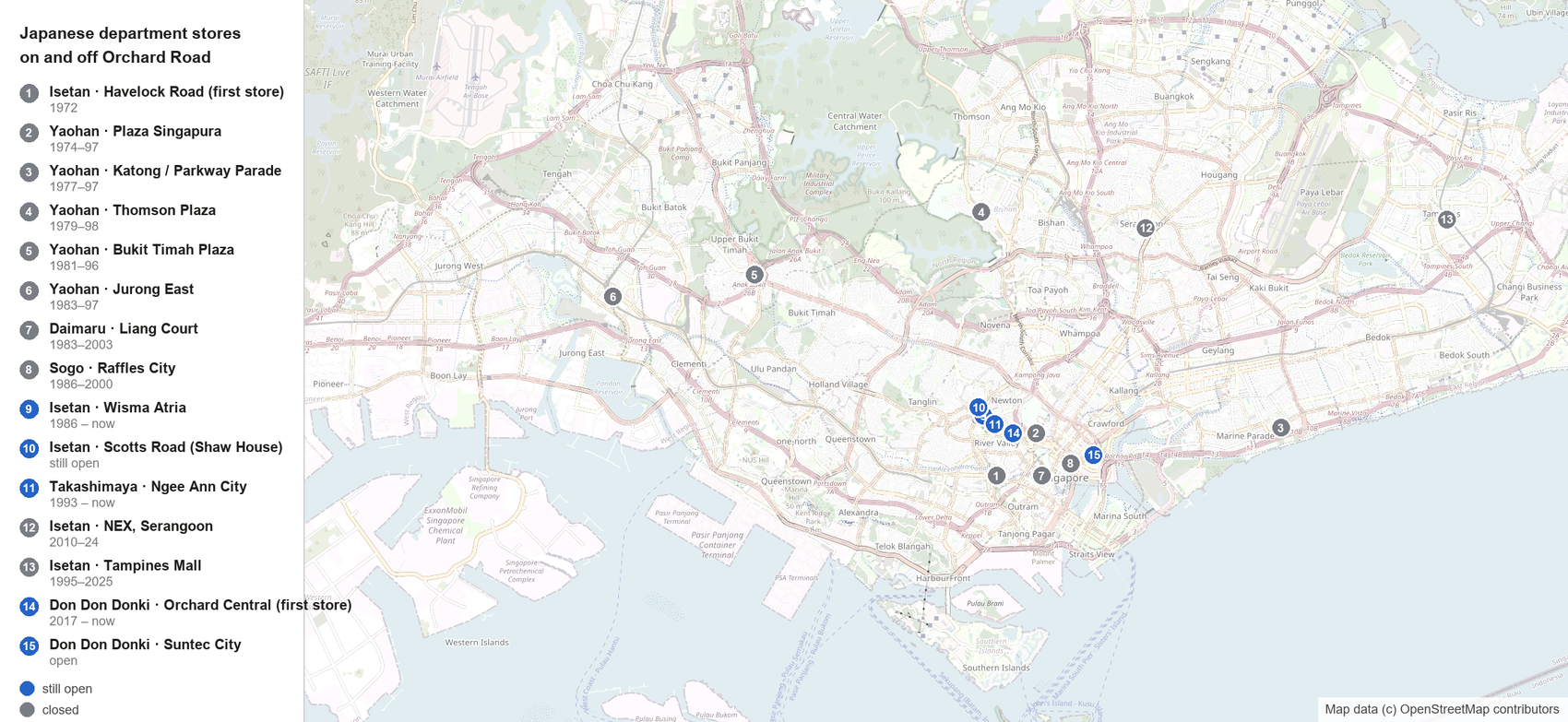
Where the Japanese department stores were. Each numbered marker sits at the mall it occupied, keyed to the list at left with the years it traded there; blue markers are still open, grey ones have closed. The cluster around Orchard Road and the city is most of the list; only Yaohan, and later Isetan, moved out into the housing estates. (Map by Lesser Known Singapore; base map data © OpenStreetMap contributors)
The bet on China
By 1990 Kazuo Wada had decided the company’s future was in China, and he moved the group’s base to Hong Kong to run the expansion from there, listing the international arm on the Hong Kong exchange. The plans were enormous — a thousand stores in China, and a flagship in Shanghai that was, briefly, one of the largest department stores in the world. The group borrowed heavily to build them and was thinly capitalised when the 1997 Asian financial crisis arrived.
On 18 September 1997 Yaohan’s Japanese parent filed for protection from its creditors, owing about 161 billion yen. It was the biggest failure the Japanese retail sector had seen since the war. The national operations were sold off in pieces: the Japanese stores went to the Aeon group, the Hong Kong stores became Jusco, and the American stores were bought by their own managers and, from 1998, rebranded as Mitsuwa Marketplace. Yaohan’s Singapore stores, already unprofitable, closed through 1997 and 1998.
What outlasted the stores
Yaohan was not the only one to leave. Sogo went into judicial management in Singapore and shut its Raffles City store in 2000. Daimaru closed at Liang Court in 2003 after twenty years. Isetan held on longer but has been closing one store after another — Jurong in 2020, Katong in 2022, the Serangoon and Tampines outlets more recently — and by the end of 2025 was down from six stores in 2013 to essentially one, its flagship on Scotts Road. Of the department stores that defined Orchard Road in the 1980s and 1990s, only Takashimaya still trades in something close to its original form, held up by its location, its size, and a year-round calendar of fairs and events.

A Don Don Donki outlet at Suntec City. The Japanese discount chain opened its first Singapore store — and its first anywhere outside Japan — at Orchard Central in December 2017, and has expanded steadily since. (Photo: Eugene Ormandy / Wikimedia Commons, CC BY-SA 4.0)
What did carry through is the basement. The Japanese term is depachika — the department-store food hall, stacked with prepared dishes, bento, bakery and deli counters. Takashimaya’s food hall on Basement 2 is still one of the busiest places in the building, and Isetan’s basement is still where its shoppers go. The clearest sign of how durable the idea is came in December 2017, when Don Don Donki opened at Orchard Central: a 24-hour Japanese store built around cheap, good, ready-to-eat food, which is close to what Yaohan brought to Plaza Singapura in 1974. It now has outlets across the island.

A Mitsuwa Marketplace in Edgewater, New Jersey, in 2006. Mitsuwa was formed in 1998 from Yaohan’s former American stores, and still runs Japanese-grocery-anchored malls in the United States — including one in Arlington Heights, Illinois, that traded as “Yaohan Plaza” before the rebrand. (Photo: Hou-ou / Wikimedia Commons, public domain)
Yaohan itself did not vanish completely. Its American stores live on as Mitsuwa, its Macau store still trades as New Yaohan, and a shopper who moved from Singapore to a Chicago suburb could walk into a Mitsuwa today and be standing in what was, until 1998, a Yaohan.
See more photographs related to this post →
Where it fits in the bigger story: the shape of an ordinary Singapore mall — a department store over several floors, groceries and a food hall in the basement, a fixed price on everything — was a Japanese import, arriving with a company that then bet itself on China and lost. The stores are nearly all gone. The habit they taught, of going downstairs for something good to eat, is stronger than it has ever been.
Sources:
- Yaohan (Singapore) — Singapore Infopedia, National Library Board
- Yaohan — Wikipedia
- Kazuo Wada — Wikipedia
- Mitsuwa Marketplace — Wikipedia
- Plaza Singapura — Wikipedia
- “15 Defunct Department Stores We Miss the Most” — Remember Singapore
- “Department Stores In Singapore That Have Closed” — The Smart Local
- “Isetan in Tampines Mall to shutter in Nov 2025 after nearly 30 years” — Mothership
- “Don Don Donki arrives at Orchard Central” — Inside Retail Asia, 1 December 2017
- “Depachika: Japan’s Basement-Level Food Markets” — Nippon.com
- File:Plaza Singapura, Dec 05.JPG — Wikimedia Commons
- File:Ngee Ann City and Orchard Road panorama, Singapore.jpg — Wikimedia Commons
- File:DON DON DONKI in Singapore.jpg — Wikimedia Commons
- File:Mitsuwa in NJ.JPG — Wikimedia Commons
- OpenStreetMap — Singapore (base map tiles for the store-location map; map data © OpenStreetMap contributors)
- File:Ngee Ann City, Dec 05.JPG — Wikimedia Commons (gallery)
- File:Wisma Atria building 2011.jpg — Wikimedia Commons (gallery)
- File:Shaw House 2, Xmas, Dec 06.JPG — Wikimedia Commons (gallery)
- File:Liang Court, Feb 06.JPG — Wikimedia Commons (gallery)
- File:RafflesCityExterior.JPG — Wikimedia Commons (gallery)
- File:Large interior view of Plaza Singapura Shopping mall Orchard Road Singapore.jpg — Wikimedia Commons (gallery)
- File:Jewel Changi Airport Don Don Donki 18-05-2024(5).jpg — Wikimedia Commons (gallery)


