The Satay Club Moved Four Times. The Satay Stayed the Same.
I remember going to the Satay Club at the Esplanade as a kid — the waterfront version, under the big old trees, opposite Raffles Hotel. When I looked into it properly as an adult, I found that wasn’t where it started. The place moved four times before it finally closed for good, and the Esplanade — the version most people my age picture — wasn’t its first home.

Satay being prepared at the Esplanade Satay Club, photographed in 1973 or 1974. (Photo: Rainer Halama / Wikimedia Commons, CC BY-SA 4.0)
 The Alhambra Cinema (right) and the neighbouring Marlborough Cinema on Beach Road, photographed in the 1920s — about two decades before the first Satay Club stalls set up alongside. (Photo: Wikimedia Commons, CC BY-SA 4.0)
The very first Satay Club set up along Hoi How Road off Beach Road in the late 1940s, on a short lane flanked by two cinemas — one of them the Alhambra — and the Singapore Volunteer Corps headquarters. In the mid-1950s the hawkers were moved out to a field between Dhoby Ghaut and Prinsep Street, but trade there dried up, and after a petition they were allowed back to the original Beach Road site. They stayed until 1970, when they were told to move again — this time to the waterfront strip along the Esplanade and Queen Elizabeth Walk, opposite Raffles Hotel. That version, which opened in January 1971, is the one most people my age remember: later called a “romantic spot for courting couples” and an “iconic waterfront hawker haven,” the one that showed up in old Singapore Tourism Board brochures, the one every taxi driver apparently knew. At its height it held around 26 stalls, nearly all of them selling satay, charging customers by counting up the skewers left on the table rather than taking orders up front.

A general view of the Esplanade Satay Club, photographed in 1973 or 1974. (Photo: Rainer Halama / Wikimedia Commons, CC BY-SA 4.0)
It lasted there until 1995, when the site was cleared to build the Esplanade — Theatres on the Bay and extend Nicoll Highway. The 26 stallholders were given until May that year to relocate or take a payout. Eight of them tried to keep the format going at Clarke Quay, where rent jumped from roughly S$300 to S$3,000 a month; that reboot lasted until 2005. A later attempt under the Esplanade Bridge folded within a year. When Satay by the Bay opened at Gardens by the Bay in January 2013, it was, by the Straits Times’ own description at the time, only “reminiscent of the old Satay Club” — a themed recreation built for tourists, not a reunion of the people who’d actually run it.
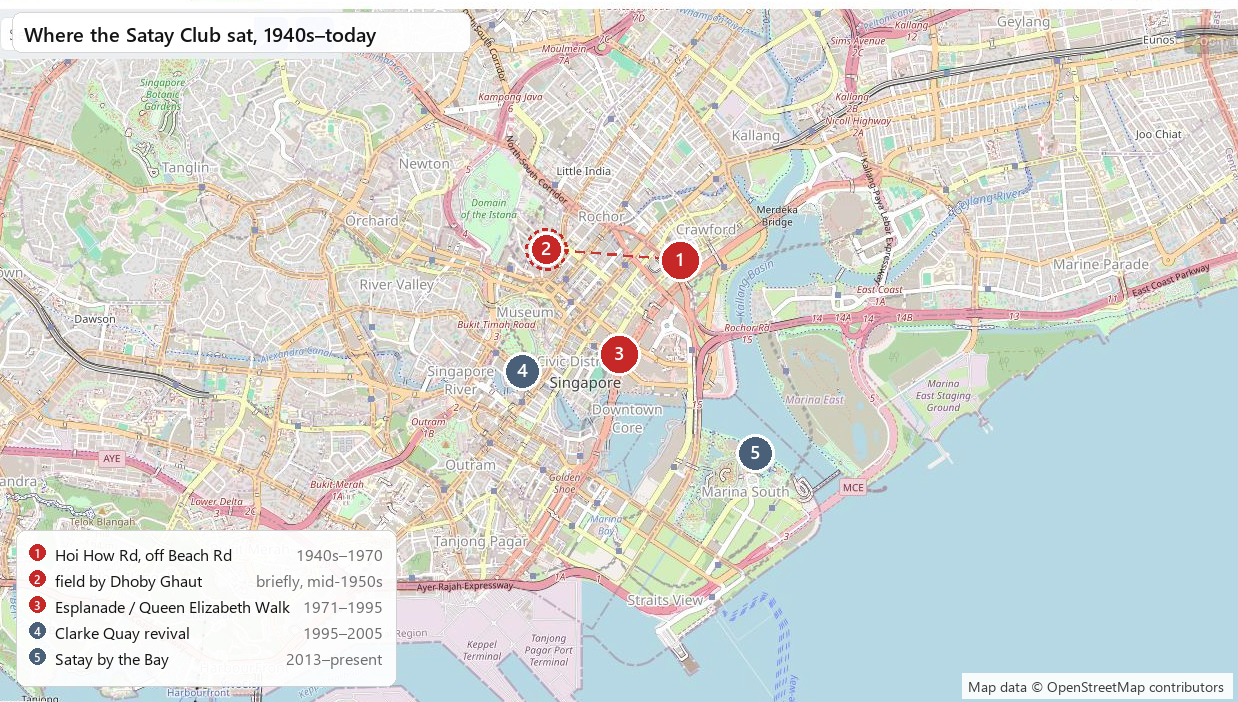
The Satay Club’s addresses over eight decades — the original Beach Road home (with a brief, later-reversed move to a field near Dhoby Ghaut in the mid-1950s), the 1971–1995 Esplanade waterfront site, and the two revivals at Clarke Quay and Gardens by the Bay. Positions for the two earliest sites are approximate. (Map data © OpenStreetMap contributors)
The closest thing to a real survivor is a stall most visitors would walk straight past. Encik Saiful bin Haji Juwahir, now 71, runs Original Alhambra Satay out of two ordinary hawker centres — Circuit Road and Geylang Serai Market — using a recipe and method that trace directly back to his father’s stall at that very first Beach Road location in the late 1940s. He inherited it in 1980, turned down offers to join the Clarke Quay reboot because the rent was too steep, and still makes every stick by hand: no machines, thigh meat only for the chicken, a charcoal fire instead of gas, and an eight-spice marinade he won’t fully disclose. Of the Satay Club’s original stallholders, his is, as far as anyone has documented, the only one still standing. See nine more historical photos related to this post →

Satay by the Bay, the themed food court at Gardens by the Bay, photographed in January 2026. (Photo: Kbseah / Wikimedia Commons, CC BY-SA 4.0)
What’s actually persisted isn’t the address, or even really the club — it’s the food, moving in two directions at once. Locally, satay has gotten pricier the way most hawker food has: a stick that cost around 30 cents in the 1980s typically runs $0.70 to a dollar or more today, though one stall in Geylang Bahru, tracing back to a former stand outside the old Hoover Theatre, has held that 1980s price of 30 cents a stick for over three decades out of what looks like sheer stubbornness. Meanwhile the dish itself has travelled the other way, far past Singapore and even past Southeast Asia — Javanese and Malay in origin, carried into Dutch restaurant menus as “saté” through colonial-era ties to the Dutch East Indies, into South African cooking as “sosatie” via the Cape Malay community, and now a standard fixture on Southeast Asian menus on more or less every continent, usually a long way from a charcoal fire and a running tab counted in skewers.
The stretch of pavement I actually sat on as a kid, eating off a skewer someone would tally up later, went under the Nicoll Highway extension and the new arts centre in 1995. But the thing on the skewer hasn’t really gone anywhere. It just got a little more expensive at home, and turned up on a lot more menus everywhere else.
Why it matters today: Not many Singapore food institutions have moved four times, spawned two failed revivals and one themed recreation, and still ended up outliving all of them — not as an address, but as whatever’s left once you take away everywhere it used to be.
Sources:
- Satay Club — Wikipedia
- Satay Club — Singapore Infopedia, National Library Board
- Original Alhambra Satay: The Last Survivor Of Singapore’s Historical Satay Club — Eatbook.sg
- S’pore’s cheapest satay at 30 cents a stick still in operation — Mothership.SG
- Geylang Bahru Satay Stall Has Kept 1980s Price, Still $0.30/Stick 41 Years Later — MustShareNews
- File:Singapore-Satay-1973-74-WUS08150.jpg — Wikimedia Commons
- File:Singapore-Hawker Centre.1973-74-WUS08151.jpg — Wikimedia Commons
- File:Satay by the Bay.jpg — Wikimedia Commons
- File:Singapore-Satay-1973-74-WUS08150-2.jpg — Wikimedia Commons
- File:Singapore-Food stall-1973-74-WUS08236.jpg — Wikimedia Commons
- File:Satay by the Bay (14314).jpg — Wikimedia Commons
- File:Lau Pa Sat satay and shrimp 10-08-2025.jpg — Wikimedia Commons
- File:Lau Pa Sat satay and shrimp 04-12-2024.jpg — Wikimedia Commons
- File:1920s photo of Marlborough Cinema and the next-door Alhambra Cinema.jpg — Wikimedia Commons
- File:KITLV - 103979 - Washing and bleaching field, Singapore - circa 1880.tif — Wikimedia Commons
- File:Collectie Wereldmuseum, TM-FV-0586-104 (saté for a rijsttafel, 1943-45) — Wikimedia Commons
- File:Esplanade Theatres on the Bay Singapore at blue hour.jpg — Wikimedia Commons
- File:Queen Elizabeth Walk, Aug 06.JPG — Wikimedia Commons
- Central Singapore — OpenStreetMap (base map for the locations diagram; Map data © OpenStreetMap contributors)


