The Japanese Garden That Reconciliation Built, Then Forgot
When the Japanese Garden in Jurong reopened in September 2024 after five years of redevelopment, the new attractions were a Water Lily Pavilion with over 150 varieties, a cenote-inspired Sunken Garden, and a “Breathing Gallery” of terrariums and aquariums. Nothing in the coverage of the relaunch explained why there was a Japanese garden at Jurong Lake in the first place. Fifty years earlier, its 1973 opening had nothing to do with water lilies — it was one of the more understated acts of postwar reconciliation between Singapore and the country whose army had occupied it only three decades before.

The red arched bridge in the Japanese Garden, photographed in November 2012, before its 2019–2024 redevelopment. (Photo: Erwin Soo / Wikimedia Commons, CC BY 2.0)
Reconciliation was not simple to arrange. The mass graves uncovered around Singapore in 1962, the “blood debt” rallies that followed, and the S$50 million settlement Japan finally agreed to on 25 October 1966 are their own story — told in more detail here — but that settlement, split between an outright grant and a loan, is the backdrop against which everything at Jurong happened. It closed the formal account. It didn’t require either side to build anything friendlier than a memorial.
The Japanese Garden was a separate undertaking, but it grew out of the same thaw. Work began in May 1968 on a roughly 32-acre artificial island in the newly dammed Jurong Lake, jointly paid for by the Singapore and Japanese governments along with Singapore’s own Japanese business community — the same community whose compatriots had run the wartime occupation now underwriting a monument to peace with it. The design, named Seiwaen, was entrusted to Kinsaku Nakane, one of postwar Japan’s most respected landscape architects, who modelled it on the garden aesthetics of Japan’s Muromachi and Momoyama periods: dry karesansui gravel gardens, koi ponds, arched vermilion bridges. It took nearly five years and S$3 million to complete.
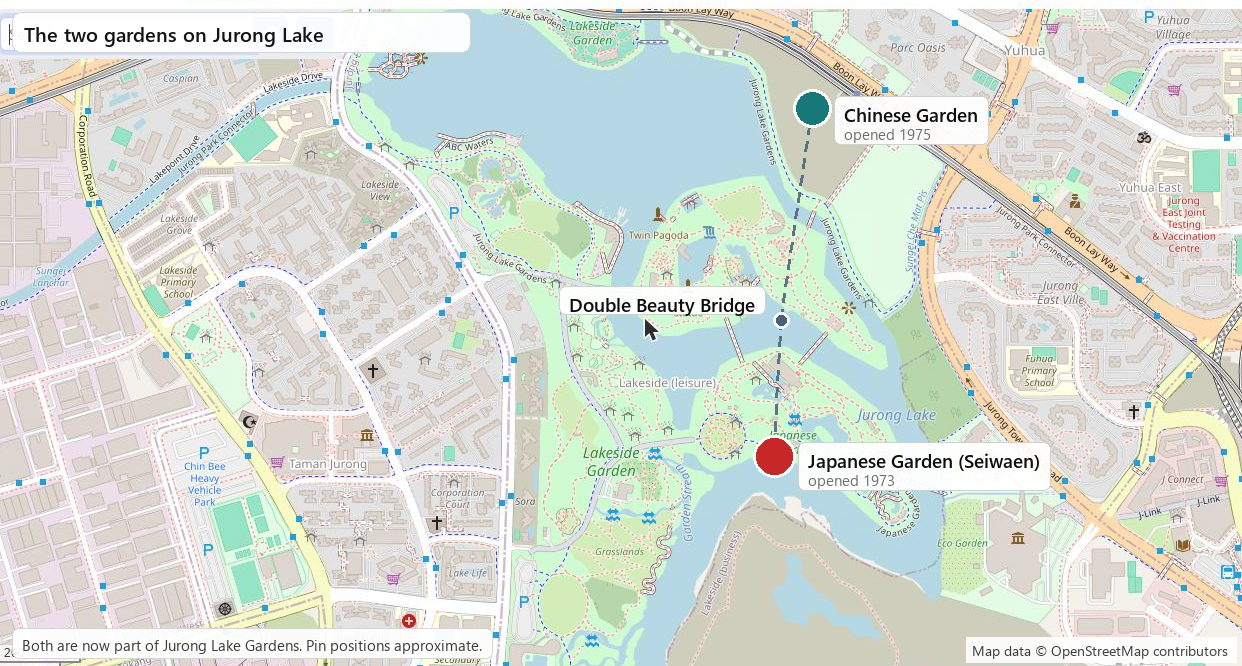
The Japanese Garden sits on its own island in Jurong Lake, linked by the Double Beauty Bridge to the Chinese Garden that opened two years later. Both are now folded into Jurong Lake Gardens, ringed by the HDB estates and industrial parks of Jurong. Pin positions are approximate. (Map data © OpenStreetMap contributors)

A view of the Japanese Garden’s grounds, photographed in November 2015, in the decades of quiet decline before its 2019 closure. (Photo: Zairon / Wikimedia Commons, CC BY-SA 4.0)
When the garden opened on 16 February 1973, the man cutting the ribbon was, fittingly or not, Goh Keng Swee — Singapore’s Minister for Defence. His speech, preserved in the National Archives, never once used the words reconciliation, Japan, or occupation. He filed the Japanese Garden alongside the nearly finished National Stadium and Sentosa’s new golf course and cable car as one more piece of leisure infrastructure for a population that, in his words, had “worked very hard in the last few years” and deserved to enjoy the fruits of its labour: “it will provide many hours of pleasant relaxation to Singaporeans and their families; it will also serve as a notable tourist attraction.” Having dispensed with the ribbon-cutting in a single paragraph, Goh spent most of the speech on an unrelated complaint — that Singapore, unlike Liverpool or the English resort town of Bournemouth, still had no symphony orchestra — and blamed “the barbarous form of music produced by the steel guitar” for coarsening the young. Whatever reconciliation the garden represented, it went unspoken at its own opening.
For a while it worked as intended: pleasant relaxation, a notable tourist draw. But Jurong’s Chinese and Japanese Gardens aged the way most 1970s civic amenities do — interest thinned across the decades as newer attractions opened elsewhere on the island and the site began to read as dated rather than serene. By 2014, the National Parks Board had folded both gardens into a masterplan for a unified Jurong Lake Gardens, and in May 2019 they closed outright, this time for a five-year rebuild rather than a touch-up. See five more historical photos related to this post →

The moon bridge in the reopened Japanese Garden, photographed in October 2024, weeks after the five-year redevelopment finished. (Photo: FN-082 / Wikimedia Commons, CC BY-SA 4.0)
What reopened in September 2024 kept some of the bones — the Double Beauty Bridge to the neighbouring Chinese Garden survived, along with fragments of Nakane’s original stonework — but the pitch to visitors was entirely new: water lilies, a sunken garden, a gallery of terrariums. Nowhere in the press coverage of the relaunch, or in the park’s own marketing, does the garden’s original purpose resurface. A garden built as an unspoken act of peace with Japan has become, in its second life, simply a nice place to walk.
Where it fits in the bigger story: Singapore’s postwar reckoning with Japan produced a war crimes tribunal, a reparations dispute settled by euphemism, and — almost as an afterthought — thirty-two acres of Muromachi-style garden design on an industrial satellite town’s doorstep. That the reconciliation went unstated even at its own ribbon-cutting says as much about how Singapore chose to move on from the occupation as any memorial built explicitly to remember it.
Sources:
- Japanese Garden, Singapore — Wikipedia
- Japanese Garden — Roots.gov.sg, Jurong Heritage Trail
- SPEECH BY DR. GOH KENG SWEE, MINISTER OF DEFENCE, AT THE OPENING OF THE SEIWAEN (JAPANESE GARDEN), 16 FEBRUARY 1973 — National Archives of Singapore
- Tokyo kept war redress out of ‘67 Singapore accord title — The Japan Times
- “Blood debt” rally is held at City Hall — Roots.gov.sg / NLB
- Operation Sook Ching — Roots.gov.sg / NLB
- The Chinese and Japanese Gardens reinterpreted — The Long and Winding Road
- Chinese & Japanese gardens in Jurong reopen after 5 years — Mothership.SG
- File:Redbridge (8166305323).jpg — Wikimedia Commons
- File:Singapore Japanischer Garten 3.jpg — Wikimedia Commons
- File:Moon bridge, Japanese Garden, Singapore 202409.jpg — Wikimedia Commons
- File:Double Beauty Bridge, Singapore.jpg — Wikimedia Commons
- File:Niches with horticultural showcase, Japanese Garden, Singapore 202409.jpg — Wikimedia Commons
- File:2012-07-07 Jurong East 26.JPG — Wikimedia Commons
- File:Bridge at Japanese Gardens (8153514054).jpg — Wikimedia Commons
- File:Singapore Japanischer Garten 5.jpg — Wikimedia Commons
- Jurong Lake and the Japanese Garden — OpenStreetMap (base map for the locations diagram; Map data © OpenStreetMap contributors)
- Straits Times, 17 February 1973, p.9 — “Barbaric music a serious menace says Goh” (NewspaperSG; report of Goh Keng Swee’s speech at the garden’s opening)


