SkillsFuture at Ten: The Promise Still Outruns the Practice
At the end of 2025, a $500 credit that the government had handed to every Singaporean aged 25 and older quietly expired. It had been sitting in accounts since 2020, meant to nudge people into a course, a workshop, anything that counted as upskilling, before a deadline forced the decision. Roughly seven in ten eligible Singaporeans let it lapse unused. Weeks later, in January 2026, an MP was still asking Parliament whether the unclaimed money could at least be passed on to a family member — an elderly parent, say, or someone with a disability — before it disappeared back into the state’s books for good. The Ministry said no: SkillsFuture credits are not transferable, “including [to] immediate family members,” because the scheme is built around Singaporeans “taking ownership of their own lifelong learning journey.”
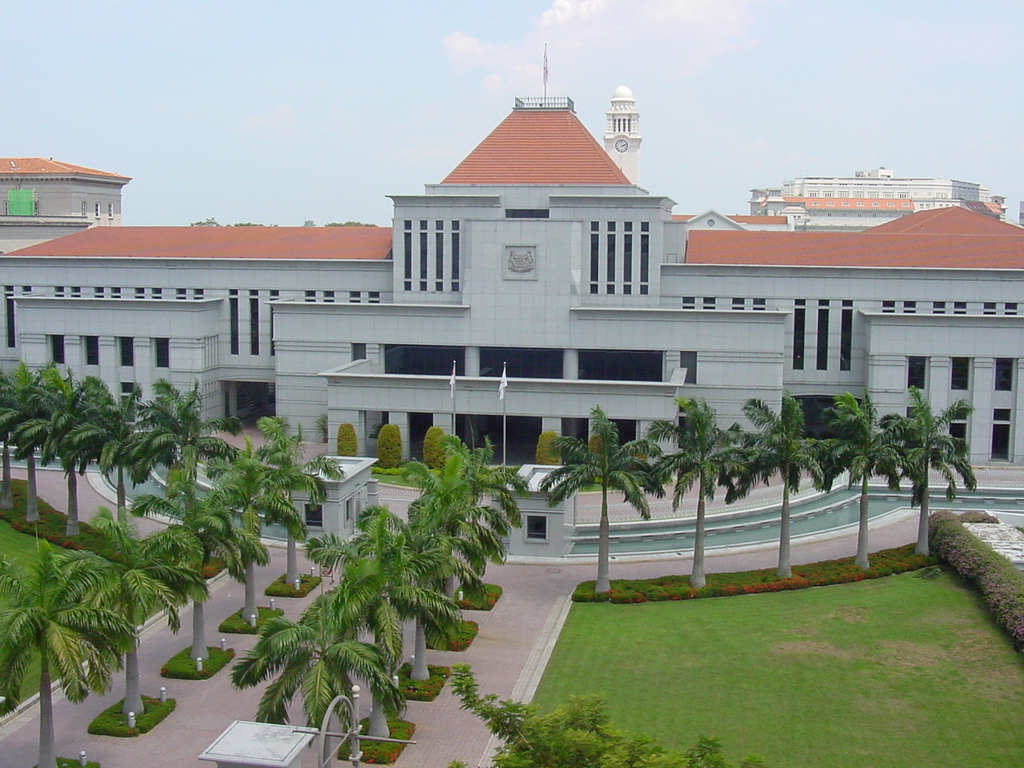
Parliament House, Singapore, where MPs were still asking in January 2026 what would happen to hundreds of thousands of unclaimed SkillsFuture credits. (Photo: TteckK / Wikimedia Commons, public domain)
Rewind ten years and the mood around SkillsFuture was entirely different. It launched in 2015 as a “national movement,” the product of a SkillsFuture Council chaired by then-Deputy Prime Minister Tharman Shanmugaratnam, built on the promise that Singaporeans could keep developing their potential “throughout life, regardless of their starting points.” Every citizen turning 25 would get an Opening Credit of $500 — no strings, no expiry — to spend on courses whenever they were ready.
 Tharman Shanmugaratnam, who chaired the SkillsFuture Council behind the 2015 launch, pictured in his official 2023 portrait. (Photo: Mohd Fyrol Anwar Aziz Marican & Lim Sin Thai, Ministry of Communications and Information / Wikimedia Commons, CC BY-SA 4.0)
What followed was less a movement than a slow, patient build. In its first year, just 126,000 people had used the credit. By the end of 2019, that was 540,000 people — 20% of those eligible. By mid-2022 it had crept to 29%. Employers came along too, if gradually: the number of companies participating doubled from 12,000 in 2015 to 24,000 in 2024, and the training catalogue grew to more than 28,000 courses. By the time SkillsFuture marked its tenth anniversary in 2025, more than half of eligible Singaporeans aged 30 to 75 had used their credit at least once — a genuinely large number, just one that took a full decade to reach.
Somewhere along that decade, SkillsFuture also picked up a second, unplanned purpose. It was pitched as workforce policy — keep Singaporeans employable as industries change — but as the population has aged, take-up among older Singaporeans has kept climbing too: utilisation among those in their 60s rose from around a quarter in 2022 to roughly a third by 2025. Community classes teaching seniors to use generative AI chatbots, reported on in mid-2026, aren’t really about job security for people well past their working years. For a lot of older Singaporeans, the credit has quietly become less a career tool and more a low-stakes way to try something new — proof that a scheme built around “upskilling” can end up mattering just as much for its own sake.
Patience compounds. A deadline caps.
Share of eligible Singaporeans who have used their SkillsFuture Credit, by years since each scheme began
Both schemes track close to each other for their first four years — the top-up only falls behind because it expired at year 5, while the Opening Credit kept accumulating users for another five.
View data as table
| Years since introduction | Opening Credit (2015–) | 2020 top-up |
|---|---|---|
| 0 | 0% | 0% |
| 4 | 20% (end-2019) | 26% (Nov 2024) |
| 5 | — | 30% (Sep 2025, expired end-2025) |
| 7 | 29% (Jun 2022) | — |
| 10 | 50%+ (2025, 10th anniversary) | — |
The top-up was meant to fix exactly this kind of drift. In 2020, the government handed every eligible Singaporean an extra $500 — but this time with an actual deadline, five years, to force the decision that the open-ended Opening Credit never had. It didn’t really work. By November 2024, only 26% had used it. By September 2025, with three months left on the clock, that had inched up to about 30% — still meaning seven in ten people were about to lose free money. The government held firm on the deadline anyway: no extension, and — as the January 2026 exchange in Parliament confirmed — no way to hand the unused balance to someone else either. See five more historical photos related to this post →
Where it fits in the bigger story: A policy built to close a skills gap has, after a decade, done something quieter and more human — become a way for an aging Singapore to try something new just because it can. But that same decade shows the gap between offering people something and getting them to actually take it hasn’t closed at all; it just moved from Singaporeans’ skills to their bank of unclaimed government credit.
Sources:
- Celebrating a Decade of Empowering Singaporeans to Upskill and Reskill — SkillsFuture Singapore
- PM Lawrence Wong at the SkillsFuture 10th Anniversary — Prime Minister’s Office Singapore
- SkillsFuture Movement — SkillsFuture Singapore
- SkillsFuture credits utilisation (2019/2020 figures) — MOE Parliamentary Replies
- SkillsFuture Credits (2022 figures) — MOE Parliamentary Replies
- Encouraging More Singaporeans to Utilise SkillsFuture Credits Top-up Given in 2020 before Expiration — MOE Parliamentary Replies
- Reasons for Low Take-Up Rate of $500 SkillsFuture Credit Top-Up — MOE Parliamentary Replies
- Considerations and Efforts Taken to Increase Usage of $500 — MOE Parliamentary Replies
- Data on Unutilised SkillsFuture Credits and Plans for Redeployment of Unutilised Funds — MOE Parliamentary Replies
- Unutilised SkillsFuture Credits and Transfer Options to Immediate Family Members — MOE Parliamentary Replies
- Inside Singapore: More workers upskilling proves SkillsFuture ROI — People Matters
- Feature: Inside an AI class for seniors in Singapore — Xinhua
- File:Parliament House Singapore.jpg — Wikimedia Commons
- File:Tharman Shanmugaratnam Official photo 2023.tif — Wikimedia Commons
- File:Signs pointing to Jurong Industrial Estate in Singapore June 1964.jpg — Wikimedia Commons
- File:ITE College Central.jpg — Wikimedia Commons
- File:Institute of Technical Education Headquarters, Nov 06.JPG — Wikimedia Commons
- File:2018-skillsfuture-festival.jpg — Wikimedia Commons
- File:Old Parliament House, Singapore, Feb 06.JPG — Wikimedia Commons


