A Typical Day for Singapore's Silver Generation
For many Singaporeans now in their 80s, the day starts early — not out of habit, but because that’s when the shuttle to the nearest Active Ageing Centre picks up. A quick blood-pressure check, a subsidised breakfast, maybe a round of Rummy-O or a stretching class before the heat sets in. Some still work a few hours a day, clearing tables or wiping counters at the neighbourhood hawker centre. It’s an unremarkable morning, and that’s rather the point: for a generation that spent decades without much of a safety net, an unremarkable morning is a small daily win.

Our Tampines Hub — one of the regional hubs built to support seniors’ daily routines. (Photo: Tamprovers / Wikimedia Commons, CC BY-SA 4.0)

A public fitness corner outside an HDB block — the kind of neighbourhood exercise stations built into estates across Singapore, popular with seniors for a morning stretch before the heat sets in. (Photo: Wzhkevin / Wikimedia Commons, CC BY-SA 4.0)
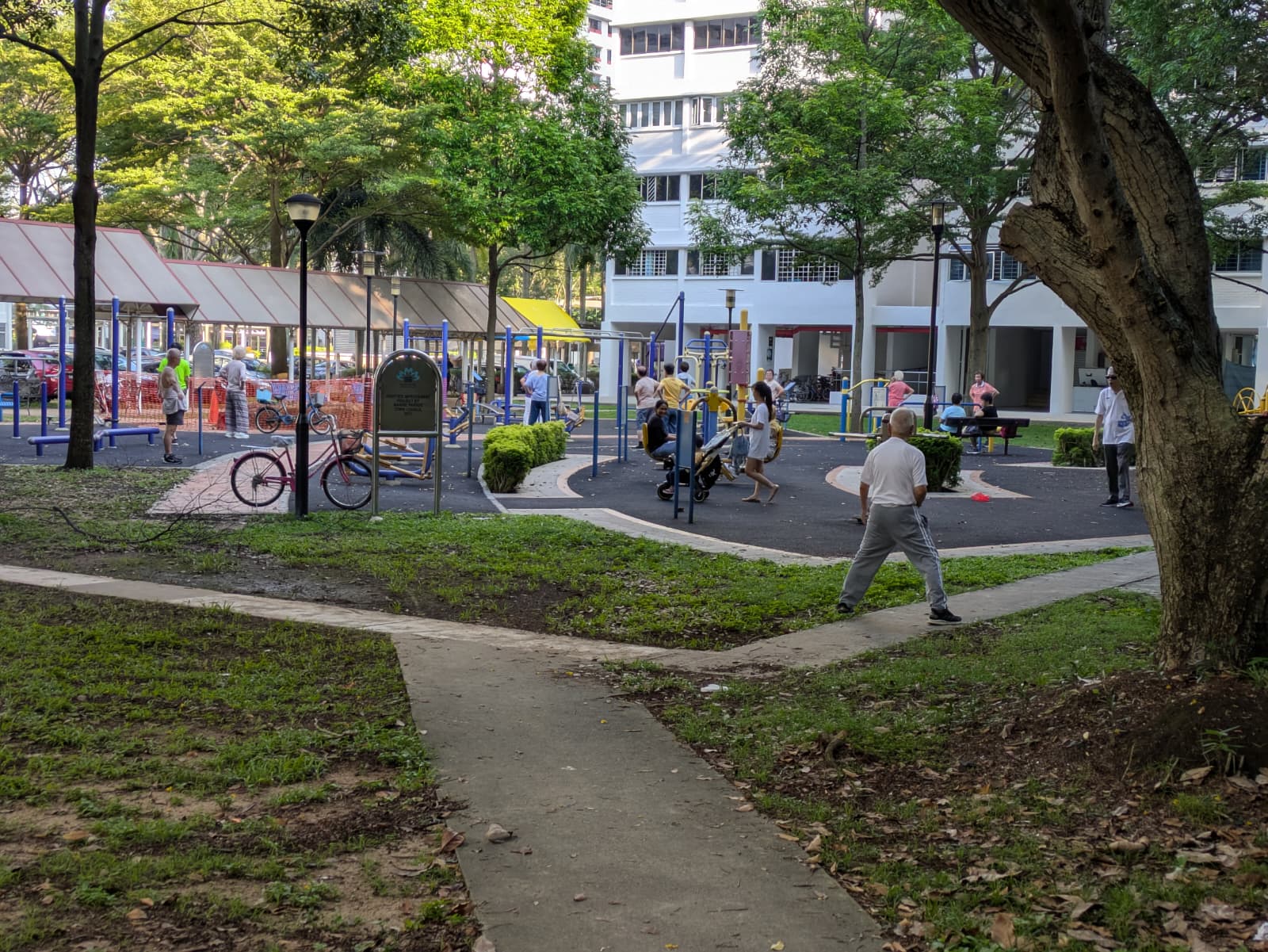
A morning scene at a fitness corner along the Haig Road park connector — much like the “unremarkable morning” this post opens with. (Photo: Chris Lee)

A neighbourhood hawker centre — for some seniors, still a place of light work rather than just meals. (Photo: DylanAngGuanZhe / Wikimedia Commons, CC BY-SA 4.0)
The reason this generation leans so heavily on subsidised programmes traces back to how they spent their working years. Many held informal jobs — hawking, portering, piecework — in an economy that hadn’t yet built the retirement infrastructure people take for granted now. The Central Provident Fund was set up in 1955 as a compulsory savings scheme, but it took decades to mature into a genuine retirement system. Someone already well into their working life when it did had little time left to build up savings through it. Large families were, for a long time, the actual retirement plan — and that has become far less reliable as households have shrunk and children have moved out.

The CPF Building on Robinson Road, once the headquarters of the scheme meant to be every worker’s retirement fund. (Photo: Nlannuzel / Wikimedia Commons, CC BY-SA 3.0)
The government’s response has been to build the infrastructure this generation missed the first time around. The Silver Support Scheme, introduced in 2016, gives seniors with low lifetime wages and little family support a quarterly cash top-up — enhanced in 2025 to as much as $1,080 a quarter, and reaching roughly 260,000 seniors in 2023 alone. Alongside the cash support sit the physical spaces: Active Ageing Centres in almost every neighbourhood, and larger integrated developments like Our Tampines Hub, which opened in 2017 and folds a library, hawker centre, sports facilities, and community programming for seniors into a single town square. See six more photos related to this post →
Why it matters today: the generation now in their 80s and 90s is, in many ways, the last to have lived most of their working life before Singapore’s retirement systems caught up — which makes the hubs, subsidies, and quiet daily routines built around them one of the more overlooked ways the island is still adjusting for its own history.
Sources:
- Silver Support Scheme — CPF Board
- Central Provident Fund — Wikipedia
- PCS Active Ageing Centres
- Our Tampines Hub — Wikipedia
- File:Our Tampines Hub Town Square.jpg — Wikimedia Commons
- File:Outdoor adult exercise equipment on Woodlands Street 83, Singapore.jpg — Wikimedia Commons
- File:Bedok Hawker Centre.jpg — Wikimedia Commons
- File:CPF Building.jpg — Wikimedia Commons
- File:Singapore-Street Vendor 1973-74-WUS08155.jpg — Wikimedia Commons
- File:Singapore-Hawker Centre.1973-74-WUS08151.jpg — Wikimedia Commons
- File:Singapore-Public Housing-1973-74-WUS08215.jpg — Wikimedia Commons
- File:Family planning, Singapore - UNESCO - PHOTO0000000902 0001.tiff — Wikimedia Commons
- File:HDB living room (1970s and 1980s), Singapore History Gallery, National Museum of Singapore - 20151125-01.jpg — Wikimedia Commons


