More Photos: The Spanish Dollar and Singapore's Early Money
← Back to “The Spanish Dollar That Ruled Singapore's Early Economy”
The coin at the centre of the story, where it circulated, and what replaced it.
A pillar dollar of Charles III, 1771
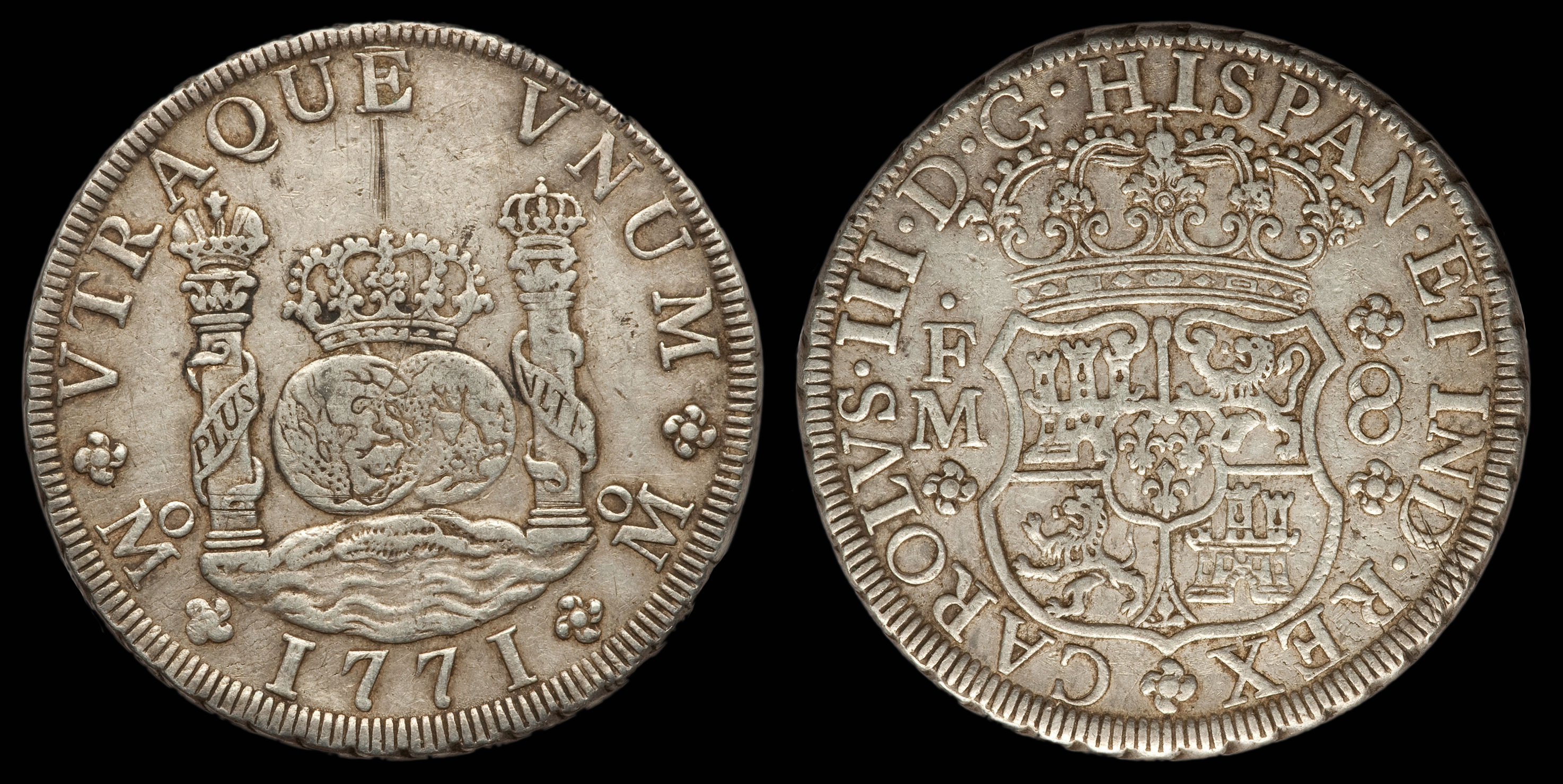
Both faces of a Mexican-minted eight-real “pillar dollar,” 1771. The coin’s uniform silver content was the source of its reputation across three continents. (Photo: Heritage Auctions, via Wikimedia Commons, CC BY 4.0 / public domain mark)
Where the coin’s influence reached

The historical area of influence of the eight-real coin and other Spanish and Portuguese currencies, across the Americas, Africa, Asia and Europe. (Photo: Nagihuin, CC BY-SA 4.0, via Wikimedia Commons)
The other side of the 1904 dollar

The reverse of the 1904 Straits dollar: an ornament and the value in Chinese (“yi yuan”) and Malay (“satu ringit”), on a coin of 26.95 grams of 90 percent silver. (Photo: 5snake5, CC0, via Wikimedia Commons)
A one-dollar note, 1935

A Straits Settlements one-dollar note of 1935, printed in English, Chinese and Malay, by which time the Straits dollar had long been tied to sterling. (Photo: Bradbury, Wilkinson & Co., public domain, via Wikimedia Commons)
← Back to “The Spanish Dollar That Ruled Singapore's Early Economy”