<?xml version="1.0" encoding="utf-8"?><feed xmlns="http://www.w3.org/2005/Atom" xml:lang="en-SG"><generator uri="https://jekyllrb.com/" version="3.10.0">Jekyll</generator><link href="https://pikaia.github.io/feed.xml" rel="self" type="application/atom+xml" /><link href="https://pikaia.github.io/" rel="alternate" type="text/html" hreflang="en-SG" /><updated>2026-11-28T08:56:10+00:00</updated><id>https://pikaia.github.io/feed.xml</id><title type="html">Lesser Known Singapore</title><subtitle>Forgotten facts, obscure history, and overlooked people from Singapore&apos;s past and present.</subtitle><entry><title type="html">The Padang and the Cricket Club: The Field That Was Ordered to Stay Empty</title><link href="https://pikaia.github.io/2026/11/28/the-padang-and-the-cricket-club-the-field-that-was-ordered-to-stay-empty/" rel="alternate" type="text/html" title="The Padang and the Cricket Club: The Field That Was Ordered to Stay Empty" /><published>2026-11-28T06:00:00+00:00</published><updated>2026-11-28T06:20:00+00:00</updated><id>https://pikaia.github.io/2026/11/28/the-padang-and-the-cricket-club-the-field-that-was-ordered-to-stay-empty</id><content type="html" xml:base="https://pikaia.github.io/2026/11/28/the-padang-and-the-cricket-club-the-field-that-was-ordered-to-stay-empty/"><![CDATA[<p>In the middle of Singapore’s civic district, in front of the old City Hall, lies 4.3 hectares of grass that has never been built on. Armies have camped on it, kings’ birthdays have been saluted across it, a surrender was signed in the chamber above it, and a nation’s first cabinet was sworn in within sight of it — but for two hundred years the field itself has stayed empty, by order. In 2022 the emptiness itself was made a national monument. This is the story of the Padang, and of the two Victorian sports clubs that guard its ends.</p>

<p><a href="/">← Back to all posts</a></p>

<!-- WATCH-WIDGET:BEGIN (generated by scripts/build_watch_widget.py - do not hand-edit between these markers, re-run the script instead) -->

<div style="display: flex; gap: 2em; margin: 0.5em 0 1.5em 0; align-items: flex-end;">
  <div id="listen-widget" role="button" tabindex="0" aria-label="Play audio narration of this post" style="display: inline-flex; flex-direction: column; align-items: center; cursor: pointer; gap: 0.2em; user-select: none;">
    <span id="listen-icon" aria-hidden="true" style="display: inline-flex; align-items: center; justify-content: center; width: 2.1em; height: 2.1em; border-radius: 50%; border: 1px solid #888; font-size: 1.1em;">&#127911;</span>
    <span style="font-size: 0.7em; text-transform: uppercase; letter-spacing: 0.05em; opacity: 0.75;">Listen</span>
  </div>
  <div id="watch-widget" role="button" tabindex="0" aria-label="Watch an animated version of this post" style="display: inline-flex; flex-direction: column; align-items: center; cursor: pointer; gap: 0.2em; user-select: none;">
    <span aria-hidden="true" style="display: inline-flex; align-items: center; justify-content: center; width: 2.1em; height: 2.1em; border-radius: 50%; border: 1px solid #888; font-size: 1.1em;">&#127916;</span>
    <span style="font-size: 0.7em; text-transform: uppercase; letter-spacing: 0.05em; opacity: 0.75;">Watch</span>
  </div>
  <a href="https://youtu.be/Tf0jd8P-fk8" target="_blank" rel="noopener" aria-label="Watch this story as a video on YouTube" style="display: inline-flex; flex-direction: column; align-items: center; gap: 0.2em; text-decoration: none; color: inherit;">
    <span aria-hidden="true" style="display: inline-flex; align-items: center; justify-content: center; width: 2.4em; height: 2.4em; border-radius: 50%; border: 1px solid #888;">
      <svg width="1.4em" height="1.4em" viewBox="0 0 24 24" aria-hidden="true"><rect x="1" y="4" width="22" height="16" rx="5" fill="#FF0000" /><path d="M10 8.5l6 3.5-6 3.5z" fill="#fff" /></svg>
    </span>
    <span style="font-size: 0.7em; text-transform: uppercase; letter-spacing: 0.05em; opacity: 0.75;">YouTube</span>
  </a>
  <a href="https://youtube.com/shorts/syWyWGSNLvA" target="_blank" rel="noopener" aria-label="Watch a short version of this story on YouTube Shorts" style="display: inline-flex; flex-direction: column; align-items: center; gap: 0.2em; text-decoration: none; color: inherit;">
    <span aria-hidden="true" style="display: inline-flex; align-items: center; justify-content: center; width: 2.4em; height: 2.4em; border-radius: 50%; border: 1px solid #888;">
      <svg width="1.4em" height="1.4em" viewBox="0 0 24 24" aria-hidden="true">
        <defs>
          <linearGradient id="shortsGradThePadangAnd8d28" x1="0%" y1="0%" x2="100%" y2="100%">
            <stop offset="0%" stop-color="#FF0000" />
            <stop offset="100%" stop-color="#FF4E8B" />
          </linearGradient>
        </defs>
        <rect x="1" y="1" width="22" height="22" rx="7" fill="url(#shortsGradThePadangAnd8d28)" />
        <path d="M13 6 L7.5 13.5 H11.5 L10.5 18 L16.5 10 H12.5 Z" fill="#fff" />
      </svg>
    </span>
    <span style="font-size: 0.7em; text-transform: uppercase; letter-spacing: 0.05em; opacity: 0.75;">Shorts</span>
  </a>
  <a href="https://www.tiktok.com/@lesserknownsingapore/video/7713132272647507230" target="_blank" rel="noopener" aria-label="Watch a short version of this story on TikTok" style="display: inline-flex; flex-direction: column; align-items: center; gap: 0.2em; text-decoration: none; color: inherit;">
    <span aria-hidden="true" style="display: inline-flex; align-items: center; justify-content: center; width: 2.4em; height: 2.4em; border-radius: 50%; border: 1px solid #888;">
      <svg width="1.4em" height="1.4em" viewBox="0 0 24 24" aria-hidden="true">
        <rect x="1" y="1" width="22" height="22" rx="7" fill="#000" />
        <path d="M13.2 5h2.3c.2 1.6 1.4 2.8 3 3v2.3a5.3 5.3 0 0 1-3-1v5.2a4.2 4.2 0 1 1-4.2-4.2h.4v2.4h-.4a1.8 1.8 0 1 0 1.9 1.8z" fill="#25F4EE" transform="translate(-0.6 -0.4)" />
        <path d="M13.2 5h2.3c.2 1.6 1.4 2.8 3 3v2.3a5.3 5.3 0 0 1-3-1v5.2a4.2 4.2 0 1 1-4.2-4.2h.4v2.4h-.4a1.8 1.8 0 1 0 1.9 1.8z" fill="#FE2C55" transform="translate(0.6 0.4)" />
        <path d="M13.2 5h2.3c.2 1.6 1.4 2.8 3 3v2.3a5.3 5.3 0 0 1-3-1v5.2a4.2 4.2 0 1 1-4.2-4.2h.4v2.4h-.4a1.8 1.8 0 1 0 1.9 1.8z" fill="#fff" />
      </svg>
    </span>
    <span style="font-size: 0.7em; text-transform: uppercase; letter-spacing: 0.05em; opacity: 0.75;">TikTok</span>
  </a>
</div>

<audio id="listen-audio" preload="none" style="display: none;">
  <source src="/audio/the-padang-and-the-cricket-club-the-field-that-was-ordered-to-stay-empty.mp3" type="audio/mpeg" />
</audio>

<div id="watch-viewer" style="position: fixed; inset: 0; background: #000; z-index: 9999; display: none;">
  <div id="watch-stage" style="position: absolute; inset: 0; overflow: hidden;"></div>
  <div style="position: absolute; left: 0; right: 0; bottom: 12%; text-align: center; padding: 0 5%; z-index: 2;">
    <span id="watch-caption" style="display: inline-block; background: rgba(0,0,0,0.55); color: #fff; font-size: 1.3em; font-weight: 600; padding: 0.5em 0.8em; border-radius: 4px; max-width: 700px;"></span>
  </div>
  <button id="watch-close" aria-label="Close" style="position: absolute; top: 1em; right: 1.2em; color: #fff; font-size: 1.6em; cursor: pointer; background: none; border: none; z-index: 2;">&times;</button>
  <div style="position: absolute; bottom: 0; left: 0; right: 0; padding: 1em 1.5em; display: flex; align-items: center; gap: 1em; background: linear-gradient(transparent, rgba(0,0,0,0.6)); z-index: 2;">
    <button id="watch-play" aria-label="Play/Pause" style="background: none; border: none; color: #fff; font-size: 1.4em; cursor: pointer; line-height: 1; padding: 0.2em;">&#10074;&#10074;</button>
    <div id="watch-progress" style="flex: 1; height: 4px; background: rgba(255,255,255,0.25); border-radius: 2px; overflow: hidden; cursor: pointer;">
      <div id="watch-progress-fill" style="height: 100%; width: 0%; background: #fff;"></div>
    </div>
    <span id="watch-time" style="color: #fff; font-size: 0.85em; font-variant-numeric: tabular-nums; opacity: 0.8;">0:00 / 0:00</span>
  </div>
</div>

<script>
(function () {
  var widget = document.getElementById('listen-widget');
  var icon = document.getElementById('listen-icon');
  var audio = document.getElementById('listen-audio');

  function setIcon(playing) {
    icon.innerHTML = playing ? '&#10074;&#10074;' : '&#127911;';
  }
  function toggle() {
    if (audio.paused) { audio.play(); } else { audio.pause(); }
  }

  widget.addEventListener('click', toggle);
  widget.addEventListener('keydown', function (e) {
    if (e.key === 'Enter' || e.key === ' ') { e.preventDefault(); toggle(); }
  });
  audio.addEventListener('play', function () { setIcon(true); });
  audio.addEventListener('pause', function () { setIcon(false); });
  audio.addEventListener('ended', function () { setIcon(false); });
})();
</script>

<script>
(function () {
  var CITYHALL = "https://upload.wikimedia.org/wikipedia/commons/7/70/Old_Supreme_Court_Building_and_City_Hall_from_the_Padang%2C_Singapore_-_20110205.jpg";
  var ESPLANADE = "https://upload.wikimedia.org/wikipedia/commons/2/25/Park_met_wandelaars_in_Singapore_Esplanade%2C_S.pore_%28titel_op_object%29%2C_RP-F-F01197-AG.jpg";
  var PHOTOCHROME = "https://upload.wikimedia.org/wikipedia/commons/d/d3/Singapore._Esplanade_Cricket_Club_LCCN2017657648.jpg";
  var SCC1910 = "https://thumb.wikimedia.org/wikipedia/commons/thumb/6/67/KITLV_A887_-_Singapore_Cricket_Club_te_Singapore%2C_KITLV_101724.tiff/lossy-page1-1280px-KITLV_A887_-_Singapore_Cricket_Club_te_Singapore%2C_KITLV_101724.tiff.jpg";
  var RAFFLES1890 = "https://thumb.wikimedia.org/wikipedia/commons/thumb/5/56/KITLV_-_377458_-_Statue_of_Sir_Thomas_Stamford_Raffles_in_Singapore_-_circa_1890.tif/lossy-page1-1280px-KITLV_-_377458_-_Statue_of_Sir_Thomas_Stamford_Raffles_in_Singapore_-_circa_1890.tif.jpg";
  var MUNICIPAL = "https://thumb.wikimedia.org/wikipedia/commons/thumb/b/b6/The_Municipal_Building_te_Singapore%2C_KITLV_104790.tiff/lossy-page1-1280px-The_Municipal_Building_te_Singapore%2C_KITLV_104790.tiff.jpg";
  var INSPECT = "https://upload.wikimedia.org/wikipedia/commons/e/ea/Louis_Mountbatten_Inspection%2C_Singapore_1945.jpg";
  var ADDRESS = "https://upload.wikimedia.org/wikipedia/commons/c/c7/Mountbatten_address%2C_Singapore_1945.jpg";
  var NDP1968 = "https://upload.wikimedia.org/wikipedia/commons/e/eb/NationalDayParade-Singapore-1968.jpg";
  var CRICKETMBS = "https://upload.wikimedia.org/wikipedia/commons/7/7e/Cricket_match_and_Marina_Bay_Sands_Hotel_in_Singapore.jpg";
  var RAFFLES1900 = "https://thumb.wikimedia.org/wikipedia/commons/thumb/6/6d/KITLV_-_105827_-_Lambert_%26_Co.%2C_G.R._-_Singapore_-_Rafflesmonument_in_Singapore_-_circa_1900.tif/lossy-page1-1280px-KITLV_-_105827_-_Lambert_%26_Co.%2C_G.R._-_Singapore_-_Rafflesmonument_in_Singapore_-_circa_1900.tif.jpg";
  var SOUVENIR = "https://upload.wikimedia.org/wikipedia/commons/4/41/Souvenir_of_Singapore%2C_1914_-_Plate_12_-_Singapore_Cricket_Club%2C_Town_Hall%2C_Supreme_Court_and_Europe_Hotel.jpg";
  var SCC1921 = "https://thumb.wikimedia.org/wikipedia/commons/thumb/d/d4/Singapore_Cricket_Club%2C_Singapore%2C_KITLV_1404869.tiff/lossy-page1-1280px-Singapore_Cricket_Club%2C_Singapore%2C_KITLV_1404869.tiff.jpg";
  var SCC1963 = "https://upload.wikimedia.org/wikipedia/commons/4/4e/Singapore_Cricket_Club_1963.jpg";
  var PADANG7374 = "https://upload.wikimedia.org/wikipedia/commons/a/a7/Singapore-Padang-1973-74-WUS01252.jpg";
  var SCC7374 = "https://upload.wikimedia.org/wikipedia/commons/c/cc/Singapore-Singapore_Cricket_Club-7973-74-WUS08188.jpg";
  var SCC2016 = "https://upload.wikimedia.org/wikipedia/commons/9/91/Singapore_Cricket_Club_building_2016.jpg";
  var BOWLERS = "https://upload.wikimedia.org/wikipedia/commons/6/64/Singapore_Cricket_Club_Bowlers.jpg";
  var NDP2024 = "https://upload.wikimedia.org/wikipedia/commons/2/2e/Singapore_NDP_2024_-_Rehearsal.jpg";
  var PADANG2025 = "https://upload.wikimedia.org/wikipedia/commons/3/3d/The_Padang%2C_October_2025.jpg";

  var slides = [
    { src: CITYHALL, type: "cover", zoom: [1.0, 1.06, 1.12], pan: ["50% 50%", "50% 50%", "50% 50%"], ease: "ease-in-out" },
    { src: PADANG2025, type: "cover", zoom: [1.12, 1.06, 1.0], pan: ["50% 50%", "50% 50%", "50% 50%"], ease: "ease-in-out" },
    { src: INSPECT, type: "cover", zoom: [1.0, 1.06, 1.12], pan: ["50% 50%", "50% 50%", "50% 50%"], ease: "ease-in-out" },
    { src: CRICKETMBS, type: "cover", zoom: [1.12, 1.06, 1.0], pan: ["50% 50%", "50% 50%", "50% 50%"], ease: "ease-in-out" },
    { src: ESPLANADE, type: "cover", zoom: [1.0, 1.06, 1.12], pan: ["50% 50%", "50% 50%", "50% 50%"], ease: "ease-in-out" },
    { src: RAFFLES1900, type: "cover", zoom: [1.12, 1.06, 1.0], pan: ["50% 50%", "50% 50%", "50% 50%"], ease: "ease-in-out" },
    { src: ESPLANADE, type: "cover", zoom: [1.0, 1.06, 1.12], pan: ["50% 50%", "50% 50%", "50% 50%"], ease: "ease-in-out" },
    { src: SOUVENIR, type: "cover", zoom: [1.12, 1.06, 1.0], pan: ["50% 50%", "50% 50%", "50% 50%"], ease: "ease-in-out" },
    { src: PADANG7374, type: "cover", zoom: [1.0, 1.06, 1.12], pan: ["50% 50%", "50% 50%", "50% 50%"], ease: "ease-in-out" },
    { src: PHOTOCHROME, type: "cover", zoom: [1.12, 1.06, 1.0], pan: ["50% 50%", "50% 50%", "50% 50%"], ease: "ease-in-out" },
    { src: SCC1910, type: "cover", zoom: [1.0, 1.06, 1.12], pan: ["50% 50%", "50% 50%", "50% 50%"], ease: "ease-in-out" },
    { src: PADANG7374, type: "cover", zoom: [1.12, 1.06, 1.0], pan: ["50% 50%", "50% 50%", "50% 50%"], ease: "ease-in-out" },
    { src: SOUVENIR, type: "cover", zoom: [1.0, 1.06, 1.12], pan: ["50% 50%", "50% 50%", "50% 50%"], ease: "ease-in-out" },
    { src: CITYHALL, type: "cover", zoom: [1.12, 1.06, 1.0], pan: ["50% 50%", "50% 50%", "50% 50%"], ease: "ease-in-out" },
    { src: PHOTOCHROME, type: "cover", zoom: [1.0, 1.06, 1.12], pan: ["50% 50%", "50% 50%", "50% 50%"], ease: "ease-in-out" },
    { src: SCC1910, type: "cover", zoom: [1.12, 1.06, 1.0], pan: ["50% 50%", "50% 50%", "50% 50%"], ease: "ease-in-out" },
    { src: SCC1921, type: "cover", zoom: [1.0, 1.06, 1.12], pan: ["50% 50%", "50% 50%", "50% 50%"], ease: "ease-in-out" },
    { src: SCC1921, type: "cover", zoom: [1.12, 1.06, 1.0], pan: ["50% 50%", "50% 50%", "50% 50%"], ease: "ease-in-out" },
    { src: SCC1921, type: "cover", zoom: [1.0, 1.06, 1.12], pan: ["50% 50%", "50% 50%", "50% 50%"], ease: "ease-in-out" },
    { src: SCC1910, type: "cover", zoom: [1.12, 1.06, 1.0], pan: ["50% 50%", "50% 50%", "50% 50%"], ease: "ease-in-out" },
    { src: SCC1963, type: "cover", zoom: [1.0, 1.06, 1.12], pan: ["50% 50%", "50% 50%", "50% 50%"], ease: "ease-in-out" },
    { src: SCC7374, type: "cover", zoom: [1.12, 1.06, 1.0], pan: ["50% 50%", "50% 50%", "50% 50%"], ease: "ease-in-out" },
    { src: CITYHALL, type: "cover", zoom: [1.0, 1.06, 1.12], pan: ["50% 50%", "50% 50%", "50% 50%"], ease: "ease-in-out" },
    { src: PADANG2025, type: "cover", zoom: [1.12, 1.06, 1.0], pan: ["50% 50%", "50% 50%", "50% 50%"], ease: "ease-in-out" },
    { src: PADANG7374, type: "cover", zoom: [1.0, 1.06, 1.12], pan: ["50% 50%", "50% 50%", "50% 50%"], ease: "ease-in-out" },
    { src: CRICKETMBS, type: "cover", zoom: [1.12, 1.06, 1.0], pan: ["50% 50%", "50% 50%", "50% 50%"], ease: "ease-in-out" },
    { src: PADANG2025, type: "cover", zoom: [1.0, 1.06, 1.12], pan: ["50% 50%", "50% 50%", "50% 50%"], ease: "ease-in-out" },
    { src: CITYHALL, type: "cover", zoom: [1.12, 1.06, 1.0], pan: ["50% 50%", "50% 50%", "50% 50%"], ease: "ease-in-out" },
    { src: MUNICIPAL, type: "cover", zoom: [1.0, 1.06, 1.12], pan: ["50% 50%", "50% 50%", "50% 50%"], ease: "ease-in-out" },
    { src: MUNICIPAL, type: "cover", zoom: [1.12, 1.06, 1.0], pan: ["50% 50%", "50% 50%", "50% 50%"], ease: "ease-in-out" },
    { src: CITYHALL, type: "cover", zoom: [1.0, 1.06, 1.12], pan: ["50% 50%", "50% 50%", "50% 50%"], ease: "ease-in-out" },
    { src: RAFFLES1890, type: "cover", zoom: [1.12, 1.06, 1.0], pan: ["50% 35%", "50% 35%", "50% 35%"], ease: "ease-in-out" },
    { src: RAFFLES1890, type: "cover", zoom: [1.0, 1.06, 1.12], pan: ["50% 35%", "50% 35%", "50% 35%"], ease: "ease-in-out" },
    { src: PADANG2025, type: "cover", zoom: [1.12, 1.06, 1.0], pan: ["50% 50%", "50% 50%", "50% 50%"], ease: "ease-in-out" },
    { src: SCC7374, type: "cover", zoom: [1.0, 1.06, 1.12], pan: ["50% 50%", "50% 50%", "50% 50%"], ease: "ease-in-out" },
    { src: PADANG7374, type: "cover", zoom: [1.12, 1.06, 1.0], pan: ["50% 50%", "50% 50%", "50% 50%"], ease: "ease-in-out" },
    { src: PADANG2025, type: "cover", zoom: [1.0, 1.06, 1.12], pan: ["50% 50%", "50% 50%", "50% 50%"], ease: "ease-in-out" },
    { src: MUNICIPAL, type: "cover", zoom: [1.12, 1.06, 1.0], pan: ["50% 50%", "50% 50%", "50% 50%"], ease: "ease-in-out" },
    { src: SCC1910, type: "cover", zoom: [1.0, 1.06, 1.12], pan: ["50% 50%", "50% 50%", "50% 50%"], ease: "ease-in-out" },
    { src: SCC7374, type: "cover", zoom: [1.12, 1.06, 1.0], pan: ["50% 50%", "50% 50%", "50% 50%"], ease: "ease-in-out" },
    { src: PADANG7374, type: "cover", zoom: [1.0, 1.06, 1.12], pan: ["50% 50%", "50% 50%", "50% 50%"], ease: "ease-in-out" },
    { src: PADANG2025, type: "cover", zoom: [1.12, 1.06, 1.0], pan: ["50% 50%", "50% 50%", "50% 50%"], ease: "ease-in-out" },
    { src: ADDRESS, type: "cover", zoom: [1.0, 1.06, 1.12], pan: ["50% 50%", "50% 50%", "50% 50%"], ease: "ease-in-out" },
    { src: INSPECT, type: "cover", zoom: [1.12, 1.06, 1.0], pan: ["50% 50%", "50% 50%", "50% 50%"], ease: "ease-in-out" },
    { src: INSPECT, type: "cover", zoom: [1.0, 1.06, 1.12], pan: ["50% 50%", "50% 50%", "50% 50%"], ease: "ease-in-out" },
    { src: ADDRESS, type: "cover", zoom: [1.12, 1.06, 1.0], pan: ["50% 50%", "50% 50%", "50% 50%"], ease: "ease-in-out" },
    { src: ADDRESS, type: "cover", zoom: [1.0, 1.06, 1.12], pan: ["50% 50%", "50% 50%", "50% 50%"], ease: "ease-in-out" },
    { src: CITYHALL, type: "cover", zoom: [1.12, 1.06, 1.0], pan: ["50% 50%", "50% 50%", "50% 50%"], ease: "ease-in-out" },
    { src: CITYHALL, type: "cover", zoom: [1.0, 1.06, 1.12], pan: ["50% 50%", "50% 50%", "50% 50%"], ease: "ease-in-out" },
    { src: PADANG2025, type: "cover", zoom: [1.12, 1.06, 1.0], pan: ["50% 50%", "50% 50%", "50% 50%"], ease: "ease-in-out" },
    { src: MUNICIPAL, type: "cover", zoom: [1.0, 1.06, 1.12], pan: ["50% 50%", "50% 50%", "50% 50%"], ease: "ease-in-out" },
    { src: MUNICIPAL, type: "cover", zoom: [1.12, 1.06, 1.0], pan: ["50% 50%", "50% 50%", "50% 50%"], ease: "ease-in-out" },
    { src: CITYHALL, type: "cover", zoom: [1.0, 1.06, 1.12], pan: ["50% 50%", "50% 50%", "50% 50%"], ease: "ease-in-out" },
    { src: CITYHALL, type: "cover", zoom: [1.12, 1.06, 1.0], pan: ["50% 50%", "50% 50%", "50% 50%"], ease: "ease-in-out" },
    { src: NDP2024, type: "cover", zoom: [1.0, 1.06, 1.12], pan: ["50% 50%", "50% 50%", "50% 50%"], ease: "ease-in-out" },
    { src: NDP1968, type: "cover", zoom: [1.12, 1.06, 1.0], pan: ["50% 50%", "50% 50%", "50% 50%"], ease: "ease-in-out" },
    { src: NDP1968, type: "cover", zoom: [1.0, 1.06, 1.12], pan: ["50% 50%", "50% 50%", "50% 50%"], ease: "ease-in-out" },
    { src: PADANG7374, type: "cover", zoom: [1.12, 1.06, 1.0], pan: ["50% 50%", "50% 50%", "50% 50%"], ease: "ease-in-out" },
    { src: NDP2024, type: "cover", zoom: [1.0, 1.06, 1.12], pan: ["50% 50%", "50% 50%", "50% 50%"], ease: "ease-in-out" },
    { src: CRICKETMBS, type: "cover", zoom: [1.12, 1.06, 1.0], pan: ["50% 50%", "50% 50%", "50% 50%"], ease: "ease-in-out" },
    { src: CITYHALL, type: "cover", zoom: [1.0, 1.06, 1.12], pan: ["50% 50%", "50% 50%", "50% 50%"], ease: "ease-in-out" },
    { src: CRICKETMBS, type: "cover", zoom: [1.12, 1.06, 1.0], pan: ["50% 50%", "50% 50%", "50% 50%"], ease: "ease-in-out" },
    { src: BOWLERS, type: "letterbox", zoom: [1.0, 1.03, 1.06], pan: ["50% 50%", "50% 50%", "50% 50%"], ease: "linear" },
    { src: PADANG2025, type: "cover", zoom: [1.12, 1.06, 1.0], pan: ["50% 50%", "50% 50%", "50% 50%"], ease: "ease-in-out" },
    { src: PADANG2025, type: "cover", zoom: [1.0, 1.06, 1.12], pan: ["50% 50%", "50% 50%", "50% 50%"], ease: "ease-in-out" },
    { src: CITYHALL, type: "cover", zoom: [1.12, 1.06, 1.0], pan: ["50% 50%", "50% 50%", "50% 50%"], ease: "ease-in-out" },
    { src: CITYHALL, type: "cover", zoom: [1.0, 1.06, 1.12], pan: ["50% 50%", "50% 50%", "50% 50%"], ease: "ease-in-out" },
    { src: CITYHALL, type: "cover", zoom: [1.12, 1.06, 1.0], pan: ["50% 50%", "50% 50%", "50% 50%"], ease: "ease-in-out" },
  ];

  var sentences = [{"text": "The Padang and the Cricket Club: The Field That Was Ordered to Stay Empty", "offset_s": 0.0, "duration_s": 5.275}, {"text": "In the middle of Singapore's civic district, in front of the old City Hall, lies 4.3 hectares of grass that has never been built on.", "offset_s": 5.275, "duration_s": 9.35}, {"text": "Armies have camped on it, kings' birthdays have been saluted across it, a surrender was signed in the chamber above it, and a nation's first cabinet was sworn in within sight of it — but for two hundred years the field itself has stayed empty, by order.", "offset_s": 14.625, "duration_s": 16.275}, {"text": "In 2022 the emptiness itself was made a national monument.", "offset_s": 30.9, "duration_s": 5.575}, {"text": "This is the story of the Padang, and of the two Victorian sports clubs that guard its ends.", "offset_s": 36.475, "duration_s": 6.525}, {"text": "\"Padang\" is simply the Malay word for a field or open plain, and the plain was old before Singapore was.", "offset_s": 43.0, "duration_s": 7.525}, {"text": "The Sejarah Melayu, the Malay Annals, calls it \"the plain near the mouth of the river\" at Temasek, and legend in the same text has Sang Nila Utama spotting his lion on this shore in the 13th century — legend, but the right shore.", "offset_s": 50.525, "duration_s": 15.475}, {"text": "When Raffles and William Farquhar landed at the Singapore River mouth on the 28th of January 1819, it was Farquhar who picked the open plain for the camp: the ground was cleared, the Union Jack raised the next morning, and the treaty with the Sultan and the Temenggong followed on the 6th of February.", "offset_s": 66.0, "duration_s": 19.45}, {"text": "The field's survival was decided three years later.", "offset_s": 85.45, "duration_s": 4.225}, {"text": "Raffles returned in 1822 to find European merchants building on land he had ordered kept for public purposes.", "offset_s": 89.675, "duration_s": 8.95}, {"text": "He stopped the building, and the town plan drawn by Lieutenant Philip Jackson under his instructions — the plan whose authorship this blog has untangled elsewhere — marks the field plainly as an \"Open Square\".", "offset_s": 98.625, "duration_s": 13.85}, {"text": "It was first the Sepoy Lines and the Cantonment, then simply the Plain; from 1831 it was the Esplanade, a name it kept until \"Padang\" took over in 1907.", "offset_s": 112.475, "duration_s": 12.675}, {"text": "What the square was for, Singapore decided for itself: everything outdoors.", "offset_s": 125.15, "duration_s": 5.475}, {"text": "An artillery salute for the King's birthday crossed it in April 1824.", "offset_s": 130.625, "duration_s": 6.175}, {"text": "From the 1830s and 1840s the New Year brought a regatta on the water and sports on the grass — tug-of-war, foot races, pony races, sack races, rickshaw races, and, the record insists, a race after a pig.", "offset_s": 136.8, "duration_s": 15.475}, {"text": "By 1845 the crowd needed managing: fearing for children's safety, the Municipal Committee ringed the green with bollards and chains to protect it \"from the incursions of pony-racing drunken sailors\".", "offset_s": 152.275, "duration_s": 14.475}, {"text": "At the field's northern end a small knoll, once mounted with guns against attack from the sea, became the place where colonial society gathered to exchange news, and was named, with feeling, Scandal Point.", "offset_s": 166.75, "duration_s": 13.875}, {"text": "Fourteen centuries of the town lie under the grass, as the 1984 Fort Canning dig and a 2003 excavation at one corner of the cricket ground both showed — but the surface stayed grass.", "offset_s": 180.625, "duration_s": 14.15}, {"text": "Cricket came early and stayed.", "offset_s": 194.775, "duration_s": 2.75}, {"text": "The game was being played on the field by 1837 — the earliest mention is a complaint about Europeans playing on Sundays.", "offset_s": 197.525, "duration_s": 9.775}, {"text": "In October 1852 a meeting formally established the Singapore Cricket Club; the first two matches arranged both failed to raise full sides, the first eleven-a-side fixture came in March 1853, and 28 members signed on that year.", "offset_s": 207.3, "duration_s": 17.2}, {"text": "The club is Singapore's second-oldest, a decade younger than the Turf Club.", "offset_s": 224.5, "duration_s": 5.575}, {"text": "Its pavilion grew with it, at the field's southern end.", "offset_s": 230.075, "duration_s": 4.1}, {"text": "First, in the 1860s, came a simple wooden hut under the angsana trees at the Esplanade's western corner.", "offset_s": 234.175, "duration_s": 8.425}, {"text": "A single-storey bungalow followed in 1877, when membership stood at 98.", "offset_s": 242.6, "duration_s": 6.7}, {"text": "In 1884 the club built on its present site the pavilion that still forms the core of today's clubhouse; membership reached 378 by 1891, an addition followed in 1907, and in 1922 the northern and southern wings completed the building much as it stands.", "offset_s": 249.3, "duration_s": 20.025}, {"text": "Cricket was only the start: an annual tennis tournament from 1875, lawn bowls from the 1870s, hockey from 1892, and football and rugby planted in Singapore in the 1880s with the club's help.", "offset_s": 269.325, "duration_s": 16.2}, {"text": "Touring sides made the Padang a stop on the cricket map — Charles Macartney's Australian XI in 1927, Sir Julien Cahn's XI in 1937, the first English team to visit, and a Commonwealth XI with Garfield Sobers in 1964.", "offset_s": 285.525, "duration_s": 18.575}, {"text": "But the club at the southern end was, in practice, for Europeans only — club membership, as Roots puts it, was \"exclusively for British and Europeans residents in Singapore\", and it was opened to Asians only after the Second World War.", "offset_s": 304.1, "duration_s": 16.0}, {"text": "So the field acquired a second club as an answer.", "offset_s": 320.1, "duration_s": 4.15}, {"text": "On the 23rd of June 1883 some thirty Eurasian men founded the Singapore Recreation Club, and the government granted it the Padang's northern end for its cricket; its first pavilion was completed there in November 1885, a second clubhouse opened in 1905, and the present seven-level clubhouse in 1997.", "offset_s": 324.25, "duration_s": 22.725}, {"text": "The SRC's own colour line lasted eighty years: only on the 11th of February 1963 did its members vote, overwhelmingly, to open membership to all communities.", "offset_s": 346.975, "duration_s": 12.775}, {"text": "Two clubs, one field, and for most of a century a line drawn down the middle of the grass that nobody had painted.", "offset_s": 359.75, "duration_s": 8.175}, {"text": "The field reached its present shape around 1890, when reclamation pushed the shoreline out and roughly doubled it; the new road between field and sea was renamed Connaught Drive in 1907.", "offset_s": 367.925, "duration_s": 13.625}, {"text": "What rose behind it turned a sports ground into a stage.", "offset_s": 381.55, "duration_s": 4.425}, {"text": "In 1926 the Municipal Commission began its new headquarters on part of the old Hotel de l'Europe site: designed by the municipal architect S. D. Meadows and, from 1925, his successor Alexander Gordon, the Municipal Building was completed in 1929 at a cost of about two million Straits dollars and opened by Governor Sir Hugh Clifford on the 23rd of July 1929.", "offset_s": 385.975, "duration_s": 26.225}, {"text": "Renamed City Hall in 1951, when Singapore became a city, it gave the Padang its backdrop and its steps.", "offset_s": 412.2, "duration_s": 8.475}, {"text": "Beside it in 1939 rose the domed Supreme Court, on the site of the Grand Hotel de l'Europe, whose guests had watched the parades from its verandahs — that building's story is told in that post.", "offset_s": 420.675, "duration_s": 13.975}, {"text": "The field's most famous piece of furniture arrived on the 27th of June 1887, when Governor Frederick Weld unveiled Thomas Woolner's bronze statue of Raffles at the centre of the sea side, the highlight of Queen Victoria's Golden Jubilee.", "offset_s": 434.65, "duration_s": 17.525}, {"text": "It stood in the line of fire: stray footballs hit it often enough that in February 1919, for the centenary of the founding, it was moved to Empress Place, where it stands today.", "offset_s": 452.175, "duration_s": 12.375}, {"text": "The Padang kept escaping the planners — a governor's idea of selling it in the 1830s, a proposal in the 1850s to move Saint Andrew's Cathedral into its centre, and a 1930s scheme to pave it into a plaza, dropped after the public objected.", "offset_s": 464.55, "duration_s": 17.55}, {"text": "King George V's Silver Jubilee was celebrated on the grass in 1935, and then the stage was struck by war.", "offset_s": 482.1, "duration_s": 8.8}, {"text": "On the 17th of February 1942, two days after the fall of Singapore, the Japanese used the Padang as an assembly ground: the European population, civilians and prisoners of war, was held and interrogated on the field before being marched off to internment — the civilians to Changi Prison, whose own story this blog told yesterday.", "offset_s": 490.9, "duration_s": 22.425}, {"text": "On the 3rd of March the Eurasian community was assembled in front of the Recreation Club's clubhouse, which served as a registration centre; those of British or Dutch parentage were sent to the camps.", "offset_s": 513.325, "duration_s": 13.6}, {"text": "The Municipal Building became the headquarters of the Syonan Tokubetsu-si, the Japanese municipal administration, and the Padang its parade ground.", "offset_s": 526.925, "duration_s": 10.625}, {"text": "The Cricket Club's pavilion became a Japanese restaurant, the Yamoto, and its clubhouse the Syonan-ko Tonan Club, an officers' tearoom.", "offset_s": 537.55, "duration_s": 9.725}, {"text": "On the 6th of July 1943 Prime Minister Tojo Hideki and Subhas Chandra Bose reviewed a parade of Indian National Army troops on the field before a crowd reported at some 25,000.", "offset_s": 547.275, "duration_s": 14.775}, {"text": "By 1944, with food scarce, the Padang had been dug up and planted with tapioca — part of the same Grow More Food drive that sent settlers to Endau.", "offset_s": 562.05, "duration_s": 11.3}, {"text": "In July 1945 Bose laid the foundation stone of an INA memorial at the field's southern edge; it was built that August and demolished within weeks, on Mountbatten's orders, after the British returned.", "offset_s": 573.35, "duration_s": 14.875}, {"text": "A marker stands on the site today.", "offset_s": 588.225, "duration_s": 2.95}, {"text": "The Padang's most retold moment is usually told wrong.", "offset_s": 591.175, "duration_s": 4.775}, {"text": "The Japanese surrender of 1945 was not signed on the City Hall steps.", "offset_s": 595.95, "duration_s": 6.4}, {"text": "It was signed inside, in the Municipal Building's chamber, at 11.10 in the morning on the 12th of September 1945, when Lord Louis Mountbatten, Supreme Allied Commander South East Asia, accepted the surrender of Japanese forces in the region.", "offset_s": 602.35, "duration_s": 18.1}, {"text": "General Seishiro Itagaki signed the Instrument of Surrender on behalf of Field Marshal Count Terauchi, who had suffered a stroke; eleven copies were signed, for the British, American, Chinese, French, Dutch, Australian, Indian and Japanese governments, the King, the Supreme Commander and the record.", "offset_s": 620.45, "duration_s": 19.7}, {"text": "Some 400 spectators watched, among them Malayan community leaders, the Sultan of Johore and released prisoners of war.", "offset_s": 640.15, "duration_s": 8.875}, {"text": "The steps and the field got the ceremony around the signing: four guards of honour, a fleet band, a seventeen-gun salute, Mountbatten's address from the steps, and a victory parade across the Padang — after which Japanese prisoners, never officially called prisoners, were set to cleaning the city, the Municipal Building among the first buildings they scrubbed.", "offset_s": 649.025, "duration_s": 22.075}, {"text": "In January 1946 Mountbatten was back on the field, decorating sixteen Malayan resistance leaders led by Chin Peng — eleven of whom silently answered with clenched-fist salutes.", "offset_s": 671.1, "duration_s": 13.425}, {"text": "In December 1950 the field saw the other face of civic life when the Maria Hertogh riots erupted in front of the Supreme Court: eighteen dead in three days.", "offset_s": 684.525, "duration_s": 11.9}, {"text": "The chamber then had a second life.", "offset_s": 696.425, "duration_s": 3.15}, {"text": "On the 3rd of June 1959 the People's Action Party held its victory rally on the Padang before a crowd Lee Kuan Yew put at some 50,000, and Lee used the field itself as his text.", "offset_s": 699.575, "duration_s": 13.75}, {"text": "His party had wanted to hold night rallies there, he said, but \"a small group of Europeans who were given this field by the former Colonial Government, refused it, although they only use it in the day time for a few people to play games\".", "offset_s": 713.325, "duration_s": 15.25}, {"text": "\"Well,\" he concluded, \"times have changed, and will stay changed.\"", "offset_s": 728.575, "duration_s": 4.65}, {"text": "Two days later, on the 5th of June 1959, Lee and his eight ministers were sworn in inside City Hall — in the same chamber where Mountbatten had taken the surrender — deliberately breaking protocol to be sworn in there rather than at Government House, and wearing the party's open-necked white shirts and trousers instead of lounge suits.", "offset_s": 733.225, "duration_s": 21.625}, {"text": "That December, in the same building, Yusof Ishak became the first Malayan-born Yang di-Pertuan Negara and the flag and anthem were unveiled, a story this blog has told in full.", "offset_s": 754.85, "duration_s": 12.725}, {"text": "In August 1963 a rally on the Padang demanding Japanese war reparations drew a crowd reported at some 120,000, among the largest gatherings in Singapore's history; a month later, on the 16th of September 1963, Lee proclaimed Singapore's merger into Malaysia from the same field.", "offset_s": 767.575, "duration_s": 21.825}, {"text": "On the 9th of August 1966, at nine in the morning, Singapore held its first National Day Parade on the Padang: over 23,000 participants, the Straits Times reported, among them six People's Defence Force contingents and four government ministers marching as officer cadets.", "offset_s": 789.4, "duration_s": 19.7}, {"text": "The Padang remained the parade's only home until the parades were decentralised in 1975; the first National Stadium parade followed in 1976.", "offset_s": 809.1, "duration_s": 12.225}, {"text": "The parade that fixed the field in the national memory was 1968's, which went ahead in pouring rain and became the emblem of the \"rugged society\" the young republic meant to be.", "offset_s": 821.325, "duration_s": 12.875}, {"text": "Parades moved to the evening from 1973, and from 1984 the Padang came back into rotation — every five years from 1995, and for the milestone years: 2010, SG50 in 2015, the bicentennial in 2019, and 2023, 2024 and SG60 in 2025.", "offset_s": 834.2, "duration_s": 22.625}, {"text": "The field's modern life runs on the same double track as its old one: ceremony and sport.", "offset_s": 856.825, "duration_s": 6.9}, {"text": "On the 28th of September 2008 the first Formula 1 night race ran down Saint Andrew's Road, past the Padang and City Hall, on its way to Anderson Bridge.", "offset_s": 863.725, "duration_s": 11.925}, {"text": "In 2015 the two buildings behind the field reopened as the National Gallery Singapore.", "offset_s": 875.65, "duration_s": 7.075}, {"text": "And the sports never left: cricket is still played on the Padang — the Cricket Club's square is, Sport Singapore notes, the only cricket square in Singapore — the SCC's international rugby sevens is held on the field, the Recreation Club runs its weekly soccer and softball, and the Singapore Marathon starts and finishes there.", "offset_s": 882.725, "duration_s": 20.925}, {"text": "The two clubs now describe themselves as the field's co-custodians.", "offset_s": 903.65, "duration_s": 5.4}, {"text": "What protects it now is the strangest entry on Singapore's monument list.", "offset_s": 909.05, "duration_s": 5.625}, {"text": "The Padang was announced for gazetting in August 2019, but the law had to change first: the Preservation of Monuments Act was amended in November 2021 to let a monument be an open site, not only a building.", "offset_s": 914.675, "duration_s": 15.225}, {"text": "On the 9th of August 2022, National Day, the Padang became Singapore's 75th National Monument — the first green, open space on the list.", "offset_s": 929.9, "duration_s": 11.35}, {"text": "The gazette, the Minister for Culture, Community and Youth said, \"will protect it, as it is now, from alteration and change which would affect its character and significance, while allowing it to continue to be a social and community space.\"", "offset_s": 941.25, "duration_s": 15.425}, {"text": "A month later the Padang and its ring of monuments were put forward as the Padang Civic Ensemble on UNESCO's World Heritage Tentative List.", "offset_s": 956.675, "duration_s": 10.375}, {"text": "Every city keeps a field it cannot bring itself to build on; Singapore is the one that wrote the order down in 1822, watched empires, occupiers and a new nation all obey it, and in 2022 made the emptiness itself a monument — a lesser-known national treasure precisely because there is nothing there.", "offset_s": 967.05, "duration_s": 20.95}];

  var imageSchedule = [
    { t: 0.0, slide: 0 }, { t: 5.275, slide: 1 }, { t: 14.625, slide: 2 }, { t: 30.9, slide: 3 }, { t: 43.0, slide: 4 }, { t: 66.0, slide: 5 }, { t: 85.45, slide: 6 }, { t: 98.625, slide: 7 }, { t: 112.475, slide: 8 }, { t: 125.15, slide: 9 }, { t: 136.8, slide: 10 }, { t: 152.275, slide: 11 }, { t: 166.75, slide: 12 }, { t: 180.625, slide: 13 }, { t: 194.775, slide: 14 }, { t: 207.3, slide: 15 }, { t: 224.5, slide: 16 }, { t: 230.075, slide: 17 }, { t: 242.6, slide: 18 }, { t: 249.3, slide: 19 }, { t: 269.325, slide: 20 }, { t: 285.525, slide: 21 }, { t: 304.1, slide: 22 }, { t: 320.1, slide: 23 }, { t: 346.975, slide: 24 }, { t: 359.75, slide: 25 }, { t: 367.925, slide: 26 }, { t: 381.55, slide: 27 }, { t: 385.975, slide: 28 }, { t: 412.2, slide: 29 }, { t: 420.675, slide: 30 }, { t: 434.65, slide: 31 }, { t: 452.175, slide: 32 }, { t: 464.55, slide: 33 }, { t: 482.1, slide: 34 }, { t: 490.9, slide: 35 }, { t: 513.325, slide: 36 }, { t: 526.925, slide: 37 }, { t: 537.55, slide: 38 }, { t: 547.275, slide: 39 }, { t: 562.05, slide: 40 }, { t: 573.35, slide: 41 }, { t: 591.175, slide: 42 }, { t: 602.35, slide: 43 }, { t: 620.45, slide: 44 }, { t: 640.15, slide: 45 }, { t: 649.025, slide: 46 }, { t: 671.1, slide: 47 }, { t: 684.525, slide: 48 }, { t: 696.425, slide: 49 }, { t: 713.325, slide: 50 }, { t: 728.575, slide: 51 }, { t: 733.225, slide: 52 }, { t: 754.85, slide: 53 }, { t: 767.575, slide: 54 }, { t: 789.4, slide: 55 }, { t: 809.1, slide: 56 }, { t: 821.325, slide: 57 }, { t: 834.2, slide: 58 }, { t: 856.825, slide: 59 }, { t: 875.65, slide: 60 }, { t: 882.725, slide: 61 }, { t: 903.65, slide: 62 }, { t: 909.05, slide: 63 }, { t: 929.9, slide: 64 }, { t: 941.25, slide: 65 }, { t: 956.675, slide: 66 }, { t: 967.05, slide: 67 }
  ];
  var TOTAL_DURATION = 988.0;

  var MAX_CHARS = 100;
  function splitLongSentence(text, offset, duration) {
    if (text.length <= MAX_CHARS) return [{ text: text, offset_s: offset, duration_s: duration }];
    var parts = text.split(/(?<=[:;])\s+/);
    var chunks = [];
    parts.forEach(function (p) {
      if (p.length <= MAX_CHARS) { chunks.push(p); return; }
      var words = p.split(' ');
      var cur = '';
      words.forEach(function (w) {
        if ((cur + ' ' + w).trim().length > MAX_CHARS) { chunks.push(cur.trim()); cur = w; }
        else { cur = (cur + ' ' + w).trim(); }
      });
      if (cur) chunks.push(cur.trim());
    });
    var totalChars = chunks.reduce(function (a, c) { return a + c.length; }, 0);
    var t = offset;
    return chunks.map(function (c) {
      var share = duration * (c.length / totalChars);
      var entry = { text: c, offset_s: t, duration_s: share };
      t += share;
      return entry;
    });
  }
  var captionChunks = [];
  sentences.forEach(function (s) {
    captionChunks = captionChunks.concat(splitLongSentence(s.text, s.offset_s, s.duration_s));
  });

  var slideDurations = imageSchedule.map(function (entry, i) {
    var next = imageSchedule[i + 1];
    return (next ? next.t : TOTAL_DURATION) - entry.t;
  });

  var viewer = document.getElementById('watch-viewer');
  var stage = document.getElementById('watch-stage');
  var captionEl = document.getElementById('watch-caption');
  var closeBtn = document.getElementById('watch-close');
  var playBtn = document.getElementById('watch-play');
  var progress = document.getElementById('watch-progress');
  var progressFill = document.getElementById('watch-progress-fill');
  var timeEl = document.getElementById('watch-time');
  var watchWidget = document.getElementById('watch-widget');

  // Separate Audio object from the Listen widget's <audio> element -
  // never share the `audio` variable across the two IIFEs (the #1
  // recurring bug in this pipeline's history, see
  // docs/production-pipeline.md section 13).
  var listenAudio = document.getElementById('listen-audio');
  var watchAudio = new Audio(listenAudio.querySelector('source').src);
  watchAudio.preload = 'none';

  var styleEl = document.createElement('style');
  document.head.appendChild(styleEl);

  var slideEls = slides.map(function (s, i) {
    var el = document.createElement('div');
    el.style.cssText = 'position:absolute;inset:0;opacity:0;transition:opacity 0.8s ease;';
    var ease = s.ease || 'linear';
    var dur = slideDurations[imageSchedule.findIndex(function (e) { return e.slide === i; })];

    if (s.type === 'chart') {
      var chart = buildChartSlide(s);
      el.appendChild(chart.svg);
      el._chartUpdate = chart.update;
    } else if (s.type === 'letterbox') {
      var bg = document.createElement('div');
      bg.style.cssText = 'position:absolute;inset:-8%;background-size:cover;background-position:center;filter:blur(30px) brightness(0.55);background-image:url(\'' + s.src + '\');transform-origin:' + s.pan[0] + ';';
      bg.style.animation = 'kb' + i + ' ' + dur + 's ' + ease + ' forwards';
      if (s.bgc) { bg.style.cssText = 'position:absolute;inset:0;background:' + s.bgc + ';'; bg.style.animation = ''; }
      var fg = document.createElement('div');
      fg.style.cssText = 'position:absolute;inset:6%;background-size:contain;background-position:center;background-repeat:no-repeat;background-image:url(\'' + s.src + '\');';
      el.appendChild(bg); el.appendChild(fg);
      el._animTargets = [bg];
    } else {
      var layer = document.createElement('div');
      layer.style.cssText = 'position:absolute;inset:-8%;background-size:cover;background-image:url(\'' + s.src + '\');transform-origin:' + s.pan[0] + ';';
      layer.style.animation = 'kb' + i + ' ' + dur + 's ' + ease + ' forwards';
      el.appendChild(layer);
      el._animTargets = [layer];
    }
    if (s.type !== 'chart') {
      // transform-origin is keyframed alongside transform/background-position,
      // always matching that keyframe's own pan value - not left at CSS's
      // default 50% 50% (center). scale() magnifies around transform-origin,
      // so a default center origin makes zoom drift away from wherever pan
      // moved the crop, worse the further pan sits from center and the
      // higher the zoom - for an aggressive pan (e.g. a newspaper-page
      // "cover" slide targeting one corner) this made the live widget end
      // up centered on the opposite side of the image from the Python
      // renderer's own crop, a real bug, not a stale-cache issue (caught by
      // Chris on the Lim Peng Siang post, 2026-09-22, isolated with a
      // static-keyframe CSS-only reproduction before this fix). The Python
      // renderer (watch_video_lib.py) is unaffected - it does its own pixel
      // crop, no CSS transform-origin concept applies there.
      styleEl.textContent += '@keyframes kb' + i + ' { 0% { transform: scale(' + s.zoom[0] + '); background-position: ' + s.pan[0] + '; transform-origin: ' + s.pan[0] + '; } 50% { transform: scale(' + s.zoom[1] + '); background-position: ' + s.pan[1] + '; transform-origin: ' + s.pan[1] + '; } 100% { transform: scale(' + s.zoom[2] + '); background-position: ' + s.pan[2] + '; transform-origin: ' + s.pan[2] + '; } }\n';
    }
    stage.appendChild(el);
    return el;
  });
  slides.forEach(function (s) { if (s.src) { var img = new Image(); img.src = s.src; } });

  var currentIndex = -1, currentSentenceIndex = -1;
  function fmtTime(t) {
    if (!isFinite(t)) return '0:00';
    var m = Math.floor(t / 60), s = Math.floor(t % 60);
    return m + ':' + (s < 10 ? '0' : '') + s;
  }
  function slideIndexForTime(t) {
    var idx = 0;
    for (var i = 0; i < imageSchedule.length; i++) { if (imageSchedule[i].t <= t) idx = imageSchedule[i].slide; else break; }
    return idx;
  }
  function sentenceIndexForTime(t) {
    var idx = 0;
    for (var i = 0; i < captionChunks.length; i++) { if (captionChunks[i].offset_s <= t) idx = i; else break; }
    return idx;
  }
  function updateForTime(t) {
    var sIdx = slideIndexForTime(t);
    if (sIdx !== currentIndex) {
      if (currentIndex >= 0) slideEls[currentIndex].style.opacity = '0';
      slideEls[sIdx].style.opacity = '1';
      currentIndex = sIdx;
    }
    if (slideEls[sIdx]._chartUpdate) {
      var schedIdx = imageSchedule.findIndex(function (e) { return e.slide === sIdx; });
      var segStart = imageSchedule[schedIdx].t;
      var nextEntry = imageSchedule[schedIdx + 1];
      var segEnd = nextEntry ? nextEntry.t : TOTAL_DURATION;
      var chartProgress = Math.min(1, Math.max(0, (t - segStart) / Math.max(0.001, segEnd - segStart)));
      slideEls[sIdx]._chartUpdate(t, chartProgress);
    }
    var cIdx = sentenceIndexForTime(t);
    if (cIdx !== currentSentenceIndex) { captionEl.textContent = captionChunks[cIdx].text; currentSentenceIndex = cIdx; }
    var pct = Math.min(100, (t / TOTAL_DURATION) * 100);
    progressFill.style.width = pct + '%';
    timeEl.textContent = fmtTime(t) + ' / ' + fmtTime(TOTAL_DURATION);
  }
  function openViewer() {
    viewer.style.display = 'block';
    currentIndex = -1; currentSentenceIndex = -1;
    slideEls.forEach(function (el) { el.style.opacity = '0'; });
    watchAudio.currentTime = 0;
    updateForTime(0);
    watchAudio.play();
  }
  function closeViewer() { viewer.style.display = 'none'; watchAudio.pause(); }

  watchWidget.addEventListener('click', openViewer);
  watchWidget.addEventListener('keydown', function (e) { if (e.key === 'Enter' || e.key === ' ') { e.preventDefault(); openViewer(); } });
  closeBtn.addEventListener('click', closeViewer);
  playBtn.addEventListener('click', function () { if (watchAudio.paused) watchAudio.play(); else watchAudio.pause(); });
  watchAudio.addEventListener('play', function () { playBtn.innerHTML = '&#10074;&#10074;'; });
  watchAudio.addEventListener('pause', function () { playBtn.innerHTML = '&#9654;'; });
  watchAudio.addEventListener('timeupdate', function () { updateForTime(watchAudio.currentTime); });
  watchAudio.addEventListener('ended', closeViewer);
  progress.addEventListener('click', function (e) {
    var rect = progress.getBoundingClientRect();
    var pct = (e.clientX - rect.left) / rect.width;
    watchAudio.currentTime = pct * TOTAL_DURATION;
  });
})();
</script>

<!-- WATCH-WIDGET:END -->

<p><img src="https://upload.wikimedia.org/wikipedia/commons/7/70/Old_Supreme_Court_Building_and_City_Hall_from_the_Padang%2C_Singapore_-_20110205.jpg" alt="The former Supreme Court and City Hall from across the Padang, 2011" /></p>

<p><em>The Padang in 2011, looking across the grass to the former Supreme Court (left) and City Hall — the two buildings that now form the National Gallery Singapore. (Dayou_X, CC BY-SA 2.0, via Wikimedia Commons)</em></p>

<h2 id="an-open-square-by-instruction">An open square, by instruction</h2>

<p>“Padang” is simply the Malay word for a field or open plain, and the plain was old before Singapore was. The <em>Sejarah Melayu</em>, the Malay Annals, calls it “the plain near the mouth of the river” at Temasek, and legend in the same text has Sang Nila Utama spotting his lion on this shore in the 13th century — legend, but the right shore. When Raffles and William Farquhar landed at the Singapore River mouth on 28 January 1819, it was Farquhar who picked the open plain for the camp: the ground was cleared, the Union Jack raised the next morning, and the treaty with the Sultan and the Temenggong followed on 6 February.</p>

<p>The field’s survival was decided three years later. Raffles returned in 1822 to find European merchants building on land he had ordered kept for public purposes. He stopped the building, and the town plan drawn by Lieutenant Philip Jackson under his instructions — <a href="https://pikaia.github.io/2026/09/17/william-farquhar-the-co-founder-written-out-of-the-story/">the plan whose authorship this blog has untangled elsewhere</a> — marks the field plainly as an “Open Square”. It was first the Sepoy Lines and the Cantonment, then simply the Plain; from 1831 it was the Esplanade, a name it kept until “Padang” took over in 1907.</p>

<p>What the square was for, Singapore decided for itself: everything outdoors. An artillery salute for the King’s birthday crossed it in April 1824. From the 1830s and 1840s the New Year brought a regatta on the water and sports on the grass — tug-of-war, foot races, pony races, sack races, rickshaw races, and, the record insists, a race after a pig. By 1845 the crowd needed managing: fearing for children’s safety, the Municipal Committee ringed the green with bollards and chains to protect it “from the incursions of pony-racing drunken sailors”. At the field’s northern end a small knoll, once mounted with guns against attack from the sea, became the place where colonial society gathered to exchange news, and was named, with feeling, Scandal Point. Fourteen centuries of the town lie under the grass, as <a href="https://pikaia.github.io/2026/10/11/forbidden-hill-the-1984-dig-that-found-14th-century-singapura-on-fort-canning/">the 1984 Fort Canning dig and a 2003 excavation at one corner of the cricket ground</a> both showed — but the surface stayed grass.</p>

<p><img src="https://upload.wikimedia.org/wikipedia/commons/2/25/Park_met_wandelaars_in_Singapore_Esplanade%2C_S.pore_%28titel_op_object%29%2C_RP-F-F01197-AG.jpg" alt="The Esplanade promenade, photographed between about 1870 and 1900" /></p>

<p><em>The Esplanade, Singapore’s promenade, in an albumen print of about 1870 to 1900 — the field in its first career, as the town’s front lawn. (G. R. Lambert &amp; Co., CC0, via Wikimedia Commons)</em></p>

<h2 id="two-clubs-two-ends-one-colour-line">Two clubs, two ends, one colour line</h2>

<p>Cricket came early and stayed. The game was being played on the field by 1837 — the earliest mention is a complaint about Europeans playing on Sundays. In October 1852 a meeting formally established the Singapore Cricket Club; the first two matches arranged both failed to raise full sides, the first eleven-a-side fixture came in March 1853, and 28 members signed on that year. The club is Singapore’s second-oldest, a decade younger than the Turf Club.</p>

<p>Its pavilion grew with it, at the field’s southern end. First, in the 1860s, came a simple wooden hut under the angsana trees at the Esplanade’s western corner. A single-storey bungalow followed in 1877, when membership stood at 98. In 1884 the club built on its present site the pavilion that still forms the core of today’s clubhouse; membership reached 378 by 1891, an addition followed in 1907, and in 1922 the northern and southern wings completed the building much as it stands. Cricket was only the start: an annual tennis tournament from 1875, lawn bowls from the 1870s, hockey from 1892, and football and rugby planted in Singapore in the 1880s with the club’s help. Touring sides made the Padang a stop on the cricket map — Charles Macartney’s Australian XI in 1927, Sir Julien Cahn’s XI in 1937, the first English team to visit, and a Commonwealth XI with Garfield Sobers in 1964.</p>

<p><img src="https://upload.wikimedia.org/wikipedia/commons/d/d3/Singapore._Esplanade_Cricket_Club_LCCN2017657648.jpg" alt="The Esplanade cricket ground and pavilion in a colour photochrome of 1890" /></p>

<p><em>The cricket ground in 1890: the pavilion of the Singapore Cricket Club on its field by the sea, in a Photoglob photochrome published by the Library of Congress. (Photoglob Co., Public domain, via Wikimedia Commons)</em></p>

<p><img src="https://thumb.wikimedia.org/wikipedia/commons/thumb/6/67/KITLV_A887_-_Singapore_Cricket_Club_te_Singapore%2C_KITLV_101724.tiff/lossy-page1-1280px-KITLV_A887_-_Singapore_Cricket_Club_te_Singapore%2C_KITLV_101724.tiff.jpg" alt="The Singapore Cricket Club pavilion, published about 1910" /></p>

<p><em>The pavilion of 1884, with its 1907 addition, photographed for the KITLV album published about 1910. (Kelly &amp; Walsh Ltd., CC BY 4.0, via Wikimedia Commons)</em></p>

<p>But the club at the southern end was, in practice, for Europeans only — club membership, as Roots puts it, was “exclusively for British and Europeans residents in Singapore”, and it was opened to Asians only after the Second World War. So the field acquired a second club as an answer. On 23 June 1883 some thirty Eurasian men founded the Singapore Recreation Club, and the government granted it the Padang’s northern end for its cricket; its first pavilion was completed there in November 1885, a second clubhouse opened in 1905, and the present seven-level clubhouse in 1997. The SRC’s own colour line lasted eighty years: only on 11 February 1963 did its members vote, overwhelmingly, to open membership to all communities. Two clubs, one field, and for most of a century a line drawn down the middle of the grass that nobody had painted.</p>

<h2 id="the-stage-set-of-empire">The stage set of empire</h2>

<p>The field reached its present shape around 1890, when reclamation pushed the shoreline out and roughly doubled it; the new road between field and sea was renamed Connaught Drive in 1907. What rose behind it turned a sports ground into a stage. In 1926 the Municipal Commission began its new headquarters on part of the old Hotel de l’Europe site: designed by the municipal architect S. D. Meadows and, from 1925, his successor Alexander Gordon, the Municipal Building was completed in 1929 at a cost of about two million Straits dollars and opened by Governor Sir Hugh Clifford on 23 July 1929. Renamed City Hall in 1951, when Singapore became a city, it gave the Padang its backdrop and its steps. Beside it in 1939 rose the domed Supreme Court, on the site of <a href="https://pikaia.github.io/2026/10/31/the-hotel-de-l-europe-singapores-grand-hotel-before-the-raffles/">the Grand Hotel de l’Europe, whose guests had watched the parades from its verandahs</a> — that building’s story is told in that post.</p>

<div style="float: right; max-width: 250px; width: 40%; margin: 0.25em 0 1em 1.5em;">
<img src="https://thumb.wikimedia.org/wikipedia/commons/thumb/5/56/KITLV_-_377458_-_Statue_of_Sir_Thomas_Stamford_Raffles_in_Singapore_-_circa_1890.tif/lossy-page1-1280px-KITLV_-_377458_-_Statue_of_Sir_Thomas_Stamford_Raffles_in_Singapore_-_circa_1890.tif.jpg" alt="The statue of Sir Stamford Raffles on the Padang, about 1890" style="width: 100%; display: block; border-radius: 4px;" />
<em style="display: block; font-size: 0.8em; margin-top: 0.5em;">The Raffles statue on the Padang about 1890, three years after its unveiling — close enough to the cricket to be hit by stray footballs. (Unknown photographer, Public domain, via Wikimedia Commons)</em>
</div>

<p>The field’s most famous piece of furniture arrived on 27 June 1887, when Governor Frederick Weld unveiled Thomas Woolner’s bronze statue of Raffles at the centre of the sea side, the highlight of Queen Victoria’s Golden Jubilee. It stood in the line of fire: stray footballs hit it often enough that in February 1919, for the centenary of the founding, it was moved to Empress Place, where it stands today. The Padang kept escaping the planners — a governor’s idea of selling it in the 1830s, a proposal in the 1850s to move St Andrew’s Cathedral into its centre, and a 1930s scheme to pave it into a plaza, dropped after the public objected. King George V’s Silver Jubilee was celebrated on the grass in 1935, and then the stage was struck by war.</p>

<p><img src="https://thumb.wikimedia.org/wikipedia/commons/thumb/b/b6/The_Municipal_Building_te_Singapore%2C_KITLV_104790.tiff/lossy-page1-1280px-The_Municipal_Building_te_Singapore%2C_KITLV_104790.tiff.jpg" alt="The Municipal Building, later City Hall, photographed about 1930" /></p>

<p><em>The Municipal Building a year or so after its 1929 opening — the backdrop the Padang had lacked for a century. (Anonymous, CC BY 4.0, via Wikimedia Commons)</em></p>

<div style="clear: both;"></div>

<h2 id="occupation">Occupation</h2>

<p>On 17 February 1942, two days after the fall of Singapore, the Japanese used the Padang as an assembly ground: the European population, civilians and prisoners of war, was held and interrogated on the field before being marched off to internment — <a href="https://pikaia.github.io/2026/11/27/changi-prison-1936-to-2004-the-gaol-whose-wall-and-gate-were-kept/">the civilians to Changi Prison, whose own story this blog told yesterday</a>. On 3 March the Eurasian community was assembled in front of the Recreation Club’s clubhouse, which served as a registration centre; those of British or Dutch parentage were sent to the camps. The Municipal Building became the headquarters of the Syonan Tokubetsu-si, the Japanese municipal administration, and the Padang its parade ground. The Cricket Club’s pavilion became a Japanese restaurant, the Yamoto, and its clubhouse the Syonan-ko Tonan Club, an officers’ tearoom. On 6 July 1943 Prime Minister Tojo Hideki and Subhas Chandra Bose reviewed a parade of Indian National Army troops on the field before a crowd reported at some 25,000. By 1944, with food scarce, the Padang had been dug up and planted with tapioca — <a href="https://pikaia.github.io/2026/10/08/new-syonan-the-endau-settlement-1943/">part of the same Grow More Food drive that sent settlers to Endau</a>. In July 1945 Bose laid the foundation stone of an INA memorial at the field’s southern edge; it was built that August and demolished within weeks, on Mountbatten’s orders, after the British returned. A marker stands on the site today.</p>

<h2 id="the-chamber-and-the-steps">The chamber and the steps</h2>

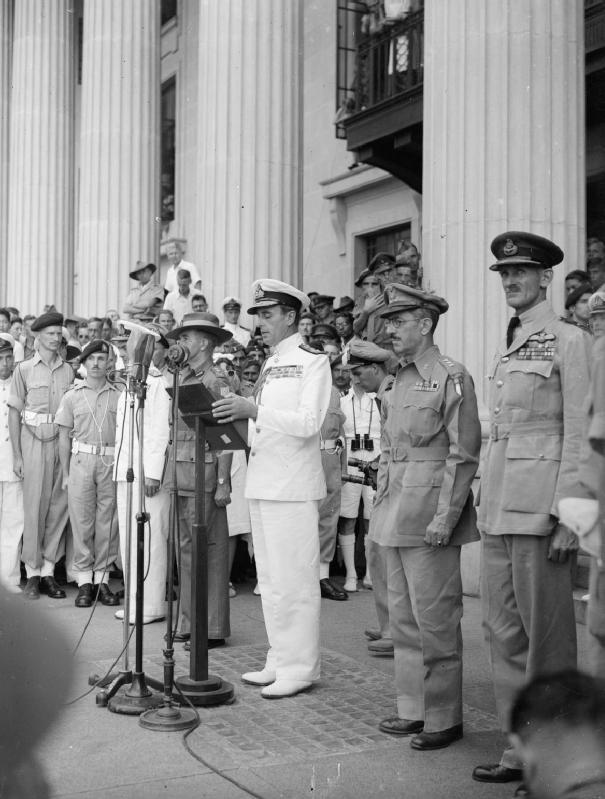
<p>The Padang’s most retold moment is usually told wrong. The Japanese surrender of 1945 was not signed on the City Hall steps. It was signed inside, in the Municipal Building’s chamber, at 11.10 in the morning on 12 September 1945, when Lord Louis Mountbatten, Supreme Allied Commander South East Asia, accepted the surrender of Japanese forces in the region. General Seishiro Itagaki signed the Instrument of Surrender on behalf of Field Marshal Count Terauchi, who had suffered a stroke; eleven copies were signed, for the British, American, Chinese, French, Dutch, Australian, Indian and Japanese governments, the King, the Supreme Commander and the record. Some 400 spectators watched, among them Malayan community leaders, the Sultan of Johore and released prisoners of war. The steps and the field got the ceremony around the signing: four guards of honour, a fleet band, a seventeen-gun salute, Mountbatten’s address from the steps, and a victory parade across the Padang — <a href="https://pikaia.github.io/2026/08/30/japanese-surrendered-personnel-singapore-cleanup-1945/">after which Japanese prisoners, never officially called prisoners, were set to cleaning the city, the Municipal Building among the first buildings they scrubbed</a>. In January 1946 Mountbatten was back on the field, decorating sixteen Malayan resistance leaders led by Chin Peng — eleven of whom silently answered with clenched-fist salutes. In December 1950 the field saw the other face of civic life when the Maria Hertogh riots erupted in front of the Supreme Court: eighteen dead in three days.</p>

<div style="float: right; max-width: 250px; width: 40%; margin: 0.25em 0 1em 1.5em;">
<img src="https://upload.wikimedia.org/wikipedia/commons/e/ea/Louis_Mountbatten_Inspection%2C_Singapore_1945.jpg" alt="Mountbatten inspecting the naval guard of honour outside the Municipal Building, September 1945" style="width: 100%; display: block; border-radius: 4px;" />
<em style="display: block; font-size: 0.8em; margin-top: 0.5em;">Mountbatten inspects the naval guard of honour outside the Municipal Building before the surrender ceremony, September 1945. (Lt C. Trusler, Royal Navy official photographer, Public domain, via Wikimedia Commons)</em>
</div>

<div style="float: left; max-width: 250px; width: 40%; margin: 0.25em 1.5em 1em 0;">
<img src="https://upload.wikimedia.org/wikipedia/commons/c/c7/Mountbatten_address%2C_Singapore_1945.jpg" alt="Mountbatten addressing the crowd from the Municipal Building steps, 12 September 1945" style="width: 100%; display: block; border-radius: 4px;" />
<em style="display: block; font-size: 0.8em; margin-top: 0.5em;">After the signing inside, the steps: Mountbatten delivers his address on 12 September 1945, with Slim, Wheeler and Park beside him. (Lt C. Trusler, Royal Navy official photographer, Public domain, via Wikimedia Commons)</em>
</div>

<p>The chamber then had a second life. On 3 June 1959 the People’s Action Party held its victory rally on the Padang before a crowd Lee Kuan Yew put at some 50,000, and Lee used the field itself as his text. His party had wanted to hold night rallies there, he said, but “a small group of Europeans who were given this field by the former Colonial Government, refused it, although they only use it in the day time for a few people to play games”. “Well,” he concluded, “times have changed, and will stay changed.” Two days later, on 5 June 1959, Lee and his eight ministers were sworn in inside City Hall — in the same chamber where Mountbatten had taken the surrender — deliberately breaking protocol to be sworn in there rather than at Government House, and wearing the party’s open-necked white shirts and trousers instead of lounge suits. That December, in the same building, Yusof Ishak became the first Malayan-born Yang di-Pertuan Negara and <a href="https://pikaia.github.io/2026/08/19/singapore-flag-anthem-pledge-written-on-deadline/">the flag and anthem were unveiled, a story this blog has told in full</a>. In August 1963 a rally on the Padang demanding Japanese war reparations drew a crowd reported at some 120,000, among the largest gatherings in Singapore’s history; a month later, on 16 September 1963, Lee proclaimed Singapore’s merger into Malaysia from the same field.</p>

<div style="clear: both;"></div>

<h2 id="the-peoples-parade-ground">The people’s parade ground</h2>

<p>On 9 August 1966, at nine in the morning, Singapore held its first National Day Parade on the Padang: over 23,000 participants, the Straits Times reported, among them six People’s Defence Force contingents and four government ministers marching as officer cadets. The Padang remained the parade’s only home until the parades were decentralised in 1975; the first National Stadium parade followed in 1976. The parade that fixed the field in the national memory was 1968’s, which went ahead in pouring rain and became the emblem of the “rugged society” the young republic meant to be. Parades moved to the evening from 1973, and from 1984 the Padang came back into rotation — every five years from 1995, and for the milestone years: 2010, SG50 in 2015, the bicentennial in 2019, and 2023, 2024 and SG60 in 2025.</p>

<div style="float: right; max-width: 250px; width: 40%; margin: 0.25em 0 1em 1.5em;">
<img src="https://upload.wikimedia.org/wikipedia/commons/e/eb/NationalDayParade-Singapore-1968.jpg" alt="A People's Association contingent marching at the National Day Parade, 1968" style="width: 100%; display: block; border-radius: 4px;" />
<em style="display: block; font-size: 0.8em; margin-top: 0.5em;">A People's Association contingent marches at the National Day Parade of 1968 — the rain-soaked parade that became a national parable. No freely licensed photograph of the first parade, in 1966, exists; this is the earliest the blog can show. (Lama Jey Tsong Kapa, CC BY-SA 2.0, via Wikimedia Commons)</em>
</div>

<div style="clear: both;"></div>

<h2 id="the-monument-that-is-a-field">The monument that is a field</h2>

<p>The field’s modern life runs on the same double track as its old one: ceremony and sport. On 28 September 2008 the first Formula 1 night race ran down St Andrew’s Road, past the Padang and City Hall, on its way to Anderson Bridge. In 2015 the two buildings behind the field reopened as the National Gallery Singapore. And the sports never left: cricket is still played on the Padang — the Cricket Club’s square is, Sport Singapore notes, the only cricket square in Singapore — the SCC’s international rugby sevens is held on the field, the Recreation Club runs its weekly soccer and softball, and the Singapore Marathon starts and finishes there. The two clubs now describe themselves as the field’s co-custodians.</p>

<p><img src="https://upload.wikimedia.org/wikipedia/commons/7/7e/Cricket_match_and_Marina_Bay_Sands_Hotel_in_Singapore.jpg" alt="A cricket match on the Padang in 2018, with Marina Bay Sands behind" /></p>

<p><em>Cricket on the Padang in June 2018, photographed from the National Gallery steps — the 1852 club’s game, still on the 1822 square, with Marina Bay Sands for a sightscreen. (Basile Morin, CC BY-SA 4.0, via Wikimedia Commons)</em></p>

<p>What protects it now is the strangest entry on Singapore’s monument list. The Padang was announced for gazetting in August 2019, but the law had to change first: the Preservation of Monuments Act was amended in November 2021 to let a monument be an open site, not only a building. On 9 August 2022, National Day, the Padang became Singapore’s 75th National Monument — the first green, open space on the list. The gazette, the Minister for Culture, Community and Youth said, “will protect it, as it is now, from alteration and change which would affect its character and significance, while allowing it to continue to be a social and community space.” A month later the Padang and its ring of monuments were put forward as the Padang Civic Ensemble on UNESCO’s World Heritage Tentative List.</p>

<p><a href="/gallery/the-padang-and-the-cricket-club-the-field-that-was-ordered-to-stay-empty/">See more photos of the Padang and the Cricket Club</a></p>

<p><strong>Every city keeps a field it cannot bring itself to build on; Singapore is the one that wrote the order down in 1822, watched empires, occupiers and a new nation all obey it, and in 2022 made the emptiness itself a monument — a lesser-known national treasure precisely because there is nothing there.</strong></p>

<hr />

<p><strong>Sources:</strong></p>

<ul>
  <li>National Library Board, Infopedia — The Padang</li>
  <li>National Library Board, Infopedia — Singapore Cricket Club</li>
  <li>National Library Board, Infopedia — Singapore Recreation Club</li>
  <li>National Library Board, Infopedia — Former City Hall</li>
  <li>National Library Board, Infopedia — Japanese surrender</li>
  <li>National Library Board, Infopedia — The first cabinet is sworn in; 1959 Legislative Assembly General Election</li>
  <li>Kevin Y. L. Tan — A History of the Padang, BiblioAsia (National Library Board), April–June 2022</li>
  <li>National Heritage Board — media release, 8 August 2022: The Padang to be gazetted as Singapore’s 75th National Monument</li>
  <li>Ministry of Culture, Community and Youth — The Padang Gazetted as Singapore’s 75th National Monument</li>
  <li>Roots (National Heritage Board) — The Singapore Cricket Club and the Supreme Court; Indian National Army Memorial</li>
  <li>Sport Singapore — Singapore Cricket Club; Singapore Recreation Club</li>
  <li>Singapore Cricket Club — Heritage, Design and Culture; Singapore Recreation Club — About</li>
  <li>Singapore GP — 2008 fast facts (the first night race, 28 September 2008)</li>
  <li>UNESCO World Heritage Centre — The Padang Civic Ensemble, Tentative List</li>
  <li>Image file pages: Wikimedia Commons (each image is credited under its photograph)</li>
</ul>

<p><a href="/">← Back to all posts</a></p>]]></content><author><name></name></author><category term="history" /><category term="places" /><summary type="html"><![CDATA[In the middle of Singapore’s civic district, in front of the old City Hall, lies 4.3 hectares of grass that has never been built on. Armies have camped on it, kings’ birthdays have been saluted across it, a surrender was signed in the chamber above it, and a nation’s first cabinet was sworn in within sight of it — but for two hundred years the field itself has stayed empty, by order. In 2022 the emptiness itself was made a national monument. This is the story of the Padang, and of the two Victorian sports clubs that guard its ends.]]></summary><media:thumbnail xmlns:media="http://search.yahoo.com/mrss/" url="https://upload.wikimedia.org/wikipedia/commons/7/70/Old_Supreme_Court_Building_and_City_Hall_from_the_Padang%2C_Singapore_-_20110205.jpg" /><media:content medium="image" url="https://upload.wikimedia.org/wikipedia/commons/7/70/Old_Supreme_Court_Building_and_City_Hall_from_the_Padang%2C_Singapore_-_20110205.jpg" xmlns:media="http://search.yahoo.com/mrss/" /></entry><entry><title type="html">Changi Prison, 1936 to 2004: The Gaol Whose Wall and Gate Were Kept</title><link href="https://pikaia.github.io/2026/11/27/changi-prison-1936-to-2004-the-gaol-whose-wall-and-gate-were-kept/" rel="alternate" type="text/html" title="Changi Prison, 1936 to 2004: The Gaol Whose Wall and Gate Were Kept" /><published>2026-11-27T13:00:00+00:00</published><updated>2026-11-27T13:00:00+00:00</updated><id>https://pikaia.github.io/2026/11/27/changi-prison-1936-to-2004-the-gaol-whose-wall-and-gate-were-kept</id><content type="html" xml:base="https://pikaia.github.io/2026/11/27/changi-prison-1936-to-2004-the-gaol-whose-wall-and-gate-were-kept/"><![CDATA[<p>Along Upper Changi Road North stands a fragment of a prison: an entrance gate, 180 metres of high wall and two corner turrets, kept when everything behind them was demolished in 2004. The fragment is a national monument, gazetted in 2016, but it stands inside a restricted area and almost nobody can walk up to it. The gaol it belonged to was, in turn, Singapore’s most modern prison, an internment camp for the colony’s own rulers, the most crowded prisoner-of-war cage in Singapore, the place where Japanese war criminals were hanged, and then the country’s main prison for another half-century. This is the gaol’s own story.</p>

<p><a href="/">← Back to all posts</a></p>

<!-- WATCH-WIDGET:BEGIN (generated by scripts/build_watch_widget.py - do not hand-edit between these markers, re-run the script instead) -->

<div style="display: flex; gap: 2em; margin: 0.5em 0 1.5em 0; align-items: flex-end;">
  <div id="listen-widget" role="button" tabindex="0" aria-label="Play audio narration of this post" style="display: inline-flex; flex-direction: column; align-items: center; cursor: pointer; gap: 0.2em; user-select: none;">
    <span id="listen-icon" aria-hidden="true" style="display: inline-flex; align-items: center; justify-content: center; width: 2.1em; height: 2.1em; border-radius: 50%; border: 1px solid #888; font-size: 1.1em;">&#127911;</span>
    <span style="font-size: 0.7em; text-transform: uppercase; letter-spacing: 0.05em; opacity: 0.75;">Listen</span>
  </div>
  <div id="watch-widget" role="button" tabindex="0" aria-label="Watch an animated version of this post" style="display: inline-flex; flex-direction: column; align-items: center; cursor: pointer; gap: 0.2em; user-select: none;">
    <span aria-hidden="true" style="display: inline-flex; align-items: center; justify-content: center; width: 2.1em; height: 2.1em; border-radius: 50%; border: 1px solid #888; font-size: 1.1em;">&#127916;</span>
    <span style="font-size: 0.7em; text-transform: uppercase; letter-spacing: 0.05em; opacity: 0.75;">Watch</span>
  </div>
  <a href="https://youtu.be/M2Yp_6cOlfA" target="_blank" rel="noopener" aria-label="Watch this story as a video on YouTube" style="display: inline-flex; flex-direction: column; align-items: center; gap: 0.2em; text-decoration: none; color: inherit;">
    <span aria-hidden="true" style="display: inline-flex; align-items: center; justify-content: center; width: 2.4em; height: 2.4em; border-radius: 50%; border: 1px solid #888;">
      <svg width="1.4em" height="1.4em" viewBox="0 0 24 24" aria-hidden="true"><rect x="1" y="4" width="22" height="16" rx="5" fill="#FF0000" /><path d="M10 8.5l6 3.5-6 3.5z" fill="#fff" /></svg>
    </span>
    <span style="font-size: 0.7em; text-transform: uppercase; letter-spacing: 0.05em; opacity: 0.75;">YouTube</span>
  </a>
  <a href="https://youtube.com/shorts/tVSBTPf-Rzs" target="_blank" rel="noopener" aria-label="Watch a short version of this story on YouTube Shorts" style="display: inline-flex; flex-direction: column; align-items: center; gap: 0.2em; text-decoration: none; color: inherit;">
    <span aria-hidden="true" style="display: inline-flex; align-items: center; justify-content: center; width: 2.4em; height: 2.4em; border-radius: 50%; border: 1px solid #888;">
      <svg width="1.4em" height="1.4em" viewBox="0 0 24 24" aria-hidden="true">
        <defs>
          <linearGradient id="shortsGradChangiPrison1936cdf0" x1="0%" y1="0%" x2="100%" y2="100%">
            <stop offset="0%" stop-color="#FF0000" />
            <stop offset="100%" stop-color="#FF4E8B" />
          </linearGradient>
        </defs>
        <rect x="1" y="1" width="22" height="22" rx="7" fill="url(#shortsGradChangiPrison1936cdf0)" />
        <path d="M13 6 L7.5 13.5 H11.5 L10.5 18 L16.5 10 H12.5 Z" fill="#fff" />
      </svg>
    </span>
    <span style="font-size: 0.7em; text-transform: uppercase; letter-spacing: 0.05em; opacity: 0.75;">Shorts</span>
  </a>
  <a href="https://www.tiktok.com/@lesserknownsingapore/video/7713089682233445662" target="_blank" rel="noopener" aria-label="Watch a short version of this story on TikTok" style="display: inline-flex; flex-direction: column; align-items: center; gap: 0.2em; text-decoration: none; color: inherit;">
    <span aria-hidden="true" style="display: inline-flex; align-items: center; justify-content: center; width: 2.4em; height: 2.4em; border-radius: 50%; border: 1px solid #888;">
      <svg width="1.4em" height="1.4em" viewBox="0 0 24 24" aria-hidden="true">
        <rect x="1" y="1" width="22" height="22" rx="7" fill="#000" />
        <path d="M13.2 5h2.3c.2 1.6 1.4 2.8 3 3v2.3a5.3 5.3 0 0 1-3-1v5.2a4.2 4.2 0 1 1-4.2-4.2h.4v2.4h-.4a1.8 1.8 0 1 0 1.9 1.8z" fill="#25F4EE" transform="translate(-0.6 -0.4)" />
        <path d="M13.2 5h2.3c.2 1.6 1.4 2.8 3 3v2.3a5.3 5.3 0 0 1-3-1v5.2a4.2 4.2 0 1 1-4.2-4.2h.4v2.4h-.4a1.8 1.8 0 1 0 1.9 1.8z" fill="#FE2C55" transform="translate(0.6 0.4)" />
        <path d="M13.2 5h2.3c.2 1.6 1.4 2.8 3 3v2.3a5.3 5.3 0 0 1-3-1v5.2a4.2 4.2 0 1 1-4.2-4.2h.4v2.4h-.4a1.8 1.8 0 1 0 1.9 1.8z" fill="#fff" />
      </svg>
    </span>
    <span style="font-size: 0.7em; text-transform: uppercase; letter-spacing: 0.05em; opacity: 0.75;">TikTok</span>
  </a>
</div>

<audio id="listen-audio" preload="none" style="display: none;">
  <source src="/audio/changi-prison-1936-to-2004-the-gaol-whose-wall-and-gate-were-kept.mp3" type="audio/mpeg" />
</audio>

<div id="watch-viewer" style="position: fixed; inset: 0; background: #000; z-index: 9999; display: none;">
  <div id="watch-stage" style="position: absolute; inset: 0; overflow: hidden;"></div>
  <div style="position: absolute; left: 0; right: 0; bottom: 12%; text-align: center; padding: 0 5%; z-index: 2;">
    <span id="watch-caption" style="display: inline-block; background: rgba(0,0,0,0.55); color: #fff; font-size: 1.3em; font-weight: 600; padding: 0.5em 0.8em; border-radius: 4px; max-width: 700px;"></span>
  </div>
  <button id="watch-close" aria-label="Close" style="position: absolute; top: 1em; right: 1.2em; color: #fff; font-size: 1.6em; cursor: pointer; background: none; border: none; z-index: 2;">&times;</button>
  <div style="position: absolute; bottom: 0; left: 0; right: 0; padding: 1em 1.5em; display: flex; align-items: center; gap: 1em; background: linear-gradient(transparent, rgba(0,0,0,0.6)); z-index: 2;">
    <button id="watch-play" aria-label="Play/Pause" style="background: none; border: none; color: #fff; font-size: 1.4em; cursor: pointer; line-height: 1; padding: 0.2em;">&#10074;&#10074;</button>
    <div id="watch-progress" style="flex: 1; height: 4px; background: rgba(255,255,255,0.25); border-radius: 2px; overflow: hidden; cursor: pointer;">
      <div id="watch-progress-fill" style="height: 100%; width: 0%; background: #fff;"></div>
    </div>
    <span id="watch-time" style="color: #fff; font-size: 0.85em; font-variant-numeric: tabular-nums; opacity: 0.8;">0:00 / 0:00</span>
  </div>
</div>

<script>
(function () {
  var widget = document.getElementById('listen-widget');
  var icon = document.getElementById('listen-icon');
  var audio = document.getElementById('listen-audio');

  function setIcon(playing) {
    icon.innerHTML = playing ? '&#10074;&#10074;' : '&#127911;';
  }
  function toggle() {
    if (audio.paused) { audio.play(); } else { audio.pause(); }
  }

  widget.addEventListener('click', toggle);
  widget.addEventListener('keydown', function (e) {
    if (e.key === 'Enter' || e.key === ' ') { e.preventDefault(); toggle(); }
  });
  audio.addEventListener('play', function () { setIcon(true); });
  audio.addEventListener('pause', function () { setIcon(false); });
  audio.addEventListener('ended', function () { setIcon(false); });
})();
</script>

<script>
(function () {
  var GATES = "https://upload.wikimedia.org/wikipedia/commons/9/91/Allied_prisoners_of_war_after_the_liberation_of_Changi_Prison%2C_Singapore_-_c._1945_-_02_edited.jpg";
  var DOOR = "https://upload.wikimedia.org/wikipedia/commons/a/a6/Changi_Prison_cell_door_%28exterior%29%2C_Singapore_History_Gallery%2C_National_Museum_of_Singapore_-_20151125.jpg";
  var DOORIN = "https://upload.wikimedia.org/wikipedia/commons/a/a6/Changi_Prison_cell_door_%28interior%29%2C_Singapore_History_Gallery%2C_National_Museum_of_Singapore_-_20151125.jpg";
  var POW = "https://upload.wikimedia.org/wikipedia/commons/2/2d/Krijgsgevangene_van_de_Japanners_in_Changi_gevangenis_in_Singapore%2C_Bestanddeelnr_935-3623.jpg";
  var HUT = "https://upload.wikimedia.org/wikipedia/commons/2/28/2-18th_Changi.jpg";
  var LINK = "https://upload.wikimedia.org/wikipedia/commons/b/b2/Changi_Prison%2C_Singapore.jpg";
  var TURRET = "/assets/images/changi-turret-2025.jpg";
  var BANNER = "https://upload.wikimedia.org/wikipedia/commons/4/45/Banner_on_a_wall_of_Changi_Prison%2C_Singapore_-_20090116.jpg";

  var slides = [
    { src: GATES, type: "cover", zoom: [1.0, 1.06, 1.12], pan: ["50% 50%", "50% 50%", "50% 50%"], ease: "ease-in-out" },
    { src: TURRET, type: "cover", zoom: [1.12, 1.06, 1.0], pan: ["35% 50%", "35% 50%", "35% 50%"], ease: "ease-in-out" },
    { src: DOORIN, type: "cover", zoom: [1.0, 1.06, 1.12], pan: ["50% 50%", "50% 50%", "50% 50%"], ease: "ease-in-out" },
    { src: DOOR, type: "cover", zoom: [1.12, 1.06, 1.0], pan: ["50% 50%", "50% 50%", "50% 50%"], ease: "ease-in-out" },
    { src: DOOR, type: "cover", zoom: [1.0, 1.06, 1.12], pan: ["50% 50%", "50% 50%", "50% 50%"], ease: "ease-in-out" },
    { src: DOORIN, type: "cover", zoom: [1.12, 1.06, 1.0], pan: ["50% 50%", "50% 50%", "50% 50%"], ease: "ease-in-out" },
    { src: DOOR, type: "cover", zoom: [1.0, 1.06, 1.12], pan: ["50% 50%", "50% 50%", "50% 50%"], ease: "ease-in-out" },
    { src: DOORIN, type: "cover", zoom: [1.12, 1.06, 1.0], pan: ["50% 50%", "50% 50%", "50% 50%"], ease: "ease-in-out" },
    { src: DOOR, type: "cover", zoom: [1.0, 1.06, 1.12], pan: ["50% 50%", "50% 50%", "50% 50%"], ease: "ease-in-out" },
    { src: GATES, type: "cover", zoom: [1.12, 1.06, 1.0], pan: ["50% 50%", "50% 50%", "50% 50%"], ease: "ease-in-out" },
    { src: HUT, type: "cover", zoom: [1.0, 1.06, 1.12], pan: ["50% 40%", "50% 40%", "50% 40%"], ease: "ease-in-out" },
    { src: DOORIN, type: "cover", zoom: [1.12, 1.06, 1.0], pan: ["50% 50%", "50% 50%", "50% 50%"], ease: "ease-in-out" },
    { src: DOOR, type: "cover", zoom: [1.0, 1.06, 1.12], pan: ["50% 50%", "50% 50%", "50% 50%"], ease: "ease-in-out" },
    { src: DOOR, type: "cover", zoom: [1.12, 1.06, 1.0], pan: ["50% 50%", "50% 50%", "50% 50%"], ease: "ease-in-out" },
    { src: GATES, type: "cover", zoom: [1.0, 1.06, 1.12], pan: ["65% 50%", "65% 50%", "65% 50%"], ease: "ease-in-out" },
    { src: GATES, type: "cover", zoom: [1.12, 1.06, 1.0], pan: ["50% 50%", "50% 50%", "50% 50%"], ease: "ease-in-out" },
    { src: DOORIN, type: "cover", zoom: [1.0, 1.06, 1.12], pan: ["50% 50%", "50% 50%", "50% 50%"], ease: "ease-in-out" },
    { src: DOOR, type: "cover", zoom: [1.12, 1.06, 1.0], pan: ["50% 50%", "50% 50%", "50% 50%"], ease: "ease-in-out" },
    { src: DOORIN, type: "cover", zoom: [1.0, 1.06, 1.12], pan: ["50% 50%", "50% 50%", "50% 50%"], ease: "ease-in-out" },
    { src: DOOR, type: "cover", zoom: [1.12, 1.06, 1.0], pan: ["50% 50%", "50% 50%", "50% 50%"], ease: "ease-in-out" },
    { src: DOORIN, type: "cover", zoom: [1.0, 1.06, 1.12], pan: ["50% 50%", "50% 50%", "50% 50%"], ease: "ease-in-out" },
    { src: DOOR, type: "cover", zoom: [1.12, 1.06, 1.0], pan: ["50% 50%", "50% 50%", "50% 50%"], ease: "ease-in-out" },
    { src: DOORIN, type: "cover", zoom: [1.0, 1.06, 1.12], pan: ["50% 50%", "50% 50%", "50% 50%"], ease: "ease-in-out" },
    { src: POW, type: "cover", zoom: [1.12, 1.06, 1.0], pan: ["50% 35%", "50% 35%", "50% 35%"], ease: "ease-in-out" },
    { src: POW, type: "cover", zoom: [1.0, 1.06, 1.12], pan: ["50% 35%", "50% 35%", "50% 35%"], ease: "ease-in-out" },
    { src: DOORIN, type: "cover", zoom: [1.12, 1.06, 1.0], pan: ["50% 50%", "50% 50%", "50% 50%"], ease: "ease-in-out" },
    { src: HUT, type: "cover", zoom: [1.0, 1.06, 1.12], pan: ["50% 40%", "50% 40%", "50% 40%"], ease: "ease-in-out" },
    { src: POW, type: "cover", zoom: [1.12, 1.06, 1.0], pan: ["50% 35%", "50% 35%", "50% 35%"], ease: "ease-in-out" },
    { src: POW, type: "cover", zoom: [1.0, 1.06, 1.12], pan: ["50% 35%", "50% 35%", "50% 35%"], ease: "ease-in-out" },
    { src: HUT, type: "cover", zoom: [1.12, 1.06, 1.0], pan: ["50% 40%", "50% 40%", "50% 40%"], ease: "ease-in-out" },
    { src: POW, type: "cover", zoom: [1.0, 1.06, 1.12], pan: ["50% 35%", "50% 35%", "50% 35%"], ease: "ease-in-out" },
    { src: GATES, type: "cover", zoom: [1.12, 1.06, 1.0], pan: ["35% 50%", "35% 50%", "35% 50%"], ease: "ease-in-out" },
    { src: DOORIN, type: "cover", zoom: [1.0, 1.06, 1.12], pan: ["50% 50%", "50% 50%", "50% 50%"], ease: "ease-in-out" },
    { src: DOOR, type: "cover", zoom: [1.12, 1.06, 1.0], pan: ["50% 50%", "50% 50%", "50% 50%"], ease: "ease-in-out" },
    { src: DOORIN, type: "cover", zoom: [1.0, 1.06, 1.12], pan: ["50% 50%", "50% 50%", "50% 50%"], ease: "ease-in-out" },
    { src: DOOR, type: "cover", zoom: [1.12, 1.06, 1.0], pan: ["50% 50%", "50% 50%", "50% 50%"], ease: "ease-in-out" },
    { src: DOORIN, type: "cover", zoom: [1.0, 1.06, 1.12], pan: ["50% 50%", "50% 50%", "50% 50%"], ease: "ease-in-out" },
    { src: BANNER, type: "cover", zoom: [1.12, 1.06, 1.0], pan: ["35% 50%", "35% 50%", "35% 50%"], ease: "ease-in-out" },
    { src: BANNER, type: "cover", zoom: [1.0, 1.06, 1.12], pan: ["65% 50%", "65% 50%", "65% 50%"], ease: "ease-in-out" },
    { src: BANNER, type: "cover", zoom: [1.12, 1.06, 1.0], pan: ["50% 50%", "50% 50%", "50% 50%"], ease: "ease-in-out" },
    { src: DOOR, type: "cover", zoom: [1.0, 1.06, 1.12], pan: ["50% 50%", "50% 50%", "50% 50%"], ease: "ease-in-out" },
    { src: DOORIN, type: "cover", zoom: [1.12, 1.06, 1.0], pan: ["50% 50%", "50% 50%", "50% 50%"], ease: "ease-in-out" },
    { src: DOOR, type: "cover", zoom: [1.0, 1.06, 1.12], pan: ["50% 50%", "50% 50%", "50% 50%"], ease: "ease-in-out" },
    { src: DOORIN, type: "cover", zoom: [1.12, 1.06, 1.0], pan: ["50% 50%", "50% 50%", "50% 50%"], ease: "ease-in-out" },
    { src: DOOR, type: "cover", zoom: [1.0, 1.06, 1.12], pan: ["50% 50%", "50% 50%", "50% 50%"], ease: "ease-in-out" },
    { src: LINK, type: "cover", zoom: [1.12, 1.06, 1.0], pan: ["50% 50%", "50% 50%", "50% 50%"], ease: "ease-in-out" },
    { src: TURRET, type: "cover", zoom: [1.0, 1.06, 1.12], pan: ["35% 50%", "35% 50%", "35% 50%"], ease: "ease-in-out" },
    { src: TURRET, type: "cover", zoom: [1.12, 1.06, 1.0], pan: ["65% 50%", "65% 50%", "65% 50%"], ease: "ease-in-out" },
    { src: LINK, type: "cover", zoom: [1.0, 1.06, 1.12], pan: ["50% 50%", "50% 50%", "50% 50%"], ease: "ease-in-out" },
    { src: TURRET, type: "cover", zoom: [1.12, 1.06, 1.0], pan: ["35% 50%", "35% 50%", "35% 50%"], ease: "ease-in-out" },
    { src: TURRET, type: "cover", zoom: [1.0, 1.06, 1.12], pan: ["65% 50%", "65% 50%", "65% 50%"], ease: "ease-in-out" },
    { src: TURRET, type: "cover", zoom: [1.12, 1.06, 1.0], pan: ["50% 50%", "50% 50%", "50% 50%"], ease: "ease-in-out" },
    { src: GATES, type: "cover", zoom: [1.0, 1.06, 1.12], pan: ["35% 50%", "35% 50%", "35% 50%"], ease: "ease-in-out" },
  ];

  var sentences = [{"text": "Changi Prison, 1936 to 2004: The Gaol Whose Wall and Gate Were Kept", "offset_s": 0.0, "duration_s": 6.625}, {"text": "Along Upper Changi Road North stands a fragment of a prison: an entrance gate, 180 metres of high wall and two corner turrets, kept when everything behind them was demolished in 2004.", "offset_s": 6.625, "duration_s": 14.175}, {"text": "The fragment is a national monument, gazetted in 2016, but it stands inside a restricted area and almost nobody can walk up to it.", "offset_s": 20.8, "duration_s": 10.275}, {"text": "The gaol it belonged to was, in turn, Singapore's most modern prison, an internment camp for the colony's own rulers, the most crowded prisoner-of-war cage in Singapore, the place where Japanese war criminals were hanged, and then the country's main prison for another half-century.", "offset_s": 31.075, "duration_s": 18.2}, {"text": "This is the gaol's own story.", "offset_s": 49.275, "duration_s": 3.1}, {"text": "By the early 1930s, Singapore's only prison, at Pearl's Hill — later known as Outram Road Prison — was overcrowded and could not keep different classes of prisoner apart.", "offset_s": 52.375, "duration_s": 12.25}, {"text": "In January 1933 the Legislative Council approved a new convict gaol at Changi, out on the island's rural east coast, and the local firm Woh Hup began building it that year.", "offset_s": 64.625, "duration_s": 13.15}, {"text": "The design came from the Public Works Department — an academic study of the prison's heritage names the government architect Frank Dorrington Ward as the man responsible — and it followed the \"telephone-pole\" plan of the modern prison: two four-storey cell blocks branching off a central covered corridor, so that warders could reach any block quickly.", "offset_s": 77.775, "duration_s": 21.7}, {"text": "Around the cells stood work rooms, a hospital block, punishment cells, a separate small block for European prisoners, and a perimeter wall six metres high with a watchtower turret at each of its four corners, entered through a double-leafed steel gate.", "offset_s": 99.475, "duration_s": 16.175}, {"text": "It was built for 600 long-sentence prisoners, and by the standards of its day it was remarkably civilised in its fittings: a modern sewerage system, a central laundry and kitchen, showers by the exercise yards, and in every cell an electric light and a flushing latrine.", "offset_s": 115.65, "duration_s": 18.5}, {"text": "Roots, the National Heritage Board's portal, calls the finished prison \"the most modern institution of its kind in the East\".", "offset_s": 134.15, "duration_s": 8.25}, {"text": "It was gazetted as a prison on the 24th of December 1936 and received its first prisoners on the 4th of January 1937, long-term men transferred from Pearl's Hill, which settled down to holding short-term convicts instead.", "offset_s": 142.4, "duration_s": 17.625}, {"text": "One of its cell doors survives in the National Museum of Singapore, a heavy blue steel door with its inspection flap and food hatch, labelled simply as a Changi Prison cell door of the 1930s.", "offset_s": 160.025, "duration_s": 14.075}, {"text": "It is worth remembering that door when the numbers start to climb, because everything that happened to this building happened one cell at a time.", "offset_s": 174.1, "duration_s": 9.4}, {"text": "\"Changi\" the wartime camp was much bigger than Changi Prison the building.", "offset_s": 183.5, "duration_s": 5.175}, {"text": "Most Allied prisoners of war spent the war in and around the British Army's own barracks at Changi — Selarang, Roberts and Kitchener — and this blog has told two of those stories already: the Selarang Square Squeeze of September 1942, and Stanley Warren's chapel murals at Roberts Barracks.", "offset_s": 188.675, "duration_s": 19.825}, {"text": "The gaol had a different war: first it held civilians, and only at the end was it filled with soldiers.", "offset_s": 208.5, "duration_s": 7.2}, {"text": "Singapore fell on the 15th of February 1942.", "offset_s": 215.7, "duration_s": 4.6}, {"text": "Two days later, on the 17th of February, the colony's European civilians were rounded up and marched to Changi Prison.", "offset_s": 220.3, "duration_s": 8.45}, {"text": "The National Library Board's breakdown of who went in is 2,200 men, 359 women and 61 children — 2,620 people, other accounts putting the total somewhere between 2,400 and 2,500 — into a building designed for 600.", "offset_s": 228.75, "duration_s": 20.65}, {"text": "Among them, in one of the neatest reversals of the war, was the Governor of the Straits Settlements himself, Sir Shenton Thomas.", "offset_s": 249.4, "duration_s": 8.625}, {"text": "The Japanese largely left the internees to run the place themselves.", "offset_s": 258.025, "duration_s": 5.1}, {"text": "Each block elected its leader; the internees maintained the camp, ran schools for the children (history and geography were banned subjects), and organised concerts, theatre and lectures.", "offset_s": 263.125, "duration_s": 12.65}, {"text": "Men and women were held in separate blocks and forbidden to meet, but families passed messages to each other in code through the scripts and songs of the concerts each side performed.", "offset_s": 275.775, "duration_s": 11.775}, {"text": "The women produced a camp newspaper, POW WOW, led by a former Malaya Tribune journalist, Freddy Bloom, which ran from April 1942 for almost nineteen months; the men had the Changi Guardian.", "offset_s": 287.55, "duration_s": 14.225}, {"text": "Food in the first year was adequate if basic, and the building's modern plumbing spared the internees some of the worst of camp disease — but dysentery and malaria were constant, and as the war ground on, malnutrition diseases such as beri-beri and tuberculosis took hold.", "offset_s": 301.775, "duration_s": 18.9}, {"text": "In 1942, mainly between March and August, the women internees made three quilts.", "offset_s": 320.675, "duration_s": 6.95}, {"text": "Each is a signature quilt of 66 embroidered squares, every square signed by the woman who made it.", "offset_s": 327.625, "duration_s": 7.625}, {"text": "The idea came from Ethel Mulvany, a Canadian internee who had been a Red Cross representative in Singapore and acted as the women's Red Cross representative in the camp.", "offset_s": 335.25, "duration_s": 12.625}, {"text": "The quilts were partly to relieve boredom and raise morale — but their real purpose was to let the men in the other camps know that the women and children were alive.", "offset_s": 347.875, "duration_s": 10.95}, {"text": "Each woman was asked to put something of herself into her square, with her name.", "offset_s": 358.825, "duration_s": 5.325}, {"text": "Mulvany won the Japanese commandant's permission by presenting the quilts as gifts for the wounded, and by making one of the three for wounded Japanese soldiers.", "offset_s": 364.15, "duration_s": 11.2}, {"text": "Even then, the word \"prison\" was not acceptable and had to be unpicked from the squares as they were assembled; the word \"gaol\" was allowed.", "offset_s": 375.35, "duration_s": 9.4}, {"text": "The Australian War Memorial, which now holds the Australian and Japanese quilts — the British quilt is with the British Red Cross in London — is careful about what the quilts were: there is no evidence they were ever used by the wounded, and they were not made as objects of resistance.", "offset_s": 384.75, "duration_s": 18.275}, {"text": "They were, more simply and more movingly, a list of names in thread, sent out of the wire in the hope of being read.", "offset_s": 403.025, "duration_s": 7.85}, {"text": "No photograph of them is freely licensed, so on this blog, as in the camp, they travel in words.", "offset_s": 410.875, "duration_s": 7.2}, {"text": "On the night of 26–the 27th of September 1943, Australian commandos of Operation Jaywick sank or damaged seven Japanese vessels in Singapore's harbour.", "offset_s": 418.075, "duration_s": 12.9}, {"text": "The Kempeitai, the Japanese military police, were convinced the attack had been directed by a spy network among the Changi internees.", "offset_s": 430.975, "duration_s": 9.75}, {"text": "On the 10th of October 1943 — the Double Tenth, the tenth day of the tenth month — they raided the gaol, and over the following months arrested 57 internees.", "offset_s": 440.725, "duration_s": 11.9}, {"text": "The 57 were taken not back to cells but to the YMCA building on Orchard Road, the Central Police Station and Smith Street Police Station, and interrogated under torture until April 1944.", "offset_s": 452.625, "duration_s": 14.75}, {"text": "Fifteen died.", "offset_s": 467.375, "duration_s": 1.925}, {"text": "One more, an ambulance driver named John Long, was executed.", "offset_s": 469.3, "duration_s": 4.95}, {"text": "Among the tortured were the Anglican Bishop of Singapore, John Leonard Wilson, and, in the wider sweep, Elizabeth Choy, who had run a canteen at Tan Tock Seng Hospital and passed food and money to prisoners; she survived nearly 200 days of interrogation.", "offset_s": 474.25, "duration_s": 17.025}, {"text": "In May 1944 the surviving civilians were moved out of the gaol to Sime Road Camp, where they stayed until the war ended.", "offset_s": 491.275, "duration_s": 9.275}, {"text": "The civilians' departure made room for a grimmer population.", "offset_s": 500.55, "duration_s": 4.725}, {"text": "In May 1944 the Japanese concentrated the Allied prisoners of war of the Changi area in and around the gaol.", "offset_s": 505.275, "duration_s": 9.15}, {"text": "The Australian War Memorial's figures give the shape of it: about 5,000 men squeezed into the prison building itself — five men to a cell built for one — and some 11,700 prisoners in all, in less than a quarter of a square kilometre around it, with attap huts put up in the courtyards for the overflow; the National Library Board rounds the complex's population to about 12,000.", "offset_s": 514.425, "duration_s": 25.025}, {"text": "Conditions in the gaol were worse than in the barracks the men had come from: tighter control, shorter rations, and in July 1944 the Japanese revoked the authority of the Allied senior officers over their own men.", "offset_s": 539.45, "duration_s": 15.5}, {"text": "Even so, the prisoners opened a makeshift Playhouse Theatre inside in September 1944.", "offset_s": 554.95, "duration_s": 7.6}, {"text": "By the last months of the war, food was so short that men were eating sparrows and rats to supplement what they were given.", "offset_s": 562.55, "duration_s": 8.25}, {"text": "Japan surrendered on the 2nd of September 1945, and the prisoners at Changi were released on the 6th of September, six days before the formal surrender ceremony in the city.", "offset_s": 570.8, "duration_s": 12.85}, {"text": "The photograph at the head of this post — men pouring out of a gate, waving, half of them in nothing but shorts — is that week.", "offset_s": 583.65, "duration_s": 8.15}, {"text": "The gaol then changed sides.", "offset_s": 591.8, "duration_s": 2.925}, {"text": "It now held Japanese war-crimes suspects, and it became the place where Singapore's war-crimes sentences were carried out: the National Library Board records that most of the executions for those convicted with a death sentence — by hanging or by firing squad — took place at Changi, and the newspapers of 1946 and 1947 carry the brief reports to prove it.", "offset_s": 594.725, "duration_s": 23.475}, {"text": "One published count puts the number executed there at 135.", "offset_s": 618.2, "duration_s": 5.65}, {"text": "In all, 131 British military trials were held in Singapore between January 1946 and March 1948, most of them in the Supreme Court Building.", "offset_s": 623.85, "duration_s": 12.825}, {"text": "The trial with the most direct line back to the gaol was the Double Tenth trial, heard from the 18th of March to the 15th of April 1946.", "offset_s": 636.675, "duration_s": 10.375}, {"text": "Twenty-one Kempeitai officers and interpreters stood accused of the torture of the 57 internees.", "offset_s": 647.05, "duration_s": 8.15}, {"text": "Fourteen were found guilty; eight, including the Singapore Kempeitai commander, Lieutenant Colonel Sumida Haruzo, were sentenced to death by hanging, and three to life imprisonment — though two of the condemned, interpreters who were British subjects, were later retried in the local courts and imprisoned instead.", "offset_s": 655.2, "duration_s": 20.2}, {"text": "On the 15th of October 1947 the prison was handed back to the Prisons Department, and the long-sentence men from Pearl's Hill came back to fill it, as they had in 1937.", "offset_s": 675.4, "duration_s": 13.6}, {"text": "For the next half-century Changi was simply Singapore's main prison, and its peacetime history is quieter and stranger than its wartime fame suggests.", "offset_s": 689.0, "duration_s": 10.575}, {"text": "It was the first prison in Singapore with land enough for a farm: from July 1949 a 30-acre prisoner-run farm outside the walls grew vegetables for the prisoners' meals, followed by pigs in 1950, chickens in 1951 and cattle in 1953, until the prison was largely self-sufficient in fresh food.", "offset_s": 699.575, "duration_s": 22.4}, {"text": "Good-conduct prisoners worked the farm under light supervision, and though there were escapes, the authorities kept it for what it did for the men.", "offset_s": 721.975, "duration_s": 9.15}, {"text": "A graded earning scheme for prison labour followed in 1950, paying eight to fifteen cents a day.", "offset_s": 731.125, "duration_s": 7.075}, {"text": "In 1955 Changi introduced corrective training for young offenders and preventive detention for older recidivists — Singapore reportedly the first place in Southeast Asia to do so — and from 1960 the National Library supplied the prison with books in all languages.", "offset_s": 738.2, "duration_s": 19.575}, {"text": "A Prisons Department report of 1948 had counted 597 cells and reckoned the gaol could hold 1,000 inmates comfortably, a long way from five to a cell.", "offset_s": 757.775, "duration_s": 13.35}, {"text": "Between the late 1970s and the early 1980s the prison was upgraded with two new five-storey blocks to relieve overcrowding.", "offset_s": 771.125, "duration_s": 10.025}, {"text": "The gaol also held the political prisoners of the new nation.", "offset_s": 781.15, "duration_s": 4.725}, {"text": "Trade unionists and suspected communists were detained there through the 1950s and 1960s, among them many swept up in Operation Cold Store in 1963 — Lim Chin Siong, Fong Swee Suan, Lim Hock Siew, James Puthucheary, Poh Soo Kai, Said Zahari and Devan Nair among the names the National Library Board records.", "offset_s": 785.875, "duration_s": 21.8}, {"text": "Nair and others arrested in the unrest of October 1956 were released from Changi on the 4th of June 1959, greeted by more than 2,000 supporters, after Lee Kuan Yew made their release a condition of forming Singapore's first elected government.", "offset_s": 807.675, "duration_s": 18.425}, {"text": "And through all these decades, hanging remained the gaol's other function: capital punishment was, and in the new complex still is, carried out at Changi.", "offset_s": 826.1, "duration_s": 10.475}, {"text": "By the late 1990s the government had decided to gather Singapore's scattered prisons into one modern complex on the Changi site.", "offset_s": 836.575, "duration_s": 9.475}, {"text": "Ground was broken for the new 48-hectare Changi Prison Complex on the 31st of December 1999 — and the old gaol stood in its way.", "offset_s": 846.05, "duration_s": 11.2}, {"text": "The plan to demolish it drew resistance from heritage advocates, former prisoners of war and Australian politicians, for whom the building was a war memorial as much as a prison.", "offset_s": 857.25, "duration_s": 12.7}, {"text": "The compromise, announced in March 2004, was a fragment: the entrance gate, a 180-metre stretch of the perimeter wall and two of the four corner turrets would be kept.", "offset_s": 869.95, "duration_s": 12.525}, {"text": "Everything else — the cell blocks, the hospital, the yards, the farm — was demolished that year.", "offset_s": 882.475, "duration_s": 6.25}, {"text": "In August 2004 the new complex's Cluster A was unveiled, and the old prison's inmates were transferred into it along with those of three other institutions.", "offset_s": 888.725, "duration_s": 11.875}, {"text": "A second cluster opened in January 2010, and the complex can now hold 11,000 prisoners.", "offset_s": 900.6, "duration_s": 7.975}, {"text": "On the 15th of February 2016 — chosen deliberately, the 74th anniversary of the fall of Singapore — the National Heritage Board gazetted the Changi Prison Entrance Gate, Wall and Turrets as Singapore's 72nd National Monument.", "offset_s": 908.575, "duration_s": 17.15}, {"text": "Announcing it, the Board's Director of Preservation of Sites and Monuments, Jean Wee, said the prison \"stands today as an enduring symbol of the suffering of those who defended Singapore during the tumultuous war years between 1942 and 1945\".", "offset_s": 925.725, "duration_s": 18.275}, {"text": "The monument stands inside a restricted area and is not open to the public; there is an information board on Upper Changi Road North for anyone who goes to look at the wall from the road.", "offset_s": 944.0, "duration_s": 12.625}, {"text": "Singapore demolished almost all of its most famous prison and kept the one part every prisoner passed through and none could pass: the gate, a stretch of wall, and the towers that watched it.", "offset_s": 956.625, "duration_s": 12.35}, {"text": "The gaol is gone; the threshold remains, still guarded, still closed — a lesser-known monument precisely because it can only be read from the road.", "offset_s": 968.975, "duration_s": 10.025}];

  var imageSchedule = [
    { t: 0.0, slide: 0 }, { t: 6.625, slide: 1 }, { t: 31.075, slide: 2 }, { t: 52.375, slide: 3 }, { t: 77.775, slide: 4 }, { t: 99.475, slide: 5 }, { t: 115.65, slide: 6 }, { t: 134.15, slide: 7 }, { t: 160.025, slide: 8 }, { t: 183.5, slide: 9 }, { t: 208.5, slide: 10 }, { t: 220.3, slide: 11 }, { t: 228.75, slide: 12 }, { t: 249.4, slide: 13 }, { t: 258.025, slide: 14 }, { t: 275.775, slide: 15 }, { t: 301.775, slide: 16 }, { t: 320.675, slide: 17 }, { t: 335.25, slide: 18 }, { t: 358.825, slide: 19 }, { t: 375.35, slide: 20 }, { t: 384.75, slide: 21 }, { t: 410.875, slide: 22 }, { t: 418.075, slide: 23 }, { t: 440.725, slide: 24 }, { t: 467.375, slide: 25 }, { t: 491.275, slide: 26 }, { t: 500.55, slide: 27 }, { t: 514.425, slide: 28 }, { t: 539.45, slide: 29 }, { t: 562.55, slide: 30 }, { t: 570.8, slide: 31 }, { t: 591.8, slide: 32 }, { t: 618.2, slide: 33 }, { t: 636.675, slide: 34 }, { t: 655.2, slide: 35 }, { t: 675.4, slide: 36 }, { t: 689.0, slide: 37 }, { t: 699.575, slide: 38 }, { t: 721.975, slide: 39 }, { t: 738.2, slide: 40 }, { t: 757.775, slide: 41 }, { t: 781.15, slide: 42 }, { t: 807.675, slide: 43 }, { t: 826.1, slide: 44 }, { t: 836.575, slide: 45 }, { t: 857.25, slide: 46 }, { t: 869.95, slide: 47 }, { t: 888.725, slide: 48 }, { t: 908.575, slide: 49 }, { t: 925.725, slide: 50 }, { t: 944.0, slide: 51 }, { t: 956.625, slide: 52 }
  ];
  var TOTAL_DURATION = 979.0;

  var MAX_CHARS = 100;
  function splitLongSentence(text, offset, duration) {
    if (text.length <= MAX_CHARS) return [{ text: text, offset_s: offset, duration_s: duration }];
    var parts = text.split(/(?<=[:;])\s+/);
    var chunks = [];
    parts.forEach(function (p) {
      if (p.length <= MAX_CHARS) { chunks.push(p); return; }
      var words = p.split(' ');
      var cur = '';
      words.forEach(function (w) {
        if ((cur + ' ' + w).trim().length > MAX_CHARS) { chunks.push(cur.trim()); cur = w; }
        else { cur = (cur + ' ' + w).trim(); }
      });
      if (cur) chunks.push(cur.trim());
    });
    var totalChars = chunks.reduce(function (a, c) { return a + c.length; }, 0);
    var t = offset;
    return chunks.map(function (c) {
      var share = duration * (c.length / totalChars);
      var entry = { text: c, offset_s: t, duration_s: share };
      t += share;
      return entry;
    });
  }
  var captionChunks = [];
  sentences.forEach(function (s) {
    captionChunks = captionChunks.concat(splitLongSentence(s.text, s.offset_s, s.duration_s));
  });

  var slideDurations = imageSchedule.map(function (entry, i) {
    var next = imageSchedule[i + 1];
    return (next ? next.t : TOTAL_DURATION) - entry.t;
  });

  var viewer = document.getElementById('watch-viewer');
  var stage = document.getElementById('watch-stage');
  var captionEl = document.getElementById('watch-caption');
  var closeBtn = document.getElementById('watch-close');
  var playBtn = document.getElementById('watch-play');
  var progress = document.getElementById('watch-progress');
  var progressFill = document.getElementById('watch-progress-fill');
  var timeEl = document.getElementById('watch-time');
  var watchWidget = document.getElementById('watch-widget');

  // Separate Audio object from the Listen widget's <audio> element -
  // never share the `audio` variable across the two IIFEs (the #1
  // recurring bug in this pipeline's history, see
  // docs/production-pipeline.md section 13).
  var listenAudio = document.getElementById('listen-audio');
  var watchAudio = new Audio(listenAudio.querySelector('source').src);
  watchAudio.preload = 'none';

  var styleEl = document.createElement('style');
  document.head.appendChild(styleEl);

  var slideEls = slides.map(function (s, i) {
    var el = document.createElement('div');
    el.style.cssText = 'position:absolute;inset:0;opacity:0;transition:opacity 0.8s ease;';
    var ease = s.ease || 'linear';
    var dur = slideDurations[imageSchedule.findIndex(function (e) { return e.slide === i; })];

    if (s.type === 'chart') {
      var chart = buildChartSlide(s);
      el.appendChild(chart.svg);
      el._chartUpdate = chart.update;
    } else if (s.type === 'letterbox') {
      var bg = document.createElement('div');
      bg.style.cssText = 'position:absolute;inset:-8%;background-size:cover;background-position:center;filter:blur(30px) brightness(0.55);background-image:url(\'' + s.src + '\');transform-origin:' + s.pan[0] + ';';
      bg.style.animation = 'kb' + i + ' ' + dur + 's ' + ease + ' forwards';
      if (s.bgc) { bg.style.cssText = 'position:absolute;inset:0;background:' + s.bgc + ';'; bg.style.animation = ''; }
      var fg = document.createElement('div');
      fg.style.cssText = 'position:absolute;inset:6%;background-size:contain;background-position:center;background-repeat:no-repeat;background-image:url(\'' + s.src + '\');';
      el.appendChild(bg); el.appendChild(fg);
      el._animTargets = [bg];
    } else {
      var layer = document.createElement('div');
      layer.style.cssText = 'position:absolute;inset:-8%;background-size:cover;background-image:url(\'' + s.src + '\');transform-origin:' + s.pan[0] + ';';
      layer.style.animation = 'kb' + i + ' ' + dur + 's ' + ease + ' forwards';
      el.appendChild(layer);
      el._animTargets = [layer];
    }
    if (s.type !== 'chart') {
      // transform-origin is keyframed alongside transform/background-position,
      // always matching that keyframe's own pan value - not left at CSS's
      // default 50% 50% (center). scale() magnifies around transform-origin,
      // so a default center origin makes zoom drift away from wherever pan
      // moved the crop, worse the further pan sits from center and the
      // higher the zoom - for an aggressive pan (e.g. a newspaper-page
      // "cover" slide targeting one corner) this made the live widget end
      // up centered on the opposite side of the image from the Python
      // renderer's own crop, a real bug, not a stale-cache issue (caught by
      // Chris on the Lim Peng Siang post, 2026-09-22, isolated with a
      // static-keyframe CSS-only reproduction before this fix). The Python
      // renderer (watch_video_lib.py) is unaffected - it does its own pixel
      // crop, no CSS transform-origin concept applies there.
      styleEl.textContent += '@keyframes kb' + i + ' { 0% { transform: scale(' + s.zoom[0] + '); background-position: ' + s.pan[0] + '; transform-origin: ' + s.pan[0] + '; } 50% { transform: scale(' + s.zoom[1] + '); background-position: ' + s.pan[1] + '; transform-origin: ' + s.pan[1] + '; } 100% { transform: scale(' + s.zoom[2] + '); background-position: ' + s.pan[2] + '; transform-origin: ' + s.pan[2] + '; } }\n';
    }
    stage.appendChild(el);
    return el;
  });
  slides.forEach(function (s) { if (s.src) { var img = new Image(); img.src = s.src; } });

  var currentIndex = -1, currentSentenceIndex = -1;
  function fmtTime(t) {
    if (!isFinite(t)) return '0:00';
    var m = Math.floor(t / 60), s = Math.floor(t % 60);
    return m + ':' + (s < 10 ? '0' : '') + s;
  }
  function slideIndexForTime(t) {
    var idx = 0;
    for (var i = 0; i < imageSchedule.length; i++) { if (imageSchedule[i].t <= t) idx = imageSchedule[i].slide; else break; }
    return idx;
  }
  function sentenceIndexForTime(t) {
    var idx = 0;
    for (var i = 0; i < captionChunks.length; i++) { if (captionChunks[i].offset_s <= t) idx = i; else break; }
    return idx;
  }
  function updateForTime(t) {
    var sIdx = slideIndexForTime(t);
    if (sIdx !== currentIndex) {
      if (currentIndex >= 0) slideEls[currentIndex].style.opacity = '0';
      slideEls[sIdx].style.opacity = '1';
      currentIndex = sIdx;
    }
    if (slideEls[sIdx]._chartUpdate) {
      var schedIdx = imageSchedule.findIndex(function (e) { return e.slide === sIdx; });
      var segStart = imageSchedule[schedIdx].t;
      var nextEntry = imageSchedule[schedIdx + 1];
      var segEnd = nextEntry ? nextEntry.t : TOTAL_DURATION;
      var chartProgress = Math.min(1, Math.max(0, (t - segStart) / Math.max(0.001, segEnd - segStart)));
      slideEls[sIdx]._chartUpdate(t, chartProgress);
    }
    var cIdx = sentenceIndexForTime(t);
    if (cIdx !== currentSentenceIndex) { captionEl.textContent = captionChunks[cIdx].text; currentSentenceIndex = cIdx; }
    var pct = Math.min(100, (t / TOTAL_DURATION) * 100);
    progressFill.style.width = pct + '%';
    timeEl.textContent = fmtTime(t) + ' / ' + fmtTime(TOTAL_DURATION);
  }
  function openViewer() {
    viewer.style.display = 'block';
    currentIndex = -1; currentSentenceIndex = -1;
    slideEls.forEach(function (el) { el.style.opacity = '0'; });
    watchAudio.currentTime = 0;
    updateForTime(0);
    watchAudio.play();
  }
  function closeViewer() { viewer.style.display = 'none'; watchAudio.pause(); }

  watchWidget.addEventListener('click', openViewer);
  watchWidget.addEventListener('keydown', function (e) { if (e.key === 'Enter' || e.key === ' ') { e.preventDefault(); openViewer(); } });
  closeBtn.addEventListener('click', closeViewer);
  playBtn.addEventListener('click', function () { if (watchAudio.paused) watchAudio.play(); else watchAudio.pause(); });
  watchAudio.addEventListener('play', function () { playBtn.innerHTML = '&#10074;&#10074;'; });
  watchAudio.addEventListener('pause', function () { playBtn.innerHTML = '&#9654;'; });
  watchAudio.addEventListener('timeupdate', function () { updateForTime(watchAudio.currentTime); });
  watchAudio.addEventListener('ended', closeViewer);
  progress.addEventListener('click', function (e) {
    var rect = progress.getBoundingClientRect();
    var pct = (e.clientX - rect.left) / rect.width;
    watchAudio.currentTime = pct * TOTAL_DURATION;
  });
})();
</script>

<!-- WATCH-WIDGET:END -->

<p><img src="https://upload.wikimedia.org/wikipedia/commons/9/91/Allied_prisoners_of_war_after_the_liberation_of_Changi_Prison%2C_Singapore_-_c._1945_-_02_edited.jpg" alt="Allied prisoners pouring out of the gates at the liberation, September 1945" /></p>

<p><em>Allied prisoners pouring out of the gates at the liberation, September 1945. The State Library of Victoria, which holds the photograph, captions it as Changi Prison, possibly Sime Road Camp. (Unknown photographer, Argus Newspaper Collection of the State Library of Victoria, Public domain, via Wikimedia Commons)</em></p>

<h2 id="the-model-prison">The model prison</h2>

<p>By the early 1930s, Singapore’s only prison, at Pearl’s Hill — later known as Outram Road Prison — was overcrowded and could not keep different classes of prisoner apart. In January 1933 the Legislative Council approved a new convict gaol at Changi, out on the island’s rural east coast, and the local firm Woh Hup began building it that year. The design came from the Public Works Department — an academic study of the prison’s heritage names the government architect Frank Dorrington Ward as the man responsible — and it followed the “telephone-pole” plan of the modern prison: two four-storey cell blocks branching off a central covered corridor, so that warders could reach any block quickly. Around the cells stood work rooms, a hospital block, punishment cells, a separate small block for European prisoners, and a perimeter wall six metres high with a watchtower turret at each of its four corners, entered through a double-leafed steel gate.</p>

<p>It was built for 600 long-sentence prisoners, and by the standards of its day it was remarkably civilised in its fittings: a modern sewerage system, a central laundry and kitchen, showers by the exercise yards, and in every cell an electric light and a flushing latrine. Roots, the National Heritage Board’s portal, calls the finished prison “the most modern institution of its kind in the East”. It was gazetted as a prison on 24 December 1936 and received its first prisoners on 4 January 1937, long-term men transferred from Pearl’s Hill, which settled down to holding short-term convicts instead.</p>

<div style="float: right; max-width: 250px; width: 40%; margin: 0.25em 0 1em 1.5em;">
<img src="https://upload.wikimedia.org/wikipedia/commons/a/a6/Changi_Prison_cell_door_%28exterior%29%2C_Singapore_History_Gallery%2C_National_Museum_of_Singapore_-_20151125.jpg" alt="An original 1930s Changi Prison cell door at the National Museum of Singapore" style="width: 100%; display: block; border-radius: 4px;" />
<em style="display: block; font-size: 0.8em; margin-top: 0.5em;">An original 1930s Changi Prison cell door, preserved at the National Museum of Singapore. (Jacklee, CC BY-SA 4.0, via Wikimedia Commons)</em>
</div>

<p>One of its cell doors survives in the National Museum of Singapore, a heavy blue steel door with its inspection flap and food hatch, labelled simply as a Changi Prison cell door of the 1930s. It is worth remembering that door when the numbers start to climb, because everything that happened to this building happened one cell at a time.</p>

<div style="clear: both;"></div>

<h2 id="a-word-about-changi">A word about “Changi”</h2>

<p>“Changi” the wartime camp was much bigger than Changi Prison the building. Most Allied prisoners of war spent the war in and around the British Army’s own barracks at Changi — Selarang, Roberts and Kitchener — and this blog has told two of those stories already: the <a href="/2026/10/24/the-selarang-square-squeeze-1942/">Selarang Square Squeeze of September 1942</a>, and <a href="/2026/10/25/the-changi-murals-stanley-warrens-chapel-paintings-at-roberts-barracks/">Stanley Warren’s chapel murals at Roberts Barracks</a>. The gaol had a different war: first it held civilians, and only at the end was it filled with soldiers.</p>

<h2 id="the-internees">The internees</h2>

<p>Singapore fell on 15 February 1942. Two days later, on 17 February, the colony’s European civilians were rounded up and marched to Changi Prison. The National Library Board’s breakdown of who went in is 2,200 men, 359 women and 61 children — 2,620 people, other accounts putting the total somewhere between 2,400 and 2,500 — into a building designed for 600. Among them, in one of the neatest reversals of the war, was the Governor of the Straits Settlements himself, Sir Shenton Thomas.</p>

<p>The Japanese largely left the internees to run the place themselves. Each block elected its leader; the internees maintained the camp, ran schools for the children (history and geography were banned subjects), and organised concerts, theatre and lectures. Men and women were held in separate blocks and forbidden to meet, but families passed messages to each other in code through the scripts and songs of the concerts each side performed. The women produced a camp newspaper, POW WOW, led by a former Malaya Tribune journalist, Freddy Bloom, which ran from April 1942 for almost nineteen months; the men had the Changi Guardian. Food in the first year was adequate if basic, and the building’s modern plumbing spared the internees some of the worst of camp disease — but dysentery and malaria were constant, and as the war ground on, malnutrition diseases such as beri-beri and tuberculosis took hold.</p>

<h3 id="the-quilts">The quilts</h3>

<p>In 1942, mainly between March and August, the women internees made three quilts. Each is a signature quilt of 66 embroidered squares, every square signed by the woman who made it. The idea came from Ethel Mulvany, a Canadian internee who had been a Red Cross representative in Singapore and acted as the women’s Red Cross representative in the camp. The quilts were partly to relieve boredom and raise morale — but their real purpose was to let the men in the other camps know that the women and children were alive. Each woman was asked to put something of herself into her square, with her name.</p>

<p>Mulvany won the Japanese commandant’s permission by presenting the quilts as gifts for the wounded, and by making one of the three for wounded Japanese soldiers. Even then, the word “prison” was not acceptable and had to be unpicked from the squares as they were assembled; the word “gaol” was allowed. The Australian War Memorial, which now holds the Australian and Japanese quilts — the British quilt is with the British Red Cross in London — is careful about what the quilts were: there is no evidence they were ever used by the wounded, and they were not made as objects of resistance. They were, more simply and more movingly, a list of names in thread, sent out of the wire in the hope of being read. No photograph of them is freely licensed, so on this blog, as in the camp, they travel in words.</p>

<h3 id="the-double-tenth">The Double Tenth</h3>

<p>On the night of 26–27 September 1943, Australian commandos of Operation Jaywick sank or damaged seven Japanese vessels in Singapore’s harbour. The Kempeitai, the Japanese military police, were convinced the attack had been directed by a spy network among the Changi internees. On 10 October 1943 — the Double Tenth, the tenth day of the tenth month — they raided the gaol, and over the following months arrested 57 internees. The 57 were taken not back to cells but to the YMCA building on Orchard Road, the Central Police Station and Smith Street Police Station, and interrogated under torture until April 1944. Fifteen died. One more, an ambulance driver named John Long, was executed. Among the tortured were the Anglican Bishop of Singapore, John Leonard Wilson, and, in the wider sweep, Elizabeth Choy, who had run a canteen at Tan Tock Seng Hospital and passed food and money to prisoners; she survived nearly 200 days of interrogation. In May 1944 the surviving civilians were moved out of the gaol to Sime Road Camp, where they stayed until the war ended.</p>

<h2 id="five-to-a-cell">Five to a cell</h2>

<p>The civilians’ departure made room for a grimmer population. In May 1944 the Japanese concentrated the Allied prisoners of war of the Changi area in and around the gaol. The Australian War Memorial’s figures give the shape of it: about 5,000 men squeezed into the prison building itself — five men to a cell built for one — and some 11,700 prisoners in all, in less than a quarter of a square kilometre around it, with attap huts put up in the courtyards for the overflow; the National Library Board rounds the complex’s population to about 12,000.</p>

<div style="float: left; max-width: 250px; width: 40%; margin: 0.25em 1.5em 1em 0;">
<img src="https://upload.wikimedia.org/wikipedia/commons/2/2d/Krijgsgevangene_van_de_Japanners_in_Changi_gevangenis_in_Singapore%2C_Bestanddeelnr_935-3623.jpg" alt="A prisoner of war eating in his hut at Changi, September 1945" style="width: 100%; display: block; border-radius: 4px;" />
<em style="display: block; font-size: 0.8em; margin-top: 0.5em;">A prisoner of war at Changi in September 1945, eating in the hut that was his home. (Anefo, Nationaal Archief, CC0, via Wikimedia Commons)</em>
</div>

<p>Conditions in the gaol were worse than in the barracks the men had come from: tighter control, shorter rations, and in July 1944 the Japanese revoked the authority of the Allied senior officers over their own men. Even so, the prisoners opened a makeshift Playhouse Theatre inside in September 1944. By the last months of the war, food was so short that men were eating sparrows and rats to supplement what they were given.</p>

<div style="clear: both;"></div>

<h2 id="liberation-and-the-reckoning">Liberation, and the reckoning</h2>

<p>Japan surrendered on 2 September 1945, and the prisoners at Changi were released on 6 September, six days before the formal surrender ceremony in the city. The photograph at the head of this post — men pouring out of a gate, waving, half of them in nothing but shorts — is that week.</p>

<p><img src="https://upload.wikimedia.org/wikipedia/commons/2/28/2-18th_Changi.jpg" alt="Men of the 2/18th Battalion looking out from their hut at Changi Gaol, 10 September 1945" /></p>

<p><em>Men of the 2/18th Australian Infantry Battalion, newly liberated, looking out from their hut at Changi Gaol on 10 September 1945. (Australian War Memorial, Public domain, via Wikimedia Commons)</em></p>

<p>The gaol then changed sides. It now held Japanese war-crimes suspects, and it became the place where Singapore’s war-crimes sentences were carried out: the National Library Board records that most of the executions for those convicted with a death sentence — by hanging or by firing squad — took place at Changi, and the newspapers of 1946 and 1947 carry the brief reports to prove it. One published count puts the number executed there at 135. In all, 131 British military trials were held in Singapore between January 1946 and March 1948, most of them in the Supreme Court Building.</p>

<p>The trial with the most direct line back to the gaol was the Double Tenth trial, heard from 18 March to 15 April 1946. Twenty-one Kempeitai officers and interpreters stood accused of the torture of the 57 internees. Fourteen were found guilty; eight, including the Singapore Kempeitai commander, Lieutenant Colonel Sumida Haruzo, were sentenced to death by hanging, and three to life imprisonment — though two of the condemned, interpreters who were British subjects, were later retried in the local courts and imprisoned instead. On 15 October 1947 the prison was handed back to the Prisons Department, and the long-sentence men from Pearl’s Hill came back to fill it, as they had in 1937.</p>

<h2 id="the-peacetime-prison">The peacetime prison</h2>

<p>For the next half-century Changi was simply Singapore’s main prison, and its peacetime history is quieter and stranger than its wartime fame suggests. It was the first prison in Singapore with land enough for a farm: from July 1949 a 30-acre prisoner-run farm outside the walls grew vegetables for the prisoners’ meals, followed by pigs in 1950, chickens in 1951 and cattle in 1953, until the prison was largely self-sufficient in fresh food. Good-conduct prisoners worked the farm under light supervision, and though there were escapes, the authorities kept it for what it did for the men. A graded earning scheme for prison labour followed in 1950, paying eight to fifteen cents a day. In 1955 Changi introduced corrective training for young offenders and preventive detention for older recidivists — Singapore reportedly the first place in Southeast Asia to do so — and from 1960 the National Library supplied the prison with books in all languages. A Prisons Department report of 1948 had counted 597 cells and reckoned the gaol could hold 1,000 inmates comfortably, a long way from five to a cell. Between the late 1970s and the early 1980s the prison was upgraded with two new five-storey blocks to relieve overcrowding.</p>

<p>The gaol also held the political prisoners of the new nation. Trade unionists and suspected communists were detained there through the 1950s and 1960s, among them many swept up in Operation Cold Store in 1963 — Lim Chin Siong, Fong Swee Suan, Lim Hock Siew, James Puthucheary, Poh Soo Kai, Said Zahari and Devan Nair among the names the National Library Board records. Nair and others arrested in the unrest of October 1956 were released from Changi on 4 June 1959, greeted by more than 2,000 supporters, after Lee Kuan Yew made their release a condition of forming Singapore’s first elected government. And through all these decades, hanging remained the gaol’s other function: capital punishment was, and in the new complex still is, carried out at Changi.</p>

<h2 id="the-wall-and-gate-were-kept">The wall and gate were kept</h2>

<p>By the late 1990s the government had decided to gather Singapore’s scattered prisons into one modern complex on the Changi site. Ground was broken for the new 48-hectare Changi Prison Complex on 31 December 1999 — and the old gaol stood in its way. The plan to demolish it drew resistance from heritage advocates, former prisoners of war and Australian politicians, for whom the building was a war memorial as much as a prison. The compromise, announced in March 2004, was a fragment: the entrance gate, a 180-metre stretch of the perimeter wall and two of the four corner turrets would be kept. Everything else — the cell blocks, the hospital, the yards, the farm — was demolished that year. In August 2004 the new complex’s Cluster A was unveiled, and the old prison’s inmates were transferred into it along with those of three other institutions. A second cluster opened in January 2010, and the complex can now hold 11,000 prisoners.</p>

<p><img src="https://upload.wikimedia.org/wikipedia/commons/b/b2/Changi_Prison%2C_Singapore.jpg" alt="The Prison Link Centre of the present Changi Prison Complex, photographed in 2007" /></p>

<p><em>The Prison Link Centre of the present Changi Prison Complex, photographed in 2007. (Waycool27, Public domain, via Wikimedia Commons)</em></p>

<p>On 15 February 2016 — chosen deliberately, the 74th anniversary of the fall of Singapore — the National Heritage Board gazetted the Changi Prison Entrance Gate, Wall and Turrets as Singapore’s 72nd National Monument. Announcing it, the Board’s Director of Preservation of Sites and Monuments, Jean Wee, said the prison “stands today as an enduring symbol of the suffering of those who defended Singapore during the tumultuous war years between 1942 and 1945”. The monument stands inside a restricted area and is not open to the public; there is an information board on Upper Changi Road North for anyone who goes to look at the wall from the road.</p>

<p><a href="/gallery/changi-prison-1936-to-2004-the-gaol-whose-wall-and-gate-were-kept/">See more photos of Changi Prison and what survives of it</a></p>

<p><strong>Singapore demolished almost all of its most famous prison and kept the one part every prisoner passed through and none could pass: the gate, a stretch of wall, and the towers that watched it. The gaol is gone; the threshold remains, still guarded, still closed — a lesser-known monument precisely because it can only be read from the road.</strong></p>

<hr />

<p><strong>Sources:</strong></p>

<ul>
  <li>National Library Board, Infopedia — Changi Prison Complex: <a href="https://www.nlb.gov.sg/main/article-detail?cmsuuid=4f8172b8-7571-4cc9-8fe3-f6dfd9e38e2e">nlb.gov.sg</a></li>
  <li>National Library Board, Infopedia — Singapore Prison Service: <a href="https://www.nlb.gov.sg/main/article-detail?cmsuuid=b31be8fd-5fd0-478b-a2ac-8cacf0c0560d">nlb.gov.sg</a></li>
  <li>National Library Board, Infopedia — Double Tenth incident: <a href="https://www.nlb.gov.sg/main/article-detail?cmsuuid=9f82451d-2e94-4f73-be28-295636c6eb3b">nlb.gov.sg</a></li>
  <li>National Library Board, Infopedia — Double Tenth trial: <a href="https://www.nlb.gov.sg/main/article-detail?cmsuuid=9d5f7c14-bde9-414c-803f-59dc16487dab">nlb.gov.sg</a></li>
  <li>BiblioAsia (National Library Board) — A War Crimes Trial Snapshot: <a href="https://biblioasia.nlb.gov.sg/all-sections/vol-11-issue-4-jan-mar-2016-photographs-singapore-war-crimes-trial/">biblioasia.nlb.gov.sg</a></li>
  <li>Roots (National Heritage Board) — Changi Prison Gate Wall and Turrets, national monument: <a href="https://www.roots.gov.sg/places/places-landing/places/national-monuments/changi-prison-gate-wall-and-turrets">roots.gov.sg</a></li>
  <li>Roots (National Heritage Board) — Changi Prison, Changi Heritage Trail: <a href="https://www.roots.gov.sg/places/places-landing/Places/landmarks/Changi-Heritage-Trail/Changi-Prison">roots.gov.sg</a></li>
  <li>Roots (National Heritage Board) — The Changi Prison cell door, the Singapore Story through 60 objects: <a href="https://www.roots.gov.sg/stories-landing/stories/the-singapore-story-through-60-objects/colonial/changi-prison-cell-door/story">roots.gov.sg</a></li>
  <li>National Heritage Board — media release, 15 February 2016, gazetting the Changi Prison Entrance Gate, Wall and Turrets as a National Monument</li>
  <li>Australian War Memorial — History of the Changi quilts: <a href="https://www.AWM.gov.au/articles/encyclopedia/quilt/history">awm.gov.au</a></li>
  <li>Australian War Memorial — Changi, prisoners of war encyclopedia: <a href="https://www.awm.gov.au/articles/encyclopedia/pow/changi">awm.gov.au</a></li>
  <li>Asia Media Centre — Liz Coward, Victory over Japan in Singapore in 1945 (the Freddy Bloom and George Peet diaries): <a href="https://www.asiamediacentre.org.nz/victory-over-japan-in-singapore-in-1945">asiamediacentre.org.nz</a></li>
  <li>Chang Jiat-Hwee — Divided histories of the Pacific War: revisiting Changi’s (post)colonial heritage (on Frank Dorrington Ward as the prison’s architect)</li>
  <li>Image file pages: Wikimedia Commons (each image is credited under its photograph)</li>
</ul>

<p><a href="/">← Back to all posts</a></p>]]></content><author><name></name></author><category term="history" /><category term="places" /><summary type="html"><![CDATA[Along Upper Changi Road North stands a fragment of a prison: an entrance gate, 180 metres of high wall and two corner turrets, kept when everything behind them was demolished in 2004. The fragment is a national monument, gazetted in 2016, but it stands inside a restricted area and almost nobody can walk up to it. The gaol it belonged to was, in turn, Singapore’s most modern prison, an internment camp for the colony’s own rulers, the most crowded prisoner-of-war cage in Singapore, the place where Japanese war criminals were hanged, and then the country’s main prison for another half-century. This is the gaol’s own story.]]></summary><media:thumbnail xmlns:media="http://search.yahoo.com/mrss/" url="https://upload.wikimedia.org/wikipedia/commons/9/91/Allied_prisoners_of_war_after_the_liberation_of_Changi_Prison%2C_Singapore_-_c._1945_-_02_edited.jpg" /><media:content medium="image" url="https://upload.wikimedia.org/wikipedia/commons/9/91/Allied_prisoners_of_war_after_the_liberation_of_Changi_Prison%2C_Singapore_-_c._1945_-_02_edited.jpg" xmlns:media="http://search.yahoo.com/mrss/" /></entry><entry><title type="html">1973: The Oil Shock and the Winter Singapore Turned Down the Lights</title><link href="https://pikaia.github.io/2026/11/27/1973-the-oil-shock-and-the-winter-singapore-turned-down-the-lights/" rel="alternate" type="text/html" title="1973: The Oil Shock and the Winter Singapore Turned Down the Lights" /><published>2026-11-27T02:00:00+00:00</published><updated>2026-11-27T02:00:00+00:00</updated><id>https://pikaia.github.io/2026/11/27/1973-the-oil-shock-and-the-winter-singapore-turned-down-the-lights</id><content type="html" xml:base="https://pikaia.github.io/2026/11/27/1973-the-oil-shock-and-the-winter-singapore-turned-down-the-lights/"><![CDATA[<p>In the winter of 1973, Singapore’s lights did not go out — and that was not luck. The island had no oil of its own, yet it refined other people’s oil on a world scale and burned imported oil for every unit of its electricity. When the Arab oil producers cut production and the price of crude quadrupled in three months, Singapore’s response was a strange one: it refused to help itself to the oil sitting in its own tanks, taxed its own motorists hard, and asked everyone to save a litre a day. The lights were turned down deliberately, by policy — and only just a little.</p>

<p><a href="/">← Back to all posts</a></p>

<!-- WATCH-WIDGET:BEGIN (generated by scripts/build_watch_widget.py - do not hand-edit between these markers, re-run the script instead) -->

<div style="display: flex; gap: 2em; margin: 0.5em 0 1.5em 0; align-items: flex-end;">
  <div id="listen-widget" role="button" tabindex="0" aria-label="Play audio narration of this post" style="display: inline-flex; flex-direction: column; align-items: center; cursor: pointer; gap: 0.2em; user-select: none;">
    <span id="listen-icon" aria-hidden="true" style="display: inline-flex; align-items: center; justify-content: center; width: 2.1em; height: 2.1em; border-radius: 50%; border: 1px solid #888; font-size: 1.1em;">&#127911;</span>
    <span style="font-size: 0.7em; text-transform: uppercase; letter-spacing: 0.05em; opacity: 0.75;">Listen</span>
  </div>
  <div id="watch-widget" role="button" tabindex="0" aria-label="Watch an animated version of this post" style="display: inline-flex; flex-direction: column; align-items: center; cursor: pointer; gap: 0.2em; user-select: none;">
    <span aria-hidden="true" style="display: inline-flex; align-items: center; justify-content: center; width: 2.1em; height: 2.1em; border-radius: 50%; border: 1px solid #888; font-size: 1.1em;">&#127916;</span>
    <span style="font-size: 0.7em; text-transform: uppercase; letter-spacing: 0.05em; opacity: 0.75;">Watch</span>
  </div>
  <a href="https://youtu.be/pQDBrrWHhsI" target="_blank" rel="noopener" aria-label="Watch this story as a video on YouTube" style="display: inline-flex; flex-direction: column; align-items: center; gap: 0.2em; text-decoration: none; color: inherit;">
    <span aria-hidden="true" style="display: inline-flex; align-items: center; justify-content: center; width: 2.4em; height: 2.4em; border-radius: 50%; border: 1px solid #888;">
      <svg width="1.4em" height="1.4em" viewBox="0 0 24 24" aria-hidden="true"><rect x="1" y="4" width="22" height="16" rx="5" fill="#FF0000" /><path d="M10 8.5l6 3.5-6 3.5z" fill="#fff" /></svg>
    </span>
    <span style="font-size: 0.7em; text-transform: uppercase; letter-spacing: 0.05em; opacity: 0.75;">YouTube</span>
  </a>
  <a href="https://youtube.com/shorts/vVsdc568ruQ" target="_blank" rel="noopener" aria-label="Watch a short version of this story on YouTube Shorts" style="display: inline-flex; flex-direction: column; align-items: center; gap: 0.2em; text-decoration: none; color: inherit;">
    <span aria-hidden="true" style="display: inline-flex; align-items: center; justify-content: center; width: 2.4em; height: 2.4em; border-radius: 50%; border: 1px solid #888;">
      <svg width="1.4em" height="1.4em" viewBox="0 0 24 24" aria-hidden="true">
        <defs>
          <linearGradient id="shortsGrad1973TheOilbddf" x1="0%" y1="0%" x2="100%" y2="100%">
            <stop offset="0%" stop-color="#FF0000" />
            <stop offset="100%" stop-color="#FF4E8B" />
          </linearGradient>
        </defs>
        <rect x="1" y="1" width="22" height="22" rx="7" fill="url(#shortsGrad1973TheOilbddf)" />
        <path d="M13 6 L7.5 13.5 H11.5 L10.5 18 L16.5 10 H12.5 Z" fill="#fff" />
      </svg>
    </span>
    <span style="font-size: 0.7em; text-transform: uppercase; letter-spacing: 0.05em; opacity: 0.75;">Shorts</span>
  </a>
  <a href="https://www.tiktok.com/@lesserknownsingapore/video/7712871373630197023" target="_blank" rel="noopener" aria-label="Watch a short version of this story on TikTok" style="display: inline-flex; flex-direction: column; align-items: center; gap: 0.2em; text-decoration: none; color: inherit;">
    <span aria-hidden="true" style="display: inline-flex; align-items: center; justify-content: center; width: 2.4em; height: 2.4em; border-radius: 50%; border: 1px solid #888;">
      <svg width="1.4em" height="1.4em" viewBox="0 0 24 24" aria-hidden="true">
        <rect x="1" y="1" width="22" height="22" rx="7" fill="#000" />
        <path d="M13.2 5h2.3c.2 1.6 1.4 2.8 3 3v2.3a5.3 5.3 0 0 1-3-1v5.2a4.2 4.2 0 1 1-4.2-4.2h.4v2.4h-.4a1.8 1.8 0 1 0 1.9 1.8z" fill="#25F4EE" transform="translate(-0.6 -0.4)" />
        <path d="M13.2 5h2.3c.2 1.6 1.4 2.8 3 3v2.3a5.3 5.3 0 0 1-3-1v5.2a4.2 4.2 0 1 1-4.2-4.2h.4v2.4h-.4a1.8 1.8 0 1 0 1.9 1.8z" fill="#FE2C55" transform="translate(0.6 0.4)" />
        <path d="M13.2 5h2.3c.2 1.6 1.4 2.8 3 3v2.3a5.3 5.3 0 0 1-3-1v5.2a4.2 4.2 0 1 1-4.2-4.2h.4v2.4h-.4a1.8 1.8 0 1 0 1.9 1.8z" fill="#fff" />
      </svg>
    </span>
    <span style="font-size: 0.7em; text-transform: uppercase; letter-spacing: 0.05em; opacity: 0.75;">TikTok</span>
  </a>
</div>

<audio id="listen-audio" preload="none" style="display: none;">
  <source src="/audio/1973-the-oil-shock-and-the-winter-singapore-turned-down-the-lights.mp3" type="audio/mpeg" />
</audio>

<div id="watch-viewer" style="position: fixed; inset: 0; background: #000; z-index: 9999; display: none;">
  <div id="watch-stage" style="position: absolute; inset: 0; overflow: hidden;"></div>
  <div style="position: absolute; left: 0; right: 0; bottom: 12%; text-align: center; padding: 0 5%; z-index: 2;">
    <span id="watch-caption" style="display: inline-block; background: rgba(0,0,0,0.55); color: #fff; font-size: 1.3em; font-weight: 600; padding: 0.5em 0.8em; border-radius: 4px; max-width: 700px;"></span>
  </div>
  <button id="watch-close" aria-label="Close" style="position: absolute; top: 1em; right: 1.2em; color: #fff; font-size: 1.6em; cursor: pointer; background: none; border: none; z-index: 2;">&times;</button>
  <div style="position: absolute; bottom: 0; left: 0; right: 0; padding: 1em 1.5em; display: flex; align-items: center; gap: 1em; background: linear-gradient(transparent, rgba(0,0,0,0.6)); z-index: 2;">
    <button id="watch-play" aria-label="Play/Pause" style="background: none; border: none; color: #fff; font-size: 1.4em; cursor: pointer; line-height: 1; padding: 0.2em;">&#10074;&#10074;</button>
    <div id="watch-progress" style="flex: 1; height: 4px; background: rgba(255,255,255,0.25); border-radius: 2px; overflow: hidden; cursor: pointer;">
      <div id="watch-progress-fill" style="height: 100%; width: 0%; background: #fff;"></div>
    </div>
    <span id="watch-time" style="color: #fff; font-size: 0.85em; font-variant-numeric: tabular-nums; opacity: 0.8;">0:00 / 0:00</span>
  </div>
</div>

<script>
(function () {
  var widget = document.getElementById('listen-widget');
  var icon = document.getElementById('listen-icon');
  var audio = document.getElementById('listen-audio');

  function setIcon(playing) {
    icon.innerHTML = playing ? '&#10074;&#10074;' : '&#127911;';
  }
  function toggle() {
    if (audio.paused) { audio.play(); } else { audio.pause(); }
  }

  widget.addEventListener('click', toggle);
  widget.addEventListener('keydown', function (e) {
    if (e.key === 'Enter' || e.key === ' ') { e.preventDefault(); toggle(); }
  });
  audio.addEventListener('play', function () { setIcon(true); });
  audio.addEventListener('pause', function () { setIcon(false); });
  audio.addEventListener('ended', function () { setIcon(false); });
})();
</script>

<script>
(function () {
  var STREET = "https://upload.wikimedia.org/wikipedia/commons/3/3c/Singapore-Street_Scene-1973-74-WUS08222.jpg";
  var RIVER = "https://upload.wikimedia.org/wikipedia/commons/4/42/Singapore-Singapore_River-1973-74-WUS08203.jpg";
  var BUKOM = "https://upload.wikimedia.org/wikipedia/commons/f/f5/Pulau_Bukom_from_Sentosa.JPG";
  var JURONGPANO = "https://upload.wikimedia.org/wikipedia/commons/f/f4/Jurong_Hill_aerial_panorama.jpg";
  var SENOKO = "https://upload.wikimedia.org/wikipedia/commons/d/d2/Senoko_Power_Station.JPG";
  var ESSO = "https://upload.wikimedia.org/wikipedia/commons/5/5d/Esso_Singapore.JPG";
  var HDBNIGHT = "https://upload.wikimedia.org/wikipedia/commons/b/b9/HDB_at_night_%288144994286%29.jpg";
  var FAISAL = "https://upload.wikimedia.org/wikipedia/commons/0/0d/Arrival_ceremony_welcoming_King_Faisal_of_Saudi_Arabia_05-27-1971.jpg";
  var YAMANI = "https://upload.wikimedia.org/wikipedia/commons/e/e9/Saudi_Oil_Minister_Ahmed_Zaki_Yamani_%2810729444005%29.jpg";
  var CHART = "/assets/images/crude-oil-prices-1970-1980.png";
  var FLAG = "https://upload.wikimedia.org/wikipedia/commons/9/93/THE_STATE_OF_OREGON_HAD_A_FLAG_SYSTEM_IN_ADDITION_TO_ITS_ODD-EVEN_SYSTEM_OF_ALLOCATING_GASOLINE._A_GREEN_FLAG_MEANT..._-_NARA_-_555485.jpg";
  var ODDEVEN = "https://upload.wikimedia.org/wikipedia/commons/e/e9/THE_STATE_OF_OREGON_WAS_THE_FIRST_TO_GO_TO_A_SYSTEM_OF_ODD_AND_EVEN_NUMBERS_DURING_THE_GASOLINE_CRISIS_IN_THE_FALL..._-_NARA_-_555489.jpg";
  var NOGAS = "https://upload.wikimedia.org/wikipedia/commons/4/4f/%22NO_GAS%22_SIGNS_WERE_A_COMMON_SIGHT_IN_OREGON_DURING_THE_FALL_OF_1973%2C_SUCH_AS_AT_THIS_STATION_IN_LINCOLN_CITY_ALONG..._-_NARA_-_555416.jpg";

  var slides = [
    { src: STREET, type: "cover", zoom: [1.0, 1.06, 1.12], pan: ["50% 50%", "50% 50%", "50% 50%"], ease: "ease-in-out" },
    { src: RIVER, type: "cover", zoom: [1.12, 1.06, 1.0], pan: ["35% 50%", "35% 50%", "35% 50%"], ease: "ease-in-out" },
    { src: STREET, type: "cover", zoom: [1.0, 1.06, 1.12], pan: ["65% 50%", "65% 50%", "65% 50%"], ease: "ease-in-out" },
    { src: BUKOM, type: "cover", zoom: [1.12, 1.06, 1.0], pan: ["50% 50%", "50% 50%", "50% 50%"], ease: "ease-in-out" },
    { src: JURONGPANO, type: "letterbox", zoom: [1.0, 1.03, 1.06], pan: ["50% 50%", "50% 50%", "50% 50%"], ease: "ease-in-out" },
    { src: SENOKO, type: "cover", zoom: [1.12, 1.06, 1.0], pan: ["65% 50%", "65% 50%", "65% 50%"], ease: "ease-in-out" },
    { src: STREET, type: "cover", zoom: [1.0, 1.06, 1.12], pan: ["50% 50%", "50% 50%", "50% 50%"], ease: "ease-in-out" },
    { src: SENOKO, type: "cover", zoom: [1.12, 1.06, 1.0], pan: ["35% 50%", "35% 50%", "35% 50%"], ease: "ease-in-out" },
    { src: FAISAL, type: "cover", zoom: [1.0, 1.06, 1.12], pan: ["65% 50%", "65% 50%", "65% 50%"], ease: "ease-in-out" },
    { src: CHART, type: "letterbox", zoom: [1.0, 1.0, 1.0], pan: ["50% 50%", "50% 50%", "50% 50%"], ease: "linear" },
    { src: YAMANI, type: "cover", zoom: [1.0, 1.06, 1.12], pan: ["50% 40%", "50% 40%", "50% 40%"], ease: "ease-in-out" },
    { src: STREET, type: "cover", zoom: [1.12, 1.06, 1.0], pan: ["65% 50%", "65% 50%", "65% 50%"], ease: "ease-in-out" },
    { src: RIVER, type: "cover", zoom: [1.0, 1.06, 1.12], pan: ["50% 50%", "50% 50%", "50% 50%"], ease: "ease-in-out" },
    { src: STREET, type: "cover", zoom: [1.12, 1.06, 1.0], pan: ["35% 50%", "35% 50%", "35% 50%"], ease: "ease-in-out" },
    { src: SENOKO, type: "cover", zoom: [1.0, 1.06, 1.12], pan: ["65% 50%", "65% 50%", "65% 50%"], ease: "ease-in-out" },
    { src: BUKOM, type: "cover", zoom: [1.12, 1.06, 1.0], pan: ["50% 50%", "50% 50%", "50% 50%"], ease: "ease-in-out" },
    { src: JURONGPANO, type: "letterbox", zoom: [1.0, 1.03, 1.06], pan: ["50% 50%", "50% 50%", "50% 50%"], ease: "ease-in-out" },
    { src: RIVER, type: "cover", zoom: [1.12, 1.06, 1.0], pan: ["65% 50%", "65% 50%", "65% 50%"], ease: "ease-in-out" },
    { src: STREET, type: "cover", zoom: [1.0, 1.06, 1.12], pan: ["50% 50%", "50% 50%", "50% 50%"], ease: "ease-in-out" },
    { src: SENOKO, type: "cover", zoom: [1.12, 1.06, 1.0], pan: ["35% 50%", "35% 50%", "35% 50%"], ease: "ease-in-out" },
    { src: BUKOM, type: "cover", zoom: [1.0, 1.06, 1.12], pan: ["65% 50%", "65% 50%", "65% 50%"], ease: "ease-in-out" },
    { src: RIVER, type: "cover", zoom: [1.12, 1.06, 1.0], pan: ["50% 50%", "50% 50%", "50% 50%"], ease: "ease-in-out" },
    { src: STREET, type: "cover", zoom: [1.0, 1.06, 1.12], pan: ["35% 50%", "35% 50%", "35% 50%"], ease: "ease-in-out" },
    { src: JURONGPANO, type: "letterbox", zoom: [1.0, 1.03, 1.06], pan: ["50% 50%", "50% 50%", "50% 50%"], ease: "ease-in-out" },
    { src: BUKOM, type: "cover", zoom: [1.0, 1.06, 1.12], pan: ["50% 50%", "50% 50%", "50% 50%"], ease: "ease-in-out" },
    { src: STREET, type: "cover", zoom: [1.12, 1.06, 1.0], pan: ["35% 50%", "35% 50%", "35% 50%"], ease: "ease-in-out" },
    { src: RIVER, type: "cover", zoom: [1.0, 1.06, 1.12], pan: ["65% 50%", "65% 50%", "65% 50%"], ease: "ease-in-out" },
    { src: BUKOM, type: "cover", zoom: [1.12, 1.06, 1.0], pan: ["50% 50%", "50% 50%", "50% 50%"], ease: "ease-in-out" },
    { src: STREET, type: "cover", zoom: [1.0, 1.06, 1.12], pan: ["35% 50%", "35% 50%", "35% 50%"], ease: "ease-in-out" },
    { src: RIVER, type: "cover", zoom: [1.12, 1.06, 1.0], pan: ["65% 50%", "65% 50%", "65% 50%"], ease: "ease-in-out" },
    { src: ESSO, type: "cover", zoom: [1.0, 1.06, 1.12], pan: ["50% 50%", "50% 50%", "50% 50%"], ease: "ease-in-out" },
    { src: STREET, type: "cover", zoom: [1.12, 1.06, 1.0], pan: ["35% 50%", "35% 50%", "35% 50%"], ease: "ease-in-out" },
    { src: ESSO, type: "cover", zoom: [1.0, 1.06, 1.12], pan: ["65% 50%", "65% 50%", "65% 50%"], ease: "ease-in-out" },
    { src: STREET, type: "cover", zoom: [1.12, 1.06, 1.0], pan: ["50% 50%", "50% 50%", "50% 50%"], ease: "ease-in-out" },
    { src: RIVER, type: "cover", zoom: [1.0, 1.06, 1.12], pan: ["35% 50%", "35% 50%", "35% 50%"], ease: "ease-in-out" },
    { src: BUKOM, type: "cover", zoom: [1.12, 1.06, 1.0], pan: ["65% 50%", "65% 50%", "65% 50%"], ease: "ease-in-out" },
    { src: FLAG, type: "cover", zoom: [1.0, 1.06, 1.12], pan: ["50% 50%", "50% 50%", "50% 50%"], ease: "ease-in-out" },
    { src: ODDEVEN, type: "cover", zoom: [1.12, 1.06, 1.0], pan: ["35% 50%", "35% 50%", "35% 50%"], ease: "ease-in-out" },
    { src: STREET, type: "cover", zoom: [1.0, 1.06, 1.12], pan: ["65% 50%", "65% 50%", "65% 50%"], ease: "ease-in-out" },
    { src: HDBNIGHT, type: "cover", zoom: [1.12, 1.06, 1.0], pan: ["50% 50%", "50% 50%", "50% 50%"], ease: "ease-in-out" },
    { src: STREET, type: "cover", zoom: [1.0, 1.06, 1.12], pan: ["35% 50%", "35% 50%", "35% 50%"], ease: "ease-in-out" },
    { src: HDBNIGHT, type: "cover", zoom: [1.12, 1.06, 1.0], pan: ["65% 50%", "65% 50%", "65% 50%"], ease: "ease-in-out" },
    { src: ESSO, type: "cover", zoom: [1.0, 1.06, 1.12], pan: ["50% 50%", "50% 50%", "50% 50%"], ease: "ease-in-out" },
    { src: CHART, type: "letterbox", zoom: [1.0, 1.0, 1.0], pan: ["50% 50%", "50% 50%", "50% 50%"], ease: "linear" },
    { src: SENOKO, type: "cover", zoom: [1.0, 1.06, 1.12], pan: ["65% 50%", "65% 50%", "65% 50%"], ease: "ease-in-out" },
    { src: RIVER, type: "cover", zoom: [1.12, 1.06, 1.0], pan: ["50% 50%", "50% 50%", "50% 50%"], ease: "ease-in-out" },
    { src: STREET, type: "cover", zoom: [1.0, 1.06, 1.12], pan: ["35% 50%", "35% 50%", "35% 50%"], ease: "ease-in-out" },
    { src: BUKOM, type: "cover", zoom: [1.12, 1.06, 1.0], pan: ["65% 50%", "65% 50%", "65% 50%"], ease: "ease-in-out" },
    { src: JURONGPANO, type: "letterbox", zoom: [1.0, 1.03, 1.06], pan: ["50% 50%", "50% 50%", "50% 50%"], ease: "ease-in-out" },
    { src: STREET, type: "cover", zoom: [1.12, 1.06, 1.0], pan: ["35% 50%", "35% 50%", "35% 50%"], ease: "ease-in-out" },
    { src: RIVER, type: "cover", zoom: [1.0, 1.06, 1.12], pan: ["65% 50%", "65% 50%", "65% 50%"], ease: "ease-in-out" },
    { src: BUKOM, type: "cover", zoom: [1.12, 1.06, 1.0], pan: ["50% 50%", "50% 50%", "50% 50%"], ease: "ease-in-out" },
    { src: RIVER, type: "cover", zoom: [1.0, 1.06, 1.12], pan: ["35% 50%", "35% 50%", "35% 50%"], ease: "ease-in-out" },
    { src: SENOKO, type: "cover", zoom: [1.12, 1.06, 1.0], pan: ["65% 50%", "65% 50%", "65% 50%"], ease: "ease-in-out" },
    { src: CHART, type: "letterbox", zoom: [1.0, 1.0, 1.0], pan: ["50% 50%", "50% 50%", "50% 50%"], ease: "linear" },
    { src: HDBNIGHT, type: "cover", zoom: [1.12, 1.06, 1.0], pan: ["35% 50%", "35% 50%", "35% 50%"], ease: "ease-in-out" },
    { src: STREET, type: "cover", zoom: [1.0, 1.06, 1.12], pan: ["65% 50%", "65% 50%", "65% 50%"], ease: "ease-in-out" },
    { src: JURONGPANO, type: "letterbox", zoom: [1.0, 1.03, 1.06], pan: ["50% 50%", "50% 50%", "50% 50%"], ease: "ease-in-out" },
    { src: STREET, type: "cover", zoom: [1.0, 1.06, 1.12], pan: ["35% 50%", "35% 50%", "35% 50%"], ease: "ease-in-out" },
  ];

  var sentences = [{"text": "1973: The Oil Shock and the Winter Singapore Turned Down the Lights", "offset_s": 0.0, "duration_s": 5.675}, {"text": "In the winter of 1973, Singapore's lights did not go out — and that was not luck.", "offset_s": 5.675, "duration_s": 6.4}, {"text": "The island had no oil of its own, yet it refined other people's oil on a world scale and burned imported oil for every unit of its electricity.", "offset_s": 12.075, "duration_s": 10.4}, {"text": "When the Arab oil producers cut production and the price of crude quadrupled in three months, Singapore's response was a strange one: it refused to help itself to the oil sitting in its own tanks, taxed its own motorists hard, and asked everyone to save a litre a day.", "offset_s": 22.475, "duration_s": 17.875}, {"text": "The lights were turned down deliberately, by policy — and only just a little.", "offset_s": 40.35, "duration_s": 5.275}, {"text": "By 1973 Singapore was one of the world's top three refining and trading centres, alongside Houston and Rotterdam.", "offset_s": 45.625, "duration_s": 9.475}, {"text": "Four refineries had been built in just over a decade: Shell's on Pulau Bukom, opened in 1961; Esso's on Pulau Ayer Chawan in 1970, starting at 90,000 barrels a day; Mobil's on the Jurong coast; and the Singapore Petroleum Company's plant on Pulau Merlimau, which came on stream in July 1973 — months before the shock.", "offset_s": 55.1, "duration_s": 23.775}, {"text": "Together the refineries contributed more than 30 percent of total manufacturing output.", "offset_s": 78.875, "duration_s": 6.95}, {"text": "They imported crude from the Middle East, Africa and Asia, refined it, and shipped most of it out again; in the course of the 1970s the island's refining capacity reached a million barrels a day.", "offset_s": 85.825, "duration_s": 13.75}, {"text": "Almost everything else ran on the same barrel.", "offset_s": 99.575, "duration_s": 3.725}, {"text": "BP's Singapore marketing manager, Colin Horn, put it plainly in 1973: \"About 98% of our energy resources are derived from oil.", "offset_s": 103.3, "duration_s": 11.375}, {"text": "All our electricity is generated from oil.", "offset_s": 114.675, "duration_s": 3.825}, {"text": "Town gas and bottle gas is also obtained from oil... almost the entire economy of the country runs on oil.\"", "offset_s": 118.5, "duration_s": 8.2}, {"text": "A country with no oil, whose whole economy ran on it, was about to find out what that meant.", "offset_s": 126.7, "duration_s": 6.625}, {"text": "When war came to the Middle East in October 1973, the Arab oil-exporting countries cut production — by a quarter at the peak measure — and embargoed the United States, the Netherlands and a few others.", "offset_s": 133.325, "duration_s": 14.275}, {"text": "Singapore was not a named target.", "offset_s": 147.6, "duration_s": 3.4}, {"text": "Its exposure came through the world market: less crude being produced anywhere, and a price that climbed out of sight.", "offset_s": 151.0, "duration_s": 8.075}, {"text": "The posted price of crude went from $3.00 a barrel to $5.11 within October, and to $11.65 at the producers' Tehran meeting in January 1974 — roughly four times higher in three months.", "offset_s": 159.075, "duration_s": 17.525}, {"text": "The embargo's public face was Saudi Arabia's oil minister, Sheikh Ahmed Zaki Yamani, and its instrument was the production cut as much as the embargo list: a quarter of the world's oil supply politics had changed in a month.", "offset_s": 176.6, "duration_s": 16.375}, {"text": "For a refining island, the question was not whether Singapore would be embargoed.", "offset_s": 192.975, "duration_s": 5.575}, {"text": "It was how much crude would still arrive, and at what price.", "offset_s": 198.55, "duration_s": 4.2}, {"text": "The squeeze, as it reached Singapore, is recorded week by week in the American embassy's cables home, now declassified.", "offset_s": 202.75, "duration_s": 8.75}, {"text": "On the 8th of November 1973 the embassy reported that the Arab cutbacks \"will probably result in 10 percent decrease in oil supplies throughout region according to local refineries\".", "offset_s": 211.5, "duration_s": 14.0}, {"text": "A joint Industry-Government Committee on petroleum supply had been set up under the Finance Ministry's Permanent Secretary, Ngiam Tong Dow, and the government was drawing up a contingency plan against a serious shortage.", "offset_s": 225.5, "duration_s": 15.175}, {"text": "The next day's cable was blunter: the American oil companies expected a cutback of 10 to 20 percent in crude supplies to Singapore-based refineries, though nobody could say when it would start.", "offset_s": 240.675, "duration_s": 13.525}, {"text": "The newest refinery, SPC, was a joint venture of Amoco, the Summit group and the Development Bank of Singapore, and it had no crude of its own — for its first nine months it had relied on its partners' supply, and it feared being cut off altogether.", "offset_s": 254.2, "duration_s": 16.725}, {"text": "Singapore's Foreign Minister planned to approach Kuwait and Saudi Arabia to ask that Singapore be put on a \"good guy list\" and allowed full shipments, pointing out that SPC's products supplied Malaysia, Bangladesh and Indonesia as well.", "offset_s": 270.925, "duration_s": 16.425}, {"text": "At the sharpest point, the arithmetic ran through the Aramco partners.", "offset_s": 287.35, "duration_s": 4.975}, {"text": "A 35 percent cutback of Saudi crude to Exxon was expected to mean a 5 to 10 percent reduction in supplies to Esso's Singapore refinery.", "offset_s": 292.325, "duration_s": 11.375}, {"text": "Saudi Arabia was also insisting that refineries receiving its crude must not supply American military requirements — and Esso Singapore duly terminated its bunkering and shipments to United States military customers, pleading force majeure.", "offset_s": 303.7, "duration_s": 17.525}, {"text": "Singapore, for its part, made clear it did not want refined products shipped on to embargoed destinations through its port.", "offset_s": 321.225, "duration_s": 8.45}, {"text": "In the embassy's shorthand, the government \"did not want Singapore to be another Rotterdam\".", "offset_s": 329.675, "duration_s": 5.975}, {"text": "By the 29th of November the line had hardened into a principle.", "offset_s": 335.65, "duration_s": 5.025}, {"text": "The government, the embassy reported, had advised the oil companies to \"not do a thing\" that might jeopardise Singapore's non-aligned status — and the companies readily agreed.", "offset_s": 340.675, "duration_s": 11.725}, {"text": "The same day, Shell told the embassy it could provide neither jet fuel for the aircraft of Governor Ronald Reagan, in Singapore as a presidential envoy, nor any fuel for United States military aircraft; some 10 to 15 itinerant aircraft a month that landed to refuel could not be refuelled. (Reagan's aircraft was, in the end, refuelled.)", "offset_s": 352.4, "duration_s": 22.475}, {"text": "The cable added a warning that reached beyond Singapore: the ASEAN partners who took Singapore's refined products \"would be seriously affected\" if Arab crude supplies were sufficiently reduced.", "offset_s": 374.875, "duration_s": 13.25}, {"text": "The hardest decision of that winter concerned the oil already in Singapore.", "offset_s": 388.125, "duration_s": 5.675}, {"text": "The refineries' tanks held stocks that, on paper, could have kept the island supplied for a long time.", "offset_s": 393.8, "duration_s": 6.95}, {"text": "Lee Kuan Yew later described the choice in his memoirs: \"Within days of the oil crisis in October 1973, I decided to give a clear signal to the oil companies that we did not claim any special privilege over the stocks of oil they held in their Singapore refineries.", "offset_s": 400.75, "duration_s": 18.825}, {"text": "If we blocked export from those stocks, we would have enough oil for our own consumption for two years, but we would have shown ourselves to be completely undependable.\"", "offset_s": 419.575, "duration_s": 10.225}, {"text": "The \"two years\" figure is Lee's own, from his memoir; no contemporary document puts a number on it.", "offset_s": 429.8, "duration_s": 6.875}, {"text": "But the decision itself is part of the official record, retold by Foreign Minister Vivian Balakrishnan in 2018: the government told the oil majors \"we are not going to touch a single drop of oil in those oil tanks that belong to the multinational oil majors.", "offset_s": 436.675, "duration_s": 17.925}, {"text": "And if we need anything, we will buy it from you at the full market price.\"", "offset_s": 454.6, "duration_s": 5.175}, {"text": "Put the two halves of that winter together and the position was exact: no special privilege for Singapore itself — and no help for anyone else in evading the embargo either.", "offset_s": 459.775, "duration_s": 11.75}, {"text": "The island would take its share of the cut along with the rest of the world, and pay the world price.", "offset_s": 471.525, "duration_s": 6.525}, {"text": "What Singapore did not do is as striking as what it did.", "offset_s": 478.05, "duration_s": 4.4}, {"text": "There was no rationing, and no lowering of speed limits.", "offset_s": 482.45, "duration_s": 4.1}, {"text": "Looking back in an April 1975 survey of Singapore's energy consumption, the American embassy summarised the settled instruments: taxes on all petroleum products for local use had been greatly increased, electricity rates on an ascending graduated scale had been introduced — the more you used, the more each unit cost — and restrictions on the use of private vehicles had been put into effect.", "offset_s": 486.55, "duration_s": 25.55}, {"text": "Car-pooling was strongly encouraged, and annual vehicle taxes were raised three times.", "offset_s": 512.1, "duration_s": 6.3}, {"text": "The state reached for the price mechanism and for persuasion, and left the pumps alone.", "offset_s": 518.4, "duration_s": 5.875}, {"text": "The persuasion had a memorable local form.", "offset_s": 524.275, "duration_s": 3.85}, {"text": "BP's campaign told motorists to \"save a litre a day\" — worth 49.5 cents a day, $14.85 a month, at 1973 prices.", "offset_s": 528.125, "duration_s": 12.625}, {"text": "Its service-station dealers agreed to switch off their forecourt signs at 10 p.m., to halve their canopy lights from fourteen to seven, to minimise air-conditioning and switch off unused lights, and to consider shorter opening hours.", "offset_s": 540.75, "duration_s": 15.625}, {"text": "Posters went up at every station, and every motorist who drove in received a leaflet in three languages with fifteen fuel-saving hints: avoid \"jack rabbit starts\" and sudden stops, and keep the engine in tune, which was worth about ten percent better mileage.", "offset_s": 556.375, "duration_s": 17.375}, {"text": "Goh Chok Tong, looking back in 2001, judged that it worked: \"In 1973, Singaporeans heeded the Government's call to cut down on the use of oil and electricity.\"", "offset_s": 573.75, "duration_s": 12.7}, {"text": "The contrast with the embargoed countries was sharp.", "offset_s": 586.45, "duration_s": 4.05}, {"text": "In the United States, states rationed petrol by number plate — Oregon first — and \"No Gas\" signs went up at stations that had run dry by midday.", "offset_s": 590.5, "duration_s": 10.225}, {"text": "Singapore had no queues to photograph: its winter was fought with tax schedules, tariff scales and leaflets, not with flags and ration days.", "offset_s": 600.725, "duration_s": 9.8}, {"text": "The post's title is, in the end, almost literal.", "offset_s": 610.525, "duration_s": 4.05}, {"text": "In January 1974 the Public Utilities Board set out to convert the lighting of all major roads to high-pressure sodium-vapour lamps — the orange lamps a generation of Singaporeans grew up under.", "offset_s": 614.575, "duration_s": 14.875}, {"text": "More than 500 were already installed, on Nicoll Highway, Maxwell Road, Orchard Boulevard, Stamford Road and Connaught Drive, and the change was expected to cut the electricity used by street lighting by a third.", "offset_s": 629.45, "duration_s": 14.775}, {"text": "The lights were not switched off.", "offset_s": 644.225, "duration_s": 2.5}, {"text": "They were changed, dimmed by technology, as part of the same arithmetic that was repricing everything else.", "offset_s": 646.725, "duration_s": 7.4}, {"text": "None of this came free.", "offset_s": 654.125, "duration_s": 2.2}, {"text": "In December 1973 the price of petrol in Singapore was raised 9 percent and diesel 14 percent — the increase, the embassy noted, being largely due to increased taxes.", "offset_s": 656.325, "duration_s": 13.325}, {"text": "Across 1973 and 1974, Singapore prices rose by 90 percent for motor gasoline, 120 percent for kerosene, 100 percent for ships' bunkers and 80 percent for aviation fuel.", "offset_s": 669.65, "duration_s": 15.925}, {"text": "Total petroleum consumption fell from 19.9 million tonnes in 1973 to 18.0 million tonnes in 1974, a decrease of 9.4 percent — though the embassy's breakdown shows where the saving really sat: 70 percent of all petroleum consumed in Singapore was ships' bunkers, 5 percent was aviation fuel, and only 25 percent was domestic use at all.", "offset_s": 685.575, "duration_s": 26.3}, {"text": "The household campaign was real, but it was the smaller part of the fall.", "offset_s": 711.875, "duration_s": 5.15}, {"text": "The wider economy took the shock through prices.", "offset_s": 717.025, "duration_s": 3.775}, {"text": "On the World Bank's consumer price series, Singapore's inflation went from 2.1 percent in 1972 to 19.6 percent in 1973 and 22.4 percent in 1974 — still the highest figure in that series.", "offset_s": 720.8, "duration_s": 18.375}, {"text": "Economic growth fell from 11 percent in 1973 to 6.8 percent in 1974: a hard landing, but not a recession year.", "offset_s": 739.175, "duration_s": 11.1}, {"text": "Almost 17,000 workers were retrenched during 1974, mainly in electronics, textiles and woodworking, even as total employment rose.", "offset_s": 750.275, "duration_s": 11.15}, {"text": "The petroleum trade balance swung from a surplus of 67 million US dollars in 1973 to a deficit of 44 million US dollars in 1974.", "offset_s": 761.425, "duration_s": 13.575}, {"text": "The crisis left its marks in odd corners.", "offset_s": 775.0, "duration_s": 3.825}, {"text": "Plaza Singapura, the big new shopping centre on Orchard Road, opened in 1974 straight into the downturn; tenants and shoppers stayed away, and the bank let shop units at $1 a month to be used as showrooms until the economy picked up.", "offset_s": 778.825, "duration_s": 17.15}, {"text": "At Singapore General Hospital, a new block had been designed, in Lee Kuan Yew's words, \"lavish with total airconditioning\" — when the crisis struck, the Cabinet gave instructions to strip the air-conditioning down, because the electricity it would use had become prohibitively expensive.", "offset_s": 795.975, "duration_s": 18.8}, {"text": "And the same winter brought violence to the refinery shore itself: on the 31st of January 1974, gunmen attacked the Bukom complex in the Laju incident, a story this blog has told in the Bukom post.", "offset_s": 814.775, "duration_s": 15.375}, {"text": "The embargo was lifted in March 1974.", "offset_s": 830.15, "duration_s": 4.6}, {"text": "Singapore, never a target, had no ending of its own; what it had instead was a permanent change of habit.", "offset_s": 834.75, "duration_s": 7.575}, {"text": "A further energy conservation campaign is listed for 1977, and by 1981 the government had an Energy Unit and an Inter-Ministry Energy Coordinating Committee.", "offset_s": 842.325, "duration_s": 13.175}, {"text": "Conservation had stopped being an emergency measure and become a standing feature of policy.", "offset_s": 855.5, "duration_s": 6.8}, {"text": "It was tested again within the decade.", "offset_s": 862.3, "duration_s": 3.3}, {"text": "The Iranian Revolution's disruption of 1978 to 1979 was, by the measure of lost supply, larger than 1973's, and oil prices rose 105 percent in 1979.", "offset_s": 865.6, "duration_s": 16.0}, {"text": "This time Singapore answered with a named, dated campaign: the PUB's Save Electricity Campaign began on the 1st of April 1979.", "offset_s": 881.6, "duration_s": 10.8}, {"text": "Within weeks the Board was warning that consumption was still rising and that it would tighten its measures if it did not fall; Parliament took up the subject on the 15th of May.", "offset_s": 892.4, "duration_s": 11.725}, {"text": "The settled approach — no subsidies, prices allowed to rise with the market, penalties for wasteful use, and a publicity campaign that had become a permanent feature of Singaporean life — carried the island through: Singapore still grew by more than 10 percent in 1980.", "offset_s": 904.125, "duration_s": 18.125}, {"text": "The winter of 1973 is the moment Singapore first priced its oldest weakness: an island with everything imported and everything running on oil.", "offset_s": 922.25, "duration_s": 11.1}, {"text": "The refineries are still there, but the answers built since — the pipelines that feed Singapore, the LNG terminal raised as insurance against exactly this winter — all begin with the season the lights were turned down, and stayed on.", "offset_s": 933.35, "duration_s": 15.6}];

  var imageSchedule = [
    { t: 0.0, slide: 0 }, { t: 5.675, slide: 1 }, { t: 22.475, slide: 2 }, { t: 40.35, slide: 3 }, { t: 55.1, slide: 4 }, { t: 78.875, slide: 5 }, { t: 99.575, slide: 6 }, { t: 114.675, slide: 7 }, { t: 133.325, slide: 8 }, { t: 151.0, slide: 9 }, { t: 176.6, slide: 10 }, { t: 192.975, slide: 11 }, { t: 202.75, slide: 12 }, { t: 211.5, slide: 13 }, { t: 225.5, slide: 14 }, { t: 240.675, slide: 15 }, { t: 254.2, slide: 16 }, { t: 270.925, slide: 17 }, { t: 287.35, slide: 18 }, { t: 303.7, slide: 19 }, { t: 321.225, slide: 20 }, { t: 335.65, slide: 21 }, { t: 352.4, slide: 22 }, { t: 374.875, slide: 23 }, { t: 388.125, slide: 24 }, { t: 400.75, slide: 25 }, { t: 419.575, slide: 26 }, { t: 436.675, slide: 27 }, { t: 454.6, slide: 28 }, { t: 478.05, slide: 29 }, { t: 486.55, slide: 30 }, { t: 512.1, slide: 31 }, { t: 524.275, slide: 32 }, { t: 540.75, slide: 33 }, { t: 556.375, slide: 34 }, { t: 573.75, slide: 35 }, { t: 586.45, slide: 36 }, { t: 590.5, slide: 37 }, { t: 600.725, slide: 38 }, { t: 614.575, slide: 39 }, { t: 629.45, slide: 40 }, { t: 644.225, slide: 41 }, { t: 654.125, slide: 42 }, { t: 669.65, slide: 43 }, { t: 685.575, slide: 44 }, { t: 711.875, slide: 45 }, { t: 720.8, slide: 46 }, { t: 739.175, slide: 47 }, { t: 761.425, slide: 48 }, { t: 775.0, slide: 49 }, { t: 795.975, slide: 50 }, { t: 814.775, slide: 51 }, { t: 830.15, slide: 52 }, { t: 842.325, slide: 53 }, { t: 862.3, slide: 54 }, { t: 881.6, slide: 55 }, { t: 904.125, slide: 56 }, { t: 922.25, slide: 57 }, { t: 933.35, slide: 58 }
  ];
  var TOTAL_DURATION = 948.95;

  var MAX_CHARS = 100;
  function splitLongSentence(text, offset, duration) {
    if (text.length <= MAX_CHARS) return [{ text: text, offset_s: offset, duration_s: duration }];
    var parts = text.split(/(?<=[:;])\s+/);
    var chunks = [];
    parts.forEach(function (p) {
      if (p.length <= MAX_CHARS) { chunks.push(p); return; }
      var words = p.split(' ');
      var cur = '';
      words.forEach(function (w) {
        if ((cur + ' ' + w).trim().length > MAX_CHARS) { chunks.push(cur.trim()); cur = w; }
        else { cur = (cur + ' ' + w).trim(); }
      });
      if (cur) chunks.push(cur.trim());
    });
    var totalChars = chunks.reduce(function (a, c) { return a + c.length; }, 0);
    var t = offset;
    return chunks.map(function (c) {
      var share = duration * (c.length / totalChars);
      var entry = { text: c, offset_s: t, duration_s: share };
      t += share;
      return entry;
    });
  }
  var captionChunks = [];
  sentences.forEach(function (s) {
    captionChunks = captionChunks.concat(splitLongSentence(s.text, s.offset_s, s.duration_s));
  });

  var slideDurations = imageSchedule.map(function (entry, i) {
    var next = imageSchedule[i + 1];
    return (next ? next.t : TOTAL_DURATION) - entry.t;
  });

  var viewer = document.getElementById('watch-viewer');
  var stage = document.getElementById('watch-stage');
  var captionEl = document.getElementById('watch-caption');
  var closeBtn = document.getElementById('watch-close');
  var playBtn = document.getElementById('watch-play');
  var progress = document.getElementById('watch-progress');
  var progressFill = document.getElementById('watch-progress-fill');
  var timeEl = document.getElementById('watch-time');
  var watchWidget = document.getElementById('watch-widget');

  // Separate Audio object from the Listen widget's <audio> element -
  // never share the `audio` variable across the two IIFEs (the #1
  // recurring bug in this pipeline's history, see
  // docs/production-pipeline.md section 13).
  var listenAudio = document.getElementById('listen-audio');
  var watchAudio = new Audio(listenAudio.querySelector('source').src);
  watchAudio.preload = 'none';

  var styleEl = document.createElement('style');
  document.head.appendChild(styleEl);

  var slideEls = slides.map(function (s, i) {
    var el = document.createElement('div');
    el.style.cssText = 'position:absolute;inset:0;opacity:0;transition:opacity 0.8s ease;';
    var ease = s.ease || 'linear';
    var dur = slideDurations[imageSchedule.findIndex(function (e) { return e.slide === i; })];

    if (s.type === 'chart') {
      var chart = buildChartSlide(s);
      el.appendChild(chart.svg);
      el._chartUpdate = chart.update;
    } else if (s.type === 'letterbox') {
      var bg = document.createElement('div');
      bg.style.cssText = 'position:absolute;inset:-8%;background-size:cover;background-position:center;filter:blur(30px) brightness(0.55);background-image:url(\'' + s.src + '\');transform-origin:' + s.pan[0] + ';';
      bg.style.animation = 'kb' + i + ' ' + dur + 's ' + ease + ' forwards';
      if (s.bgc) { bg.style.cssText = 'position:absolute;inset:0;background:' + s.bgc + ';'; bg.style.animation = ''; }
      var fg = document.createElement('div');
      fg.style.cssText = 'position:absolute;inset:6%;background-size:contain;background-position:center;background-repeat:no-repeat;background-image:url(\'' + s.src + '\');';
      el.appendChild(bg); el.appendChild(fg);
      el._animTargets = [bg];
    } else {
      var layer = document.createElement('div');
      layer.style.cssText = 'position:absolute;inset:-8%;background-size:cover;background-image:url(\'' + s.src + '\');transform-origin:' + s.pan[0] + ';';
      layer.style.animation = 'kb' + i + ' ' + dur + 's ' + ease + ' forwards';
      el.appendChild(layer);
      el._animTargets = [layer];
    }
    if (s.type !== 'chart') {
      // transform-origin is keyframed alongside transform/background-position,
      // always matching that keyframe's own pan value - not left at CSS's
      // default 50% 50% (center). scale() magnifies around transform-origin,
      // so a default center origin makes zoom drift away from wherever pan
      // moved the crop, worse the further pan sits from center and the
      // higher the zoom - for an aggressive pan (e.g. a newspaper-page
      // "cover" slide targeting one corner) this made the live widget end
      // up centered on the opposite side of the image from the Python
      // renderer's own crop, a real bug, not a stale-cache issue (caught by
      // Chris on the Lim Peng Siang post, 2026-09-22, isolated with a
      // static-keyframe CSS-only reproduction before this fix). The Python
      // renderer (watch_video_lib.py) is unaffected - it does its own pixel
      // crop, no CSS transform-origin concept applies there.
      styleEl.textContent += '@keyframes kb' + i + ' { 0% { transform: scale(' + s.zoom[0] + '); background-position: ' + s.pan[0] + '; transform-origin: ' + s.pan[0] + '; } 50% { transform: scale(' + s.zoom[1] + '); background-position: ' + s.pan[1] + '; transform-origin: ' + s.pan[1] + '; } 100% { transform: scale(' + s.zoom[2] + '); background-position: ' + s.pan[2] + '; transform-origin: ' + s.pan[2] + '; } }\n';
    }
    stage.appendChild(el);
    return el;
  });
  slides.forEach(function (s) { if (s.src) { var img = new Image(); img.src = s.src; } });

  var currentIndex = -1, currentSentenceIndex = -1;
  function fmtTime(t) {
    if (!isFinite(t)) return '0:00';
    var m = Math.floor(t / 60), s = Math.floor(t % 60);
    return m + ':' + (s < 10 ? '0' : '') + s;
  }
  function slideIndexForTime(t) {
    var idx = 0;
    for (var i = 0; i < imageSchedule.length; i++) { if (imageSchedule[i].t <= t) idx = imageSchedule[i].slide; else break; }
    return idx;
  }
  function sentenceIndexForTime(t) {
    var idx = 0;
    for (var i = 0; i < captionChunks.length; i++) { if (captionChunks[i].offset_s <= t) idx = i; else break; }
    return idx;
  }
  function updateForTime(t) {
    var sIdx = slideIndexForTime(t);
    if (sIdx !== currentIndex) {
      if (currentIndex >= 0) slideEls[currentIndex].style.opacity = '0';
      slideEls[sIdx].style.opacity = '1';
      currentIndex = sIdx;
    }
    if (slideEls[sIdx]._chartUpdate) {
      var schedIdx = imageSchedule.findIndex(function (e) { return e.slide === sIdx; });
      var segStart = imageSchedule[schedIdx].t;
      var nextEntry = imageSchedule[schedIdx + 1];
      var segEnd = nextEntry ? nextEntry.t : TOTAL_DURATION;
      var chartProgress = Math.min(1, Math.max(0, (t - segStart) / Math.max(0.001, segEnd - segStart)));
      slideEls[sIdx]._chartUpdate(t, chartProgress);
    }
    var cIdx = sentenceIndexForTime(t);
    if (cIdx !== currentSentenceIndex) { captionEl.textContent = captionChunks[cIdx].text; currentSentenceIndex = cIdx; }
    var pct = Math.min(100, (t / TOTAL_DURATION) * 100);
    progressFill.style.width = pct + '%';
    timeEl.textContent = fmtTime(t) + ' / ' + fmtTime(TOTAL_DURATION);
  }
  function openViewer() {
    viewer.style.display = 'block';
    currentIndex = -1; currentSentenceIndex = -1;
    slideEls.forEach(function (el) { el.style.opacity = '0'; });
    watchAudio.currentTime = 0;
    updateForTime(0);
    watchAudio.play();
  }
  function closeViewer() { viewer.style.display = 'none'; watchAudio.pause(); }

  watchWidget.addEventListener('click', openViewer);
  watchWidget.addEventListener('keydown', function (e) { if (e.key === 'Enter' || e.key === ' ') { e.preventDefault(); openViewer(); } });
  closeBtn.addEventListener('click', closeViewer);
  playBtn.addEventListener('click', function () { if (watchAudio.paused) watchAudio.play(); else watchAudio.pause(); });
  watchAudio.addEventListener('play', function () { playBtn.innerHTML = '&#10074;&#10074;'; });
  watchAudio.addEventListener('pause', function () { playBtn.innerHTML = '&#9654;'; });
  watchAudio.addEventListener('timeupdate', function () { updateForTime(watchAudio.currentTime); });
  watchAudio.addEventListener('ended', closeViewer);
  progress.addEventListener('click', function (e) {
    var rect = progress.getBoundingClientRect();
    var pct = (e.clientX - rect.left) / rect.width;
    watchAudio.currentTime = pct * TOTAL_DURATION;
  });
})();
</script>

<!-- WATCH-WIDGET:END -->

<p><img src="https://upload.wikimedia.org/wikipedia/commons/3/3c/Singapore-Street_Scene-1973-74-WUS08222.jpg" alt="A Singapore street in 1973/74" /></p>

<p><em>A Singapore street in 1973/74: shophouses, laundry poles and crowds — the city as the oil shock reached it. (Rainer Halama, CC BY-SA 4.0, via Wikimedia Commons)</em></p>

<h2 id="an-island-that-ran-on-oil">An island that ran on oil</h2>

<p>By 1973 Singapore was one of the world’s top three refining and trading centres, alongside Houston and Rotterdam. Four refineries had been built in just over a decade: Shell’s on Pulau Bukom, opened in 1961; Esso’s on Pulau Ayer Chawan in 1970, starting at 90,000 barrels a day; Mobil’s on the Jurong coast; and the Singapore Petroleum Company’s plant on Pulau Merlimau, which came on stream in July 1973 — months before the shock. Together the refineries contributed more than 30 percent of total manufacturing output. They imported crude from the Middle East, Africa and Asia, refined it, and shipped most of it out again; in the course of the 1970s the island’s refining capacity reached a million barrels a day.</p>

<p>Almost everything else ran on the same barrel. BP’s Singapore marketing manager, Colin Horn, put it plainly in 1973: “About 98% of our energy resources are derived from oil. All our electricity is generated from oil. Town gas and bottle gas is also obtained from oil… almost the entire economy of the country runs on oil.” A country with no oil, whose whole economy ran on it, was about to find out what that meant.</p>

<p><img src="https://upload.wikimedia.org/wikipedia/commons/4/42/Singapore-Singapore_River-1973-74-WUS08203.jpg" alt="The Singapore River in 1973/74" /></p>

<p><em>The Singapore River in 1973/74: shophouse rooftops in front, the growing city behind. (Rainer Halama, CC BY-SA 4.0, via Wikimedia Commons)</em></p>

<p><img src="https://upload.wikimedia.org/wikipedia/commons/f/f5/Pulau_Bukom_from_Sentosa.JPG" alt="Pulau Bukom from Sentosa" /></p>

<p><em>Pulau Bukom from Sentosa: Shell’s refinery island, the first and largest of the four plants that made Singapore an oil centre. (Terence Ong, CC BY 2.5, via Wikimedia Commons)</em></p>

<h2 id="october-1973-the-taps-turn">October 1973: the taps turn</h2>

<p>When war came to the Middle East in October 1973, the Arab oil-exporting countries cut production — by a quarter at the peak measure — and embargoed the United States, the Netherlands and a few others. Singapore was not a named target. Its exposure came through the world market: less crude being produced anywhere, and a price that climbed out of sight. The posted price of crude went from $3.00 a barrel to $5.11 within October, and to $11.65 at the producers’ Tehran meeting in January 1974 — roughly four times higher in three months.</p>

<div style="float: right; max-width: 250px; width: 40%; margin: 0.25em 0 1em 1.5em;">
<img src="https://upload.wikimedia.org/wikipedia/commons/e/e9/Saudi_Oil_Minister_Ahmed_Zaki_Yamani_%2810729444005%29.jpg" alt="Sheikh Ahmed Zaki Yamani" style="width: 100%; display: block; border-radius: 4px;" />
<em style="display: block; font-size: 0.8em; margin-top: 0.5em;">Sheikh Ahmed Zaki Yamani, Saudi Arabia's oil minister, the public face of the embargo. (Central Intelligence Agency, Public domain, via Wikimedia Commons)</em>
</div>

<p>The embargo’s public face was Saudi Arabia’s oil minister, Sheikh Ahmed Zaki Yamani, and its instrument was the production cut as much as the embargo list: a quarter of the world’s oil supply politics had changed in a month. For a refining island, the question was not whether Singapore would be embargoed. It was how much crude would still arrive, and at what price.</p>

<div style="clear: both;"></div>

<p><img src="/assets/images/crude-oil-prices-1970-1980.png" alt="World crude oil price, 1970-1980" /></p>

<p><em>The price of crude oil across the 1970s: the two steps up are the two shocks. (Chart by Seven (Muse), from the BP Statistical Review benchmark price series)</em></p>

<h2 id="what-the-cables-said">What the cables said</h2>

<p>The squeeze, as it reached Singapore, is recorded week by week in the American embassy’s cables home, now declassified. On 8 November 1973 the embassy reported that the Arab cutbacks “will probably result in 10 percent decrease in oil supplies throughout region according to local refineries”. A joint Industry-Government Committee on petroleum supply had been set up under the Finance Ministry’s Permanent Secretary, Ngiam Tong Dow, and the government was drawing up a contingency plan against a serious shortage.</p>

<p>The next day’s cable was blunter: the American oil companies expected a cutback of 10 to 20 percent in crude supplies to Singapore-based refineries, though nobody could say when it would start. The newest refinery, SPC, was a joint venture of Amoco, the Summit group and the Development Bank of Singapore, and it had no crude of its own — for its first nine months it had relied on its partners’ supply, and it feared being cut off altogether. Singapore’s Foreign Minister planned to approach Kuwait and Saudi Arabia to ask that Singapore be put on a “good guy list” and allowed full shipments, pointing out that SPC’s products supplied Malaysia, Bangladesh and Indonesia as well.</p>

<p>At the sharpest point, the arithmetic ran through the Aramco partners. A 35 percent cutback of Saudi crude to Exxon was expected to mean a 5 to 10 percent reduction in supplies to Esso’s Singapore refinery. Saudi Arabia was also insisting that refineries receiving its crude must not supply American military requirements — and Esso Singapore duly terminated its bunkering and shipments to United States military customers, pleading force majeure. Singapore, for its part, made clear it did not want refined products shipped on to embargoed destinations through its port. In the embassy’s shorthand, the government “did not want Singapore to be another Rotterdam”.</p>

<p>By 29 November the line had hardened into a principle. The government, the embassy reported, had advised the oil companies to “not do a thing” that might jeopardise Singapore’s non-aligned status — and the companies readily agreed. The same day, Shell told the embassy it could provide neither jet fuel for the aircraft of Governor Ronald Reagan, in Singapore as a presidential envoy, nor any fuel for United States military aircraft; some 10 to 15 itinerant aircraft a month that landed to refuel could not be refuelled. (Reagan’s aircraft was, in the end, refuelled.) The cable added a warning that reached beyond Singapore: the ASEAN partners who took Singapore’s refined products “would be seriously affected” if Arab crude supplies were sufficiently reduced.</p>

<h2 id="the-oil-in-the-tanks">The oil in the tanks</h2>

<p>The hardest decision of that winter concerned the oil already in Singapore. The refineries’ tanks held stocks that, on paper, could have kept the island supplied for a long time. Lee Kuan Yew later described the choice in his memoirs: “Within days of the oil crisis in October 1973, I decided to give a clear signal to the oil companies that we did not claim any special privilege over the stocks of oil they held in their Singapore refineries. If we blocked export from those stocks, we would have enough oil for our own consumption for two years, but we would have shown ourselves to be completely undependable.”</p>

<p>The “two years” figure is Lee’s own, from his memoir; no contemporary document puts a number on it. But the decision itself is part of the official record, retold by Foreign Minister Vivian Balakrishnan in 2018: the government told the oil majors “we are not going to touch a single drop of oil in those oil tanks that belong to the multinational oil majors. And if we need anything, we will buy it from you at the full market price.” Put the two halves of that winter together and the position was exact: no special privilege for Singapore itself — and no help for anyone else in evading the embargo either. The island would take its share of the cut along with the rest of the world, and pay the world price.</p>

<h2 id="the-answer-at-home-tax-exhort-save-a-litre-a-day">The answer at home: tax, exhort, save a litre a day</h2>

<p>What Singapore did not do is as striking as what it did. There was no rationing, and no lowering of speed limits. Looking back in an April 1975 survey of Singapore’s energy consumption, the American embassy summarised the settled instruments: taxes on all petroleum products for local use had been greatly increased, electricity rates on an ascending graduated scale had been introduced — the more you used, the more each unit cost — and restrictions on the use of private vehicles had been put into effect. Car-pooling was strongly encouraged, and annual vehicle taxes were raised three times. The state reached for the price mechanism and for persuasion, and left the pumps alone.</p>

<p>The persuasion had a memorable local form. BP’s campaign told motorists to “save a litre a day” — worth 49.5 cents a day, $14.85 a month, at 1973 prices. Its service-station dealers agreed to switch off their forecourt signs at 10 p.m., to halve their canopy lights from fourteen to seven, to minimise air-conditioning and switch off unused lights, and to consider shorter opening hours. Posters went up at every station, and every motorist who drove in received a leaflet in three languages with fifteen fuel-saving hints: avoid “jack rabbit starts” and sudden stops, and keep the engine in tune, which was worth about ten percent better mileage. Goh Chok Tong, looking back in 2001, judged that it worked: “In 1973, Singaporeans heeded the Government’s call to cut down on the use of oil and electricity.”</p>

<p><img src="https://upload.wikimedia.org/wikipedia/commons/5/5d/Esso_Singapore.JPG" alt="An Esso station on Still Road" /></p>

<p><em>An Esso station on Still Road today. In December 1973 the price at Singapore pumps rose 9 percent in a single step — and most of the increase was tax. (Terence Ong, CC BY 2.5, via Wikimedia Commons)</em></p>

<p>The contrast with the embargoed countries was sharp. In the United States, states rationed petrol by number plate — Oregon first — and “No Gas” signs went up at stations that had run dry by midday. Singapore had no queues to photograph: its winter was fought with tax schedules, tariff scales and leaflets, not with flags and ration days.</p>

<p><img src="https://upload.wikimedia.org/wikipedia/commons/4/4f/%22NO_GAS%22_SIGNS_WERE_A_COMMON_SIGHT_IN_OREGON_DURING_THE_FALL_OF_1973%2C_SUCH_AS_AT_THIS_STATION_IN_LINCOLN_CITY_ALONG..._-_NARA_-_555416.jpg" alt="A &quot;No Gas&quot; sign in Oregon, 1973" /></p>

<p><em>America’s winter: a “Sorry… NO GAS TODAY” sign in Oregon in the fall of 1973. Singapore never saw this sign — which is part of the story. (David Falconer, for the US Environmental Protection Agency, Public domain, via Wikimedia Commons)</em></p>

<h2 id="turning-down-the-lights">Turning down the lights</h2>

<p>The post’s title is, in the end, almost literal. In January 1974 the Public Utilities Board set out to convert the lighting of all major roads to high-pressure sodium-vapour lamps — the orange lamps a generation of Singaporeans grew up under. More than 500 were already installed, on Nicoll Highway, Maxwell Road, Orchard Boulevard, Stamford Road and Connaught Drive, and the change was expected to cut the electricity used by street lighting by a third. The lights were not switched off. They were changed, dimmed by technology, as part of the same arithmetic that was repricing everything else.</p>

<p><img src="https://upload.wikimedia.org/wikipedia/commons/b/b9/HDB_at_night_%288144994286%29.jpg" alt="HDB blocks lit at night" /></p>

<p><em>Lit HDB blocks at night on North Bridge Road. In 1973 every one of those lights was lit by oil. (Erwin Soo, CC BY 2.0, via Wikimedia Commons)</em></p>

<h2 id="the-bill">The bill</h2>

<p>None of this came free. In December 1973 the price of petrol in Singapore was raised 9 percent and diesel 14 percent — the increase, the embassy noted, being largely due to increased taxes. Across 1973 and 1974, Singapore prices rose by 90 percent for motor gasoline, 120 percent for kerosene, 100 percent for ships’ bunkers and 80 percent for aviation fuel. Total petroleum consumption fell from 19.9 million tonnes in 1973 to 18.0 million tonnes in 1974, a decrease of 9.4 percent — though the embassy’s breakdown shows where the saving really sat: 70 percent of all petroleum consumed in Singapore was ships’ bunkers, 5 percent was aviation fuel, and only 25 percent was domestic use at all. The household campaign was real, but it was the smaller part of the fall.</p>

<p>The wider economy took the shock through prices. On the World Bank’s consumer price series, Singapore’s inflation went from 2.1 percent in 1972 to 19.6 percent in 1973 and 22.4 percent in 1974 — still the highest figure in that series. Economic growth fell from 11 percent in 1973 to 6.8 percent in 1974: a hard landing, but not a recession year. Almost 17,000 workers were retrenched during 1974, mainly in electronics, textiles and woodworking, even as total employment rose. The petroleum trade balance swung from a surplus of US$67 million in 1973 to a deficit of US$44 million in 1974.</p>

<p>The crisis left its marks in odd corners. Plaza Singapura, the big new shopping centre on Orchard Road, opened in 1974 straight into the downturn; tenants and shoppers stayed away, and the bank let shop units at $1 a month to be used as showrooms until the economy picked up. At Singapore General Hospital, a new block had been designed, in Lee Kuan Yew’s words, “lavish with total airconditioning” — when the crisis struck, the Cabinet gave instructions to strip the air-conditioning down, because the electricity it would use had become prohibitively expensive. And the same winter brought violence to the refinery shore itself: on 31 January 1974, gunmen attacked the Bukom complex in the <a href="/2026/11/19/pulau-bukom-the-kerosene-island-that-became-singapores-first-refinery/">Laju incident</a>, a story this blog has told in the Bukom post.</p>

<h2 id="the-long-shadow">The long shadow</h2>

<p>The embargo was lifted in March 1974. Singapore, never a target, had no ending of its own; what it had instead was a permanent change of habit. A further energy conservation campaign is listed for 1977, and by 1981 the government had an Energy Unit and an Inter-Ministry Energy Coordinating Committee. Conservation had stopped being an emergency measure and become a standing feature of policy.</p>

<p>It was tested again within the decade. The Iranian Revolution’s disruption of 1978-79 was, by the measure of lost supply, larger than 1973’s, and oil prices rose 105 percent in 1979. This time Singapore answered with a named, dated campaign: the PUB’s Save Electricity Campaign began on 1 April 1979. Within weeks the Board was warning that consumption was still rising and that it would tighten its measures if it did not fall; Parliament took up the subject on 15 May. The settled approach — no subsidies, prices allowed to rise with the market, penalties for wasteful use, and a publicity campaign that had become a permanent feature of Singaporean life — carried the island through: Singapore still grew by more than 10 percent in 1980.</p>

<p><a href="/gallery/1973-the-oil-shock-and-the-winter-singapore-turned-down-the-lights/">See more photos…</a></p>

<p><strong>The winter of 1973 is the moment Singapore first priced its oldest weakness: an island with everything imported and everything running on oil. The refineries are still there, but the answers built since — the <a href="/2026/10/27/the-pipelines-that-feed-singapore/">pipelines that feed Singapore</a>, the <a href="/2026/11/26/the-lng-terminal-the-insurance-policy-singapore-built-in-2013/">LNG terminal</a> raised as insurance against exactly this winter — all begin with the season the lights were turned down, and stayed on.</strong></p>

<hr />

<p><strong>Sources:</strong></p>

<ul>
  <li>Centre for Liveable Cities, <em>Energising Singapore: Channelling Energy for a Sustainable Future</em> (2018) — refining rank, refinery history, price and disruption figures: <a href="https://www.clc.gov.sg/docs/default-source/urban-systems-studies/uss-energising-singapore.pdf?sfvrsn=9c9973bd_10">clc.gov.sg</a></li>
  <li>BP, <em>Growing With Singapore</em> — Colin Horn’s 1973 account and the “Save a litre a day” campaign (p.56): <a href="https://viewer.joomag.com/growing-with-singapore/0160987001422118890/p56">joomag.com</a></li>
  <li>US Embassy Singapore cables, November 1973 (declassified, via WikiLeaks PlusD): <a href="https://www.wikileaks.org/plusd/cables/1973SINGAP04304.html">8 Nov 1973</a> · <a href="https://www.wikileaks.org/plusd/cables/1973SINGAP04327.html">9 Nov 1973 (refinery cutbacks)</a> · <a href="https://www.wikileaks.org/plusd/cables/1973SINGAP04328.html">9 Nov 1973 (Esso)</a> · <a href="https://wikileaks.org/plusd/cables/1973SINGAP04620.html">29 Nov 1973</a></li>
  <li>US Embassy Singapore cable, 21 April 1975, “Energy Consumption Patterns” — taxes, tariffs, prices and the 9.4 percent consumption fall: <a href="https://ia801307.us.archive.org/17/items/State-Dept-cable-1975-1796/State%20Dept%20cable%201975-1796.pdf">archive.org</a></li>
  <li>US Embassy Singapore cable, March 1975 — retrenchment figures: <a href="https://www.wikileaks.org/plusd/cables/1975SINGAP00996_b.html">wikileaks.org</a></li>
  <li>Lee Kuan Yew, <em>From Third World to First</em> — the stocks decision, as quoted in <em>Crossroads</em> journal: <a href="https://crossroadsjournal.org/crossroads/article/download/Political-and-Economic-Philosophy-of-Sikhs-Inderjit-Grewal/1/4">crossroadsjournal.org</a></li>
  <li>Vivian Balakrishnan, speech at the Alibaba Cloud Summit, 2018 — the stocks decision retold: <a href="https://www.mddi.gov.sg/newsroom/alibaba-cloud-summit-infinity-2018/">mddi.gov.sg</a></li>
  <li>Lee Kuan Yew, New Year Message 1974 — world production at 85–87 percent of September 1973 levels: <a href="https://www.nas.gov.sg/archivesonline/data/pdfdoc/lky19740101.pdf">nas.gov.sg</a></li>
  <li>Lee Kuan Yew, 1981 — the Singapore General Hospital air-conditioning: <a href="https://www.nas.gov.sg/archivesonline/data/pdfdoc/lky19810912.pdf">nas.gov.sg</a></li>
  <li>Goh Chok Tong, 2001 — “Singaporeans heeded the Government’s call”: <a href="https://www.nas.gov.sg/archivesonline/data/pdfdoc/20010826001.pdf">nas.gov.sg</a></li>
  <li>National Library Board, <em>Street Lighting</em> — the January 1974 sodium-lamp conversion (citing <em>New Nation</em>, 21 Jan 1974): <a href="https://www.nlb.gov.sg/main/article-detail?cmsuuid=b4147e0d-1b7d-42ed-a3b2-aa5cdcfd726a">nlb.gov.sg</a></li>
  <li>Roots (National Heritage Board) — Plaza Singapura’s $1-a-month showrooms: <a href="https://www.roots.gov.sg/stories-landing/stories/lesser-known-histories-of-iconic-singapore-buildings/story">roots.gov.sg</a></li>
  <li>World Bank consumer price inflation series for Singapore (via FRED) — 2.1 / 19.6 / 22.4 percent: <a href="https://fred.stlouisfed.org/data/FPCPITOTLZGSGP">fred.stlouisfed.org</a></li>
  <li>World Bank, 1975 country report on Singapore — growth and trade figures: <a href="https://documents1.worldbank.org/curated/en/929061468103757734/pdf/multi0page.pdf">worldbank.org</a></li>
  <li>Bernard Chen, 1980 (National Archives) — the 1979 price rise: <a href="https://www.nas.gov.sg/archivesonline/data/pdfdoc/cb19800901s.pdf">nas.gov.sg</a></li>
  <li><em>The Straits Times</em>, 21 April 1979 — the Save Electricity Campaign’s first weeks: <a href="https://eresources.nlb.gov.sg/newspapers/Digitised/Issue/straitstimes19790421-1">eresources.nlb.gov.sg</a></li>
  <li>Parliament of Singapore, 15 May 1979: <a href="https://www.parliament.gov.sg/docs/default-source/default-document-library/no-20_15-may-1979.pdf">parliament.gov.sg</a></li>
  <li>Posted oil prices, 1973–74: <a href="https://en.wikipedia.org/wiki/Posted_oil_price">wikipedia.org</a>; the 1973–74 oil embargo: <a href="https://www.encyclopedia.com/humanities/encyclopedias-almanacs-transcripts-and-maps/oil-embargo-1973-1974">encyclopedia.com</a></li>
  <li>Chart data: BP Statistical Review benchmark crude prices, as tabulated at <a href="http://chartsbin.com/view/oau">chartsbin.com</a></li>
  <li>Remember Singapore — Singapore’s past national campaigns (the 1977 energy conservation campaign): <a href="https://remembersingapore.org/2013/01/18/singapore-campaigns-of-the-past/">remembersingapore.org</a></li>
  <li>Photo: <a href="https://commons.wikimedia.org/wiki/File:Singapore-Street_Scene-1973-74-WUS08222.jpg">Singapore street scene, 1973/74</a> (Rainer Halama, CC BY-SA 4.0)</li>
  <li>Photo: <a href="https://commons.wikimedia.org/wiki/File:Singapore-Singapore_River-1973-74-WUS08203.jpg">Singapore River, 1973/74</a> (Rainer Halama, CC BY-SA 4.0)</li>
  <li>Photo: <a href="https://commons.wikimedia.org/wiki/File:Saudi_Oil_Minister_Ahmed_Zaki_Yamani_(10729444005).jpg">Sheikh Ahmed Zaki Yamani</a> (Central Intelligence Agency, Public domain)</li>
  <li>Photo: <a href="https://commons.wikimedia.org/wiki/File:%22NO_GAS%22_SIGNS_WERE_A_COMMON_SIGHT_IN_OREGON_DURING_THE_FALL_OF_1973,_SUCH_AS_AT_THIS_STATION_IN_LINCOLN_CITY_ALONG..._-_NARA_-_555416.jpg">“NO GAS” sign, Oregon, 1973</a> (David Falconer, Public domain)</li>
  <li>Photo: <a href="https://commons.wikimedia.org/wiki/File:Pulau_Bukom_from_Sentosa.JPG">Pulau Bukom from Sentosa</a> (Terence Ong, CC BY 2.5)</li>
  <li>Photo: <a href="https://commons.wikimedia.org/wiki/File:Esso_Singapore.JPG">Esso station, Still Road</a> (Terence Ong, CC BY 2.5)</li>
  <li>Photo: <a href="https://commons.wikimedia.org/wiki/File:HDB_at_night_(8144994286).jpg">HDB blocks at night, North Bridge Road</a> (Erwin Soo, CC BY 2.0)</li>
  <li>Photo: <a href="https://commons.wikimedia.org/wiki/File:Jurong_Hill_aerial_panorama.jpg">Jurong panorama from Jurong Hill</a> (Bob T, CC BY-SA 4.0)</li>
  <li>Photo: <a href="https://commons.wikimedia.org/wiki/File:Senoko_Power_Station.JPG">Senoko Power Station</a> (Terence Ong, CC BY 2.5)</li>
  <li>Photo: <a href="https://commons.wikimedia.org/wiki/File:THE_STATE_OF_OREGON_HAD_A_FLAG_SYSTEM_IN_ADDITION_TO_ITS_ODD-EVEN_SYSTEM_OF_ALLOCATING_GASOLINE._A_GREEN_FLAG_MEANT..._-_NARA_-_555485.jpg">Oregon flag system, 1974</a> (David Falconer, Public domain)</li>
  <li>Photo: <a href="https://commons.wikimedia.org/wiki/File:THE_STATE_OF_OREGON_WAS_THE_FIRST_TO_GO_TO_A_SYSTEM_OF_ODD_AND_EVEN_NUMBERS_DURING_THE_GASOLINE_CRISIS_IN_THE_FALL..._-_NARA_-_555489.jpg">Odd–even rationing, Oregon, 1973</a> (David Falconer, Public domain)</li>
  <li>Photo: <a href="https://commons.wikimedia.org/wiki/File:GAS_RATIONING_SYSTEM_(ODD-EVEN_PLAN)_IS_ANNOUNCED_IN_AN_AFTERNOON_NEWSPAPER_BEING_READ_AT_A_SERVICE_STATION_WITH_A..._-_NARA_-_555474.jpg">Reading the odd–even plan, Oregon, 1973</a> (David Falconer, Public domain)</li>
  <li>Photo: <a href="https://commons.wikimedia.org/wiki/File:%22NEVER_ON_SUNDAY%22_WAS_THE_THEME_SONG_OF_THE_OREGON_GASOLINE_DEALERS_ASSOCIATION_DURING_THE_GASOLINE_SHORTAGE_DURING..._-_NARA_-_555477.jpg">“Never on Sunday”, Oregon, 1973</a> (David Falconer, Public domain)</li>
  <li>Photo: <a href="https://commons.wikimedia.org/wiki/File:GASOLINE_SHORTAGE_HIT_THE_STATE_OF_OREGON_IN_THE_FALL_OF_1973_BY_MIDDAY_GASOLINE_WAS_BECOMING_UNAVAILABLE_ALONG..._-_NARA_-_555405.jpg">Stations running dry, Highway 101, 1973</a> (David Falconer, Public domain)</li>
  <li>Photo: <a href="https://commons.wikimedia.org/wiki/File:Arrival_ceremony_welcoming_King_Faisal_of_Saudi_Arabia_05-27-1971.jpg">King Faisal at the White House, 1971</a> (Robert L. Knudsen, Public domain)</li>
</ul>

<p><a href="/">← Back to all posts</a></p>]]></content><author><name></name></author><category term="energy" /><category term="systems" /><category term="money" /><summary type="html"><![CDATA[In the winter of 1973, Singapore’s lights did not go out — and that was not luck. The island had no oil of its own, yet it refined other people’s oil on a world scale and burned imported oil for every unit of its electricity. When the Arab oil producers cut production and the price of crude quadrupled in three months, Singapore’s response was a strange one: it refused to help itself to the oil sitting in its own tanks, taxed its own motorists hard, and asked everyone to save a litre a day. The lights were turned down deliberately, by policy — and only just a little.]]></summary><media:thumbnail xmlns:media="http://search.yahoo.com/mrss/" url="https://upload.wikimedia.org/wikipedia/commons/3/3c/Singapore-Street_Scene-1973-74-WUS08222.jpg" /><media:content medium="image" url="https://upload.wikimedia.org/wikipedia/commons/3/3c/Singapore-Street_Scene-1973-74-WUS08222.jpg" xmlns:media="http://search.yahoo.com/mrss/" /></entry><entry><title type="html">Haw Par Villa: The Tiger Balm Garden of Statues</title><link href="https://pikaia.github.io/2026/11/27/haw-par-villa-the-tiger-balm-garden-of-statues/" rel="alternate" type="text/html" title="Haw Par Villa: The Tiger Balm Garden of Statues" /><published>2026-11-27T02:00:00+00:00</published><updated>2026-11-27T07:50:00+00:00</updated><id>https://pikaia.github.io/2026/11/27/haw-par-villa-the-tiger-balm-garden-of-statues</id><content type="html" xml:base="https://pikaia.github.io/2026/11/27/haw-par-villa-the-tiger-balm-garden-of-statues/"><![CDATA[<p>On a hill above Pasir Panjang Road stands the strangest garden in Singapore: a terraced hillside crowded with painted concrete statues — gods and demons, monkeys and mermaids, sinners being sawn in half — built by the Tiger Balm fortune as part gift, part advertisement and part moral textbook. It has outlived the mansion it was built around, the company town of theme parks that tried to replace it, and the family that made it. Today it waits behind a partial closure while the state decides what to do with it. This is the garden’s own story; the brothers who paid for it, Aw Boon Haw and Aw Boon Par, have <a href="/2026/09/02/aw-brothers-tiger-balm-fortune/">their own post on this blog</a>.</p>

<p><a href="/">← Back to all posts</a></p>

<!-- WATCH-WIDGET:BEGIN (generated by scripts/build_watch_widget.py - do not hand-edit between these markers, re-run the script instead) -->

<div style="display: flex; gap: 2em; margin: 0.5em 0 1.5em 0; align-items: flex-end;">
  <div id="listen-widget" role="button" tabindex="0" aria-label="Play audio narration of this post" style="display: inline-flex; flex-direction: column; align-items: center; cursor: pointer; gap: 0.2em; user-select: none;">
    <span id="listen-icon" aria-hidden="true" style="display: inline-flex; align-items: center; justify-content: center; width: 2.1em; height: 2.1em; border-radius: 50%; border: 1px solid #888; font-size: 1.1em;">&#127911;</span>
    <span style="font-size: 0.7em; text-transform: uppercase; letter-spacing: 0.05em; opacity: 0.75;">Listen</span>
  </div>
  <div id="watch-widget" role="button" tabindex="0" aria-label="Watch an animated version of this post" style="display: inline-flex; flex-direction: column; align-items: center; cursor: pointer; gap: 0.2em; user-select: none;">
    <span aria-hidden="true" style="display: inline-flex; align-items: center; justify-content: center; width: 2.1em; height: 2.1em; border-radius: 50%; border: 1px solid #888; font-size: 1.1em;">&#127916;</span>
    <span style="font-size: 0.7em; text-transform: uppercase; letter-spacing: 0.05em; opacity: 0.75;">Watch</span>
  </div>
  <a href="https://youtu.be/-bquuijWdzE" target="_blank" rel="noopener" aria-label="Watch this story as a video on YouTube" style="display: inline-flex; flex-direction: column; align-items: center; gap: 0.2em; text-decoration: none; color: inherit;">
    <span aria-hidden="true" style="display: inline-flex; align-items: center; justify-content: center; width: 2.4em; height: 2.4em; border-radius: 50%; border: 1px solid #888;">
      <svg width="1.4em" height="1.4em" viewBox="0 0 24 24" aria-hidden="true"><rect x="1" y="4" width="22" height="16" rx="5" fill="#FF0000" /><path d="M10 8.5l6 3.5-6 3.5z" fill="#fff" /></svg>
    </span>
    <span style="font-size: 0.7em; text-transform: uppercase; letter-spacing: 0.05em; opacity: 0.75;">YouTube</span>
  </a>
  <a href="https://youtube.com/shorts/BEGcuDxKmho" target="_blank" rel="noopener" aria-label="Watch a short version of this story on YouTube Shorts" style="display: inline-flex; flex-direction: column; align-items: center; gap: 0.2em; text-decoration: none; color: inherit;">
    <span aria-hidden="true" style="display: inline-flex; align-items: center; justify-content: center; width: 2.4em; height: 2.4em; border-radius: 50%; border: 1px solid #888;">
      <svg width="1.4em" height="1.4em" viewBox="0 0 24 24" aria-hidden="true">
        <defs>
          <linearGradient id="shortsGradHawParVilla4d74" x1="0%" y1="0%" x2="100%" y2="100%">
            <stop offset="0%" stop-color="#FF0000" />
            <stop offset="100%" stop-color="#FF4E8B" />
          </linearGradient>
        </defs>
        <rect x="1" y="1" width="22" height="22" rx="7" fill="url(#shortsGradHawParVilla4d74)" />
        <path d="M13 6 L7.5 13.5 H11.5 L10.5 18 L16.5 10 H12.5 Z" fill="#fff" />
      </svg>
    </span>
    <span style="font-size: 0.7em; text-transform: uppercase; letter-spacing: 0.05em; opacity: 0.75;">Shorts</span>
  </a>
  <a href="https://www.tiktok.com/@lesserknownsingapore/video/7712996206145801502" target="_blank" rel="noopener" aria-label="Watch a short version of this story on TikTok" style="display: inline-flex; flex-direction: column; align-items: center; gap: 0.2em; text-decoration: none; color: inherit;">
    <span aria-hidden="true" style="display: inline-flex; align-items: center; justify-content: center; width: 2.4em; height: 2.4em; border-radius: 50%; border: 1px solid #888;">
      <svg width="1.4em" height="1.4em" viewBox="0 0 24 24" aria-hidden="true">
        <rect x="1" y="1" width="22" height="22" rx="7" fill="#000" />
        <path d="M13.2 5h2.3c.2 1.6 1.4 2.8 3 3v2.3a5.3 5.3 0 0 1-3-1v5.2a4.2 4.2 0 1 1-4.2-4.2h.4v2.4h-.4a1.8 1.8 0 1 0 1.9 1.8z" fill="#25F4EE" transform="translate(-0.6 -0.4)" />
        <path d="M13.2 5h2.3c.2 1.6 1.4 2.8 3 3v2.3a5.3 5.3 0 0 1-3-1v5.2a4.2 4.2 0 1 1-4.2-4.2h.4v2.4h-.4a1.8 1.8 0 1 0 1.9 1.8z" fill="#FE2C55" transform="translate(0.6 0.4)" />
        <path d="M13.2 5h2.3c.2 1.6 1.4 2.8 3 3v2.3a5.3 5.3 0 0 1-3-1v5.2a4.2 4.2 0 1 1-4.2-4.2h.4v2.4h-.4a1.8 1.8 0 1 0 1.9 1.8z" fill="#fff" />
      </svg>
    </span>
    <span style="font-size: 0.7em; text-transform: uppercase; letter-spacing: 0.05em; opacity: 0.75;">TikTok</span>
  </a>
</div>

<audio id="listen-audio" preload="none" style="display: none;">
  <source src="/audio/haw-par-villa-the-tiger-balm-garden-of-statues.mp3" type="audio/mpeg" />
</audio>

<div id="watch-viewer" style="position: fixed; inset: 0; background: #000; z-index: 9999; display: none;">
  <div id="watch-stage" style="position: absolute; inset: 0; overflow: hidden;"></div>
  <div style="position: absolute; left: 0; right: 0; bottom: 12%; text-align: center; padding: 0 5%; z-index: 2;">
    <span id="watch-caption" style="display: inline-block; background: rgba(0,0,0,0.55); color: #fff; font-size: 1.3em; font-weight: 600; padding: 0.5em 0.8em; border-radius: 4px; max-width: 700px;"></span>
  </div>
  <button id="watch-close" aria-label="Close" style="position: absolute; top: 1em; right: 1.2em; color: #fff; font-size: 1.6em; cursor: pointer; background: none; border: none; z-index: 2;">&times;</button>
  <div style="position: absolute; bottom: 0; left: 0; right: 0; padding: 1em 1.5em; display: flex; align-items: center; gap: 1em; background: linear-gradient(transparent, rgba(0,0,0,0.6)); z-index: 2;">
    <button id="watch-play" aria-label="Play/Pause" style="background: none; border: none; color: #fff; font-size: 1.4em; cursor: pointer; line-height: 1; padding: 0.2em;">&#10074;&#10074;</button>
    <div id="watch-progress" style="flex: 1; height: 4px; background: rgba(255,255,255,0.25); border-radius: 2px; overflow: hidden; cursor: pointer;">
      <div id="watch-progress-fill" style="height: 100%; width: 0%; background: #fff;"></div>
    </div>
    <span id="watch-time" style="color: #fff; font-size: 0.85em; font-variant-numeric: tabular-nums; opacity: 0.8;">0:00 / 0:00</span>
  </div>
</div>

<script>
(function () {
  var widget = document.getElementById('listen-widget');
  var icon = document.getElementById('listen-icon');
  var audio = document.getElementById('listen-audio');

  function setIcon(playing) {
    icon.innerHTML = playing ? '&#10074;&#10074;' : '&#127911;';
  }
  function toggle() {
    if (audio.paused) { audio.play(); } else { audio.pause(); }
  }

  widget.addEventListener('click', toggle);
  widget.addEventListener('keydown', function (e) {
    if (e.key === 'Enter' || e.key === ' ') { e.preventDefault(); toggle(); }
  });
  audio.addEventListener('play', function () { setIcon(true); });
  audio.addEventListener('pause', function () { setIcon(false); });
  audio.addEventListener('ended', function () { setIcon(false); });
})();
</script>

<script>
(function () {
  var PAIFANG = "https://upload.wikimedia.org/wikipedia/commons/1/14/Haw_Par_Villa_Paifang.jpg";
  var HILLS = "https://upload.wikimedia.org/wikipedia/commons/a/a2/Hilly_grounds_of_Haw_Par_Villa_%2814813779273%29.jpg";
  var ENT1960 = "https://upload.wikimedia.org/wikipedia/commons/b/b5/TigerBalmGarden-HawParVilla-entrance-Singapore-196009.jpg";
  var ARCH2014 = "https://upload.wikimedia.org/wikipedia/commons/0/0b/Chinese_arch_at_entrance_of_Haw_Par_Villa_%2814791657844%29.jpg";
  var POND = "https://upload.wikimedia.org/wikipedia/commons/6/63/Pond_of_Legacy%2C_Haw_Par_Villa_%2814790804261%29.jpg";
  var BRIDGE = "https://upload.wikimedia.org/wikipedia/commons/5/5c/Bridge_connecting_to_pavilion_island%2C_Haw_Par_Villa_%2814770947476%29.jpg";
  var LANE = "https://upload.wikimedia.org/wikipedia/commons/f/fb/Virtues_and_Vices_lane%2C_Haw_Par_Villa_%2814607157740%29.jpg";
  var PARADE = "https://upload.wikimedia.org/wikipedia/commons/a/ab/Animal_parade%2C_Haw_Par_Villa_%2814770865746%29.jpg";
  var PAGODA = "https://upload.wikimedia.org/wikipedia/commons/e/ef/Towering_pagoda%2C_Haw_Par_Villa_%2814607177310%29.jpg";
  var GARDEN1963 = "https://upload.wikimedia.org/wikipedia/commons/0/0c/Haw_Par_Villa_Tiger_Balm_Gardens_Singapore_1963_01.jpg";
  var KITLV = "https://upload.wikimedia.org/wikipedia/commons/thumb/5/59/D_101_View_of_Haw_Par_Villa._S_%27pore.%2C_KITLV_1404805.tiff/lossy-page1-1280px-D_101_View_of_Haw_Par_Villa._S_%27pore.%2C_KITLV_1404805.tiff.jpg";
  var COURTCU = "https://upload.wikimedia.org/wikipedia/commons/d/db/Chinese_Court_of_Hell.jpg";
  var COURT1 = "https://upload.wikimedia.org/wikipedia/commons/4/48/First_Court_of_Hell%2C_Haw_Par_Villa_%2814607331868%29.jpg";
  var COURT6 = "https://upload.wikimedia.org/wikipedia/commons/5/55/Body_sawn_into_two%2C_Sixth_Court_of_Hell_%E2%80%93_Yama_King_Piencheng%2C_Haw_Par_Villa_%2814813818183%29.jpg";
  var HELLGATE = "https://upload.wikimedia.org/wikipedia/commons/4/45/Entrance_to_10_Courts_of_Hell.jpg";
  var MONKEYARMY = "https://upload.wikimedia.org/wikipedia/commons/f/f6/Monkey_army%2C_Haw_Par_Villa_%2814791531714%29.jpg";
  var MONKEY25 = "https://upload.wikimedia.org/wikipedia/commons/5/54/20250629_monkeyking.jpg";
  var AWSTATUES = "https://upload.wikimedia.org/wikipedia/commons/c/c4/Aw_Boon_Haw%2C_Aw_Boon_Par%2C_Haw_Par_Villa_%2814813863263%29.jpg";

  var slides = [
    { src: PAIFANG, type: "cover", zoom: [1.0, 1.06, 1.12], pan: ["50% 50%", "50% 50%", "50% 50%"], ease: "ease-in-out" },
    { src: HILLS, type: "cover", zoom: [1.12, 1.06, 1.0], pan: ["35% 50%", "35% 50%", "35% 50%"], ease: "ease-in-out" },
    { src: ENT1960, type: "cover", zoom: [1.0, 1.06, 1.12], pan: ["65% 50%", "65% 50%", "65% 50%"], ease: "ease-in-out" },
    { src: ARCH2014, type: "cover", zoom: [1.12, 1.06, 1.0], pan: ["50% 50%", "50% 50%", "50% 50%"], ease: "ease-in-out" },
    { src: PAIFANG, type: "cover", zoom: [1.0, 1.06, 1.12], pan: ["35% 50%", "35% 50%", "35% 50%"], ease: "ease-in-out" },
    { src: ARCH2014, type: "cover", zoom: [1.12, 1.06, 1.0], pan: ["65% 50%", "65% 50%", "65% 50%"], ease: "ease-in-out" },
    { src: HILLS, type: "cover", zoom: [1.0, 1.06, 1.12], pan: ["50% 50%", "50% 50%", "50% 50%"], ease: "ease-in-out" },
    { src: PAIFANG, type: "cover", zoom: [1.12, 1.06, 1.0], pan: ["35% 50%", "35% 50%", "35% 50%"], ease: "ease-in-out" },
    { src: LANE, type: "cover", zoom: [1.0, 1.06, 1.12], pan: ["65% 50%", "65% 50%", "65% 50%"], ease: "ease-in-out" },
    { src: HILLS, type: "cover", zoom: [1.12, 1.06, 1.0], pan: ["50% 50%", "50% 50%", "50% 50%"], ease: "ease-in-out" },
    { src: POND, type: "cover", zoom: [1.0, 1.06, 1.12], pan: ["35% 50%", "35% 50%", "35% 50%"], ease: "ease-in-out" },
    { src: BRIDGE, type: "cover", zoom: [1.12, 1.06, 1.0], pan: ["65% 50%", "65% 50%", "65% 50%"], ease: "ease-in-out" },
    { src: PARADE, type: "cover", zoom: [1.0, 1.06, 1.12], pan: ["50% 50%", "50% 50%", "50% 50%"], ease: "ease-in-out" },
    { src: PAGODA, type: "cover", zoom: [1.12, 1.06, 1.0], pan: ["35% 50%", "35% 50%", "35% 50%"], ease: "ease-in-out" },
    { src: COURTCU, type: "cover", zoom: [1.0, 1.06, 1.12], pan: ["65% 50%", "65% 50%", "65% 50%"], ease: "ease-in-out" },
    { src: KITLV, type: "cover", zoom: [1.12, 1.06, 1.0], pan: ["50% 50%", "50% 50%", "50% 50%"], ease: "ease-in-out" },
    { src: HILLS, type: "cover", zoom: [1.0, 1.06, 1.12], pan: ["35% 50%", "35% 50%", "35% 50%"], ease: "ease-in-out" },
    { src: PAIFANG, type: "cover", zoom: [1.12, 1.06, 1.0], pan: ["65% 50%", "65% 50%", "65% 50%"], ease: "ease-in-out" },
    { src: LANE, type: "cover", zoom: [1.0, 1.06, 1.12], pan: ["50% 50%", "50% 50%", "50% 50%"], ease: "ease-in-out" },
    { src: MONKEY25, type: "cover", zoom: [1.12, 1.06, 1.0], pan: ["35% 50%", "35% 50%", "35% 50%"], ease: "ease-in-out" },
    { src: PARADE, type: "cover", zoom: [1.0, 1.06, 1.12], pan: ["65% 50%", "65% 50%", "65% 50%"], ease: "ease-in-out" },
    { src: ENT1960, type: "cover", zoom: [1.12, 1.06, 1.0], pan: ["50% 50%", "50% 50%", "50% 50%"], ease: "ease-in-out" },
    { src: HILLS, type: "cover", zoom: [1.0, 1.06, 1.12], pan: ["35% 50%", "35% 50%", "35% 50%"], ease: "ease-in-out" },
    { src: GARDEN1963, type: "cover", zoom: [1.12, 1.06, 1.0], pan: ["65% 50%", "65% 50%", "65% 50%"], ease: "ease-in-out" },
    { src: COURT1, type: "cover", zoom: [1.0, 1.06, 1.12], pan: ["50% 50%", "50% 50%", "50% 50%"], ease: "ease-in-out" },
    { src: COURTCU, type: "cover", zoom: [1.12, 1.06, 1.0], pan: ["35% 50%", "35% 50%", "35% 50%"], ease: "ease-in-out" },
    { src: COURT1, type: "cover", zoom: [1.0, 1.06, 1.12], pan: ["65% 50%", "65% 50%", "65% 50%"], ease: "ease-in-out" },
    { src: HELLGATE, type: "cover", zoom: [1.12, 1.06, 1.0], pan: ["50% 50%", "50% 50%", "50% 50%"], ease: "ease-in-out" },
    { src: COURT1, type: "cover", zoom: [1.0, 1.06, 1.12], pan: ["35% 50%", "35% 50%", "35% 50%"], ease: "ease-in-out" },
    { src: HELLGATE, type: "cover", zoom: [1.12, 1.06, 1.0], pan: ["65% 50%", "65% 50%", "65% 50%"], ease: "ease-in-out" },
    { src: COURTCU, type: "cover", zoom: [1.0, 1.06, 1.12], pan: ["50% 50%", "50% 50%", "50% 50%"], ease: "ease-in-out" },
    { src: KITLV, type: "cover", zoom: [1.12, 1.06, 1.0], pan: ["35% 50%", "35% 50%", "35% 50%"], ease: "ease-in-out" },
    { src: COURT6, type: "cover", zoom: [1.0, 1.06, 1.12], pan: ["65% 50%", "65% 50%", "65% 50%"], ease: "ease-in-out" },
    { src: MONKEYARMY, type: "cover", zoom: [1.12, 1.06, 1.0], pan: ["50% 50%", "50% 50%", "50% 50%"], ease: "ease-in-out" },
    { src: AWSTATUES, type: "cover", zoom: [1.0, 1.06, 1.12], pan: ["35% 50%", "35% 50%", "35% 50%"], ease: "ease-in-out" },
    { src: HILLS, type: "cover", zoom: [1.12, 1.06, 1.0], pan: ["65% 50%", "65% 50%", "65% 50%"], ease: "ease-in-out" },
    { src: GARDEN1963, type: "cover", zoom: [1.0, 1.06, 1.12], pan: ["50% 50%", "50% 50%", "50% 50%"], ease: "ease-in-out" },
    { src: AWSTATUES, type: "cover", zoom: [1.12, 1.06, 1.0], pan: ["35% 50%", "35% 50%", "35% 50%"], ease: "ease-in-out" },
    { src: ARCH2014, type: "cover", zoom: [1.0, 1.06, 1.12], pan: ["65% 50%", "65% 50%", "65% 50%"], ease: "ease-in-out" },
    { src: HELLGATE, type: "cover", zoom: [1.12, 1.06, 1.0], pan: ["50% 50%", "50% 50%", "50% 50%"], ease: "ease-in-out" },
    { src: HILLS, type: "cover", zoom: [1.0, 1.06, 1.12], pan: ["35% 50%", "35% 50%", "35% 50%"], ease: "ease-in-out" },
    { src: COURTCU, type: "cover", zoom: [1.12, 1.06, 1.0], pan: ["65% 50%", "65% 50%", "65% 50%"], ease: "ease-in-out" },
    { src: POND, type: "cover", zoom: [1.0, 1.06, 1.12], pan: ["50% 50%", "50% 50%", "50% 50%"], ease: "ease-in-out" },
    { src: PAIFANG, type: "cover", zoom: [1.12, 1.06, 1.0], pan: ["35% 50%", "35% 50%", "35% 50%"], ease: "ease-in-out" },
    { src: ARCH2014, type: "cover", zoom: [1.0, 1.06, 1.12], pan: ["65% 50%", "65% 50%", "65% 50%"], ease: "ease-in-out" },
    { src: HELLGATE, type: "cover", zoom: [1.12, 1.06, 1.0], pan: ["50% 50%", "50% 50%", "50% 50%"], ease: "ease-in-out" },
    { src: PAIFANG, type: "cover", zoom: [1.0, 1.06, 1.12], pan: ["35% 50%", "35% 50%", "35% 50%"], ease: "ease-in-out" },
    { src: HILLS, type: "cover", zoom: [1.12, 1.06, 1.0], pan: ["65% 50%", "65% 50%", "65% 50%"], ease: "ease-in-out" },
    { src: ARCH2014, type: "cover", zoom: [1.0, 1.06, 1.12], pan: ["50% 50%", "50% 50%", "50% 50%"], ease: "ease-in-out" },
    { src: HELLGATE, type: "cover", zoom: [1.12, 1.06, 1.0], pan: ["35% 50%", "35% 50%", "35% 50%"], ease: "ease-in-out" },
    { src: MONKEY25, type: "cover", zoom: [1.0, 1.06, 1.12], pan: ["65% 50%", "65% 50%", "65% 50%"], ease: "ease-in-out" },
    { src: PAIFANG, type: "cover", zoom: [1.12, 1.06, 1.0], pan: ["50% 50%", "50% 50%", "50% 50%"], ease: "ease-in-out" },
  ];

  var sentences = [{"text": "Haw Par Villa: The Tiger Balm Garden of Statues", "offset_s": 0.0, "duration_s": 4.025}, {"text": "On a hill above Pasir Panjang Road stands the strangest garden in Singapore: a terraced hillside crowded with painted concrete statues — gods and demons, monkeys and mermaids, sinners being sawn in half — built by the Tiger Balm fortune as part gift, part advertisement and part moral textbook.", "offset_s": 4.025, "duration_s": 20.375}, {"text": "It has outlived the mansion it was built around, the company town of theme parks that tried to replace it, and the family that made it.", "offset_s": 24.4, "duration_s": 8.725}, {"text": "Today it waits behind a partial closure while the state decides what to do with it.", "offset_s": 33.125, "duration_s": 5.875}, {"text": "This is the garden's own story; the brothers who paid for it, Aw Boon Haw and Aw Boon Par, have their own post on this blog.", "offset_s": 39.0, "duration_s": 8.525}, {"text": "The founding can be told briefly, because the brothers' post tells it in full.", "offset_s": 47.525, "duration_s": 5.425}, {"text": "In 1935 Aw Boon Haw bought a seafront hill on Pasir Panjang Road, on the rural south-western coast.", "offset_s": 52.95, "duration_s": 8.625}, {"text": "There the architect Ho Kwang Yew built an Art Deco villa, finished in 1937, which Boon Haw gave to his younger brother Boon Par.", "offset_s": 61.575, "duration_s": 10.05}, {"text": "The name Haw Par joins the brothers' two names; in Chinese the place is the Tiger Leopard Villa.", "offset_s": 71.625, "duration_s": 7.125}, {"text": "It was the second Tiger Balm Garden — Boon Haw had built the first behind a house in Hong Kong in 1932 — and like the first, its garden was opened to the public free of charge.", "offset_s": 78.75, "duration_s": 12.875}, {"text": "Boon Haw made no secret of why.", "offset_s": 91.625, "duration_s": 3.05}, {"text": "The National Library Board records that he wanted the garden to be an advertisement for Tiger Balm products.", "offset_s": 94.675, "duration_s": 7.475}, {"text": "It was also, quite deliberately, a school: its statues were meant to teach Chinese cultural values — filial piety, charity, loyalty, resistance to temptation, and what awaited the wicked after death.", "offset_s": 102.15, "duration_s": 14.3}, {"text": "The Singapore garden climbed its hill in four terraces, where the Hong Kong garden had been built up a single steep plane.", "offset_s": 116.45, "duration_s": 8.25}, {"text": "At ground level came the garage and parking.", "offset_s": 124.7, "duration_s": 3.55}, {"text": "The second tier held a large fish pond that served as the family's aquarium, stocked with fish and tortoises.", "offset_s": 128.25, "duration_s": 8.075}, {"text": "The third was the family's own pleasure ground — a lawn, tennis courts and a swimming pool.", "offset_s": 136.325, "duration_s": 6.4}, {"text": "On the fourth and uppermost tier stood the villa itself, with its gold-gilded domes, looking out over the Singapore Strait.", "offset_s": 142.725, "duration_s": 8.25}, {"text": "The garden of 1937 was, by the National Library Board's account, a simple one — some rock structures among gateways, ponds and pavilions in the Chinese manner.", "offset_s": 150.975, "duration_s": 12.1}, {"text": "There was even a small zoo at first: animals roamed freely, were later caged, and were finally removed altogether — snakes were said to have escaped — and replaced by animal statues, which were easier to keep.", "offset_s": 163.075, "duration_s": 13.825}, {"text": "The pagoda that still rises over the grounds was originally fifteen storeys tall; Boon Haw later had its top storeys taken down and replaced with a statue of Sakyamuni, leaving the four storeys that stand today.", "offset_s": 176.9, "duration_s": 14.775}, {"text": "The statues were made by craftsmen brought from Swatow, in Guangdong, for their knowledge of Chinese folklore.", "offset_s": 191.675, "duration_s": 7.475}, {"text": "The National Library Board names the first of them: Kwek Hoon Sua, who had worked on the Hong Kong garden and brought over his brother Kwek Choon Sua and a team of apprentices.", "offset_s": 199.15, "duration_s": 11.825}, {"text": "The Singapore team also included a father and son, Tan See Hua and Tan Seng Hua, and a Mr Liu.", "offset_s": 210.975, "duration_s": 7.2}, {"text": "There were no blueprints.", "offset_s": 218.175, "duration_s": 2.0}, {"text": "Boon Haw directed the work in person, walking the grounds in early-morning rounds of about two hours on his visits every few months, inspecting what the sculptors had made and ordering changes — down, the National Library Board notes, to the colours used.", "offset_s": 220.175, "duration_s": 16.65}, {"text": "The garden was in that sense drawn at full scale, in concrete, by a man selling ointment: every tableau an advertisement's argument that this was a family firm rooted in Chinese tradition, and every moral a lesson the visitor was meant to carry home along with the name of the balm.", "offset_s": 236.825, "duration_s": 19.025}, {"text": "The exhibits mixed Buddhist, Taoist and Confucian material with Chinese history and myth.", "offset_s": 255.85, "duration_s": 6.375}, {"text": "There were the Virtues and Vices tableaux, a lane of moral tales in painted concrete.", "offset_s": 262.225, "duration_s": 6.6}, {"text": "There was Journey to the West, the Monkey King's story; the Eight Immortals Crossing the Sea; Monkey Mountain.", "offset_s": 268.825, "duration_s": 7.2}, {"text": "Sculpted plants and animals carried their own meanings — the lotus for purity, the carp for success.", "offset_s": 276.025, "duration_s": 7.0}, {"text": "The point of it all was instruction by spectacle: virtue and vice set side by side, larger than life, in a garden anyone could walk through free.", "offset_s": 283.025, "duration_s": 10.3}, {"text": "Boon Par enjoyed his villa for only a few years.", "offset_s": 293.325, "duration_s": 4.125}, {"text": "On the eve of the Japanese Occupation in 1942 he left for Rangoon, and he died there in 1944.", "offset_s": 297.45, "duration_s": 8.775}, {"text": "The compound suffered extensive damage during the war — the villa was bombed — and after the war the ruined mansion was demolished.", "offset_s": 306.225, "duration_s": 8.925}, {"text": "No official account gives the demolition a date, and nothing was built in the house's place; the hilltop simply became part of the garden.", "offset_s": 315.15, "duration_s": 9.15}, {"text": "What Boon Haw did next is the making of the place as Singapore knows it.", "offset_s": 324.3, "duration_s": 5.4}, {"text": "Returning from Hong Kong, he rebuilt the garden and greatly enlarged it, adding sculptures in the spaces that had been the family's recreation ground — over the swimming pool, the tennis courts and the lawns.", "offset_s": 329.7, "duration_s": 13.7}, {"text": "Most of the famous statuary dates from this post-war rebuilding.", "offset_s": 343.4, "duration_s": 4.75}, {"text": "So, above all, do the Ten Courts of Hell.", "offset_s": 348.15, "duration_s": 3.525}, {"text": "The Courts are a walk-through of the underworld of Chinese Buddhist and Taoist belief, in which the dead are judged court by court by ten Yama kings, each presiding over punishments fitted to particular sins, before their next reincarnation is decided.", "offset_s": 351.675, "duration_s": 16.475}, {"text": "The idea underneath the gore is cause and effect — one reaps what one sows — and the garden's makers meant it as the moral core of the whole hillside.", "offset_s": 368.15, "duration_s": 10.375}, {"text": "The entrance is guarded by Ox-Head and Horse-Face, the escorts of the dead.", "offset_s": 378.525, "duration_s": 5.225}, {"text": "In the First Court, King Qinguang conducts the preliminary trial.", "offset_s": 383.75, "duration_s": 4.8}, {"text": "The virtuous cross the Golden Bridge to paradise; those whose good deeds outweigh their sins cross the Silver Bridge; the wicked are shown their own faces in the Mirror of Retribution and sent on to the courts below.", "offset_s": 388.55, "duration_s": 14.325}, {"text": "The punishments, set out on the courts' own signage, are specific.", "offset_s": 402.875, "duration_s": 4.675}, {"text": "In the Second Court, those who inflicted injury, and conmen and robbers, are thrown into a volcanic pit; the corrupt, thieves and gamblers are frozen in blocks of ice.", "offset_s": 407.55, "duration_s": 11.275}, {"text": "In the Third Court, the ungrateful and those who disrespected their elders have their hearts cut out, while drug traffickers and tomb robbers are tied to a red-hot copper pillar and grilled.", "offset_s": 418.825, "duration_s": 12.425}, {"text": "In the Fifth Court, those who plotted another's death for his property, and moneylenders who charged exorbitant interest, are thrown onto a hill of knives.", "offset_s": 431.25, "duration_s": 10.025}, {"text": "Generations of Singaporean schoolchildren were walked through the Courts on school trips and came out the other side promising to be good — which was, of course, the point.", "offset_s": 441.275, "duration_s": 11.3}, {"text": "The Courts' graphic reputation only grew with retelling, and the garden collected the usual folklore of such places, including the legend that the statues come alive at night.", "offset_s": 452.575, "duration_s": 11.875}, {"text": "Boon Haw died in 1954, and the garden passed to his nephew Aw Cheng Chye.", "offset_s": 464.45, "duration_s": 6.35}, {"text": "Cheng Chye added the International Corners — sculptures representing the cultures of the world, among them a sumo wrestler, a Thai dancer and a replica of the Statue of Liberty — together with replicas of Tiger Brand products, the family's goods joining the gods.", "offset_s": 470.8, "duration_s": 17.675}, {"text": "After his death in 1971 the family made no major changes, and the garden settled into its long peak as one of Singapore's great free attractions: in the 1970s and 1980s it drew, by the Straits Times figure commonly cited, at least a million visitors a year.", "offset_s": 488.475, "duration_s": 19.5}, {"text": "In 1985 the government acquired the grounds under the Land Acquisition Act.", "offset_s": 507.975, "duration_s": 6.25}, {"text": "The Aw family donated the statues to the nation, on one condition: that the Haw Par name and the family memorials in the grounds be retained.", "offset_s": 514.225, "duration_s": 10.2}, {"text": "The Singapore Tourist Promotion Board took over the management, and in 1988 leased the park to International Theme Parks Ltd to develop as a theme park.", "offset_s": 524.425, "duration_s": 11.025}, {"text": "The result, reopened in 1990, was Haw Par Villa Dragon World — an 80 Singapore dollars-million theme park with an amphitheatre, theatres, and the Ten Courts of Hell rebuilt as a boat ride through the inside of a 60-metre-long dragon.", "offset_s": 535.45, "duration_s": 17.375}, {"text": "It charged admission, and it lost money heavily.", "offset_s": 552.825, "duration_s": 3.825}, {"text": "In 2001 the operator gave up its rights, the board took the park back, and Haw Par Villa became a free public park again, as it had been in the family's day.", "offset_s": 556.65, "duration_s": 11.5}, {"text": "The dragon was demolished, and the Courts went back behind stone walls.", "offset_s": 568.15, "duration_s": 5.1}, {"text": "A museum of the Chinese diaspora, the Hua Song Museum, occupied part of the park from 2005 until it closed in 2012; in 2014 the tourist board marked its own fiftieth anniversary with a festival in the grounds that drew more than 12,000 people over two weekends.", "offset_s": 573.25, "duration_s": 20.3}, {"text": "In 2015 the tourist board appointed Journeys Private Limited, a heritage operator, to run the park.", "offset_s": 593.55, "duration_s": 7.925}, {"text": "Journeys closed it in October 2020 for extensive works — conservation of the sculptures including the entrance arch, new night lighting, and the Ten Courts of Hell made fully air-conditioned — and the park reopened on the 1st of July 2021.", "offset_s": 601.475, "duration_s": 17.15}, {"text": "That October came the boldest addition since Boon Haw's day: Hell's Museum, billed as the world's first museum dedicated to death and the afterlife — 3,800 square metres on how the world's religions and cultures treat death, with replicas of an altar, a burial crypt, a traditional Chinese grave and a void-deck funeral, wrapped around the Ten Courts, which now sit inside it.", "offset_s": 618.625, "duration_s": 24.65}, {"text": "The park had by then acquired one more distinction: the Circle Line station beside its gate, opened in 2011, is named Haw Par Villa — the garden had become a place on the map in its own right.", "offset_s": 643.275, "duration_s": 13.35}, {"text": "And there the story pauses.", "offset_s": 656.625, "duration_s": 2.55}, {"text": "Journeys' contract ended on the 7th of December 2025, and from the next day the Singapore Tourism Board closed the park partially, for essential maintenance and repair works, until further notice — saying the works were needed to ensure public safety while preserving the park's cultural and artistic elements, and that it was reviewing the future plans for Haw Par Villa.", "offset_s": 659.175, "duration_s": 23.325}, {"text": "No reopening date has been announced.", "offset_s": 682.5, "duration_s": 3.325}, {"text": "The park, unusually for a place so loved, is not gazetted as a national monument.", "offset_s": 685.825, "duration_s": 6.25}, {"text": "What remains open is Hell's Museum, run by an associate company of the former operator: open daily from 10 in the morning to 6, at 22 Singapore dollars for an adult and 12 Singapore dollars for a child, the Ten Courts at its heart.", "offset_s": 692.075, "duration_s": 16.7}, {"text": "The Halloween event the museum spawned, Haw Ror Villa, even returned in the autumn of 2026 for a fifth edition, staged in and around the museum while the grounds beyond stayed shut.", "offset_s": 708.775, "duration_s": 13.075}, {"text": "The villa is gone, the ointment empire is gone, and the garden has now outlived its makers, its theme park and its managers — a hillside of painted lessons, built to sell balm, waiting behind its fence for Singapore to decide what it is for.", "offset_s": 721.85, "duration_s": 16.275}];

  var imageSchedule = [
    { t: 0.0, slide: 0 }, { t: 4.025, slide: 1 }, { t: 24.4, slide: 2 }, { t: 39.0, slide: 3 }, { t: 47.525, slide: 4 }, { t: 61.575, slide: 5 }, { t: 78.75, slide: 6 }, { t: 91.625, slide: 7 }, { t: 102.15, slide: 8 }, { t: 116.45, slide: 9 }, { t: 128.25, slide: 10 }, { t: 136.325, slide: 11 }, { t: 150.975, slide: 12 }, { t: 176.9, slide: 13 }, { t: 191.675, slide: 14 }, { t: 210.975, slide: 15 }, { t: 220.175, slide: 16 }, { t: 236.825, slide: 17 }, { t: 255.85, slide: 18 }, { t: 268.825, slide: 19 }, { t: 276.025, slide: 20 }, { t: 293.325, slide: 21 }, { t: 306.225, slide: 22 }, { t: 324.3, slide: 23 }, { t: 343.4, slide: 24 }, { t: 351.675, slide: 25 }, { t: 368.15, slide: 26 }, { t: 378.525, slide: 27 }, { t: 383.75, slide: 28 }, { t: 402.875, slide: 29 }, { t: 418.825, slide: 30 }, { t: 431.25, slide: 31 }, { t: 441.275, slide: 32 }, { t: 452.575, slide: 33 }, { t: 464.45, slide: 34 }, { t: 470.8, slide: 35 }, { t: 488.475, slide: 36 }, { t: 507.975, slide: 37 }, { t: 524.425, slide: 38 }, { t: 535.45, slide: 39 }, { t: 552.825, slide: 40 }, { t: 568.15, slide: 41 }, { t: 573.25, slide: 42 }, { t: 593.55, slide: 43 }, { t: 601.475, slide: 44 }, { t: 618.625, slide: 45 }, { t: 643.275, slide: 46 }, { t: 656.625, slide: 47 }, { t: 682.5, slide: 48 }, { t: 692.075, slide: 49 }, { t: 708.775, slide: 50 }, { t: 721.85, slide: 51 }
  ];
  var TOTAL_DURATION = 738.125;

  var MAX_CHARS = 100;
  function splitLongSentence(text, offset, duration) {
    if (text.length <= MAX_CHARS) return [{ text: text, offset_s: offset, duration_s: duration }];
    var parts = text.split(/(?<=[:;])\s+/);
    var chunks = [];
    parts.forEach(function (p) {
      if (p.length <= MAX_CHARS) { chunks.push(p); return; }
      var words = p.split(' ');
      var cur = '';
      words.forEach(function (w) {
        if ((cur + ' ' + w).trim().length > MAX_CHARS) { chunks.push(cur.trim()); cur = w; }
        else { cur = (cur + ' ' + w).trim(); }
      });
      if (cur) chunks.push(cur.trim());
    });
    var totalChars = chunks.reduce(function (a, c) { return a + c.length; }, 0);
    var t = offset;
    return chunks.map(function (c) {
      var share = duration * (c.length / totalChars);
      var entry = { text: c, offset_s: t, duration_s: share };
      t += share;
      return entry;
    });
  }
  var captionChunks = [];
  sentences.forEach(function (s) {
    captionChunks = captionChunks.concat(splitLongSentence(s.text, s.offset_s, s.duration_s));
  });

  var slideDurations = imageSchedule.map(function (entry, i) {
    var next = imageSchedule[i + 1];
    return (next ? next.t : TOTAL_DURATION) - entry.t;
  });

  var viewer = document.getElementById('watch-viewer');
  var stage = document.getElementById('watch-stage');
  var captionEl = document.getElementById('watch-caption');
  var closeBtn = document.getElementById('watch-close');
  var playBtn = document.getElementById('watch-play');
  var progress = document.getElementById('watch-progress');
  var progressFill = document.getElementById('watch-progress-fill');
  var timeEl = document.getElementById('watch-time');
  var watchWidget = document.getElementById('watch-widget');

  // Separate Audio object from the Listen widget's <audio> element -
  // never share the `audio` variable across the two IIFEs (the #1
  // recurring bug in this pipeline's history, see
  // docs/production-pipeline.md section 13).
  var listenAudio = document.getElementById('listen-audio');
  var watchAudio = new Audio(listenAudio.querySelector('source').src);
  watchAudio.preload = 'none';

  var styleEl = document.createElement('style');
  document.head.appendChild(styleEl);

  var slideEls = slides.map(function (s, i) {
    var el = document.createElement('div');
    el.style.cssText = 'position:absolute;inset:0;opacity:0;transition:opacity 0.8s ease;';
    var ease = s.ease || 'linear';
    var dur = slideDurations[imageSchedule.findIndex(function (e) { return e.slide === i; })];

    if (s.type === 'chart') {
      var chart = buildChartSlide(s);
      el.appendChild(chart.svg);
      el._chartUpdate = chart.update;
    } else if (s.type === 'letterbox') {
      var bg = document.createElement('div');
      bg.style.cssText = 'position:absolute;inset:-8%;background-size:cover;background-position:center;filter:blur(30px) brightness(0.55);background-image:url(\'' + s.src + '\');transform-origin:' + s.pan[0] + ';';
      bg.style.animation = 'kb' + i + ' ' + dur + 's ' + ease + ' forwards';
      if (s.bgc) { bg.style.cssText = 'position:absolute;inset:0;background:' + s.bgc + ';'; bg.style.animation = ''; }
      var fg = document.createElement('div');
      fg.style.cssText = 'position:absolute;inset:6%;background-size:contain;background-position:center;background-repeat:no-repeat;background-image:url(\'' + s.src + '\');';
      el.appendChild(bg); el.appendChild(fg);
      el._animTargets = [bg];
    } else {
      var layer = document.createElement('div');
      layer.style.cssText = 'position:absolute;inset:-8%;background-size:cover;background-image:url(\'' + s.src + '\');transform-origin:' + s.pan[0] + ';';
      layer.style.animation = 'kb' + i + ' ' + dur + 's ' + ease + ' forwards';
      el.appendChild(layer);
      el._animTargets = [layer];
    }
    if (s.type !== 'chart') {
      // transform-origin is keyframed alongside transform/background-position,
      // always matching that keyframe's own pan value - not left at CSS's
      // default 50% 50% (center). scale() magnifies around transform-origin,
      // so a default center origin makes zoom drift away from wherever pan
      // moved the crop, worse the further pan sits from center and the
      // higher the zoom - for an aggressive pan (e.g. a newspaper-page
      // "cover" slide targeting one corner) this made the live widget end
      // up centered on the opposite side of the image from the Python
      // renderer's own crop, a real bug, not a stale-cache issue (caught by
      // Chris on the Lim Peng Siang post, 2026-09-22, isolated with a
      // static-keyframe CSS-only reproduction before this fix). The Python
      // renderer (watch_video_lib.py) is unaffected - it does its own pixel
      // crop, no CSS transform-origin concept applies there.
      styleEl.textContent += '@keyframes kb' + i + ' { 0% { transform: scale(' + s.zoom[0] + '); background-position: ' + s.pan[0] + '; transform-origin: ' + s.pan[0] + '; } 50% { transform: scale(' + s.zoom[1] + '); background-position: ' + s.pan[1] + '; transform-origin: ' + s.pan[1] + '; } 100% { transform: scale(' + s.zoom[2] + '); background-position: ' + s.pan[2] + '; transform-origin: ' + s.pan[2] + '; } }\n';
    }
    stage.appendChild(el);
    return el;
  });
  slides.forEach(function (s) { if (s.src) { var img = new Image(); img.src = s.src; } });

  var currentIndex = -1, currentSentenceIndex = -1;
  function fmtTime(t) {
    if (!isFinite(t)) return '0:00';
    var m = Math.floor(t / 60), s = Math.floor(t % 60);
    return m + ':' + (s < 10 ? '0' : '') + s;
  }
  function slideIndexForTime(t) {
    var idx = 0;
    for (var i = 0; i < imageSchedule.length; i++) { if (imageSchedule[i].t <= t) idx = imageSchedule[i].slide; else break; }
    return idx;
  }
  function sentenceIndexForTime(t) {
    var idx = 0;
    for (var i = 0; i < captionChunks.length; i++) { if (captionChunks[i].offset_s <= t) idx = i; else break; }
    return idx;
  }
  function updateForTime(t) {
    var sIdx = slideIndexForTime(t);
    if (sIdx !== currentIndex) {
      if (currentIndex >= 0) slideEls[currentIndex].style.opacity = '0';
      slideEls[sIdx].style.opacity = '1';
      currentIndex = sIdx;
    }
    if (slideEls[sIdx]._chartUpdate) {
      var schedIdx = imageSchedule.findIndex(function (e) { return e.slide === sIdx; });
      var segStart = imageSchedule[schedIdx].t;
      var nextEntry = imageSchedule[schedIdx + 1];
      var segEnd = nextEntry ? nextEntry.t : TOTAL_DURATION;
      var chartProgress = Math.min(1, Math.max(0, (t - segStart) / Math.max(0.001, segEnd - segStart)));
      slideEls[sIdx]._chartUpdate(t, chartProgress);
    }
    var cIdx = sentenceIndexForTime(t);
    if (cIdx !== currentSentenceIndex) { captionEl.textContent = captionChunks[cIdx].text; currentSentenceIndex = cIdx; }
    var pct = Math.min(100, (t / TOTAL_DURATION) * 100);
    progressFill.style.width = pct + '%';
    timeEl.textContent = fmtTime(t) + ' / ' + fmtTime(TOTAL_DURATION);
  }
  function openViewer() {
    viewer.style.display = 'block';
    currentIndex = -1; currentSentenceIndex = -1;
    slideEls.forEach(function (el) { el.style.opacity = '0'; });
    watchAudio.currentTime = 0;
    updateForTime(0);
    watchAudio.play();
  }
  function closeViewer() { viewer.style.display = 'none'; watchAudio.pause(); }

  watchWidget.addEventListener('click', openViewer);
  watchWidget.addEventListener('keydown', function (e) { if (e.key === 'Enter' || e.key === ' ') { e.preventDefault(); openViewer(); } });
  closeBtn.addEventListener('click', closeViewer);
  playBtn.addEventListener('click', function () { if (watchAudio.paused) watchAudio.play(); else watchAudio.pause(); });
  watchAudio.addEventListener('play', function () { playBtn.innerHTML = '&#10074;&#10074;'; });
  watchAudio.addEventListener('pause', function () { playBtn.innerHTML = '&#9654;'; });
  watchAudio.addEventListener('timeupdate', function () { updateForTime(watchAudio.currentTime); });
  watchAudio.addEventListener('ended', closeViewer);
  progress.addEventListener('click', function (e) {
    var rect = progress.getBoundingClientRect();
    var pct = (e.clientX - rect.left) / rect.width;
    watchAudio.currentTime = pct * TOTAL_DURATION;
  });
})();
</script>

<!-- WATCH-WIDGET:END -->

<p><img src="https://upload.wikimedia.org/wikipedia/commons/1/14/Haw_Par_Villa_Paifang.jpg" alt="The entrance arch of Haw Par Villa, with its tiger panel and the garden's name in English and Chinese" /></p>

<p><em>The entrance paifang of Haw Par Villa on Pasir Panjang Road, its central panel carrying the tiger of Tiger Balm. (ScribblingGeek, CC BY-SA 4.0, via Wikimedia Commons)</em></p>

<p>The founding can be told briefly, because the brothers’ post tells it in full. In 1935 Aw Boon Haw bought a seafront hill on Pasir Panjang Road, on the rural south-western coast. There the architect Ho Kwang Yew built an Art Deco villa, finished in 1937, which Boon Haw gave to his younger brother Boon Par. The name Haw Par joins the brothers’ two names; in Chinese the place is the Tiger Leopard Villa. It was the second Tiger Balm Garden — Boon Haw had built the first behind a house in Hong Kong in 1932 — and like the first, its garden was opened to the public free of charge. Boon Haw made no secret of why. The National Library Board records that he wanted the garden to be an advertisement for Tiger Balm products. It was also, quite deliberately, a school: its statues were meant to teach Chinese cultural values — filial piety, charity, loyalty, resistance to temptation, and what awaited the wicked after death.</p>

<h2 id="a-garden-in-four-tiers">A garden in four tiers</h2>

<p>The Singapore garden climbed its hill in four terraces, where the Hong Kong garden had been built up a single steep plane. At ground level came the garage and parking. The second tier held a large fish pond that served as the family’s aquarium, stocked with fish and tortoises. The third was the family’s own pleasure ground — a lawn, tennis courts and a swimming pool. On the fourth and uppermost tier stood the villa itself, with its gold-gilded domes, looking out over the Singapore Strait.</p>

<p>The garden of 1937 was, by the National Library Board’s account, a simple one — some rock structures among gateways, ponds and pavilions in the Chinese manner. There was even a small zoo at first: animals roamed freely, were later caged, and were finally removed altogether — snakes were said to have escaped — and replaced by animal statues, which were easier to keep. The pagoda that still rises over the grounds was originally fifteen storeys tall; Boon Haw later had its top storeys taken down and replaced with a statue of Sakyamuni, leaving the four storeys that stand today.</p>

<p><img src="https://upload.wikimedia.org/wikipedia/commons/6/63/Pond_of_Legacy%2C_Haw_Par_Villa_%2814790804261%29.jpg" alt="The Pond of Legacy, one of the garden's ornamental waters" /></p>

<p><em>The Pond of Legacy. The original grounds were laid out with ponds, pavilions and gateways in Chinese architectural traditions. (Jnzl’s Photos, CC BY 2.0, via Wikimedia Commons)</em></p>

<h2 id="the-men-who-made-the-statues">The men who made the statues</h2>

<p>The statues were made by craftsmen brought from Swatow, in Guangdong, for their knowledge of Chinese folklore. The National Library Board names the first of them: Kwek Hoon Sua, who had worked on the Hong Kong garden and brought over his brother Kwek Choon Sua and a team of apprentices. The Singapore team also included a father and son, Tan See Hua and Tan Seng Hua, and a Mr Liu.</p>

<p>There were no blueprints. Boon Haw directed the work in person, walking the grounds in early-morning rounds of about two hours on his visits every few months, inspecting what the sculptors had made and ordering changes — down, the National Library Board notes, to the colours used. The garden was in that sense drawn at full scale, in concrete, by a man selling ointment: every tableau an advertisement’s argument that this was a family firm rooted in Chinese tradition, and every moral a lesson the visitor was meant to carry home along with the name of the balm.</p>

<h2 id="what-the-statues-taught">What the statues taught</h2>

<p>The exhibits mixed Buddhist, Taoist and Confucian material with Chinese history and myth. There were the Virtues and Vices tableaux, a lane of moral tales in painted concrete. There was Journey to the West, the Monkey King’s story; the Eight Immortals Crossing the Sea; Monkey Mountain. Sculpted plants and animals carried their own meanings — the lotus for purity, the carp for success. The point of it all was instruction by spectacle: virtue and vice set side by side, larger than life, in a garden anyone could walk through free.</p>

<p><img src="https://upload.wikimedia.org/wikipedia/commons/f/fb/Virtues_and_Vices_lane%2C_Haw_Par_Villa_%2814607157740%29.jpg" alt="The Virtues and Vices lane, a long stretch of moral-tale dioramas" /></p>

<p><em>The Virtues and Vices lane, where moral tales were set out in painted concrete for anyone to read. (Jnzl’s Photos, CC BY 2.0, via Wikimedia Commons)</em></p>

<p><img src="https://upload.wikimedia.org/wikipedia/commons/0/0c/Haw_Par_Villa_Tiger_Balm_Gardens_Singapore_1963_01.jpg" alt="Two giant apes of the gardens, photographed in 1963" /></p>

<p><em>The garden’s giant apes in 1963 — by then the grounds had been rebuilt and greatly enlarged after the war. (Don Christie, CC BY-SA 4.0, via Wikimedia Commons; photographed 1963)</em></p>

<h2 id="war-and-the-garden-that-grew-from-the-ruins">War, and the garden that grew from the ruins</h2>

<p>Boon Par enjoyed his villa for only a few years. On the eve of the Japanese Occupation in 1942 he left for Rangoon, and he died there in 1944. The compound suffered extensive damage during the war — the villa was bombed — and after the war the ruined mansion was demolished. No official account gives the demolition a date, and nothing was built in the house’s place; the hilltop simply became part of the garden.</p>

<p>What Boon Haw did next is the making of the place as Singapore knows it. Returning from Hong Kong, he rebuilt the garden and greatly enlarged it, adding sculptures in the spaces that had been the family’s recreation ground — over the swimming pool, the tennis courts and the lawns. Most of the famous statuary dates from this post-war rebuilding. So, above all, do the Ten Courts of Hell.</p>

<h2 id="the-ten-courts-of-hell">The Ten Courts of Hell</h2>

<p>The Courts are a walk-through of the underworld of Chinese Buddhist and Taoist belief, in which the dead are judged court by court by ten Yama kings, each presiding over punishments fitted to particular sins, before their next reincarnation is decided. The idea underneath the gore is cause and effect — one reaps what one sows — and the garden’s makers meant it as the moral core of the whole hillside.</p>

<p>The entrance is guarded by Ox-Head and Horse-Face, the escorts of the dead. In the First Court, King Qinguang conducts the preliminary trial. The virtuous cross the Golden Bridge to paradise; those whose good deeds outweigh their sins cross the Silver Bridge; the wicked are shown their own faces in the Mirror of Retribution and sent on to the courts below. The punishments, set out on the courts’ own signage, are specific. In the Second Court, those who inflicted injury, and conmen and robbers, are thrown into a volcanic pit; the corrupt, thieves and gamblers are frozen in blocks of ice. In the Third Court, the ungrateful and those who disrespected their elders have their hearts cut out, while drug traffickers and tomb robbers are tied to a red-hot copper pillar and grilled. In the Fifth Court, those who plotted another’s death for his property, and moneylenders who charged exorbitant interest, are thrown onto a hill of knives.</p>

<p><img src="https://upload.wikimedia.org/wikipedia/commons/thumb/5/59/D_101_View_of_Haw_Par_Villa._S_%27pore.%2C_KITLV_1404805.tiff/lossy-page1-1280px-D_101_View_of_Haw_Par_Villa._S_%27pore.%2C_KITLV_1404805.tiff.jpg" alt="A court of hell in an early photograph: a Yama king presides, flanked by an animal-headed guard" /></p>

<p><em>An early view of a court of hell tableau, from the KITLV collection at Leiden University Library. The Courts were a post-war addition to the garden; the photograph is undated in the collection’s record. (Anonymous, CC BY 4.0, via Wikimedia Commons)</em></p>

<p><img src="https://upload.wikimedia.org/wikipedia/commons/4/48/First_Court_of_Hell%2C_Haw_Par_Villa_%2814607331868%29.jpg" alt="The First Court of Hell, where King Qinguang holds the preliminary trial of the dead" /></p>

<p><em>The First Court of Hell, the preliminary trial from which the virtuous cross to paradise and the rest are sent downward. (Jnzl’s Photos, CC BY 2.0, via Wikimedia Commons)</em></p>

<p>Generations of Singaporean schoolchildren were walked through the Courts on school trips and came out the other side promising to be good — which was, of course, the point. The Courts’ graphic reputation only grew with retelling, and the garden collected the usual folklore of such places, including the legend that the statues come alive at night.</p>

<h2 id="nephews-replicas-and-a-million-visitors-a-year">Nephews, replicas and a million visitors a year</h2>

<p>Boon Haw died in 1954, and the garden passed to his nephew Aw Cheng Chye. Cheng Chye added the International Corners — sculptures representing the cultures of the world, among them a sumo wrestler, a Thai dancer and a replica of the Statue of Liberty — together with replicas of Tiger Brand products, the family’s goods joining the gods. After his death in 1971 the family made no major changes, and the garden settled into its long peak as one of Singapore’s great free attractions: in the 1970s and 1980s it drew, by the Straits Times figure commonly cited, at least a million visitors a year.</p>

<p><img src="https://upload.wikimedia.org/wikipedia/commons/5/54/20250629_monkeyking.jpg" alt="The Monkey King's home, Hua Guo Shan, photographed in 2025" /></p>

<p><em>Journey to the West remains in the garden: the Monkey King’s home on Hua Guo Shan, photographed in 2025. (Wombatjpw, CC BY-SA 4.0, via Wikimedia Commons; photographed 2025)</em></p>

<h2 id="the-state-the-dragon-and-the-free-park-again">The state, the dragon, and the free park again</h2>

<p>In 1985 the government acquired the grounds under the Land Acquisition Act. The Aw family donated the statues to the nation, on one condition: that the Haw Par name and the family memorials in the grounds be retained. The Singapore Tourist Promotion Board took over the management, and in 1988 leased the park to International Theme Parks Ltd to develop as a theme park.</p>

<p>The result, reopened in 1990, was Haw Par Villa Dragon World — an S$80-million theme park with an amphitheatre, theatres, and the Ten Courts of Hell rebuilt as a boat ride through the inside of a 60-metre-long dragon. It charged admission, and it lost money heavily. In 2001 the operator gave up its rights, the board took the park back, and Haw Par Villa became a free public park again, as it had been in the family’s day. The dragon was demolished, and the Courts went back behind stone walls. A museum of the Chinese diaspora, the Hua Song Museum, occupied part of the park from 2005 until it closed in 2012; in 2014 the tourist board marked its own fiftieth anniversary with a festival in the grounds that drew more than 12,000 people over two weekends.</p>

<h2 id="the-museum-of-death-and-a-park-in-limbo">The museum of death, and a park in limbo</h2>

<p>In 2015 the tourist board appointed Journeys Pte Ltd, a heritage operator, to run the park. Journeys closed it in October 2020 for extensive works — conservation of the sculptures including the entrance arch, new night lighting, and the Ten Courts of Hell made fully air-conditioned — and the park reopened on 1 July 2021. That October came the boldest addition since Boon Haw’s day: Hell’s Museum, billed as the world’s first museum dedicated to death and the afterlife — 3,800 square metres on how the world’s religions and cultures treat death, with replicas of an altar, a burial crypt, a traditional Chinese grave and a void-deck funeral, wrapped around the Ten Courts, which now sit inside it. The park had by then acquired one more distinction: the Circle Line station beside its gate, opened in 2011, is named Haw Par Villa — the garden had become a place on the map in its own right.</p>

<p><img src="https://upload.wikimedia.org/wikipedia/commons/4/45/Entrance_to_10_Courts_of_Hell.jpg" alt="The entrance to the Ten Courts of Hell today, guarded by Ox-Head and Horse-Face, now the heart of Hell's Museum" /></p>

<p><em>The cave-mouth entrance to the Ten Courts of Hell, guarded by Ox-Head and Horse-Face, the escorts of the dead. Since 2021 the Courts have formed the centrepiece of Hell’s Museum. (Jameslee 1993, CC BY-SA 4.0, via Wikimedia Commons)</em></p>

<p>And there the story pauses. Journeys’ contract ended on 7 December 2025, and from the next day the Singapore Tourism Board closed the park partially, for essential maintenance and repair works, until further notice — saying the works were needed to ensure public safety while preserving the park’s cultural and artistic elements, and that it was reviewing the future plans for Haw Par Villa. No reopening date has been announced. The park, unusually for a place so loved, is not gazetted as a national monument. What remains open is Hell’s Museum, run by an associate company of the former operator: open daily from 10 in the morning to 6, at S$22 for an adult and S$12 for a child, the Ten Courts at its heart. The Halloween event the museum spawned, Haw Ror Villa, even returned in the autumn of 2026 for a fifth edition, staged in and around the museum while the grounds beyond stayed shut.</p>

<p><strong>The villa is gone, the ointment empire is gone, and the garden has now outlived its makers, its theme park and its managers — a hillside of painted lessons, built to sell balm, waiting behind its fence for Singapore to decide what it is for.</strong></p>

<p><a href="/gallery/haw-par-villa-the-tiger-balm-garden-of-statues/">See more photos of Haw Par Villa</a></p>

<hr />

<p><strong>Sources:</strong></p>

<ul>
  <li>National Library Board, Infopedia — Haw Par Villa (Tiger Balm Gardens): <a href="https://www.nlb.gov.sg/main/article-detail?cmsuuid=7809f4c9-d067-455c-8dbb-a511073e4d31">nlb.gov.sg</a></li>
  <li>Roots (National Heritage Board) — Haw Par Villa, surveyed sites: <a href="https://www.roots.gov.sg/places/places-landing/Places/surveyed-sites/haw-par-villa">roots.gov.sg</a></li>
  <li>Roots (National Heritage Board) — The Haw Par Villa residence: <a href="https://www.roots.gov.sg/Collection-Landing/listing/1048453">roots.gov.sg</a></li>
  <li>Roots (National Heritage Board) — The pavilion and pagoda at Haw Par Villa: <a href="https://www.roots.gov.sg/Collection-Landing/listing/1084417">roots.gov.sg</a></li>
  <li>Roots (National Heritage Board) — The Singapore Story through 60 objects: Tiger Balm: <a href="https://www.roots.gov.sg/stories-landing/stories/the-singapore-story-through-60-objects/self-government-and-independence/tiger-balm/story">roots.gov.sg</a></li>
  <li>SG101 — Haw Par Villa: <a href="https://www.sg101.gov.sg/resources/archives/haw-par-villa/">sg101.gov.sg</a></li>
  <li>Singapore Tourism Board, media release, 18 November 2025 — Haw Par Villa to partially close temporarily for maintenance works: <a href="https://www.stb.gov.sg/about-stb/media-publications/media-centre/haw-par-villa-to-partially-close-temporarily-for-maintenance-works-/">stb.gov.sg</a></li>
  <li>Haw Par Villa official site — Hell’s Museum (tickets and hours checked November 2026): <a href="https://www.hawparvilla.sg/hells-museum/">hawparvilla.sg</a></li>
  <li>Haw Par Villa official site — About us and park FAQ: <a href="https://www.hawparvilla.sg/about-us/">hawparvilla.sg</a></li>
  <li>The New Age Parents — Haw Par Villa Ten Courts of Hell (the courts’ own explanatory text and signage): <a href="https://thenewageparents.com/haw-par-villa-ten-courts-of-hell/">thenewageparents.com</a></li>
  <li>The Straits Times, 11 January 2025 — “Saving Haw Par Villa” (the park ungazetted; the revival under Journeys): via SPH archive</li>
  <li>Image file pages: Wikimedia Commons (each image is credited under its photograph)</li>
</ul>

<p><a href="/">← Back to all posts</a></p>]]></content><author><name></name></author><category term="history" /><category term="places" /><summary type="html"><![CDATA[On a hill above Pasir Panjang Road stands the strangest garden in Singapore: a terraced hillside crowded with painted concrete statues — gods and demons, monkeys and mermaids, sinners being sawn in half — built by the Tiger Balm fortune as part gift, part advertisement and part moral textbook. It has outlived the mansion it was built around, the company town of theme parks that tried to replace it, and the family that made it. Today it waits behind a partial closure while the state decides what to do with it. This is the garden’s own story; the brothers who paid for it, Aw Boon Haw and Aw Boon Par, have their own post on this blog.]]></summary><media:thumbnail xmlns:media="http://search.yahoo.com/mrss/" url="https://upload.wikimedia.org/wikipedia/commons/1/14/Haw_Par_Villa_Paifang.jpg" /><media:content medium="image" url="https://upload.wikimedia.org/wikipedia/commons/1/14/Haw_Par_Villa_Paifang.jpg" xmlns:media="http://search.yahoo.com/mrss/" /></entry><entry><title type="html">St James Power Station: The Coal-Fired Station of 1926</title><link href="https://pikaia.github.io/2026/11/26/st-james-power-station-the-coal-fired-station-of-1926/" rel="alternate" type="text/html" title="St James Power Station: The Coal-Fired Station of 1926" /><published>2026-11-26T10:00:00+00:00</published><updated>2026-11-26T10:00:00+00:00</updated><id>https://pikaia.github.io/2026/11/26/st-james-power-station-the-coal-fired-station-of-1926</id><content type="html" xml:base="https://pikaia.github.io/2026/11/26/st-james-power-station-the-coal-fired-station-of-1926/"><![CDATA[<p>Ask a Singaporean about St James Power Station and you will likely hear about a nightclub, or about Dyson. Both answers are right, and both skip the point. The red-brick building at HarbourFront began as a coal-fired power station — Singapore’s first municipal power station — and its first generator was commissioned a century ago, on 30 September 1926. For fifty years it made the town’s electricity. The parties and the technology headquarters came later, and they are only the building’s second and third lives.</p>

<p><a href="/">← Back to all posts</a></p>

<!-- WATCH-WIDGET:BEGIN (generated by scripts/build_watch_widget.py - do not hand-edit between these markers, re-run the script instead) -->

<div style="display: flex; gap: 2em; margin: 0.5em 0 1.5em 0; align-items: flex-end;">
  <div id="listen-widget" role="button" tabindex="0" aria-label="Play audio narration of this post" style="display: inline-flex; flex-direction: column; align-items: center; cursor: pointer; gap: 0.2em; user-select: none;">
    <span id="listen-icon" aria-hidden="true" style="display: inline-flex; align-items: center; justify-content: center; width: 2.1em; height: 2.1em; border-radius: 50%; border: 1px solid #888; font-size: 1.1em;">&#127911;</span>
    <span style="font-size: 0.7em; text-transform: uppercase; letter-spacing: 0.05em; opacity: 0.75;">Listen</span>
  </div>
  <div id="watch-widget" role="button" tabindex="0" aria-label="Watch an animated version of this post" style="display: inline-flex; flex-direction: column; align-items: center; cursor: pointer; gap: 0.2em; user-select: none;">
    <span aria-hidden="true" style="display: inline-flex; align-items: center; justify-content: center; width: 2.1em; height: 2.1em; border-radius: 50%; border: 1px solid #888; font-size: 1.1em;">&#127916;</span>
    <span style="font-size: 0.7em; text-transform: uppercase; letter-spacing: 0.05em; opacity: 0.75;">Watch</span>
  </div>
  <a href="https://youtu.be/cxpUmHzcPq4" target="_blank" rel="noopener" aria-label="Watch this story as a video on YouTube" style="display: inline-flex; flex-direction: column; align-items: center; gap: 0.2em; text-decoration: none; color: inherit;">
    <span aria-hidden="true" style="display: inline-flex; align-items: center; justify-content: center; width: 2.4em; height: 2.4em; border-radius: 50%; border: 1px solid #888;">
      <svg width="1.4em" height="1.4em" viewBox="0 0 24 24" aria-hidden="true"><rect x="1" y="4" width="22" height="16" rx="5" fill="#FF0000" /><path d="M10 8.5l6 3.5-6 3.5z" fill="#fff" /></svg>
    </span>
    <span style="font-size: 0.7em; text-transform: uppercase; letter-spacing: 0.05em; opacity: 0.75;">YouTube</span>
  </a>
  <a href="https://youtube.com/shorts/atW767Z_mNw" target="_blank" rel="noopener" aria-label="Watch a short version of this story on YouTube Shorts" style="display: inline-flex; flex-direction: column; align-items: center; gap: 0.2em; text-decoration: none; color: inherit;">
    <span aria-hidden="true" style="display: inline-flex; align-items: center; justify-content: center; width: 2.4em; height: 2.4em; border-radius: 50%; border: 1px solid #888;">
      <svg width="1.4em" height="1.4em" viewBox="0 0 24 24" aria-hidden="true">
        <defs>
          <linearGradient id="shortsGradStJamesPower7b36" x1="0%" y1="0%" x2="100%" y2="100%">
            <stop offset="0%" stop-color="#FF0000" />
            <stop offset="100%" stop-color="#FF4E8B" />
          </linearGradient>
        </defs>
        <rect x="1" y="1" width="22" height="22" rx="7" fill="url(#shortsGradStJamesPower7b36)" />
        <path d="M13 6 L7.5 13.5 H11.5 L10.5 18 L16.5 10 H12.5 Z" fill="#fff" />
      </svg>
    </span>
    <span style="font-size: 0.7em; text-transform: uppercase; letter-spacing: 0.05em; opacity: 0.75;">Shorts</span>
  </a>
  <a href="https://www.tiktok.com/@lesserknownsingapore/video/7712695872961645837" target="_blank" rel="noopener" aria-label="Watch a short version of this story on TikTok" style="display: inline-flex; flex-direction: column; align-items: center; gap: 0.2em; text-decoration: none; color: inherit;">
    <span aria-hidden="true" style="display: inline-flex; align-items: center; justify-content: center; width: 2.4em; height: 2.4em; border-radius: 50%; border: 1px solid #888;">
      <svg width="1.4em" height="1.4em" viewBox="0 0 24 24" aria-hidden="true">
        <rect x="1" y="1" width="22" height="22" rx="7" fill="#000" />
        <path d="M13.2 5h2.3c.2 1.6 1.4 2.8 3 3v2.3a5.3 5.3 0 0 1-3-1v5.2a4.2 4.2 0 1 1-4.2-4.2h.4v2.4h-.4a1.8 1.8 0 1 0 1.9 1.8z" fill="#25F4EE" transform="translate(-0.6 -0.4)" />
        <path d="M13.2 5h2.3c.2 1.6 1.4 2.8 3 3v2.3a5.3 5.3 0 0 1-3-1v5.2a4.2 4.2 0 1 1-4.2-4.2h.4v2.4h-.4a1.8 1.8 0 1 0 1.9 1.8z" fill="#FE2C55" transform="translate(0.6 0.4)" />
        <path d="M13.2 5h2.3c.2 1.6 1.4 2.8 3 3v2.3a5.3 5.3 0 0 1-3-1v5.2a4.2 4.2 0 1 1-4.2-4.2h.4v2.4h-.4a1.8 1.8 0 1 0 1.9 1.8z" fill="#fff" />
      </svg>
    </span>
    <span style="font-size: 0.7em; text-transform: uppercase; letter-spacing: 0.05em; opacity: 0.75;">TikTok</span>
  </a>
</div>

<audio id="listen-audio" preload="none" style="display: none;">
  <source src="/audio/st-james-power-station-the-coal-fired-station-of-1926.mp3" type="audio/mpeg" />
</audio>

<div id="watch-viewer" style="position: fixed; inset: 0; background: #000; z-index: 9999; display: none;">
  <div id="watch-stage" style="position: absolute; inset: 0; overflow: hidden;"></div>
  <div style="position: absolute; left: 0; right: 0; bottom: 12%; text-align: center; padding: 0 5%; z-index: 2;">
    <span id="watch-caption" style="display: inline-block; background: rgba(0,0,0,0.55); color: #fff; font-size: 1.3em; font-weight: 600; padding: 0.5em 0.8em; border-radius: 4px; max-width: 700px;"></span>
  </div>
  <button id="watch-close" aria-label="Close" style="position: absolute; top: 1em; right: 1.2em; color: #fff; font-size: 1.6em; cursor: pointer; background: none; border: none; z-index: 2;">&times;</button>
  <div style="position: absolute; bottom: 0; left: 0; right: 0; padding: 1em 1.5em; display: flex; align-items: center; gap: 1em; background: linear-gradient(transparent, rgba(0,0,0,0.6)); z-index: 2;">
    <button id="watch-play" aria-label="Play/Pause" style="background: none; border: none; color: #fff; font-size: 1.4em; cursor: pointer; line-height: 1; padding: 0.2em;">&#10074;&#10074;</button>
    <div id="watch-progress" style="flex: 1; height: 4px; background: rgba(255,255,255,0.25); border-radius: 2px; overflow: hidden; cursor: pointer;">
      <div id="watch-progress-fill" style="height: 100%; width: 0%; background: #fff;"></div>
    </div>
    <span id="watch-time" style="color: #fff; font-size: 0.85em; font-variant-numeric: tabular-nums; opacity: 0.8;">0:00 / 0:00</span>
  </div>
</div>

<script>
(function () {
  var widget = document.getElementById('listen-widget');
  var icon = document.getElementById('listen-icon');
  var audio = document.getElementById('listen-audio');

  function setIcon(playing) {
    icon.innerHTML = playing ? '&#10074;&#10074;' : '&#127911;';
  }
  function toggle() {
    if (audio.paused) { audio.play(); } else { audio.pause(); }
  }

  widget.addEventListener('click', toggle);
  widget.addEventListener('keydown', function (e) {
    if (e.key === 'Enter' || e.key === ' ') { e.preventDefault(); toggle(); }
  });
  audio.addEventListener('play', function () { setIcon(true); });
  audio.addEventListener('pause', function () { setIcon(false); });
  audio.addEventListener('ended', function () { setIcon(false); });
})();
</script>

<script>
(function () {
  var NIGHT1 = "https://upload.wikimedia.org/wikipedia/commons/4/42/St_James_Power_Station%2C_Singapore%2C_at_night_-_20070127-01.jpg";
  var NIGHT2 = "https://upload.wikimedia.org/wikipedia/commons/1/16/St_James_Power_Station%2C_Singapore%2C_at_night_-_20070127-02.jpg";
  var POSTCARD = "https://upload.wikimedia.org/wikipedia/commons/thumb/f/f0/Singapore._View_from_St._James%2C_KITLV_1404953.tiff/1280px-Singapore._View_from_St._James%2C_KITLV_1404953.jpg";
  var HARB52 = "https://upload.wikimedia.org/wikipedia/commons/a/ac/Singapore_-_Keppel_Harb_1952.jpg";
  var HARB71 = "https://upload.wikimedia.org/wikipedia/commons/0/0f/160a_Singapore_Harbour_from_Frasers_Hill_1971_%2851253058814%29.jpg";
  var NOV06 = "https://upload.wikimedia.org/wikipedia/commons/b/ba/Saint_James_Power_Station%2C_Nov_06.JPG";
  var DUSK09 = "https://upload.wikimedia.org/wikipedia/commons/7/75/St_James_Power_Station%2C_Singapore_-_20090926.jpg";
  var DYSONDAY = "https://upload.wikimedia.org/wikipedia/commons/f/f3/SJPSDay.jpg";
  var TODAY25 = "https://upload.wikimedia.org/wikipedia/commons/8/82/St._James_Power_Station%2C_October_2025.jpg";
  var DAY06A = "https://upload.wikimedia.org/wikipedia/commons/d/d3/St._James_Power_Station.JPG";
  var DAY06B = "https://upload.wikimedia.org/wikipedia/commons/4/4e/St._James_Power_Station_2.JPG";
  var PORTRAIT = "https://upload.wikimedia.org/wikipedia/commons/4/46/St._James_Power_Station_3.JPG";
  var DYSONNIGHT = "https://upload.wikimedia.org/wikipedia/commons/1/12/SJPSNight.jpg";
  var GATEWAY25 = "https://upload.wikimedia.org/wikipedia/commons/f/fc/St._James_Power_Station%2C_Sentosa_Gateway%2C_October_2025.jpg";
  var PANOHF = "https://upload.wikimedia.org/wikipedia/commons/b/b6/HarbourFront_and_Keppel_Harbour%2C_panorama%2C_Aug_06.jpg";
  var PANOKEPPEL = "https://upload.wikimedia.org/wikipedia/commons/8/8a/Keppel_Harbour%2C_panorama%2C_Aug_06.jpg";

  var slides = [
    { src: NIGHT1, type: "cover", zoom: [1.0, 1.06, 1.12], pan: ["50% 50%", "50% 50%", "50% 50%"], ease: "ease-in-out" },
    { src: NIGHT2, type: "cover", zoom: [1.12, 1.06, 1.0], pan: ["35% 50%", "35% 50%", "35% 50%"], ease: "ease-in-out" },
    { src: NOV06, type: "cover", zoom: [1.0, 1.06, 1.12], pan: ["65% 50%", "65% 50%", "65% 50%"], ease: "ease-in-out" },
    { src: GATEWAY25, type: "cover", zoom: [1.12, 1.06, 1.0], pan: ["50% 50%", "50% 50%", "50% 50%"], ease: "ease-in-out" },
    { src: POSTCARD, type: "cover", zoom: [1.0, 1.06, 1.12], pan: ["35% 50%", "35% 50%", "35% 50%"], ease: "ease-in-out" },
    { src: PANOKEPPEL, type: "letterbox", zoom: [1.0, 1.03, 1.06], pan: ["50% 50%", "50% 50%", "50% 50%"], ease: "ease-in-out" },
    { src: DAY06B, type: "cover", zoom: [1.0, 1.06, 1.12], pan: ["50% 50%", "50% 50%", "50% 50%"], ease: "ease-in-out" },
    { src: DAY06A, type: "cover", zoom: [1.12, 1.06, 1.0], pan: ["35% 50%", "35% 50%", "35% 50%"], ease: "ease-in-out" },
    { src: PANOHF, type: "letterbox", zoom: [1.0, 1.03, 1.06], pan: ["50% 50%", "50% 50%", "50% 50%"], ease: "ease-in-out" },
    { src: HARB52, type: "cover", zoom: [1.12, 1.06, 1.0], pan: ["50% 50%", "50% 50%", "50% 50%"], ease: "ease-in-out" },
    { src: PORTRAIT, type: "cover", zoom: [1.0, 1.06, 1.12], pan: ["35% 40%", "35% 40%", "35% 40%"], ease: "ease-in-out" },
    { src: DAY06A, type: "cover", zoom: [1.12, 1.06, 1.0], pan: ["65% 50%", "65% 50%", "65% 50%"], ease: "ease-in-out" },
    { src: PORTRAIT, type: "cover", zoom: [1.0, 1.06, 1.12], pan: ["50% 40%", "50% 40%", "50% 40%"], ease: "ease-in-out" },
    { src: DAY06B, type: "cover", zoom: [1.12, 1.06, 1.0], pan: ["35% 50%", "35% 50%", "35% 50%"], ease: "ease-in-out" },
    { src: NOV06, type: "cover", zoom: [1.0, 1.06, 1.12], pan: ["65% 50%", "65% 50%", "65% 50%"], ease: "ease-in-out" },
    { src: DAY06B, type: "cover", zoom: [1.12, 1.06, 1.0], pan: ["50% 50%", "50% 50%", "50% 50%"], ease: "ease-in-out" },
    { src: DAY06A, type: "cover", zoom: [1.0, 1.06, 1.12], pan: ["35% 50%", "35% 50%", "35% 50%"], ease: "ease-in-out" },
    { src: NOV06, type: "cover", zoom: [1.12, 1.06, 1.0], pan: ["65% 50%", "65% 50%", "65% 50%"], ease: "ease-in-out" },
    { src: DAY06B, type: "cover", zoom: [1.0, 1.06, 1.12], pan: ["50% 50%", "50% 50%", "50% 50%"], ease: "ease-in-out" },
    { src: NOV06, type: "cover", zoom: [1.12, 1.06, 1.0], pan: ["35% 50%", "35% 50%", "35% 50%"], ease: "ease-in-out" },
    { src: PORTRAIT, type: "cover", zoom: [1.0, 1.06, 1.12], pan: ["65% 40%", "65% 40%", "65% 40%"], ease: "ease-in-out" },
    { src: DAY06B, type: "cover", zoom: [1.12, 1.06, 1.0], pan: ["50% 50%", "50% 50%", "50% 50%"], ease: "ease-in-out" },
    { src: HARB52, type: "cover", zoom: [1.0, 1.06, 1.12], pan: ["35% 50%", "35% 50%", "35% 50%"], ease: "ease-in-out" },
    { src: HARB71, type: "cover", zoom: [1.12, 1.06, 1.0], pan: ["65% 50%", "65% 50%", "65% 50%"], ease: "ease-in-out" },
    { src: DAY06A, type: "cover", zoom: [1.0, 1.06, 1.12], pan: ["50% 50%", "50% 50%", "50% 50%"], ease: "ease-in-out" },
    { src: DAY06B, type: "cover", zoom: [1.12, 1.06, 1.0], pan: ["35% 50%", "35% 50%", "35% 50%"], ease: "ease-in-out" },
    { src: PORTRAIT, type: "cover", zoom: [1.0, 1.06, 1.12], pan: ["65% 40%", "65% 40%", "65% 40%"], ease: "ease-in-out" },
    { src: HARB71, type: "cover", zoom: [1.12, 1.06, 1.0], pan: ["50% 50%", "50% 50%", "50% 50%"], ease: "ease-in-out" },
    { src: HARB52, type: "cover", zoom: [1.0, 1.06, 1.12], pan: ["35% 50%", "35% 50%", "35% 50%"], ease: "ease-in-out" },
    { src: DAY06A, type: "cover", zoom: [1.12, 1.06, 1.0], pan: ["65% 50%", "65% 50%", "65% 50%"], ease: "ease-in-out" },
    { src: HARB71, type: "cover", zoom: [1.0, 1.06, 1.12], pan: ["50% 50%", "50% 50%", "50% 50%"], ease: "ease-in-out" },
    { src: PANOHF, type: "letterbox", zoom: [1.0, 1.03, 1.06], pan: ["50% 50%", "50% 50%", "50% 50%"], ease: "ease-in-out" },
    { src: DAY06B, type: "cover", zoom: [1.0, 1.06, 1.12], pan: ["65% 50%", "65% 50%", "65% 50%"], ease: "ease-in-out" },
    { src: NOV06, type: "cover", zoom: [1.12, 1.06, 1.0], pan: ["50% 50%", "50% 50%", "50% 50%"], ease: "ease-in-out" },
    { src: HARB52, type: "cover", zoom: [1.0, 1.06, 1.12], pan: ["35% 50%", "35% 50%", "35% 50%"], ease: "ease-in-out" },
    { src: TODAY25, type: "cover", zoom: [1.12, 1.06, 1.0], pan: ["65% 50%", "65% 50%", "65% 50%"], ease: "ease-in-out" },
    { src: GATEWAY25, type: "cover", zoom: [1.0, 1.06, 1.12], pan: ["50% 50%", "50% 50%", "50% 50%"], ease: "ease-in-out" },
    { src: DAY06A, type: "cover", zoom: [1.12, 1.06, 1.0], pan: ["35% 50%", "35% 50%", "35% 50%"], ease: "ease-in-out" },
    { src: DAY06B, type: "cover", zoom: [1.0, 1.06, 1.12], pan: ["65% 50%", "65% 50%", "65% 50%"], ease: "ease-in-out" },
    { src: NOV06, type: "cover", zoom: [1.12, 1.06, 1.0], pan: ["50% 50%", "50% 50%", "50% 50%"], ease: "ease-in-out" },
    { src: PANOHF, type: "letterbox", zoom: [1.0, 1.03, 1.06], pan: ["50% 50%", "50% 50%", "50% 50%"], ease: "ease-in-out" },
    { src: DAY06A, type: "cover", zoom: [1.12, 1.06, 1.0], pan: ["65% 50%", "65% 50%", "65% 50%"], ease: "ease-in-out" },
    { src: NOV06, type: "cover", zoom: [1.0, 1.06, 1.12], pan: ["50% 50%", "50% 50%", "50% 50%"], ease: "ease-in-out" },
    { src: NIGHT1, type: "cover", zoom: [1.12, 1.06, 1.0], pan: ["35% 50%", "35% 50%", "35% 50%"], ease: "ease-in-out" },
    { src: NIGHT2, type: "cover", zoom: [1.0, 1.06, 1.12], pan: ["65% 50%", "65% 50%", "65% 50%"], ease: "ease-in-out" },
    { src: DUSK09, type: "cover", zoom: [1.12, 1.06, 1.0], pan: ["50% 50%", "50% 50%", "50% 50%"], ease: "ease-in-out" },
    { src: NOV06, type: "cover", zoom: [1.0, 1.06, 1.12], pan: ["35% 50%", "35% 50%", "35% 50%"], ease: "ease-in-out" },
    { src: GATEWAY25, type: "cover", zoom: [1.12, 1.06, 1.0], pan: ["65% 50%", "65% 50%", "65% 50%"], ease: "ease-in-out" },
    { src: DYSONNIGHT, type: "cover", zoom: [1.0, 1.06, 1.12], pan: ["50% 50%", "50% 50%", "50% 50%"], ease: "ease-in-out" },
    { src: DYSONDAY, type: "cover", zoom: [1.12, 1.06, 1.0], pan: ["35% 50%", "35% 50%", "35% 50%"], ease: "ease-in-out" },
    { src: GATEWAY25, type: "cover", zoom: [1.0, 1.06, 1.12], pan: ["65% 50%", "65% 50%", "65% 50%"], ease: "ease-in-out" },
    { src: DYSONNIGHT, type: "cover", zoom: [1.12, 1.06, 1.0], pan: ["50% 50%", "50% 50%", "50% 50%"], ease: "ease-in-out" },
    { src: DYSONDAY, type: "cover", zoom: [1.0, 1.06, 1.12], pan: ["35% 50%", "35% 50%", "35% 50%"], ease: "ease-in-out" },
    { src: HARB71, type: "cover", zoom: [1.12, 1.06, 1.0], pan: ["65% 50%", "65% 50%", "65% 50%"], ease: "ease-in-out" },
    { src: POSTCARD, type: "cover", zoom: [1.0, 1.06, 1.12], pan: ["50% 50%", "50% 50%", "50% 50%"], ease: "ease-in-out" },
    { src: NIGHT1, type: "cover", zoom: [1.12, 1.06, 1.0], pan: ["35% 50%", "35% 50%", "35% 50%"], ease: "ease-in-out" },
  ];

  var sentences = [{"text": "Saint James Power Station: The Coal-Fired Station of 1926", "offset_s": 0.0, "duration_s": 5.675}, {"text": "Ask a Singaporean about Saint James Power Station and you will likely hear about a nightclub, or about Dyson.", "offset_s": 5.675, "duration_s": 7.85}, {"text": "Both answers are right, and both skip the point.", "offset_s": 13.525, "duration_s": 3.725}, {"text": "The red-brick building at HarbourFront began as a coal-fired power station — Singapore's first municipal power station — and its first generator was commissioned a century ago, on the 30th of September 1926.", "offset_s": 17.25, "duration_s": 15.225}, {"text": "For fifty years it made the town's electricity.", "offset_s": 32.475, "duration_s": 3.95}, {"text": "The parties and the technology headquarters came later, and they are only the building's second and third lives.", "offset_s": 36.425, "duration_s": 7.675}, {"text": "Electricity came to Singapore in small pieces.", "offset_s": 44.1, "duration_s": 4.15}, {"text": "In 1878 the Tanjong Pagar Dock Company built a small power station outside its dock and put up an arc lamp at the wharves, so that ships could be worked and watched at night.", "offset_s": 48.25, "duration_s": 12.825}, {"text": "A generation later, the tramway-era station on Mackenzie Road was generating for the electric trams by 1905, and in 1906 its current lit Raffles Place and the Esplanade — the town's first electric street lamps, with the Municipality buying power in bulk and laying the distribution network.", "offset_s": 61.075, "duration_s": 20.875}, {"text": "By the early 1920s that arrangement had run out of road.", "offset_s": 81.95, "duration_s": 5.2}, {"text": "Mackenzie Road was overtaxed and could not grow, and in 1921 the Municipal Engineer-in-Chief warned that \"the backward state of the electrical situation is holding back the progress of the town\".", "offset_s": 87.15, "duration_s": 14.4}, {"text": "Singapore needed a proper power station, built for the town rather than borrowed from the docks and the trams.", "offset_s": 101.55, "duration_s": 7.475}, {"text": "In October 1923 the Municipal Commissioners sent the London consulting engineers Preece, Cardew and Rider to find a site.", "offset_s": 109.025, "duration_s": 9.975}, {"text": "They chose Cape Saint James, a tidal-swamp headland on Telok Blangah Bay beside Keppel Harbour, on land that had once belonged to the Temenggong.", "offset_s": 119.0, "duration_s": 10.2}, {"text": "The reasons were practical ones.", "offset_s": 129.2, "duration_s": 2.95}, {"text": "The sea provided cooling water.", "offset_s": 132.15, "duration_s": 3.0}, {"text": "Wharves at the doorstep could land sea-borne coal.", "offset_s": 135.15, "duration_s": 4.05}, {"text": "And the Federated Malay States Railway station nearby could bring in coal and materials by rail.", "offset_s": 139.2, "duration_s": 7.35}, {"text": "In 1924 the Municipality bought the 65,000 square foot site for $375,000.", "offset_s": 146.55, "duration_s": 9.15}, {"text": "The swamp was reclaimed and levelled, foundation work began late that year, and by Christmas 1925 the foundations of the boiler house, turbine house and switchgear house were complete.", "offset_s": 155.7, "duration_s": 13.1}, {"text": "The station was designed by the Chief Municipal Architect, Alexander Gordon — the architect of City Hall — with Preece, Cardew and Rider advising.", "offset_s": 168.8, "duration_s": 10.25}, {"text": "Behind an Edwardian red-brick facade with full-length tinted-glass windows stood a steel skeleton of some 820 tons, six British boilers, and three turbines: one of 2,000 kilowatts and two of 5,000 kilowatts each.", "offset_s": 179.05, "duration_s": 16.275}, {"text": "Demand would not wait for the full plant.", "offset_s": 195.325, "duration_s": 3.475}, {"text": "The first unit, the 2,000 kilowatt generator, was installed and commissioned on the 30th of September 1926, running only from 6 to 11 in the evening to shave the peak.", "offset_s": 198.8, "duration_s": 13.475}, {"text": "As it ramped up, Mackenzie Road's supply was wound down and ceased on the 29th of October 1926.", "offset_s": 212.275, "duration_s": 8.175}, {"text": "By the 1st of June 1927 Saint James was supplying the whole existing system.", "offset_s": 220.45, "duration_s": 7.125}, {"text": "The Commissioners, foreseeing still more demand, authorised an additional 10,000 kilowatt set that June, bringing the plant to about 22,000 kilowatts — almost seven times the roughly 3,200 kilowatts of everything that had come before.", "offset_s": 227.575, "duration_s": 17.275}, {"text": "The building itself was designed to be extended to 40,000 kilowatts.", "offset_s": 244.85, "duration_s": 5.525}, {"text": "On the 7th of November 1927 the station was officially opened by Sir Hugh Clifford, Governor of the Straits Settlements, who marked the novelty of the age with a story about a servant in Nigeria asking to bring his wife to see a kettle boil water from \"a peg into the wall\".", "offset_s": 250.375, "duration_s": 18.975}, {"text": "The power reached some 28,255 people, besides street lighting, tramways, the port and industry.", "offset_s": 269.35, "duration_s": 8.7}, {"text": "Tariffs fell from 14 cents a unit in 1927 to 6.2 cents in 1932, and in 1928 the Electricity Department opened an office on Orchard Road to teach the public to use — and to lease — electric cookers, fans and water heaters.", "offset_s": 278.05, "duration_s": 19.325}, {"text": "Saint James burned coal delivered by sea to its own doorstep, and the supply line reached further than most people would guess.", "offset_s": 297.375, "duration_s": 8.625}, {"text": "Singapore's coal initially arrived from Manchuria, shipped through Japanese firms that were the lowest tenderers, until that supply stopped in the late 1930s; after that, coal came from Peninsular Malaysia.", "offset_s": 306.0, "duration_s": 14.85}, {"text": "But coal costs were rising, and in 1940 the station switched from coal to fuel oil, with two boilers converted for oil-firing.", "offset_s": 320.85, "duration_s": 9.725}, {"text": "So the famous coal-fired station burned coal for only about fourteen of its fifty years.", "offset_s": 330.575, "duration_s": 6.625}, {"text": "The label is not wrong — coal is what it was built for, and coal shaped its site, its wharves and its early working life — but the greater part of its career ran on oil, and its last machines were gas turbines.", "offset_s": 337.2, "duration_s": 13.925}, {"text": "The early years were troubled.", "offset_s": 351.125, "duration_s": 2.75}, {"text": "There were blackouts as early as 1928, and one shutdown that November was traced to the negligence of junior shift engineers, who were dismissed.", "offset_s": 353.875, "duration_s": 10.275}, {"text": "Working the station was hard, round-the-clock labour, and staff were expected to answer a fault \"in a matter of ten minutes or so\".", "offset_s": 364.15, "duration_s": 9.025}, {"text": "Then came the war.", "offset_s": 373.175, "duration_s": 2.075}, {"text": "When the expatriate engineers were interned in Changi, local staff kept the station and the distribution network running under the Japanese — two Japanese supervisors over the distribution section, and Singaporean foremen and assistants below them, improvising spare parts off the black market.", "offset_s": 375.25, "duration_s": 19.525}, {"text": "One wireman, Lim Loo Cheong, recalled being fetched from home for cable faults and paid in rice and vegetables.", "offset_s": 394.775, "duration_s": 8.15}, {"text": "The war wrecked the plant all the same: by 1945 the turbines were \"all very seriously damaged\" and the boiler house \"in deplorable condition\".", "offset_s": 402.925, "duration_s": 10.8}, {"text": "Demand jumped by about half after the war, while the machinery was still on temporary repairs, and the failures made headlines.", "offset_s": 413.725, "duration_s": 8.75}, {"text": "On the 7th of February 1948 a generator breakdown cut power for eight and a half hours across all non-city areas — the Straits Times mourned the melted ice-cream.", "offset_s": 422.475, "duration_s": 12.275}, {"text": "On the 19th of September 1950 a single generator failure cascaded into an island-wide blackout of about an hour and a half: babies were delivered by lamplight at Kandang Kerbau Hospital, and a play at the Victoria Memorial Hall was lit by a car's headlamps reflected in a mirror.", "offset_s": 434.75, "duration_s": 19.75}, {"text": "In January 1951 a welding accident at the station killed two men and injured four.", "offset_s": 454.5, "duration_s": 7.375}, {"text": "The engineers, meanwhile, fought the Monday-morning demand spike — the Monday Syndrome — by starting their sets at three or four in the morning.", "offset_s": 461.875, "duration_s": 9.35}, {"text": "By the mid-1950s the verdict was inefficiency: in 1955 Saint James generated at 3.57 cents a unit against the newer Pasir Panjang station's 1.4 cents.", "offset_s": 471.225, "duration_s": 14.8}, {"text": "The station closed for upgrading in 1956, and the renovated plant was reopened on the 2nd of July 1960 by the Finance Minister, Goh Keng Swee, with new machines that increased output by 18,000 kilowatts.", "offset_s": 486.025, "duration_s": 16.425}, {"text": "The two tall chimneys that define the building today date from this rebuild; the west chimney, 32 metres high, now houses the station's heritage gallery.", "offset_s": 502.45, "duration_s": 10.95}, {"text": "In 1963 the Public Utilities Board was formed to manage Singapore's electricity, water and gas, and Saint James ran under the PUB for its remaining years.", "offset_s": 513.4, "duration_s": 12.65}, {"text": "It was not enough to keep the old station in the front rank.", "offset_s": 526.05, "duration_s": 4.4}, {"text": "With the full opening of Pasir Panjang Power Station in 1966, and Jurong Power Station following, Saint James was gradually phased out.", "offset_s": 530.45, "duration_s": 10.825}, {"text": "The last of its gas turbines was decommissioned in 1976 — fifty years after the first small generator had been switched on to cover the evening peak.", "offset_s": 541.275, "duration_s": 11.775}, {"text": "The building was not demolished.", "offset_s": 553.05, "duration_s": 2.85}, {"text": "In the early 1980s the Port of Singapore Authority converted it into a high-bay, semi-automated warehouse — described as Southeast Asia's first fully automated commercial warehouse — which opened in 1983 and served the PSA until 1992.", "offset_s": 555.9, "duration_s": 18.55}, {"text": "After that the station sat largely vacant, while the HarbourFront precinct was replanned around it.", "offset_s": 574.45, "duration_s": 6.7}, {"text": "The second life began with nightlife entrepreneur Dennis Foo, investing through Dennon Entertainment with partners that included the state-owned Mapletree Investments.", "offset_s": 581.15, "duration_s": 11.175}, {"text": "The conversion cost about 40 million Singapore dollars — half from Mapletree, primarily for conservation, and half from the other investors for the interiors.", "offset_s": 592.325, "duration_s": 11.075}, {"text": "Keeping the name Saint James Power Station, the complex officially launched on the 24th of September 2006 with 12 outlets for live entertainment, music and dining, holding more than 10,000 people.", "offset_s": 603.4, "duration_s": 15.075}, {"text": "In its later years it was described as 11 nightclubs and live-entertainment venues under one roof — Dragonfly for Mandopop, The Boiler Room for rock and R&B among them.", "offset_s": 618.475, "duration_s": 12.6}, {"text": "Midway through the party years, the building received its formal protection.", "offset_s": 631.075, "duration_s": 5.35}, {"text": "On the 11th of November 2009 the National Heritage Board gazetted Saint James Power Station a national monument — the 60th building or site so gazetted — while the nightclubs were still trading inside it.", "offset_s": 636.425, "duration_s": 15.175}, {"text": "In 2010 the conversion won the URA Architectural Heritage Award.", "offset_s": 651.6, "duration_s": 5.975}, {"text": "The clubs ran on until the lease expired, and the complex closed in September 2018.", "offset_s": 657.575, "duration_s": 6.9}, {"text": "In November 2019 Mapletree announced that the monument would be restored with Dyson as its tenant, as part of the Greater Southern Waterfront transformation.", "offset_s": 664.475, "duration_s": 11.225}, {"text": "The restoration inserted floating floor slabs and atriums into the cavernous halls, conserved the facade and chimneys, fitted a heritage gallery into the west chimney and laid a heritage trail around the building.", "offset_s": 675.7, "duration_s": 14.35}, {"text": "On the 25th of March 2022 Prime Minister Lee Hsien Loong officially opened Dyson's new global headquarters at Saint James, with the company's founder, James Dyson, present.", "offset_s": 690.05, "duration_s": 13.25}, {"text": "The restored monument holds 110,000 square feet; more than 1,400 Dyson people work in Singapore, 560 of them engineers and scientists, and the company announced a further 1.5 billion Singapore dollars of Singapore investment over four years.", "offset_s": 703.3, "duration_s": 19.325}, {"text": "The heritage gallery opened the following month, and the restoration won the URA Architectural Heritage Award for Conservation and Innovation (Distinction) in 2022 — the building's second heritage award.", "offset_s": 722.625, "duration_s": 14.625}, {"text": "A century after its first generator was commissioned, the coal station is a technology company's world headquarters, and its chimney carries the word \"dyson\".", "offset_s": 737.25, "duration_s": 10.875}, {"text": "The harbour at its doorstep has changed as completely as the building.", "offset_s": 748.125, "duration_s": 5.175}, {"text": "The coal wharves are gone; the gas that now does the work coal once did arrives by pipeline and by ship at a terminal on Jurong Island — a story this blog has told in The Pipelines That Feed Singapore and The LNG Terminal.", "offset_s": 753.3, "duration_s": 15.35}, {"text": "Saint James stands at the start of that arc: the place where Singapore first built power at municipal scale, in brick, on a reclaimed swamp.", "offset_s": 768.65, "duration_s": 9.5}, {"text": "A century on, Singapore's best-known power station is famous for everything except power — the nightclub it became, the headquarters it now houses — but each of its lives has run inside the same Edwardian shell that first lit the town.", "offset_s": 778.15, "duration_s": 15.95}];

  var imageSchedule = [
    { t: 0.0, slide: 0 }, { t: 5.675, slide: 1 }, { t: 17.25, slide: 2 }, { t: 36.425, slide: 3 }, { t: 44.1, slide: 4 }, { t: 61.075, slide: 5 }, { t: 81.95, slide: 6 }, { t: 101.55, slide: 7 }, { t: 109.025, slide: 8 }, { t: 129.2, slide: 9 }, { t: 146.55, slide: 10 }, { t: 155.7, slide: 11 }, { t: 168.8, slide: 12 }, { t: 179.05, slide: 13 }, { t: 195.325, slide: 14 }, { t: 212.275, slide: 15 }, { t: 220.45, slide: 16 }, { t: 227.575, slide: 17 }, { t: 244.85, slide: 18 }, { t: 250.375, slide: 19 }, { t: 269.35, slide: 20 }, { t: 278.05, slide: 21 }, { t: 297.375, slide: 22 }, { t: 320.85, slide: 23 }, { t: 330.575, slide: 24 }, { t: 351.125, slide: 25 }, { t: 364.15, slide: 26 }, { t: 373.175, slide: 27 }, { t: 394.775, slide: 28 }, { t: 402.925, slide: 29 }, { t: 413.725, slide: 30 }, { t: 434.75, slide: 31 }, { t: 454.5, slide: 32 }, { t: 461.875, slide: 33 }, { t: 471.225, slide: 34 }, { t: 486.025, slide: 35 }, { t: 502.45, slide: 36 }, { t: 513.4, slide: 37 }, { t: 526.05, slide: 38 }, { t: 541.275, slide: 39 }, { t: 553.05, slide: 40 }, { t: 574.45, slide: 41 }, { t: 581.15, slide: 42 }, { t: 603.4, slide: 43 }, { t: 618.475, slide: 44 }, { t: 631.075, slide: 45 }, { t: 651.6, slide: 46 }, { t: 664.475, slide: 47 }, { t: 675.7, slide: 48 }, { t: 690.05, slide: 49 }, { t: 703.3, slide: 50 }, { t: 722.625, slide: 51 }, { t: 737.25, slide: 52 }, { t: 748.125, slide: 53 }, { t: 768.65, slide: 54 }, { t: 778.15, slide: 55 }
  ];
  var TOTAL_DURATION = 794.1;

  var MAX_CHARS = 100;
  function splitLongSentence(text, offset, duration) {
    if (text.length <= MAX_CHARS) return [{ text: text, offset_s: offset, duration_s: duration }];
    var parts = text.split(/(?<=[:;])\s+/);
    var chunks = [];
    parts.forEach(function (p) {
      if (p.length <= MAX_CHARS) { chunks.push(p); return; }
      var words = p.split(' ');
      var cur = '';
      words.forEach(function (w) {
        if ((cur + ' ' + w).trim().length > MAX_CHARS) { chunks.push(cur.trim()); cur = w; }
        else { cur = (cur + ' ' + w).trim(); }
      });
      if (cur) chunks.push(cur.trim());
    });
    var totalChars = chunks.reduce(function (a, c) { return a + c.length; }, 0);
    var t = offset;
    return chunks.map(function (c) {
      var share = duration * (c.length / totalChars);
      var entry = { text: c, offset_s: t, duration_s: share };
      t += share;
      return entry;
    });
  }
  var captionChunks = [];
  sentences.forEach(function (s) {
    captionChunks = captionChunks.concat(splitLongSentence(s.text, s.offset_s, s.duration_s));
  });

  var slideDurations = imageSchedule.map(function (entry, i) {
    var next = imageSchedule[i + 1];
    return (next ? next.t : TOTAL_DURATION) - entry.t;
  });

  var viewer = document.getElementById('watch-viewer');
  var stage = document.getElementById('watch-stage');
  var captionEl = document.getElementById('watch-caption');
  var closeBtn = document.getElementById('watch-close');
  var playBtn = document.getElementById('watch-play');
  var progress = document.getElementById('watch-progress');
  var progressFill = document.getElementById('watch-progress-fill');
  var timeEl = document.getElementById('watch-time');
  var watchWidget = document.getElementById('watch-widget');

  // Separate Audio object from the Listen widget's <audio> element -
  // never share the `audio` variable across the two IIFEs (the #1
  // recurring bug in this pipeline's history, see
  // docs/production-pipeline.md section 13).
  var listenAudio = document.getElementById('listen-audio');
  var watchAudio = new Audio(listenAudio.querySelector('source').src);
  watchAudio.preload = 'none';

  var styleEl = document.createElement('style');
  document.head.appendChild(styleEl);

  var slideEls = slides.map(function (s, i) {
    var el = document.createElement('div');
    el.style.cssText = 'position:absolute;inset:0;opacity:0;transition:opacity 0.8s ease;';
    var ease = s.ease || 'linear';
    var dur = slideDurations[imageSchedule.findIndex(function (e) { return e.slide === i; })];

    if (s.type === 'chart') {
      var chart = buildChartSlide(s);
      el.appendChild(chart.svg);
      el._chartUpdate = chart.update;
    } else if (s.type === 'letterbox') {
      var bg = document.createElement('div');
      bg.style.cssText = 'position:absolute;inset:-8%;background-size:cover;background-position:center;filter:blur(30px) brightness(0.55);background-image:url(\'' + s.src + '\');transform-origin:' + s.pan[0] + ';';
      bg.style.animation = 'kb' + i + ' ' + dur + 's ' + ease + ' forwards';
      if (s.bgc) { bg.style.cssText = 'position:absolute;inset:0;background:' + s.bgc + ';'; bg.style.animation = ''; }
      var fg = document.createElement('div');
      fg.style.cssText = 'position:absolute;inset:6%;background-size:contain;background-position:center;background-repeat:no-repeat;background-image:url(\'' + s.src + '\');';
      el.appendChild(bg); el.appendChild(fg);
      el._animTargets = [bg];
    } else {
      var layer = document.createElement('div');
      layer.style.cssText = 'position:absolute;inset:-8%;background-size:cover;background-image:url(\'' + s.src + '\');transform-origin:' + s.pan[0] + ';';
      layer.style.animation = 'kb' + i + ' ' + dur + 's ' + ease + ' forwards';
      el.appendChild(layer);
      el._animTargets = [layer];
    }
    if (s.type !== 'chart') {
      // transform-origin is keyframed alongside transform/background-position,
      // always matching that keyframe's own pan value - not left at CSS's
      // default 50% 50% (center). scale() magnifies around transform-origin,
      // so a default center origin makes zoom drift away from wherever pan
      // moved the crop, worse the further pan sits from center and the
      // higher the zoom - for an aggressive pan (e.g. a newspaper-page
      // "cover" slide targeting one corner) this made the live widget end
      // up centered on the opposite side of the image from the Python
      // renderer's own crop, a real bug, not a stale-cache issue (caught by
      // Chris on the Lim Peng Siang post, 2026-09-22, isolated with a
      // static-keyframe CSS-only reproduction before this fix). The Python
      // renderer (watch_video_lib.py) is unaffected - it does its own pixel
      // crop, no CSS transform-origin concept applies there.
      styleEl.textContent += '@keyframes kb' + i + ' { 0% { transform: scale(' + s.zoom[0] + '); background-position: ' + s.pan[0] + '; transform-origin: ' + s.pan[0] + '; } 50% { transform: scale(' + s.zoom[1] + '); background-position: ' + s.pan[1] + '; transform-origin: ' + s.pan[1] + '; } 100% { transform: scale(' + s.zoom[2] + '); background-position: ' + s.pan[2] + '; transform-origin: ' + s.pan[2] + '; } }\n';
    }
    stage.appendChild(el);
    return el;
  });
  slides.forEach(function (s) { if (s.src) { var img = new Image(); img.src = s.src; } });

  var currentIndex = -1, currentSentenceIndex = -1;
  function fmtTime(t) {
    if (!isFinite(t)) return '0:00';
    var m = Math.floor(t / 60), s = Math.floor(t % 60);
    return m + ':' + (s < 10 ? '0' : '') + s;
  }
  function slideIndexForTime(t) {
    var idx = 0;
    for (var i = 0; i < imageSchedule.length; i++) { if (imageSchedule[i].t <= t) idx = imageSchedule[i].slide; else break; }
    return idx;
  }
  function sentenceIndexForTime(t) {
    var idx = 0;
    for (var i = 0; i < captionChunks.length; i++) { if (captionChunks[i].offset_s <= t) idx = i; else break; }
    return idx;
  }
  function updateForTime(t) {
    var sIdx = slideIndexForTime(t);
    if (sIdx !== currentIndex) {
      if (currentIndex >= 0) slideEls[currentIndex].style.opacity = '0';
      slideEls[sIdx].style.opacity = '1';
      currentIndex = sIdx;
    }
    if (slideEls[sIdx]._chartUpdate) {
      var schedIdx = imageSchedule.findIndex(function (e) { return e.slide === sIdx; });
      var segStart = imageSchedule[schedIdx].t;
      var nextEntry = imageSchedule[schedIdx + 1];
      var segEnd = nextEntry ? nextEntry.t : TOTAL_DURATION;
      var chartProgress = Math.min(1, Math.max(0, (t - segStart) / Math.max(0.001, segEnd - segStart)));
      slideEls[sIdx]._chartUpdate(t, chartProgress);
    }
    var cIdx = sentenceIndexForTime(t);
    if (cIdx !== currentSentenceIndex) { captionEl.textContent = captionChunks[cIdx].text; currentSentenceIndex = cIdx; }
    var pct = Math.min(100, (t / TOTAL_DURATION) * 100);
    progressFill.style.width = pct + '%';
    timeEl.textContent = fmtTime(t) + ' / ' + fmtTime(TOTAL_DURATION);
  }
  function openViewer() {
    viewer.style.display = 'block';
    currentIndex = -1; currentSentenceIndex = -1;
    slideEls.forEach(function (el) { el.style.opacity = '0'; });
    watchAudio.currentTime = 0;
    updateForTime(0);
    watchAudio.play();
  }
  function closeViewer() { viewer.style.display = 'none'; watchAudio.pause(); }

  watchWidget.addEventListener('click', openViewer);
  watchWidget.addEventListener('keydown', function (e) { if (e.key === 'Enter' || e.key === ' ') { e.preventDefault(); openViewer(); } });
  closeBtn.addEventListener('click', closeViewer);
  playBtn.addEventListener('click', function () { if (watchAudio.paused) watchAudio.play(); else watchAudio.pause(); });
  watchAudio.addEventListener('play', function () { playBtn.innerHTML = '&#10074;&#10074;'; });
  watchAudio.addEventListener('pause', function () { playBtn.innerHTML = '&#9654;'; });
  watchAudio.addEventListener('timeupdate', function () { updateForTime(watchAudio.currentTime); });
  watchAudio.addEventListener('ended', closeViewer);
  progress.addEventListener('click', function (e) {
    var rect = progress.getBoundingClientRect();
    var pct = (e.clientX - rect.left) / rect.width;
    watchAudio.currentTime = pct * TOTAL_DURATION;
  });
})();
</script>

<!-- WATCH-WIDGET:END -->

<p><img src="https://upload.wikimedia.org/wikipedia/commons/4/42/St_James_Power_Station%2C_Singapore%2C_at_night_-_20070127-01.jpg" alt="St James Power Station lit up at night in January 2007, in its years as an entertainment complex, its name lettered across the facade and its chimney washed purple" /></p>

<p><em>St James Power Station at night, January 2007. (alex.ch, CC BY 2.0, via Wikimedia Commons)</em></p>

<h2 id="the-lights-before-st-james">The lights before St James</h2>

<p>Electricity came to Singapore in small pieces. In 1878 the Tanjong Pagar Dock Company built a small power station outside its dock and put up an arc lamp at the wharves, so that ships could be worked and watched at night. A generation later, the tramway-era station on Mackenzie Road was generating for the electric trams by 1905, and in 1906 its current lit Raffles Place and the Esplanade — the town’s first electric street lamps, with the Municipality buying power in bulk and laying the distribution network.</p>

<p>By the early 1920s that arrangement had run out of road. Mackenzie Road was overtaxed and could not grow, and in 1921 the Municipal Engineer-in-Chief warned that “the backward state of the electrical situation is holding back the progress of the town”. Singapore needed a proper power station, built for the town rather than borrowed from the docks and the trams.</p>

<h2 id="a-swamp-at-cape-st-james">A swamp at Cape St James</h2>

<p>In October 1923 the Municipal Commissioners sent the London consulting engineers Preece, Cardew and Rider to find a site. They chose Cape St James, a tidal-swamp headland on Telok Blangah Bay beside Keppel Harbour, on land that had once belonged to the Temenggong. The reasons were practical ones. The sea provided cooling water. Wharves at the doorstep could land sea-borne coal. And the Federated Malay States Railway station nearby could bring in coal and materials by rail.</p>

<p>In 1924 the Municipality bought the 65,000 square foot site for $375,000. The swamp was reclaimed and levelled, foundation work began late that year, and by Christmas 1925 the foundations of the boiler house, turbine house and switchgear house were complete.</p>

<p><img src="https://upload.wikimedia.org/wikipedia/commons/thumb/f/f0/Singapore._View_from_St._James%2C_KITLV_1404953.tiff/1280px-Singapore._View_from_St._James%2C_KITLV_1404953.jpg" alt="A period postcard, &quot;Singapore. View from St. James&quot;: the Cape St James shoreline looking across Telok Blangah Bay to the Orang Laut stilt village, before the power station was built" /></p>

<p><em>The shoreline at St James before the station: a period postcard view across Telok Blangah Bay. (Max H. Hilckes, KITLV, CC BY 4.0, via Wikimedia Commons)</em></p>

<h2 id="built-ahead-of-itself">Built ahead of itself</h2>

<p>The station was designed by the Chief Municipal Architect, Alexander Gordon — the architect of City Hall — with Preece, Cardew and Rider advising. Behind an Edwardian red-brick facade with full-length tinted-glass windows stood a steel skeleton of some 820 tons, six British boilers, and three turbines: one of 2,000 kilowatts and two of 5,000 kilowatts each.</p>

<p>Demand would not wait for the full plant. The first unit, the 2,000 kilowatt generator, was installed and commissioned on 30 September 1926, running only from 6 to 11 in the evening to shave the peak. As it ramped up, Mackenzie Road’s supply was wound down and ceased on 29 October 1926. By 1 June 1927 St James was supplying the whole existing system. The Commissioners, foreseeing still more demand, authorised an additional 10,000 kilowatt set that June, bringing the plant to about 22,000 kilowatts — almost seven times the roughly 3,200 kilowatts of everything that had come before. The building itself was designed to be extended to 40,000 kilowatts.</p>

<p>On 7 November 1927 the station was officially opened by Sir Hugh Clifford, Governor of the Straits Settlements, who marked the novelty of the age with a story about a servant in Nigeria asking to bring his wife to see a kettle boil water from “a peg into the wall”. The power reached some 28,255 people, besides street lighting, tramways, the port and industry. Tariffs fell from 14 cents a unit in 1927 to 6.2 cents in 1932, and in 1928 the Electricity Department opened an office on Orchard Road to teach the public to use — and to lease — electric cookers, fans and water heaters.</p>

<h2 id="the-coal-briefly">The coal, briefly</h2>

<p>St James burned coal delivered by sea to its own doorstep, and the supply line reached further than most people would guess. Singapore’s coal initially arrived from Manchuria, shipped through Japanese firms that were the lowest tenderers, until that supply stopped in the late 1930s; after that, coal came from Peninsular Malaysia. But coal costs were rising, and in 1940 the station switched from coal to fuel oil, with two boilers converted for oil-firing.</p>

<p>So the famous coal-fired station burned coal for only about fourteen of its fifty years. The label is not wrong — coal is what it was built for, and coal shaped its site, its wharves and its early working life — but the greater part of its career ran on oil, and its last machines were gas turbines.</p>

<p><img src="https://upload.wikimedia.org/wikipedia/commons/a/ac/Singapore_-_Keppel_Harb_1952.jpg" alt="Keppel Harbour in 1952: a sailing junk in the foreground, steamers and low shoreline buildings behind — the working harbour the station served in its coal and oil years" /></p>

<p><em>Keppel Harbour in 1952, the harbour the station served. (Terry Fitzpatrick, CC BY-SA 4.0, via Wikimedia Commons)</em></p>

<h2 id="breakdowns-blackouts-and-war">Breakdowns, blackouts and war</h2>

<p>The early years were troubled. There were blackouts as early as 1928, and one shutdown that November was traced to the negligence of junior shift engineers, who were dismissed. Working the station was hard, round-the-clock labour, and staff were expected to answer a fault “in a matter of ten minutes or so”.</p>

<p>Then came the war. When the expatriate engineers were interned in Changi, local staff kept the station and the distribution network running under the Japanese — two Japanese supervisors over the distribution section, and Singaporean foremen and assistants below them, improvising spare parts off the black market. One wireman, Lim Loo Cheong, recalled being fetched from home for cable faults and paid in rice and vegetables. The war wrecked the plant all the same: by 1945 the turbines were “all very seriously damaged” and the boiler house “in deplorable condition”.</p>

<p>Demand jumped by about half after the war, while the machinery was still on temporary repairs, and the failures made headlines. On 7 February 1948 a generator breakdown cut power for eight and a half hours across all non-city areas — the Straits Times mourned the melted ice-cream. On 19 September 1950 a single generator failure cascaded into an island-wide blackout of about an hour and a half: babies were delivered by lamplight at Kandang Kerbau Hospital, and a play at the Victoria Memorial Hall was lit by a car’s headlamps reflected in a mirror. In January 1951 a welding accident at the station killed two men and injured four. The engineers, meanwhile, fought the Monday-morning demand spike — the Monday Syndrome — by starting their sets at three or four in the morning.</p>

<h2 id="rebuilt-then-overtaken">Rebuilt, then overtaken</h2>

<p>By the mid-1950s the verdict was inefficiency: in 1955 St James generated at 3.57 cents a unit against the newer Pasir Panjang station’s 1.4 cents. The station closed for upgrading in 1956, and the renovated plant was reopened on 2 July 1960 by the Finance Minister, Goh Keng Swee, with new machines that increased output by 18,000 kilowatts. The two tall chimneys that define the building today date from this rebuild; the west chimney, 32 metres high, now houses the station’s heritage gallery. In 1963 the Public Utilities Board was formed to manage Singapore’s electricity, water and gas, and St James ran under the PUB for its remaining years.</p>

<p><img src="https://upload.wikimedia.org/wikipedia/commons/0/0f/160a_Singapore_Harbour_from_Frasers_Hill_1971_%2851253058814%29.jpg" alt="The Keppel drydock and yards in 1971, ships at anchor beyond — the working harbour in the station's last decade" /></p>

<p><em>Keppel Harbour from the hill, 1971. (wilford peloquin, CC BY 2.0, via Wikimedia Commons)</em></p>

<p>It was not enough to keep the old station in the front rank. With the full opening of Pasir Panjang Power Station in 1966, and Jurong Power Station following, St James was gradually phased out. The last of its gas turbines was decommissioned in 1976 — fifty years after the first small generator had been switched on to cover the evening peak.</p>

<h2 id="the-warehouse-years">The warehouse years</h2>

<p>The building was not demolished. In the early 1980s the Port of Singapore Authority converted it into a high-bay, semi-automated warehouse — described as Southeast Asia’s first fully automated commercial warehouse — which opened in 1983 and served the PSA until 1992. After that the station sat largely vacant, while the HarbourFront precinct was replanned around it.</p>

<h2 id="the-nightclub-years">The nightclub years</h2>

<p>The second life began with nightlife entrepreneur Dennis Foo, investing through Dennon Entertainment with partners that included the state-owned Mapletree Investments. The conversion cost about S$40 million — half from Mapletree, primarily for conservation, and half from the other investors for the interiors. Keeping the name St James Power Station, the complex officially launched on 24 September 2006 with 12 outlets for live entertainment, music and dining, holding more than 10,000 people. In its later years it was described as 11 nightclubs and live-entertainment venues under one roof — Dragonfly for Mandopop, The Boiler Room for rock and R&amp;B among them.</p>

<p><img src="https://upload.wikimedia.org/wikipedia/commons/b/ba/Saint_James_Power_Station%2C_Nov_06.JPG" alt="The restored station in November 2006, weeks after the entertainment complex opened: red-brick facade, full-length windows, the white chimney, finishing works and lorries still outside" /></p>

<p><em>The station weeks after the complex opened, November 2006. (Sengkang, Copyrighted free use, via Wikimedia Commons)</em></p>

<p><img src="https://upload.wikimedia.org/wikipedia/commons/1/16/St_James_Power_Station%2C_Singapore%2C_at_night_-_20070127-02.jpg" alt="A second night view of the complex, January 2007: the facade lit, the chimney purple, the windows glowing" /></p>

<p><em>The complex at night, January 2007. (alex.ch, CC BY 2.0, via Wikimedia Commons)</em></p>

<p>Midway through the party years, the building received its formal protection. On 11 November 2009 the National Heritage Board gazetted St James Power Station a national monument — the 60th building or site so gazetted — while the nightclubs were still trading inside it. In 2010 the conversion won the URA Architectural Heritage Award. The clubs ran on until the lease expired, and the complex closed in September 2018.</p>

<p><img src="https://upload.wikimedia.org/wikipedia/commons/7/75/St_James_Power_Station%2C_Singapore_-_20090926.jpg" alt="A dusk event night in September 2009: the floodlit facade and chimney, an inflatable venue glowing red in the forecourt, Keppel container cranes behind" /></p>

<p><em>An event night at the complex, September 2009. (William Cho, CC BY-SA 2.0, via Wikimedia Commons)</em></p>

<h2 id="the-third-life-dyson">The third life: Dyson</h2>

<p>In November 2019 Mapletree announced that the monument would be restored with Dyson as its tenant, as part of the Greater Southern Waterfront transformation. The restoration inserted floating floor slabs and atriums into the cavernous halls, conserved the facade and chimneys, fitted a heritage gallery into the west chimney and laid a heritage trail around the building.</p>

<p>On 25 March 2022 Prime Minister Lee Hsien Loong officially opened Dyson’s new global headquarters at St James, with the company’s founder, James Dyson, present. The restored monument holds 110,000 square feet; more than 1,400 Dyson people work in Singapore, 560 of them engineers and scientists, and the company announced a further S$1.5 billion of Singapore investment over four years. The heritage gallery opened the following month, and the restoration won the URA Architectural Heritage Award for Conservation and Innovation (Distinction) in 2022 — the building’s second heritage award. A century after its first generator was commissioned, the coal station is a technology company’s world headquarters, and its chimney carries the word “dyson”.</p>

<p><img src="https://upload.wikimedia.org/wikipedia/commons/f/f3/SJPSDay.jpg" alt="The restored headquarters in March 2022, days before the official opening: brick and white trim crisp, landscaped forecourt, and &quot;dyson&quot; lettered vertically down the chimney" /></p>

<p><em>Dyson’s global headquarters, March 2022. (Westliche, CC BY-SA 4.0, via Wikimedia Commons)</em></p>

<p><img src="https://upload.wikimedia.org/wikipedia/commons/8/82/St._James_Power_Station%2C_October_2025.jpg" alt="The building today, October 2025, from across the road: the full facade and both chimneys — the pair added in the 1950s rebuild" /></p>

<p><em>St James Power Station today, October 2025. (GoAheadFan95, CC BY-SA 4.0, via Wikimedia Commons)</em></p>

<p>The harbour at its doorstep has changed as completely as the building. The coal wharves are gone; the gas that now does the work coal once did arrives by pipeline and by ship at a terminal on Jurong Island — a story this blog has told in <a href="/2026/10/27/the-pipelines-that-feed-singapore/">The Pipelines That Feed Singapore</a> and <a href="/2026/11/26/the-lng-terminal-the-insurance-policy-singapore-built-in-2013/">The LNG Terminal</a>. St James stands at the start of that arc: the place where Singapore first built power at municipal scale, in brick, on a reclaimed swamp.</p>

<p><a href="/gallery/st-james-power-station-the-coal-fired-station-of-1926/">See more photos…</a></p>

<p><strong>A century on, Singapore’s best-known power station is famous for everything except power — the nightclub it became, the headquarters it now houses — but each of its lives has run inside the same Edwardian shell that first lit the town.</strong></p>

<hr />

<p><strong>Sources:</strong></p>

<ul>
  <li><a href="https://www.roots.gov.sg/places/places-landing/Places/national-monuments/former-st-james-power-station">Former St James Power Station, National Monuments, Roots, National Heritage Board</a></li>
  <li><a href="https://biblioasia.nlb.gov.sg/all-sections/vol-22-issue-4-jan-mar-2027-still-generating-interest-st-james-power-station-at-100/">Still Generating Interest: St James Power Station at 100, BiblioAsia, National Library Board</a></li>
  <li><a href="https://www.nlb.gov.sg/main/article-detail?cmsuuid=e67deaf6-63e0-449e-bc12-a4bff90b3c1a">St James Power Station, Singapore Infopedia, National Library Board</a></li>
  <li><a href="https://biblioasia.nlb.gov.sg/all-sections/vol-16-issue-4-jan-mar-2021-street-lighting-in-singapore/">Let There Be Light: street lighting in Singapore, BiblioAsia, National Library Board</a></li>
  <li><a href="https://www.nlb.gov.sg/main/article-detail?cmsuuid=7360ccda-7367-4db3-9ef1-8405e2d38711">Trams in Singapore, Singapore Infopedia, National Library Board</a></li>
  <li><a href="https://www.ema.gov.sg/news-events/news/feature-stories/2026/Celebrating-25-Years-of-Powering-Possibilities">Celebrating 25 Years of Powering Possibilities, Energy Market Authority</a></li>
  <li><a href="https://www.moe.gov.sg/sgis/sponsoring-organisations/industries/energy-and-natural-resources">St James Power Station, sponsoring organisations, Ministry of Education</a></li>
  <li><a href="https://en.mapletree.com.sg/property/st-james-power-station/">St James Power Station, Mapletree</a></li>
  <li><a href="https://www.docomomo.sg/happenings/industrial-heritage-ii-power-stations-and-jurong-industrial-estate">Industrial Heritage II: Power Stations and Jurong Industrial Estate, Docomomo Singapore</a></li>
  <li><a href="https://www.straitstimes.com/singapore/partys-over-for-st-james-power-station">Party’s over for St James Power Station, The Straits Times, 6 September 2018</a></li>
  <li><a href="https://wonderwall.sg/places/national-monuments-of-singapore-st-james-power-station">National Monuments of Singapore: St James Power Station, Wonderwall, National Heritage Board</a></li>
  <li><a href="https://www.mapletree.com.sg/newsroom/mapletree-creates-another-destination-for-global-best-in-st-james-power-station/">Mapletree creates another destination with Dyson at St James Power Station, Mapletree, November 2019</a></li>
  <li><a href="https://www.edb.gov.sg/en/news-and-insights/his-excellency-lee-hsien-loong-officially-opens-dyson-new-global-headquarters-at-the-historic-st-james-power-station">PM Lee Hsien Loong officially opens Dyson’s new global headquarters at St James Power Station, Economic Development Board, March 2022</a></li>
  <li><a href="https://www.dyson.com.sg/newsroom/st-james-power-station-opening">Dyson opens its new global headquarters at St James Power Station, Dyson, March 2022</a></li>
  <li><a href="https://commons.wikimedia.org/wiki/File:St_James_Power_Station,_Singapore,_at_night_-_20070127-01.jpg">St James Power Station, Singapore, at night - 20070127-01.jpg, Wikimedia Commons</a></li>
  <li><a href="https://commons.wikimedia.org/wiki/File:Singapore._View_from_St._James,_KITLV_1404953.tiff">Singapore. View from St. James, KITLV 1404953, Wikimedia Commons</a></li>
  <li><a href="https://commons.wikimedia.org/wiki/File:Singapore_-_Keppel_Harb_1952.jpg">Singapore - Keppel Harb 1952.jpg, Wikimedia Commons</a></li>
  <li><a href="https://commons.wikimedia.org/wiki/File:160a_Singapore_Harbour_from_Frasers_Hill_1971_(51253058814).jpg">Singapore Harbour from Frasers Hill 1971, Wikimedia Commons</a></li>
  <li><a href="https://commons.wikimedia.org/wiki/File:Saint_James_Power_Station,_Nov_06.JPG">Saint James Power Station, Nov 06.JPG, Wikimedia Commons</a></li>
  <li><a href="https://commons.wikimedia.org/wiki/File:St_James_Power_Station,_Singapore,_at_night_-_20070127-02.jpg">St James Power Station, Singapore, at night - 20070127-02.jpg, Wikimedia Commons</a></li>
  <li><a href="https://commons.wikimedia.org/wiki/File:St_James_Power_Station,_Singapore_-_20090926.jpg">St James Power Station, Singapore - 20090926.jpg, Wikimedia Commons</a></li>
  <li><a href="https://commons.wikimedia.org/wiki/File:SJPSDay.jpg">SJPSDay.jpg, Wikimedia Commons</a></li>
  <li><a href="https://commons.wikimedia.org/wiki/File:St._James_Power_Station,_October_2025.jpg">St. James Power Station, October 2025.jpg, Wikimedia Commons</a></li>
  <li><a href="https://commons.wikimedia.org/wiki/File:St._James_Power_Station.JPG">St. James Power Station.JPG, Wikimedia Commons</a></li>
  <li><a href="https://commons.wikimedia.org/wiki/File:St._James_Power_Station_2.JPG">St. James Power Station 2.JPG, Wikimedia Commons</a></li>
  <li><a href="https://commons.wikimedia.org/wiki/File:St._James_Power_Station_3.JPG">St. James Power Station 3.JPG, Wikimedia Commons</a></li>
  <li><a href="https://commons.wikimedia.org/wiki/File:SJPSNight.jpg">SJPSNight.jpg, Wikimedia Commons</a></li>
  <li><a href="https://commons.wikimedia.org/wiki/File:St._James_Power_Station,_Sentosa_Gateway,_October_2025.jpg">St. James Power Station, Sentosa Gateway, October 2025.jpg, Wikimedia Commons</a></li>
  <li><a href="https://commons.wikimedia.org/wiki/File:HarbourFront_and_Keppel_Harbour,_panorama,_Aug_06.jpg">HarbourFront and Keppel Harbour, panorama, Aug 06.jpg, Wikimedia Commons</a></li>
  <li><a href="https://commons.wikimedia.org/wiki/File:Keppel_Harbour,_panorama,_Aug_06.jpg">Keppel Harbour, panorama, Aug 06.jpg, Wikimedia Commons</a></li>
</ul>

<p><a href="/">← Back to all posts</a></p>]]></content><author><name></name></author><category term="energy" /><category term="history" /><summary type="html"><![CDATA[Ask a Singaporean about St James Power Station and you will likely hear about a nightclub, or about Dyson. Both answers are right, and both skip the point. The red-brick building at HarbourFront began as a coal-fired power station — Singapore’s first municipal power station — and its first generator was commissioned a century ago, on 30 September 1926. For fifty years it made the town’s electricity. The parties and the technology headquarters came later, and they are only the building’s second and third lives.]]></summary><media:thumbnail xmlns:media="http://search.yahoo.com/mrss/" url="https://upload.wikimedia.org/wikipedia/commons/4/42/St_James_Power_Station%2C_Singapore%2C_at_night_-_20070127-01.jpg" /><media:content medium="image" url="https://upload.wikimedia.org/wikipedia/commons/4/42/St_James_Power_Station%2C_Singapore%2C_at_night_-_20070127-01.jpg" xmlns:media="http://search.yahoo.com/mrss/" /></entry><entry><title type="html">The LNG Terminal: The Insurance Policy Singapore Built in 2013</title><link href="https://pikaia.github.io/2026/11/26/the-lng-terminal-the-insurance-policy-singapore-built-in-2013/" rel="alternate" type="text/html" title="The LNG Terminal: The Insurance Policy Singapore Built in 2013" /><published>2026-11-26T02:00:00+00:00</published><updated>2026-11-26T02:00:00+00:00</updated><id>https://pikaia.github.io/2026/11/26/the-lng-terminal-the-insurance-policy-singapore-built-in-2013</id><content type="html" xml:base="https://pikaia.github.io/2026/11/26/the-lng-terminal-the-insurance-policy-singapore-built-in-2013/"><![CDATA[<p>When Indonesia trimmed the pipeline gas it sends to Singapore in October 2026, the official answer took one sentence: more liquefied natural gas could be brought in at any time. That sentence rested on a terminal on Jurong Island that had been built thirteen years earlier, at a cost of S$1.7 billion, against exactly this day. This post is the story of that terminal — the companion piece to <a href="/2026/10/27/the-pipelines-that-feed-singapore/">The Pipelines That Feed Singapore</a>, which told the story of the pipes it insures against.</p>

<p><a href="/">← Back to all posts</a></p>

<!-- WATCH-WIDGET:BEGIN (generated by scripts/build_watch_widget.py - do not hand-edit between these markers, re-run the script instead) -->

<div style="display: flex; gap: 2em; margin: 0.5em 0 1.5em 0; align-items: flex-end;">
  <div id="listen-widget" role="button" tabindex="0" aria-label="Play audio narration of this post" style="display: inline-flex; flex-direction: column; align-items: center; cursor: pointer; gap: 0.2em; user-select: none;">
    <span id="listen-icon" aria-hidden="true" style="display: inline-flex; align-items: center; justify-content: center; width: 2.1em; height: 2.1em; border-radius: 50%; border: 1px solid #888; font-size: 1.1em;">&#127911;</span>
    <span style="font-size: 0.7em; text-transform: uppercase; letter-spacing: 0.05em; opacity: 0.75;">Listen</span>
  </div>
  <div id="watch-widget" role="button" tabindex="0" aria-label="Watch an animated version of this post" style="display: inline-flex; flex-direction: column; align-items: center; cursor: pointer; gap: 0.2em; user-select: none;">
    <span aria-hidden="true" style="display: inline-flex; align-items: center; justify-content: center; width: 2.1em; height: 2.1em; border-radius: 50%; border: 1px solid #888; font-size: 1.1em;">&#127916;</span>
    <span style="font-size: 0.7em; text-transform: uppercase; letter-spacing: 0.05em; opacity: 0.75;">Watch</span>
  </div>
  <a href="https://youtu.be/JrJwZuoKQiw" target="_blank" rel="noopener" aria-label="Watch this story as a video on YouTube" style="display: inline-flex; flex-direction: column; align-items: center; gap: 0.2em; text-decoration: none; color: inherit;">
    <span aria-hidden="true" style="display: inline-flex; align-items: center; justify-content: center; width: 2.4em; height: 2.4em; border-radius: 50%; border: 1px solid #888;">
      <svg width="1.4em" height="1.4em" viewBox="0 0 24 24" aria-hidden="true"><rect x="1" y="4" width="22" height="16" rx="5" fill="#FF0000" /><path d="M10 8.5l6 3.5-6 3.5z" fill="#fff" /></svg>
    </span>
    <span style="font-size: 0.7em; text-transform: uppercase; letter-spacing: 0.05em; opacity: 0.75;">YouTube</span>
  </a>
  <a href="https://youtube.com/shorts/NL4IzC6Lkhw" target="_blank" rel="noopener" aria-label="Watch a short version of this story on YouTube Shorts" style="display: inline-flex; flex-direction: column; align-items: center; gap: 0.2em; text-decoration: none; color: inherit;">
    <span aria-hidden="true" style="display: inline-flex; align-items: center; justify-content: center; width: 2.4em; height: 2.4em; border-radius: 50%; border: 1px solid #888;">
      <svg width="1.4em" height="1.4em" viewBox="0 0 24 24" aria-hidden="true">
        <defs>
          <linearGradient id="shortsGradTheLngTerminald4ef" x1="0%" y1="0%" x2="100%" y2="100%">
            <stop offset="0%" stop-color="#FF0000" />
            <stop offset="100%" stop-color="#FF4E8B" />
          </linearGradient>
        </defs>
        <rect x="1" y="1" width="22" height="22" rx="7" fill="url(#shortsGradTheLngTerminald4ef)" />
        <path d="M13 6 L7.5 13.5 H11.5 L10.5 18 L16.5 10 H12.5 Z" fill="#fff" />
      </svg>
    </span>
    <span style="font-size: 0.7em; text-transform: uppercase; letter-spacing: 0.05em; opacity: 0.75;">Shorts</span>
  </a>
  <a href="https://www.tiktok.com/@lesserknownsingapore/video/7712606908011547935" target="_blank" rel="noopener" aria-label="Watch a short version of this story on TikTok" style="display: inline-flex; flex-direction: column; align-items: center; gap: 0.2em; text-decoration: none; color: inherit;">
    <span aria-hidden="true" style="display: inline-flex; align-items: center; justify-content: center; width: 2.4em; height: 2.4em; border-radius: 50%; border: 1px solid #888;">
      <svg width="1.4em" height="1.4em" viewBox="0 0 24 24" aria-hidden="true">
        <rect x="1" y="1" width="22" height="22" rx="7" fill="#000" />
        <path d="M13.2 5h2.3c.2 1.6 1.4 2.8 3 3v2.3a5.3 5.3 0 0 1-3-1v5.2a4.2 4.2 0 1 1-4.2-4.2h.4v2.4h-.4a1.8 1.8 0 1 0 1.9 1.8z" fill="#25F4EE" transform="translate(-0.6 -0.4)" />
        <path d="M13.2 5h2.3c.2 1.6 1.4 2.8 3 3v2.3a5.3 5.3 0 0 1-3-1v5.2a4.2 4.2 0 1 1-4.2-4.2h.4v2.4h-.4a1.8 1.8 0 1 0 1.9 1.8z" fill="#FE2C55" transform="translate(0.6 0.4)" />
        <path d="M13.2 5h2.3c.2 1.6 1.4 2.8 3 3v2.3a5.3 5.3 0 0 1-3-1v5.2a4.2 4.2 0 1 1-4.2-4.2h.4v2.4h-.4a1.8 1.8 0 1 0 1.9 1.8z" fill="#fff" />
      </svg>
    </span>
    <span style="font-size: 0.7em; text-transform: uppercase; letter-spacing: 0.05em; opacity: 0.75;">TikTok</span>
  </a>
</div>

<audio id="listen-audio" preload="none" style="display: none;">
  <source src="/audio/the-lng-terminal-the-insurance-policy-singapore-built-in-2013.mp3" type="audio/mpeg" />
</audio>

<div id="watch-viewer" style="position: fixed; inset: 0; background: #000; z-index: 9999; display: none;">
  <div id="watch-stage" style="position: absolute; inset: 0; overflow: hidden;"></div>
  <div style="position: absolute; left: 0; right: 0; bottom: 12%; text-align: center; padding: 0 5%; z-index: 2;">
    <span id="watch-caption" style="display: inline-block; background: rgba(0,0,0,0.55); color: #fff; font-size: 1.3em; font-weight: 600; padding: 0.5em 0.8em; border-radius: 4px; max-width: 700px;"></span>
  </div>
  <button id="watch-close" aria-label="Close" style="position: absolute; top: 1em; right: 1.2em; color: #fff; font-size: 1.6em; cursor: pointer; background: none; border: none; z-index: 2;">&times;</button>
  <div style="position: absolute; bottom: 0; left: 0; right: 0; padding: 1em 1.5em; display: flex; align-items: center; gap: 1em; background: linear-gradient(transparent, rgba(0,0,0,0.6)); z-index: 2;">
    <button id="watch-play" aria-label="Play/Pause" style="background: none; border: none; color: #fff; font-size: 1.4em; cursor: pointer; line-height: 1; padding: 0.2em;">&#10074;&#10074;</button>
    <div id="watch-progress" style="flex: 1; height: 4px; background: rgba(255,255,255,0.25); border-radius: 2px; overflow: hidden; cursor: pointer;">
      <div id="watch-progress-fill" style="height: 100%; width: 0%; background: #fff;"></div>
    </div>
    <span id="watch-time" style="color: #fff; font-size: 0.85em; font-variant-numeric: tabular-nums; opacity: 0.8;">0:00 / 0:00</span>
  </div>
</div>

<script>
(function () {
  var widget = document.getElementById('listen-widget');
  var icon = document.getElementById('listen-icon');
  var audio = document.getElementById('listen-audio');

  function setIcon(playing) {
    icon.innerHTML = playing ? '&#10074;&#10074;' : '&#127911;';
  }
  function toggle() {
    if (audio.paused) { audio.play(); } else { audio.pause(); }
  }

  widget.addEventListener('click', toggle);
  widget.addEventListener('keydown', function (e) {
    if (e.key === 'Enter' || e.key === ' ') { e.preventDefault(); toggle(); }
  });
  audio.addEventListener('play', function () { setIcon(true); });
  audio.addEventListener('pause', function () { setIcon(false); });
  audio.addEventListener('ended', function () { setIcon(false); });
})();
</script>

<script>
(function () {
  var HERO = "https://upload.wikimedia.org/wikipedia/commons/thumb/d/de/Jurong_Island%2C_Singapore_-_20110227-02.jpg/1280px-Jurong_Island%2C_Singapore_-_20110227-02.jpg";
  var MAP = "/assets/images/lng-terminal-locator-map.png";
  var MELKOYA = "https://upload.wikimedia.org/wikipedia/commons/thumb/6/61/07647_NOR_Hammerfest_Melkoya_LNG_Terminal_V-P.jpg/1280px-07647_NOR_Hammerfest_Melkoya_LNG_Terminal_V-P.jpg";
  var MOZAH = "https://upload.wikimedia.org/wikipedia/commons/thumb/6/63/Mozah%2C_Nakilat%27s_flagship_vessel.JPG/1280px-Mozah%2C_Nakilat%27s_flagship_vessel.JPG";
  var CHART = "/assets/images/lng-import-split-chart.png";
  var SEMBAWANG = "https://upload.wikimedia.org/wikipedia/commons/thumb/3/3f/Kapal_Pengangkut_LNG_dilihat_dari_Sembawang.jpg/1280px-Kapal_Pengangkut_LNG_dilihat_dari_Sembawang.jpg";
  var SOUTHHOOK = "https://upload.wikimedia.org/wikipedia/commons/thumb/e/e8/South_Hook_LNG_terminal_above_Little_Wick_-_geograph.org.uk_-_8315622.jpg/1280px-South_Hook_LNG_terminal_above_Little_Wick_-_geograph.org.uk_-_8315622.jpg";
  var FSRU = "https://upload.wikimedia.org/wikipedia/commons/0/05/FSRU_Independence_in_the_port_of_Klaip%C4%97da%2C_Lithuania.jpg";
  var PLP = "https://upload.wikimedia.org/wikipedia/commons/thumb/1/15/PLPplant.jpg/1280px-PLPplant.jpg";
  var LIJMILIYA = "https://upload.wikimedia.org/wikipedia/commons/thumb/f/f2/Lijmiliya_LNG_carrier_QatarGas.jpg/1280px-Lijmiliya_LNG_carrier_QatarGas.jpg";
  var SEMB21 = "https://upload.wikimedia.org/wikipedia/commons/thumb/9/96/LNG_Carriers_dilihat_dari_Sembawang_2021.jpg/1280px-LNG_Carriers_dilihat_dari_Sembawang_2021.jpg";
  var PANO06 = "https://upload.wikimedia.org/wikipedia/commons/thumb/e/ee/Jurong_Industrial_Estate_and_Jurong_Island%2C_panorama%2C_Nov_06.jpg/1280px-Jurong_Industrial_Estate_and_Jurong_Island%2C_panorama%2C_Nov_06.jpg";
  var MELKDAY = "https://upload.wikimedia.org/wikipedia/commons/thumb/1/19/00919_NOR_Hammerfest_Melkoya_LNG_Terminal_day_V-P.jpg/1280px-00919_NOR_Hammerfest_Melkoya_LNG_Terminal_day_V-P.jpg";
  var NEGISHI = "https://upload.wikimedia.org/wikipedia/commons/thumb/c/cd/Negishi_LNG_Terminal_01.jpg/1280px-Negishi_LNG_Terminal_01.jpg";
  var JETTY = "https://upload.wikimedia.org/wikipedia/commons/thumb/2/22/Jetty_and_pipelines.jpg/1280px-Jetty_and_pipelines.jpg";
  var GOLDEN = "https://upload.wikimedia.org/wikipedia/commons/thumb/6/6d/Golden_Pass_LNG%2C_Sabine_Pass.jpg/1280px-Golden_Pass_LNG%2C_Sabine_Pass.jpg";
  var SWIN = "https://upload.wikimedia.org/wikipedia/commons/thumb/5/53/LNG_terminal%2C_Swinoujscie_%2820250326-P1034516%29.jpg/1280px-LNG_terminal%2C_Swinoujscie_%2820250326-P1034516%29.jpg";
  var COVE = "https://upload.wikimedia.org/wikipedia/commons/thumb/5/57/Cove_Point_LNG_Terminal.jpg/1280px-Cove_Point_LNG_Terminal.jpg";

  var slides = [
    { src: HERO, type: "cover", zoom: [1.0, 1.06, 1.12], pan: ["50% 50%", "50% 50%", "50% 50%"], ease: "ease-in-out" },
    { src: SEMBAWANG, type: "cover", zoom: [1.12, 1.06, 1.0], pan: ["35% 50%", "35% 50%", "35% 50%"], ease: "ease-in-out" },
    { src: MOZAH, type: "cover", zoom: [1.0, 1.06, 1.12], pan: ["65% 50%", "65% 50%", "65% 50%"], ease: "ease-in-out" },
    { src: MAP, type: "letterbox", zoom: [1.0, 1.04, 1.08], pan: ["50% 50%", "50% 50%", "50% 50%"], ease: "ease-in-out" },
    { src: PANO06, type: "cover", zoom: [1.0, 1.06, 1.12], pan: ["50% 50%", "50% 50%", "50% 50%"], ease: "ease-in-out" },
    { src: PLP, type: "cover", zoom: [1.12, 1.06, 1.0], pan: ["35% 50%", "35% 50%", "35% 50%"], ease: "ease-in-out" },
    { src: HERO, type: "cover", zoom: [1.0, 1.06, 1.12], pan: ["65% 50%", "65% 50%", "65% 50%"], ease: "ease-in-out" },
    { src: MELKDAY, type: "cover", zoom: [1.12, 1.06, 1.0], pan: ["50% 40%", "50% 40%", "50% 40%"], ease: "ease-in-out" },
    { src: JETTY, type: "cover", zoom: [1.0, 1.06, 1.12], pan: ["50% 50%", "50% 50%", "50% 50%"], ease: "ease-in-out" },
    { src: NEGISHI, type: "cover", zoom: [1.12, 1.06, 1.0], pan: ["35% 50%", "35% 50%", "35% 50%"], ease: "ease-in-out" },
    { src: LIJMILIYA, type: "cover", zoom: [1.0, 1.06, 1.12], pan: ["65% 50%", "65% 50%", "65% 50%"], ease: "ease-in-out" },
    { src: MELKDAY, type: "cover", zoom: [1.12, 1.06, 1.0], pan: ["50% 40%", "50% 40%", "50% 40%"], ease: "ease-in-out" },
    { src: MELKOYA, type: "cover", zoom: [1.0, 1.06, 1.12], pan: ["50% 50%", "50% 50%", "50% 50%"], ease: "ease-in-out" },
    { src: MOZAH, type: "cover", zoom: [1.12, 1.06, 1.0], pan: ["35% 50%", "35% 50%", "35% 50%"], ease: "ease-in-out" },
    { src: SOUTHHOOK, type: "cover", zoom: [1.0, 1.06, 1.12], pan: ["65% 50%", "65% 50%", "65% 50%"], ease: "ease-in-out" },
    { src: FSRU, type: "cover", zoom: [1.12, 1.06, 1.0], pan: ["50% 40%", "50% 40%", "50% 40%"], ease: "ease-in-out" },
    { src: HERO, type: "cover", zoom: [1.0, 1.06, 1.12], pan: ["50% 50%", "50% 50%", "50% 50%"], ease: "ease-in-out" },
    { src: LIJMILIYA, type: "cover", zoom: [1.12, 1.06, 1.0], pan: ["35% 50%", "35% 50%", "35% 50%"], ease: "ease-in-out" },
    { src: PLP, type: "cover", zoom: [1.0, 1.06, 1.12], pan: ["65% 50%", "65% 50%", "65% 50%"], ease: "ease-in-out" },
    { src: PANO06, type: "cover", zoom: [1.12, 1.06, 1.0], pan: ["50% 40%", "50% 40%", "50% 40%"], ease: "ease-in-out" },
    { src: JETTY, type: "cover", zoom: [1.0, 1.06, 1.12], pan: ["50% 50%", "50% 50%", "50% 50%"], ease: "ease-in-out" },
    { src: HERO, type: "cover", zoom: [1.12, 1.06, 1.0], pan: ["35% 50%", "35% 50%", "35% 50%"], ease: "ease-in-out" },
    { src: GOLDEN, type: "cover", zoom: [1.0, 1.06, 1.12], pan: ["65% 50%", "65% 50%", "65% 50%"], ease: "ease-in-out" },
    { src: NEGISHI, type: "cover", zoom: [1.12, 1.06, 1.0], pan: ["50% 40%", "50% 40%", "50% 40%"], ease: "ease-in-out" },
    { src: COVE, type: "cover", zoom: [1.0, 1.06, 1.12], pan: ["50% 50%", "50% 50%", "50% 50%"], ease: "ease-in-out" },
    { src: SEMBAWANG, type: "cover", zoom: [1.12, 1.06, 1.0], pan: ["35% 50%", "35% 50%", "35% 50%"], ease: "ease-in-out" },
    { src: MOZAH, type: "cover", zoom: [1.0, 1.06, 1.12], pan: ["65% 50%", "65% 50%", "65% 50%"], ease: "ease-in-out" },
    { src: LIJMILIYA, type: "cover", zoom: [1.12, 1.06, 1.0], pan: ["50% 40%", "50% 40%", "50% 40%"], ease: "ease-in-out" },
    { src: MELKDAY, type: "cover", zoom: [1.0, 1.06, 1.12], pan: ["50% 50%", "50% 50%", "50% 50%"], ease: "ease-in-out" },
    { src: HERO, type: "cover", zoom: [1.12, 1.06, 1.0], pan: ["35% 50%", "35% 50%", "35% 50%"], ease: "ease-in-out" },
    { src: SOUTHHOOK, type: "cover", zoom: [1.0, 1.06, 1.12], pan: ["65% 50%", "65% 50%", "65% 50%"], ease: "ease-in-out" },
    { src: SEMB21, type: "cover", zoom: [1.12, 1.06, 1.0], pan: ["50% 40%", "50% 40%", "50% 40%"], ease: "ease-in-out" },
    { src: MAP, type: "letterbox", zoom: [1.0, 1.04, 1.08], pan: ["50% 50%", "50% 50%", "50% 50%"], ease: "ease-in-out" },
    { src: NEGISHI, type: "cover", zoom: [1.12, 1.06, 1.0], pan: ["35% 50%", "35% 50%", "35% 50%"], ease: "ease-in-out" },
    { src: MELKOYA, type: "cover", zoom: [1.0, 1.06, 1.12], pan: ["65% 50%", "65% 50%", "65% 50%"], ease: "ease-in-out" },
    { src: PLP, type: "cover", zoom: [1.12, 1.06, 1.0], pan: ["50% 40%", "50% 40%", "50% 40%"], ease: "ease-in-out" },
    { src: GOLDEN, type: "cover", zoom: [1.0, 1.06, 1.12], pan: ["50% 50%", "50% 50%", "50% 50%"], ease: "ease-in-out" },
    { src: JETTY, type: "cover", zoom: [1.12, 1.06, 1.0], pan: ["35% 50%", "35% 50%", "35% 50%"], ease: "ease-in-out" },
    { src: SEMBAWANG, type: "cover", zoom: [1.0, 1.06, 1.12], pan: ["65% 50%", "65% 50%", "65% 50%"], ease: "ease-in-out" },
    { src: CHART, type: "letterbox", zoom: [1.0, 1.0, 1.0], pan: ["50% 50%", "50% 50%", "50% 50%"], ease: "linear" },
    { src: PANO06, type: "cover", zoom: [1.0, 1.06, 1.12], pan: ["50% 50%", "50% 50%", "50% 50%"], ease: "ease-in-out" },
    { src: SEMB21, type: "cover", zoom: [1.12, 1.06, 1.0], pan: ["35% 50%", "35% 50%", "35% 50%"], ease: "ease-in-out" },
    { src: LIJMILIYA, type: "cover", zoom: [1.0, 1.06, 1.12], pan: ["65% 50%", "65% 50%", "65% 50%"], ease: "ease-in-out" },
    { src: PLP, type: "cover", zoom: [1.12, 1.06, 1.0], pan: ["50% 40%", "50% 40%", "50% 40%"], ease: "ease-in-out" },
    { src: SOUTHHOOK, type: "cover", zoom: [1.0, 1.06, 1.12], pan: ["50% 50%", "50% 50%", "50% 50%"], ease: "ease-in-out" },
    { src: HERO, type: "cover", zoom: [1.12, 1.06, 1.0], pan: ["35% 50%", "35% 50%", "35% 50%"], ease: "ease-in-out" },
    { src: MOZAH, type: "cover", zoom: [1.0, 1.06, 1.12], pan: ["65% 50%", "65% 50%", "65% 50%"], ease: "ease-in-out" },
    { src: MELKDAY, type: "cover", zoom: [1.12, 1.06, 1.0], pan: ["50% 40%", "50% 40%", "50% 40%"], ease: "ease-in-out" },
    { src: JETTY, type: "cover", zoom: [1.0, 1.06, 1.12], pan: ["50% 50%", "50% 50%", "50% 50%"], ease: "ease-in-out" },
    { src: SEMBAWANG, type: "cover", zoom: [1.12, 1.06, 1.0], pan: ["35% 50%", "35% 50%", "35% 50%"], ease: "ease-in-out" },
    { src: PLP, type: "cover", zoom: [1.0, 1.06, 1.12], pan: ["65% 50%", "65% 50%", "65% 50%"], ease: "ease-in-out" },
    { src: HERO, type: "cover", zoom: [1.12, 1.06, 1.0], pan: ["50% 40%", "50% 40%", "50% 40%"], ease: "ease-in-out" },
    { src: FSRU, type: "cover", zoom: [1.0, 1.06, 1.12], pan: ["50% 50%", "50% 50%", "50% 50%"], ease: "ease-in-out" },
    { src: COVE, type: "cover", zoom: [1.12, 1.06, 1.0], pan: ["35% 50%", "35% 50%", "35% 50%"], ease: "ease-in-out" },
    { src: MELKOYA, type: "cover", zoom: [1.0, 1.06, 1.12], pan: ["65% 50%", "65% 50%", "65% 50%"], ease: "ease-in-out" },
    { src: GOLDEN, type: "cover", zoom: [1.12, 1.06, 1.0], pan: ["50% 40%", "50% 40%", "50% 40%"], ease: "ease-in-out" },
    { src: MAP, type: "letterbox", zoom: [1.0, 1.04, 1.08], pan: ["50% 50%", "50% 50%", "50% 50%"], ease: "ease-in-out" },
    { src: SEMB21, type: "cover", zoom: [1.12, 1.06, 1.0], pan: ["35% 50%", "35% 50%", "35% 50%"], ease: "ease-in-out" },
    { src: SEMBAWANG, type: "cover", zoom: [1.0, 1.06, 1.12], pan: ["65% 50%", "65% 50%", "65% 50%"], ease: "ease-in-out" },
    { src: HERO, type: "cover", zoom: [1.12, 1.06, 1.0], pan: ["50% 40%", "50% 40%", "50% 40%"], ease: "ease-in-out" },
    { src: PANO06, type: "cover", zoom: [1.0, 1.06, 1.12], pan: ["50% 50%", "50% 50%", "50% 50%"], ease: "ease-in-out" },
    { src: PLP, type: "cover", zoom: [1.12, 1.06, 1.0], pan: ["35% 50%", "35% 50%", "35% 50%"], ease: "ease-in-out" },
    { src: MOZAH, type: "cover", zoom: [1.0, 1.06, 1.12], pan: ["65% 50%", "65% 50%", "65% 50%"], ease: "ease-in-out" },
    { src: HERO, type: "cover", zoom: [1.12, 1.06, 1.0], pan: ["50% 40%", "50% 40%", "50% 40%"], ease: "ease-in-out" },
  ];

  var sentences = [{"text": "The LNG Terminal: The Insurance Policy Singapore Built in 2013", "offset_s": 0.0, "duration_s": 5.95}, {"text": "When Indonesia trimmed the pipeline gas it sends to Singapore in October 2026, the official answer took one sentence: more liquefied natural gas could be brought in at any time.", "offset_s": 5.95, "duration_s": 13.575}, {"text": "That sentence rested on a terminal on Jurong Island that had been built thirteen years earlier, at a cost of 1.7 billion Singapore dollars, against exactly this day.", "offset_s": 19.525, "duration_s": 12.6}, {"text": "This post is the story of that terminal — the companion piece to The Pipelines That Feed Singapore, which told the story of the pipes it insures against.", "offset_s": 32.125, "duration_s": 10.55}, {"text": "By the middle of the 2000s, natural gas made about 80% of Singapore's electricity, and every bit of that gas arrived by pipeline — from Malaysia across the Johor Strait, and from Indonesia's West Natuna fields and South Sumatra, about 800 million cubic feet a day in all.", "offset_s": 42.675, "duration_s": 20.375}, {"text": "The arrangement worked, but it had a shape that worried planners: two suppliers, three pipes, no alternative.", "offset_s": 63.05, "duration_s": 7.35}, {"text": "A disruption to Indonesian supply in 2004 had already caused blackouts.", "offset_s": 70.4, "duration_s": 6.225}, {"text": "The fields themselves would one day run down.", "offset_s": 76.625, "duration_s": 3.95}, {"text": "And gas was still growing — the pipelines' share of the country's power was heading towards almost everything.", "offset_s": 80.575, "duration_s": 7.325}, {"text": "On the 7th of August 2006, the Minister for Trade and Industry, Lim Hng Kiang, announced the decision at the first EMA Forum.", "offset_s": 87.9, "duration_s": 10.1}, {"text": "\"We need to diversify our energy sources in order to ensure that we are not over-reliant on a single source for our energy needs,\" he said.", "offset_s": 98.0, "duration_s": 9.775}, {"text": "\"As such, the Government has decided to import Liquefied Natural Gas.\"", "offset_s": 107.775, "duration_s": 5.525}, {"text": "The plan was a terminal of 3 million tonnes a year, with the first gas flowing around 2012, built and run commercially.", "offset_s": 113.3, "duration_s": 9.15}, {"text": "An investor search would follow.", "offset_s": 122.45, "duration_s": 2.85}, {"text": "LNG itself deserves a sentence, because the whole story hangs on what it makes possible.", "offset_s": 125.3, "duration_s": 6.625}, {"text": "Natural gas cooled to about minus 162 degrees turns liquid and shrinks to roughly one six-hundredth of its volume.", "offset_s": 131.925, "duration_s": 9.5}, {"text": "In that form it can be loaded onto a ship anywhere on earth and unloaded anywhere else.", "offset_s": 141.425, "duration_s": 6.45}, {"text": "A pipeline ties you to whoever is at the other end of it.", "offset_s": 147.875, "duration_s": 4.125}, {"text": "LNG unties you — the supplier becomes whoever has a cargo to sell.", "offset_s": 152.0, "duration_s": 5.65}, {"text": "An LNG trade has three links, and they are partners, not rivals.", "offset_s": 157.65, "duration_s": 5.1}, {"text": "At the export end, a liquefaction plant does the cooling and the loading — Norway's Melkøya plant, in the photograph below, or Canada's new plant at Kitimat, which shipped its first cargo only in 2025.", "offset_s": 162.75, "duration_s": 14.275}, {"text": "In the middle, the tanker carries the liquid, kept cold in insulated tanks.", "offset_s": 177.025, "duration_s": 5.65}, {"text": "At the import end, a receiving terminal stores the liquid and warms it back into gas for the local network.", "offset_s": 182.675, "duration_s": 7.725}, {"text": "Singapore's terminal is the third kind.", "offset_s": 190.4, "duration_s": 3.525}, {"text": "Its floating counterpart, a storage and regasification ship moored at a berth, does the same import job afloat — a distinction that matters later in this story, when Singapore ordered one of those too.", "offset_s": 193.925, "duration_s": 13.675}, {"text": "The commercial version came first.", "offset_s": 207.6, "duration_s": 3.025}, {"text": "PowerGas, Singapore Power's gas arm, was designated to own and run the terminal in 2007 and appointed its developer in April 2008.", "offset_s": 210.625, "duration_s": 11.175}, {"text": "The same month, the Energy Market Authority appointed BG Asia Pacific as the LNG aggregator — the company licensed to bring in and sell up to 3 million tonnes a year of regasified LNG, drawn from BG's worldwide portfolio, for up to twenty years.", "offset_s": 221.8, "duration_s": 19.225}, {"text": "Then the global financial crisis arrived, and the sums stopped working.", "offset_s": 241.025, "duration_s": 5.225}, {"text": "On the 30th of June 2009, Second Minister S Iswaran announced that the Government would take over the terminal's development and ownership, \"as it was difficult to proceed with the project on a commercial basis.\"", "offset_s": 246.25, "duration_s": 14.625}, {"text": "The EMA incorporated a new company, Singapore LNG Corporation — SLNG — to build, own and operate it, holding the shares in trust.", "offset_s": 260.875, "duration_s": 10.675}, {"text": "Prime Minister Lee Hsien Loong, looking back at the opening five years later, put the reasoning plainly: \"The project became too risky for any private operator to carry.", "offset_s": 271.55, "duration_s": 11.25}, {"text": "But we believed that it was in Singapore's strategic interests to proceed, and we decided that the Government would take over.\"", "offset_s": 282.8, "duration_s": 8.475}, {"text": "Samsung C&T won the construction contract in February 2010, and ground was broken on the 31st of March that year, on about thirty hectares at the south-western end of Jurong Island.", "offset_s": 291.275, "duration_s": 14.3}, {"text": "The design grew while it was being built: a third storage tank, decided in November 2010, lifted the planned throughput from 3.5 to 6 million tonnes a year.", "offset_s": 305.575, "duration_s": 12.075}, {"text": "A secondary berth project reclaimed about ten more hectares beside it.", "offset_s": 317.65, "duration_s": 5.15}, {"text": "The overall project cost came to 1.7 billion Singapore dollars.", "offset_s": 322.8, "duration_s": 5.625}, {"text": "The terminal took two first cargoes, and they are worth keeping separate.", "offset_s": 328.425, "duration_s": 4.775}, {"text": "The first cargo of any kind was a commissioning cargo: bought by SLNG directly from Qatargas, loaded at Ras Laffan in Qatar, and delivered on the 27th of March 2013 by the Umm Slal — a Q-Max, then the largest type of LNG ship in the world — to cool the tanks down and prove the plant.", "offset_s": 333.2, "duration_s": 20.925}, {"text": "Commercial operations began six weeks later, on the 7th of May 2013, with BG's first cargo, carried by the Methane Kari Elin.", "offset_s": 354.125, "duration_s": 10.575}, {"text": "The terminal that opened for business had two storage tanks of 180,000 cubic metres each, one jetty, and a throughput of 3.5 million tonnes a year.", "offset_s": 364.7, "duration_s": 12.125}, {"text": "By the time Prime Minister Lee officially opened the terminal on the 25th of February 2014, the third tank was in service and throughput stood at 6 million tonnes a year; the secondary jetty followed a month later.", "offset_s": 376.825, "duration_s": 14.8}, {"text": "His speech is where the insurance idea lives, though he never used the word.", "offset_s": 391.625, "duration_s": 5.375}, {"text": "The terminal, he said, \"greatly increases our options and enhances our energy security,\" and building capacity ahead of demand \"will give us a strategic buffer.\"", "offset_s": 397.0, "duration_s": 11.375}, {"text": "He looked further ahead still: \"We are preparing for the possibility that our demand for natural gas may one day be met entirely by liquefied natural gas.\"", "offset_s": 408.375, "duration_s": 11.1}, {"text": "At the same opening he announced a fourth tank, and studies for a second terminal.", "offset_s": 419.475, "duration_s": 5.725}, {"text": "He also noted the site's ceiling — Jurong Island could hold seven tanks and about 15 million tonnes a year, \"but that is the limit, because of land constraints.\"", "offset_s": 425.2, "duration_s": 11.175}, {"text": "The fourth tank, added under a 700 million Singapore dollars third phase, holds 260,000 cubic metres — one of the largest LNG storage tanks in the world — and entered service in 2018.", "offset_s": 436.375, "duration_s": 15.225}, {"text": "The terminal today has four tanks holding 800,000 cubic metres in all, two jetties able to take the largest LNG ships afloat, and a regasification plant rated at an average of 9 million tonnes a year, with a peak of up to 11 million.", "offset_s": 451.6, "duration_s": 17.8}, {"text": "SLNG's own summary of what that means is the policy in one line: if required, the terminal has sufficient capacity to meet all of the country's present natural gas demand.", "offset_s": 469.4, "duration_s": 13.425}, {"text": "Around that core job, a side business grew.", "offset_s": 482.825, "duration_s": 3.625}, {"text": "Trucks began loading LNG at the terminal in April 2017 — the five-thousandth truckload left in June 2024.", "offset_s": 486.45, "duration_s": 9.525}, {"text": "Small ships reload there for the region; Singapore's first LNG bunker vessel, the FueLNG Bellina, took its first load from the terminal in March 2021, and more than a hundred bunker reloads followed in 2024 alone.", "offset_s": 495.975, "duration_s": 16.825}, {"text": "By the end of September 2023 the terminal had received about 430 cargoes.", "offset_s": 512.8, "duration_s": 7.15}, {"text": "The balance of supply shifted underneath it all.", "offset_s": 519.95, "duration_s": 3.85}, {"text": "In 2013, LNG made up about 11% of Singapore's gas imports.", "offset_s": 523.8, "duration_s": 6.725}, {"text": "By 2025 it was 57% — the pipelines, for the first time, were the smaller half.", "offset_s": 530.525, "duration_s": 7.5}, {"text": "Insurance is only interesting when it is claimed on, and this policy was claimed on once before 2026 — at a price.", "offset_s": 538.025, "duration_s": 9.2}, {"text": "From the 6th of September to the 26th of December 2021, upstream problems in West Natuna curtailed the pipeline supply, and low pressure from South Sumatra added to the shortfall in the last quarter.", "offset_s": 547.225, "duration_s": 14.8}, {"text": "The power stations made up the difference the way the terminal was built to let them: as the Ministry of Trade and Industry later told Parliament, they \"had to purchase more spot LNG at elevated global gas prices to make up for the drop in PNG supplies.\"", "offset_s": 562.025, "duration_s": 17.75}, {"text": "The lights stayed on.", "offset_s": 579.775, "duration_s": 1.975}, {"text": "The bill arrived instead.", "offset_s": 581.75, "duration_s": 2.6}, {"text": "World gas prices had risen about fivefold since March 2021; Singapore's wholesale electricity price averaged 491 Singapore dollars per megawatt-hour in October 2021, against 78 Singapore dollars to 104 Singapore dollars earlier that year.", "offset_s": 584.35, "duration_s": 20.275}, {"text": "Six electricity retailers left the market that quarter, and the regulated household tariff climbed to a peak of 30.17 cents per kilowatt-hour in the third quarter of 2022.", "offset_s": 604.625, "duration_s": 13.625}, {"text": "The episode taught the precise lesson the terminal embodies: LNG insures the route of supply, not its price.", "offset_s": 618.25, "duration_s": 8.075}, {"text": "A cargo can always be bought — the terminal guarantees a door to bring it through — but in a panic, the world charges what it charges.", "offset_s": 626.325, "duration_s": 8.925}, {"text": "The system adjusted around the lesson.", "offset_s": 635.25, "duration_s": 3.45}, {"text": "A Standby LNG Facility, a reserve stock arrangement managed by SLNG, was set up in October 2021 and made permanent a year later.", "offset_s": 638.7, "duration_s": 11.425}, {"text": "And in October 2023 the government announced the deeper change: gas buying for the power sector would be centralised in a single national buyer.", "offset_s": 650.125, "duration_s": 10.5}, {"text": "Singapore GasCo was established in April 2025, fully government-owned, under chief executive Alan Heng — the single company that now buys gas for the power stations, pooling their demand to sign longer contracts with more diverse suppliers.", "offset_s": 660.625, "duration_s": 17.575}, {"text": "It is the commercial half of the insurance: the terminal is the physical door, GasCo is the standing arrangement for walking through it.", "offset_s": 678.2, "duration_s": 8.925}, {"text": "The second door is on its way.", "offset_s": 687.125, "duration_s": 2.925}, {"text": "Announced in October 2023, Singapore's second LNG terminal will not be a bigger version of the first.", "offset_s": 690.05, "duration_s": 8.525}, {"text": "It is a floating terminal — an FSRU, a ship that stores LNG and regasifies it aboard — owned and operated by Mitsui O.S.K. Lines, built by Hanwha Ocean in South Korea with 204,000 cubic metres of storage and 5 million tonnes a year of capacity, and moored not at Jurong Island but at Jurong Port, on the mainland shore.", "offset_s": 698.575, "duration_s": 22.975}, {"text": "Its steel was cut in October 2025, its keel laid in May 2026, and the onshore works to connect it began at Jurong Port in March 2026.", "offset_s": 721.55, "duration_s": 12.4}, {"text": "It is due in service by the end of the decade, taking the two terminals together to up to 15 million tonnes a year.", "offset_s": 733.95, "duration_s": 8.55}, {"text": "The first terminal is still growing in its own way: in October 2026 SLNG broke ground on a third jetty, for the smaller ships of the bunkering trade.", "offset_s": 742.5, "duration_s": 11.375}, {"text": "Which brings the story back to where it began.", "offset_s": 753.875, "duration_s": 3.4}, {"text": "When Indonesia's regulator cut pipeline deliveries on the 24th of October 2026 — about 31 million cubic feet a day, redirected to power stations on Batam, Bintan and Sumatra after a long blackout — the EMA's response the same evening was that Singapore GasCo \"is operationally ready to import more at any time,\" and Prime Minister Lawrence Wong pointed to the LNG terminals as the reason the country could cope.", "offset_s": 757.275, "duration_s": 27.275}, {"text": "No emergency purchase was ever announced, and none may have been needed: the cut came to under 2% of a day's gas demand.", "offset_s": 784.55, "duration_s": 9.275}, {"text": "That is what a mature insurance policy looks like from outside.", "offset_s": 793.825, "duration_s": 4.9}, {"text": "Nothing happens, expensively, for years — and then, on the one day it is needed, nothing happening is the point.", "offset_s": 798.725, "duration_s": 7.725}, {"text": "Where it fits in the bigger story: Singapore has never had fuel of its own — not the coal, not the oil, not the gas — so its energy history is a history of doors: how many ways in, from how many directions, under whose control.", "offset_s": 806.45, "duration_s": 14.85}, {"text": "The pipelines made three doors, all opening onto two neighbours.", "offset_s": 821.3, "duration_s": 4.675}, {"text": "The terminal on Jurong Island was the first door that opened onto the whole world, and it cost 1.7 billion Singapore dollars precisely because it might never be strictly needed.", "offset_s": 825.975, "duration_s": 12.35}, {"text": "The pipelines post tells how the gas arrives.", "offset_s": 838.325, "duration_s": 3.75}, {"text": "This one is about the door that was built in case it stopped.", "offset_s": 842.075, "duration_s": 4.55}];

  var imageSchedule = [
    { t: 0.0, slide: 0 }, { t: 5.95, slide: 1 }, { t: 19.525, slide: 2 }, { t: 32.125, slide: 3 }, { t: 42.675, slide: 4 }, { t: 63.05, slide: 5 }, { t: 76.625, slide: 6 }, { t: 87.9, slide: 7 }, { t: 107.775, slide: 8 }, { t: 125.3, slide: 9 }, { t: 141.425, slide: 10 }, { t: 157.65, slide: 11 }, { t: 162.75, slide: 12 }, { t: 177.025, slide: 13 }, { t: 182.675, slide: 14 }, { t: 193.925, slide: 15 }, { t: 207.6, slide: 16 }, { t: 221.8, slide: 17 }, { t: 241.025, slide: 18 }, { t: 246.25, slide: 19 }, { t: 260.875, slide: 20 }, { t: 271.55, slide: 21 }, { t: 291.275, slide: 22 }, { t: 305.575, slide: 23 }, { t: 317.65, slide: 24 }, { t: 328.425, slide: 25 }, { t: 333.2, slide: 26 }, { t: 354.125, slide: 27 }, { t: 364.7, slide: 28 }, { t: 376.825, slide: 29 }, { t: 391.625, slide: 30 }, { t: 408.375, slide: 31 }, { t: 419.475, slide: 32 }, { t: 436.375, slide: 33 }, { t: 451.6, slide: 34 }, { t: 469.4, slide: 35 }, { t: 482.825, slide: 36 }, { t: 495.975, slide: 37 }, { t: 512.8, slide: 38 }, { t: 523.8, slide: 39 }, { t: 538.025, slide: 40 }, { t: 547.225, slide: 41 }, { t: 562.025, slide: 42 }, { t: 579.775, slide: 43 }, { t: 584.35, slide: 44 }, { t: 604.625, slide: 45 }, { t: 618.25, slide: 46 }, { t: 635.25, slide: 47 }, { t: 650.125, slide: 48 }, { t: 660.625, slide: 49 }, { t: 678.2, slide: 50 }, { t: 687.125, slide: 51 }, { t: 698.575, slide: 52 }, { t: 721.55, slide: 53 }, { t: 733.95, slide: 54 }, { t: 742.5, slide: 55 }, { t: 753.875, slide: 56 }, { t: 757.275, slide: 57 }, { t: 784.55, slide: 58 }, { t: 793.825, slide: 59 }, { t: 806.45, slide: 60 }, { t: 821.3, slide: 61 }, { t: 825.975, slide: 62 }, { t: 838.325, slide: 63 }
  ];
  var TOTAL_DURATION = 846.625;

  var MAX_CHARS = 100;
  function splitLongSentence(text, offset, duration) {
    if (text.length <= MAX_CHARS) return [{ text: text, offset_s: offset, duration_s: duration }];
    var parts = text.split(/(?<=[:;])\s+/);
    var chunks = [];
    parts.forEach(function (p) {
      if (p.length <= MAX_CHARS) { chunks.push(p); return; }
      var words = p.split(' ');
      var cur = '';
      words.forEach(function (w) {
        if ((cur + ' ' + w).trim().length > MAX_CHARS) { chunks.push(cur.trim()); cur = w; }
        else { cur = (cur + ' ' + w).trim(); }
      });
      if (cur) chunks.push(cur.trim());
    });
    var totalChars = chunks.reduce(function (a, c) { return a + c.length; }, 0);
    var t = offset;
    return chunks.map(function (c) {
      var share = duration * (c.length / totalChars);
      var entry = { text: c, offset_s: t, duration_s: share };
      t += share;
      return entry;
    });
  }
  var captionChunks = [];
  sentences.forEach(function (s) {
    captionChunks = captionChunks.concat(splitLongSentence(s.text, s.offset_s, s.duration_s));
  });

  var slideDurations = imageSchedule.map(function (entry, i) {
    var next = imageSchedule[i + 1];
    return (next ? next.t : TOTAL_DURATION) - entry.t;
  });

  var viewer = document.getElementById('watch-viewer');
  var stage = document.getElementById('watch-stage');
  var captionEl = document.getElementById('watch-caption');
  var closeBtn = document.getElementById('watch-close');
  var playBtn = document.getElementById('watch-play');
  var progress = document.getElementById('watch-progress');
  var progressFill = document.getElementById('watch-progress-fill');
  var timeEl = document.getElementById('watch-time');
  var watchWidget = document.getElementById('watch-widget');

  // Separate Audio object from the Listen widget's <audio> element -
  // never share the `audio` variable across the two IIFEs (the #1
  // recurring bug in this pipeline's history, see
  // docs/production-pipeline.md section 13).
  var listenAudio = document.getElementById('listen-audio');
  var watchAudio = new Audio(listenAudio.querySelector('source').src);
  watchAudio.preload = 'none';

  var styleEl = document.createElement('style');
  document.head.appendChild(styleEl);

  var slideEls = slides.map(function (s, i) {
    var el = document.createElement('div');
    el.style.cssText = 'position:absolute;inset:0;opacity:0;transition:opacity 0.8s ease;';
    var ease = s.ease || 'linear';
    var dur = slideDurations[imageSchedule.findIndex(function (e) { return e.slide === i; })];

    if (s.type === 'chart') {
      var chart = buildChartSlide(s);
      el.appendChild(chart.svg);
      el._chartUpdate = chart.update;
    } else if (s.type === 'letterbox') {
      var bg = document.createElement('div');
      bg.style.cssText = 'position:absolute;inset:-8%;background-size:cover;background-position:center;filter:blur(30px) brightness(0.55);background-image:url(\'' + s.src + '\');transform-origin:' + s.pan[0] + ';';
      bg.style.animation = 'kb' + i + ' ' + dur + 's ' + ease + ' forwards';
      if (s.bgc) { bg.style.cssText = 'position:absolute;inset:0;background:' + s.bgc + ';'; bg.style.animation = ''; }
      var fg = document.createElement('div');
      fg.style.cssText = 'position:absolute;inset:6%;background-size:contain;background-position:center;background-repeat:no-repeat;background-image:url(\'' + s.src + '\');';
      el.appendChild(bg); el.appendChild(fg);
      el._animTargets = [bg];
    } else {
      var layer = document.createElement('div');
      layer.style.cssText = 'position:absolute;inset:-8%;background-size:cover;background-image:url(\'' + s.src + '\');transform-origin:' + s.pan[0] + ';';
      layer.style.animation = 'kb' + i + ' ' + dur + 's ' + ease + ' forwards';
      el.appendChild(layer);
      el._animTargets = [layer];
    }
    if (s.type !== 'chart') {
      // transform-origin is keyframed alongside transform/background-position,
      // always matching that keyframe's own pan value - not left at CSS's
      // default 50% 50% (center). scale() magnifies around transform-origin,
      // so a default center origin makes zoom drift away from wherever pan
      // moved the crop, worse the further pan sits from center and the
      // higher the zoom - for an aggressive pan (e.g. a newspaper-page
      // "cover" slide targeting one corner) this made the live widget end
      // up centered on the opposite side of the image from the Python
      // renderer's own crop, a real bug, not a stale-cache issue (caught by
      // Chris on the Lim Peng Siang post, 2026-09-22, isolated with a
      // static-keyframe CSS-only reproduction before this fix). The Python
      // renderer (watch_video_lib.py) is unaffected - it does its own pixel
      // crop, no CSS transform-origin concept applies there.
      styleEl.textContent += '@keyframes kb' + i + ' { 0% { transform: scale(' + s.zoom[0] + '); background-position: ' + s.pan[0] + '; transform-origin: ' + s.pan[0] + '; } 50% { transform: scale(' + s.zoom[1] + '); background-position: ' + s.pan[1] + '; transform-origin: ' + s.pan[1] + '; } 100% { transform: scale(' + s.zoom[2] + '); background-position: ' + s.pan[2] + '; transform-origin: ' + s.pan[2] + '; } }\n';
    }
    stage.appendChild(el);
    return el;
  });
  slides.forEach(function (s) { if (s.src) { var img = new Image(); img.src = s.src; } });

  var currentIndex = -1, currentSentenceIndex = -1;
  function fmtTime(t) {
    if (!isFinite(t)) return '0:00';
    var m = Math.floor(t / 60), s = Math.floor(t % 60);
    return m + ':' + (s < 10 ? '0' : '') + s;
  }
  function slideIndexForTime(t) {
    var idx = 0;
    for (var i = 0; i < imageSchedule.length; i++) { if (imageSchedule[i].t <= t) idx = imageSchedule[i].slide; else break; }
    return idx;
  }
  function sentenceIndexForTime(t) {
    var idx = 0;
    for (var i = 0; i < captionChunks.length; i++) { if (captionChunks[i].offset_s <= t) idx = i; else break; }
    return idx;
  }
  function updateForTime(t) {
    var sIdx = slideIndexForTime(t);
    if (sIdx !== currentIndex) {
      if (currentIndex >= 0) slideEls[currentIndex].style.opacity = '0';
      slideEls[sIdx].style.opacity = '1';
      currentIndex = sIdx;
    }
    if (slideEls[sIdx]._chartUpdate) {
      var schedIdx = imageSchedule.findIndex(function (e) { return e.slide === sIdx; });
      var segStart = imageSchedule[schedIdx].t;
      var nextEntry = imageSchedule[schedIdx + 1];
      var segEnd = nextEntry ? nextEntry.t : TOTAL_DURATION;
      var chartProgress = Math.min(1, Math.max(0, (t - segStart) / Math.max(0.001, segEnd - segStart)));
      slideEls[sIdx]._chartUpdate(t, chartProgress);
    }
    var cIdx = sentenceIndexForTime(t);
    if (cIdx !== currentSentenceIndex) { captionEl.textContent = captionChunks[cIdx].text; currentSentenceIndex = cIdx; }
    var pct = Math.min(100, (t / TOTAL_DURATION) * 100);
    progressFill.style.width = pct + '%';
    timeEl.textContent = fmtTime(t) + ' / ' + fmtTime(TOTAL_DURATION);
  }
  function openViewer() {
    viewer.style.display = 'block';
    currentIndex = -1; currentSentenceIndex = -1;
    slideEls.forEach(function (el) { el.style.opacity = '0'; });
    watchAudio.currentTime = 0;
    updateForTime(0);
    watchAudio.play();
  }
  function closeViewer() { viewer.style.display = 'none'; watchAudio.pause(); }

  watchWidget.addEventListener('click', openViewer);
  watchWidget.addEventListener('keydown', function (e) { if (e.key === 'Enter' || e.key === ' ') { e.preventDefault(); openViewer(); } });
  closeBtn.addEventListener('click', closeViewer);
  playBtn.addEventListener('click', function () { if (watchAudio.paused) watchAudio.play(); else watchAudio.pause(); });
  watchAudio.addEventListener('play', function () { playBtn.innerHTML = '&#10074;&#10074;'; });
  watchAudio.addEventListener('pause', function () { playBtn.innerHTML = '&#9654;'; });
  watchAudio.addEventListener('timeupdate', function () { updateForTime(watchAudio.currentTime); });
  watchAudio.addEventListener('ended', closeViewer);
  progress.addEventListener('click', function (e) {
    var rect = progress.getBoundingClientRect();
    var pct = (e.clientX - rect.left) / rect.width;
    watchAudio.currentTime = pct * TOTAL_DURATION;
  });
})();
</script>

<!-- WATCH-WIDGET:END -->

<p><img src="https://upload.wikimedia.org/wikipedia/commons/thumb/d/de/Jurong_Island%2C_Singapore_-_20110227-02.jpg/1280px-Jurong_Island%2C_Singapore_-_20110227-02.jpg" alt="Jurong Island seen from the sea, its tanks and plants along the shore" /></p>

<p><em>Jurong Island from the sea in February 2011, while the LNG terminal was under construction on its south-western shore. (Jacklee, CC BY-SA 3.0, via Wikimedia Commons)</em></p>

<h2 id="all-the-eggs-in-two-pipelines">All the eggs in two pipelines</h2>

<p>By the middle of the 2000s, natural gas made about 80% of Singapore’s electricity, and every bit of that gas arrived by pipeline — from Malaysia across the Johor Strait, and from Indonesia’s West Natuna fields and South Sumatra, about 800 million cubic feet a day in all. The arrangement worked, but it had a shape that worried planners: two suppliers, three pipes, no alternative. A disruption to Indonesian supply in 2004 had already caused blackouts. The fields themselves would one day run down. And gas was still growing — the pipelines’ share of the country’s power was heading towards almost everything.</p>

<p><img src="/assets/images/lng-terminal-locator-map.png" alt="A map of Singapore's west coast with Jurong Island and a marker on its south-western shore" /></p>

<p><em>The terminal’s site, on the south-western shore of Jurong Island. (Map data © OpenStreetMap contributors)</em></p>

<h2 id="the-decision-2006">The decision, 2006</h2>

<p>On the 7th of August 2006, the Minister for Trade and Industry, Lim Hng Kiang, announced the decision at the first EMA Forum. “We need to diversify our energy sources in order to ensure that we are not over-reliant on a single source for our energy needs,” he said. “As such, the Government has decided to import Liquefied Natural Gas.” The plan was a terminal of 3 million tonnes a year, with the first gas flowing around 2012, built and run commercially. An investor search would follow.</p>

<p>LNG itself deserves a sentence, because the whole story hangs on what it makes possible. Natural gas cooled to about minus 162 degrees turns liquid and shrinks to roughly one six-hundredth of its volume. In that form it can be loaded onto a ship anywhere on earth and unloaded anywhere else. A pipeline ties you to whoever is at the other end of it. LNG unties you — the supplier becomes whoever has a cargo to sell.</p>

<h2 id="how-the-chain-works">How the chain works</h2>

<p>An LNG trade has three links, and they are partners, not rivals. At the export end, a liquefaction plant does the cooling and the loading — Norway’s Melkøya plant, in the photograph below, or Canada’s new plant at Kitimat, which shipped its first cargo only in 2025. In the middle, the tanker carries the liquid, kept cold in insulated tanks. At the import end, a receiving terminal stores the liquid and warms it back into gas for the local network. Singapore’s terminal is the third kind. Its floating counterpart, a storage and regasification ship moored at a berth, does the same import job afloat — a distinction that matters later in this story, when Singapore ordered one of those too.</p>

<p><img src="https://upload.wikimedia.org/wikipedia/commons/thumb/6/61/07647_NOR_Hammerfest_Melkoya_LNG_Terminal_V-P.jpg/1280px-07647_NOR_Hammerfest_Melkoya_LNG_Terminal_V-P.jpg" alt="A liquefaction plant on a snow-covered island at twilight, with a tanker alongside" /></p>

<p><em>The export end of the chain: the liquefaction plant on Melkøya island, Hammerfest, Norway, where gas from the Snøhvit field is cooled into liquid and loaded onto tankers. (Virtual-Pano, CC BY-SA 4.0, via Wikimedia Commons)</em></p>

<h2 id="the-commercial-attempt-and-the-takeover">The commercial attempt, and the takeover</h2>

<p>The commercial version came first. PowerGas, Singapore Power’s gas arm, was designated to own and run the terminal in 2007 and appointed its developer in April 2008. The same month, the Energy Market Authority appointed BG Asia Pacific as the LNG aggregator — the company licensed to bring in and sell up to 3 million tonnes a year of regasified LNG, drawn from BG’s worldwide portfolio, for up to twenty years.</p>

<p>Then the global financial crisis arrived, and the sums stopped working. On the 30th of June 2009, Second Minister S Iswaran announced that the Government would take over the terminal’s development and ownership, “as it was difficult to proceed with the project on a commercial basis.” The EMA incorporated a new company, Singapore LNG Corporation — SLNG — to build, own and operate it, holding the shares in trust. Prime Minister Lee Hsien Loong, looking back at the opening five years later, put the reasoning plainly: “The project became too risky for any private operator to carry. But we believed that it was in Singapore’s strategic interests to proceed, and we decided that the Government would take over.”</p>

<h2 id="the-build">The build</h2>

<p>Samsung C&amp;T won the construction contract in February 2010, and ground was broken on the 31st of March that year, on about thirty hectares at the south-western end of Jurong Island. The design grew while it was being built: a third storage tank, decided in November 2010, lifted the planned throughput from 3.5 to 6 million tonnes a year. A secondary berth project reclaimed about ten more hectares beside it. The overall project cost came to S$1.7 billion.</p>

<p>The terminal took two first cargoes, and they are worth keeping separate. The first cargo of any kind was a commissioning cargo: bought by SLNG directly from Qatargas, loaded at Ras Laffan in Qatar, and delivered on the 27th of March 2013 by the Umm Slal — a Q-Max, then the largest type of LNG ship in the world — to cool the tanks down and prove the plant. Commercial operations began six weeks later, on the 7th of May 2013, with BG’s first cargo, carried by the Methane Kari Elin. The terminal that opened for business had two storage tanks of 180,000 cubic metres each, one jetty, and a throughput of 3.5 million tonnes a year.</p>

<p><img src="https://upload.wikimedia.org/wikipedia/commons/thumb/6/63/Mozah%2C_Nakilat%27s_flagship_vessel.JPG/1280px-Mozah%2C_Nakilat%27s_flagship_vessel.JPG" alt="A very large LNG carrier with four spherical tanks, moored at a terminal" /></p>

<p><em>The Mozah, lead ship of the Q-Max class, at Ras Laffan in Qatar. The commissioning cargo of March 2013 arrived on a ship of this class, from this port. (Nakilat, CC BY-SA 4.0, via Wikimedia Commons)</em></p>

<h2 id="the-opening-2014">The opening, 2014</h2>

<p>By the time Prime Minister Lee officially opened the terminal on the 25th of February 2014, the third tank was in service and throughput stood at 6 million tonnes a year; the secondary jetty followed a month later. His speech is where the insurance idea lives, though he never used the word. The terminal, he said, “greatly increases our options and enhances our energy security,” and building capacity ahead of demand “will give us a strategic buffer.” He looked further ahead still: “We are preparing for the possibility that our demand for natural gas may one day be met entirely by liquefied natural gas.” At the same opening he announced a fourth tank, and studies for a second terminal. He also noted the site’s ceiling — Jurong Island could hold seven tanks and about 15 million tonnes a year, “but that is the limit, because of land constraints.”</p>

<h2 id="the-growth">The growth</h2>

<p>The fourth tank, added under a S$700 million third phase, holds 260,000 cubic metres — one of the largest LNG storage tanks in the world — and entered service in 2018. The terminal today has four tanks holding 800,000 cubic metres in all, two jetties able to take the largest LNG ships afloat, and a regasification plant rated at an average of 9 million tonnes a year, with a peak of up to 11 million. SLNG’s own summary of what that means is the policy in one line: if required, the terminal has sufficient capacity to meet all of the country’s present natural gas demand.</p>

<p>Around that core job, a side business grew. Trucks began loading LNG at the terminal in April 2017 — the five-thousandth truckload left in June 2024. Small ships reload there for the region; Singapore’s first LNG bunker vessel, the FueLNG Bellina, took its first load from the terminal in March 2021, and more than a hundred bunker reloads followed in 2024 alone. By the end of September 2023 the terminal had received about 430 cargoes.</p>

<p>The balance of supply shifted underneath it all. In 2013, LNG made up about 11% of Singapore’s gas imports. By 2025 it was 57% — the pipelines, for the first time, were the smaller half.</p>

<p><img src="/assets/images/lng-import-split-chart.png" alt="A bar chart showing LNG's share of Singapore's gas imports rising from about 11 percent in 2013 to 57 percent in 2025" /></p>

<p><em>LNG’s share of Singapore’s natural gas imports. The crossover came in 2024, when LNG supplied more than half for the first time.</em></p>

<p><img src="https://upload.wikimedia.org/wikipedia/commons/thumb/3/3f/Kapal_Pengangkut_LNG_dilihat_dari_Sembawang.jpg/1280px-Kapal_Pengangkut_LNG_dilihat_dari_Sembawang.jpg" alt="An LNG carrier on the water, seen from the shore at Sembawang" /></p>

<p><em>An LNG carrier in Singapore waters, seen from Sembawang. (Encik Tekateki, CC BY-SA 4.0, via Wikimedia Commons)</em></p>

<h2 id="the-payout-2021">The payout, 2021</h2>

<p>Insurance is only interesting when it is claimed on, and this policy was claimed on once before 2026 — at a price. From the 6th of September to the 26th of December 2021, upstream problems in West Natuna curtailed the pipeline supply, and low pressure from South Sumatra added to the shortfall in the last quarter. The power stations made up the difference the way the terminal was built to let them: as the Ministry of Trade and Industry later told Parliament, they “had to purchase more spot LNG at elevated global gas prices to make up for the drop in PNG supplies.”</p>

<p>The lights stayed on. The bill arrived instead. World gas prices had risen about fivefold since March 2021; Singapore’s wholesale electricity price averaged S$491 per megawatt-hour in October 2021, against S$78 to S$104 earlier that year. Six electricity retailers left the market that quarter, and the regulated household tariff climbed to a peak of 30.17 cents per kilowatt-hour in the third quarter of 2022. The episode taught the precise lesson the terminal embodies: LNG insures the <em>route</em> of supply, not its <em>price</em>. A cargo can always be bought — the terminal guarantees a door to bring it through — but in a panic, the world charges what it charges.</p>

<p>The system adjusted around the lesson. A Standby LNG Facility, a reserve stock arrangement managed by SLNG, was set up in October 2021 and made permanent a year later. And in October 2023 the government announced the deeper change: gas buying for the power sector would be centralised in a single national buyer.</p>

<p><img src="https://upload.wikimedia.org/wikipedia/commons/thumb/e/e8/South_Hook_LNG_terminal_above_Little_Wick_-_geograph.org.uk_-_8315622.jpg/1280px-South_Hook_LNG_terminal_above_Little_Wick_-_geograph.org.uk_-_8315622.jpg" alt="A receiving terminal with storage tanks and a jetty, seen from across the water" /></p>

<p><em>The import end of the chain, elsewhere: South Hook in Wales, one of Europe’s largest LNG receiving terminals and, like Singapore’s, a landing point for Qatari gas. (M J Roscoe, CC BY-SA 2.0, via Wikimedia Commons)</em></p>

<h2 id="one-buyer-and-a-second-door">One buyer, and a second door</h2>

<p>Singapore GasCo was established in April 2025, fully government-owned, under chief executive Alan Heng — the single company that now buys gas for the power stations, pooling their demand to sign longer contracts with more diverse suppliers. It is the commercial half of the insurance: the terminal is the physical door, GasCo is the standing arrangement for walking through it.</p>

<p>The second door is on its way. Announced in October 2023, Singapore’s second LNG terminal will not be a bigger version of the first. It is a floating terminal — an FSRU, a ship that stores LNG and regasifies it aboard — owned and operated by Mitsui O.S.K. Lines, built by Hanwha Ocean in South Korea with 204,000 cubic metres of storage and 5 million tonnes a year of capacity, and moored not at Jurong Island but at Jurong Port, on the mainland shore. Its steel was cut in October 2025, its keel laid in May 2026, and the onshore works to connect it began at Jurong Port in March 2026. It is due in service by the end of the decade, taking the two terminals together to up to 15 million tonnes a year. The first terminal is still growing in its own way: in October 2026 SLNG broke ground on a third jetty, for the smaller ships of the bunkering trade.</p>

<p><img src="https://upload.wikimedia.org/wikipedia/commons/0/05/FSRU_Independence_in_the_port_of_Klaip%C4%97da%2C_Lithuania.jpg" alt="A floating storage and regasification unit moored in port" /></p>

<p><em>The FSRU Independence in Klaipėda, Lithuania — the same kind of ship Singapore has ordered for its second terminal: storage and regasification in one hull, moored at a berth. (AB Klaipėdos Nafta, CC BY-SA 4.0, via Wikimedia Commons)</em></p>

<h2 id="october-2026">October 2026</h2>

<p>Which brings the story back to where it began. When Indonesia’s regulator cut pipeline deliveries on the 24th of October 2026 — about 31 million cubic feet a day, redirected to power stations on Batam, Bintan and Sumatra after a long blackout — the EMA’s response the same evening was that Singapore GasCo “is operationally ready to import more at any time,” and Prime Minister Lawrence Wong pointed to the LNG terminals as the reason the country could cope. No emergency purchase was ever announced, and none may have been needed: the cut came to under 2% of a day’s gas demand. That is what a mature insurance policy looks like from outside. Nothing happens, expensively, for years — and then, on the one day it is needed, nothing happening is the point.</p>

<p><img src="https://upload.wikimedia.org/wikipedia/commons/thumb/1/15/PLPplant.jpg/1280px-PLPplant.jpg" alt="A gas-fired power station with chimneys and cooling structures" /></p>

<p><em>The demand end of the story: PacificLight’s gas-fired power station on Jurong Island. (Jeremy Foo, CC BY-SA 4.0, via Wikimedia Commons)</em></p>

<p><a href="/gallery/the-lng-terminal-the-insurance-policy-singapore-built-in-2013/">See more photos…</a></p>

<p><strong>Where it fits in the bigger story:</strong> Singapore has never had fuel of its own — not the coal, not the oil, not the gas — so its energy history is a history of doors: how many ways in, from how many directions, under whose control. The pipelines made three doors, all opening onto two neighbours. The terminal on Jurong Island was the first door that opened onto the whole world, and it cost S$1.7 billion precisely because it might never be strictly needed. The pipelines post tells how the gas arrives. This one is about the door that was built in case it stopped.</p>

<hr />

<p><strong>Sources:</strong></p>

<ul>
  <li><a href="https://www.mti.gov.sg/newsroom/minister-lim-hng-kiang-at-the-ema-forum">Minister Lim Hng Kiang at the EMA Forum, 7 August 2006, Ministry of Trade and Industry</a></li>
  <li><a href="https://www.ema.gov.sg/content/dam/corporate/news/media-releases/2008/1254365125ENERGY%20MARKET%20AUTHORITY%20APPOINTS%20BG%20ASIA%20PACIFIC%20PTE%20LIMIT.pdf.coredownload.pdf">Energy Market Authority appoints BG Asia Pacific as LNG aggregator, EMA, April 2008</a></li>
  <li><a href="https://www.slng.com.sg/press-releases/singapores-lng-terminal-starts-commercial-operations">Singapore’s LNG terminal starts commercial operations, SLNG/EMA/MTI, May 2013</a></li>
  <li><a href="https://www.ema.gov.sg/news-events/news/media-releases/2013/singapores-lng-terminal-starts-commercial-operations">Singapore’s LNG terminal starts commercial operations, EMA, May 2013</a></li>
  <li><a href="https://www.slng.com.sg/press-releases/slng-awards-epc-contract-for-secondary-berth-project">SLNG awards EPC contract for Secondary Berth Project, SLNG</a></li>
  <li><a href="https://www.offshore-energy.biz/2013/04/02/q-max-lng-carrier-umm-slal-delivers-first-cargo-to-singapore">Q-Max LNG carrier Umm Slal delivers first cargo to Singapore, Offshore Energy, April 2013</a></li>
  <li><a href="https://www.slng.com.sg/prime-minister-lee-hsien-loong-officially-opens-singapore-lng-terminal">Prime Minister Lee Hsien Loong officially opens the Singapore LNG Terminal, SLNG, February 2014</a></li>
  <li><a href="https://www.pmo.gov.sg/newsroom/transcript-speech-prime-minister-lee-hsien-loong-official-opening-liquefied-natural-gas/">Transcript of PM Lee’s speech at the official opening, Prime Minister’s Office</a></li>
  <li><a href="https://www.slng.com.sg/slng-terminal-overview">SLNG Terminal Overview, Singapore LNG Corporation</a></li>
  <li><a href="https://www.slng.com.sg/key-milestones">SLNG Key Milestones, Singapore LNG Corporation</a></li>
  <li><a href="https://www.slng.com.sg/stories/catalysing-lng-ecosystem-and-energy-transition">Catalysing the LNG Ecosystem and the Energy Transition, SLNG</a></li>
  <li><a href="https://www.ema.gov.sg/our-energy-story/energy-market-landscape/gas">Gas, Energy Market Authority</a></li>
  <li><a href="https://www.meti.gov.sg/energy-and-carbon/energy-supply/natural-gas/">Natural Gas, Ministry of Energy, Trade and Industry</a></li>
  <li><a href="https://www.ema.gov.sg/resources/singapore-energy-statistics/chapter2">Singapore Energy Statistics, chapter 2, Energy Market Authority</a></li>
  <li><a href="https://www.meti.gov.sg/newsroom/written-reply-to-pqs-on-natural-gas/">Written reply to Parliamentary Questions on natural gas, MTI</a></li>
  <li><a href="https://www.mti.gov.sg/newsroom/ministerial-statement-by-second-minister-for-trade-and-industry-dr-tan-see-leng-for-parliament-sitting-on-4-april-2022">Ministerial statement on energy security, Second Minister Tan See Leng, 4 April 2022, MTI</a></li>
  <li><a href="https://www.ema.gov.sg/news-events/news/media-releases/2021/pre-emptive-measures-to-enhance-singapores-energy-security-and-resilience">Pre-emptive measures to enhance Singapore’s energy security and resilience, EMA, October 2021</a></li>
  <li><a href="https://www.ema.gov.sg/news-events/news/media-releases/2023/centralising-gas-procurement-for-singapore-power-sector">Centralising gas procurement for Singapore’s power sector, EMA, October 2023</a></li>
  <li><a href="https://www.enlit-asia.com/latest-news/establishment-singapore-gasco">Establishment of Singapore GasCo, EMA, May 2025</a></li>
  <li><a href="https://www.slng.com.sg/press-releases/slng-to-develop-own-and-operate-second-lng-terminal-in-singapore-as-it-marks-10-years-of-commercial-operations">SLNG to develop, own and operate second LNG terminal in Singapore, SLNG, October 2023</a></li>
  <li><a href="https://www.slng.com.sg/press-releases/slng-inks-agreements-with-mol-jurong-port-and-wood-for-development-of-second-lng-terminal-in-singapore">SLNG inks agreements with MOL, Jurong Port and Wood for the second LNG terminal, SLNG, October 2024</a></li>
  <li><a href="https://www.slng.com.sg/construction-of-the-FSRU-for-Singapores-second-LNG-terminal-begins">Construction of the FSRU for Singapore’s second LNG terminal begins, SLNG</a></li>
  <li><a href="https://www.slng.com.sg/building-the-link-behind-singapore-second-lng-terminal">Building the link behind Singapore’s second LNG terminal, SLNG, March 2026</a></li>
  <li><a href="https://www.slng.com.sg/press-releases/slng-begins-construction-of-third-jetty">SLNG begins construction of third jetty, SLNG, October 2026</a></li>
  <li><a href="https://www.argusmedia.com/en/news-and-insights/latest-market-news/2796677-singapore-s-power-prices-may-rise-on-us-iran-conflict">Singapore’s power prices may rise on US-Iran conflict (EMA figures via Argus), Argus Media</a></li>
  <li><a href="https://commons.wikimedia.org/wiki/File:Jurong_Island,_Singapore_-_20110227-02.jpg">Jurong Island from the sea, 2011 — photo file page, Wikimedia Commons</a></li>
  <li><a href="https://commons.wikimedia.org/wiki/File:Mozah,_Nakilat%27s_flagship_vessel.JPG">Mozah, Nakilat’s flagship vessel — photo file page, Wikimedia Commons</a></li>
  <li><a href="https://commons.wikimedia.org/wiki/File:07647_NOR_Hammerfest_Melkoya_LNG_Terminal_V-P.jpg">Melkøya LNG terminal at twilight — photo file page, Wikimedia Commons</a></li>
  <li><a href="https://commons.wikimedia.org/wiki/File:Kapal_Pengangkut_LNG_dilihat_dari_Sembawang.jpg">LNG carrier seen from Sembawang — photo file page, Wikimedia Commons</a></li>
  <li><a href="https://commons.wikimedia.org/wiki/File:South_Hook_LNG_terminal_above_Little_Wick_-_geograph.org.uk_-_8315622.jpg">South Hook LNG terminal — photo file page, Wikimedia Commons</a></li>
  <li><a href="https://commons.wikimedia.org/wiki/File:FSRU_Independence_in_the_port_of_Klaip%C4%97da,_Lithuania.jpg">FSRU Independence in Klaipėda — photo file page, Wikimedia Commons</a></li>
  <li><a href="https://commons.wikimedia.org/wiki/File:PLPplant.jpg">PacificLight power plant — photo file page, Wikimedia Commons</a></li>
</ul>

<p><a href="/">← Back to all posts</a></p>]]></content><author><name></name></author><category term="energy" /><category term="systems" /><category term="money" /><summary type="html"><![CDATA[When Indonesia trimmed the pipeline gas it sends to Singapore in October 2026, the official answer took one sentence: more liquefied natural gas could be brought in at any time. That sentence rested on a terminal on Jurong Island that had been built thirteen years earlier, at a cost of S$1.7 billion, against exactly this day. This post is the story of that terminal — the companion piece to The Pipelines That Feed Singapore, which told the story of the pipes it insures against.]]></summary><media:thumbnail xmlns:media="http://search.yahoo.com/mrss/" url="https://upload.wikimedia.org/wikipedia/commons/thumb/d/de/Jurong_Island%2C_Singapore_-_20110227-02.jpg/1280px-Jurong_Island%2C_Singapore_-_20110227-02.jpg" /><media:content medium="image" url="https://upload.wikimedia.org/wikipedia/commons/thumb/d/de/Jurong_Island%2C_Singapore_-_20110227-02.jpg/1280px-Jurong_Island%2C_Singapore_-_20110227-02.jpg" xmlns:media="http://search.yahoo.com/mrss/" /></entry><entry><title type="html">Pulau Ubin: The Island Singapore Decided to Keep</title><link href="https://pikaia.github.io/2026/11/25/pulau-ubin-the-island-singapore-decided-to-keep/" rel="alternate" type="text/html" title="Pulau Ubin: The Island Singapore Decided to Keep" /><published>2026-11-25T02:00:00+00:00</published><updated>2026-11-25T02:00:00+00:00</updated><id>https://pikaia.github.io/2026/11/25/pulau-ubin-the-island-singapore-decided-to-keep</id><content type="html" xml:base="https://pikaia.github.io/2026/11/25/pulau-ubin-the-island-singapore-decided-to-keep/"><![CDATA[<p>Ten minutes by bumboat from Changi Point, Singapore becomes another country. There are no traffic lights on Pulau Ubin, no shopping malls, no housing blocks — just a village of bicycle shops, kampong houses among the coconut palms, flooded granite quarries turned into lakes, and a few dozen residents living much as their grandparents did. Every other island around Singapore has been remade — merged, built on, connected, closed. Ubin alone was left as it was, and in the end that was a decision, not an accident. This is the story of the island Singapore decided to keep.</p>

<p><a href="/">← Back to all posts</a></p>

<!-- WATCH-WIDGET:BEGIN (generated by scripts/build_watch_widget.py - do not hand-edit between these markers, re-run the script instead) -->

<div style="display: flex; gap: 2em; margin: 0.5em 0 1.5em 0; align-items: flex-end;">
  <div id="listen-widget" role="button" tabindex="0" aria-label="Play audio narration of this post" style="display: inline-flex; flex-direction: column; align-items: center; cursor: pointer; gap: 0.2em; user-select: none;">
    <span id="listen-icon" aria-hidden="true" style="display: inline-flex; align-items: center; justify-content: center; width: 2.1em; height: 2.1em; border-radius: 50%; border: 1px solid #888; font-size: 1.1em;">&#127911;</span>
    <span style="font-size: 0.7em; text-transform: uppercase; letter-spacing: 0.05em; opacity: 0.75;">Listen</span>
  </div>
  <div id="watch-widget" role="button" tabindex="0" aria-label="Watch an animated version of this post" style="display: inline-flex; flex-direction: column; align-items: center; cursor: pointer; gap: 0.2em; user-select: none;">
    <span aria-hidden="true" style="display: inline-flex; align-items: center; justify-content: center; width: 2.1em; height: 2.1em; border-radius: 50%; border: 1px solid #888; font-size: 1.1em;">&#127916;</span>
    <span style="font-size: 0.7em; text-transform: uppercase; letter-spacing: 0.05em; opacity: 0.75;">Watch</span>
  </div>
  <a href="https://youtu.be/kQPm0wetr_Q" target="_blank" rel="noopener" aria-label="Watch this story as a video on YouTube" style="display: inline-flex; flex-direction: column; align-items: center; gap: 0.2em; text-decoration: none; color: inherit;">
    <span aria-hidden="true" style="display: inline-flex; align-items: center; justify-content: center; width: 2.4em; height: 2.4em; border-radius: 50%; border: 1px solid #888;">
      <svg width="1.4em" height="1.4em" viewBox="0 0 24 24" aria-hidden="true"><rect x="1" y="4" width="22" height="16" rx="5" fill="#FF0000" /><path d="M10 8.5l6 3.5-6 3.5z" fill="#fff" /></svg>
    </span>
    <span style="font-size: 0.7em; text-transform: uppercase; letter-spacing: 0.05em; opacity: 0.75;">YouTube</span>
  </a>
  <a href="https://youtube.com/shorts/ra6JT3UzYFM" target="_blank" rel="noopener" aria-label="Watch a short version of this story on YouTube Shorts" style="display: inline-flex; flex-direction: column; align-items: center; gap: 0.2em; text-decoration: none; color: inherit;">
    <span aria-hidden="true" style="display: inline-flex; align-items: center; justify-content: center; width: 2.4em; height: 2.4em; border-radius: 50%; border: 1px solid #888;">
      <svg width="1.4em" height="1.4em" viewBox="0 0 24 24" aria-hidden="true">
        <defs>
          <linearGradient id="shortsGradPulauUbinThe0bd1" x1="0%" y1="0%" x2="100%" y2="100%">
            <stop offset="0%" stop-color="#FF0000" />
            <stop offset="100%" stop-color="#FF4E8B" />
          </linearGradient>
        </defs>
        <rect x="1" y="1" width="22" height="22" rx="7" fill="url(#shortsGradPulauUbinThe0bd1)" />
        <path d="M13 6 L7.5 13.5 H11.5 L10.5 18 L16.5 10 H12.5 Z" fill="#fff" />
      </svg>
    </span>
    <span style="font-size: 0.7em; text-transform: uppercase; letter-spacing: 0.05em; opacity: 0.75;">Shorts</span>
  </a>
  <a href="https://www.tiktok.com/@lesserknownsingapore/video/7712368363275701535" target="_blank" rel="noopener" aria-label="Watch a short version of this story on TikTok" style="display: inline-flex; flex-direction: column; align-items: center; gap: 0.2em; text-decoration: none; color: inherit;">
    <span aria-hidden="true" style="display: inline-flex; align-items: center; justify-content: center; width: 2.4em; height: 2.4em; border-radius: 50%; border: 1px solid #888;">
      <svg width="1.4em" height="1.4em" viewBox="0 0 24 24" aria-hidden="true">
        <rect x="1" y="1" width="22" height="22" rx="7" fill="#000" />
        <path d="M13.2 5h2.3c.2 1.6 1.4 2.8 3 3v2.3a5.3 5.3 0 0 1-3-1v5.2a4.2 4.2 0 1 1-4.2-4.2h.4v2.4h-.4a1.8 1.8 0 1 0 1.9 1.8z" fill="#25F4EE" transform="translate(-0.6 -0.4)" />
        <path d="M13.2 5h2.3c.2 1.6 1.4 2.8 3 3v2.3a5.3 5.3 0 0 1-3-1v5.2a4.2 4.2 0 1 1-4.2-4.2h.4v2.4h-.4a1.8 1.8 0 1 0 1.9 1.8z" fill="#FE2C55" transform="translate(0.6 0.4)" />
        <path d="M13.2 5h2.3c.2 1.6 1.4 2.8 3 3v2.3a5.3 5.3 0 0 1-3-1v5.2a4.2 4.2 0 1 1-4.2-4.2h.4v2.4h-.4a1.8 1.8 0 1 0 1.9 1.8z" fill="#fff" />
      </svg>
    </span>
    <span style="font-size: 0.7em; text-transform: uppercase; letter-spacing: 0.05em; opacity: 0.75;">TikTok</span>
  </a>
</div>

<audio id="listen-audio" preload="none" style="display: none;">
  <source src="/audio/pulau-ubin-the-island-singapore-decided-to-keep.mp3" type="audio/mpeg" />
</audio>

<div id="watch-viewer" style="position: fixed; inset: 0; background: #000; z-index: 9999; display: none;">
  <div id="watch-stage" style="position: absolute; inset: 0; overflow: hidden;"></div>
  <div style="position: absolute; left: 0; right: 0; bottom: 12%; text-align: center; padding: 0 5%; z-index: 2;">
    <span id="watch-caption" style="display: inline-block; background: rgba(0,0,0,0.55); color: #fff; font-size: 1.3em; font-weight: 600; padding: 0.5em 0.8em; border-radius: 4px; max-width: 700px;"></span>
  </div>
  <button id="watch-close" aria-label="Close" style="position: absolute; top: 1em; right: 1.2em; color: #fff; font-size: 1.6em; cursor: pointer; background: none; border: none; z-index: 2;">&times;</button>
  <div style="position: absolute; bottom: 0; left: 0; right: 0; padding: 1em 1.5em; display: flex; align-items: center; gap: 1em; background: linear-gradient(transparent, rgba(0,0,0,0.6)); z-index: 2;">
    <button id="watch-play" aria-label="Play/Pause" style="background: none; border: none; color: #fff; font-size: 1.4em; cursor: pointer; line-height: 1; padding: 0.2em;">&#10074;&#10074;</button>
    <div id="watch-progress" style="flex: 1; height: 4px; background: rgba(255,255,255,0.25); border-radius: 2px; overflow: hidden; cursor: pointer;">
      <div id="watch-progress-fill" style="height: 100%; width: 0%; background: #fff;"></div>
    </div>
    <span id="watch-time" style="color: #fff; font-size: 0.85em; font-variant-numeric: tabular-nums; opacity: 0.8;">0:00 / 0:00</span>
  </div>
</div>

<script>
(function () {
  var widget = document.getElementById('listen-widget');
  var icon = document.getElementById('listen-icon');
  var audio = document.getElementById('listen-audio');

  function setIcon(playing) {
    icon.innerHTML = playing ? '&#10074;&#10074;' : '&#127911;';
  }
  function toggle() {
    if (audio.paused) { audio.play(); } else { audio.pause(); }
  }

  widget.addEventListener('click', toggle);
  widget.addEventListener('keydown', function (e) {
    if (e.key === 'Enter' || e.key === ' ') { e.preventDefault(); toggle(); }
  });
  audio.addEventListener('play', function () { setIcon(true); });
  audio.addEventListener('pause', function () { setIcon(false); });
  audio.addEventListener('ended', function () { setIcon(false); });
})();
</script>

<script>
(function () {
  var SOLARHOUSE = "https://upload.wikimedia.org/wikipedia/commons/6/60/Kampong_house%2C_Pulau_Ubin%2C_Singapore_-_20090801.jpg";
  var MAP1945 = "https://upload.wikimedia.org/wikipedia/commons/d/dc/P_Ubin_1945_map.jpg";
  var QUARRY = "https://upload.wikimedia.org/wikipedia/commons/c/c6/Ubin_Quarry_01.jpg";
  var ELDER = "https://upload.wikimedia.org/wikipedia/commons/0/09/Elderly_Chinese_man%2C_Pulau_Ubin%2C_Singapore_-_20070225.jpg";
  var SHRINE = "https://upload.wikimedia.org/wikipedia/commons/e/e5/German_Girl_Shrine_%28526020601%29.jpg";
  var BIKESHOP = "https://upload.wikimedia.org/wikipedia/commons/4/43/Bicycle_rental_shop%2C_Pulau_Ubin%2C_Singapore_-_20071102-01.jpg";
  var CJPANO = "https://upload.wikimedia.org/wikipedia/commons/e/e8/Chek_Jawa%2C_panorama_6%2C_Aug_07.jpg";
  var BUMBOATS = "https://upload.wikimedia.org/wikipedia/commons/4/4d/SINGAPOREAN_BUMBOATS.jpg";
  var PANO = "https://upload.wikimedia.org/wikipedia/commons/2/22/Singapore_Pulau_Ubin_02.jpg";
  var KHOUSE = "https://upload.wikimedia.org/wikipedia/commons/4/45/Pulau_Ubin_kampong_house.jpg";
  var NHOUSE = "https://upload.wikimedia.org/wikipedia/commons/b/bb/House_near_the_northern_coast_of_Pulau_Ubin%2C_Singapore_-_20050803.jpg";
  var CYCLEHIRE = "https://upload.wikimedia.org/wikipedia/commons/c/ce/Pulau_Ubin_cycle_hire.jpg";
  var TAXI = "https://upload.wikimedia.org/wikipedia/commons/a/a1/Toyota_Crown_%28S110%29%2C_Pulau_Ubin%2C_Singapore_-_20071102.jpg";
  var SHRINEIN = "https://upload.wikimedia.org/wikipedia/commons/e/ea/Inside_German_Girl_Shrine_%28525927644%29.jpg";
  var BARBIE = "https://upload.wikimedia.org/wikipedia/commons/0/01/German_girl_shrine_a.k.a._Barbie_doll_shrine_-singapore_%2816664410223%29.jpg";
  var CJ2 = "https://upload.wikimedia.org/wikipedia/commons/b/b8/Chek_Jawa_2%2C_Aug_07.JPG";
  var HOUSE1 = "https://upload.wikimedia.org/wikipedia/commons/0/01/Chek_Jawa_Visitor_Centre%2C_Pulau_Ubin_%E2%80%93_Singapore_%283817430741%29.jpg";
  var NIGHTJETTY = "https://upload.wikimedia.org/wikipedia/commons/0/00/Leaving_Pulau_Ubin_jetty_on_a_bumboat_%2814043336260%29.jpg";
  var CROSS2025 = "https://upload.wikimedia.org/wikipedia/commons/6/6a/SC3619D_Changi_Point_to_Pulau_Ubin_10-08-2025%281%29.jpg";
  var BOAR = "https://upload.wikimedia.org/wikipedia/commons/6/64/Pulau_Ubin_tame_wild_boar.jpg";

  var slides = [
    { src: SOLARHOUSE, type: "cover", zoom: [1.0, 1.06, 1.12], pan: ["50% 50%", "50% 50%", "50% 50%"], ease: "ease-in-out" },
    { src: BUMBOATS, type: "cover", zoom: [1.12, 1.06, 1.0], pan: ["35% 50%", "35% 50%", "35% 50%"], ease: "ease-in-out" },
    { src: PANO, type: "cover", zoom: [1.0, 1.06, 1.12], pan: ["65% 50%", "65% 50%", "65% 50%"], ease: "ease-in-out" },
    { src: KHOUSE, type: "cover", zoom: [1.12, 1.06, 1.0], pan: ["50% 40%", "50% 40%", "50% 40%"], ease: "ease-in-out" },
    { src: MAP1945, type: "cover", zoom: [1.0, 1.06, 1.12], pan: ["50% 50%", "50% 50%", "50% 50%"], ease: "ease-in-out" },
    { src: MAP1945, type: "cover", zoom: [1.12, 1.06, 1.0], pan: ["35% 50%", "35% 50%", "35% 50%"], ease: "ease-in-out" },
    { src: QUARRY, type: "cover", zoom: [1.0, 1.06, 1.12], pan: ["65% 50%", "65% 50%", "65% 50%"], ease: "ease-in-out" },
    { src: QUARRY, type: "cover", zoom: [1.12, 1.06, 1.0], pan: ["50% 40%", "50% 40%", "50% 40%"], ease: "ease-in-out" },
    { src: MAP1945, type: "cover", zoom: [1.0, 1.06, 1.12], pan: ["50% 50%", "50% 50%", "50% 50%"], ease: "ease-in-out" },
    { src: QUARRY, type: "cover", zoom: [1.12, 1.06, 1.0], pan: ["35% 50%", "35% 50%", "35% 50%"], ease: "ease-in-out" },
    { src: QUARRY, type: "cover", zoom: [1.0, 1.06, 1.12], pan: ["65% 50%", "65% 50%", "65% 50%"], ease: "ease-in-out" },
    { src: NHOUSE, type: "cover", zoom: [1.12, 1.06, 1.0], pan: ["50% 40%", "50% 40%", "50% 40%"], ease: "ease-in-out" },
    { src: KHOUSE, type: "cover", zoom: [1.0, 1.06, 1.12], pan: ["50% 50%", "50% 50%", "50% 50%"], ease: "ease-in-out" },
    { src: NHOUSE, type: "cover", zoom: [1.12, 1.06, 1.0], pan: ["35% 50%", "35% 50%", "35% 50%"], ease: "ease-in-out" },
    { src: KHOUSE, type: "cover", zoom: [1.0, 1.06, 1.12], pan: ["65% 50%", "65% 50%", "65% 50%"], ease: "ease-in-out" },
    { src: CYCLEHIRE, type: "cover", zoom: [1.12, 1.06, 1.0], pan: ["50% 40%", "50% 40%", "50% 40%"], ease: "ease-in-out" },
    { src: NHOUSE, type: "cover", zoom: [1.0, 1.06, 1.12], pan: ["50% 50%", "50% 50%", "50% 50%"], ease: "ease-in-out" },
    { src: NHOUSE, type: "cover", zoom: [1.12, 1.06, 1.0], pan: ["35% 50%", "35% 50%", "35% 50%"], ease: "ease-in-out" },
    { src: ELDER, type: "cover", zoom: [1.0, 1.06, 1.12], pan: ["65% 50%", "65% 50%", "65% 50%"], ease: "ease-in-out" },
    { src: KHOUSE, type: "cover", zoom: [1.12, 1.06, 1.0], pan: ["50% 40%", "50% 40%", "50% 40%"], ease: "ease-in-out" },
    { src: KHOUSE, type: "cover", zoom: [1.0, 1.06, 1.12], pan: ["50% 50%", "50% 50%", "50% 50%"], ease: "ease-in-out" },
    { src: SHRINE, type: "cover", zoom: [1.12, 1.06, 1.0], pan: ["35% 50%", "35% 50%", "35% 50%"], ease: "ease-in-out" },
    { src: SHRINEIN, type: "cover", zoom: [1.0, 1.06, 1.12], pan: ["65% 50%", "65% 50%", "65% 50%"], ease: "ease-in-out" },
    { src: SHRINE, type: "cover", zoom: [1.12, 1.06, 1.0], pan: ["50% 40%", "50% 40%", "50% 40%"], ease: "ease-in-out" },
    { src: BARBIE, type: "cover", zoom: [1.0, 1.06, 1.12], pan: ["50% 50%", "50% 50%", "50% 50%"], ease: "ease-in-out" },
    { src: SHRINEIN, type: "cover", zoom: [1.12, 1.06, 1.0], pan: ["35% 50%", "35% 50%", "35% 50%"], ease: "ease-in-out" },
    { src: SHRINE, type: "cover", zoom: [1.0, 1.06, 1.12], pan: ["65% 50%", "65% 50%", "65% 50%"], ease: "ease-in-out" },
    { src: SHRINEIN, type: "cover", zoom: [1.12, 1.06, 1.0], pan: ["50% 40%", "50% 40%", "50% 40%"], ease: "ease-in-out" },
    { src: QUARRY, type: "cover", zoom: [1.0, 1.06, 1.12], pan: ["50% 50%", "50% 50%", "50% 50%"], ease: "ease-in-out" },
    { src: SHRINE, type: "cover", zoom: [1.12, 1.06, 1.0], pan: ["35% 50%", "35% 50%", "35% 50%"], ease: "ease-in-out" },
    { src: BARBIE, type: "cover", zoom: [1.0, 1.06, 1.12], pan: ["65% 50%", "65% 50%", "65% 50%"], ease: "ease-in-out" },
    { src: SHRINEIN, type: "cover", zoom: [1.12, 1.06, 1.0], pan: ["50% 40%", "50% 40%", "50% 40%"], ease: "ease-in-out" },
    { src: MAP1945, type: "cover", zoom: [1.0, 1.06, 1.12], pan: ["50% 50%", "50% 50%", "50% 50%"], ease: "ease-in-out" },
    { src: MAP1945, type: "cover", zoom: [1.12, 1.06, 1.0], pan: ["35% 50%", "35% 50%", "35% 50%"], ease: "ease-in-out" },
    { src: PANO, type: "cover", zoom: [1.0, 1.06, 1.12], pan: ["65% 50%", "65% 50%", "65% 50%"], ease: "ease-in-out" },
    { src: NHOUSE, type: "cover", zoom: [1.12, 1.06, 1.0], pan: ["50% 40%", "50% 40%", "50% 40%"], ease: "ease-in-out" },
    { src: KHOUSE, type: "cover", zoom: [1.0, 1.06, 1.12], pan: ["50% 50%", "50% 50%", "50% 50%"], ease: "ease-in-out" },
    { src: PANO, type: "cover", zoom: [1.12, 1.06, 1.0], pan: ["35% 50%", "35% 50%", "35% 50%"], ease: "ease-in-out" },
    { src: NHOUSE, type: "cover", zoom: [1.0, 1.06, 1.12], pan: ["65% 50%", "65% 50%", "65% 50%"], ease: "ease-in-out" },
    { src: BOAR, type: "cover", zoom: [1.12, 1.06, 1.0], pan: ["50% 40%", "50% 40%", "50% 40%"], ease: "ease-in-out" },
    { src: NIGHTJETTY, type: "cover", zoom: [1.0, 1.06, 1.12], pan: ["50% 50%", "50% 50%", "50% 50%"], ease: "ease-in-out" },
    { src: PANO, type: "cover", zoom: [1.12, 1.06, 1.0], pan: ["35% 50%", "35% 50%", "35% 50%"], ease: "ease-in-out" },
    { src: PANO, type: "cover", zoom: [1.0, 1.06, 1.12], pan: ["65% 50%", "65% 50%", "65% 50%"], ease: "ease-in-out" },
    { src: CJPANO, type: "cover", zoom: [1.12, 1.06, 1.0], pan: ["50% 40%", "50% 40%", "50% 40%"], ease: "ease-in-out" },
    { src: CJ2, type: "cover", zoom: [1.0, 1.06, 1.12], pan: ["50% 50%", "50% 50%", "50% 50%"], ease: "ease-in-out" },
    { src: HOUSE1, type: "cover", zoom: [1.12, 1.06, 1.0], pan: ["35% 50%", "35% 50%", "35% 50%"], ease: "ease-in-out" },
    { src: SOLARHOUSE, type: "cover", zoom: [1.0, 1.06, 1.12], pan: ["65% 50%", "65% 50%", "65% 50%"], ease: "ease-in-out" },
    { src: SOLARHOUSE, type: "cover", zoom: [1.12, 1.06, 1.0], pan: ["50% 40%", "50% 40%", "50% 40%"], ease: "ease-in-out" },
    { src: NHOUSE, type: "cover", zoom: [1.0, 1.06, 1.12], pan: ["50% 50%", "50% 50%", "50% 50%"], ease: "ease-in-out" },
    { src: TAXI, type: "cover", zoom: [1.12, 1.06, 1.0], pan: ["35% 50%", "35% 50%", "35% 50%"], ease: "ease-in-out" },
    { src: BIKESHOP, type: "cover", zoom: [1.0, 1.06, 1.12], pan: ["65% 50%", "65% 50%", "65% 50%"], ease: "ease-in-out" },
    { src: SOLARHOUSE, type: "cover", zoom: [1.12, 1.06, 1.0], pan: ["50% 40%", "50% 40%", "50% 40%"], ease: "ease-in-out" },
    { src: NHOUSE, type: "cover", zoom: [1.0, 1.06, 1.12], pan: ["50% 50%", "50% 50%", "50% 50%"], ease: "ease-in-out" },
    { src: KHOUSE, type: "cover", zoom: [1.12, 1.06, 1.0], pan: ["35% 50%", "35% 50%", "35% 50%"], ease: "ease-in-out" },
    { src: PANO, type: "cover", zoom: [1.0, 1.06, 1.12], pan: ["65% 50%", "65% 50%", "65% 50%"], ease: "ease-in-out" },
    { src: PANO, type: "cover", zoom: [1.12, 1.06, 1.0], pan: ["50% 40%", "50% 40%", "50% 40%"], ease: "ease-in-out" },
    { src: KHOUSE, type: "cover", zoom: [1.0, 1.06, 1.12], pan: ["50% 50%", "50% 50%", "50% 50%"], ease: "ease-in-out" },
    { src: CROSS2025, type: "cover", zoom: [1.12, 1.06, 1.0], pan: ["35% 50%", "35% 50%", "35% 50%"], ease: "ease-in-out" },
    { src: BUMBOATS, type: "cover", zoom: [1.0, 1.06, 1.12], pan: ["65% 50%", "65% 50%", "65% 50%"], ease: "ease-in-out" },
    { src: BIKESHOP, type: "cover", zoom: [1.12, 1.06, 1.0], pan: ["50% 40%", "50% 40%", "50% 40%"], ease: "ease-in-out" },
    { src: PANO, type: "cover", zoom: [1.0, 1.06, 1.12], pan: ["50% 50%", "50% 50%", "50% 50%"], ease: "ease-in-out" },
    { src: MAP1945, type: "cover", zoom: [1.12, 1.06, 1.0], pan: ["35% 50%", "35% 50%", "35% 50%"], ease: "ease-in-out" },
    { src: SOLARHOUSE, type: "cover", zoom: [1.0, 1.06, 1.12], pan: ["65% 50%", "65% 50%", "65% 50%"], ease: "ease-in-out" },
  ];

  var sentences = [{"text": "Pulau Ubin: The Island Singapore Decided to Keep", "offset_s": 0.0, "duration_s": 4.25}, {"text": "Ten minutes by bumboat from Changi Point, Singapore becomes another country.", "offset_s": 4.25, "duration_s": 5.575}, {"text": "There are no traffic lights on Pulau Ubin, no shopping malls, no housing blocks — just a village of bicycle shops, kampong houses among the coconut palms, flooded granite quarries turned into lakes, and a few dozen residents living much as their grandparents did.", "offset_s": 9.825, "duration_s": 17.65}, {"text": "Every other island around Singapore has been remade — merged, built on, connected, closed.", "offset_s": 27.475, "duration_s": 6.55}, {"text": "Ubin alone was left as it was, and in the end that was a decision, not an accident.", "offset_s": 34.025, "duration_s": 6.4}, {"text": "This is the story of the island Singapore decided to keep.", "offset_s": 40.425, "duration_s": 4.675}, {"text": "Ubin's original Malay name says what the island is made of: Pulau Batu Jubin, Granite Stone Island.", "offset_s": 45.1, "duration_s": 7.575}, {"text": "Ubin itself comes from jubin, the squared granite tiles cut from its seven hills; in Hokkien the island is Chioh-sua, Stone Hill.", "offset_s": 52.675, "duration_s": 9.45}, {"text": "What looks like one island was once five, separated by tidal rivers and joined by bunds thrown up for prawn farming — 1,020 hectares of granite, rubber and mangrove, the second-largest of Singapore's offshore islands.", "offset_s": 62.125, "duration_s": 15.675}, {"text": "The stone was the point.", "offset_s": 77.8, "duration_s": 2.425}, {"text": "From the nineteenth century, Ubin's quarries fed the building of Singapore itself.", "offset_s": 80.225, "duration_s": 5.55}, {"text": "Granite blocks quarried and shaped on the island by Indian convict labour went into the Horsburgh Lighthouse in 1851; Ubin stone built the Istana in 1869 and went, with Bukit Timah granite, into the Singapore–Johore Causeway in 1923.", "offset_s": 85.775, "duration_s": 18.525}, {"text": "The National Parks Board counts six quarries on the island — Balai, Kekek, Ketam, Pekan, Petai and Ubin — some dug 40 metres below sea level.", "offset_s": 104.3, "duration_s": 10.8}, {"text": "The last and biggest was Ketam Quarry, worked by the Aik Hwa company from 1964.", "offset_s": 115.1, "duration_s": 7.075}, {"text": "It employed more than a hundred men, most of them islanders, and in the 1990s it was still supplying 160 to 180 tons of granite a month — some 30 to 40 percent of Singapore's whole demand.", "offset_s": 122.175, "duration_s": 15.275}, {"text": "When Ketam closed in May 1999, quarrying on Ubin ended for good.", "offset_s": 137.45, "duration_s": 6.1}, {"text": "The pits filled with rain, and the holes the island's stone was taken from became still, dark lakes, now among its most beautiful sights.", "offset_s": 143.55, "duration_s": 9.275}, {"text": "People came for the stone, and for the land.", "offset_s": 152.825, "duration_s": 3.45}, {"text": "The island's first inhabitants were Orang Laut and Malays of Bugis and Javanese origin; a European planter, Thomas Heslop Hill, opened a coffee estate in 1879 — coffee was so important that the island had a Coffee Hill.", "offset_s": 156.275, "duration_s": 16.6}, {"text": "In the 1880s came the founding migration, a move of Malay settlers from the Kallang River led, it is believed, by Encik Endut Senin (the name is also spelled Endun Senin).", "offset_s": 172.875, "duration_s": 12.775}, {"text": "Chinese quarry workers followed — Hakka first, then Hokkien and Teochew — and the island filled with kampongs named for their founders and their features: Kampung Melayu, Kampung Jelutong, Kampung Noordin, and more.", "offset_s": 185.65, "duration_s": 13.925}, {"text": "At its height the island held real institutions.", "offset_s": 199.575, "duration_s": 4.0}, {"text": "Bin Kiang School, established in 1952, was the island's first school, and a maternity and child health clinic followed in 1957.", "offset_s": 203.575, "duration_s": 10.75}, {"text": "The Fo Shan Teng Tua Pek Kong Temple still keeps one of the last three Chinese opera stages in Singapore, and its festival still runs for a week.", "offset_s": 214.325, "duration_s": 10.425}, {"text": "Islanders grew coffee, rubber, pineapple, coconut and durian, farmed prawns and fished.", "offset_s": 224.75, "duration_s": 6.45}, {"text": "Then the century turned the other way.", "offset_s": 231.2, "duration_s": 3.25}, {"text": "Resettlement to the mainland and the closing of the quarries emptied the island, decade by decade.", "offset_s": 234.45, "duration_s": 6.8}, {"text": "The figures are stark: 2,028 people at the 1970 census; about 1,000 by 1987; 139 in 2001; and by 2012, just 38 residents in 24 households.", "offset_s": 241.25, "duration_s": 16.225}, {"text": "Bin Kiang School closed in 1985 and was demolished in 2000.", "offset_s": 257.475, "duration_s": 6.05}, {"text": "Those who remain are known by name — Ahmad Kassim, whose family's wooden house in Kampung Melayu was built by his father during the war, and Ong Ang Kui, the \"Ah Ma\" of the famous Ah Ma Drink Stall, who sells drinks and fruit from the more than ninety durian trees her late husband planted.", "offset_s": 263.525, "duration_s": 19.0}, {"text": "On a hill path inside what is now the Ketam Mountain Bike Park stands a small shrine, and behind it one of Singapore's most repeated ghost stories.", "offset_s": 282.525, "duration_s": 10.7}, {"text": "The legend says that when the First World War broke out in 1914, British soldiers came to Ubin to intern the German family who ran a coffee plantation there.", "offset_s": 293.225, "duration_s": 11.35}, {"text": "The family's daughter — eighteen years old, in most tellings — fled into the jungle, fell from a cliff or a quarry edge, and died.", "offset_s": 304.575, "duration_s": 8.525}, {"text": "Workers found her body days later, covered in ants, and buried her on the hill; her spirit was kept in an urn with a crucifix and coins, and gamblers began coming to pray to her for lucky numbers.", "offset_s": 313.1, "duration_s": 12.95}, {"text": "It is a wonderful story.", "offset_s": 326.05, "duration_s": 2.525}, {"text": "It is also, on the evidence, not true — and the unravelling is the better tale.", "offset_s": 328.575, "duration_s": 5.9}, {"text": "In 2021 the historian William Gibson searched the archives for the National Library Board's BiblioAsia magazine.", "offset_s": 334.475, "duration_s": 8.725}, {"text": "The coffee estate was real, but its German owners, the firm of D. Brandt and Company, had sold it in 1907, seven years before the war.", "offset_s": 343.2, "duration_s": 10.225}, {"text": "In 1914 the estate's manager was an Anglo-Irishman, and no German family appears in the island's records.", "offset_s": 353.425, "duration_s": 8.725}, {"text": "There was no internment raid on Ubin, and no newspaper of the time reports a missing girl or parents searching for her.", "offset_s": 362.15, "duration_s": 8.275}, {"text": "The whole story traces back to a single informant, an islander born in 1928 — more than a decade after the girl was said to have died — who had it from another man who had not seen it either.", "offset_s": 370.425, "duration_s": 13.25}, {"text": "The shrine itself is genuine, and older than the legend.", "offset_s": 383.675, "duration_s": 4.5}, {"text": "It began as a datuk keramat, a local spirit shrine, on a granite hill that has since been quarried away entirely — the spot is now the Ketam Quarry pond — and one of its traditions says the \"grave\" was a termite mound, which across the region often become shrines.", "offset_s": 388.175, "duration_s": 17.95}, {"text": "When the quarrying came close, it was the Aik Hwa quarry company itself that moved the shrine and built it a yellow hut by the sea, out of respect.", "offset_s": 406.125, "duration_s": 9.95}, {"text": "The shrine was rebuilt in brick in 2015, with a statue of the girl holding coffee berries and a sign reading \"Berlin Heiligtum\", dated 1896 — a year that is itself a mistake, since the First World War began in 1914.", "offset_s": 416.075, "duration_s": 16.975}, {"text": "Worshippers still come, and the offerings now include Barbie dolls and nail polish.", "offset_s": 433.05, "duration_s": 6.1}, {"text": "The island kept the story, and kept the shrine, long after the facts had quietly left both behind.", "offset_s": 439.15, "duration_s": 7.175}, {"text": "Ubin's war, when it came, was brief and strange.", "offset_s": 446.325, "duration_s": 3.95}, {"text": "On the evening of the 7th of February 1942 the Japanese occupied the island, and the next day their guns on Ubin bombarded Changi, drawing the fortress artillery's reply.", "offset_s": 450.275, "duration_s": 12.775}, {"text": "It was a diversion.", "offset_s": 463.05, "duration_s": 2.175}, {"text": "That night, while Singapore's defences looked east, the real invasion crossed the Johore Strait in the west.", "offset_s": 465.225, "duration_s": 7.2}, {"text": "Twenty-five years later the island found its most famous institution.", "offset_s": 472.425, "duration_s": 5.625}, {"text": "In 1967 the People's Association established the Outward Bound School of Singapore on Pulau Ubin, set up by Dr Goh Keng Swee.", "offset_s": 478.05, "duration_s": 10.9}, {"text": "The British Army had run a holiday adventure camp on the island since the late 1950s, and British officers ran the school's first courses; the first intake included a fifteen-year-old named Lee Hsien Loong, who remembered, fifty years on, an island of prawn ponds, granite quarries, a few kampongs and old rubber plantations, and training built on canoes, sailing dinghies, compasses and rope courses.", "offset_s": 488.95, "duration_s": 25.275}, {"text": "The Defence Ministry ran the school from 1970 to 1991, toughening teenage boys before National Service; it then returned to the People's Association as Outward Bound Singapore, and its new campus — which it describes as the first purpose-built modern Outward Bound centre in the world — opened in 1997.", "offset_s": 514.225, "duration_s": 22.075}, {"text": "Today, under a national outdoor education masterplan, every Secondary 3 student in Singapore goes through a five-day Outward Bound expedition programme, and Ubin remains its home.", "offset_s": 536.3, "duration_s": 13.025}, {"text": "I know this part of the island's story at first hand, because I saw it as a boy.", "offset_s": 549.325, "duration_s": 5.75}, {"text": "A friend of mine — from home, from Holy Innocents Lane in Aukang, where our families' roots ran deep — had become an instructor at the school, and I visited him on the island.", "offset_s": 555.075, "duration_s": 11.45}, {"text": "To a boy it seemed an adventurer's life: the camp, the boats, the jungle, the whole island as a workplace.", "offset_s": 566.525, "duration_s": 7.4}, {"text": "I slept in the trainees' bunk one night and was woken by loud bangs going off around us; my friend explained, quite matter-of-factly, that they were thunderflashes, which the instructors set off around their trainees.", "offset_s": 573.925, "duration_s": 13.9}, {"text": "He talked, too, about the school's tradition of the solo night — a trainee sent out alone overnight, a rite of passing.", "offset_s": 587.825, "duration_s": 8.125}, {"text": "Thousands of Singaporean boys passed through that world.", "offset_s": 595.95, "duration_s": 4.2}, {"text": "For most of them, Ubin was not a day trip.", "offset_s": 600.15, "duration_s": 3.625}, {"text": "It was where they were sent to be toughened.", "offset_s": 603.775, "duration_s": 3.175}, {"text": "At the island's eastern tip lies Chek Jawa, a hundred hectares where six habitats meet — sandy beach, rocky shore, seagrass lagoon, coral rubble, mangroves and coastal forest.", "offset_s": 606.95, "duration_s": 12.25}, {"text": "It was slated for reclamation, and was saved at the very end of 2001, days before the work was due to begin, when a survey revealed how much life the shore held and the public took up its cause.", "offset_s": 619.2, "duration_s": 13.4}, {"text": "That story has its own post on this blog — Chek Jawa: The Shore That Was Saved by a Survey — and since 2007 a boardwalk, a viewing tower and a visitor centre in a 1930s Tudor-style house have let visitors see the shore without trampling it.", "offset_s": 632.6, "duration_s": 16.95}, {"text": "For all its nearness to one of the most wired cities on earth, Pulau Ubin has never been connected to the national power grid.", "offset_s": 649.55, "duration_s": 8.8}, {"text": "For generations its people drew water from wells and ran their lights and fans off diesel generators — noisy, and expensive.", "offset_s": 658.35, "duration_s": 9.25}, {"text": "As recently as 2025, the Government told Parliament that the island has around sixty residential and business electricity consumers, and that connecting it to the mainland grid is not cost-effective.", "offset_s": 667.6, "duration_s": 14.375}, {"text": "So Ubin became an experiment instead.", "offset_s": 681.975, "duration_s": 3.475}, {"text": "On the 10th of October 2013 the Energy Market Authority inaugurated the Pulau Ubin Micro-Grid Test-Bed, built by a consortium of Daily Life Renewable Energy and OKH Holdings.", "offset_s": 685.45, "duration_s": 14.225}, {"text": "Around thirty homes and businesses near the jetty were connected to a small grid of their own, powered by solar panels and biodiesel generators, at 80 cents a unit against about $1.20 for home-generated diesel electricity.", "offset_s": 699.675, "duration_s": 17.375}, {"text": "Newly able to run chillers and air-conditioners, the village shops changed what they could sell.", "offset_s": 717.05, "duration_s": 6.275}, {"text": "In 2023 the system was upgraded by EDP Renewables, with 328 kilowatts of solar panels and a megawatt-hour flow battery.", "offset_s": 723.325, "duration_s": 10.9}, {"text": "The honest coda is in the parliamentary record.", "offset_s": 734.225, "duration_s": 3.975}, {"text": "In a written reply in March 2026, the Government reported that in 2025 solar supplied only about 10 percent of the micro-grid's electricity and diesel the remaining 90 percent, and that there were thirteen power trips that year — a long way from the operator's publicity about an island running on sunshine.", "offset_s": 738.2, "duration_s": 21.775}, {"text": "A better battery is due later in 2026, and the tariff is fixed until 2034.", "offset_s": 759.975, "duration_s": 7.575}, {"text": "The experiment continues, which is perhaps the right way to see it: Ubin was never the grid's success story.", "offset_s": 767.55, "duration_s": 7.35}, {"text": "It is the place Singapore tries things out, at village scale, where the results are measured in one community's lights.", "offset_s": 774.9, "duration_s": 7.825}, {"text": "In 2016 the National Parks Board became the island's single managing agency — it had previously been split among twelve.", "offset_s": 782.725, "duration_s": 9.4}, {"text": "The Ubin Project, launched in 2014 with the island's community, carries a promise worth quoting exactly: \"We are committed to retain Ubin in its rustic state for as long as possible.\"", "offset_s": 792.125, "duration_s": 12.725}, {"text": "Its next phase, launched at the project's tenth anniversary, runs to 2034 and includes a programme to restore kampong houses and an Ubin School initiative.", "offset_s": 804.85, "duration_s": 12.0}, {"text": "About 300,000 visitors a year make the crossing now.", "offset_s": 816.85, "duration_s": 5.1}, {"text": "The bumboats leave Changi Point Ferry Terminal when about a dozen passengers have gathered, charge $4 a person each way, and take ten minutes.", "offset_s": 821.95, "duration_s": 10.1}, {"text": "On the island, the bicycle shops by the jetty — the village's main economy — hire out bikes for the day, and the roads lead past the quarries to the Ketam Mountain Bike Park, Singapore's first, built around the old Ketam Quarry.", "offset_s": 832.05, "duration_s": 15.225}, {"text": "Where it fits in the bigger story: Singapore's other islands were remade for industry, housing or leisure, each in its turn.", "offset_s": 847.275, "duration_s": 8.425}, {"text": "Ubin's distinction is that the remaking stopped — first because the quarries closed and the people drifted away, and then, deliberately, because the country decided that one island should stay as a reminder of what all of them once were.", "offset_s": 855.7, "duration_s": 16.025}, {"text": "The last villagers, the schoolboys on their solo nights, and a grid that runs an experiment at village scale are all part of the same decision: to keep one place where Singapore can still see its own beginning.", "offset_s": 871.725, "duration_s": 14.0}];

  var imageSchedule = [
    { t: 0.0, slide: 0 }, { t: 4.25, slide: 1 }, { t: 9.825, slide: 2 }, { t: 27.475, slide: 3 }, { t: 45.1, slide: 4 }, { t: 62.125, slide: 5 }, { t: 77.8, slide: 6 }, { t: 85.775, slide: 7 }, { t: 104.3, slide: 8 }, { t: 115.1, slide: 9 }, { t: 137.45, slide: 10 }, { t: 152.825, slide: 11 }, { t: 172.875, slide: 12 }, { t: 185.65, slide: 13 }, { t: 199.575, slide: 14 }, { t: 214.325, slide: 15 }, { t: 224.75, slide: 16 }, { t: 231.2, slide: 17 }, { t: 241.25, slide: 18 }, { t: 257.475, slide: 19 }, { t: 263.525, slide: 20 }, { t: 282.525, slide: 21 }, { t: 293.225, slide: 22 }, { t: 313.1, slide: 23 }, { t: 326.05, slide: 24 }, { t: 334.475, slide: 25 }, { t: 353.425, slide: 26 }, { t: 370.425, slide: 27 }, { t: 383.675, slide: 28 }, { t: 406.125, slide: 29 }, { t: 416.075, slide: 30 }, { t: 433.05, slide: 31 }, { t: 446.325, slide: 32 }, { t: 463.05, slide: 33 }, { t: 472.425, slide: 34 }, { t: 488.95, slide: 35 }, { t: 514.225, slide: 36 }, { t: 536.3, slide: 37 }, { t: 549.325, slide: 38 }, { t: 566.525, slide: 39 }, { t: 573.925, slide: 40 }, { t: 587.825, slide: 41 }, { t: 595.95, slide: 42 }, { t: 606.95, slide: 43 }, { t: 619.2, slide: 44 }, { t: 632.6, slide: 45 }, { t: 649.55, slide: 46 }, { t: 667.6, slide: 47 }, { t: 681.975, slide: 48 }, { t: 699.675, slide: 49 }, { t: 717.05, slide: 50 }, { t: 723.325, slide: 51 }, { t: 734.225, slide: 52 }, { t: 759.975, slide: 53 }, { t: 767.55, slide: 54 }, { t: 782.725, slide: 55 }, { t: 792.125, slide: 56 }, { t: 816.85, slide: 57 }, { t: 821.95, slide: 58 }, { t: 832.05, slide: 59 }, { t: 847.275, slide: 60 }, { t: 855.7, slide: 61 }, { t: 871.725, slide: 62 }
  ];
  var TOTAL_DURATION = 885.725;

  var MAX_CHARS = 100;
  function splitLongSentence(text, offset, duration) {
    if (text.length <= MAX_CHARS) return [{ text: text, offset_s: offset, duration_s: duration }];
    var parts = text.split(/(?<=[:;])\s+/);
    var chunks = [];
    parts.forEach(function (p) {
      if (p.length <= MAX_CHARS) { chunks.push(p); return; }
      var words = p.split(' ');
      var cur = '';
      words.forEach(function (w) {
        if ((cur + ' ' + w).trim().length > MAX_CHARS) { chunks.push(cur.trim()); cur = w; }
        else { cur = (cur + ' ' + w).trim(); }
      });
      if (cur) chunks.push(cur.trim());
    });
    var totalChars = chunks.reduce(function (a, c) { return a + c.length; }, 0);
    var t = offset;
    return chunks.map(function (c) {
      var share = duration * (c.length / totalChars);
      var entry = { text: c, offset_s: t, duration_s: share };
      t += share;
      return entry;
    });
  }
  var captionChunks = [];
  sentences.forEach(function (s) {
    captionChunks = captionChunks.concat(splitLongSentence(s.text, s.offset_s, s.duration_s));
  });

  var slideDurations = imageSchedule.map(function (entry, i) {
    var next = imageSchedule[i + 1];
    return (next ? next.t : TOTAL_DURATION) - entry.t;
  });

  var viewer = document.getElementById('watch-viewer');
  var stage = document.getElementById('watch-stage');
  var captionEl = document.getElementById('watch-caption');
  var closeBtn = document.getElementById('watch-close');
  var playBtn = document.getElementById('watch-play');
  var progress = document.getElementById('watch-progress');
  var progressFill = document.getElementById('watch-progress-fill');
  var timeEl = document.getElementById('watch-time');
  var watchWidget = document.getElementById('watch-widget');

  // Separate Audio object from the Listen widget's <audio> element -
  // never share the `audio` variable across the two IIFEs (the #1
  // recurring bug in this pipeline's history, see
  // docs/production-pipeline.md section 13).
  var listenAudio = document.getElementById('listen-audio');
  var watchAudio = new Audio(listenAudio.querySelector('source').src);
  watchAudio.preload = 'none';

  var styleEl = document.createElement('style');
  document.head.appendChild(styleEl);

  var slideEls = slides.map(function (s, i) {
    var el = document.createElement('div');
    el.style.cssText = 'position:absolute;inset:0;opacity:0;transition:opacity 0.8s ease;';
    var ease = s.ease || 'linear';
    var dur = slideDurations[imageSchedule.findIndex(function (e) { return e.slide === i; })];

    if (s.type === 'chart') {
      var chart = buildChartSlide(s);
      el.appendChild(chart.svg);
      el._chartUpdate = chart.update;
    } else if (s.type === 'letterbox') {
      var bg = document.createElement('div');
      bg.style.cssText = 'position:absolute;inset:-8%;background-size:cover;background-position:center;filter:blur(30px) brightness(0.55);background-image:url(\'' + s.src + '\');transform-origin:' + s.pan[0] + ';';
      bg.style.animation = 'kb' + i + ' ' + dur + 's ' + ease + ' forwards';
      if (s.bgc) { bg.style.cssText = 'position:absolute;inset:0;background:' + s.bgc + ';'; bg.style.animation = ''; }
      var fg = document.createElement('div');
      fg.style.cssText = 'position:absolute;inset:6%;background-size:contain;background-position:center;background-repeat:no-repeat;background-image:url(\'' + s.src + '\');';
      el.appendChild(bg); el.appendChild(fg);
      el._animTargets = [bg];
    } else {
      var layer = document.createElement('div');
      layer.style.cssText = 'position:absolute;inset:-8%;background-size:cover;background-image:url(\'' + s.src + '\');transform-origin:' + s.pan[0] + ';';
      layer.style.animation = 'kb' + i + ' ' + dur + 's ' + ease + ' forwards';
      el.appendChild(layer);
      el._animTargets = [layer];
    }
    if (s.type !== 'chart') {
      // transform-origin is keyframed alongside transform/background-position,
      // always matching that keyframe's own pan value - not left at CSS's
      // default 50% 50% (center). scale() magnifies around transform-origin,
      // so a default center origin makes zoom drift away from wherever pan
      // moved the crop, worse the further pan sits from center and the
      // higher the zoom - for an aggressive pan (e.g. a newspaper-page
      // "cover" slide targeting one corner) this made the live widget end
      // up centered on the opposite side of the image from the Python
      // renderer's own crop, a real bug, not a stale-cache issue (caught by
      // Chris on the Lim Peng Siang post, 2026-09-22, isolated with a
      // static-keyframe CSS-only reproduction before this fix). The Python
      // renderer (watch_video_lib.py) is unaffected - it does its own pixel
      // crop, no CSS transform-origin concept applies there.
      styleEl.textContent += '@keyframes kb' + i + ' { 0% { transform: scale(' + s.zoom[0] + '); background-position: ' + s.pan[0] + '; transform-origin: ' + s.pan[0] + '; } 50% { transform: scale(' + s.zoom[1] + '); background-position: ' + s.pan[1] + '; transform-origin: ' + s.pan[1] + '; } 100% { transform: scale(' + s.zoom[2] + '); background-position: ' + s.pan[2] + '; transform-origin: ' + s.pan[2] + '; } }\n';
    }
    stage.appendChild(el);
    return el;
  });
  slides.forEach(function (s) { if (s.src) { var img = new Image(); img.src = s.src; } });

  var currentIndex = -1, currentSentenceIndex = -1;
  function fmtTime(t) {
    if (!isFinite(t)) return '0:00';
    var m = Math.floor(t / 60), s = Math.floor(t % 60);
    return m + ':' + (s < 10 ? '0' : '') + s;
  }
  function slideIndexForTime(t) {
    var idx = 0;
    for (var i = 0; i < imageSchedule.length; i++) { if (imageSchedule[i].t <= t) idx = imageSchedule[i].slide; else break; }
    return idx;
  }
  function sentenceIndexForTime(t) {
    var idx = 0;
    for (var i = 0; i < captionChunks.length; i++) { if (captionChunks[i].offset_s <= t) idx = i; else break; }
    return idx;
  }
  function updateForTime(t) {
    var sIdx = slideIndexForTime(t);
    if (sIdx !== currentIndex) {
      if (currentIndex >= 0) slideEls[currentIndex].style.opacity = '0';
      slideEls[sIdx].style.opacity = '1';
      currentIndex = sIdx;
    }
    if (slideEls[sIdx]._chartUpdate) {
      var schedIdx = imageSchedule.findIndex(function (e) { return e.slide === sIdx; });
      var segStart = imageSchedule[schedIdx].t;
      var nextEntry = imageSchedule[schedIdx + 1];
      var segEnd = nextEntry ? nextEntry.t : TOTAL_DURATION;
      var chartProgress = Math.min(1, Math.max(0, (t - segStart) / Math.max(0.001, segEnd - segStart)));
      slideEls[sIdx]._chartUpdate(t, chartProgress);
    }
    var cIdx = sentenceIndexForTime(t);
    if (cIdx !== currentSentenceIndex) { captionEl.textContent = captionChunks[cIdx].text; currentSentenceIndex = cIdx; }
    var pct = Math.min(100, (t / TOTAL_DURATION) * 100);
    progressFill.style.width = pct + '%';
    timeEl.textContent = fmtTime(t) + ' / ' + fmtTime(TOTAL_DURATION);
  }
  function openViewer() {
    viewer.style.display = 'block';
    currentIndex = -1; currentSentenceIndex = -1;
    slideEls.forEach(function (el) { el.style.opacity = '0'; });
    watchAudio.currentTime = 0;
    updateForTime(0);
    watchAudio.play();
  }
  function closeViewer() { viewer.style.display = 'none'; watchAudio.pause(); }

  watchWidget.addEventListener('click', openViewer);
  watchWidget.addEventListener('keydown', function (e) { if (e.key === 'Enter' || e.key === ' ') { e.preventDefault(); openViewer(); } });
  closeBtn.addEventListener('click', closeViewer);
  playBtn.addEventListener('click', function () { if (watchAudio.paused) watchAudio.play(); else watchAudio.pause(); });
  watchAudio.addEventListener('play', function () { playBtn.innerHTML = '&#10074;&#10074;'; });
  watchAudio.addEventListener('pause', function () { playBtn.innerHTML = '&#9654;'; });
  watchAudio.addEventListener('timeupdate', function () { updateForTime(watchAudio.currentTime); });
  watchAudio.addEventListener('ended', closeViewer);
  progress.addEventListener('click', function (e) {
    var rect = progress.getBoundingClientRect();
    var pct = (e.clientX - rect.left) / rect.width;
    watchAudio.currentTime = pct * TOTAL_DURATION;
  });
})();
</script>

<!-- WATCH-WIDGET:END -->

<p><img src="https://upload.wikimedia.org/wikipedia/commons/6/60/Kampong_house%2C_Pulau_Ubin%2C_Singapore_-_20090801.jpg" alt="A kampong house on Pulau Ubin, with solar panels in its yard, 2009" /></p>

<p><em>A kampong house on Pulau Ubin, its own solar panels in the yard beside it — the island has never been connected to the national grid. (William Cho, CC BY-SA 2.0, via Wikimedia Commons; photographed 2009)</em></p>

<h2 id="the-stone-island">The stone island</h2>

<p>Ubin’s original Malay name says what the island is made of: Pulau Batu Jubin, Granite Stone Island. <em>Ubin</em> itself comes from <em>jubin</em>, the squared granite tiles cut from its seven hills; in Hokkien the island is Chioh-sua, Stone Hill. What looks like one island was once five, separated by tidal rivers and joined by bunds thrown up for prawn farming — 1,020 hectares of granite, rubber and mangrove, the second-largest of Singapore’s offshore islands.</p>

<p>The stone was the point. From the nineteenth century, Ubin’s quarries fed the building of Singapore itself. Granite blocks quarried and shaped on the island by Indian convict labour went into the Horsburgh Lighthouse in 1851; Ubin stone built the Istana in 1869 and went, with Bukit Timah granite, into the Singapore–Johore Causeway in 1923. The National Parks Board counts six quarries on the island — Balai, Kekek, Ketam, Pekan, Petai and Ubin — some dug 40 metres below sea level.</p>

<p><img src="https://upload.wikimedia.org/wikipedia/commons/d/dc/P_Ubin_1945_map.jpg" alt="British military map of Pulau Ubin, 1945" /></p>

<p><em>Pulau Ubin in 1945: the quarries, the kampongs and the estates all marked, with Changi across the harbour. (British military survey map, Public domain, via Wikimedia Commons)</em></p>

<p>The last and biggest was Ketam Quarry, worked by the Aik Hwa company from 1964. It employed more than a hundred men, most of them islanders, and in the 1990s it was still supplying 160 to 180 tons of granite a month — some 30 to 40 percent of Singapore’s whole demand. When Ketam closed in May 1999, quarrying on Ubin ended for good. The pits filled with rain, and the holes the island’s stone was taken from became still, dark lakes, now among its most beautiful sights.</p>

<div style="float: right; max-width: 250px; width: 40%; margin: 0.25em 0 1em 1.5em;">
<img src="https://upload.wikimedia.org/wikipedia/commons/c/c6/Ubin_Quarry_01.jpg" alt="A flooded granite quarry on Pulau Ubin, its cliffs reflected in still water" style="width: 100%; display: block; border-radius: 4px;" />
<em style="display: block; font-size: 0.8em; margin-top: 0.5em;">A flooded quarry: the granite went to build Singapore, and the rain filled the hole it left. (Huaiwei, CC BY-SA 2.5, via Wikimedia Commons)</em>
</div>

<h2 id="the-kampong-island">The kampong island</h2>

<p>People came for the stone, and for the land. The island’s first inhabitants were Orang Laut and Malays of Bugis and Javanese origin; a European planter, Thomas Heslop Hill, opened a coffee estate in 1879 — coffee was so important that the island had a Coffee Hill. In the 1880s came the founding migration, a move of Malay settlers from the Kallang River led, it is believed, by Encik Endut Senin (the name is also spelled Endun Senin). Chinese quarry workers followed — Hakka first, then Hokkien and Teochew — and the island filled with kampongs named for their founders and their features: Kampung Melayu, Kampung Jelutong, Kampung Noordin, and more.</p>

<p>At its height the island held real institutions. Bin Kiang School, established in 1952, was the island’s first school, and a maternity and child health clinic followed in 1957. The Fo Shan Teng Tua Pek Kong Temple still keeps one of the last three Chinese opera stages in Singapore, and its festival still runs for a week. Islanders grew coffee, rubber, pineapple, coconut and durian, farmed prawns and fished.</p>

<p>Then the century turned the other way. Resettlement to the mainland and the closing of the quarries emptied the island, decade by decade. The figures are stark: 2,028 people at the 1970 census; about 1,000 by 1987; 139 in 2001; and by 2012, just 38 residents in 24 households. Bin Kiang School closed in 1985 and was demolished in 2000. Those who remain are known by name — Ahmad Kassim, whose family’s wooden house in Kampung Melayu was built by his father during the war, and Ong Ang Kui, the “Ah Ma” of the famous Ah Ma Drink Stall, who sells drinks and fruit from the more than ninety durian trees her late husband planted.</p>

<div style="float: left; max-width: 250px; width: 40%; margin: 0.25em 1.5em 1em 0;">
<img src="https://upload.wikimedia.org/wikipedia/commons/0/09/Elderly_Chinese_man%2C_Pulau_Ubin%2C_Singapore_-_20070225.jpg" alt="Portrait of an elderly Pulau Ubin resident, 2007" style="width: 100%; display: block; border-radius: 4px;" />
<em style="display: block; font-size: 0.8em; margin-top: 0.5em;">An elderly islander, photographed in 2007. At the 1970 census the island held 2,028 people; today the residents number in the dozens. (William Cho, CC BY-SA 2.0, via Wikimedia Commons; photographed 2007)</em>
</div>

<div style="clear: both;"></div>

<h2 id="the-german-girl-who-never-was">The German girl who never was</h2>

<p>On a hill path inside what is now the Ketam Mountain Bike Park stands a small shrine, and behind it one of Singapore’s most repeated ghost stories. The legend says that when the First World War broke out in 1914, British soldiers came to Ubin to intern the German family who ran a coffee plantation there. The family’s daughter — eighteen years old, in most tellings — fled into the jungle, fell from a cliff or a quarry edge, and died. Workers found her body days later, covered in ants, and buried her on the hill; her spirit was kept in an urn with a crucifix and coins, and gamblers began coming to pray to her for lucky numbers.</p>

<p>It is a wonderful story. It is also, on the evidence, not true — and the unravelling is the better tale. In 2021 the historian William Gibson searched the archives for the National Library Board’s BiblioAsia magazine. The coffee estate was real, but its German owners, the firm of D. Brandt and Company, had sold it in 1907, seven years before the war. In 1914 the estate’s manager was an Anglo-Irishman, and no German family appears in the island’s records. There was no internment raid on Ubin, and no newspaper of the time reports a missing girl or parents searching for her. The whole story traces back to a single informant, an islander born in 1928 — more than a decade after the girl was said to have died — who had it from another man who had not seen it either.</p>

<p>The shrine itself is genuine, and older than the legend. It began as a datuk keramat, a local spirit shrine, on a granite hill that has since been quarried away entirely — the spot is now the Ketam Quarry pond — and one of its traditions says the “grave” was a termite mound, which across the region often become shrines. When the quarrying came close, it was the Aik Hwa quarry company itself that moved the shrine and built it a yellow hut by the sea, out of respect. The shrine was rebuilt in brick in 2015, with a statue of the girl holding coffee berries and a sign reading “Berlin Heiligtum”, dated 1896 — a year that is itself a mistake, since the First World War began in 1914. Worshippers still come, and the offerings now include Barbie dolls and nail polish. The island kept the story, and kept the shrine, long after the facts had quietly left both behind.</p>

<p><img src="https://upload.wikimedia.org/wikipedia/commons/e/e5/German_Girl_Shrine_%28526020601%29.jpg" alt="The German Girl Shrine on Pulau Ubin, in its yellow hut, 2007" /></p>

<p><em>The German Girl Shrine in the yellow hut built for it by the quarry company, photographed in 2007, before the 2015 rebuilding. (yuhui, CC BY-SA 2.0, via Wikimedia Commons; photographed 2007)</em></p>

<h2 id="a-feint-and-a-school-for-toughening-boys">A feint, and a school for toughening boys</h2>

<p>Ubin’s war, when it came, was brief and strange. On the evening of 7 February 1942 the Japanese occupied the island, and the next day their guns on Ubin bombarded Changi, drawing the fortress artillery’s reply. It was a diversion. That night, while Singapore’s defences looked east, the real invasion crossed the Johore Strait in the west.</p>

<p>Twenty-five years later the island found its most famous institution. In 1967 the People’s Association established the Outward Bound School of Singapore on Pulau Ubin, set up by Dr Goh Keng Swee. The British Army had run a holiday adventure camp on the island since the late 1950s, and British officers ran the school’s first courses; the first intake included a fifteen-year-old named Lee Hsien Loong, who remembered, fifty years on, an island of prawn ponds, granite quarries, a few kampongs and old rubber plantations, and training built on canoes, sailing dinghies, compasses and rope courses. The Defence Ministry ran the school from 1970 to 1991, toughening teenage boys before National Service; it then returned to the People’s Association as Outward Bound Singapore, and its new campus — which it describes as the first purpose-built modern Outward Bound centre in the world — opened in 1997. Today, under a national outdoor education masterplan, every Secondary 3 student in Singapore goes through a five-day Outward Bound expedition programme, and Ubin remains its home.</p>

<p>I know this part of the island’s story at first hand, because I saw it as a boy. A friend of mine — from home, from Holy Innocents Lane in Aukang, where our families’ roots ran deep — had become an instructor at the school, and I visited him on the island. To a boy it seemed an adventurer’s life: the camp, the boats, the jungle, the whole island as a workplace. I slept in the trainees’ bunk one night and was woken by loud bangs going off around us; my friend explained, quite matter-of-factly, that they were thunderflashes, which the instructors set off around their trainees. He talked, too, about the school’s tradition of the solo night — a trainee sent out alone overnight, a rite of passing. Thousands of Singaporean boys passed through that world. For most of them, Ubin was not a day trip. It was where they were sent to be toughened.</p>

<h2 id="the-shore-that-was-saved">The shore that was saved</h2>

<p>At the island’s eastern tip lies Chek Jawa, a hundred hectares where six habitats meet — sandy beach, rocky shore, seagrass lagoon, coral rubble, mangroves and coastal forest. It was slated for reclamation, and was saved at the very end of 2001, days before the work was due to begin, when a survey revealed how much life the shore held and the public took up its cause. That story has its own post on this blog — <a href="/2026/10/22/chek-jawa-the-shore-that-was-saved-by-a-survey/">Chek Jawa: The Shore That Was Saved by a Survey</a> — and since 2007 a boardwalk, a viewing tower and a visitor centre in a 1930s Tudor-style house have let visitors see the shore without trampling it.</p>

<p><img src="https://upload.wikimedia.org/wikipedia/commons/e/e8/Chek_Jawa%2C_panorama_6%2C_Aug_07.jpg" alt="The Chek Jawa boardwalk at Pulau Ubin's eastern tip" /></p>

<p><em>The boardwalk at Chek Jawa, opened in 2007 over the shore that reclamation would have buried. (Sengkang, CC BY-SA 3.0, via Wikimedia Commons; photographed 2007)</em></p>

<h2 id="the-island-that-made-its-own-power">The island that made its own power</h2>

<p>For all its nearness to one of the most wired cities on earth, Pulau Ubin has never been connected to the national power grid. For generations its people drew water from wells and ran their lights and fans off diesel generators — noisy, and expensive. As recently as 2025, the Government told Parliament that the island has around sixty residential and business electricity consumers, and that connecting it to the mainland grid is not cost-effective.</p>

<p>So Ubin became an experiment instead. On 10 October 2013 the Energy Market Authority inaugurated the Pulau Ubin Micro-Grid Test-Bed, built by a consortium of Daily Life Renewable Energy and OKH Holdings. Around thirty homes and businesses near the jetty were connected to a small grid of their own, powered by solar panels and biodiesel generators, at 80 cents a unit against about $1.20 for home-generated diesel electricity. Newly able to run chillers and air-conditioners, the village shops changed what they could sell. In 2023 the system was upgraded by EDP Renewables, with 328 kilowatts of solar panels and a megawatt-hour flow battery.</p>

<p>The honest coda is in the parliamentary record. In a written reply in March 2026, the Government reported that in 2025 solar supplied only about 10 percent of the micro-grid’s electricity and diesel the remaining 90 percent, and that there were thirteen power trips that year — a long way from the operator’s publicity about an island running on sunshine. A better battery is due later in 2026, and the tariff is fixed until 2034. The experiment continues, which is perhaps the right way to see it: Ubin was never the grid’s success story. It is the place Singapore tries things out, at village scale, where the results are measured in one community’s lights.</p>

<h2 id="the-island-today">The island today</h2>

<p>In 2016 the National Parks Board became the island’s single managing agency — it had previously been split among twelve. The Ubin Project, launched in 2014 with the island’s community, carries a promise worth quoting exactly: “We are committed to retain Ubin in its rustic state for as long as possible.” Its next phase, launched at the project’s tenth anniversary, runs to 2034 and includes a programme to restore kampong houses and an Ubin School initiative. About 300,000 visitors a year make the crossing now. The bumboats leave Changi Point Ferry Terminal when about a dozen passengers have gathered, charge $4 a person each way, and take ten minutes. On the island, the bicycle shops by the jetty — the village’s main economy — hire out bikes for the day, and the roads lead past the quarries to the Ketam Mountain Bike Park, Singapore’s first, built around the old Ketam Quarry.</p>

<p><img src="https://upload.wikimedia.org/wikipedia/commons/4/43/Bicycle_rental_shop%2C_Pulau_Ubin%2C_Singapore_-_20071102-01.jpg" alt="A bicycle rental shop in Ubin village, 2007" /></p>

<p><em>A bicycle rental shop in the village by the jetty — “We are Islanders”, says the banner. (alex.ch, CC BY 2.0, via Wikimedia Commons; photographed 2007)</em></p>

<p><img src="https://upload.wikimedia.org/wikipedia/commons/4/4d/SINGAPOREAN_BUMBOATS.jpg" alt="Bumboats, the ferries between Changi Point and Pulau Ubin" /></p>

<p><em>The bumboats that link Ubin to the mainland: ten minutes and four dollars, when a dozen passengers have gathered. (Whoosises, Public domain, via Wikimedia Commons)</em></p>

<p><a href="/gallery/pulau-ubin-the-island-singapore-decided-to-keep/">See more photos…</a></p>

<p><strong>Where it fits in the bigger story:</strong> Singapore’s other islands were remade for industry, housing or leisure, each in its turn. Ubin’s distinction is that the remaking stopped — first because the quarries closed and the people drifted away, and then, deliberately, because the country decided that one island should stay as a reminder of what all of them once were. The last villagers, the schoolboys on their solo nights, and a grid that runs an experiment at village scale are all part of the same decision: to keep one place where Singapore can still see its own beginning.</p>

<hr />

<p><strong>Sources:</strong></p>

<ul>
  <li><a href="https://www.nlb.gov.sg/main/article-detail?cmsuuid=54216697-a4d1-4f2e-97ed-9a6c14857bad">Pulau Ubin — NLB Infopedia</a></li>
  <li><a href="https://biblioasia.nlb.gov.sg/all-sections/vol-10-issue-2-jul-sep-2014-stories-of-ubin/">Standing Firm: Stories of Ubin — BiblioAsia, NLB</a></li>
  <li><a href="https://pulau-ubin.nparks.gov.sg/biodiversity/placesofinterest/quarries-of-pulau-ubin/">Quarries of Pulau Ubin — NParks</a></li>
  <li><a href="https://www.roots.gov.sg/places/places-landing/places/landmarks/pulau-ubin-heritage-trail/pekan-quarry">Pekan Quarry — Roots, NHB</a></li>
  <li><a href="https://www.roots.gov.sg/en/resources-landing/online-exhibitions/pulau-ubin">Pulau Ubin online exhibition — Roots, NHB</a></li>
  <li><a href="https://www.roots.gov.sg/en/stories-landing/stories/pulau-ubin-singapores-kampong-on-the-frontier/story">Pulau Ubin: Singapore’s Kampong on the Frontier — Roots MuseSG</a></li>
  <li><a href="https://biblioasia.nlb.gov.sg/all-sections/vol-17-issue-3-oct-dec-2021-ubins-german-girl-shrine/">Unravelling the Mystery of Ubin’s German Girl Shrine — William Gibson, BiblioAsia, NLB</a></li>
  <li><a href="https://www.roots.gov.sg/places/places-landing/Places/landmarks/pulau-ubin-heritage-trail/german-girl-shrine">German Girl Shrine — Roots, NHB</a></li>
  <li><a href="https://www.roots.gov.sg/Collection-Landing/listing/1211544?taigerlist=collections">Outward Bound School of Singapore collection record — Roots, NHB</a></li>
  <li><a href="https://www.pmo.gov.sg/newsroom/pm-lee-hsien-loong-obs-50th-anniversary-celebrations/">PM Lee Hsien Loong at the OBS 50th Anniversary Celebrations, 2017 — PMO</a></li>
  <li><a href="https://www.roots.gov.sg/stories-landing/stories/Saving-Chek-Jawa/story">Saving Chek Jawa — Roots, NHB</a></li>
  <li><a href="https://pulau-ubin.nparks.gov.sg/biodiversity/placesofinterest/chek-jawa-wetlands/">Chek Jawa Wetlands — NParks</a></li>
  <li><a href="https://www.mti.gov.sg/newsroom/mr-s-iswaran-at-the-pulau-ubin-micro-grid-test-bed-inauguration-ceremony">Mr S Iswaran at the Pulau Ubin Micro-Grid Test-Bed Inauguration, 2013 — MTI</a></li>
  <li><a href="https://www.eco-business.com/id/news/residents-businesses-pulau-ubin-get-electricity-micro-grid/">Residents and businesses in Pulau Ubin get electricity from micro-grid — Eco-Business, 2013</a></li>
  <li><a href="https://www.meti.gov.sg/newsroom/written-reply-to-pq-on-reliability-and-extent-of-use-of-pulau-ubin-s-electricity-microgrid/">Written reply to PQ on the Pulau Ubin electricity microgrid, March 2026 — METI</a></li>
  <li><a href="https://openhansard.sg/reports/oral-answer-3903">Oral answer on Pulau Ubin electricity, September 2025 — Hansard</a></li>
  <li><a href="https://edp.com/en/innovation/innovation-projects/pulau-ubin-green-microgrid">Pulau Ubin Green Microgrid — EDP Renewables APAC</a></li>
  <li><a href="https://pulau-ubin.nparks.gov.sg/the-ubin-project/our-common-vision/">The Ubin Project: Our Common Vision — NParks</a></li>
  <li><a href="https://www.nparks.gov.sg/news/news-detail/next-bound-of-the-ubin-project-launched-to-ensure-ubin's-heritage-continues-to-be-conserved-together-with-community">Next Bound of The Ubin Project — NParks news release</a></li>
  <li>Images: <a href="https://commons.wikimedia.org/wiki/File:Kampong_house,_Pulau_Ubin,_Singapore_-_20090801.jpg">Kampong house with solar panels</a>, <a href="https://commons.wikimedia.org/wiki/File:P_Ubin_1945_map.jpg">1945 map of Pulau Ubin</a>, <a href="https://commons.wikimedia.org/wiki/File:Ubin_Quarry_01.jpg">Ubin Quarry</a>, <a href="https://commons.wikimedia.org/wiki/File:Elderly_Chinese_man,_Pulau_Ubin,_Singapore_-_20070225.jpg">Elderly islander</a>, <a href="https://commons.wikimedia.org/wiki/File:German_Girl_Shrine_(526020601).jpg">German Girl Shrine</a>, <a href="https://commons.wikimedia.org/wiki/File:Chek_Jawa,_panorama_6,_Aug_07.jpg">Chek Jawa boardwalk panorama</a>, <a href="https://commons.wikimedia.org/wiki/File:Bicycle_rental_shop,_Pulau_Ubin,_Singapore_-_20071102-01.jpg">Bicycle rental shop</a>, <a href="https://commons.wikimedia.org/wiki/File:SINGAPOREAN_BUMBOATS.jpg">Bumboats</a> — Wikimedia Commons file pages</li>
</ul>

<p><a href="/">← Back to all posts</a></p>]]></content><author><name></name></author><category term="history" /><category term="present-day" /><summary type="html"><![CDATA[Ten minutes by bumboat from Changi Point, Singapore becomes another country. There are no traffic lights on Pulau Ubin, no shopping malls, no housing blocks — just a village of bicycle shops, kampong houses among the coconut palms, flooded granite quarries turned into lakes, and a few dozen residents living much as their grandparents did. Every other island around Singapore has been remade — merged, built on, connected, closed. Ubin alone was left as it was, and in the end that was a decision, not an accident. This is the story of the island Singapore decided to keep.]]></summary><media:thumbnail xmlns:media="http://search.yahoo.com/mrss/" url="https://upload.wikimedia.org/wikipedia/commons/6/60/Kampong_house%2C_Pulau_Ubin%2C_Singapore_-_20090801.jpg" /><media:content medium="image" url="https://upload.wikimedia.org/wikipedia/commons/6/60/Kampong_house%2C_Pulau_Ubin%2C_Singapore_-_20090801.jpg" xmlns:media="http://search.yahoo.com/mrss/" /></entry><entry><title type="html">Jurong Island: Seven Islands into One</title><link href="https://pikaia.github.io/2026/11/24/jurong-island-seven-islands-into-one/" rel="alternate" type="text/html" title="Jurong Island: Seven Islands into One" /><published>2026-11-24T02:00:00+00:00</published><updated>2026-11-24T02:00:00+00:00</updated><id>https://pikaia.github.io/2026/11/24/jurong-island-seven-islands-into-one</id><content type="html" xml:base="https://pikaia.github.io/2026/11/24/jurong-island-seven-islands-into-one/"><![CDATA[<p>Almost every Singaporean depends on Jurong Island, and almost none will ever set foot on it. The petrol in the car, the gas that fires the power stations, the plastic in half the things at home — all of it passes through one hard-edged artificial island off Jurong, closed to the public, guarded, and visible only from a hill, a boat or the air. What is harder to remember is that the island is not one island at all. It is seven, joined by twenty years of reclamation into a single chemical fortress — and before the refineries, those seven islands held fishing villages whose headman’s account of the strait is where this story has to start.</p>

<p><a href="/">← Back to all posts</a></p>

<!-- WATCH-WIDGET:BEGIN (generated by scripts/build_watch_widget.py - do not hand-edit between these markers, re-run the script instead) -->

<div style="display: flex; gap: 2em; margin: 0.5em 0 1.5em 0; align-items: flex-end;">
  <div id="listen-widget" role="button" tabindex="0" aria-label="Play audio narration of this post" style="display: inline-flex; flex-direction: column; align-items: center; cursor: pointer; gap: 0.2em; user-select: none;">
    <span id="listen-icon" aria-hidden="true" style="display: inline-flex; align-items: center; justify-content: center; width: 2.1em; height: 2.1em; border-radius: 50%; border: 1px solid #888; font-size: 1.1em;">&#127911;</span>
    <span style="font-size: 0.7em; text-transform: uppercase; letter-spacing: 0.05em; opacity: 0.75;">Listen</span>
  </div>
  <div id="watch-widget" role="button" tabindex="0" aria-label="Watch an animated version of this post" style="display: inline-flex; flex-direction: column; align-items: center; cursor: pointer; gap: 0.2em; user-select: none;">
    <span aria-hidden="true" style="display: inline-flex; align-items: center; justify-content: center; width: 2.1em; height: 2.1em; border-radius: 50%; border: 1px solid #888; font-size: 1.1em;">&#127916;</span>
    <span style="font-size: 0.7em; text-transform: uppercase; letter-spacing: 0.05em; opacity: 0.75;">Watch</span>
  </div>
  <a href="https://youtu.be/3x_A8_JEIf0" target="_blank" rel="noopener" aria-label="Watch this story as a video on YouTube" style="display: inline-flex; flex-direction: column; align-items: center; gap: 0.2em; text-decoration: none; color: inherit;">
    <span aria-hidden="true" style="display: inline-flex; align-items: center; justify-content: center; width: 2.4em; height: 2.4em; border-radius: 50%; border: 1px solid #888;">
      <svg width="1.4em" height="1.4em" viewBox="0 0 24 24" aria-hidden="true"><rect x="1" y="4" width="22" height="16" rx="5" fill="#FF0000" /><path d="M10 8.5l6 3.5-6 3.5z" fill="#fff" /></svg>
    </span>
    <span style="font-size: 0.7em; text-transform: uppercase; letter-spacing: 0.05em; opacity: 0.75;">YouTube</span>
  </a>
  <a href="https://youtube.com/shorts/4wZuGVzl_QU" target="_blank" rel="noopener" aria-label="Watch a short version of this story on YouTube Shorts" style="display: inline-flex; flex-direction: column; align-items: center; gap: 0.2em; text-decoration: none; color: inherit;">
    <span aria-hidden="true" style="display: inline-flex; align-items: center; justify-content: center; width: 2.4em; height: 2.4em; border-radius: 50%; border: 1px solid #888;">
      <svg width="1.4em" height="1.4em" viewBox="0 0 24 24" aria-hidden="true">
        <defs>
          <linearGradient id="shortsGradJurongIslandSeven81ed" x1="0%" y1="0%" x2="100%" y2="100%">
            <stop offset="0%" stop-color="#FF0000" />
            <stop offset="100%" stop-color="#FF4E8B" />
          </linearGradient>
        </defs>
        <rect x="1" y="1" width="22" height="22" rx="7" fill="url(#shortsGradJurongIslandSeven81ed)" />
        <path d="M13 6 L7.5 13.5 H11.5 L10.5 18 L16.5 10 H12.5 Z" fill="#fff" />
      </svg>
    </span>
    <span style="font-size: 0.7em; text-transform: uppercase; letter-spacing: 0.05em; opacity: 0.75;">Shorts</span>
  </a>
  <a href="https://www.tiktok.com/@lesserknownsingapore/video/7712167859425660191" target="_blank" rel="noopener" aria-label="Watch a short version of this story on TikTok" style="display: inline-flex; flex-direction: column; align-items: center; gap: 0.2em; text-decoration: none; color: inherit;">
    <span aria-hidden="true" style="display: inline-flex; align-items: center; justify-content: center; width: 2.4em; height: 2.4em; border-radius: 50%; border: 1px solid #888;">
      <svg width="1.4em" height="1.4em" viewBox="0 0 24 24" aria-hidden="true">
        <rect x="1" y="1" width="22" height="22" rx="7" fill="#000" />
        <path d="M13.2 5h2.3c.2 1.6 1.4 2.8 3 3v2.3a5.3 5.3 0 0 1-3-1v5.2a4.2 4.2 0 1 1-4.2-4.2h.4v2.4h-.4a1.8 1.8 0 1 0 1.9 1.8z" fill="#25F4EE" transform="translate(-0.6 -0.4)" />
        <path d="M13.2 5h2.3c.2 1.6 1.4 2.8 3 3v2.3a5.3 5.3 0 0 1-3-1v5.2a4.2 4.2 0 1 1-4.2-4.2h.4v2.4h-.4a1.8 1.8 0 1 0 1.9 1.8z" fill="#FE2C55" transform="translate(0.6 0.4)" />
        <path d="M13.2 5h2.3c.2 1.6 1.4 2.8 3 3v2.3a5.3 5.3 0 0 1-3-1v5.2a4.2 4.2 0 1 1-4.2-4.2h.4v2.4h-.4a1.8 1.8 0 1 0 1.9 1.8z" fill="#fff" />
      </svg>
    </span>
    <span style="font-size: 0.7em; text-transform: uppercase; letter-spacing: 0.05em; opacity: 0.75;">TikTok</span>
  </a>
</div>

<audio id="listen-audio" preload="none" style="display: none;">
  <source src="/audio/jurong-island-seven-islands-into-one.mp3" type="audio/mpeg" />
</audio>

<div id="watch-viewer" style="position: fixed; inset: 0; background: #000; z-index: 9999; display: none;">
  <div id="watch-stage" style="position: absolute; inset: 0; overflow: hidden;"></div>
  <div style="position: absolute; left: 0; right: 0; bottom: 12%; text-align: center; padding: 0 5%; z-index: 2;">
    <span id="watch-caption" style="display: inline-block; background: rgba(0,0,0,0.55); color: #fff; font-size: 1.3em; font-weight: 600; padding: 0.5em 0.8em; border-radius: 4px; max-width: 700px;"></span>
  </div>
  <button id="watch-close" aria-label="Close" style="position: absolute; top: 1em; right: 1.2em; color: #fff; font-size: 1.6em; cursor: pointer; background: none; border: none; z-index: 2;">&times;</button>
  <div style="position: absolute; bottom: 0; left: 0; right: 0; padding: 1em 1.5em; display: flex; align-items: center; gap: 1em; background: linear-gradient(transparent, rgba(0,0,0,0.6)); z-index: 2;">
    <button id="watch-play" aria-label="Play/Pause" style="background: none; border: none; color: #fff; font-size: 1.4em; cursor: pointer; line-height: 1; padding: 0.2em;">&#10074;&#10074;</button>
    <div id="watch-progress" style="flex: 1; height: 4px; background: rgba(255,255,255,0.25); border-radius: 2px; overflow: hidden; cursor: pointer;">
      <div id="watch-progress-fill" style="height: 100%; width: 0%; background: #fff;"></div>
    </div>
    <span id="watch-time" style="color: #fff; font-size: 0.85em; font-variant-numeric: tabular-nums; opacity: 0.8;">0:00 / 0:00</span>
  </div>
</div>

<script>
(function () {
  var widget = document.getElementById('listen-widget');
  var icon = document.getElementById('listen-icon');
  var audio = document.getElementById('listen-audio');

  function setIcon(playing) {
    icon.innerHTML = playing ? '&#10074;&#10074;' : '&#127911;';
  }
  function toggle() {
    if (audio.paused) { audio.play(); } else { audio.pause(); }
  }

  widget.addEventListener('click', toggle);
  widget.addEventListener('keydown', function (e) {
    if (e.key === 'Enter' || e.key === ' ') { e.preventDefault(); toggle(); }
  });
  audio.addEventListener('play', function () { setIcon(true); });
  audio.addEventListener('pause', function () { setIcon(false); });
  audio.addEventListener('ended', function () { setIcon(false); });
})();
</script>

<script>
(function () {
  var HERO = "https://upload.wikimedia.org/wikipedia/commons/a/a8/Jurong_Island%2C_Singapore_-_20110227-01.jpg";
  var JACKLEE02 = "https://upload.wikimedia.org/wikipedia/commons/thumb/d/de/Jurong_Island%2C_Singapore_-_20110227-02.jpg/1280px-Jurong_Island%2C_Singapore_-_20110227-02.jpg";
  var SUNSET = "https://upload.wikimedia.org/wikipedia/commons/thumb/e/ea/Ships_near_Jurong_Island%2C_Singapore%2C_at_sunset_-_20110227-01.jpg/1280px-Ships_near_Jurong_Island%2C_Singapore%2C_at_sunset_-_20110227-01.jpg";
  var MAP1945 = "https://upload.wikimedia.org/wikipedia/commons/f/f3/Singapore_-_Jurong_Islands_1945.jpg";
  var LOCATOR = "https://upload.wikimedia.org/wikipedia/commons/1/15/Jurong_Island_locator_map.png";
  var SERAYA = "https://upload.wikimedia.org/wikipedia/commons/d/db/Power_Seraya_Power_Station.jpg";
  var NIGHT = "https://upload.wikimedia.org/wikipedia/commons/7/72/Aerial_view_of_Jurong_Island_from_Hill_top.jpg";
  var SEA2026 = "https://upload.wikimedia.org/wikipedia/commons/thumb/8/89/Jurong_Island_June_2026.jpg/1280px-Jurong_Island_June_2026.jpg";
  var HILL2021 = "https://upload.wikimedia.org/wikipedia/commons/thumb/c/ca/Jurong_Island_viewed_from_the_top_of_Jurong_Hill_Tower.jpg/1280px-Jurong_Island_viewed_from_the_top_of_Jurong_Hill_Tower.jpg";
  var PANORAMA = "https://upload.wikimedia.org/wikipedia/commons/thumb/e/ee/Jurong_Industrial_Estate_and_Jurong_Island%2C_panorama%2C_Nov_06.jpg/1920px-Jurong_Industrial_Estate_and_Jurong_Island%2C_panorama%2C_Nov_06.jpg";
  var PLP2016 = "https://upload.wikimedia.org/wikipedia/commons/thumb/d/d6/PLPPowerPlant.jpg/1280px-PLPPowerPlant.jpg";
  var PLPFOO = "https://upload.wikimedia.org/wikipedia/commons/thumb/1/15/PLPplant.jpg/1280px-PLPplant.jpg";
  var GRID = "https://pikaia.github.io/assets/images/jurong-landsat-grid.jpg";
  var L73 = "https://eros.usgs.gov/sites/eros.usgs.gov/files/2020-12/1973_Jurong%28chs.%201%2C4%2C2%29.png";
  var L89 = "https://eros.usgs.gov/sites/eros.usgs.gov/files/2020-12/1989_Jurong%28chs.%207%2C4%2C2%29.png";
  var L00 = "https://eros.usgs.gov/sites/eros.usgs.gov/files/2020-12/2000_Jurong%28chs.%207%2C4%2C2%29.png";
  var L02 = "https://eros.usgs.gov/sites/eros.usgs.gov/files/2020-12/2002_Jurong%28chs.%207%2C4%2C2%29.png";
  var L09 = "https://eros.usgs.gov/sites/eros.usgs.gov/files/2020-12/2009_Jurong%28chs.%207%2C4%2C2%29.png";
  var L18 = "https://eros.usgs.gov/sites/eros.usgs.gov/files/2020-12/5-24-2018_Jurong%28chs_7%2C5%2C4%29.png";

  var slides = [
    { src: HERO, type: "cover", zoom: [1.0, 1.06, 1.12], pan: ["50% 50%", "50% 50%", "50% 50%"], ease: "ease-in-out" },
    { src: PANORAMA, type: "cover", zoom: [1.12, 1.06, 1.0], pan: ["35% 50%", "35% 50%", "35% 50%"], ease: "ease-in-out" },
    { src: JACKLEE02, type: "cover", zoom: [1.0, 1.06, 1.12], pan: ["65% 50%", "65% 50%", "65% 50%"], ease: "ease-in-out" },
    { src: LOCATOR, type: "cover", zoom: [1.12, 1.06, 1.0], pan: ["50% 40%", "50% 40%", "50% 40%"], ease: "ease-in-out" },
    { src: MAP1945, type: "cover", zoom: [1.0, 1.06, 1.12], pan: ["30% 50%", "30% 50%", "30% 50%"], ease: "ease-in-out" },
    { src: SUNSET, type: "cover", zoom: [1.12, 1.06, 1.0], pan: ["35% 50%", "35% 50%", "35% 50%"], ease: "ease-in-out" },
    { src: HILL2021, type: "cover", zoom: [1.0, 1.06, 1.12], pan: ["65% 50%", "65% 50%", "65% 50%"], ease: "ease-in-out" },
    { src: MAP1945, type: "cover", zoom: [1.12, 1.06, 1.0], pan: ["50% 40%", "50% 40%", "50% 40%"], ease: "ease-in-out" },
    { src: LOCATOR, type: "cover", zoom: [1.0, 1.06, 1.12], pan: ["50% 50%", "50% 50%", "50% 50%"], ease: "ease-in-out" },
    { src: MAP1945, type: "cover", zoom: [1.12, 1.06, 1.0], pan: ["50% 50%", "50% 50%", "50% 50%"], ease: "ease-in-out" },
    { src: MAP1945, type: "cover", zoom: [1.0, 1.06, 1.12], pan: ["70% 50%", "70% 50%", "70% 50%"], ease: "ease-in-out" },
    { src: MAP1945, type: "cover", zoom: [1.12, 1.06, 1.0], pan: ["50% 40%", "50% 40%", "50% 40%"], ease: "ease-in-out" },
    { src: SUNSET, type: "cover", zoom: [1.0, 1.06, 1.12], pan: ["50% 50%", "50% 50%", "50% 50%"], ease: "ease-in-out" },
    { src: MAP1945, type: "cover", zoom: [1.12, 1.06, 1.0], pan: ["50% 50%", "50% 50%", "50% 50%"], ease: "ease-in-out" },
    { src: MAP1945, type: "cover", zoom: [1.0, 1.06, 1.12], pan: ["70% 50%", "70% 50%", "70% 50%"], ease: "ease-in-out" },
    { src: SUNSET, type: "cover", zoom: [1.12, 1.06, 1.0], pan: ["50% 40%", "50% 40%", "50% 40%"], ease: "ease-in-out" },
    { src: MAP1945, type: "cover", zoom: [1.0, 1.06, 1.12], pan: ["30% 50%", "30% 50%", "30% 50%"], ease: "ease-in-out" },
    { src: SUNSET, type: "cover", zoom: [1.12, 1.06, 1.0], pan: ["35% 50%", "35% 50%", "35% 50%"], ease: "ease-in-out" },
    { src: MAP1945, type: "cover", zoom: [1.0, 1.06, 1.12], pan: ["70% 50%", "70% 50%", "70% 50%"], ease: "ease-in-out" },
    { src: SUNSET, type: "cover", zoom: [1.12, 1.06, 1.0], pan: ["50% 40%", "50% 40%", "50% 40%"], ease: "ease-in-out" },
    { src: HILL2021, type: "cover", zoom: [1.0, 1.06, 1.12], pan: ["50% 50%", "50% 50%", "50% 50%"], ease: "ease-in-out" },
    { src: SEA2026, type: "cover", zoom: [1.12, 1.06, 1.0], pan: ["35% 50%", "35% 50%", "35% 50%"], ease: "ease-in-out" },
    { src: JACKLEE02, type: "cover", zoom: [1.0, 1.06, 1.12], pan: ["65% 50%", "65% 50%", "65% 50%"], ease: "ease-in-out" },
    { src: HERO, type: "cover", zoom: [1.12, 1.06, 1.0], pan: ["50% 40%", "50% 40%", "50% 40%"], ease: "ease-in-out" },
    { src: JACKLEE02, type: "cover", zoom: [1.0, 1.06, 1.12], pan: ["50% 50%", "50% 50%", "50% 50%"], ease: "ease-in-out" },
    { src: PANORAMA, type: "cover", zoom: [1.12, 1.06, 1.0], pan: ["35% 50%", "35% 50%", "35% 50%"], ease: "ease-in-out" },
    { src: HERO, type: "cover", zoom: [1.0, 1.06, 1.12], pan: ["65% 50%", "65% 50%", "65% 50%"], ease: "ease-in-out" },
    { src: JACKLEE02, type: "cover", zoom: [1.12, 1.06, 1.0], pan: ["50% 40%", "50% 40%", "50% 40%"], ease: "ease-in-out" },
    { src: PANORAMA, type: "cover", zoom: [1.0, 1.06, 1.12], pan: ["50% 50%", "50% 50%", "50% 50%"], ease: "ease-in-out" },
    { src: HILL2021, type: "cover", zoom: [1.12, 1.06, 1.0], pan: ["35% 50%", "35% 50%", "35% 50%"], ease: "ease-in-out" },
    { src: SERAYA, type: "cover", zoom: [1.0, 1.06, 1.12], pan: ["65% 50%", "65% 50%", "65% 50%"], ease: "ease-in-out" },
    { src: SERAYA, type: "cover", zoom: [1.12, 1.06, 1.0], pan: ["50% 40%", "50% 40%", "50% 40%"], ease: "ease-in-out" },
    { src: L73, type: "cover", zoom: [1.0, 1.06, 1.12], pan: ["50% 50%", "50% 50%", "50% 50%"], ease: "ease-in-out" },
    { src: LOCATOR, type: "cover", zoom: [1.12, 1.06, 1.0], pan: ["35% 50%", "35% 50%", "35% 50%"], ease: "ease-in-out" },
    { src: SUNSET, type: "cover", zoom: [1.0, 1.06, 1.12], pan: ["65% 50%", "65% 50%", "65% 50%"], ease: "ease-in-out" },
    { src: JACKLEE02, type: "cover", zoom: [1.12, 1.06, 1.0], pan: ["50% 40%", "50% 40%", "50% 40%"], ease: "ease-in-out" },
    { src: MAP1945, type: "cover", zoom: [1.0, 1.06, 1.12], pan: ["30% 50%", "30% 50%", "30% 50%"], ease: "ease-in-out" },
    { src: HERO, type: "cover", zoom: [1.12, 1.06, 1.0], pan: ["35% 50%", "35% 50%", "35% 50%"], ease: "ease-in-out" },
    { src: JACKLEE02, type: "cover", zoom: [1.0, 1.06, 1.12], pan: ["65% 50%", "65% 50%", "65% 50%"], ease: "ease-in-out" },
    { src: PANORAMA, type: "cover", zoom: [1.12, 1.06, 1.0], pan: ["50% 40%", "50% 40%", "50% 40%"], ease: "ease-in-out" },
    { src: L89, type: "cover", zoom: [1.0, 1.06, 1.12], pan: ["50% 50%", "50% 50%", "50% 50%"], ease: "ease-in-out" },
    { src: PANORAMA, type: "cover", zoom: [1.12, 1.06, 1.0], pan: ["35% 50%", "35% 50%", "35% 50%"], ease: "ease-in-out" },
    { src: L00, type: "cover", zoom: [1.0, 1.06, 1.12], pan: ["65% 50%", "65% 50%", "65% 50%"], ease: "ease-in-out" },
    { src: L02, type: "cover", zoom: [1.12, 1.06, 1.0], pan: ["50% 40%", "50% 40%", "50% 40%"], ease: "ease-in-out" },
    { src: PANORAMA, type: "cover", zoom: [1.0, 1.06, 1.12], pan: ["50% 50%", "50% 50%", "50% 50%"], ease: "ease-in-out" },
    { src: PLPFOO, type: "cover", zoom: [1.12, 1.06, 1.0], pan: ["35% 50%", "35% 50%", "35% 50%"], ease: "ease-in-out" },
    { src: GRID, type: "cover", zoom: [1.0, 1.06, 1.12], pan: ["65% 50%", "65% 50%", "65% 50%"], ease: "ease-in-out" },
    { src: L09, type: "cover", zoom: [1.12, 1.06, 1.0], pan: ["50% 40%", "50% 40%", "50% 40%"], ease: "ease-in-out" },
    { src: L18, type: "cover", zoom: [1.0, 1.06, 1.12], pan: ["50% 50%", "50% 50%", "50% 50%"], ease: "ease-in-out" },
    { src: SEA2026, type: "cover", zoom: [1.12, 1.06, 1.0], pan: ["35% 50%", "35% 50%", "35% 50%"], ease: "ease-in-out" },
    { src: HERO, type: "cover", zoom: [1.0, 1.06, 1.12], pan: ["65% 50%", "65% 50%", "65% 50%"], ease: "ease-in-out" },
    { src: JACKLEE02, type: "cover", zoom: [1.12, 1.06, 1.0], pan: ["50% 40%", "50% 40%", "50% 40%"], ease: "ease-in-out" },
    { src: PANORAMA, type: "cover", zoom: [1.0, 1.06, 1.12], pan: ["50% 50%", "50% 50%", "50% 50%"], ease: "ease-in-out" },
    { src: HERO, type: "cover", zoom: [1.12, 1.06, 1.0], pan: ["35% 50%", "35% 50%", "35% 50%"], ease: "ease-in-out" },
    { src: HILL2021, type: "cover", zoom: [1.0, 1.06, 1.12], pan: ["65% 50%", "65% 50%", "65% 50%"], ease: "ease-in-out" },
    { src: NIGHT, type: "cover", zoom: [1.12, 1.06, 1.0], pan: ["50% 40%", "50% 40%", "50% 40%"], ease: "ease-in-out" },
    { src: HILL2021, type: "cover", zoom: [1.0, 1.06, 1.12], pan: ["50% 50%", "50% 50%", "50% 50%"], ease: "ease-in-out" },
    { src: PANORAMA, type: "cover", zoom: [1.12, 1.06, 1.0], pan: ["35% 50%", "35% 50%", "35% 50%"], ease: "ease-in-out" },
    { src: HILL2021, type: "cover", zoom: [1.0, 1.06, 1.12], pan: ["65% 50%", "65% 50%", "65% 50%"], ease: "ease-in-out" },
    { src: PLP2016, type: "cover", zoom: [1.12, 1.06, 1.0], pan: ["50% 40%", "50% 40%", "50% 40%"], ease: "ease-in-out" },
    { src: NIGHT, type: "cover", zoom: [1.0, 1.06, 1.12], pan: ["50% 50%", "50% 50%", "50% 50%"], ease: "ease-in-out" },
    { src: HILL2021, type: "cover", zoom: [1.12, 1.06, 1.0], pan: ["35% 50%", "35% 50%", "35% 50%"], ease: "ease-in-out" },
    { src: SEA2026, type: "cover", zoom: [1.0, 1.06, 1.12], pan: ["65% 50%", "65% 50%", "65% 50%"], ease: "ease-in-out" },
    { src: PLPFOO, type: "cover", zoom: [1.12, 1.06, 1.0], pan: ["50% 40%", "50% 40%", "50% 40%"], ease: "ease-in-out" },
    { src: PLP2016, type: "cover", zoom: [1.0, 1.06, 1.12], pan: ["50% 50%", "50% 50%", "50% 50%"], ease: "ease-in-out" },
    { src: SEA2026, type: "cover", zoom: [1.12, 1.06, 1.0], pan: ["35% 50%", "35% 50%", "35% 50%"], ease: "ease-in-out" },
    { src: JACKLEE02, type: "cover", zoom: [1.0, 1.06, 1.12], pan: ["65% 50%", "65% 50%", "65% 50%"], ease: "ease-in-out" },
    { src: HERO, type: "cover", zoom: [1.12, 1.06, 1.0], pan: ["50% 40%", "50% 40%", "50% 40%"], ease: "ease-in-out" },
    { src: MAP1945, type: "cover", zoom: [1.0, 1.06, 1.12], pan: ["30% 50%", "30% 50%", "30% 50%"], ease: "ease-in-out" },
    { src: SUNSET, type: "cover", zoom: [1.12, 1.06, 1.0], pan: ["35% 50%", "35% 50%", "35% 50%"], ease: "ease-in-out" },
  ];

  var sentences = [{"text": "Jurong Island: Seven Islands into One", "offset_s": 0.0, "duration_s": 3.625}, {"text": "Almost every Singaporean depends on Jurong Island, and almost none will ever set foot on it.", "offset_s": 3.625, "duration_s": 6.75}, {"text": "The petrol in the car, the gas that fires the power stations, the plastic in half the things at home — all of it passes through one hard-edged artificial island off Jurong, closed to the public, guarded, and visible only from a hill, a boat or the air.", "offset_s": 10.375, "duration_s": 16.75}, {"text": "What is harder to remember is that the island is not one island at all.", "offset_s": 27.125, "duration_s": 5.35}, {"text": "It is seven, joined by twenty years of reclamation into a single chemical fortress — and before the refineries, those seven islands held fishing villages whose headman's account of the strait is where this story has to start.", "offset_s": 32.475, "duration_s": 14.975}, {"text": "The channel between the islands and the Jurong mainland was called Selat Sembilan — the Strait of Nine.", "offset_s": 47.45, "duration_s": 7.25}, {"text": "Ismail bin Mohd Ali, who had been penghulu, village head, of Pulau Ayer Merbau and the islands around it, explained the name by counting nine islands clustered there: Ayer Merbau, Ayer Chawan, Sakra, Bakau, Seraya, Merlimau, Meskol, Pesek and Mesemut Laut.", "offset_s": 54.7, "duration_s": 17.3}, {"text": "His account was recorded in Berita Harian on the 30th of August 1981, less than a decade after he himself had been relocated to the mainland.", "offset_s": 72.0, "duration_s": 11.925}, {"text": "The puzzle is that the count does not hold.", "offset_s": 83.925, "duration_s": 3.65}, {"text": "A British War Office map of 1939 shows fourteen islands in the strait, not nine.", "offset_s": 87.575, "duration_s": 7.0}, {"text": "And the name is older than either count: on maps of about 1820 the strait appears as Sinbolan, Sambulan, Samulun or Semulun, and as long ago as 1889 the naturalist H. T. Haughton suggested that \"Semulun\" might be the name of an Orang Laut subgroup — in which case the Strait of Nine remembers not a number at all, but a people.", "offset_s": 94.575, "duration_s": 22.075}, {"text": "The question is still open, and it is right to leave it open: the sea people's own geography was the first map of this place, and it survives mainly in names.", "offset_s": 116.65, "duration_s": 10.775}, {"text": "The seven islands that were eventually merged were Pulau Ayer Chawan, Pulau Ayer Merbau, Pulau Merlimau, Pulau Pesek, Pulau Pesek Kechil — a reef islet also called Terumbu Pesek — Pulau Sakra, itself an earlier joining of Sakra and Pulau Bakau, and Pulau Seraya.", "offset_s": 127.425, "duration_s": 18.1}, {"text": "Smaller islets were absorbed along the way.", "offset_s": 145.525, "duration_s": 3.6}, {"text": "Together the seven measured 991 hectares.", "offset_s": 149.125, "duration_s": 5.025}, {"text": "Every one of them had been lived on, most for generations: Orang Laut groups — Seletar, Selat, and possibly the Semulun of the old maps — were there before 1819, the Orang Seletar building their pau kajang boats from seraya timber; Bugis settlers followed, farming and fishing; and the villages that lasted into living memory were Malay fishing kampongs of wooden stilt houses along palm-fringed shores.", "offset_s": 154.15, "duration_s": 25.575}, {"text": "The kampong names are the map of that lost world, and they reward reading slowly.", "offset_s": 179.725, "duration_s": 6.125}, {"text": "Ayer Chawan held Kampong Wak Benchik, Wak Sekak and Wak Jiling.", "offset_s": 185.85, "duration_s": 5.725}, {"text": "Ayer Merbau held Kampong Ayer Merbau, Kampong Bahru and Kampong Mak Boak, and a Muslim cemetery.", "offset_s": 191.575, "duration_s": 7.5}, {"text": "Merlimau's villages were Tumbok Opih, Ayer Limau and Limau Manis — the lime names repeated, because the island was orchard country; a Teochew settler, Xu Xifan, came after the Second World War to grow fruit trees on a relative's land there.", "offset_s": 199.075, "duration_s": 17.0}, {"text": "Seraya, the largest village island, had four kampongs — Tengah, Seraya, Pulau Kecil and Kubang Babi — a sacred keramat called Keramat Nenak, and another cemetery.", "offset_s": 216.075, "duration_s": 11.725}, {"text": "Sakra's village was Tanah Merah; Pesek's was simply Kampong Pesek.", "offset_s": 227.8, "duration_s": 5.25}, {"text": "Some names keep their stories.", "offset_s": 233.05, "duration_s": 2.675}, {"text": "\"Ayer\" means water, and marks the islands with fresh water on them: of Ayer Merbau's well, Ismail the penghulu said, \"Even though it was shallow, the well never ran dry, and during the dry season, residents from nearby islands would come there to collect water.\"", "offset_s": 235.725, "duration_s": 16.675}, {"text": "Ayer Chawan's name may remember the glass cups — chawan — that Bugis settlers kept digging up in their pineapple fields.", "offset_s": 252.4, "duration_s": 8.6}, {"text": "Pesek's name has two offered explanations, Bugis holed coins or violin-playing gatherings — mengesek biola — and the honest position is that nobody now knows.", "offset_s": 261.0, "duration_s": 11.375}, {"text": "Sakra's may come from kera, monkeys, or from the shikra bird.", "offset_s": 272.375, "duration_s": 4.775}, {"text": "Seraya's last penghulu was Hamzah Haji Hussein, whose family came from Bintan.", "offset_s": 277.15, "duration_s": 6.125}, {"text": "His voice is kept by the National Archives' Oral History Centre, in the series \"Communities of Singapore\" — and the collecting is not finished: his son, Ali bin Hamzah, sat for an interview on the 27th of August 2024.", "offset_s": 283.275, "duration_s": 15.95}, {"text": "The memory of the islands is still being gathered, a generation after the islands themselves ceased to exist.", "offset_s": 299.225, "duration_s": 7.65}, {"text": "Industry did not arrive all at once, and it did not arrive on an empty shore.", "offset_s": 306.875, "duration_s": 5.7}, {"text": "In 1968 the government acquired the whole of Pulau Ayer Chawan and leased it to Esso, which paid for reclamation that grew the island from 0.73 to 1.54 square kilometres and built a 200 million Singapore dollars refinery on it.", "offset_s": 312.575, "duration_s": 18.3}, {"text": "The refinery started up in 1970, at 90,000 barrels a day.", "offset_s": 330.875, "duration_s": 5.875}, {"text": "The village island had become a refinery island in about two years.", "offset_s": 336.75, "duration_s": 5.3}, {"text": "Merlimau followed.", "offset_s": 342.05, "duration_s": 2.15}, {"text": "The Singapore Petroleum Company, formed in 1969, brought its refinery on stream there in July 1973.", "offset_s": 344.2, "duration_s": 9.525}, {"text": "After the first oil shock the small plant was no longer competitive, and in 1979 SPC joined BP and Caltex to form the Singapore Refining Company — SRC — to upgrade and expand it.", "offset_s": 353.725, "duration_s": 14.8}, {"text": "SRC is still there, at 1 Merlimau Road, now a joint venture of Chevron and SPC, processing about 290,000 barrels a day: the merged island's road names still carry the old islands inside the fence.", "offset_s": 368.525, "duration_s": 15.8}, {"text": "The ambition widened in the 1980s.", "offset_s": 384.325, "duration_s": 3.75}, {"text": "The Petrochemical Corporation of Singapore, founded in 1977 by the Singapore Government and a Japanese consortium led by Sumitomo Chemical, built its complex on Ayer Merbau, and in February 1984 brought Southeast Asia's first full-fledged ethylene plant on stream — the step from refining fuel to making the feedstocks of the chemical industry.", "offset_s": 388.075, "duration_s": 23.975}, {"text": "On Seraya, merged in 1979 with the two Seburus islets at a cost of 32.7 million Singapore dollars and leased to the public utilities board, Stage 1 of Pulau Seraya Power Station was completed in 1988: Singapore's first offshore power station, its electricity carried to the mainland through a submarine cable tunnel 2.6 kilometres long and some 20 metres under the sea.", "offset_s": 412.05, "duration_s": 26.725}, {"text": "The station, finished in stages by 1997, is now YTL PowerSeraya's.", "offset_s": 438.775, "duration_s": 6.8}, {"text": "The islands had, in fact, already begun to merge, one industrial plot at a time: Ayer Merbau absorbed five small islets in 1976 to 1977, Seraya took in the Seburus pair in 1979, Sakra and Bakau were joined in 1985.", "offset_s": 445.575, "duration_s": 19.5}, {"text": "The great amalgamation of the 1990s only generalised what industry had started.", "offset_s": 465.075, "duration_s": 6.75}, {"text": "And the villages?", "offset_s": 471.825, "duration_s": 1.875}, {"text": "Most islanders were rehoused in HDB flats on the mainland, with jobs provided, and the official history records both sides of it: an effort to keep communities together as long as possible, and residents who spoke of dislocation and the loss of a community.", "offset_s": 473.7, "duration_s": 17.675}, {"text": "One group of islanders was resettled three times over — from Pulau Samulun to Pulau Merlimau for the building of Jurong Port, then to Tanjong Keling, and finally into HDB flats in Jurong.", "offset_s": 491.375, "duration_s": 13.875}, {"text": "No source gives a total count of the people moved, and this post will not invent one.", "offset_s": 505.25, "duration_s": 6.35}, {"text": "What survives is the shape of it: a whole seascape of villages, emptied within about a generation.", "offset_s": 511.6, "duration_s": 7.15}, {"text": "On the 25th of October 1988, at about half past one in the afternoon, fire broke out at an SRC naphtha storage tank on Pulau Merlimau — a 120,000-barrel tank whose jammed floating roof was under repair.", "offset_s": 518.75, "duration_s": 16.6}, {"text": "The fire spread to two neighbouring naphtha tanks and burned for about five days, until the morning of the 30th of October.", "offset_s": 535.35, "duration_s": 8.575}, {"text": "It remains the worst refinery fire in Singapore's history.", "offset_s": 543.925, "duration_s": 4.8}, {"text": "No lives were lost; twenty-five people were injured, most of them firefighters, five seriously.", "offset_s": 548.725, "duration_s": 6.85}, {"text": "It was SRC's second major fire in four years.", "offset_s": 555.575, "duration_s": 4.45}, {"text": "The big refinery fire many people remember, in September 2011, was at Pulau Bukom, not here — but Merlimau's five-day burn is the one that belongs to this island's story, and Jurong Island's first fire station followed in 1998, a second in 2008.", "offset_s": 560.025, "duration_s": 19.4}, {"text": "The plan to amalgamate the seven islands was conceived in the 1980s; JTC became the responsible agent in 1991, and industry was signing before the island existed — DuPont, Jurong Island's first lessee, took its plot on Sakra in 1990.", "offset_s": 579.425, "duration_s": 18.875}, {"text": "Reclamation began in 1995.", "offset_s": 598.3, "duration_s": 3.975}, {"text": "Japan's Penta-Ocean Construction led the joint venture that won the Phase 3 contract — 1.3 billion Singapore dollars to reclaim 977 hectares, then the largest single reclamation contract ever awarded in Singapore.", "offset_s": 602.275, "duration_s": 17.325}, {"text": "The work finished on the 25th of September 2009, twenty years ahead of schedule.", "offset_s": 619.6, "duration_s": 6.675}, {"text": "The seven islands' 991 hectares had become 3,000 hectares of new land — about 3,200 by 2015, after smaller additions.", "offset_s": 626.275, "duration_s": 11.9}, {"text": "The road link came first: the Jurong Island Highway dates from March 1999, and the road link was officially opened on the 10th of February 2000.", "offset_s": 638.175, "duration_s": 11.05}, {"text": "On the 14th of October 2000, Prime Minister Goh Chok Tong officially opened Jurong Island and called it a \"Herculean achievement\".", "offset_s": 649.225, "duration_s": 9.7}, {"text": "By opening day, more than sixty companies and over 20 billion Singapore dollars in investments were already on the island, and over 6,000 people worked there.", "offset_s": 658.925, "duration_s": 11.35}, {"text": "The United States Geological Survey's Landsat satellites watched it happen.", "offset_s": 670.275, "duration_s": 5.8}, {"text": "Their frames, all public domain, are the only honest before-and-after this post can offer — there are no copyright-clear photographs of the kampong era, and the reclamation itself was photographed mostly for official records.", "offset_s": 676.075, "duration_s": 15.025}, {"text": "What the satellites saw needs no commentary:", "offset_s": 691.1, "duration_s": 3.65}, {"text": "The island the satellites see is only the top layer.", "offset_s": 694.75, "duration_s": 4.15}, {"text": "Beneath Banyan Basin, 130 metres under the seabed, five rock caverns — each 27 metres high, 20 metres wide and 340 metres long — hold 1.47 million cubic metres of crude oil, condensate, naphtha and gas oil.", "offset_s": 698.9, "duration_s": 17.975}, {"text": "The Jurong Rock Caverns were officially opened on the 2nd of September 2014: storage space Singapore did not have on the surface, dug out of the rock below the island it had built on the sea.", "offset_s": 716.875, "duration_s": 13.925}, {"text": "And on a 40-hectare plot at the island's southern tip stands the reason readers of this blog's pipelines story will know the island best.", "offset_s": 730.8, "duration_s": 9.5}, {"text": "Until 2013, every molecule of Singapore's natural gas arrived by pipeline from Malaysia and Indonesia.", "offset_s": 740.3, "duration_s": 8.775}, {"text": "The Singapore LNG terminal — decided in 2006, built for 1.7 billion Singapore dollars — began commercial operations on the 7th of May 2013 and was officially opened the following February.", "offset_s": 749.075, "duration_s": 15.55}, {"text": "It is the insurance policy made concrete: a second way in for the fuel that makes about 95 per cent of Singapore's electricity, standing on an island that did not exist when the pipelines were laid.", "offset_s": 764.625, "duration_s": 14.0}, {"text": "In 2001 Jurong Island was gazetted a protected area, and it remains one.", "offset_s": 778.625, "duration_s": 6.65}, {"text": "Entry requires a Jurong Island Pass, and a pass requires a sponsor — a company on the island must vouch for the visitor; there is no applying as an individual, no tour, no public day.", "offset_s": 785.275, "duration_s": 13.075}, {"text": "Visitors enrol their biometrics and clear a checkpoint; the Army guards the land, the Police Coast Guard patrols the surrounding restricted waters, and photography inside is prohibited.", "offset_s": 798.35, "duration_s": 13.1}, {"text": "More than a hundred energy and chemical companies now operate there, linked by over a hundred kilometres of shared pipelines, one plant's output feeding the next.", "offset_s": 811.45, "duration_s": 11.05}, {"text": "So every photograph in this post was taken from outside the fence — from Jurong Hill, from the mainland shore, from a boat.", "offset_s": 822.5, "duration_s": 8.375}, {"text": "That is not a limitation the post can work around; it is part of the subject.", "offset_s": 830.875, "duration_s": 5.7}, {"text": "Jurong Island is the most consequential place in Singapore that Singaporeans cannot see.", "offset_s": 836.575, "duration_s": 6.85}, {"text": "The island turned twenty-five in 2025, and the anniversary brought a change of direction rather than a celebration of scale.", "offset_s": 843.425, "duration_s": 9.5}, {"text": "At the Jurong Island 25th Anniversary Dinner in November 2025, the refreshed plan was set out: a premier hub for specialty chemicals and sustainable materials, and a global testbed for new energies and low-carbon technologies.", "offset_s": 852.925, "duration_s": 17.025}, {"text": "Output of sustainable products is up 1.4 times since 2019.", "offset_s": 869.95, "duration_s": 6.175}, {"text": "On the island now: a bench-scale rig by IHI and A*STAR making sustainable aviation fuel from hydrogen and carbon dioxide; a consortium exploring low- or zero-carbon ammonia for power generation and bunkering; the island's largest solar array, about 120 megawatts-peak, from Sembcorp; a 62 million Singapore dollars low-carbon technology testbed opening in 2027; and about 20 hectares set aside for a low-carbon data centre park.", "offset_s": 876.125, "duration_s": 28.95}, {"text": "The island built for oil is being retooled, carefully, for what comes after oil.", "offset_s": 905.075, "duration_s": 5.875}, {"text": "Where it fits in the bigger story: Singapore has made land before — but Jurong Island is the only time it made land out of other inhabited islands, villages and all, and then closed the result to the public forever.", "offset_s": 910.95, "duration_s": 14.4}, {"text": "The seven islands are gone from the map and present everywhere in the island that replaced them: in 1 Merlimau Road, in Sakra and Seraya and Banyan, in a strait that is no longer called Sembilan.", "offset_s": 925.35, "duration_s": 13.3}, {"text": "The penghulu's nine islands were really fourteen, and are now one — and the one is an island almost nobody will ever see.", "offset_s": 938.65, "duration_s": 8.575}];

  var imageSchedule = [
    { t: 0.0, slide: 0 }, { t: 3.625, slide: 1 }, { t: 10.375, slide: 2 }, { t: 27.125, slide: 3 }, { t: 32.475, slide: 4 }, { t: 54.7, slide: 5 }, { t: 72.0, slide: 6 }, { t: 83.925, slide: 7 }, { t: 94.575, slide: 8 }, { t: 116.65, slide: 9 }, { t: 127.425, slide: 10 }, { t: 145.525, slide: 11 }, { t: 154.15, slide: 12 }, { t: 179.725, slide: 13 }, { t: 199.075, slide: 14 }, { t: 216.075, slide: 15 }, { t: 227.8, slide: 16 }, { t: 233.05, slide: 17 }, { t: 252.4, slide: 18 }, { t: 261.0, slide: 19 }, { t: 277.15, slide: 20 }, { t: 299.225, slide: 21 }, { t: 306.875, slide: 22 }, { t: 312.575, slide: 23 }, { t: 330.875, slide: 24 }, { t: 342.05, slide: 25 }, { t: 353.725, slide: 26 }, { t: 368.525, slide: 27 }, { t: 384.325, slide: 28 }, { t: 388.075, slide: 29 }, { t: 412.05, slide: 30 }, { t: 438.775, slide: 31 }, { t: 445.575, slide: 32 }, { t: 465.075, slide: 33 }, { t: 471.825, slide: 34 }, { t: 491.375, slide: 35 }, { t: 505.25, slide: 36 }, { t: 518.75, slide: 37 }, { t: 543.925, slide: 38 }, { t: 560.025, slide: 39 }, { t: 579.425, slide: 40 }, { t: 598.3, slide: 41 }, { t: 619.6, slide: 42 }, { t: 626.275, slide: 43 }, { t: 638.175, slide: 44 }, { t: 649.225, slide: 45 }, { t: 670.275, slide: 46 }, { t: 676.075, slide: 47 }, { t: 691.1, slide: 48 }, { t: 694.75, slide: 49 }, { t: 698.9, slide: 50 }, { t: 716.875, slide: 51 }, { t: 730.8, slide: 52 }, { t: 740.3, slide: 53 }, { t: 749.075, slide: 54 }, { t: 764.625, slide: 55 }, { t: 778.625, slide: 56 }, { t: 785.275, slide: 57 }, { t: 798.35, slide: 58 }, { t: 811.45, slide: 59 }, { t: 822.5, slide: 60 }, { t: 836.575, slide: 61 }, { t: 843.425, slide: 62 }, { t: 852.925, slide: 63 }, { t: 869.95, slide: 64 }, { t: 876.125, slide: 65 }, { t: 905.075, slide: 66 }, { t: 910.95, slide: 67 }, { t: 925.35, slide: 68 }, { t: 938.65, slide: 69 }
  ];
  var TOTAL_DURATION = 947.225;

  var MAX_CHARS = 100;
  function splitLongSentence(text, offset, duration) {
    if (text.length <= MAX_CHARS) return [{ text: text, offset_s: offset, duration_s: duration }];
    var parts = text.split(/(?<=[:;])\s+/);
    var chunks = [];
    parts.forEach(function (p) {
      if (p.length <= MAX_CHARS) { chunks.push(p); return; }
      var words = p.split(' ');
      var cur = '';
      words.forEach(function (w) {
        if ((cur + ' ' + w).trim().length > MAX_CHARS) { chunks.push(cur.trim()); cur = w; }
        else { cur = (cur + ' ' + w).trim(); }
      });
      if (cur) chunks.push(cur.trim());
    });
    var totalChars = chunks.reduce(function (a, c) { return a + c.length; }, 0);
    var t = offset;
    return chunks.map(function (c) {
      var share = duration * (c.length / totalChars);
      var entry = { text: c, offset_s: t, duration_s: share };
      t += share;
      return entry;
    });
  }
  var captionChunks = [];
  sentences.forEach(function (s) {
    captionChunks = captionChunks.concat(splitLongSentence(s.text, s.offset_s, s.duration_s));
  });

  var slideDurations = imageSchedule.map(function (entry, i) {
    var next = imageSchedule[i + 1];
    return (next ? next.t : TOTAL_DURATION) - entry.t;
  });

  var viewer = document.getElementById('watch-viewer');
  var stage = document.getElementById('watch-stage');
  var captionEl = document.getElementById('watch-caption');
  var closeBtn = document.getElementById('watch-close');
  var playBtn = document.getElementById('watch-play');
  var progress = document.getElementById('watch-progress');
  var progressFill = document.getElementById('watch-progress-fill');
  var timeEl = document.getElementById('watch-time');
  var watchWidget = document.getElementById('watch-widget');

  // Separate Audio object from the Listen widget's <audio> element -
  // never share the `audio` variable across the two IIFEs (the #1
  // recurring bug in this pipeline's history, see
  // docs/production-pipeline.md section 13).
  var listenAudio = document.getElementById('listen-audio');
  var watchAudio = new Audio(listenAudio.querySelector('source').src);
  watchAudio.preload = 'none';

  var styleEl = document.createElement('style');
  document.head.appendChild(styleEl);

  var slideEls = slides.map(function (s, i) {
    var el = document.createElement('div');
    el.style.cssText = 'position:absolute;inset:0;opacity:0;transition:opacity 0.8s ease;';
    var ease = s.ease || 'linear';
    var dur = slideDurations[imageSchedule.findIndex(function (e) { return e.slide === i; })];

    if (s.type === 'chart') {
      var chart = buildChartSlide(s);
      el.appendChild(chart.svg);
      el._chartUpdate = chart.update;
    } else if (s.type === 'letterbox') {
      var bg = document.createElement('div');
      bg.style.cssText = 'position:absolute;inset:-8%;background-size:cover;background-position:center;filter:blur(30px) brightness(0.55);background-image:url(\'' + s.src + '\');transform-origin:' + s.pan[0] + ';';
      bg.style.animation = 'kb' + i + ' ' + dur + 's ' + ease + ' forwards';
      if (s.bgc) { bg.style.cssText = 'position:absolute;inset:0;background:' + s.bgc + ';'; bg.style.animation = ''; }
      var fg = document.createElement('div');
      fg.style.cssText = 'position:absolute;inset:6%;background-size:contain;background-position:center;background-repeat:no-repeat;background-image:url(\'' + s.src + '\');';
      el.appendChild(bg); el.appendChild(fg);
      el._animTargets = [bg];
    } else {
      var layer = document.createElement('div');
      layer.style.cssText = 'position:absolute;inset:-8%;background-size:cover;background-image:url(\'' + s.src + '\');transform-origin:' + s.pan[0] + ';';
      layer.style.animation = 'kb' + i + ' ' + dur + 's ' + ease + ' forwards';
      el.appendChild(layer);
      el._animTargets = [layer];
    }
    if (s.type !== 'chart') {
      // transform-origin is keyframed alongside transform/background-position,
      // always matching that keyframe's own pan value - not left at CSS's
      // default 50% 50% (center). scale() magnifies around transform-origin,
      // so a default center origin makes zoom drift away from wherever pan
      // moved the crop, worse the further pan sits from center and the
      // higher the zoom - for an aggressive pan (e.g. a newspaper-page
      // "cover" slide targeting one corner) this made the live widget end
      // up centered on the opposite side of the image from the Python
      // renderer's own crop, a real bug, not a stale-cache issue (caught by
      // Chris on the Lim Peng Siang post, 2026-09-22, isolated with a
      // static-keyframe CSS-only reproduction before this fix). The Python
      // renderer (watch_video_lib.py) is unaffected - it does its own pixel
      // crop, no CSS transform-origin concept applies there.
      styleEl.textContent += '@keyframes kb' + i + ' { 0% { transform: scale(' + s.zoom[0] + '); background-position: ' + s.pan[0] + '; transform-origin: ' + s.pan[0] + '; } 50% { transform: scale(' + s.zoom[1] + '); background-position: ' + s.pan[1] + '; transform-origin: ' + s.pan[1] + '; } 100% { transform: scale(' + s.zoom[2] + '); background-position: ' + s.pan[2] + '; transform-origin: ' + s.pan[2] + '; } }\n';
    }
    stage.appendChild(el);
    return el;
  });
  slides.forEach(function (s) { if (s.src) { var img = new Image(); img.src = s.src; } });

  var currentIndex = -1, currentSentenceIndex = -1;
  function fmtTime(t) {
    if (!isFinite(t)) return '0:00';
    var m = Math.floor(t / 60), s = Math.floor(t % 60);
    return m + ':' + (s < 10 ? '0' : '') + s;
  }
  function slideIndexForTime(t) {
    var idx = 0;
    for (var i = 0; i < imageSchedule.length; i++) { if (imageSchedule[i].t <= t) idx = imageSchedule[i].slide; else break; }
    return idx;
  }
  function sentenceIndexForTime(t) {
    var idx = 0;
    for (var i = 0; i < captionChunks.length; i++) { if (captionChunks[i].offset_s <= t) idx = i; else break; }
    return idx;
  }
  function updateForTime(t) {
    var sIdx = slideIndexForTime(t);
    if (sIdx !== currentIndex) {
      if (currentIndex >= 0) slideEls[currentIndex].style.opacity = '0';
      slideEls[sIdx].style.opacity = '1';
      currentIndex = sIdx;
    }
    if (slideEls[sIdx]._chartUpdate) {
      var schedIdx = imageSchedule.findIndex(function (e) { return e.slide === sIdx; });
      var segStart = imageSchedule[schedIdx].t;
      var nextEntry = imageSchedule[schedIdx + 1];
      var segEnd = nextEntry ? nextEntry.t : TOTAL_DURATION;
      var chartProgress = Math.min(1, Math.max(0, (t - segStart) / Math.max(0.001, segEnd - segStart)));
      slideEls[sIdx]._chartUpdate(t, chartProgress);
    }
    var cIdx = sentenceIndexForTime(t);
    if (cIdx !== currentSentenceIndex) { captionEl.textContent = captionChunks[cIdx].text; currentSentenceIndex = cIdx; }
    var pct = Math.min(100, (t / TOTAL_DURATION) * 100);
    progressFill.style.width = pct + '%';
    timeEl.textContent = fmtTime(t) + ' / ' + fmtTime(TOTAL_DURATION);
  }
  function openViewer() {
    viewer.style.display = 'block';
    currentIndex = -1; currentSentenceIndex = -1;
    slideEls.forEach(function (el) { el.style.opacity = '0'; });
    watchAudio.currentTime = 0;
    updateForTime(0);
    watchAudio.play();
  }
  function closeViewer() { viewer.style.display = 'none'; watchAudio.pause(); }

  watchWidget.addEventListener('click', openViewer);
  watchWidget.addEventListener('keydown', function (e) { if (e.key === 'Enter' || e.key === ' ') { e.preventDefault(); openViewer(); } });
  closeBtn.addEventListener('click', closeViewer);
  playBtn.addEventListener('click', function () { if (watchAudio.paused) watchAudio.play(); else watchAudio.pause(); });
  watchAudio.addEventListener('play', function () { playBtn.innerHTML = '&#10074;&#10074;'; });
  watchAudio.addEventListener('pause', function () { playBtn.innerHTML = '&#9654;'; });
  watchAudio.addEventListener('timeupdate', function () { updateForTime(watchAudio.currentTime); });
  watchAudio.addEventListener('ended', closeViewer);
  progress.addEventListener('click', function (e) {
    var rect = progress.getBoundingClientRect();
    var pct = (e.clientX - rect.left) / rect.width;
    watchAudio.currentTime = pct * TOTAL_DURATION;
  });
})();
</script>

<!-- WATCH-WIDGET:END -->

<p><img src="https://upload.wikimedia.org/wikipedia/commons/thumb/a/a8/Jurong_Island%2C_Singapore_-_20110227-01.jpg/1280px-Jurong_Island%2C_Singapore_-_20110227-01.jpg" alt="Jurong Island seen from the sea, a row of red-and-white chimneys and distillation towers along a low shoreline" /></p>

<p><em>Jurong Island from the sea in February 2011 — one shoreline where seven islands used to be. (Jacklee, CC BY-SA 3.0, via Wikimedia Commons; photographed 2011)</em></p>

<h2 id="the-strait-of-nine">The strait of nine</h2>

<p>The channel between the islands and the Jurong mainland was called Selat Sembilan — the Strait of Nine. Ismail bin Mohd Ali, who had been penghulu, village head, of Pulau Ayer Merbau and the islands around it, explained the name by counting nine islands clustered there: Ayer Merbau, Ayer Chawan, Sakra, Bakau, Seraya, Merlimau, Meskol, Pesek and Mesemut Laut. His account was recorded in Berita Harian on 30 August 1981, less than a decade after he himself had been relocated to the mainland.</p>

<p>The puzzle is that the count does not hold. A British War Office map of 1939 shows fourteen islands in the strait, not nine. And the name is older than either count: on maps of about 1820 the strait appears as Sinbolan, Sambulan, Samulun or Semulun, and as long ago as 1889 the naturalist H. T. Haughton suggested that “Semulun” might be the name of an Orang Laut subgroup — in which case the Strait of Nine remembers not a number at all, but a people. The question is still open, and it is right to leave it open: the sea people’s own geography was the first map of this place, and it survives mainly in names.</p>

<div style="float: left; max-width: 250px; width: 40%; margin: 0.25em 1.5em 1em 0;">
<img src="https://upload.wikimedia.org/wikipedia/commons/f/f3/Singapore_-_Jurong_Islands_1945.jpg" alt="Extract from a 1945 map of Singapore showing the Jurong islands still separate in the strait off Jurong" style="width: 100%; display: block; border-radius: 4px;" />
<em style="display: block; font-size: 0.8em; margin-top: 0.5em;">The islands as a 1945 map shows them: separate, named, and surrounded by water — with SELAT SEMBILAN written across the strait, and the kampongs marked on each island. (Terry Fitzpatrick, Public domain, via Wikimedia Commons)</em>
</div>

<p>The seven islands that were eventually merged were Pulau Ayer Chawan, Pulau Ayer Merbau, Pulau Merlimau, Pulau Pesek, Pulau Pesek Kechil — a reef islet also called Terumbu Pesek — Pulau Sakra, itself an earlier joining of Sakra and Pulau Bakau, and Pulau Seraya. Smaller islets were absorbed along the way. Together the seven measured 991 hectares. Every one of them had been lived on, most for generations: Orang Laut groups — Seletar, Selat, and possibly the Semulun of the old maps — were there before 1819, the Orang Seletar building their pau kajang boats from seraya timber; Bugis settlers followed, farming and fishing; and the villages that lasted into living memory were Malay fishing kampongs of wooden stilt houses along palm-fringed shores.</p>

<p><img src="https://upload.wikimedia.org/wikipedia/commons/1/15/Jurong_Island_locator_map.png" alt="A locator map of Singapore with Jurong Island highlighted off the south-western coast" /></p>

<p><em>Where the seven islands lay: off Jurong, at Singapore’s south-western corner. (Vsion, CC BY-SA 2.5, via Wikimedia Commons; created 2005)</em></p>

<h2 id="the-kampong-world">The kampong world</h2>

<p>The kampong names are the map of that lost world, and they reward reading slowly. Ayer Chawan held Kampong Wak Benchik, Wak Sekak and Wak Jiling. Ayer Merbau held Kampong Ayer Merbau, Kampong Bahru and Kampong Mak Boak, and a Muslim cemetery. Merlimau’s villages were Tumbok Opih, Ayer Limau and Limau Manis — the lime names repeated, because the island was orchard country; a Teochew settler, Xu Xifan, came after the Second World War to grow fruit trees on a relative’s land there. Seraya, the largest village island, had four kampongs — Tengah, Seraya, Pulau Kecil and Kubang Babi — a sacred keramat called Keramat Nenak, and another cemetery. Sakra’s village was Tanah Merah; Pesek’s was simply Kampong Pesek.</p>

<p>Some names keep their stories. “Ayer” means water, and marks the islands with fresh water on them: of Ayer Merbau’s well, Ismail the penghulu said, “Even though it was shallow, the well never ran dry, and during the dry season, residents from nearby islands would come there to collect water.” Ayer Chawan’s name may remember the glass cups — chawan — that Bugis settlers kept digging up in their pineapple fields. Pesek’s name has two offered explanations, Bugis holed coins or violin-playing gatherings — mengesek biola — and the honest position is that nobody now knows. Sakra’s may come from kera, monkeys, or from the shikra bird.</p>

<p>Seraya’s last penghulu was Hamzah Haji Hussein, whose family came from Bintan. His voice is kept by the National Archives’ Oral History Centre, in the series “Communities of Singapore” — and the collecting is not finished: his son, Ali bin Hamzah, sat for an interview on 27 August 2024. The memory of the islands is still being gathered, a generation after the islands themselves ceased to exist.</p>

<h2 id="the-oil-companies-arrive-island-by-island">The oil companies arrive, island by island</h2>

<p>Industry did not arrive all at once, and it did not arrive on an empty shore. In 1968 the government acquired the whole of Pulau Ayer Chawan and leased it to Esso, which paid for reclamation that grew the island from 0.73 to 1.54 square kilometres and built a S$200 million refinery on it. The refinery started up in 1970, at 90,000 barrels a day. The village island had become a refinery island in about two years.</p>

<p>Merlimau followed. The Singapore Petroleum Company, formed in 1969, brought its refinery on stream there in July 1973. After the first oil shock the small plant was no longer competitive, and in 1979 SPC joined BP and Caltex to form the Singapore Refining Company — SRC — to upgrade and expand it. SRC is still there, at 1 Merlimau Road, now a joint venture of Chevron and SPC, processing about 290,000 barrels a day: the merged island’s road names still carry the old islands inside the fence.</p>

<p>The ambition widened in the 1980s. The Petrochemical Corporation of Singapore, founded in 1977 by the Singapore Government and a Japanese consortium led by Sumitomo Chemical, built its complex on Ayer Merbau, and in February 1984 brought Southeast Asia’s first full-fledged ethylene plant on stream — the step from refining fuel to making the feedstocks of the chemical industry. On Seraya, merged in 1979 with the two Seburus islets at a cost of S$32.7 million and leased to the public utilities board, Stage 1 of Pulau Seraya Power Station was completed in 1988: Singapore’s first offshore power station, its electricity carried to the mainland through a submarine cable tunnel 2.6 kilometres long and some 20 metres under the sea. The station, finished in stages by 1997, is now YTL PowerSeraya’s.</p>

<div style="float: right; max-width: 250px; width: 40%; margin: 0.25em 0 1em 1.5em;">
<img src="https://upload.wikimedia.org/wikipedia/commons/d/db/Power_Seraya_Power_Station.jpg" alt="Pulau Seraya Power Station, red-and-white chimneys and pipework under a blue sky" style="width: 100%; display: block; border-radius: 4px;" />
<em style="display: block; font-size: 0.8em; margin-top: 0.5em;">Pulau Seraya Power Station, on the island that once held four kampongs — Singapore's first offshore power station, completed in stages from 1988. (YTL Power International Berhad, CC BY-SA 4.0, via Wikimedia Commons; photographed 2019)</em>
</div>

<p>The islands had, in fact, already begun to merge, one industrial plot at a time: Ayer Merbau absorbed five small islets in 1976–77, Seraya took in the Seburus pair in 1979, Sakra and Bakau were joined in 1985. The great amalgamation of the 1990s only generalised what industry had started.</p>

<p>And the villages? Most islanders were rehoused in HDB flats on the mainland, with jobs provided, and the official history records both sides of it: an effort to keep communities together as long as possible, and residents who spoke of dislocation and the loss of a community. One group of islanders was resettled three times over — from Pulau Samulun to Pulau Merlimau for the building of Jurong Port, then to Tanjong Keling, and finally into HDB flats in Jurong. No source gives a total count of the people moved, and this post will not invent one. What survives is the shape of it: a whole seascape of villages, emptied within about a generation.</p>

<h2 id="the-cost-of-the-industry">The cost of the industry</h2>

<p>On 25 October 1988, at about half past one in the afternoon, fire broke out at an SRC naphtha storage tank on Pulau Merlimau — a 120,000-barrel tank whose jammed floating roof was under repair. The fire spread to two neighbouring naphtha tanks and burned for about five days, until the morning of 30 October. It remains the worst refinery fire in Singapore’s history. No lives were lost; twenty-five people were injured, most of them firefighters, five seriously. It was SRC’s second major fire in four years. The big refinery fire many people remember, in September 2011, was at Pulau Bukom, not here — but Merlimau’s five-day burn is the one that belongs to this island’s story, and Jurong Island’s first fire station followed in 1998, a second in 2008.</p>

<h2 id="seven-islands-into-one">Seven islands into one</h2>

<p>The plan to amalgamate the seven islands was conceived in the 1980s; JTC became the responsible agent in 1991, and industry was signing before the island existed — DuPont, Jurong Island’s first lessee, took its plot on Sakra in 1990. Reclamation began in 1995. Japan’s Penta-Ocean Construction led the joint venture that won the Phase 3 contract — S$1.3 billion to reclaim 977 hectares, then the largest single reclamation contract ever awarded in Singapore.</p>

<p>The work finished on 25 September 2009, twenty years ahead of schedule. The seven islands’ 991 hectares had become 3,000 hectares of new land — about 3,200 by 2015, after smaller additions. The road link came first: the Jurong Island Highway dates from March 1999, and the road link was officially opened on 10 February 2000. On 14 October 2000, Prime Minister Goh Chok Tong officially opened Jurong Island and called it a “Herculean achievement”. By opening day, more than sixty companies and over S$20 billion in investments were already on the island, and over 6,000 people worked there.</p>

<p>The United States Geological Survey’s Landsat satellites watched it happen. Their frames, all public domain, are the only honest before-and-after this post can offer — there are no copyright-clear photographs of the kampong era, and the reclamation itself was photographed mostly for official records. What the satellites saw needs no commentary:</p>

<p><img src="/assets/images/jurong-merging.gif" alt="Six Landsat satellite frames crossfading from 1973 to 2018, showing seven separate green islands gradually merging into one large industrial island" /></p>

<p><em>Seven islands into one, 1973–2018: the Landsat frames crossfade from separate green islands to a single chemical island. Pulau Bukom is at lower right throughout. (USGS EarthShots, Landsat 1/5/7/8, Public domain)</em></p>

<h2 id="underneath-and-insurance">Underneath, and insurance</h2>

<p>The island the satellites see is only the top layer. Beneath Banyan Basin, 130 metres under the seabed, five rock caverns — each 27 metres high, 20 metres wide and 340 metres long — hold 1.47 million cubic metres of crude oil, condensate, naphtha and gas oil. The Jurong Rock Caverns were officially opened on 2 September 2014: storage space Singapore did not have on the surface, dug out of the rock below the island it had built on the sea.</p>

<p>And on a 40-hectare plot at the island’s southern tip stands the reason readers of this blog’s pipelines story will know the island best. Until 2013, every molecule of Singapore’s natural gas arrived by pipeline from Malaysia and Indonesia. The Singapore LNG terminal — decided in 2006, built for S$1.7 billion — began commercial operations on 7 May 2013 and was officially opened the following February. It is the insurance policy made concrete: a second way in for the fuel that makes about 95 per cent of Singapore’s electricity, standing on an island that did not exist when the pipelines were laid.</p>

<h2 id="the-island-nobody-can-visit">The island nobody can visit</h2>

<p>In 2001 Jurong Island was gazetted a protected area, and it remains one. Entry requires a Jurong Island Pass, and a pass requires a sponsor — a company on the island must vouch for the visitor; there is no applying as an individual, no tour, no public day. Visitors enrol their biometrics and clear a checkpoint; the Army guards the land, the Police Coast Guard patrols the surrounding restricted waters, and photography inside is prohibited. More than a hundred energy and chemical companies now operate there, linked by over a hundred kilometres of shared pipelines, one plant’s output feeding the next.</p>

<p>So every photograph in this post was taken from outside the fence — from Jurong Hill, from the mainland shore, from a boat. That is not a limitation the post can work around; it is part of the subject. Jurong Island is the most consequential place in Singapore that Singaporeans cannot see.</p>

<p><img src="https://upload.wikimedia.org/wikipedia/commons/7/72/Aerial_view_of_Jurong_Island_from_Hill_top.jpg" alt="Jurong Island at night seen from Jurong Hill, its plants lit up and roads glowing across the water" /></p>

<p><em>The island at night from Jurong Hill in 2009 — the closest most people will ever get. (William Cho, CC BY-SA 2.0, via Wikimedia Commons; photographed 2009)</em></p>

<h2 id="the-reinvention">The reinvention</h2>

<p>The island turned twenty-five in 2025, and the anniversary brought a change of direction rather than a celebration of scale. At the Jurong Island 25th Anniversary Dinner in November 2025, the refreshed plan was set out: a premier hub for specialty chemicals and sustainable materials, and a global testbed for new energies and low-carbon technologies. Output of sustainable products is up 1.4 times since 2019. On the island now: a bench-scale rig by IHI and A*STAR making sustainable aviation fuel from hydrogen and carbon dioxide; a consortium exploring low- or zero-carbon ammonia for power generation and bunkering; the island’s largest solar array, about 120 megawatts-peak, from Sembcorp; a S$62 million low-carbon technology testbed opening in 2027; and about 20 hectares set aside for a low-carbon data centre park. The island built for oil is being retooled, carefully, for what comes after oil.</p>

<p><img src="https://upload.wikimedia.org/wikipedia/commons/thumb/8/89/Jurong_Island_June_2026.jpg/1280px-Jurong_Island_June_2026.jpg" alt="Jurong Island from the sea in June 2026, a low industrial shoreline under a pale sky" /></p>

<p><em>The island in June 2026, from the sea — still behind its fence, still growing into its next purpose. (ZKang123, CC BY-SA 4.0, via Wikimedia Commons; photographed 2026)</em></p>

<p><a href="/gallery/jurong-island-seven-islands-into-one/">See more photos…</a></p>

<p><strong>Where it fits in the bigger story:</strong> Singapore has made land before — but Jurong Island is the only time it made land out of other inhabited islands, villages and all, and then closed the result to the public forever. The seven islands are gone from the map and present everywhere in the island that replaced them: in 1 Merlimau Road, in Sakra and Seraya and Banyan, in a strait that is no longer called Sembilan. The penghulu’s nine islands were really fourteen, and are now one — and the one is an island almost nobody will ever see.</p>

<hr />

<p><strong>Sources:</strong></p>

<ul>
  <li><a href="https://www.nlb.gov.sg/main/article-detail?cmsuuid=ad9dd6c3-782d-474c-a632-92d57ba9e1e3">Jurong Island — Singapore Infopedia, National Library Board</a></li>
  <li><a href="https://www.nlb.gov.sg/main/article-detail?cmsuuid=a27a6821-9ee6-45c1-b3d1-0dce19252eed">Jurong Island is officially opened — National Library Board</a></li>
  <li><a href="https://www.nlb.gov.sg/main/article-detail?cmsuuid=ea7f0e25-22c4-4db0-acfd-723c87d73679">Jurong reclamation — National Library Board</a></li>
  <li><a href="https://www.nlb.gov.sg/main/article-detail?cmsuuid=e4b1bb69-d4ba-407d-9528-eba0b39a7276">Pulau Merlimau refinery fire — Singapore Infopedia, National Library Board</a></li>
  <li><a href="https://www.roots.gov.sg/muse/articles/selat-sembilan-orang-laut-bugis-and-the-place-names-of-jurongs-lost-islands">Selat Sembilan: Orang Laut, Bugis, and the Place Names of Jurong’s Lost Islands — Roots, National Heritage Board</a></li>
  <li><a href="https://isomer-user-content.by.gov.sg/50/efc85ace-8d7f-41dd-b078-326ea896df77/uss-jurong-island.pdf">Jurong Island: Creating a World-Class Energy and Chemicals Hub — Centre for Liveable Cities, 2021</a></li>
  <li><a href="https://www.jtc.gov.sg/about-jtc/news-and-stories/press-releases/opening-address-by-dpm-gan-kim-yong">Opening address by DPM Gan Kim Yong, Jurong Island 25th Anniversary Dinner — JTC</a></li>
  <li><a href="https://www.jtc.gov.sg/get-help/accessing-jurong-island/ji-pass">How to enter Jurong Island — JTC</a></li>
  <li><a href="https://www.ema.gov.sg/about-ema/who-we-are/history">History — Energy Market Authority</a></li>
  <li><a href="https://www.slng.com.sg/prime-minister-lee-hsien-loong-officially-opens-singapore-lng-terminal">Prime Minister Lee Hsien Loong officially opens Singapore LNG Terminal — Singapore LNG</a></li>
  <li><a href="https://www.pcs.com.sg/wp-content/uploads/2024/05/PCS-Brochure_2024_final.pdf">PCS brochure 2024 — Petrochemical Corporation of Singapore</a></li>
  <li><a href="https://corporate.exxonmobil.com/locations/singapore/key-milestones">Singapore: key milestones — ExxonMobil</a></li>
  <li><a href="https://ytlpowerseraya.com.sg/about-us/our-journey/">Our journey — YTL PowerSeraya</a></li>
  <li><a href="https://eros.usgs.gov/earthshots/jurong">Jurong, Singapore — USGS EarthShots</a></li>
  <li>Image file pages: <a href="https://commons.wikimedia.org/wiki/File:Jurong_Island,_Singapore_-_20110227-01.jpg">Jurong Island from the sea, 2011</a>, <a href="https://commons.wikimedia.org/wiki/File:Singapore_-_Jurong_Islands_1945.jpg">the Jurong islands in 1945</a>, <a href="https://commons.wikimedia.org/wiki/File:Jurong_Island_locator_map.png">Jurong Island locator map</a>, <a href="https://commons.wikimedia.org/wiki/File:Power_Seraya_Power_Station.jpg">Power Seraya Power Station</a>, <a href="https://commons.wikimedia.org/wiki/File:Aerial_view_of_Jurong_Island_from_Hill_top.jpg">Jurong Island at night, 2009</a>, <a href="https://commons.wikimedia.org/wiki/File:Jurong_Island_June_2026.jpg">Jurong Island, June 2026</a>, <a href="https://commons.wikimedia.org/wiki/File:Jurong_Island,_Singapore_-_20110227-02.jpg">Jurong Island from the sea, second frame, 2011</a>, <a href="https://commons.wikimedia.org/wiki/File:Ships_near_Jurong_Island,_Singapore,_at_sunset_-_20110227-01.jpg">Ships near Jurong Island at sunset, 2011</a>, <a href="https://commons.wikimedia.org/wiki/File:Jurong_Island_viewed_from_the_top_of_Jurong_Hill_Tower.jpg">Jurong Island from Jurong Hill Tower, 2021</a>, <a href="https://commons.wikimedia.org/wiki/File:PLPPowerPlant.jpg">PacificLight Power station, 2015</a>, <a href="https://commons.wikimedia.org/wiki/File:PLPplant.jpg">PacificLight Power plant</a>, <a href="https://commons.wikimedia.org/wiki/File:Jurong_Industrial_Estate_and_Jurong_Island,_panorama,_Nov_06.jpg">Jurong Industrial Estate and Jurong Island panorama, 2006</a></li>
</ul>

<p><a href="/">← Back to all posts</a></p>]]></content><author><name></name></author><category term="history" /><category term="present-day" /><summary type="html"><![CDATA[Almost every Singaporean depends on Jurong Island, and almost none will ever set foot on it. The petrol in the car, the gas that fires the power stations, the plastic in half the things at home — all of it passes through one hard-edged artificial island off Jurong, closed to the public, guarded, and visible only from a hill, a boat or the air. What is harder to remember is that the island is not one island at all. It is seven, joined by twenty years of reclamation into a single chemical fortress — and before the refineries, those seven islands held fishing villages whose headman’s account of the strait is where this story has to start.]]></summary><media:thumbnail xmlns:media="http://search.yahoo.com/mrss/" url="https://upload.wikimedia.org/wikipedia/commons/a/a8/Jurong_Island%2C_Singapore_-_20110227-01.jpg" /><media:content medium="image" url="https://upload.wikimedia.org/wikipedia/commons/a/a8/Jurong_Island%2C_Singapore_-_20110227-01.jpg" xmlns:media="http://search.yahoo.com/mrss/" /></entry><entry><title type="html">Eu Tong Sen: The Eu Yan Sang King Whose Name Is on the Street</title><link href="https://pikaia.github.io/2026/11/22/eu-tong-sen-the-eu-yan-sang-king-whose-name-is-on-the-street/" rel="alternate" type="text/html" title="Eu Tong Sen: The Eu Yan Sang King Whose Name Is on the Street" /><published>2026-11-22T02:00:00+00:00</published><updated>2026-11-22T18:12:00+00:00</updated><id>https://pikaia.github.io/2026/11/22/eu-tong-sen-the-eu-yan-sang-king-whose-name-is-on-the-street</id><content type="html" xml:base="https://pikaia.github.io/2026/11/22/eu-tong-sen-the-eu-yan-sang-king-whose-name-is-on-the-street/"><![CDATA[<p>Every day, thousands of people walk, drive or ride down Eu Tong Sen Street in Chinatown without giving the name a thought. It belongs to a Penang-born tin magnate who died in Hong Kong in 1941 — and unlike most of the men whose names are on Singapore’s streets, the business he built is still trading. Eu Yan Sang, the Chinese medicine firm his father founded in a Malayan tin town in 1879, marked its 147th anniversary in October 2026, still headquartered in Singapore, still chaired by one of his descendants. This is the story of the man, the empire behind the medicine shops, and the name that outlived him in three cities.</p>

<p><a href="/">← Back to all posts</a></p>

<!-- WATCH-WIDGET:BEGIN (generated by scripts/build_watch_widget.py - do not hand-edit between these markers, re-run the script instead) -->

<div style="display: flex; gap: 2em; margin: 0.5em 0 1.5em 0; align-items: flex-end;">
  <div id="listen-widget" role="button" tabindex="0" aria-label="Play audio narration of this post" style="display: inline-flex; flex-direction: column; align-items: center; cursor: pointer; gap: 0.2em; user-select: none;">
    <span id="listen-icon" aria-hidden="true" style="display: inline-flex; align-items: center; justify-content: center; width: 2.1em; height: 2.1em; border-radius: 50%; border: 1px solid #888; font-size: 1.1em;">&#127911;</span>
    <span style="font-size: 0.7em; text-transform: uppercase; letter-spacing: 0.05em; opacity: 0.75;">Listen</span>
  </div>
  <div id="watch-widget" role="button" tabindex="0" aria-label="Watch an animated version of this post" style="display: inline-flex; flex-direction: column; align-items: center; cursor: pointer; gap: 0.2em; user-select: none;">
    <span aria-hidden="true" style="display: inline-flex; align-items: center; justify-content: center; width: 2.1em; height: 2.1em; border-radius: 50%; border: 1px solid #888; font-size: 1.1em;">&#127916;</span>
    <span style="font-size: 0.7em; text-transform: uppercase; letter-spacing: 0.05em; opacity: 0.75;">Watch</span>
  </div>
  <a href="https://youtu.be/6BULdmHcDSs" target="_blank" rel="noopener" aria-label="Watch this story as a video on YouTube" style="display: inline-flex; flex-direction: column; align-items: center; gap: 0.2em; text-decoration: none; color: inherit;">
    <span aria-hidden="true" style="display: inline-flex; align-items: center; justify-content: center; width: 2.4em; height: 2.4em; border-radius: 50%; border: 1px solid #888;">
      <svg width="1.4em" height="1.4em" viewBox="0 0 24 24" aria-hidden="true"><rect x="1" y="4" width="22" height="16" rx="5" fill="#FF0000" /><path d="M10 8.5l6 3.5-6 3.5z" fill="#fff" /></svg>
    </span>
    <span style="font-size: 0.7em; text-transform: uppercase; letter-spacing: 0.05em; opacity: 0.75;">YouTube</span>
  </a>
  <a href="https://youtube.com/shorts/frSGXEHZxDE" target="_blank" rel="noopener" aria-label="Watch a short version of this story on YouTube Shorts" style="display: inline-flex; flex-direction: column; align-items: center; gap: 0.2em; text-decoration: none; color: inherit;">
    <span aria-hidden="true" style="display: inline-flex; align-items: center; justify-content: center; width: 2.4em; height: 2.4em; border-radius: 50%; border: 1px solid #888;">
      <svg width="1.4em" height="1.4em" viewBox="0 0 24 24" aria-hidden="true">
        <defs>
          <linearGradient id="shortsGradEuTongSen5330" x1="0%" y1="0%" x2="100%" y2="100%">
            <stop offset="0%" stop-color="#FF0000" />
            <stop offset="100%" stop-color="#FF4E8B" />
          </linearGradient>
        </defs>
        <rect x="1" y="1" width="22" height="22" rx="7" fill="url(#shortsGradEuTongSen5330)" />
        <path d="M13 6 L7.5 13.5 H11.5 L10.5 18 L16.5 10 H12.5 Z" fill="#fff" />
      </svg>
    </span>
    <span style="font-size: 0.7em; text-transform: uppercase; letter-spacing: 0.05em; opacity: 0.75;">Shorts</span>
  </a>
  <a href="https://www.tiktok.com/@lesserknownsingapore/video/7711847613108178206" target="_blank" rel="noopener" aria-label="Watch a short version of this story on TikTok" style="display: inline-flex; flex-direction: column; align-items: center; gap: 0.2em; text-decoration: none; color: inherit;">
    <span aria-hidden="true" style="display: inline-flex; align-items: center; justify-content: center; width: 2.4em; height: 2.4em; border-radius: 50%; border: 1px solid #888;">
      <svg width="1.4em" height="1.4em" viewBox="0 0 24 24" aria-hidden="true">
        <rect x="1" y="1" width="22" height="22" rx="7" fill="#000" />
        <path d="M13.2 5h2.3c.2 1.6 1.4 2.8 3 3v2.3a5.3 5.3 0 0 1-3-1v5.2a4.2 4.2 0 1 1-4.2-4.2h.4v2.4h-.4a1.8 1.8 0 1 0 1.9 1.8z" fill="#25F4EE" transform="translate(-0.6 -0.4)" />
        <path d="M13.2 5h2.3c.2 1.6 1.4 2.8 3 3v2.3a5.3 5.3 0 0 1-3-1v5.2a4.2 4.2 0 1 1-4.2-4.2h.4v2.4h-.4a1.8 1.8 0 1 0 1.9 1.8z" fill="#FE2C55" transform="translate(0.6 0.4)" />
        <path d="M13.2 5h2.3c.2 1.6 1.4 2.8 3 3v2.3a5.3 5.3 0 0 1-3-1v5.2a4.2 4.2 0 1 1-4.2-4.2h.4v2.4h-.4a1.8 1.8 0 1 0 1.9 1.8z" fill="#fff" />
      </svg>
    </span>
    <span style="font-size: 0.7em; text-transform: uppercase; letter-spacing: 0.05em; opacity: 0.75;">TikTok</span>
  </a>
</div>

<audio id="listen-audio" preload="none" style="display: none;">
  <source src="/audio/eu-tong-sen-the-eu-yan-sang-king-whose-name-is-on-the-street.mp3" type="audio/mpeg" />
</audio>

<div id="watch-viewer" style="position: fixed; inset: 0; background: #000; z-index: 9999; display: none;">
  <div id="watch-stage" style="position: absolute; inset: 0; overflow: hidden;"></div>
  <div style="position: absolute; left: 0; right: 0; bottom: 12%; text-align: center; padding: 0 5%; z-index: 2;">
    <span id="watch-caption" style="display: inline-block; background: rgba(0,0,0,0.55); color: #fff; font-size: 1.3em; font-weight: 600; padding: 0.5em 0.8em; border-radius: 4px; max-width: 700px;"></span>
  </div>
  <button id="watch-close" aria-label="Close" style="position: absolute; top: 1em; right: 1.2em; color: #fff; font-size: 1.6em; cursor: pointer; background: none; border: none; z-index: 2;">&times;</button>
  <div style="position: absolute; bottom: 0; left: 0; right: 0; padding: 1em 1.5em; display: flex; align-items: center; gap: 1em; background: linear-gradient(transparent, rgba(0,0,0,0.6)); z-index: 2;">
    <button id="watch-play" aria-label="Play/Pause" style="background: none; border: none; color: #fff; font-size: 1.4em; cursor: pointer; line-height: 1; padding: 0.2em;">&#10074;&#10074;</button>
    <div id="watch-progress" style="flex: 1; height: 4px; background: rgba(255,255,255,0.25); border-radius: 2px; overflow: hidden; cursor: pointer;">
      <div id="watch-progress-fill" style="height: 100%; width: 0%; background: #fff;"></div>
    </div>
    <span id="watch-time" style="color: #fff; font-size: 0.85em; font-variant-numeric: tabular-nums; opacity: 0.8;">0:00 / 0:00</span>
  </div>
</div>

<script>
(function () {
  var widget = document.getElementById('listen-widget');
  var icon = document.getElementById('listen-icon');
  var audio = document.getElementById('listen-audio');

  function setIcon(playing) {
    icon.innerHTML = playing ? '&#10074;&#10074;' : '&#127911;';
  }
  function toggle() {
    if (audio.paused) { audio.play(); } else { audio.pause(); }
  }

  widget.addEventListener('click', toggle);
  widget.addEventListener('keydown', function (e) {
    if (e.key === 'Enter' || e.key === ' ') { e.preventDefault(); toggle(); }
  });
  audio.addEventListener('play', function () { setIcon(true); });
  audio.addEventListener('pause', function () { setIcon(false); });
  audio.addEventListener('ended', function () { setIcon(false); });
})();
</script>

<script>
(function () {
  var YUEHWA25 = "https://upload.wikimedia.org/wikipedia/commons/1/15/Yue_Hwa_Building%2C_Singapore%2C_2025_%2801%29.jpg";
  var GOPENG = "https://thumb.wikimedia.org/wikipedia/commons/thumb/4/40/KITLV_-_79993_-_Kleingrothe%2C_C.J._-_Medan_-_Gopeng_in_Ipoh%2C_Malaysia_-_circa_1910.tif/1280px-KITLV_-_79993_-_Kleingrothe%2C_C.J._-_Medan_-_Gopeng_in_Ipoh%2C_Malaysia_-_circa_1910.tif.jpg";
  var PORTRAIT = "https://upload.wikimedia.org/wikipedia/commons/3/3a/Eu_Tong_Sen.jpg";
  var SBR23 = "https://upload.wikimedia.org/wikipedia/commons/c/c4/271_South_Bridge_Road_Singapore_%28old_Eu_Yan_Sang_building%29_2023_--_01.jpg";
  var DRAGON = "https://upload.wikimedia.org/wikipedia/commons/a/a7/Chinese_New_Year_dragon_decoration_along_Eu_Tong_Sen_Street%2C_Singapore_-_20120116.jpg";
  var MAJ18 = "https://upload.wikimedia.org/wikipedia/commons/0/0e/The_Majestic%2C_Singapore%2C_2018_%2801%29.jpg";
  var NUS = "https://upload.wikimedia.org/wikipedia/commons/8/85/Eu_Tong_Sen_Building%2C_Block_B_and_Upper_Quadrangle%2C_Faculty_of_Law%2C_National_University_of_Singapore.jpg";
  var SCHOOL = "https://upload.wikimedia.org/wikipedia/commons/0/0d/HK_PloverCoveEuTongSenSchool.jpg";
  var GEORGE = "https://upload.wikimedia.org/wikipedia/commons/d/d3/Eu_Yan_Sang_George_Town_01.jpg";
  var STREET25 = "https://upload.wikimedia.org/wikipedia/commons/2/20/Eu_Tong_Sen_Street%2C_Singapore%2C_2025_%2801%29.jpg";
  var NIGHT14 = "https://upload.wikimedia.org/wikipedia/commons/5/5d/Eu_Tong_Sen_Street_%2B_New_Bridge_Road%2C_Singapore%2C_2014_%2801%29.JPG";
  var MAJ05 = "https://upload.wikimedia.org/wikipedia/commons/2/20/The_Majestic%2C_Dec_05.JPG";
  var MAJ25 = "https://upload.wikimedia.org/wikipedia/commons/3/35/Chinatown-SG_-_The_Majestic_%282025%29_-_img_01.jpg";
  var YUEHWA05 = "https://upload.wikimedia.org/wikipedia/commons/1/15/Yue_Hwa_Building%2C_Dec_05.JPG";
  var YUEHWASTORE = "https://upload.wikimedia.org/wikipedia/commons/3/37/Yue_Hwa_Chinese_Products_Singapore_Store.jpg";
  var SBR25 = "https://upload.wikimedia.org/wikipedia/commons/6/6f/Chinatown-SG_-_Old_Eu_Yan_Sang_Building%2C_South_Bridge_Road%2C_Singapore_%282025%29_-_img_01.jpg";
  var HQ10 = "https://upload.wikimedia.org/wikipedia/commons/4/44/Eu_Yan_Sang_Headquarters_2010.jpg";
  var HKCENTRAL = "https://upload.wikimedia.org/wikipedia/commons/6/6e/Eu_Yan_Sang_20071110.jpg";
  var SSP = "https://upload.wikimedia.org/wikipedia/commons/8/85/EuYanSang_Shamshuipo.jpg";
  var SUZHOU = "https://upload.wikimedia.org/wikipedia/commons/2/23/Eu_Yan_Sang_counter_at_Jiuguang_Department_Store%2C_Suzhou.jpg";

  var slides = [
    { src: DRAGON, type: "cover", zoom: [1.0, 1.06, 1.12], pan: ["50% 50%", "50% 50%", "50% 50%"], ease: "ease-in-out" },
    { src: STREET25, type: "cover", zoom: [1.12, 1.06, 1.0], pan: ["35% 50%", "35% 50%", "35% 50%"], ease: "ease-in-out" },
    { src: PORTRAIT, type: "cover", zoom: [1.0, 1.06, 1.12], pan: ["65% 50%", "65% 50%", "65% 50%"], ease: "ease-in-out" },
    { src: GEORGE, type: "cover", zoom: [1.12, 1.06, 1.0], pan: ["50% 40%", "50% 40%", "50% 40%"], ease: "ease-in-out" },
    { src: NIGHT14, type: "cover", zoom: [1.0, 1.06, 1.12], pan: ["50% 50%", "50% 50%", "50% 50%"], ease: "ease-in-out" },
    { src: GOPENG, type: "cover", zoom: [1.12, 1.06, 1.0], pan: ["35% 50%", "35% 50%", "35% 50%"], ease: "ease-in-out" },
    { src: GEORGE, type: "cover", zoom: [1.0, 1.06, 1.12], pan: ["65% 50%", "65% 50%", "65% 50%"], ease: "ease-in-out" },
    { src: HKCENTRAL, type: "cover", zoom: [1.12, 1.06, 1.0], pan: ["50% 40%", "50% 40%", "50% 40%"], ease: "ease-in-out" },
    { src: GOPENG, type: "cover", zoom: [1.0, 1.06, 1.12], pan: ["50% 50%", "50% 50%", "50% 50%"], ease: "ease-in-out" },
    { src: SSP, type: "cover", zoom: [1.12, 1.06, 1.0], pan: ["35% 50%", "35% 50%", "35% 50%"], ease: "ease-in-out" },
    { src: PORTRAIT, type: "cover", zoom: [1.0, 1.06, 1.12], pan: ["65% 50%", "65% 50%", "65% 50%"], ease: "ease-in-out" },
    { src: GOPENG, type: "cover", zoom: [1.12, 1.06, 1.0], pan: ["50% 40%", "50% 40%", "50% 40%"], ease: "ease-in-out" },
    { src: PORTRAIT, type: "cover", zoom: [1.0, 1.06, 1.12], pan: ["50% 50%", "50% 50%", "50% 50%"], ease: "ease-in-out" },
    { src: GOPENG, type: "cover", zoom: [1.12, 1.06, 1.0], pan: ["35% 50%", "35% 50%", "35% 50%"], ease: "ease-in-out" },
    { src: GEORGE, type: "cover", zoom: [1.0, 1.06, 1.12], pan: ["65% 50%", "65% 50%", "65% 50%"], ease: "ease-in-out" },
    { src: HKCENTRAL, type: "cover", zoom: [1.12, 1.06, 1.0], pan: ["50% 40%", "50% 40%", "50% 40%"], ease: "ease-in-out" },
    { src: PORTRAIT, type: "cover", zoom: [1.0, 1.06, 1.12], pan: ["50% 50%", "50% 50%", "50% 50%"], ease: "ease-in-out" },
    { src: GOPENG, type: "cover", zoom: [1.12, 1.06, 1.0], pan: ["35% 50%", "35% 50%", "35% 50%"], ease: "ease-in-out" },
    { src: PORTRAIT, type: "cover", zoom: [1.0, 1.06, 1.12], pan: ["65% 50%", "65% 50%", "65% 50%"], ease: "ease-in-out" },
    { src: HKCENTRAL, type: "cover", zoom: [1.12, 1.06, 1.0], pan: ["50% 40%", "50% 40%", "50% 40%"], ease: "ease-in-out" },
    { src: SBR23, type: "cover", zoom: [1.0, 1.06, 1.12], pan: ["50% 50%", "50% 50%", "50% 50%"], ease: "ease-in-out" },
    { src: HQ10, type: "cover", zoom: [1.12, 1.06, 1.0], pan: ["35% 50%", "35% 50%", "35% 50%"], ease: "ease-in-out" },
    { src: STREET25, type: "cover", zoom: [1.0, 1.06, 1.12], pan: ["65% 50%", "65% 50%", "65% 50%"], ease: "ease-in-out" },
    { src: DRAGON, type: "cover", zoom: [1.12, 1.06, 1.0], pan: ["50% 40%", "50% 40%", "50% 40%"], ease: "ease-in-out" },
    { src: STREET25, type: "cover", zoom: [1.0, 1.06, 1.12], pan: ["50% 50%", "50% 50%", "50% 50%"], ease: "ease-in-out" },
    { src: DRAGON, type: "cover", zoom: [1.12, 1.06, 1.0], pan: ["35% 50%", "35% 50%", "35% 50%"], ease: "ease-in-out" },
    { src: NIGHT14, type: "cover", zoom: [1.0, 1.06, 1.12], pan: ["65% 50%", "65% 50%", "65% 50%"], ease: "ease-in-out" },
    { src: PORTRAIT, type: "cover", zoom: [1.12, 1.06, 1.0], pan: ["50% 40%", "50% 40%", "50% 40%"], ease: "ease-in-out" },
    { src: MAJ18, type: "cover", zoom: [1.0, 1.06, 1.12], pan: ["50% 50%", "50% 50%", "50% 50%"], ease: "ease-in-out" },
    { src: MAJ05, type: "cover", zoom: [1.12, 1.06, 1.0], pan: ["35% 50%", "35% 50%", "35% 50%"], ease: "ease-in-out" },
    { src: MAJ25, type: "cover", zoom: [1.0, 1.06, 1.12], pan: ["65% 50%", "65% 50%", "65% 50%"], ease: "ease-in-out" },
    { src: MAJ18, type: "cover", zoom: [1.12, 1.06, 1.0], pan: ["50% 40%", "50% 40%", "50% 40%"], ease: "ease-in-out" },
    { src: MAJ05, type: "cover", zoom: [1.0, 1.06, 1.12], pan: ["50% 50%", "50% 50%", "50% 50%"], ease: "ease-in-out" },
    { src: YUEHWA25, type: "cover", zoom: [1.12, 1.06, 1.0], pan: ["35% 50%", "35% 50%", "35% 50%"], ease: "ease-in-out" },
    { src: YUEHWASTORE, type: "cover", zoom: [1.0, 1.06, 1.12], pan: ["65% 50%", "65% 50%", "65% 50%"], ease: "ease-in-out" },
    { src: YUEHWA05, type: "cover", zoom: [1.12, 1.06, 1.0], pan: ["50% 40%", "50% 40%", "50% 40%"], ease: "ease-in-out" },
    { src: YUEHWA25, type: "cover", zoom: [1.0, 1.06, 1.12], pan: ["50% 50%", "50% 50%", "50% 50%"], ease: "ease-in-out" },
    { src: MAJ18, type: "cover", zoom: [1.12, 1.06, 1.0], pan: ["35% 50%", "35% 50%", "35% 50%"], ease: "ease-in-out" },
    { src: YUEHWA05, type: "cover", zoom: [1.0, 1.06, 1.12], pan: ["65% 50%", "65% 50%", "65% 50%"], ease: "ease-in-out" },
    { src: NUS, type: "cover", zoom: [1.12, 1.06, 1.0], pan: ["50% 40%", "50% 40%", "50% 40%"], ease: "ease-in-out" },
    { src: PORTRAIT, type: "cover", zoom: [1.0, 1.06, 1.12], pan: ["50% 50%", "50% 50%", "50% 50%"], ease: "ease-in-out" },
    { src: NUS, type: "cover", zoom: [1.12, 1.06, 1.0], pan: ["35% 50%", "35% 50%", "35% 50%"], ease: "ease-in-out" },
    { src: HKCENTRAL, type: "cover", zoom: [1.0, 1.06, 1.12], pan: ["65% 50%", "65% 50%", "65% 50%"], ease: "ease-in-out" },
    { src: PORTRAIT, type: "cover", zoom: [1.12, 1.06, 1.0], pan: ["50% 40%", "50% 40%", "50% 40%"], ease: "ease-in-out" },
    { src: SSP, type: "cover", zoom: [1.0, 1.06, 1.12], pan: ["50% 50%", "50% 50%", "50% 50%"], ease: "ease-in-out" },
    { src: HKCENTRAL, type: "cover", zoom: [1.12, 1.06, 1.0], pan: ["35% 50%", "35% 50%", "35% 50%"], ease: "ease-in-out" },
    { src: SSP, type: "cover", zoom: [1.0, 1.06, 1.12], pan: ["65% 50%", "65% 50%", "65% 50%"], ease: "ease-in-out" },
    { src: SCHOOL, type: "cover", zoom: [1.12, 1.06, 1.0], pan: ["50% 40%", "50% 40%", "50% 40%"], ease: "ease-in-out" },
    { src: HKCENTRAL, type: "cover", zoom: [1.0, 1.06, 1.12], pan: ["50% 50%", "50% 50%", "50% 50%"], ease: "ease-in-out" },
    { src: SCHOOL, type: "cover", zoom: [1.12, 1.06, 1.0], pan: ["35% 50%", "35% 50%", "35% 50%"], ease: "ease-in-out" },
    { src: GEORGE, type: "cover", zoom: [1.0, 1.06, 1.12], pan: ["65% 50%", "65% 50%", "65% 50%"], ease: "ease-in-out" },
    { src: PORTRAIT, type: "cover", zoom: [1.12, 1.06, 1.0], pan: ["50% 40%", "50% 40%", "50% 40%"], ease: "ease-in-out" },
    { src: HKCENTRAL, type: "cover", zoom: [1.0, 1.06, 1.12], pan: ["50% 50%", "50% 50%", "50% 50%"], ease: "ease-in-out" },
    { src: GEORGE, type: "cover", zoom: [1.12, 1.06, 1.0], pan: ["35% 50%", "35% 50%", "35% 50%"], ease: "ease-in-out" },
    { src: YUEHWA05, type: "cover", zoom: [1.0, 1.06, 1.12], pan: ["65% 50%", "65% 50%", "65% 50%"], ease: "ease-in-out" },
    { src: HQ10, type: "cover", zoom: [1.12, 1.06, 1.0], pan: ["50% 40%", "50% 40%", "50% 40%"], ease: "ease-in-out" },
    { src: SBR25, type: "cover", zoom: [1.0, 1.06, 1.12], pan: ["50% 50%", "50% 50%", "50% 50%"], ease: "ease-in-out" },
    { src: SUZHOU, type: "cover", zoom: [1.12, 1.06, 1.0], pan: ["35% 50%", "35% 50%", "35% 50%"], ease: "ease-in-out" },
    { src: GEORGE, type: "cover", zoom: [1.0, 1.06, 1.12], pan: ["65% 50%", "65% 50%", "65% 50%"], ease: "ease-in-out" },
    { src: SUZHOU, type: "cover", zoom: [1.12, 1.06, 1.0], pan: ["50% 40%", "50% 40%", "50% 40%"], ease: "ease-in-out" },
    { src: HQ10, type: "cover", zoom: [1.0, 1.06, 1.12], pan: ["50% 50%", "50% 50%", "50% 50%"], ease: "ease-in-out" },
    { src: HKCENTRAL, type: "cover", zoom: [1.12, 1.06, 1.0], pan: ["35% 50%", "35% 50%", "35% 50%"], ease: "ease-in-out" },
    { src: SUZHOU, type: "cover", zoom: [1.0, 1.06, 1.12], pan: ["65% 50%", "65% 50%", "65% 50%"], ease: "ease-in-out" },
    { src: GEORGE, type: "cover", zoom: [1.12, 1.06, 1.0], pan: ["50% 40%", "50% 40%", "50% 40%"], ease: "ease-in-out" },
    { src: DRAGON, type: "cover", zoom: [1.0, 1.06, 1.12], pan: ["50% 50%", "50% 50%", "50% 50%"], ease: "ease-in-out" },
    { src: GOPENG, type: "cover", zoom: [1.12, 1.06, 1.0], pan: ["35% 50%", "35% 50%", "35% 50%"], ease: "ease-in-out" },
    { src: GEORGE, type: "cover", zoom: [1.0, 1.06, 1.12], pan: ["65% 50%", "65% 50%", "65% 50%"], ease: "ease-in-out" },
  ];

  var sentences = [{"text": "Eu Tong Sen: The Eu Yan Sang King Whose Name Is on the Street", "offset_s": 0.0, "duration_s": 4.7}, {"text": "Every day, thousands of people walk, drive or ride down Eu Tong Sen Street in Chinatown without giving the name a thought.", "offset_s": 4.7, "duration_s": 8.275}, {"text": "It belongs to a Penang-born tin magnate who died in Hong Kong in 1941 — and unlike most of the men whose names are on Singapore's streets, the business he built is still trading.", "offset_s": 12.975, "duration_s": 12.95}, {"text": "Eu Yan Sang, the Chinese medicine firm his father founded in a Malayan tin town in 1879, marked its 147th anniversary in October 2026, still headquartered in Singapore, still chaired by one of his descendants.", "offset_s": 25.925, "duration_s": 17.85}, {"text": "This is the story of the man, the empire behind the medicine shops, and the name that outlived him in three cities.", "offset_s": 43.775, "duration_s": 7.825}, {"text": "Eu Tong Sen's father, Eu Kong, left Foshan in Guangdong for Penang in 1873, and his first ventures — textile dyeing, a bakery — failed.", "offset_s": 51.6, "duration_s": 10.6}, {"text": "He worked collecting debts for a grocery shop, drifted into the tin country of Perak, and in 1879, in the mining town of Gopeng, he opened a small shop selling traditional Chinese medicine.", "offset_s": 62.2, "duration_s": 13.525}, {"text": "Its customers were the Chinese tin-mine workers of the Kinta Valley, many of them addicted to opium, and the name he chose was a promise: Yan Sang, from the characters for benevolence and life — \"caring for mankind\".", "offset_s": 75.725, "duration_s": 14.425}, {"text": "The shop's own history, as the company tells it today, begins and ends with that act of care.", "offset_s": 90.15, "duration_s": 6.85}, {"text": "The National Library Board's account adds the harder edge the company version leaves out.", "offset_s": 97.0, "duration_s": 6.15}, {"text": "In 1882 Eu Kong obtained a general tax farm for the Batang Padang district — a licence to collect the government's taxes on opium, gambling, alcohol and pawnbroking — and it was the farm's revenues that financed his tin mines and the growth of the medicine business.", "offset_s": 103.15, "duration_s": 18.55}, {"text": "The medicine shop for opium addicts and the opium tax farm were two sides of the same enterprise.", "offset_s": 121.7, "duration_s": 7.0}, {"text": "Both belong in the story.", "offset_s": 128.7, "duration_s": 2.65}, {"text": "Eu Tong Sen was born in Penang on the 23rd of July 1877.", "offset_s": 131.35, "duration_s": 6.375}, {"text": "At four he was sent to Foshan for a Chinese education — where he acquired the lifelong love of Cantonese opera that later shaped his Singapore building projects — and he was brought back to Malaya in 1892.", "offset_s": 137.725, "duration_s": 14.9}, {"text": "His father had died in 1890, and the business he finally took control of, on turning 21 in 1898, was depleted: the tax farms were being phased out, the family mines were worked out, and his uncles had run down Yan Sang's cash and stock.", "offset_s": 152.625, "duration_s": 17.975}, {"text": "His answer was to start again at the rock face.", "offset_s": 170.6, "duration_s": 3.85}, {"text": "From 1898 to 1900 he prospected for tin in the Kinta Valley, riding out daily on elephant back with his uncle, and his first discovery came in 1900.", "offset_s": 174.45, "duration_s": 12.625}, {"text": "By 1908 he owned 11 mines — eight in Perak, two in Selangor, one in Negri Sembilan — employing some 12,000 workers, and he was known as the King of Tin.", "offset_s": 187.075, "duration_s": 11.975}, {"text": "He was among the first Chinese mine owners to invest in Western hydraulic machinery, and he set up a foundry and a smelting company.", "offset_s": 199.05, "duration_s": 9.55}, {"text": "Rubber followed: some 15,000 acres of plantations across Malaya, their estates named after his wives, daughters and other female relatives.", "offset_s": 208.6, "duration_s": 10.475}, {"text": "The medicine shops were the famous part of the empire, but not the most profitable.", "offset_s": 219.075, "duration_s": 5.675}, {"text": "In 1906 Eu opened a remittance office in Ipoh, sending miners' earnings home through agents in Hong Kong and Canton; the volume grew from 33,000 Hong Kong dollars in 1914 to more than 3 million Hong Kong dollars in 1935, and by the late 1920s remittances were his most profitable business, with Eu Yan Sang counted among the biggest remittance agencies in Southeast Asia.", "offset_s": 224.75, "duration_s": 26.95}, {"text": "In 1920 he co-founded Lee Wah Bank in Singapore, as its largest shareholder and first chairman; his family ran it until it merged into United Overseas Bank in 1973.", "offset_s": 251.7, "duration_s": 14.0}, {"text": "The opium question followed him through all of it.", "offset_s": 265.7, "duration_s": 3.875}, {"text": "The National Library Board records that in the early 1900s Eu held shares in opium farms in Singapore and Penang while serving as vice-president of the Perak Anti-Opium Society, and while his shops distributed a free anti-opium cure in the campaign of 1906.", "offset_s": 269.575, "duration_s": 19.575}, {"text": "His own justification, as recorded, was the obligation he felt as a leading towkay; later writers have read the shareholding as a way to control the trade and price opium out of reach.", "offset_s": 289.15, "duration_s": 13.5}, {"text": "The record carries both, and this post leaves them side by side.", "offset_s": 302.65, "duration_s": 4.875}, {"text": "Under Eu Tong Sen the medicine chain spread beyond Perak — to Penang, Ipoh, Kuala Lumpur, and in 1909 to Hong Kong, its first overseas branch.", "offset_s": 307.525, "duration_s": 11.125}, {"text": "Singapore followed in 1910, at 265 to 271 South Bridge Road: a row of four shophouses designed by Alfred Bidwell of Swan and Maclaren, the architect of the Raffles Hotel.", "offset_s": 318.65, "duration_s": 15.65}, {"text": "The Singapore branch worked in three parts — remittance, wholesale Chinese herbs, and pharmaceutical retail — and it was in this period that Eu attached his family name to the shop's, making Yan Sang into Eu Yan Sang.", "offset_s": 334.3, "duration_s": 14.775}, {"text": "In 1910 he moved his headquarters, and himself, from Perak to Singapore.", "offset_s": 349.075, "duration_s": 6.175}, {"text": "The street through Kreta Ayer was then called Wayang Street, after the Chinese opera theatres — wayang — that lined it.", "offset_s": 355.25, "duration_s": 8.4}, {"text": "Eu took an interest in it the way he took an interest in everything: he bought property along it.", "offset_s": 363.65, "duration_s": 6.625}, {"text": "In 1918 he improved part of the street, adding a bridge, railings for the monsoon drains and back lanes for theatres, and in 1919 the street was renamed Eu Tong Sen Street — in his lifetime, when he was about 42.", "offset_s": 370.275, "duration_s": 16.075}, {"text": "The National Library Board keeps two explanations for the honour, and both may be true.", "offset_s": 386.35, "duration_s": 6.05}, {"text": "The first is his First World War giving: he funded a tank and a scout fighter plane for the British war effort, and the tank was painted with \"Chinese eyes\", a marking later adopted by a battalion of the Royal Tank Regiment.", "offset_s": 392.4, "duration_s": 15.175}, {"text": "The second is the street itself: he rebuilt it, and bought over its two opera theatres, Heng Seng Peng and Heng Wai Sun, whose site is now People's Park Complex.", "offset_s": 407.575, "duration_s": 11.075}, {"text": "A third version circulates as anecdote — that a theatre troupe offended his eighth wife, and Eu bought up the street in response — and it is best left where it belongs, as the story that is told.", "offset_s": 418.65, "duration_s": 13.2}, {"text": "In 1927 his own theatre rose on the street at number 80: the Majestic, built as Tien Yien Moh Toi, a Cantonese opera house with an Art Deco façade of glazed tiles, blue dragons and opera figures, designed by Swan and Maclaren.", "offset_s": 431.85, "duration_s": 17.425}, {"text": "The official Chinatown trail tells why: he built it for his wife, after she was reportedly refused admittance to an opera performance elsewhere.", "offset_s": 449.275, "duration_s": 9.725}, {"text": "The two theatres he had bought were demolished long ago; the Majestic survives, conserved, standing beside People's Park Complex — a cinema and then a mall behind its tiled façade.", "offset_s": 459.0, "duration_s": 12.55}, {"text": "At the junction with Upper Cross Street stands the street's other 1927 landmark: the six-storey Nam Tin Building, opened that February as the Great Southern Hotel — then the tallest building in Chinatown, the first Chinese hotel in Singapore with a lift, and nicknamed the Raffles of Chinatown.", "offset_s": 471.55, "duration_s": 19.5}, {"text": "Today it is the Yue Hwa Building, the Singapore flagship of the Hong Kong Chinese-products emporium.", "offset_s": 491.05, "duration_s": 7.65}, {"text": "Was it Eu's building?", "offset_s": 498.7, "duration_s": 2.125}, {"text": "Here the record disagrees with itself, and the disagreement is worth printing.", "offset_s": 500.825, "duration_s": 5.65}, {"text": "The National Library Board's biography of Eu counts the Great Southern Hotel among his prominent Singapore buildings, and its BiblioAsia magazine calls the Yue Hwa building one of his landmarks.", "offset_s": 506.475, "duration_s": 13.425}, {"text": "But the Board's own history of the hotel, and the national heritage portal Roots, say the Nam Tin Building was owned by Lum Chang Holdings and leased to its tenants.", "offset_s": 519.9, "duration_s": 11.2}, {"text": "The Majestic's attribution to Eu is solid; this one is not, and no honest version of his story can claim the hotel outright.", "offset_s": 531.1, "duration_s": 8.925}, {"text": "What is documented is the building's later life: Lum Chang sold it in 1993 for about 25 million Singapore dollars to the Yue Hwa group, the hotel closed in 1994, and the rebuilt store opened in October 1996, winning a national Architectural Heritage Award the following year.", "offset_s": 540.025, "duration_s": 21.575}, {"text": "Eu's giving reached beyond Chinatown.", "offset_s": 561.6, "duration_s": 3.225}, {"text": "When Singapore raised funds for Raffles College — the colony's centenary memorial, opened in 1929 at Bukit Timah — he was among the business leaders who pledged money from 1919, and his own contribution was $100,000.", "offset_s": 564.825, "duration_s": 17.3}, {"text": "The college named three of its buildings for its great donors, and one of them, a student hostel around the Upper Quadrangle, took his name: the Eu Tong Sen Building.", "offset_s": 582.125, "duration_s": 10.6}, {"text": "The six college buildings were gazetted together as a National Monument in 2009, and his building served for years as the entrance of the National University of Singapore's law faculty, before the faculty's move to Kent Ridge in January 2026.", "offset_s": 592.725, "duration_s": 18.525}, {"text": "In Hong Kong, his verified gift was of the same kind: $30,000 for a gymnasium at the University of Hong Kong, opened in 1936 and bearing his name until the site was redeveloped.", "offset_s": 611.25, "duration_s": 15.025}, {"text": "A larger figure — $55,000, dated 1918 — circulates in reference works, but no University of Hong Kong source supports it, and the gymnasium is the gift the university's own records confirm.", "offset_s": 626.275, "duration_s": 15.6}, {"text": "In the late 1920s — the sources give 1927, 1928 and 1930 — Eu moved his base to Hong Kong, to run the remittance business more closely, in poor health, and, the Board's account adds, with enemies made by his political neutrality.", "offset_s": 641.875, "duration_s": 18.2}, {"text": "He built three mansions there, all called Yu Garden in Chinese: Eucliff at Repulse Bay, Euston on Bonham Road, and Sirmio at Tai Po, the largest of them.", "offset_s": 660.075, "duration_s": 11.1}, {"text": "The business he left increasingly to senior managers and to his eldest son, Eu Keng Chee, a Cambridge-trained accountant.", "offset_s": 671.175, "duration_s": 8.325}, {"text": "On the 11th of May 1941, at Sirmio, Eu Tong Sen died of heart failure, aged 63.", "offset_s": 679.5, "duration_s": 7.975}, {"text": "He was buried in the grounds; when the mansion was sold and demolished in the 1970s, his descendants moved his remains to the Chinese Permanent Cemetery at Tsuen Wan.", "offset_s": 687.475, "duration_s": 12.25}, {"text": "He never returned to Singapore.", "offset_s": 699.725, "duration_s": 2.975}, {"text": "One Hong Kong namesake resists explanation.", "offset_s": 702.7, "duration_s": 4.1}, {"text": "A village school at Shuen Wan, in the same Tai Po district where Sirmio stood, bore his name — the Shuen Wan Eu Tong Sen School — until it closed in 1994.", "offset_s": 706.8, "duration_s": 11.45}, {"text": "No source we could find, government, university or press, records why.", "offset_s": 718.25, "duration_s": 5.475}, {"text": "Local accounts date the school building to 1950, almost a decade after his death, which would make the naming a memorial rather than a donor's gift; the documented overlap is only geography.", "offset_s": 723.725, "duration_s": 13.675}, {"text": "The site has since been rebuilt as \"Good House\", a transitional housing project completed in December 2024 — his name gone from the gate, the ground put to housing the people the district now has.", "offset_s": 737.4, "duration_s": 13.975}, {"text": "What returned to Singapore was not the man but the firm.", "offset_s": 751.375, "duration_s": 4.25}, {"text": "His estate was divided into 13 equal shares among his sons, a settlement that left no one in control, and most of the empire — the mines, the estates, the theatres — was sold off over the years.", "offset_s": 755.625, "duration_s": 14.0}, {"text": "The medicine business split in two: a Hong Kong firm, and a Singapore and Malaysia firm, which incorporated in the 1950s and listed on the Singapore stock exchange in 1973.", "offset_s": 769.625, "duration_s": 13.85}, {"text": "Lee Wah Bank, the other survivor, had merged into UOB that same year.", "offset_s": 783.475, "duration_s": 5.5}, {"text": "The Singapore line's second founder was his grandson.", "offset_s": 788.975, "duration_s": 4.15}, {"text": "Richard Eu, fourth generation of the family, was born in Hong Kong in 1947 and has lived in Singapore since he was two; a merchant banker and venture capitalist, he joined the family firm as general manager in 1989.", "offset_s": 793.125, "duration_s": 16.55}, {"text": "In 1990 the Lum Chang group — the same name that appears in the Nam Tin Building's history — had taken over Eu Yan Sang Holdings.", "offset_s": 809.675, "duration_s": 10.0}, {"text": "In 1993 Richard Eu led the family's buyback of the medicine business for 21 million Singapore dollars, re-incorporated it in Singapore as Eu Yan Sang International, folded the Hong Kong arm back in during 1996 and 1997 — reuniting the two halves for the first time in more than 50 years — and listed the group on the SGX mainboard in July 2000.", "offset_s": 819.675, "duration_s": 25.325}, {"text": "The headquarters moved to Tai Seng Drive in 2013; the old South Bridge Road building, the group's home for a century, was sold in 2019 and reopened in 2022 as a co-working space, its façade and its 1910 date still in place.", "offset_s": 845.0, "duration_s": 18.425}, {"text": "The company's own milestones tell its history more tidily than the record does — they give Eu Kong's departure from Foshan a different year, hand the business to Eu Tong Sen eight years early, and never mention the tax farm at all.", "offset_s": 863.425, "duration_s": 15.325}, {"text": "The business itself has had a busier recent history than its heritage pages suggest.", "offset_s": 878.75, "duration_s": 6.25}, {"text": "In 2016 the group was taken private, at a valuation of about 269 million Singapore dollars, by a consortium of Tower Capital Asia, Temasek and members of the Eu family.", "offset_s": 885.0, "duration_s": 14.375}, {"text": "In June 2024 it changed hands again: Japan's Rohto Pharmaceutical took about 60 per cent and Mitsui about 30 per cent, in a deal valuing the company at roughly 808 million Singapore dollars.", "offset_s": 899.375, "duration_s": 16.0}, {"text": "The Eu family's remaining stake, about 10 per cent, was rolled over by Richard Eu and his son Richie Eu, of the fifth generation — and Richard Eu, the grandson who bought the business back in 1993, remains its chairman today.", "offset_s": 915.375, "duration_s": 15.975}, {"text": "The 2024 sale documents counted more than 170 retail outlets and 30 traditional Chinese medicine clinics across Singapore, Hong Kong and Malaysia, with 43 stores in Singapore alone.", "offset_s": 931.35, "duration_s": 15.325}, {"text": "The shelves hold the old standbys — bottled bird's nest, Bak Foong pills, essence of chicken — beside collagen, NMN supplements and ready-to-drink soups.", "offset_s": 946.675, "duration_s": 10.875}, {"text": "In October 2026 the company marked its 147th anniversary, and its management was already talking about the 150th, in 2029.", "offset_s": 957.55, "duration_s": 12.525}, {"text": "Where it fits in the bigger story: Eu Tong Sen's mansions are demolished, his mines and estates sold, his name carried now by a street most people hurry down, a hostel block on a monument campus, and a Hong Kong school sign that no longer exists.", "offset_s": 970.075, "duration_s": 16.6}, {"text": "But the smallest thing his family built — one medicine shop in a Perak tin town, opened by his father in 1879 — is still open for business, 147 years on: Japanese-owned, Singapore-headquartered, and chaired by his grandson.", "offset_s": 986.675, "duration_s": 17.1}, {"text": "The empire went; the shop endured.", "offset_s": 1003.775, "duration_s": 3.125}];

  var imageSchedule = [
    { t: 0.0, slide: 0 }, { t: 4.7, slide: 1 }, { t: 12.975, slide: 2 }, { t: 25.925, slide: 3 }, { t: 43.775, slide: 4 }, { t: 51.6, slide: 5 }, { t: 75.725, slide: 6 }, { t: 90.15, slide: 7 }, { t: 97.0, slide: 8 }, { t: 121.7, slide: 9 }, { t: 131.35, slide: 10 }, { t: 152.625, slide: 11 }, { t: 174.45, slide: 12 }, { t: 199.05, slide: 13 }, { t: 219.075, slide: 14 }, { t: 224.75, slide: 15 }, { t: 251.7, slide: 16 }, { t: 265.7, slide: 17 }, { t: 289.15, slide: 18 }, { t: 307.525, slide: 19 }, { t: 318.65, slide: 20 }, { t: 334.3, slide: 21 }, { t: 349.075, slide: 22 }, { t: 355.25, slide: 23 }, { t: 363.65, slide: 24 }, { t: 370.275, slide: 25 }, { t: 386.35, slide: 26 }, { t: 392.4, slide: 27 }, { t: 407.575, slide: 28 }, { t: 418.65, slide: 29 }, { t: 431.85, slide: 30 }, { t: 449.275, slide: 31 }, { t: 459.0, slide: 32 }, { t: 471.55, slide: 33 }, { t: 491.05, slide: 34 }, { t: 500.825, slide: 35 }, { t: 519.9, slide: 36 }, { t: 531.1, slide: 37 }, { t: 540.025, slide: 38 }, { t: 561.6, slide: 39 }, { t: 582.125, slide: 40 }, { t: 592.725, slide: 41 }, { t: 611.25, slide: 42 }, { t: 626.275, slide: 43 }, { t: 641.875, slide: 44 }, { t: 671.175, slide: 45 }, { t: 687.475, slide: 46 }, { t: 702.7, slide: 47 }, { t: 718.25, slide: 48 }, { t: 737.4, slide: 49 }, { t: 751.375, slide: 50 }, { t: 755.625, slide: 51 }, { t: 769.625, slide: 52 }, { t: 788.975, slide: 53 }, { t: 809.675, slide: 54 }, { t: 819.675, slide: 55 }, { t: 845.0, slide: 56 }, { t: 863.425, slide: 57 }, { t: 878.75, slide: 58 }, { t: 899.375, slide: 59 }, { t: 915.375, slide: 60 }, { t: 931.35, slide: 61 }, { t: 946.675, slide: 62 }, { t: 957.55, slide: 63 }, { t: 970.075, slide: 64 }, { t: 986.675, slide: 65 }, { t: 1003.775, slide: 66 }
  ];
  var TOTAL_DURATION = 1006.9;

  var MAX_CHARS = 100;
  function splitLongSentence(text, offset, duration) {
    if (text.length <= MAX_CHARS) return [{ text: text, offset_s: offset, duration_s: duration }];
    var parts = text.split(/(?<=[:;])\s+/);
    var chunks = [];
    parts.forEach(function (p) {
      if (p.length <= MAX_CHARS) { chunks.push(p); return; }
      var words = p.split(' ');
      var cur = '';
      words.forEach(function (w) {
        if ((cur + ' ' + w).trim().length > MAX_CHARS) { chunks.push(cur.trim()); cur = w; }
        else { cur = (cur + ' ' + w).trim(); }
      });
      if (cur) chunks.push(cur.trim());
    });
    var totalChars = chunks.reduce(function (a, c) { return a + c.length; }, 0);
    var t = offset;
    return chunks.map(function (c) {
      var share = duration * (c.length / totalChars);
      var entry = { text: c, offset_s: t, duration_s: share };
      t += share;
      return entry;
    });
  }
  var captionChunks = [];
  sentences.forEach(function (s) {
    captionChunks = captionChunks.concat(splitLongSentence(s.text, s.offset_s, s.duration_s));
  });

  var slideDurations = imageSchedule.map(function (entry, i) {
    var next = imageSchedule[i + 1];
    return (next ? next.t : TOTAL_DURATION) - entry.t;
  });

  var viewer = document.getElementById('watch-viewer');
  var stage = document.getElementById('watch-stage');
  var captionEl = document.getElementById('watch-caption');
  var closeBtn = document.getElementById('watch-close');
  var playBtn = document.getElementById('watch-play');
  var progress = document.getElementById('watch-progress');
  var progressFill = document.getElementById('watch-progress-fill');
  var timeEl = document.getElementById('watch-time');
  var watchWidget = document.getElementById('watch-widget');

  // Separate Audio object from the Listen widget's <audio> element -
  // never share the `audio` variable across the two IIFEs (the #1
  // recurring bug in this pipeline's history, see
  // docs/production-pipeline.md section 13).
  var listenAudio = document.getElementById('listen-audio');
  var watchAudio = new Audio(listenAudio.querySelector('source').src);
  watchAudio.preload = 'none';

  var styleEl = document.createElement('style');
  document.head.appendChild(styleEl);

  var slideEls = slides.map(function (s, i) {
    var el = document.createElement('div');
    el.style.cssText = 'position:absolute;inset:0;opacity:0;transition:opacity 0.8s ease;';
    var ease = s.ease || 'linear';
    var dur = slideDurations[imageSchedule.findIndex(function (e) { return e.slide === i; })];

    if (s.type === 'chart') {
      var chart = buildChartSlide(s);
      el.appendChild(chart.svg);
      el._chartUpdate = chart.update;
    } else if (s.type === 'letterbox') {
      var bg = document.createElement('div');
      bg.style.cssText = 'position:absolute;inset:-8%;background-size:cover;background-position:center;filter:blur(30px) brightness(0.55);background-image:url(\'' + s.src + '\');transform-origin:' + s.pan[0] + ';';
      bg.style.animation = 'kb' + i + ' ' + dur + 's ' + ease + ' forwards';
      if (s.bgc) { bg.style.cssText = 'position:absolute;inset:0;background:' + s.bgc + ';'; bg.style.animation = ''; }
      var fg = document.createElement('div');
      fg.style.cssText = 'position:absolute;inset:6%;background-size:contain;background-position:center;background-repeat:no-repeat;background-image:url(\'' + s.src + '\');';
      el.appendChild(bg); el.appendChild(fg);
      el._animTargets = [bg];
    } else {
      var layer = document.createElement('div');
      layer.style.cssText = 'position:absolute;inset:-8%;background-size:cover;background-image:url(\'' + s.src + '\');transform-origin:' + s.pan[0] + ';';
      layer.style.animation = 'kb' + i + ' ' + dur + 's ' + ease + ' forwards';
      el.appendChild(layer);
      el._animTargets = [layer];
    }
    if (s.type !== 'chart') {
      // transform-origin is keyframed alongside transform/background-position,
      // always matching that keyframe's own pan value - not left at CSS's
      // default 50% 50% (center). scale() magnifies around transform-origin,
      // so a default center origin makes zoom drift away from wherever pan
      // moved the crop, worse the further pan sits from center and the
      // higher the zoom - for an aggressive pan (e.g. a newspaper-page
      // "cover" slide targeting one corner) this made the live widget end
      // up centered on the opposite side of the image from the Python
      // renderer's own crop, a real bug, not a stale-cache issue (caught by
      // Chris on the Lim Peng Siang post, 2026-09-22, isolated with a
      // static-keyframe CSS-only reproduction before this fix). The Python
      // renderer (watch_video_lib.py) is unaffected - it does its own pixel
      // crop, no CSS transform-origin concept applies there.
      styleEl.textContent += '@keyframes kb' + i + ' { 0% { transform: scale(' + s.zoom[0] + '); background-position: ' + s.pan[0] + '; transform-origin: ' + s.pan[0] + '; } 50% { transform: scale(' + s.zoom[1] + '); background-position: ' + s.pan[1] + '; transform-origin: ' + s.pan[1] + '; } 100% { transform: scale(' + s.zoom[2] + '); background-position: ' + s.pan[2] + '; transform-origin: ' + s.pan[2] + '; } }\n';
    }
    stage.appendChild(el);
    return el;
  });
  slides.forEach(function (s) { if (s.src) { var img = new Image(); img.src = s.src; } });

  var currentIndex = -1, currentSentenceIndex = -1;
  function fmtTime(t) {
    if (!isFinite(t)) return '0:00';
    var m = Math.floor(t / 60), s = Math.floor(t % 60);
    return m + ':' + (s < 10 ? '0' : '') + s;
  }
  function slideIndexForTime(t) {
    var idx = 0;
    for (var i = 0; i < imageSchedule.length; i++) { if (imageSchedule[i].t <= t) idx = imageSchedule[i].slide; else break; }
    return idx;
  }
  function sentenceIndexForTime(t) {
    var idx = 0;
    for (var i = 0; i < captionChunks.length; i++) { if (captionChunks[i].offset_s <= t) idx = i; else break; }
    return idx;
  }
  function updateForTime(t) {
    var sIdx = slideIndexForTime(t);
    if (sIdx !== currentIndex) {
      if (currentIndex >= 0) slideEls[currentIndex].style.opacity = '0';
      slideEls[sIdx].style.opacity = '1';
      currentIndex = sIdx;
    }
    if (slideEls[sIdx]._chartUpdate) {
      var schedIdx = imageSchedule.findIndex(function (e) { return e.slide === sIdx; });
      var segStart = imageSchedule[schedIdx].t;
      var nextEntry = imageSchedule[schedIdx + 1];
      var segEnd = nextEntry ? nextEntry.t : TOTAL_DURATION;
      var chartProgress = Math.min(1, Math.max(0, (t - segStart) / Math.max(0.001, segEnd - segStart)));
      slideEls[sIdx]._chartUpdate(t, chartProgress);
    }
    var cIdx = sentenceIndexForTime(t);
    if (cIdx !== currentSentenceIndex) { captionEl.textContent = captionChunks[cIdx].text; currentSentenceIndex = cIdx; }
    var pct = Math.min(100, (t / TOTAL_DURATION) * 100);
    progressFill.style.width = pct + '%';
    timeEl.textContent = fmtTime(t) + ' / ' + fmtTime(TOTAL_DURATION);
  }
  function openViewer() {
    viewer.style.display = 'block';
    currentIndex = -1; currentSentenceIndex = -1;
    slideEls.forEach(function (el) { el.style.opacity = '0'; });
    watchAudio.currentTime = 0;
    updateForTime(0);
    watchAudio.play();
  }
  function closeViewer() { viewer.style.display = 'none'; watchAudio.pause(); }

  watchWidget.addEventListener('click', openViewer);
  watchWidget.addEventListener('keydown', function (e) { if (e.key === 'Enter' || e.key === ' ') { e.preventDefault(); openViewer(); } });
  closeBtn.addEventListener('click', closeViewer);
  playBtn.addEventListener('click', function () { if (watchAudio.paused) watchAudio.play(); else watchAudio.pause(); });
  watchAudio.addEventListener('play', function () { playBtn.innerHTML = '&#10074;&#10074;'; });
  watchAudio.addEventListener('pause', function () { playBtn.innerHTML = '&#9654;'; });
  watchAudio.addEventListener('timeupdate', function () { updateForTime(watchAudio.currentTime); });
  watchAudio.addEventListener('ended', closeViewer);
  progress.addEventListener('click', function (e) {
    var rect = progress.getBoundingClientRect();
    var pct = (e.clientX - rect.left) / rect.width;
    watchAudio.currentTime = pct * TOTAL_DURATION;
  });
})();
</script>

<!-- WATCH-WIDGET:END -->

<p><img src="https://upload.wikimedia.org/wikipedia/commons/1/15/Yue_Hwa_Building%2C_Singapore%2C_2025_%2801%29.jpg" alt="The Yue Hwa Building on Eu Tong Sen Street" /></p>

<p><em>The Yue Hwa Building at the junction of Eu Tong Sen Street and Upper Cross Street, built in 1927 as the Nam Tin Building. (Bahnfrend, CC BY-SA 4.0, via Wikimedia Commons; photographed 2025)</em></p>

<h3 id="a-medicine-shop-in-a-tin-town">A medicine shop in a tin town</h3>

<p>Eu Tong Sen’s father, Eu Kong, left Foshan in Guangdong for Penang in 1873, and his first ventures — textile dyeing, a bakery — failed. He worked collecting debts for a grocery shop, drifted into the tin country of Perak, and in 1879, in the mining town of Gopeng, he opened a small shop selling traditional Chinese medicine. Its customers were the Chinese tin-mine workers of the Kinta Valley, many of them addicted to opium, and the name he chose was a promise: Yan Sang, from the characters for benevolence and life — “caring for mankind”.</p>

<p><img src="https://thumb.wikimedia.org/wikipedia/commons/thumb/4/40/KITLV_-_79993_-_Kleingrothe%2C_C.J._-_Medan_-_Gopeng_in_Ipoh%2C_Malaysia_-_circa_1910.tif/1280px-KITLV_-_79993_-_Kleingrothe%2C_C.J._-_Medan_-_Gopeng_in_Ipoh%2C_Malaysia_-_circa_1910.tif.jpg" alt="Gopeng around 1910" /></p>

<p><em>Gopeng, the Perak tin town where Eu Kong opened the first Yan Sang shop in 1879, seen around 1910. (C. J. Kleingrothe, Public domain, via Wikimedia Commons; photographed c. 1910)</em></p>

<p>The shop’s own history, as the company tells it today, begins and ends with that act of care. The National Library Board’s account adds the harder edge the company version leaves out. In 1882 Eu Kong obtained a general tax farm for the Batang Padang district — a licence to collect the government’s taxes on opium, gambling, alcohol and pawnbroking — and it was the farm’s revenues that financed his tin mines and the growth of the medicine business. The medicine shop for opium addicts and the opium tax farm were two sides of the same enterprise. Both belong in the story.</p>

<h3 id="the-son-who-rebuilt-it">The son who rebuilt it</h3>

<div style="float: left; max-width: 250px; width: 40%; margin: 0.25em 1.5em 1em 0;">
<img src="https://upload.wikimedia.org/wikipedia/commons/3/3a/Eu_Tong_Sen.jpg" alt="Eu Tong Sen" style="width: 100%; display: block; border-radius: 4px;" />
<em style="display: block; font-size: 0.8em; margin-top: 0.5em;">Eu Tong Sen (1877–1941). (Unknown author, Public domain, via Wikimedia Commons)</em>
</div>

<p>Eu Tong Sen was born in Penang on 23 July 1877. At four he was sent to Foshan for a Chinese education — where he acquired the lifelong love of Cantonese opera that later shaped his Singapore building projects — and he was brought back to Malaya in 1892. His father had died in 1890, and the business he finally took control of, on turning 21 in 1898, was depleted: the tax farms were being phased out, the family mines were worked out, and his uncles had run down Yan Sang’s cash and stock.</p>

<p>His answer was to start again at the rock face. From 1898 to 1900 he prospected for tin in the Kinta Valley, riding out daily on elephant back with his uncle, and his first discovery came in 1900. By 1908 he owned 11 mines — eight in Perak, two in Selangor, one in Negri Sembilan — employing some 12,000 workers, and he was known as the King of Tin. He was among the first Chinese mine owners to invest in Western hydraulic machinery, and he set up a foundry and a smelting company. Rubber followed: some 15,000 acres of plantations across Malaya, their estates named after his wives, daughters and other female relatives.</p>

<div style="clear: both;"></div>

<h3 id="the-quiet-fortunes">The quiet fortunes</h3>

<p>The medicine shops were the famous part of the empire, but not the most profitable. In 1906 Eu opened a remittance office in Ipoh, sending miners’ earnings home through agents in Hong Kong and Canton; the volume grew from HK$33,000 in 1914 to more than HK$3 million in 1935, and by the late 1920s remittances were his most profitable business, with Eu Yan Sang counted among the biggest remittance agencies in Southeast Asia. In 1920 he co-founded Lee Wah Bank in Singapore, as its largest shareholder and first chairman; his family ran it until it merged into United Overseas Bank in 1973.</p>

<p>The opium question followed him through all of it. The National Library Board records that in the early 1900s Eu held shares in opium farms in Singapore and Penang while serving as vice-president of the Perak Anti-Opium Society, and while his shops distributed a free anti-opium cure in the campaign of 1906. His own justification, as recorded, was the obligation he felt as a leading towkay; later writers have read the shareholding as a way to control the trade and price opium out of reach. The record carries both, and this post leaves them side by side.</p>

<h3 id="eu-yan-sang-comes-to-singapore">Eu Yan Sang comes to Singapore</h3>

<p>Under Eu Tong Sen the medicine chain spread beyond Perak — to Penang, Ipoh, Kuala Lumpur, and in 1909 to Hong Kong, its first overseas branch. Singapore followed in 1910, at 265 to 271 South Bridge Road: a row of four shophouses designed by Alfred Bidwell of Swan and Maclaren, the architect of the Raffles Hotel. The Singapore branch worked in three parts — remittance, wholesale Chinese herbs, and pharmaceutical retail — and it was in this period that Eu attached his family name to the shop’s, making Yan Sang into Eu Yan Sang. In 1910 he moved his headquarters, and himself, from Perak to Singapore.</p>

<p><img src="https://upload.wikimedia.org/wikipedia/commons/c/c4/271_South_Bridge_Road_Singapore_%28old_Eu_Yan_Sang_building%29_2023_--_01.jpg" alt="The Eu Yan Sang Building on South Bridge Road" /></p>

<p><em>The Eu Yan Sang Building at 265–271 South Bridge Road, his first Singapore shop, opened in 1910 and for most of the group’s life its headquarters. (Chainwit., CC BY 4.0, via Wikimedia Commons; photographed 2023)</em></p>

<h3 id="the-street-that-took-his-name">The street that took his name</h3>

<p>The street through Kreta Ayer was then called Wayang Street, after the Chinese opera theatres — wayang — that lined it. Eu took an interest in it the way he took an interest in everything: he bought property along it. In 1918 he improved part of the street, adding a bridge, railings for the monsoon drains and back lanes for theatres, and in 1919 the street was renamed Eu Tong Sen Street — in his lifetime, when he was about 42.</p>

<p>The National Library Board keeps two explanations for the honour, and both may be true. The first is his First World War giving: he funded a tank and a scout fighter plane for the British war effort, and the tank was painted with “Chinese eyes”, a marking later adopted by a battalion of the Royal Tank Regiment. The second is the street itself: he rebuilt it, and bought over its two opera theatres, Heng Seng Peng and Heng Wai Sun, whose site is now People’s Park Complex. A third version circulates as anecdote — that a theatre troupe offended his eighth wife, and Eu bought up the street in response — and it is best left where it belongs, as the story that is told.</p>

<p><img src="https://upload.wikimedia.org/wikipedia/commons/a/a7/Chinese_New_Year_dragon_decoration_along_Eu_Tong_Sen_Street%2C_Singapore_-_20120116.jpg" alt="A Chinese New Year dragon over Eu Tong Sen Street" /></p>

<p><em>A dragon decoration over Eu Tong Sen Street at Chinese New Year, the street sign carrying his name below. (JoElise (Sivanjali Sivapatham), CC BY-SA 3.0, via Wikimedia Commons; photographed 2012)</em></p>

<p>In 1927 his own theatre rose on the street at number 80: the Majestic, built as Tien Yien Moh Toi, a Cantonese opera house with an Art Deco façade of glazed tiles, blue dragons and opera figures, designed by Swan and Maclaren. The official Chinatown trail tells why: he built it for his wife, after she was reportedly refused admittance to an opera performance elsewhere. The two theatres he had bought were demolished long ago; the Majestic survives, conserved, standing beside People’s Park Complex — a cinema and then a mall behind its tiled façade.</p>

<p><img src="https://upload.wikimedia.org/wikipedia/commons/0/0e/The_Majestic%2C_Singapore%2C_2018_%2801%29.jpg" alt="The Majestic Theatre" /></p>

<p><em>The Majestic at 80 Eu Tong Sen Street, built by Eu in 1927 as a Cantonese opera theatre. (Bahnfrend, CC BY-SA 4.0, via Wikimedia Commons; photographed 2018)</em></p>

<h3 id="the-hotel-at-the-junction--where-the-record-disagrees-with-itself">The hotel at the junction — where the record disagrees with itself</h3>

<p>At the junction with Upper Cross Street stands the street’s other 1927 landmark: the six-storey Nam Tin Building, opened that February as the Great Southern Hotel — then the tallest building in Chinatown, the first Chinese hotel in Singapore with a lift, and nicknamed the Raffles of Chinatown. Today it is the Yue Hwa Building, the Singapore flagship of the Hong Kong Chinese-products emporium.</p>

<p>Was it Eu’s building? Here the record disagrees with itself, and the disagreement is worth printing. The National Library Board’s biography of Eu counts the Great Southern Hotel among his prominent Singapore buildings, and its BiblioAsia magazine calls the Yue Hwa building one of his landmarks. But the Board’s own history of the hotel, and the national heritage portal Roots, say the Nam Tin Building was owned by Lum Chang Holdings and leased to its tenants. The Majestic’s attribution to Eu is solid; this one is not, and no honest version of his story can claim the hotel outright. What is documented is the building’s later life: Lum Chang sold it in 1993 for about S$25 million to the Yue Hwa group, the hotel closed in 1994, and the rebuilt store opened in October 1996, winning a national Architectural Heritage Award the following year.</p>

<h3 id="the-name-on-the-hill">The name on the hill</h3>

<p>Eu’s giving reached beyond Chinatown. When Singapore raised funds for Raffles College — the colony’s centenary memorial, opened in 1929 at Bukit Timah — he was among the business leaders who pledged money from 1919, and his own contribution was $100,000. The college named three of its buildings for its great donors, and one of them, a student hostel around the Upper Quadrangle, took his name: the Eu Tong Sen Building. The six college buildings were gazetted together as a National Monument in 2009, and his building served for years as the entrance of the National University of Singapore’s law faculty, before the faculty’s move to Kent Ridge in January 2026.</p>

<div style="float: left; max-width: 250px; width: 40%; margin: 0.25em 1.5em 1em 0;">
<img src="https://upload.wikimedia.org/wikipedia/commons/8/85/Eu_Tong_Sen_Building%2C_Block_B_and_Upper_Quadrangle%2C_Faculty_of_Law%2C_National_University_of_Singapore.jpg" alt="The Eu Tong Sen Building at Bukit Timah" style="width: 100%; display: block; border-radius: 4px;" />
<em style="display: block; font-size: 0.8em; margin-top: 0.5em;">The Eu Tong Sen Building at 469 Bukit Timah Road, one of the former Raffles College buildings named for the college's donors. (Chensiyuan, CC BY-SA 3.0, via Wikimedia Commons; photographed 2007)</em>
</div>

<p>In Hong Kong, his verified gift was of the same kind: $30,000 for a gymnasium at the University of Hong Kong, opened in 1936 and bearing his name until the site was redeveloped. A larger figure — $55,000, dated 1918 — circulates in reference works, but no University of Hong Kong source supports it, and the gymnasium is the gift the university’s own records confirm.</p>

<div style="clear: both;"></div>

<h3 id="hong-kong-mansions-death-and-a-school-sign">Hong Kong: mansions, death, and a school sign</h3>

<p>In the late 1920s — the sources give 1927, 1928 and 1930 — Eu moved his base to Hong Kong, to run the remittance business more closely, in poor health, and, the Board’s account adds, with enemies made by his political neutrality. He built three mansions there, all called Yu Garden in Chinese: Eucliff at Repulse Bay, Euston on Bonham Road, and Sirmio at Tai Po, the largest of them. The business he left increasingly to senior managers and to his eldest son, Eu Keng Chee, a Cambridge-trained accountant. On 11 May 1941, at Sirmio, Eu Tong Sen died of heart failure, aged 63. He was buried in the grounds; when the mansion was sold and demolished in the 1970s, his descendants moved his remains to the Chinese Permanent Cemetery at Tsuen Wan. He never returned to Singapore.</p>

<p><img src="https://upload.wikimedia.org/wikipedia/commons/0/0d/HK_PloverCoveEuTongSenSchool.jpg" alt="The Shuen Wan Eu Tong Sen School in Tai Po" /></p>

<p><em>The former Shuen Wan Eu Tong Sen School at Shuen Wan, Tai Po, photographed in 2015, two decades after it closed. (Chong Fat, CC BY-SA 3.0, via Wikimedia Commons; photographed 2015)</em></p>

<p>One Hong Kong namesake resists explanation. A village school at Shuen Wan, in the same Tai Po district where Sirmio stood, bore his name — the Shuen Wan Eu Tong Sen School — until it closed in 1994. No source we could find, government, university or press, records why. Local accounts date the school building to 1950, almost a decade after his death, which would make the naming a memorial rather than a donor’s gift; the documented overlap is only geography. The site has since been rebuilt as “Good House”, a transitional housing project completed in December 2024 — his name gone from the gate, the ground put to housing the people the district now has.</p>

<h3 id="the-business-comes-back-without-him">The business comes back without him</h3>

<p>What returned to Singapore was not the man but the firm. His estate was divided into 13 equal shares among his sons, a settlement that left no one in control, and most of the empire — the mines, the estates, the theatres — was sold off over the years. The medicine business split in two: a Hong Kong firm, and a Singapore and Malaysia firm, which incorporated in the 1950s and listed on the Singapore stock exchange in 1973. Lee Wah Bank, the other survivor, had merged into UOB that same year.</p>

<p>The Singapore line’s second founder was his grandson. Richard Eu, fourth generation of the family, was born in Hong Kong in 1947 and has lived in Singapore since he was two; a merchant banker and venture capitalist, he joined the family firm as general manager in 1989. In 1990 the Lum Chang group — the same name that appears in the Nam Tin Building’s history — had taken over Eu Yan Sang Holdings. In 1993 Richard Eu led the family’s buyback of the medicine business for S$21 million, re-incorporated it in Singapore as Eu Yan Sang International, folded the Hong Kong arm back in during 1996 and 1997 — reuniting the two halves for the first time in more than 50 years — and listed the group on the SGX mainboard in July 2000. The headquarters moved to Tai Seng Drive in 2013; the old South Bridge Road building, the group’s home for a century, was sold in 2019 and reopened in 2022 as a co-working space, its façade and its 1910 date still in place.</p>

<p><img src="https://upload.wikimedia.org/wikipedia/commons/d/d3/Eu_Yan_Sang_George_Town_01.jpg" alt="A Eu Yan Sang shop in George Town, Penang" /></p>

<p><em>A Eu Yan Sang store in a heritage shophouse in George Town, Penang — the city where Eu Tong Sen was born, and where the chain still trades. (LEE 003, CC BY 4.0, via Wikimedia Commons; photographed 2026)</em></p>

<h3 id="eu-yan-sang-today">Eu Yan Sang today</h3>

<p>The company’s own milestones tell its history more tidily than the record does — they give Eu Kong’s departure from Foshan a different year, hand the business to Eu Tong Sen eight years early, and never mention the tax farm at all. The business itself has had a busier recent history than its heritage pages suggest. In 2016 the group was taken private, at a valuation of about S$269 million, by a consortium of Tower Capital Asia, Temasek and members of the Eu family. In June 2024 it changed hands again: Japan’s Rohto Pharmaceutical took about 60 per cent and Mitsui about 30 per cent, in a deal valuing the company at roughly S$808 million. The Eu family’s remaining stake, about 10 per cent, was rolled over by Richard Eu and his son Richie Eu, of the fifth generation — and Richard Eu, the grandson who bought the business back in 1993, remains its chairman today.</p>

<p>The 2024 sale documents counted more than 170 retail outlets and 30 traditional Chinese medicine clinics across Singapore, Hong Kong and Malaysia, with 43 stores in Singapore alone. The shelves hold the old standbys — bottled bird’s nest, Bak Foong pills, essence of chicken — beside collagen, NMN supplements and ready-to-drink soups. In October 2026 the company marked its 147th anniversary, and its management was already talking about the 150th, in 2029.</p>

<p><a href="/gallery/eu-tong-sen-the-eu-yan-sang-king-whose-name-is-on-the-street/">See more photos…</a></p>

<p><strong>Where it fits in the bigger story:</strong> Eu Tong Sen’s mansions are demolished, his mines and estates sold, his name carried now by a street most people hurry down, a hostel block on a monument campus, and a Hong Kong school sign that no longer exists. But the smallest thing his family built — one medicine shop in a Perak tin town, opened by his father in 1879 — is still open for business, 147 years on: Japanese-owned, Singapore-headquartered, and chaired by his grandson. The empire went; the shop endured.</p>

<hr />

<p><strong>Sources:</strong></p>

<ul>
  <li><a href="https://www.nlb.gov.sg/main/article-detail?cmsuuid=17c9227b-e74e-4abd-b89e-89dd64abe842">Eu Tong Sen — Singapore Infopedia, National Library Board</a></li>
  <li><a href="https://www.nlb.gov.sg/main/article-detail?cmsuuid=aec9c3cc-8910-469f-8b3e-7e12ea728bd5">Eu Tong Sen Street — Singapore Infopedia, National Library Board</a></li>
  <li><a href="https://www.nlb.gov.sg/main/article-detail?cmsuuid=9f3f8605-844c-4701-aa2a-91d61d7423a6">Great Southern Hotel — Singapore Infopedia, National Library Board</a></li>
  <li><a href="https://www.nlb.gov.sg/main/article-detail?cmsuuid=9ce5d95f-6825-4450-920b-4c04f85fae0c">Richard Eu — Singapore Infopedia, National Library Board</a></li>
  <li><a href="https://biblioasia.nlb.gov.sg/all-sections/vol-12-issue-2-jul-sep-2016-eu-tong-sen/">Eu Tong Sen and His Business Empire — BiblioAsia, National Library Board</a></li>
  <li><a href="https://biblioasia.nlb.gov.sg/all-sections/vol-4-issue4-jan-2009-prominent-people-street-name/">Prominent People in Street Names — BiblioAsia, National Library Board</a></li>
  <li><a href="https://www.roots.gov.sg/places/places-landing/Places/surveyed-sites/Yue-Hwa-Nam-Tin-Building">Yue Hwa (Nam Tin) Building — Roots, National Heritage Board</a></li>
  <li><a href="https://www.roots.gov.sg/places/places-landing/Places/national-monuments/former-raffles-college-now-nus-campus-at-bukit-timah">Former Raffles College (now NUS campus at Bukit Timah) — Roots, National Heritage Board</a></li>
  <li><a href="https://www.roots.gov.sg/stories-landing/stories/with-honours-of-469-bukit-timah-road/story">With Honours, of 469 Bukit Timah Road — Roots, National Heritage Board</a></li>
  <li><a href="https://www.roots.gov.sg/stories-landing/stories/Street-Corner-Heritage-Galleries-Chinatown">Street Corner Heritage Galleries: Chinatown — Roots, National Heritage Board</a></li>
  <li><a href="https://culturepaedia.singaporeccc.org.sg/popular-culture/the-majestic-theatre-in-singapore/">The Majestic Theatre in Singapore — Culturepaedia, Singapore Chinese Cultural Centre</a></li>
  <li><a href="http://archivesspace.uarchives.hku.hk/repositories/2/archival_objects/2058">Eu Tong Sen Gymnasium — University of Hong Kong Archives</a></li>
  <li><a href="https://www.tpb.gov.hk/uploads/page/meetings/RNTPC/A_NE-TK_753/A_NE-TK_753_MainPaper.pdf">Former Shuen Wan Eu Tong Sen School — Town Planning Board paper, Hong Kong</a></li>
  <li><a href="https://www.hb.gov.hk/eng/policy/housing/policy/transitionalhousing/details_76.html">Transitional Housing Project at “Good House”, Shuen Wan — Housing Bureau, Hong Kong</a></li>
  <li><a href="https://www.euyansang.com.sg/en/our-milestones/milestonearticle.html">Our Milestones — Eu Yan Sang</a></li>
  <li><a href="https://towercapitalasia.com/sale-of-eu-yan-sang-by-righteous-crane-holding-to-consortium-led-by-rohto-pharmaceutical-and-mitsui-co/">Sale of Eu Yan Sang by Righteous Crane Holding to a consortium led by Rohto Pharmaceutical and Mitsui — Tower Capital Asia</a></li>
  <li><a href="https://towercapitalasia.com/tower-capital-asia-announces-completion-of-sale-of-eu-yan-sang-by-righteous-crane-holding-to-rohto-pharmaceutical-and-mitsui-at-a-consideration-which-values-eu-yan-sang-at-approximately-s808-million/">Completion of sale of Eu Yan Sang — Tower Capital Asia</a></li>
  <li><a href="https://www.edgeprop.sg/property-news/great-room-opens-first-heritage-shophouse-location-eu-yan-sang-building">The Great Room opens at the Eu Yan Sang Building — EdgeProp</a></li>
  <li><a href="https://commons.wikimedia.org/wiki/File:Yue_Hwa_Building,_Singapore,_2025_(01).jpg">Yue Hwa Building, Singapore, 2025 — Wikimedia Commons</a></li>
  <li><a href="https://commons.wikimedia.org/wiki/File:KITLV_-_79993_-_Kleingrothe,_C.J._-_Medan_-_Gopeng_in_Ipoh,_Malaysia_-_circa_1910.tif">Gopeng, circa 1910 — Wikimedia Commons</a></li>
  <li><a href="https://commons.wikimedia.org/wiki/File:Eu_Tong_Sen.jpg">Eu Tong Sen portrait — Wikimedia Commons</a></li>
  <li><a href="https://commons.wikimedia.org/wiki/File:271_South_Bridge_Road_Singapore_(old_Eu_Yan_Sang_building)_2023_--_01.jpg">Eu Yan Sang Building, South Bridge Road, 2023 — Wikimedia Commons</a></li>
  <li><a href="https://commons.wikimedia.org/wiki/File:Chinese_New_Year_dragon_decoration_along_Eu_Tong_Sen_Street,_Singapore_-_20120116.jpg">Chinese New Year dragon decoration along Eu Tong Sen Street — Wikimedia Commons</a></li>
  <li><a href="https://commons.wikimedia.org/wiki/File:The_Majestic,_Singapore,_2018_(01).jpg">The Majestic, Singapore, 2018 — Wikimedia Commons</a></li>
  <li><a href="https://commons.wikimedia.org/wiki/File:Eu_Tong_Sen_Building,_Block_B_and_Upper_Quadrangle,_Faculty_of_Law,_National_University_of_Singapore.jpg">Eu Tong Sen Building, Bukit Timah — Wikimedia Commons</a></li>
  <li><a href="https://commons.wikimedia.org/wiki/File:HK_PloverCoveEuTongSenSchool.jpg">Shuen Wan Eu Tong Sen School — Wikimedia Commons</a></li>
  <li><a href="https://commons.wikimedia.org/wiki/File:Eu_Yan_Sang_George_Town_01.jpg">Eu Yan Sang, George Town — Wikimedia Commons</a></li>
  <li><a href="https://commons.wikimedia.org/wiki/File:Eu_Tong_Sen_Street,_Singapore,_2025_(01).jpg">Eu Tong Sen Street, 2025 — Wikimedia Commons</a></li>
  <li><a href="https://commons.wikimedia.org/wiki/File:Eu_Tong_Sen_Street_%2B_New_Bridge_Road,_Singapore,_2014_(01).JPG">Eu Tong Sen Street and New Bridge Road at night — Wikimedia Commons</a></li>
  <li><a href="https://commons.wikimedia.org/wiki/File:The_Majestic,_Dec_05.JPG">The Majestic, 2005 — Wikimedia Commons</a></li>
  <li><a href="https://commons.wikimedia.org/wiki/File:Chinatown-SG_-_The_Majestic_(2025)_-_img_01.jpg">The Majestic, 2025 — Wikimedia Commons</a></li>
  <li><a href="https://commons.wikimedia.org/wiki/File:Yue_Hwa_Building,_Dec_05.JPG">Yue Hwa Building, 2005 — Wikimedia Commons</a></li>
  <li><a href="https://commons.wikimedia.org/wiki/File:Yue_Hwa_Chinese_Products_Singapore_Store.jpg">Yue Hwa Chinese Products Singapore Store — Wikimedia Commons</a></li>
  <li><a href="https://commons.wikimedia.org/wiki/File:Chinatown-SG_-_Old_Eu_Yan_Sang_Building,_South_Bridge_Road,_Singapore_(2025)_-_img_01.jpg">Old Eu Yan Sang Building, South Bridge Road, 2025 — Wikimedia Commons</a></li>
  <li><a href="https://commons.wikimedia.org/wiki/File:Eu_Yan_Sang_Headquarters_2010.jpg">Eu Yan Sang Headquarters, 2010 — Wikimedia Commons</a></li>
  <li><a href="https://commons.wikimedia.org/wiki/File:Eu_Yan_Sang_20071110.jpg">Eu Yan Sang, Hong Kong, 2007 — Wikimedia Commons</a></li>
  <li><a href="https://commons.wikimedia.org/wiki/File:EuYanSang_Shamshuipo.jpg">Eu Yan Sang, Sham Shui Po — Wikimedia Commons</a></li>
  <li><a href="https://commons.wikimedia.org/wiki/File:Eu_Yan_Sang_counter_at_Jiuguang_Department_Store,_Suzhou.jpg">Eu Yan Sang counter, Suzhou — Wikimedia Commons</a></li>
</ul>

<p><a href="/">← Back to all posts</a></p>]]></content><author><name></name></author><category term="history" /><category term="present-day" /><summary type="html"><![CDATA[Every day, thousands of people walk, drive or ride down Eu Tong Sen Street in Chinatown without giving the name a thought. It belongs to a Penang-born tin magnate who died in Hong Kong in 1941 — and unlike most of the men whose names are on Singapore’s streets, the business he built is still trading. Eu Yan Sang, the Chinese medicine firm his father founded in a Malayan tin town in 1879, marked its 147th anniversary in October 2026, still headquartered in Singapore, still chaired by one of his descendants. This is the story of the man, the empire behind the medicine shops, and the name that outlived him in three cities.]]></summary><media:thumbnail xmlns:media="http://search.yahoo.com/mrss/" url="https://upload.wikimedia.org/wikipedia/commons/1/15/Yue_Hwa_Building%2C_Singapore%2C_2025_%2801%29.jpg" /><media:content medium="image" url="https://upload.wikimedia.org/wikipedia/commons/1/15/Yue_Hwa_Building%2C_Singapore%2C_2025_%2801%29.jpg" xmlns:media="http://search.yahoo.com/mrss/" /></entry><entry><title type="html">St John’s Island: The Quarantine Island</title><link href="https://pikaia.github.io/2026/11/20/st-johns-island-the-quarantine-island/" rel="alternate" type="text/html" title="St John’s Island: The Quarantine Island" /><published>2026-11-20T00:00:00+00:00</published><updated>2026-11-20T02:52:00+00:00</updated><id>https://pikaia.github.io/2026/11/20/st-johns-island-the-quarantine-island</id><content type="html" xml:base="https://pikaia.github.io/2026/11/20/st-johns-island-the-quarantine-island/"><![CDATA[<p>For more than a century, almost every stranger who came to Singapore by sea began their Singapore story on the same small island, six and a half kilometres south of the mainland: St John’s Island. Migrants, pilgrims, traders and troops were landed there first, examined, disinfected, vaccinated and held — sometimes for two days, sometimes for weeks — before they were allowed to become part of the port city. At its height the island’s quarantine station was the largest in the British Empire. Today the same island holds a holiday lodge, two marine laboratories and a small, ageing colony of cats, and most Singaporeans know it, if at all, as a quiet place for a picnic. This is the story of the island that stood guard at Singapore’s door.</p>

<p><a href="/">← Back to all posts</a></p>

<!-- WATCH-WIDGET:BEGIN (generated by scripts/build_watch_widget.py - do not hand-edit between these markers, re-run the script instead) -->

<div style="display: flex; gap: 2em; margin: 0.5em 0 1.5em 0; align-items: flex-end;">
  <div id="listen-widget" role="button" tabindex="0" aria-label="Play audio narration of this post" style="display: inline-flex; flex-direction: column; align-items: center; cursor: pointer; gap: 0.2em; user-select: none;">
    <span id="listen-icon" aria-hidden="true" style="display: inline-flex; align-items: center; justify-content: center; width: 2.1em; height: 2.1em; border-radius: 50%; border: 1px solid #888; font-size: 1.1em;">&#127911;</span>
    <span style="font-size: 0.7em; text-transform: uppercase; letter-spacing: 0.05em; opacity: 0.75;">Listen</span>
  </div>
  <div id="watch-widget" role="button" tabindex="0" aria-label="Watch an animated version of this post" style="display: inline-flex; flex-direction: column; align-items: center; cursor: pointer; gap: 0.2em; user-select: none;">
    <span aria-hidden="true" style="display: inline-flex; align-items: center; justify-content: center; width: 2.1em; height: 2.1em; border-radius: 50%; border: 1px solid #888; font-size: 1.1em;">&#127916;</span>
    <span style="font-size: 0.7em; text-transform: uppercase; letter-spacing: 0.05em; opacity: 0.75;">Watch</span>
  </div>
  <a href="https://youtu.be/VSwML_eKnF4" target="_blank" rel="noopener" aria-label="Watch this story as a video on YouTube" style="display: inline-flex; flex-direction: column; align-items: center; gap: 0.2em; text-decoration: none; color: inherit;">
    <span aria-hidden="true" style="display: inline-flex; align-items: center; justify-content: center; width: 2.4em; height: 2.4em; border-radius: 50%; border: 1px solid #888;">
      <svg width="1.4em" height="1.4em" viewBox="0 0 24 24" aria-hidden="true"><rect x="1" y="4" width="22" height="16" rx="5" fill="#FF0000" /><path d="M10 8.5l6 3.5-6 3.5z" fill="#fff" /></svg>
    </span>
    <span style="font-size: 0.7em; text-transform: uppercase; letter-spacing: 0.05em; opacity: 0.75;">YouTube</span>
  </a>
  <a href="https://www.youtube.com/shorts/v6uduTFJjvo" target="_blank" rel="noopener" aria-label="Watch a short version of this story on YouTube Shorts" style="display: inline-flex; flex-direction: column; align-items: center; gap: 0.2em; text-decoration: none; color: inherit;">
    <span aria-hidden="true" style="display: inline-flex; align-items: center; justify-content: center; width: 2.4em; height: 2.4em; border-radius: 50%; border: 1px solid #888;">
      <svg width="1.4em" height="1.4em" viewBox="0 0 24 24" aria-hidden="true">
        <defs>
          <linearGradient id="shortsGradStJohnsIslandf665" x1="0%" y1="0%" x2="100%" y2="100%">
            <stop offset="0%" stop-color="#FF0000" />
            <stop offset="100%" stop-color="#FF4E8B" />
          </linearGradient>
        </defs>
        <rect x="1" y="1" width="22" height="22" rx="7" fill="url(#shortsGradStJohnsIslandf665)" />
        <path d="M13 6 L7.5 13.5 H11.5 L10.5 18 L16.5 10 H12.5 Z" fill="#fff" />
      </svg>
    </span>
    <span style="font-size: 0.7em; text-transform: uppercase; letter-spacing: 0.05em; opacity: 0.75;">Shorts</span>
  </a>
  <a href="https://www.tiktok.com/@lesserknownsingapore/video/7710262373218585887" target="_blank" rel="noopener" aria-label="Watch a short version of this story on TikTok" style="display: inline-flex; flex-direction: column; align-items: center; gap: 0.2em; text-decoration: none; color: inherit;">
    <span aria-hidden="true" style="display: inline-flex; align-items: center; justify-content: center; width: 2.4em; height: 2.4em; border-radius: 50%; border: 1px solid #888;">
      <svg width="1.4em" height="1.4em" viewBox="0 0 24 24" aria-hidden="true">
        <rect x="1" y="1" width="22" height="22" rx="7" fill="#000" />
        <path d="M13.2 5h2.3c.2 1.6 1.4 2.8 3 3v2.3a5.3 5.3 0 0 1-3-1v5.2a4.2 4.2 0 1 1-4.2-4.2h.4v2.4h-.4a1.8 1.8 0 1 0 1.9 1.8z" fill="#25F4EE" transform="translate(-0.6 -0.4)" />
        <path d="M13.2 5h2.3c.2 1.6 1.4 2.8 3 3v2.3a5.3 5.3 0 0 1-3-1v5.2a4.2 4.2 0 1 1-4.2-4.2h.4v2.4h-.4a1.8 1.8 0 1 0 1.9 1.8z" fill="#FE2C55" transform="translate(0.6 0.4)" />
        <path d="M13.2 5h2.3c.2 1.6 1.4 2.8 3 3v2.3a5.3 5.3 0 0 1-3-1v5.2a4.2 4.2 0 1 1-4.2-4.2h.4v2.4h-.4a1.8 1.8 0 1 0 1.9 1.8z" fill="#fff" />
      </svg>
    </span>
    <span style="font-size: 0.7em; text-transform: uppercase; letter-spacing: 0.05em; opacity: 0.75;">TikTok</span>
  </a>
</div>

<audio id="listen-audio" preload="none" style="display: none;">
  <source src="/audio/st-johns-island-the-quarantine-island.mp3" type="audio/mpeg" />
</audio>

<div id="watch-viewer" style="position: fixed; inset: 0; background: #000; z-index: 9999; display: none;">
  <div id="watch-stage" style="position: absolute; inset: 0; overflow: hidden;"></div>
  <div style="position: absolute; left: 0; right: 0; bottom: 12%; text-align: center; padding: 0 5%; z-index: 2;">
    <span id="watch-caption" style="display: inline-block; background: rgba(0,0,0,0.55); color: #fff; font-size: 1.3em; font-weight: 600; padding: 0.5em 0.8em; border-radius: 4px; max-width: 700px;"></span>
  </div>
  <button id="watch-close" aria-label="Close" style="position: absolute; top: 1em; right: 1.2em; color: #fff; font-size: 1.6em; cursor: pointer; background: none; border: none; z-index: 2;">&times;</button>
  <div style="position: absolute; bottom: 0; left: 0; right: 0; padding: 1em 1.5em; display: flex; align-items: center; gap: 1em; background: linear-gradient(transparent, rgba(0,0,0,0.6)); z-index: 2;">
    <button id="watch-play" aria-label="Play/Pause" style="background: none; border: none; color: #fff; font-size: 1.4em; cursor: pointer; line-height: 1; padding: 0.2em;">&#10074;&#10074;</button>
    <div id="watch-progress" style="flex: 1; height: 4px; background: rgba(255,255,255,0.25); border-radius: 2px; overflow: hidden; cursor: pointer;">
      <div id="watch-progress-fill" style="height: 100%; width: 0%; background: #fff;"></div>
    </div>
    <span id="watch-time" style="color: #fff; font-size: 0.85em; font-variant-numeric: tabular-nums; opacity: 0.8;">0:00 / 0:00</span>
  </div>
</div>

<script>
(function () {
  var widget = document.getElementById('listen-widget');
  var icon = document.getElementById('listen-icon');
  var audio = document.getElementById('listen-audio');

  function setIcon(playing) {
    icon.innerHTML = playing ? '&#10074;&#10074;' : '&#127911;';
  }
  function toggle() {
    if (audio.paused) { audio.play(); } else { audio.pause(); }
  }

  widget.addEventListener('click', toggle);
  widget.addEventListener('keydown', function (e) {
    if (e.key === 'Enter' || e.key === ' ') { e.preventDefault(); toggle(); }
  });
  audio.addEventListener('play', function () { setIcon(true); });
  audio.addEventListener('pause', function () { setIcon(false); });
  audio.addEventListener('ended', function () { setIcon(false); });
})();
</script>

<script>
(function () {
  var HILL = "https://upload.wikimedia.org/wikipedia/commons/9/93/St._John%27s_Island%2C_Singapore%3B_the_Quarantine_Station%2C_Wellcome_V0030663.jpg";
  var SEA = "https://upload.wikimedia.org/wikipedia/commons/6/68/The_Quarantine_Station%2C_St._John%27s_Island%2C_Singapore._Wellcome_V0030662.jpg";
  var HOUSE = "https://upload.wikimedia.org/wikipedia/commons/7/70/The_Quarantine_Station%2C_St._John%27s_Island%2C_Singapore_Wellcome_V0030660.jpg";
  var DISINFECT = "https://upload.wikimedia.org/wikipedia/commons/c/cc/Quarantine_Centre_disinfection_buildings_on_St_John_Island_by_FR_Sayers_%281930%29.jpg";
  var VACCINATE = "https://upload.wikimedia.org/wikipedia/commons/9/9a/Photo_of_vaccination_of_male_passengers_on_St_John_Island_by_FR_Sayers_%281930%29.jpg";
  var JETTY = "https://upload.wikimedia.org/wikipedia/commons/0/0d/St_John%27s_Island_jetty.jpg";
  var PIER = "https://upload.wikimedia.org/wikipedia/commons/a/a6/St._John%27s_Island%2C_Singapore%2C_2023_1.jpg";
  var LAB = "https://upload.wikimedia.org/wikipedia/commons/5/5d/St._John%27s_Island%2C_Singapore%2C_2023_4.jpg";
  var SKYLINE = "https://upload.wikimedia.org/wikipedia/commons/0/0e/St._John%27s_Island%2C_Singapore%2C_2023_3.jpg";
  var BEACH2 = "https://upload.wikimedia.org/wikipedia/commons/7/74/St._John%27s_Island%2C_Singapore%2C_2023_2.jpg";
  var DOWNHILL = "https://upload.wikimedia.org/wikipedia/commons/8/86/St._John%27s_Island%2C_Singapore%2C_2023_5.jpg";
  var NORTHVIEW = "https://upload.wikimedia.org/wikipedia/commons/9/91/St._John%27s_Island%2C_Singapore%2C_2023_7.jpg";
  var BEACHWATER = "https://upload.wikimedia.org/wikipedia/commons/4/44/St._John%27s_Island%2C_Singapore%2C_2023_8.jpg";
  var TOWERS = "https://upload.wikimedia.org/wikipedia/commons/4/40/St._John%27s_Island%2C_Singapore%2C_2023_6.jpg";
  var PANO = "https://upload.wikimedia.org/wikipedia/commons/8/8a/St_John%27s_Island_Panorama.jpg";

  var slides = [
    { src: HILL, type: "cover", zoom: [1.0, 1.06, 1.12], pan: ["50% 50%", "50% 50%", "50% 50%"], ease: "ease-in-out" },
    { src: SEA, type: "cover", zoom: [1.12, 1.06, 1.0], pan: ["35% 50%", "35% 50%", "35% 50%"], ease: "ease-in-out" },
    { src: HILL, type: "cover", zoom: [1.0, 1.06, 1.12], pan: ["65% 50%", "65% 50%", "65% 50%"], ease: "ease-in-out" },
    { src: JETTY, type: "cover", zoom: [1.12, 1.06, 1.0], pan: ["50% 40%", "50% 40%", "50% 40%"], ease: "ease-in-out" },
    { src: SEA, type: "cover", zoom: [1.0, 1.06, 1.12], pan: ["50% 50%", "50% 50%", "50% 50%"], ease: "ease-in-out" },
    { src: HOUSE, type: "cover", zoom: [1.12, 1.06, 1.0], pan: ["35% 50%", "35% 50%", "35% 50%"], ease: "ease-in-out" },
    { src: SEA, type: "cover", zoom: [1.0, 1.06, 1.12], pan: ["65% 50%", "65% 50%", "65% 50%"], ease: "ease-in-out" },
    { src: HOUSE, type: "cover", zoom: [1.12, 1.06, 1.0], pan: ["50% 40%", "50% 40%", "50% 40%"], ease: "ease-in-out" },
    { src: BEACHWATER, type: "cover", zoom: [1.0, 1.06, 1.12], pan: ["50% 50%", "50% 50%", "50% 50%"], ease: "ease-in-out" },
    { src: BEACH2, type: "cover", zoom: [1.12, 1.06, 1.0], pan: ["35% 50%", "35% 50%", "35% 50%"], ease: "ease-in-out" },
    { src: HILL, type: "cover", zoom: [1.0, 1.06, 1.12], pan: ["65% 50%", "65% 50%", "65% 50%"], ease: "ease-in-out" },
    { src: SEA, type: "cover", zoom: [1.12, 1.06, 1.0], pan: ["50% 40%", "50% 40%", "50% 40%"], ease: "ease-in-out" },
    { src: HILL, type: "cover", zoom: [1.0, 1.06, 1.12], pan: ["50% 50%", "50% 50%", "50% 50%"], ease: "ease-in-out" },
    { src: HOUSE, type: "cover", zoom: [1.12, 1.06, 1.0], pan: ["35% 50%", "35% 50%", "35% 50%"], ease: "ease-in-out" },
    { src: HILL, type: "cover", zoom: [1.0, 1.06, 1.12], pan: ["65% 50%", "65% 50%", "65% 50%"], ease: "ease-in-out" },
    { src: PANO, type: "cover", zoom: [1.12, 1.06, 1.0], pan: ["50% 40%", "50% 40%", "50% 40%"], ease: "ease-in-out" },
    { src: SEA, type: "cover", zoom: [1.0, 1.06, 1.12], pan: ["50% 50%", "50% 50%", "50% 50%"], ease: "ease-in-out" },
    { src: HOUSE, type: "cover", zoom: [1.12, 1.06, 1.0], pan: ["35% 50%", "35% 50%", "35% 50%"], ease: "ease-in-out" },
    { src: DISINFECT, type: "cover", zoom: [1.0, 1.06, 1.12], pan: ["65% 50%", "65% 50%", "65% 50%"], ease: "ease-in-out" },
    { src: VACCINATE, type: "cover", zoom: [1.12, 1.06, 1.0], pan: ["50% 40%", "50% 40%", "50% 40%"], ease: "ease-in-out" },
    { src: HOUSE, type: "cover", zoom: [1.0, 1.06, 1.12], pan: ["50% 50%", "50% 50%", "50% 50%"], ease: "ease-in-out" },
    { src: SEA, type: "cover", zoom: [1.12, 1.06, 1.0], pan: ["35% 50%", "35% 50%", "35% 50%"], ease: "ease-in-out" },
    { src: DISINFECT, type: "cover", zoom: [1.0, 1.06, 1.12], pan: ["65% 50%", "65% 50%", "65% 50%"], ease: "ease-in-out" },
    { src: HOUSE, type: "cover", zoom: [1.12, 1.06, 1.0], pan: ["50% 40%", "50% 40%", "50% 40%"], ease: "ease-in-out" },
    { src: HILL, type: "cover", zoom: [1.0, 1.06, 1.12], pan: ["50% 50%", "50% 50%", "50% 50%"], ease: "ease-in-out" },
    { src: SEA, type: "cover", zoom: [1.12, 1.06, 1.0], pan: ["35% 50%", "35% 50%", "35% 50%"], ease: "ease-in-out" },
    { src: HILL, type: "cover", zoom: [1.0, 1.06, 1.12], pan: ["65% 50%", "65% 50%", "65% 50%"], ease: "ease-in-out" },
    { src: HOUSE, type: "cover", zoom: [1.12, 1.06, 1.0], pan: ["50% 40%", "50% 40%", "50% 40%"], ease: "ease-in-out" },
    { src: SEA, type: "cover", zoom: [1.0, 1.06, 1.12], pan: ["50% 50%", "50% 50%", "50% 50%"], ease: "ease-in-out" },
    { src: HOUSE, type: "cover", zoom: [1.12, 1.06, 1.0], pan: ["35% 50%", "35% 50%", "35% 50%"], ease: "ease-in-out" },
    { src: HILL, type: "cover", zoom: [1.0, 1.06, 1.12], pan: ["65% 50%", "65% 50%", "65% 50%"], ease: "ease-in-out" },
    { src: SEA, type: "cover", zoom: [1.12, 1.06, 1.0], pan: ["50% 40%", "50% 40%", "50% 40%"], ease: "ease-in-out" },
    { src: HOUSE, type: "cover", zoom: [1.0, 1.06, 1.12], pan: ["50% 50%", "50% 50%", "50% 50%"], ease: "ease-in-out" },
    { src: HILL, type: "cover", zoom: [1.12, 1.06, 1.0], pan: ["35% 50%", "35% 50%", "35% 50%"], ease: "ease-in-out" },
    { src: SEA, type: "cover", zoom: [1.0, 1.06, 1.12], pan: ["65% 50%", "65% 50%", "65% 50%"], ease: "ease-in-out" },
    { src: HOUSE, type: "cover", zoom: [1.12, 1.06, 1.0], pan: ["50% 40%", "50% 40%", "50% 40%"], ease: "ease-in-out" },
    { src: HILL, type: "cover", zoom: [1.0, 1.06, 1.12], pan: ["50% 50%", "50% 50%", "50% 50%"], ease: "ease-in-out" },
    { src: SEA, type: "cover", zoom: [1.12, 1.06, 1.0], pan: ["35% 50%", "35% 50%", "35% 50%"], ease: "ease-in-out" },
    { src: HOUSE, type: "cover", zoom: [1.0, 1.06, 1.12], pan: ["65% 50%", "65% 50%", "65% 50%"], ease: "ease-in-out" },
    { src: HILL, type: "cover", zoom: [1.12, 1.06, 1.0], pan: ["50% 40%", "50% 40%", "50% 40%"], ease: "ease-in-out" },
    { src: SEA, type: "cover", zoom: [1.0, 1.06, 1.12], pan: ["50% 50%", "50% 50%", "50% 50%"], ease: "ease-in-out" },
    { src: HOUSE, type: "cover", zoom: [1.12, 1.06, 1.0], pan: ["35% 50%", "35% 50%", "35% 50%"], ease: "ease-in-out" },
    { src: BEACH2, type: "cover", zoom: [1.0, 1.06, 1.12], pan: ["65% 50%", "65% 50%", "65% 50%"], ease: "ease-in-out" },
    { src: SEA, type: "cover", zoom: [1.12, 1.06, 1.0], pan: ["50% 40%", "50% 40%", "50% 40%"], ease: "ease-in-out" },
    { src: HILL, type: "cover", zoom: [1.0, 1.06, 1.12], pan: ["50% 50%", "50% 50%", "50% 50%"], ease: "ease-in-out" },
    { src: BEACH2, type: "cover", zoom: [1.12, 1.06, 1.0], pan: ["35% 50%", "35% 50%", "35% 50%"], ease: "ease-in-out" },
    { src: NORTHVIEW, type: "cover", zoom: [1.0, 1.06, 1.12], pan: ["65% 50%", "65% 50%", "65% 50%"], ease: "ease-in-out" },
    { src: JETTY, type: "cover", zoom: [1.12, 1.06, 1.0], pan: ["50% 40%", "50% 40%", "50% 40%"], ease: "ease-in-out" },
    { src: PIER, type: "cover", zoom: [1.0, 1.06, 1.12], pan: ["50% 50%", "50% 50%", "50% 50%"], ease: "ease-in-out" },
    { src: JETTY, type: "cover", zoom: [1.12, 1.06, 1.0], pan: ["35% 50%", "35% 50%", "35% 50%"], ease: "ease-in-out" },
    { src: PANO, type: "cover", zoom: [1.0, 1.06, 1.12], pan: ["65% 50%", "65% 50%", "65% 50%"], ease: "ease-in-out" },
    { src: LAB, type: "cover", zoom: [1.12, 1.06, 1.0], pan: ["50% 40%", "50% 40%", "50% 40%"], ease: "ease-in-out" },
    { src: TOWERS, type: "cover", zoom: [1.0, 1.06, 1.12], pan: ["50% 50%", "50% 50%", "50% 50%"], ease: "ease-in-out" },
    { src: BEACHWATER, type: "cover", zoom: [1.12, 1.06, 1.0], pan: ["35% 50%", "35% 50%", "35% 50%"], ease: "ease-in-out" },
    { src: BEACH2, type: "cover", zoom: [1.0, 1.06, 1.12], pan: ["65% 50%", "65% 50%", "65% 50%"], ease: "ease-in-out" },
    { src: DOWNHILL, type: "cover", zoom: [1.12, 1.06, 1.0], pan: ["50% 40%", "50% 40%", "50% 40%"], ease: "ease-in-out" },
    { src: SKYLINE, type: "cover", zoom: [1.0, 1.06, 1.12], pan: ["50% 50%", "50% 50%", "50% 50%"], ease: "ease-in-out" },
    { src: SEA, type: "cover", zoom: [1.12, 1.06, 1.0], pan: ["35% 50%", "35% 50%", "35% 50%"], ease: "ease-in-out" },
    { src: SKYLINE, type: "cover", zoom: [1.0, 1.06, 1.12], pan: ["65% 50%", "65% 50%", "65% 50%"], ease: "ease-in-out" },
    { src: JETTY, type: "cover", zoom: [1.12, 1.06, 1.0], pan: ["50% 40%", "50% 40%", "50% 40%"], ease: "ease-in-out" },
  ];

  var sentences = [{"text": "Saint John's Island: The Quarantine Island", "offset_s": 0.0, "duration_s": 3.675}, {"text": "For more than a century, almost every stranger who came to Singapore by sea began their Singapore story on the same small island, six and a half kilometres south of the mainland: Saint John's Island.", "offset_s": 3.675, "duration_s": 13.575}, {"text": "Migrants, pilgrims, traders and troops were landed there first, examined, disinfected, vaccinated and held — sometimes for two days, sometimes for weeks — before they were allowed to become part of the port city.", "offset_s": 17.25, "duration_s": 14.575}, {"text": "At its height the island's quarantine station was the largest in the British Empire.", "offset_s": 31.825, "duration_s": 5.925}, {"text": "Today the same island holds a holiday lodge, two marine laboratories and a small, ageing colony of cats, and most Singaporeans know it, if at all, as a quiet place for a picnic.", "offset_s": 37.75, "duration_s": 12.525}, {"text": "This is the story of the island that stood guard at Singapore's door.", "offset_s": 50.275, "duration_s": 5.1}, {"text": "Saint John's was Singapore's doorstep before it was anything else.", "offset_s": 55.375, "duration_s": 4.775}, {"text": "On the 28th of January 1819, Stamford Raffles' fleet anchored off the island, and representatives of the Temenggong of Johor came out to the ships and assured the British that there were no Dutch settlers on the main island.", "offset_s": 60.15, "duration_s": 15.525}, {"text": "Only the next day, the 29th of January, did Raffles land on Singapore itself and begin the founding of the port.", "offset_s": 75.675, "duration_s": 8.5}, {"text": "For its first decades the island served the new port as an outer signal post.", "offset_s": 84.175, "duration_s": 5.8}, {"text": "Raffles' instructions of February 1819 ordered a European stationed on Saint John's with a boat and a small crew, to board square-sailed vessels passing through the Straits — in effect, heralds announcing the new port to passing captains.", "offset_s": 89.975, "duration_s": 17.0}, {"text": "A signal flagstaff, moved from Pulau Tambakul (today's Kusu Island) in 1823, stood on the island until 1833, and the flag survives in the island's Malay name: Pulau Sekijang Bendera, bendera being the Malay word for a flag.", "offset_s": 106.975, "duration_s": 17.65}, {"text": "Its neighbour, Lazarus Island, is Pulau Sekijang Pelepah, after its palm fronds; both began as \"Sekijang\", barking-deer island, a name the European charts gradually bent into \"Saint John\".", "offset_s": 124.625, "duration_s": 13.45}, {"text": "When the signal station was abandoned in 1834, the island went quiet.", "offset_s": 138.075, "duration_s": 6.0}, {"text": "A visiting naturalist that year found a single old Malay inhabitant among coconut, orange, guava and plantain trees.", "offset_s": 144.075, "duration_s": 8.925}, {"text": "It would not stay quiet for long.", "offset_s": 153.0, "duration_s": 2.55}, {"text": "The legal groundwork came in 1868, when the Quarantine Ordinance gave the port its first real powers: a ship arriving with cholera, smallpox or fever aboard had to anchor outside the harbour limits, hoist the yellow quarantine flag, and let nobody board or leave until it was medically cleared.", "offset_s": 155.55, "duration_s": 20.0}, {"text": "Merchants grumbled for years that the rules interfered with trade.", "offset_s": 175.55, "duration_s": 4.875}, {"text": "Then, in 1873, cholera arrived from Bangkok despite an order quarantining vessels from Siam, and between July and September there were 857 cases and, by the National Library Board's account, 448 deaths.", "offset_s": 180.425, "duration_s": 17.125}, {"text": "Shipboard orders, it turned out, were not enough.", "offset_s": 197.55, "duration_s": 3.625}, {"text": "Singapore needed a place to put the people.", "offset_s": 201.175, "duration_s": 3.575}, {"text": "The plan came from the Acting Master Attendant, Henry Ellis: a lazaretto — a quarantine station — on Saint John's Island, with a hospital, a patrol boat and a burial ground on Peak Island, today's Kusu.", "offset_s": 204.75, "duration_s": 14.175}, {"text": "It was approved and announced in the Governor's speech to the Legislative Council on the 21st of March 1874.", "offset_s": 218.925, "duration_s": 8.975}, {"text": "The station opened that November, barely finished, and was tested at once: its first intake was the passengers of the cholera-stricken S.S. Milton, out of Swatow and bound for Penang — over a thousand Chinese passengers landed on an island that had, months before, held almost nobody.", "offset_s": 227.9, "duration_s": 19.35}, {"text": "One part of Ellis's plan did not survive contact with the community.", "offset_s": 247.25, "duration_s": 5.3}, {"text": "Burials began on Kusu, but in 1875 the community leader Cheang Hong Lim objected in writing that the island had been used for over thirty years for Chinese and Malay religious observances, and had been desecrated by the interments.", "offset_s": 252.55, "duration_s": 17.275}, {"text": "From the early twentieth century, passengers who died on arrival or soon after were buried instead on Lazarus Island, which only officials could visit.", "offset_s": 269.825, "duration_s": 10.575}, {"text": "The routine hardened into a system.", "offset_s": 280.4, "duration_s": 3.25}, {"text": "A ship classed as \"infected\" — a case of disease within twelve days before arrival — or merely \"suspected\" sent its passengers to the island.", "offset_s": 283.65, "duration_s": 10.05}, {"text": "Steerage passengers landed at the jetty and passed through muster sheds, where they changed while their clothes and belongings were steamed in boiler houses; by 1930 they were also sprayed with Izal disinfectant in purpose-built disinfection buildings.", "offset_s": 293.7, "duration_s": 17.175}, {"text": "The ships themselves were fumigated with sulphur, stored loose on the island.", "offset_s": 310.875, "duration_s": 5.65}, {"text": "Then came the camps: rows of accommodation with their own kitchens, a vaccination for everyone, and a wait — two or three days for most deck passengers, a week or more for migrants from China — until the doctors cleared the batch for the mainland.", "offset_s": 316.525, "duration_s": 15.725}, {"text": "Quarantine, though, ran on a class system.", "offset_s": 332.25, "duration_s": 3.425}, {"text": "First- and second-class cabin passengers simply presented themselves for clearance and walked ashore; it was the steerage passengers, the ones who had shared a deck or a hold, who were ferried to the island.", "offset_s": 335.675, "duration_s": 13.5}, {"text": "The station served others besides immigrants: returning Haj pilgrims were routinely processed there too, and in 1890 the pilgrims of the steamer Queen Margaret, homeward bound from Mecca, were quarantined on the Deputy Health Officer's instruction because cholera deaths had occurred aboard during the voyage — even though no cases remained when she arrived.", "offset_s": 349.175, "duration_s": 23.05}, {"text": "The diseases that kept the island busy changed with the decades: cholera first, then smallpox — the Singapore Free Press noted in 1926 that smallpox appeared on two out of every four immigrant ships — and bubonic plague, which prompted a plague hospital on the island after the 1894 Hong Kong outbreak; a plague case was caught there in March 1896.", "offset_s": 372.225, "duration_s": 24.2}, {"text": "Chickenpox, measles and beri-beri all passed through as well.", "offset_s": 396.425, "duration_s": 4.775}, {"text": "What began in 1874 as a cluster of attap huts grew steadily: a hospital in 1894, more than $300,000 of redevelopment from 1903, and by 1908 a station that covered the whole island.", "offset_s": 401.2, "duration_s": 17.05}, {"text": "An inventory published in The Straits Times in 1935 gives the measure of the place: hospitals for smallpox, cholera, plague and chickenpox; muster sheds and disinfection buildings; sulphur storehouses; a dispensary; a police station, a Coroner's court and a lock-up; barracks for fifteen Sikh policemen, with a temple; a mosque; quarters for gardeners, coolies and workmen; a post office; and telephone wires tying it all to the mainland.", "offset_s": 418.25, "duration_s": 26.275}, {"text": "By the mid-1920s the station could hold 6,000 people at any one time, organised by 1935 into 22 camps.", "offset_s": 444.525, "duration_s": 10.225}, {"text": "Between 1903 and 1923, by the Singapore Free Press's account, it inspected some 8 million arrivals and quarantined about 300,000 of them.", "offset_s": 454.75, "duration_s": 11.925}, {"text": "A model of the station was exhibited in the Malaya Pavilion at the British Empire Exhibition at Wembley in 1924.", "offset_s": 466.675, "duration_s": 9.325}, {"text": "The National Library Board describes it as the largest quarantine station in the British Empire; The Straits Times in 1935 ranked it the largest in the world after New York's Ellis Island and El Tor in Egypt.", "offset_s": 476.0, "duration_s": 15.275}, {"text": "The official view was sunny.", "offset_s": 491.275, "duration_s": 2.65}, {"text": "The Free Press in 1926 assured its readers that immigrants \"arrive hungry, dirty and miserable after a deck passage through the China Sea and they spend five blissful days… with nothing to do, wholesome food to eat and the beaches of the island on which to lounge\".", "offset_s": 493.925, "duration_s": 17.625}, {"text": "The migrants' own recorded memories, preserved in National Archives oral histories, are more mixed.", "offset_s": 511.55, "duration_s": 7.175}, {"text": "Teo Choon Hong, who arrived from Amoy in 1937, remembered the class divide bitterly: \"Only those on the lower deck were quarantined.", "offset_s": 518.725, "duration_s": 9.975}, {"text": "Those who stayed in the cabins did not have to go.", "offset_s": 528.7, "duration_s": 3.825}, {"text": "There was a class distinction… We were bossed around like chickens and ducks.\"", "offset_s": 532.525, "duration_s": 5.075}, {"text": "He was held two days, cooking his own rations in the camp.", "offset_s": 537.6, "duration_s": 4.35}, {"text": "Teong Eng Siong, arriving from Foochow in 1948, remembered the same system mildly: three to five days, three meals a day — two small slices of bread and milk tea for breakfast, eggs, vegetables and fish later — two showers a day and a big shared hall to sleep in.", "offset_s": 541.95, "duration_s": 18.7}, {"text": "And Saravana Perumal, who came from Jaffna in 1947, recalled being \"locked up in the camp\" with rations, firewood and pots, and being frightened by the centipedes and cockroaches.", "offset_s": 560.65, "duration_s": 13.3}, {"text": "Perumal's story has a second act: in 1955 he returned to Saint John's as a member of staff, transferred to help set up the island's next institution.", "offset_s": 573.95, "duration_s": 11.875}, {"text": "Quarantine was never the island's only use.", "offset_s": 585.825, "duration_s": 3.85}, {"text": "In the First World War, most German men in Singapore were interned on Saint John's; by 1916, 296 enemy nationals from the island had been shipped on to internment in Australia.", "offset_s": 589.675, "duration_s": 14.175}, {"text": "In the Second World War the pattern repeated: enemy nationals — some of them refugees who had fled Nazi Germany — were interned there in 1940, Japanese women and children were held on the island from late 1941, and Allied prisoners of war were detained there after the invasion.", "offset_s": 603.85, "duration_s": 19.825}, {"text": "A Chinese-style moon gate built by German internees still stands on the island's western shore.", "offset_s": 623.675, "duration_s": 6.85}, {"text": "When the Malayan Emergency was declared in 1948, the island was fitted out as a detention centre: the first batch, 200 political prisoners from Johor Bahru, arrived on the 20th of September 1948, and within two years more than 600 people were held there.", "offset_s": 630.525, "duration_s": 19.375}, {"text": "Among the detainees of the 1950s was C. V. Devan Nair, held for anti-colonial activities, who called the island \"Saint John's University\" for the reading he did there; a young lawyer named Lee Kuan Yew visited him on the island in 1952.", "offset_s": 649.9, "duration_s": 17.025}, {"text": "In Operation Coldstore, on the 2nd of February 1963, 113 left-wing politicians and trade unionists were arrested, and 99 of them were moved to Saint John's. Nair, released and detained again over the years, went on to become Singapore's third President.", "offset_s": 666.925, "duration_s": 19.1}, {"text": "The island's last great institution treated a different kind of arrival.", "offset_s": 686.025, "duration_s": 5.3}, {"text": "Post-war Singapore counted more than 16,000 opium addicts; opium had been banned in October 1945, yet over 1,400 opium dens were still operating in 1949.", "offset_s": 691.325, "duration_s": 14.95}, {"text": "In February 1955 the colonial government opened the Opium Treatment Centre on Saint John's — its first attempt at rehabilitation instead of imprisonment — run, strikingly, by the Prisons Department.", "offset_s": 706.275, "duration_s": 14.875}, {"text": "The regime ran in phases: withdrawal over two to four weeks in the prison hospital, the drug tapered rather than stopped outright; then six months to a year of rehabilitation on the island, learning carpentry, canework, tailoring and gardening; then follow-up ashore.", "offset_s": 721.15, "duration_s": 17.925}, {"text": "By 1966 more than 4,000 addicts had been treated there.", "offset_s": 739.075, "duration_s": 5.65}, {"text": "In 1973 the centre was converted into Singapore's first Drug Rehabilitation Centre, for addicts of all drugs, and in 1975 it closed, the island earmarked for redevelopment.", "offset_s": 744.725, "duration_s": 14.4}, {"text": "That same year, from May to October, the emptied island took in South Vietnamese refugees — its last intake of strangers in transit.", "offset_s": 759.125, "duration_s": 9.875}, {"text": "Quarantine itself died by stages, killed by the aeroplane and the health certificate.", "offset_s": 769.0, "duration_s": 6.25}, {"text": "Deck passengers from China were exempted in 1971 if they held valid health certificates; compulsory quarantine for arrivals from India ended in 1973.", "offset_s": 775.25, "duration_s": 13.1}, {"text": "On the 14th of January 1976, just over a century after the S.S. Milton, the quarantine station officially closed.", "offset_s": 788.35, "duration_s": 9.725}, {"text": "The islanders — staff families and villagers across Saint John's, Lazarus and Seringat, more than 400 people in the early 1960s — were relocated to the mainland in 1976 and 1977, and the island's little primary school, which had taught the staff's children since the 1950s, closed.", "offset_s": 798.075, "duration_s": 21.725}, {"text": "A handful of residents stayed on for decades; the last permanent islanders left only in 2017.", "offset_s": 819.8, "duration_s": 7.85}, {"text": "In 1998 and 1999 a temporary detention centre was built on the island for an expected influx of illegal immigrants and refugees that never came; it stood unused, a fence in search of a purpose, and the island settled into quiet.", "offset_s": 827.65, "duration_s": 17.775}, {"text": "The afterlife began the same year quarantine ended: in 1976 a subsidised holiday camp opened on the island, and grander resort schemes — restaurants, a golf course, even a casino — came to nothing.", "offset_s": 845.425, "duration_s": 15.325}, {"text": "Today the overnight option is the Saint John's Island Lodge, run by the Singapore Land Authority in the island's old fabric: the former holiday bungalow and, under new names, the old camps themselves.", "offset_s": 860.75, "duration_s": 13.8}, {"text": "Day visitors come on the ferries from Marina South Pier, about half an hour out; there are no shops, and everyone leaves on the last boat. (At the time of writing, the island's own jetty is temporarily closed and ferries land at Seringat jetty, a half-hour's walk away.)", "offset_s": 874.55, "duration_s": 17.5}, {"text": "In 2006, reclamation and causeways completed the linking of Saint John's to Lazarus and Seringat, and the quarantine island became a beach island: you can now walk from the old station site across to Lazarus Island's lagoons.", "offset_s": 892.05, "duration_s": 16.575}, {"text": "Science moved into the quiet.", "offset_s": 908.625, "duration_s": 2.875}, {"text": "The Tropical Marine Science Institute opened its island laboratory in 2002; upgraded with national funding, it was launched in 2016 as the Saint John's Island National Marine Laboratory, Singapore's only offshore marine research facility, open to researchers from all local institutions.", "offset_s": 911.5, "duration_s": 21.25}, {"text": "Next door, the Marine Aquaculture Centre, established in 2003, works on breeding food fish such as Asian seabass.", "offset_s": 932.75, "duration_s": 9.15}, {"text": "Since 2014 the island's western reefs have lain inside the Sisters' Islands Marine Park, Singapore's first, and a second marine park has been announced for the waters off Lazarus and Kusu — announced, as of this writing, but not yet gazetted.", "offset_s": 941.9, "duration_s": 17.25}, {"text": "And then there are the cats.", "offset_s": 959.15, "duration_s": 2.575}, {"text": "Saint John's became locally famous as a cat island: in 2014 it held over a hundred cats in five or six colonies.", "offset_s": 961.725, "duration_s": 9.525}, {"text": "The SPCA had begun a sterilisation programme in 2011, and the population has since aged and thinned — about sixteen cats by 2018 — cared for now by volunteer feeders who raise money for the old animals' vet bills.", "offset_s": 971.25, "duration_s": 16.575}, {"text": "The island that once processed eight million arrivals ends its story, for now, as the charge of a few dozen researchers, some weekend picnickers and a small pride of elderly cats.", "offset_s": 987.825, "duration_s": 12.275}, {"text": "Where it fits in the bigger story: Singapore's island posts usually face outward — Semakau the rubbish island, Bukom the refinery.", "offset_s": 1000.1, "duration_s": 8.975}, {"text": "Saint John's faced inward: it was the filter through which the port's people had to pass, and for a century the first Singapore that newcomers ever saw was a jetty, a disinfection shed and a camp bed on a small island offshore.", "offset_s": 1009.075, "duration_s": 15.5}, {"text": "The door has closed; the doorstep remains.", "offset_s": 1024.575, "duration_s": 3.65}];

  var imageSchedule = [
    { t: 0.0, slide: 0 }, { t: 3.675, slide: 1 }, { t: 17.25, slide: 2 }, { t: 37.75, slide: 3 }, { t: 55.375, slide: 4 }, { t: 75.675, slide: 5 }, { t: 89.975, slide: 6 }, { t: 106.975, slide: 7 }, { t: 124.625, slide: 8 }, { t: 138.075, slide: 9 }, { t: 153.0, slide: 10 }, { t: 175.55, slide: 11 }, { t: 197.55, slide: 12 }, { t: 218.925, slide: 13 }, { t: 227.9, slide: 14 }, { t: 247.25, slide: 15 }, { t: 269.825, slide: 16 }, { t: 280.4, slide: 17 }, { t: 293.7, slide: 18 }, { t: 310.875, slide: 19 }, { t: 332.25, slide: 20 }, { t: 349.175, slide: 21 }, { t: 372.225, slide: 22 }, { t: 396.425, slide: 23 }, { t: 401.2, slide: 24 }, { t: 418.25, slide: 25 }, { t: 444.525, slide: 26 }, { t: 466.675, slide: 27 }, { t: 491.275, slide: 28 }, { t: 511.55, slide: 29 }, { t: 528.7, slide: 30 }, { t: 541.95, slide: 31 }, { t: 560.65, slide: 32 }, { t: 585.825, slide: 33 }, { t: 603.85, slide: 34 }, { t: 623.675, slide: 35 }, { t: 649.9, slide: 36 }, { t: 666.925, slide: 37 }, { t: 686.025, slide: 38 }, { t: 706.275, slide: 39 }, { t: 721.15, slide: 40 }, { t: 739.075, slide: 41 }, { t: 759.125, slide: 42 }, { t: 769.0, slide: 43 }, { t: 788.35, slide: 44 }, { t: 798.075, slide: 45 }, { t: 819.8, slide: 46 }, { t: 845.425, slide: 47 }, { t: 860.75, slide: 48 }, { t: 874.55, slide: 49 }, { t: 892.05, slide: 50 }, { t: 908.625, slide: 51 }, { t: 932.75, slide: 52 }, { t: 941.9, slide: 53 }, { t: 959.15, slide: 54 }, { t: 971.25, slide: 55 }, { t: 987.825, slide: 56 }, { t: 1000.1, slide: 57 }, { t: 1009.075, slide: 58 }, { t: 1024.575, slide: 59 }
  ];
  var TOTAL_DURATION = 1028.225;

  var MAX_CHARS = 100;
  function splitLongSentence(text, offset, duration) {
    if (text.length <= MAX_CHARS) return [{ text: text, offset_s: offset, duration_s: duration }];
    var parts = text.split(/(?<=[:;])\s+/);
    var chunks = [];
    parts.forEach(function (p) {
      if (p.length <= MAX_CHARS) { chunks.push(p); return; }
      var words = p.split(' ');
      var cur = '';
      words.forEach(function (w) {
        if ((cur + ' ' + w).trim().length > MAX_CHARS) { chunks.push(cur.trim()); cur = w; }
        else { cur = (cur + ' ' + w).trim(); }
      });
      if (cur) chunks.push(cur.trim());
    });
    var totalChars = chunks.reduce(function (a, c) { return a + c.length; }, 0);
    var t = offset;
    return chunks.map(function (c) {
      var share = duration * (c.length / totalChars);
      var entry = { text: c, offset_s: t, duration_s: share };
      t += share;
      return entry;
    });
  }
  var captionChunks = [];
  sentences.forEach(function (s) {
    captionChunks = captionChunks.concat(splitLongSentence(s.text, s.offset_s, s.duration_s));
  });

  var slideDurations = imageSchedule.map(function (entry, i) {
    var next = imageSchedule[i + 1];
    return (next ? next.t : TOTAL_DURATION) - entry.t;
  });

  var viewer = document.getElementById('watch-viewer');
  var stage = document.getElementById('watch-stage');
  var captionEl = document.getElementById('watch-caption');
  var closeBtn = document.getElementById('watch-close');
  var playBtn = document.getElementById('watch-play');
  var progress = document.getElementById('watch-progress');
  var progressFill = document.getElementById('watch-progress-fill');
  var timeEl = document.getElementById('watch-time');
  var watchWidget = document.getElementById('watch-widget');

  // Separate Audio object from the Listen widget's <audio> element -
  // never share the `audio` variable across the two IIFEs (the #1
  // recurring bug in this pipeline's history, see
  // docs/production-pipeline.md section 13).
  var listenAudio = document.getElementById('listen-audio');
  var watchAudio = new Audio(listenAudio.querySelector('source').src);
  watchAudio.preload = 'none';

  var styleEl = document.createElement('style');
  document.head.appendChild(styleEl);

  var slideEls = slides.map(function (s, i) {
    var el = document.createElement('div');
    el.style.cssText = 'position:absolute;inset:0;opacity:0;transition:opacity 0.8s ease;';
    var ease = s.ease || 'linear';
    var dur = slideDurations[imageSchedule.findIndex(function (e) { return e.slide === i; })];

    if (s.type === 'chart') {
      var chart = buildChartSlide(s);
      el.appendChild(chart.svg);
      el._chartUpdate = chart.update;
    } else if (s.type === 'letterbox') {
      var bg = document.createElement('div');
      bg.style.cssText = 'position:absolute;inset:-8%;background-size:cover;background-position:center;filter:blur(30px) brightness(0.55);background-image:url(\'' + s.src + '\');transform-origin:' + s.pan[0] + ';';
      bg.style.animation = 'kb' + i + ' ' + dur + 's ' + ease + ' forwards';
      if (s.bgc) { bg.style.cssText = 'position:absolute;inset:0;background:' + s.bgc + ';'; bg.style.animation = ''; }
      var fg = document.createElement('div');
      fg.style.cssText = 'position:absolute;inset:6%;background-size:contain;background-position:center;background-repeat:no-repeat;background-image:url(\'' + s.src + '\');';
      el.appendChild(bg); el.appendChild(fg);
      el._animTargets = [bg];
    } else {
      var layer = document.createElement('div');
      layer.style.cssText = 'position:absolute;inset:-8%;background-size:cover;background-image:url(\'' + s.src + '\');transform-origin:' + s.pan[0] + ';';
      layer.style.animation = 'kb' + i + ' ' + dur + 's ' + ease + ' forwards';
      el.appendChild(layer);
      el._animTargets = [layer];
    }
    if (s.type !== 'chart') {
      // transform-origin is keyframed alongside transform/background-position,
      // always matching that keyframe's own pan value - not left at CSS's
      // default 50% 50% (center). scale() magnifies around transform-origin,
      // so a default center origin makes zoom drift away from wherever pan
      // moved the crop, worse the further pan sits from center and the
      // higher the zoom - for an aggressive pan (e.g. a newspaper-page
      // "cover" slide targeting one corner) this made the live widget end
      // up centered on the opposite side of the image from the Python
      // renderer's own crop, a real bug, not a stale-cache issue (caught by
      // Chris on the Lim Peng Siang post, 2026-09-22, isolated with a
      // static-keyframe CSS-only reproduction before this fix). The Python
      // renderer (watch_video_lib.py) is unaffected - it does its own pixel
      // crop, no CSS transform-origin concept applies there.
      styleEl.textContent += '@keyframes kb' + i + ' { 0% { transform: scale(' + s.zoom[0] + '); background-position: ' + s.pan[0] + '; transform-origin: ' + s.pan[0] + '; } 50% { transform: scale(' + s.zoom[1] + '); background-position: ' + s.pan[1] + '; transform-origin: ' + s.pan[1] + '; } 100% { transform: scale(' + s.zoom[2] + '); background-position: ' + s.pan[2] + '; transform-origin: ' + s.pan[2] + '; } }\n';
    }
    stage.appendChild(el);
    return el;
  });
  slides.forEach(function (s) { if (s.src) { var img = new Image(); img.src = s.src; } });

  var currentIndex = -1, currentSentenceIndex = -1;
  function fmtTime(t) {
    if (!isFinite(t)) return '0:00';
    var m = Math.floor(t / 60), s = Math.floor(t % 60);
    return m + ':' + (s < 10 ? '0' : '') + s;
  }
  function slideIndexForTime(t) {
    var idx = 0;
    for (var i = 0; i < imageSchedule.length; i++) { if (imageSchedule[i].t <= t) idx = imageSchedule[i].slide; else break; }
    return idx;
  }
  function sentenceIndexForTime(t) {
    var idx = 0;
    for (var i = 0; i < captionChunks.length; i++) { if (captionChunks[i].offset_s <= t) idx = i; else break; }
    return idx;
  }
  function updateForTime(t) {
    var sIdx = slideIndexForTime(t);
    if (sIdx !== currentIndex) {
      if (currentIndex >= 0) slideEls[currentIndex].style.opacity = '0';
      slideEls[sIdx].style.opacity = '1';
      currentIndex = sIdx;
    }
    if (slideEls[sIdx]._chartUpdate) {
      var schedIdx = imageSchedule.findIndex(function (e) { return e.slide === sIdx; });
      var segStart = imageSchedule[schedIdx].t;
      var nextEntry = imageSchedule[schedIdx + 1];
      var segEnd = nextEntry ? nextEntry.t : TOTAL_DURATION;
      var chartProgress = Math.min(1, Math.max(0, (t - segStart) / Math.max(0.001, segEnd - segStart)));
      slideEls[sIdx]._chartUpdate(t, chartProgress);
    }
    var cIdx = sentenceIndexForTime(t);
    if (cIdx !== currentSentenceIndex) { captionEl.textContent = captionChunks[cIdx].text; currentSentenceIndex = cIdx; }
    var pct = Math.min(100, (t / TOTAL_DURATION) * 100);
    progressFill.style.width = pct + '%';
    timeEl.textContent = fmtTime(t) + ' / ' + fmtTime(TOTAL_DURATION);
  }
  function openViewer() {
    viewer.style.display = 'block';
    currentIndex = -1; currentSentenceIndex = -1;
    slideEls.forEach(function (el) { el.style.opacity = '0'; });
    watchAudio.currentTime = 0;
    updateForTime(0);
    watchAudio.play();
  }
  function closeViewer() { viewer.style.display = 'none'; watchAudio.pause(); }

  watchWidget.addEventListener('click', openViewer);
  watchWidget.addEventListener('keydown', function (e) { if (e.key === 'Enter' || e.key === ' ') { e.preventDefault(); openViewer(); } });
  closeBtn.addEventListener('click', closeViewer);
  playBtn.addEventListener('click', function () { if (watchAudio.paused) watchAudio.play(); else watchAudio.pause(); });
  watchAudio.addEventListener('play', function () { playBtn.innerHTML = '&#10074;&#10074;'; });
  watchAudio.addEventListener('pause', function () { playBtn.innerHTML = '&#9654;'; });
  watchAudio.addEventListener('timeupdate', function () { updateForTime(watchAudio.currentTime); });
  watchAudio.addEventListener('ended', closeViewer);
  progress.addEventListener('click', function (e) {
    var rect = progress.getBoundingClientRect();
    var pct = (e.clientX - rect.left) / rect.width;
    watchAudio.currentTime = pct * TOTAL_DURATION;
  });
})();
</script>

<!-- WATCH-WIDGET:END -->

<p><img src="https://upload.wikimedia.org/wikipedia/commons/9/93/St._John%27s_Island%2C_Singapore%3B_the_Quarantine_Station%2C_Wellcome_V0030663.jpg" alt="The quarantine station on St John's Island in 1909: the jetty, the great shed and the disinfection building above the shore" /></p>

<p><em>The quarantine station from the island’s hill in 1909 — jetty, sheds and the disinfection building with its tall chimney, photographed by A. R. Wellington. (Wellcome Collection, CC BY 4.0, via Wikimedia Commons)</em></p>

<h2 id="the-first-anchorage">The first anchorage</h2>

<p>St John’s was Singapore’s doorstep before it was anything else. On 28 January 1819, Stamford Raffles’ fleet anchored off the island, and representatives of the Temenggong of Johor came out to the ships and assured the British that there were no Dutch settlers on the main island. Only the next day, 29 January, did Raffles land on Singapore itself and begin the founding of the port.</p>

<p>For its first decades the island served the new port as an outer signal post. Raffles’ instructions of February 1819 ordered a European stationed on St John’s with a boat and a small crew, to board square-sailed vessels passing through the Straits — in effect, heralds announcing the new port to passing captains. A signal flagstaff, moved from Pulau Tambakul (today’s Kusu Island) in 1823, stood on the island until 1833, and the flag survives in the island’s Malay name: Pulau Sekijang Bendera, <em>bendera</em> being the Malay word for a flag. Its neighbour, Lazarus Island, is Pulau Sekijang Pelepah, after its palm fronds; both began as “Sekijang”, barking-deer island, a name the European charts gradually bent into “St John”.</p>

<p>When the signal station was abandoned in 1834, the island went quiet. A visiting naturalist that year found a single old Malay inhabitant among coconut, orange, guava and plantain trees. It would not stay quiet for long.</p>

<p><img src="https://upload.wikimedia.org/wikipedia/commons/6/68/The_Quarantine_Station%2C_St._John%27s_Island%2C_Singapore._Wellcome_V0030662.jpg" alt="St John's Island seen from the sea, its station buildings scattered along the shore" /></p>

<p><em>St John’s Island from the water in 1909, photographed by A. R. Wellington. (Wellcome Collection, CC BY 4.0, via Wikimedia Commons)</em></p>

<h2 id="cholera-makes-an-island-necessary">Cholera makes an island necessary</h2>

<p>The legal groundwork came in 1868, when the Quarantine Ordinance gave the port its first real powers: a ship arriving with cholera, smallpox or fever aboard had to anchor outside the harbour limits, hoist the yellow quarantine flag, and let nobody board or leave until it was medically cleared. Merchants grumbled for years that the rules interfered with trade. Then, in 1873, cholera arrived from Bangkok despite an order quarantining vessels from Siam, and between July and September there were 857 cases and, by the National Library Board’s account, 448 deaths. Shipboard orders, it turned out, were not enough. Singapore needed a place to put the people.</p>

<p>The plan came from the Acting Master Attendant, Henry Ellis: a lazaretto — a quarantine station — on St John’s Island, with a hospital, a patrol boat and a burial ground on Peak Island, today’s Kusu. It was approved and announced in the Governor’s speech to the Legislative Council on 21 March 1874. The station opened that November, barely finished, and was tested at once: its first intake was the passengers of the cholera-stricken S.S. <em>Milton</em>, out of Swatow and bound for Penang — over a thousand Chinese passengers landed on an island that had, months before, held almost nobody.</p>

<p>One part of Ellis’s plan did not survive contact with the community. Burials began on Kusu, but in 1875 the community leader Cheang Hong Lim objected in writing that the island had been used for over thirty years for Chinese and Malay religious observances, and had been desecrated by the interments. From the early twentieth century, passengers who died on arrival or soon after were buried instead on Lazarus Island, which only officials could visit.</p>

<p><img src="https://upload.wikimedia.org/wikipedia/commons/7/70/The_Quarantine_Station%2C_St._John%27s_Island%2C_Singapore_Wellcome_V0030660.jpg" alt="A white station house among the trees on St John's Island in 1909" /></p>

<p><em>A station house on the young quarantine island, photographed by A. R. Wellington in 1909. (Wellcome Collection, CC BY 4.0, via Wikimedia Commons)</em></p>

<h2 id="how-quarantine-worked">How quarantine worked</h2>

<p>The routine hardened into a system. A ship classed as “infected” — a case of disease within twelve days before arrival — or merely “suspected” sent its passengers to the island. Steerage passengers landed at the jetty and passed through muster sheds, where they changed while their clothes and belongings were steamed in boiler houses; by 1930 they were also sprayed with Izal disinfectant in purpose-built disinfection buildings. The ships themselves were fumigated with sulphur, stored loose on the island. Then came the camps: rows of accommodation with their own kitchens, a vaccination for everyone, and a wait — two or three days for most deck passengers, a week or more for migrants from China — until the doctors cleared the batch for the mainland.</p>

<div style="float: left; max-width: 250px; width: 40%; margin: 0.25em 1.5em 1em 0;">
<img src="https://upload.wikimedia.org/wikipedia/commons/c/cc/Quarantine_Centre_disinfection_buildings_on_St_John_Island_by_FR_Sayers_%281930%29.jpg" alt="The disinfection buildings at the St John's Island quarantine centre in 1930" style="width: 100%; display: block; border-radius: 4px;" />
<em style="display: block; font-size: 0.8em; margin-top: 0.5em;">The disinfection buildings in 1930, photographed by F. R. Sayers. (Public domain, via Wikimedia Commons)</em>
</div>

<p>Quarantine, though, ran on a class system. First- and second-class cabin passengers simply presented themselves for clearance and walked ashore; it was the steerage passengers, the ones who had shared a deck or a hold, who were ferried to the island. The station served others besides immigrants: returning Haj pilgrims were routinely processed there too, and in 1890 the pilgrims of the steamer <em>Queen Margaret</em>, homeward bound from Mecca, were quarantined on the Deputy Health Officer’s instruction because cholera deaths had occurred aboard during the voyage — even though no cases remained when she arrived.</p>

<p>The diseases that kept the island busy changed with the decades: cholera first, then smallpox — the <em>Singapore Free Press</em> noted in 1926 that smallpox appeared on two out of every four immigrant ships — and bubonic plague, which prompted a plague hospital on the island after the 1894 Hong Kong outbreak; a plague case was caught there in March 1896. Chickenpox, measles and beri-beri all passed through as well.</p>

<div style="clear: both;"></div>

<p><img src="https://upload.wikimedia.org/wikipedia/commons/9/9a/Photo_of_vaccination_of_male_passengers_on_St_John_Island_by_FR_Sayers_%281930%29.jpg" alt="Passengers being vaccinated on landing at the St John's Island quarantine centre in 1930" /></p>

<p><em>Vaccination on disembarkation, photographed by F. R. Sayers in 1930. (Public domain, via Wikimedia Commons)</em></p>

<h2 id="the-largest-in-the-empire">The largest in the Empire</h2>

<p>What began in 1874 as a cluster of attap huts grew steadily: a hospital in 1894, more than $300,000 of redevelopment from 1903, and by 1908 a station that covered the whole island. An inventory published in <em>The Straits Times</em> in 1935 gives the measure of the place: hospitals for smallpox, cholera, plague and chickenpox; muster sheds and disinfection buildings; sulphur storehouses; a dispensary; a police station, a Coroner’s court and a lock-up; barracks for fifteen Sikh policemen, with a temple; a mosque; quarters for gardeners, coolies and workmen; a post office; and telephone wires tying it all to the mainland.</p>

<p>By the mid-1920s the station could hold 6,000 people at any one time, organised by 1935 into 22 camps. Between 1903 and 1923, by the <em>Singapore Free Press</em>’s account, it inspected some 8 million arrivals and quarantined about 300,000 of them. A model of the station was exhibited in the Malaya Pavilion at the British Empire Exhibition at Wembley in 1924. The National Library Board describes it as the largest quarantine station in the British Empire; <em>The Straits Times</em> in 1935 ranked it the largest in the world after New York’s Ellis Island and El Tor in Egypt.</p>

<h2 id="the-voices-of-the-quarantined">The voices of the quarantined</h2>

<p>The official view was sunny. The <em>Free Press</em> in 1926 assured its readers that immigrants “arrive hungry, dirty and miserable after a deck passage through the China Sea and they spend five blissful days… with nothing to do, wholesome food to eat and the beaches of the island on which to lounge”. The migrants’ own recorded memories, preserved in National Archives oral histories, are more mixed.</p>

<p>Teo Choon Hong, who arrived from Amoy in 1937, remembered the class divide bitterly: “Only those on the lower deck were quarantined. Those who stayed in the cabins did not have to go. There was a class distinction… We were bossed around like chickens and ducks.” He was held two days, cooking his own rations in the camp. Teong Eng Siong, arriving from Foochow in 1948, remembered the same system mildly: three to five days, three meals a day — two small slices of bread and milk tea for breakfast, eggs, vegetables and fish later — two showers a day and a big shared hall to sleep in. And Saravana Perumal, who came from Jaffna in 1947, recalled being “locked up in the camp” with rations, firewood and pots, and being frightened by the centipedes and cockroaches. Perumal’s story has a second act: in 1955 he returned to St John’s as a member of staff, transferred to help set up the island’s next institution.</p>

<h2 id="an-island-of-detentions">An island of detentions</h2>

<p>Quarantine was never the island’s only use. In the First World War, most German men in Singapore were interned on St John’s; by 1916, 296 enemy nationals from the island had been shipped on to internment in Australia. In the Second World War the pattern repeated: enemy nationals — some of them refugees who had fled Nazi Germany — were interned there in 1940, Japanese women and children were held on the island from late 1941, and Allied prisoners of war were detained there after the invasion. A Chinese-style moon gate built by German internees still stands on the island’s western shore.</p>

<p>When the Malayan Emergency was declared in 1948, the island was fitted out as a detention centre: the first batch, 200 political prisoners from Johor Bahru, arrived on 20 September 1948, and within two years more than 600 people were held there. Among the detainees of the 1950s was C. V. Devan Nair, held for anti-colonial activities, who called the island “St John’s University” for the reading he did there; a young lawyer named Lee Kuan Yew visited him on the island in 1952. In Operation Coldstore, on 2 February 1963, 113 left-wing politicians and trade unionists were arrested, and 99 of them were moved to St John’s. Nair, released and detained again over the years, went on to become Singapore’s third President.</p>

<h2 id="the-other-cure">The other cure</h2>

<p>The island’s last great institution treated a different kind of arrival. Post-war Singapore counted more than 16,000 opium addicts; opium had been banned in October 1945, yet over 1,400 opium dens were still operating in 1949. In February 1955 the colonial government opened the Opium Treatment Centre on St John’s — its first attempt at rehabilitation instead of imprisonment — run, strikingly, by the Prisons Department.</p>

<p>The regime ran in phases: withdrawal over two to four weeks in the prison hospital, the drug tapered rather than stopped outright; then six months to a year of rehabilitation on the island, learning carpentry, canework, tailoring and gardening; then follow-up ashore. By 1966 more than 4,000 addicts had been treated there. In 1973 the centre was converted into Singapore’s first Drug Rehabilitation Centre, for addicts of all drugs, and in 1975 it closed, the island earmarked for redevelopment. That same year, from May to October, the emptied island took in South Vietnamese refugees — its last intake of strangers in transit.</p>

<h2 id="the-long-goodbye">The long goodbye</h2>

<p>Quarantine itself died by stages, killed by the aeroplane and the health certificate. Deck passengers from China were exempted in 1971 if they held valid health certificates; compulsory quarantine for arrivals from India ended in 1973. On 14 January 1976, just over a century after the S.S. <em>Milton</em>, the quarantine station officially closed. The islanders — staff families and villagers across St John’s, Lazarus and Seringat, more than 400 people in the early 1960s — were relocated to the mainland in 1976 and 1977, and the island’s little primary school, which had taught the staff’s children since the 1950s, closed. A handful of residents stayed on for decades; the last permanent islanders left only in 2017. In 1998 and 1999 a temporary detention centre was built on the island for an expected influx of illegal immigrants and refugees that never came; it stood unused, a fence in search of a purpose, and the island settled into quiet.</p>

<h2 id="the-island-today">The island today</h2>

<p><img src="https://upload.wikimedia.org/wikipedia/commons/0/0d/St_John%27s_Island_jetty.jpg" alt="The St John's Island jetty from above, with a ferry alongside the pontoon" /></p>

<p><em>The island’s jetty from above in 2022, a ferry alongside — the modern version of the landing every arrival once made. (Bob Tan, CC BY-SA 4.0, via Wikimedia Commons)</em></p>

<p>The afterlife began the same year quarantine ended: in 1976 a subsidised holiday camp opened on the island, and grander resort schemes — restaurants, a golf course, even a casino — came to nothing. Today the overnight option is the St John’s Island Lodge, run by the Singapore Land Authority in the island’s old fabric: the former holiday bungalow and, under new names, the old camps themselves. Day visitors come on the ferries from Marina South Pier, about half an hour out; there are no shops, and everyone leaves on the last boat. (At the time of writing, the island’s own jetty is temporarily closed and ferries land at Seringat jetty, a half-hour’s walk away.)</p>

<p>In 2006, reclamation and causeways completed the linking of St John’s to Lazarus and Seringat, and the quarantine island became a beach island: you can now walk from the old station site across to Lazarus Island’s lagoons.</p>

<p><img src="https://upload.wikimedia.org/wikipedia/commons/a/a6/St._John%27s_Island%2C_Singapore%2C_2023_1.jpg" alt="Pier Beach on St John's Island: sand, palms and still water" /></p>

<p><em>Pier Beach today — the landing shore as a picnic beach, photographed in 2023. (Denis Barthel, CC BY-SA 4.0, via Wikimedia Commons)</em></p>

<p>Science moved into the quiet. The Tropical Marine Science Institute opened its island laboratory in 2002; upgraded with national funding, it was launched in 2016 as the St John’s Island National Marine Laboratory, Singapore’s only offshore marine research facility, open to researchers from all local institutions. Next door, the Marine Aquaculture Centre, established in 2003, works on breeding food fish such as Asian seabass.</p>

<p><img src="https://upload.wikimedia.org/wikipedia/commons/5/5d/St._John%27s_Island%2C_Singapore%2C_2023_4.jpg" alt="The path through the island's centre, with the Marine Aquaculture Centre and the National Marine Laboratory beyond the trees" /></p>

<p><em>The island’s centre in 2023: the Marine Aquaculture Centre (right) and the National Marine Laboratory (left) behind the trees. (Denis Barthel, CC BY-SA 4.0, via Wikimedia Commons)</em></p>

<p>Since 2014 the island’s western reefs have lain inside the Sisters’ Islands Marine Park, Singapore’s first, and a second marine park has been announced for the waters off Lazarus and Kusu — announced, as of this writing, but not yet gazetted.</p>

<p>And then there are the cats. St John’s became locally famous as a cat island: in 2014 it held over a hundred cats in five or six colonies. The SPCA had begun a sterilisation programme in 2011, and the population has since aged and thinned — about sixteen cats by 2018 — cared for now by volunteer feeders who raise money for the old animals’ vet bills. The island that once processed eight million arrivals ends its story, for now, as the charge of a few dozen researchers, some weekend picnickers and a small pride of elderly cats.</p>

<p><img src="https://upload.wikimedia.org/wikipedia/commons/0/0e/St._John%27s_Island%2C_Singapore%2C_2023_3.jpg" alt="Singapore's skyline seen across the water from St John's Island" /></p>

<p><em>The city from the island in 2023 — half an hour away, and for a century’s worth of newcomers, a world they had to be cleared to enter. (Denis Barthel, CC BY-SA 4.0, via Wikimedia Commons)</em></p>

<p><a href="/gallery/st-johns-island-the-quarantine-island/">See more photos…</a></p>

<p><strong>Where it fits in the bigger story:</strong> Singapore’s island posts usually face outward — Semakau the rubbish island, Bukom the refinery. St John’s faced inward: it was the filter through which the port’s people had to pass, and for a century the first Singapore that newcomers ever saw was a jetty, a disinfection shed and a camp bed on a small island offshore. The door has closed; the doorstep remains.</p>

<hr />

<p><strong>Sources:</strong></p>

<ul>
  <li><a href="https://www.nlb.gov.sg/main/article-detail?cmsuuid=5861fe5c-1bc0-4f9a-a139-fa2070080a6a">NLB Infopedia, “St John’s Island”</a></li>
  <li><a href="https://www.nlb.gov.sg/main/article-detail?cmsuuid=a542c1cf-96b9-4037-83aa-746b6dda9abd">NLB Infopedia, “St John’s Island quarantine station”</a></li>
  <li><a href="https://www.nlb.gov.sg/main/article-detail?cmsuuid=227cbdaf-b426-4614-86b2-787c50da0e4a">NLB Infopedia, “The Quarantine Ordinance of 1868”</a></li>
  <li><a href="https://simplebooklet.com/stjohnisland1?textonly=1">Marcus Ng, “St John’s Island: From Gateway to Getaway”, BiblioAsia Vol 14 Issue 1 (2018)</a></li>
  <li><a href="https://www.sg101.gov.sg/resources/archives/til-st-john-island-quarantine-station/">SG101, “St John’s Island Quarantine Station”</a></li>
  <li><a href="https://www.nlb.gov.sg/main/article-detail?cmsuuid=b31be8fd-5fd0-478b-a2ac-8cacf0c0560d">NLB Infopedia, Prisons Department / detention history</a></li>
  <li><a href="https://sjinml.nus.edu.sg/sjinml-about-us/">St John’s Island National Marine Laboratory, “About us”</a></li>
  <li><a href="https://news.nus.edu.sg/marine-lab-opens-to-all/">NUS News, “Marine lab opens to all”</a></li>
  <li><a href="https://www.sla.gov.sg/articles/st-john-s-island/">Singapore Land Authority, “St John’s Island”</a></li>
  <li><a href="https://www.ura.gov.sg/land-planning/master-plan/master-plan-2025/themes/stewarding-nature-and-heritage/a-city-in-nature/">URA Master Plan 2025, “A City in Nature”</a></li>
  <li>Image: <a href="https://commons.wikimedia.org/wiki/File:St._John%27s_Island,_Singapore;_the_Quarantine_Station,_Wellcome_V0030663.jpg">The Quarantine Station, St John’s Island (Wellcome V0030663), Wikimedia Commons</a></li>
  <li>Image: <a href="https://commons.wikimedia.org/wiki/File:The_Quarantine_Station,_St._John%27s_Island,_Singapore._Wellcome_V0030662.jpg">The Quarantine Station, St John’s Island (Wellcome V0030662), Wikimedia Commons</a></li>
  <li>Image: <a href="https://commons.wikimedia.org/wiki/File:The_Quarantine_Station,_St._John%27s_Island,_Singapore_Wellcome_V0030660.jpg">The Quarantine Station, St John’s Island (Wellcome V0030660), Wikimedia Commons</a></li>
  <li>Image: <a href="https://commons.wikimedia.org/wiki/File:Quarantine_Centre_disinfection_buildings_on_St_John_Island_by_FR_Sayers_(1930).jpg">Quarantine Centre disinfection buildings, F. R. Sayers (1930), Wikimedia Commons</a></li>
  <li>Image: <a href="https://commons.wikimedia.org/wiki/File:Photo_of_vaccination_of_male_passengers_on_St_John_Island_by_FR_Sayers_(1930).jpg">Vaccination of male passengers, F. R. Sayers (1930), Wikimedia Commons</a></li>
  <li>Image: <a href="https://commons.wikimedia.org/wiki/File:St_John%27s_Island_jetty.jpg">St John’s Island jetty, Bob Tan, Wikimedia Commons</a></li>
  <li>Image: <a href="https://commons.wikimedia.org/wiki/File:St._John%27s_Island,_Singapore,_2023_1.jpg">St John’s Island, 2023 (1), Denis Barthel, Wikimedia Commons</a></li>
  <li>Image: <a href="https://commons.wikimedia.org/wiki/File:St._John%27s_Island,_Singapore,_2023_4.jpg">St John’s Island, 2023 (4), Denis Barthel, Wikimedia Commons</a></li>
  <li>Image: <a href="https://commons.wikimedia.org/wiki/File:St._John%27s_Island,_Singapore,_2023_3.jpg">St John’s Island, 2023 (3), Denis Barthel, Wikimedia Commons</a></li>
</ul>

<p><a href="/">← Back to all posts</a></p>]]></content><author><name></name></author><category term="history" /><category term="present-day" /><summary type="html"><![CDATA[For more than a century, almost every stranger who came to Singapore by sea began their Singapore story on the same small island, six and a half kilometres south of the mainland: St John’s Island. Migrants, pilgrims, traders and troops were landed there first, examined, disinfected, vaccinated and held — sometimes for two days, sometimes for weeks — before they were allowed to become part of the port city. At its height the island’s quarantine station was the largest in the British Empire. Today the same island holds a holiday lodge, two marine laboratories and a small, ageing colony of cats, and most Singaporeans know it, if at all, as a quiet place for a picnic. This is the story of the island that stood guard at Singapore’s door.]]></summary><media:thumbnail xmlns:media="http://search.yahoo.com/mrss/" url="https://upload.wikimedia.org/wikipedia/commons/9/93/St._John%27s_Island%2C_Singapore%3B_the_Quarantine_Station%2C_Wellcome_V0030663.jpg" /><media:content medium="image" url="https://upload.wikimedia.org/wikipedia/commons/9/93/St._John%27s_Island%2C_Singapore%3B_the_Quarantine_Station%2C_Wellcome_V0030663.jpg" xmlns:media="http://search.yahoo.com/mrss/" /></entry></feed>